
North America 3D Printing Materials Market (2025-2030)

The North America 3D Printing Materials Market was valued at $1324.4 Million in 2025 and projected to reach to $3514.4 Million by 2030, representing a compound annual growth rate of 21.6%. North America's 3D printing materials market is poised for exceptional growth, expanding from $1,324.4 million in 2025 to $3,514.4 million by 2030.


| Market Size in | USD 26.32 MN |
| Market Forecast in | |
| CAGR | |
| Forecast Period | |
| Units Considered | Value (USD MN) |
North America 3D Printing Materials Market Trends and Insights
- This represents a compound annual growth rate of 21.6%, outpacing global trends and reflecting strong regional demand across aerospace, automotive, healthcare, and consumer goods sectors.
- North America's advanced manufacturing infrastructure, significant R&D investment, and early adoption of additive manufacturing technologies position the region as a critical growth engine. The North America market benefits from established supply chains, a concentration of leading 3D printing material manufacturers, and supportive regulatory frameworks.
- Between 2025 and 2030, North America is expected to capture increasing market share as enterprises scale production capabilities and material innovation accelerates.
- Key drivers include rising adoption of metal and polymer-based printing materials, cost reduction initiatives, and expanding applications in prototyping and end-use production across North America's industrial base..
Key Market Statistics
- CAGR (2025-2030) 21.6% CAGR
- Market Size, 2025 ~USD 1324.4 Million
- Forecast, 2030 ~USD 3514.4 Million
- Geography North America
North America 3D Printing Materials Market Overview
Market Leadership Position :
North America commands a significant share of the global 3D printing materials market, with a regional CAGR of 21.6% substantially exceeding the global growth rate of 20.9%, demonstrating the region's technological advancement and manufacturing dominance.
Aerospace & Defense Dominance :
The region's robust aerospace and defense sectors drive substantial demand for high-performance 3D printing materials, with major manufacturers leveraging advanced polymers and metal powders for critical component production and prototyping.
Healthcare Innovation Hub :
North America's leading medical device and pharmaceutical industries increasingly adopt 3D printing materials for biocompatible implants, surgical guides, and personalized medical devices, creating sustained market expansion.
Manufacturing Infrastructure Excellence :
Advanced manufacturing ecosystems, R&D investments, and skilled workforce across the US and Canada accelerate adoption of 3D printing technologies across automotive, consumer goods, and industrial sectors.
North America 3D Printing Materials Market Dynamics
- This 21.6% CAGR reflects strong regional demand driven by aerospace, automotive, healthcare, and consumer goods sectors leveraging advanced manufacturing capabilities.
- The region's technological leadership, substantial R&D investments, and established supply chains position it as a critical growth engine. Key growth catalysts include increasing adoption of metal and polymer 3D printing materials in production environments, regulatory approvals for medical applications, and cost reductions in material production.
- North America's commitment to advanced manufacturing and Industry 4.0 initiatives will continue supporting market expansion, with the US and Canada emerging as innovation centers for next-generation 3D printing material solutions..
Market Ecosystem
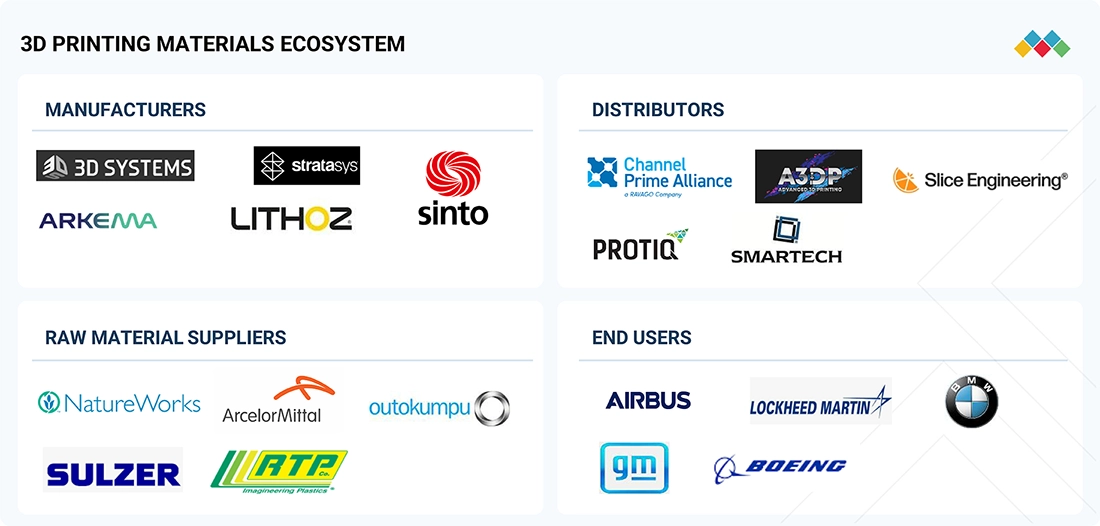
3D Printing Materials Market: COMMERCIAL USE CASES ACROSS INDUSTRIES
| COMPANY | USE CASE DESCRIPTION | BENEFITS |
|---|---|---|
 |
GE uses metal powder 3D printing to manufacture fuel nozzle tips for its LEAP engines, consolidating many parts into a single printed component | Achieves ~25 % weight reduction, fewer parts to assemble, and greater durability than conventionally manufactured equivalents |
 |
Stryker produces orthopedic implants (e.g., titanium knee and spinal implants) using additive manufacturing to create porous, bone-integrating geometries. | Enables better osseointegration, customization, lower waste, and scalability of complex implant designs |
 |
Align uses 3D printing (resins) to produce molds and is planning to shift toward direct 3D printing of clear aligner trays | Improves production speed, reduces material waste, and enables scaling of custom appliance manufacture |
Logos and trademarks shown above are the property of their respective owners. Their use here is for informational and illustrative purposes only.
Related Ecosystem
Aviation
Automotive Advance Technologies
Resins And Polymers
Key Takeaways
- North America's 3D printing materials market will grow from $1,324.4M (2025) to $3,514.4M (2030) at a 21.6% CAGR, significantly outpacing global growth.
- North America leads in aerospace and automotive applications, where high-performance materials and precision manufacturing drive material demand.
- Material innovation and cost reduction in North America are enabling broader adoption across mid-market manufacturers and emerging verticals.
- North America's established supply chain infrastructure and regulatory environment provide competitive advantages for market consolidation and technology advancement.
3D Printing Materials Market Report Scope
| Report Metric | Details |
|---|---|
| Base Year | 2025 |
| Forecast Period | 2025–2030 |
| Growth Rate | CAGR of 20.9% from 2025 to 2030 |
| Market Size Base Year (Billions) | ~USD 3.88 (2025) |
| Revenue Forecast (Billions) | ~USD 10.02 (2030) |
| Segments Covered | Type |
North America 3D Printing Materials Market Report Segmentation
1 segment dimensions are covered across the global market.
By Type
- Ceramics
- Metals
- Other Types
- Plastics
Target Audience
- Materials Manufacturers & Suppliers : 3D printing material producers need North America-specific demand forecasts, competitive positioning data, and sector-specific growth opportunities to optimize production capacity and market expansion strategies.
- Aerospace & Defense OEMs : Major aerospace manufacturers require detailed insights into material availability, performance specifications, cost trends, and supply chain dynamics to support critical component production and certification requirements.
- Medical Device Companies : Healthcare innovators need regulatory pathway information, biocompatible material options, and market adoption trends specific to North America to accelerate product development and commercialization.
- Automotive Manufacturers : Auto industry players require data on 3D printing material capabilities, cost-benefit analysis, production scalability, and competitive benchmarking to integrate additive manufacturing into manufacturing strategies.
- Investment & Strategy Consultants : Private equity, venture capital, and management consultants need comprehensive North America market intelligence to identify investment opportunities, assess portfolio company positioning, and guide strategic decisions.
Key Companies in the North America 3D Printing Materials Market
| Company | HQ | Ownership | Strongest segments |
|---|---|---|---|
| ARCONIC | United States | Private Company | Metals,Other Types,Plastics, |
| 3D SYSTEMS, INC. | United States | Public Company | Plastics (SLA, SLS, MJP polymers, nylon, elastomers),Metals (DMP powders and alloys),Ceramics and dental/biocompatible materials, |
| ARKEMA | France | Public Company | Plastics (incl. specialty polyamides, PVDF, PEKK, related polymers),Photocure resins / Liquids (Sartomer, coating-derived systems),Powder metals and ceramics-related systems, |
| SYENSQO | Belgium | Public Company | Plastics (high-performance polymers and composites),Metals,Ceramics, |
| STRATASYS | United States | Public Company | Plastics – Filament (FDM),Plastics – Photopolymer Resins (PolyJet, SLA, P3, DentaJet, Anatomy),Other Polymers and Specialty Materials (GelMatrix, TissueMatrix, BoneMatrix, SAF powders, TechStyle-related), |
| EVONIK INDUSTRIES AG | Germany | Public Company | Plastics,Metals,Ceramics, |
| GE AEROSPACE | United States | Public Company | Metals,Plastics,Ceramics, |
| CARPENTER TECHNOLOGY CORPORATION | United States | Public Company | Metals – Powder (AM-grade specialty alloys, titanium, stainless, tool steels),Metals – Wires, bars, and near-net shapes for AM-adjacent uses,Other Types – Specialty powder blends and engineered products, |
| HöGANäS AB | Sweden | Private Company | Metals – Powder (AM-grade iron and metal powders),Metals – MIM / injection-molding related feedstocks,Plastics & Other Types (including experimental or partner-sourced), |
| SANDVIK AB | Sweden | Public Company | Metals,Plastics,Ceramics, |
| NANO DIMENSION | Israel | Public Company | Plastics / Resins (including DLP and FFF polymers),Metals & Binder Jetting Materials (metal and sandcasting),Additively Manufactured Electronics Materials & Inks, |
| SINTOKOGIO, LTD. | Japan | Public Company | Metals,Ceramics,Plastics, |
| NANOE | South Korea | Public Company | Plastics-based components and consumables,Ceramic and glass-aligned components,Metals and structural parts, |
ARCONIC
Arconic is a private U.S. company founded in 1888 with 11,550 employees, operating in the materials and manufacturing sector.
3D SYSTEMS, INC.
3D Systems, Inc. is a publicly traded U.S. company founded in 1986 with 1,418 employees, specializing in 3D printing and digital manufacturing technologies.
ARKEMA
Arkema is a publicly traded French company founded in 2003 with 20,700 employees, operating in specialty chemicals and advanced materials.
SYENSQO
Syensqo is a publicly traded Belgian company founded in 1863 with 13,000 employees, engaged in specialty chemicals and materials science.
STRATASYS
Stratasys is a publicly traded U.S. company with 1,757 employees, operating in the 3D printing and additive manufacturing industry.
EVONIK INDUSTRIES AG
Evonik Industries AG is a publicly traded German company founded in 1847 with 30,643 employees, specializing in specialty chemicals and advanced materials.
GE AEROSPACE
GE Aerospace is a U.S. company founded in 1892 with 57,000 employees, operating as a major aerospace and defense manufacturer.
CARPENTER TECHNOLOGY CORPORATION
Carpenter Technology Corporation is a publicly traded U.S. company founded in 1889 with 4,500 employees, specializing in specialty alloys and advanced materials.
HöGANäS AB
Höganäs AB is a private Swedish company founded in 1797 with 1,623 employees, operating in powder metallurgy and materials manufacturing.
SANDVIK AB
Sandvik AB is a publicly traded Swedish company founded in 1862 with 42,373 employees, specializing in engineering and advanced materials.
NANO DIMENSION
Nano Dimension is a publicly traded Israeli company with 468 employees, operating in additive manufacturing and 3D printing technologies.
SINTOKOGIO, LTD.
Sintokogio, Ltd. is a publicly traded Japanese company founded in 1934 with 4,760 employees, engaged in manufacturing and materials processing.
NANOE
Nanoe is a publicly traded South Korean company founded in 1987 with 97 employees.
Countries within North America - compare and drill down
| Country | 2025 size (native) |
|---|---|
| US | USD 3036.1 Million |
| Canada | USD 478.3 Million |
Country market size visualization
Reasons to Buy this Report
- Regional Market Sizing & Forecasts : Obtain precise market valuations for North America ($1,324.4M in 2025) with detailed 5-year forecasts through 2030, enabling accurate budget allocation and investment planning specific to regional opportunities.
- Competitive Landscape Analysis : Understand key players, market share distribution, and competitive strategies within North America's 3D printing materials ecosystem to identify partnership and acquisition opportunities.
- Sector-Specific Growth Drivers : Access detailed insights into aerospace, automotive, healthcare, and consumer goods demand patterns unique to North America, supporting targeted product development and market entry strategies.
- Country-Level Intelligence : Leverage granular data for US and Canadian markets separately, identifying regional variations in adoption rates, regulatory environments, and customer preferences for localized business strategies.
- Technology & Material Trends : Stay informed on emerging material innovations, regulatory approvals, and technology adoption patterns specific to North America's advanced manufacturing landscape and competitive positioning.
Frequently asked questions
What is the projected market size for 3D printing materials in North America by 2030?
North America's 3D printing materials market is projected to reach $3,514.4 million by 2030, growing from $1,324.4 million in 2025.
What is the CAGR for North America's 3D printing materials market?
North America's 3D printing materials market is expected to grow at a compound annual growth rate of 21.6% between 2025 and 2030.
Which industries are driving 3D printing materials demand in North America?
North America's demand is primarily driven by aerospace, automotive, healthcare, and consumer goods sectors, where additive manufacturing enables cost savings and design innovation.
What material types dominate North America's 3D printing market?
North America's market is dominated by polymer-based materials and metal powders, with growing adoption of composite and specialty materials for high-performance applications.
How does North America's growth compare to global 3D printing materials market trends?
North America's 21.6% CAGR exceeds the global average of 20.9%, reflecting the region's advanced manufacturing capabilities and early technology adoption.
RESEARCH METHODOLOGY
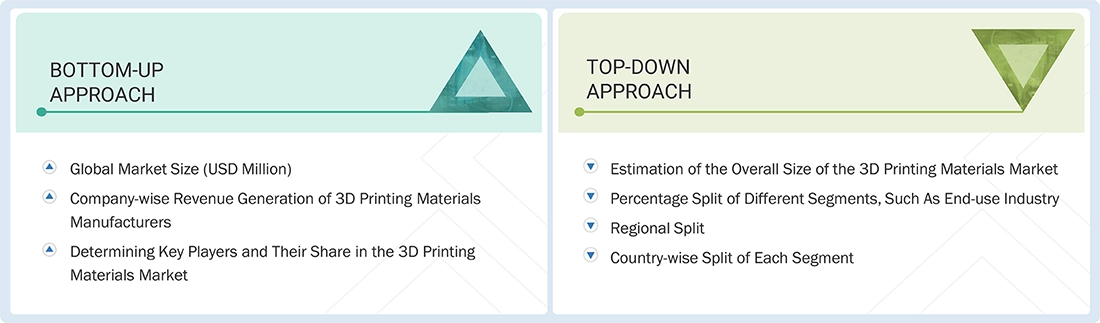
The study involves two major activities in estimating the current market size for the 3D printing materials market. Exhaustive secondary research was done to collect information on the market, peer market, and parent market. The next step was to validate these findings, assumptions, and sizing with industry experts across the value chain through primary research. Both top-down and bottom-up approaches were employed to estimate the complete market size. After that, market breakdown and data triangulation were used to estimate the market size of segments and subsegments.
Secondary Research
Secondary sources referred to for this research study include financial statements of companies offering 3D printing materials and information from various trade, business, and professional associations. Secondary research has been used to obtain critical information about the industry’s value chain, the total pool of key players, market classification, and segmentation according to industry trends, to the bottom-most level, and regional markets. The secondary data was collected and analyzed to arrive at the overall size of the 3D printing materials market, which was validated by primary respondents.
Primary Research
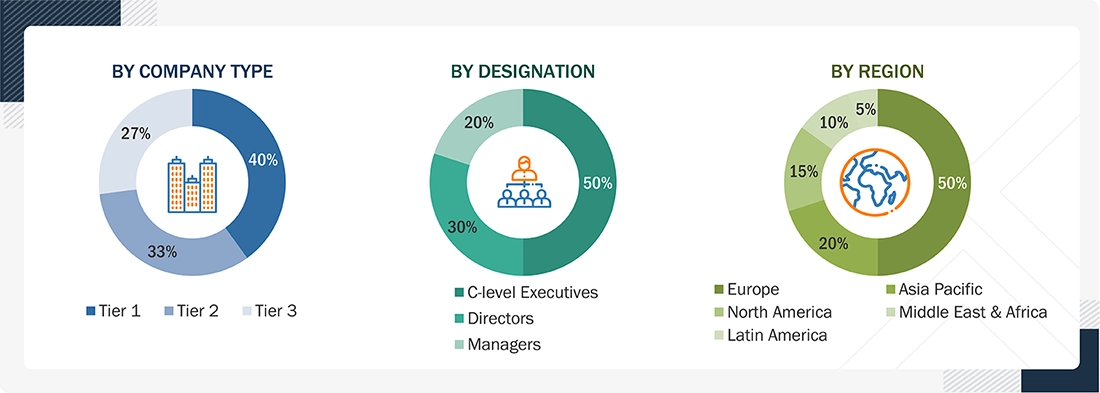
Extensive primary research was conducted after obtaining information regarding the 3D printing materials market scenario through secondary research. Several primary interviews were conducted with market experts from both the demand and supply sides across major countries of North America, Europe, Asia Pacific, the Middle East & Africa, and Latin America. Primary data was collected through questionnaires, emails, and telephonic interviews. The primary sources from the supply side included various industry experts, such as chief experience officers (CXOs), vice presidents (VPs), business development/marketing directors, product development/innovation teams, related key executives from the 3D printing materials industry, system integrators, component providers, distributors, and key opinion leaders. Primary interviews were conducted to gather insights such as market statistics, data on revenue collected from the products and services, market breakdowns, market size estimations, market forecasting, and data triangulation. Primary research also helped in understanding the various trends related to type, form, technology, application, end-use industry, and region. Stakeholders from the demand side, including CIOs, CTOs, CSOs, and installation teams of customers/end users for 3D printing materials services, were interviewed to understand the buyer’s perspective on the suppliers, products, component providers, and their current usage of 3D printing materials and future outlook of their business, which will affect the overall market.
Breakup of Primary Research:
To know about the assumptions considered for the study, download the pdf brochure
Market Size Estimation
The research methodology used to estimate the size of the 3D printing materials market includes the following details. The market size was determined from the demand side. The market was upsized based on the demand for 3D printing materials in different applications at the regional level. Such procurements provide information on the demand aspects of the 3D printing materials industry for each application. For each application, all possible segments of the 3D printing materials market were integrated and mapped.
Data Triangulation
After arriving at the overall size from the market size estimation process explained above, the total market was split into several segments and subsegments. The data triangulation and market breakdown procedures explained below were implemented, wherever applicable, to complete the overall market engineering process and arrive at the exact statistics for various market segments and subsegments. The data was triangulated by studying various factors and trends from the demand and supply sides. Along with this, the market size was validated using both the top-down and bottom-up approaches.
Market Definition
According to the US Food and Drug Administration, 3D printing is a process that creates a three-dimensional object by building successive layers of raw material. Each new layer is attached to the previous one until the object is complete. Objects are produced from a digital 3D file, such as a computer-aided design (CAD) drawing or a magnetic resonance image (MRI).
The technology of printing a 3D object from a digital file using materials such as plastic, metal, and ceramic is called 3D printing, and the materials used are called 3D printing materials. Plastics, metals (including powders), resins, and ceramics are among the materials used in 3D printing. 3D printing materials are available in a variety of shapes and sizes. Designers and engineers prefer to create functional prototypes using 3D printing materials that have the same or similar material properties as those of the final product. Plastics are the most commonly used 3D printed materials, and they are available in filament, resin, granule, and powder forms.
The development of the latest technologies and innovative materials has enabled 3D printing to become a revolutionary technology that can completely alter the dynamics of the manufacturing sector. 3D printing finds major applications in printing parts or objects in industries such as aerospace & defense, healthcare, consumer goods, and automotive.
Stakeholders
- 3D Printing Material Manufacturers
- 3D Printing Material Distributors and Suppliers
- Universities, Governments, and Research Organizations
- Associations and Industrial Bodies
- R&D Institutes
- Environmental Support Agencies
- Investment Banks and Private Equity Firms
- Research and Consulting Firms
Report Objectives
- To define, describe, and forecast the 3D printing materials market size in terms of volume and value
- To provide detailed information regarding the key factors, such as drivers, restraints, opportunities, and challenges influencing market growth
- To analyze and project the global 3D printing materials market by type, form, technology, application, end-use industry, and region
- To forecast the market size concerning five main regions (along with country-level data), namely, North America, Europe, Asia Pacific, the Middle East & Africa, and Latin America, and analyze the significant region-specific trends
- To strategically analyze micromarkets with respect to individual growth trends, prospects, and contributions of the submarkets to the overall market
- To analyze the market opportunities and the competitive landscape for stakeholders and market leaders
- To assess recent market developments and competitive strategies, such as agreements, contracts, acquisitions, and product developments/product launches, to draw the competitive landscape
- To strategically profile the key market players and comprehensively analyze their core competencies
Get the Full 3D Printing Materials Market Report
Full forecast, segment splits, and company analysis for all 3D Printing Materials Market.
- US 3D Printing Materials Market
- Canada 3D Printing Materials Market
- Germany 3D Printing Materials Market
- France 3D Printing Materials Market
- UK 3D Printing Materials Market
- Italy 3D Printing Materials Market
- China 3D Printing Materials Market
- Japan 3D Printing Materials Market
- South Korea 3D Printing Materials Market
- India 3D Printing Materials Market
- South Africa 3D Printing Materials Market
- Brazil 3D Printing Materials Market
- Mexico 3D Printing Materials Market
Need a Tailored Report?
Customize this report to your needs
Get 10% FREE Customization
Customize This Report
