
US 3D Weaving Market (2025-2030)

The US 3D Weaving Market was valued at $7.03 Million in 2025 and projected to reach to $11.72 Million by 2030, representing a compound annual growth rate of 10.8%. The US 3D Weaving Market is positioned for sustained expansion through 2030, driven by accelerating demand from aerospace, automotive, and electronics sectors seeking superior composite materials.


| Market Size in | USD 26.32 MN |
| Market Forecast in | |
| CAGR | |
| Forecast Period | |
| Units Considered | Value (USD MN) |
US 3D Weaving Market Trends and Insights
- The US market is driven by increasing demand for advanced composite materials in aerospace, automotive, and electronics applications, where 3D weaving technology offers superior structural integrity and manufacturing efficiency.
- The US semiconductor and electronics sector is particularly leveraging 3D weaving for enhanced circuit board durability and thermal management solutions. US manufacturers are investing heavily in 3D weaving capabilities to meet stringent performance requirements and reduce production waste.
- The US market's 10.8% compound annual growth rate reflects strong adoption across defense, industrial, and consumer electronics segments.
- By 2030, the US is expected to solidify its position as a key hub for 3D weaving innovation, supported by technological advancements and strategic partnerships within the North American region..
Key Market Statistics
- CAGR (2025-2030) 10.8% CAGR
- Market Size, 2025 ~USD 7.03 Million
- Forecast, 2030 ~USD 11.72 Million
- Country US
US 3D Weaving Market Overview
Market Valuation :
The US 3D Weaving Market is valued at $7.03 million in 2025, with strong growth trajectory reaching $11.72 million by 2030, representing a robust 10.8% CAGR.
Aerospace & Defense Leadership :
US aerospace and defense sectors are primary drivers of 3D weaving adoption, leveraging advanced composite materials for lightweight, high-strength aircraft components and structural applications.
Manufacturing Innovation :
American manufacturers are increasingly adopting 3D weaving technology to enhance production efficiency, reduce material waste, and improve structural integrity in complex composite fabrication.
Electronics Integration :
The US semiconductor and electronics industry is expanding 3D weaving applications for thermal management, electromagnetic shielding, and advanced packaging solutions in high-performance devices.
US 3D Weaving Market Dynamics
- Investment in advanced manufacturing technologies and R&D initiatives across major US industrial hubs will further propel market growth.
- The semiconductor industry's push for innovative packaging solutions and thermal management systems creates additional growth opportunities for 3D weaving applications.
- Regulatory support for lightweight materials in automotive and aerospace sectors strengthens market fundamentals, while increasing competition among US manufacturers drives technological advancement and cost optimization..
Market Ecosystem
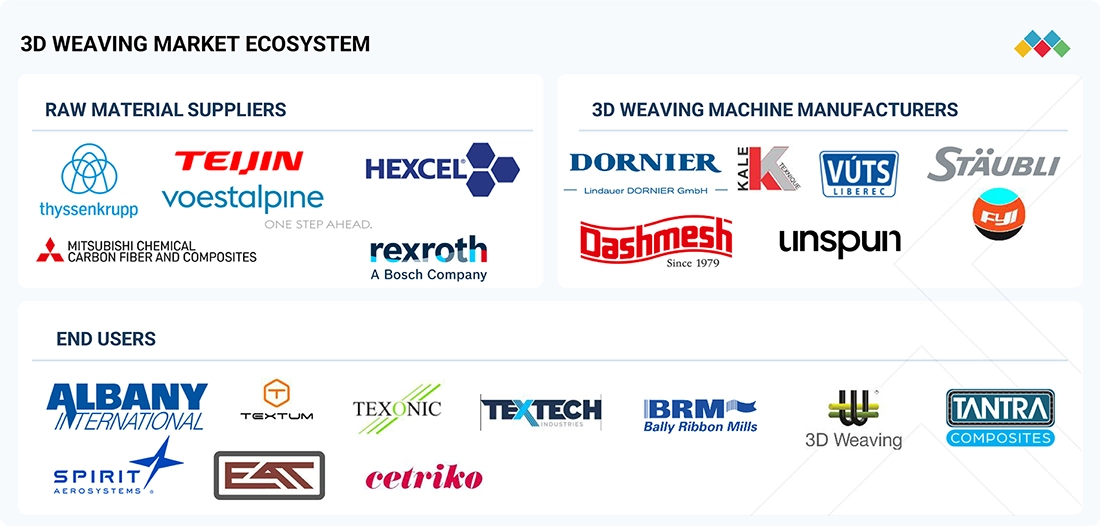
3D Weaving Market Growth: COMMERCIAL USE CASES ACROSS INDUSTRIES
| COMPANY | USE CASE DESCRIPTION | BENEFITS |
|---|---|---|
 |
Production of complex, multi-layer composite fabrics for aerospace, automotive, and industry with the TRITOS PP machine | High-precision, programmable 3D weaving, digital pattern control, optimized material usage and waste reduction, and enhanced structural strength and durability |
 |
3d-weaving-market-Dornier | Variable-height rapier weft insertion, minimal weft waste, handles sensitive yarns (carbon, aramid), high flexibility and yarn integrity for advanced applications |
 |
On-demand, automated 3D weaving for localized, zero-waste garment production in the fashion and sportswear sector | Consolidates manufacturing steps, speeds up production, lowers labor & energy costs, supports microfactory/local production, and significantly reduces material waste |
 |
Cost-effective, digitally controlled 3D weaving equipment for construction, automotives, and composites manufacturing | Scalable with automation and programming, targets cost-sensitive users, and enables affordable high-performance composite fabrication |
 |
Custom 3D weaving machinery for niche prototyping, research, and specialized industrial uses | Tailored machines for unique application requirements, supports prototyping and low-volume specialty production, and fosters innovation in new composite structures |
Logos and trademarks shown above are the property of their respective owners. Their use here is for informational and illustrative purposes only.
Related Ecosystem
Industrial Automation
- Sensors
- Image Sensors
- Manufacturing Execution System (MES)
- Actuators
- Flow Sensors
- ABB India Limited
- Siemens ag
- Emerson Electric Co.
- HONEYWELL INTERNATIONAL INC.
- SCHNEIDER ELECTRIC SE
Key Takeaways
- The US 3D Weaving Market is valued at $7.03 million in 2025 and is projected to reach $11.72 million by 2030, representing a 10.8% CAGR.
- US aerospace and defense sectors are primary drivers of 3D weaving adoption, leveraging the technology for lightweight composite structures.
- The US electronics industry is increasingly integrating 3D weaving for advanced circuit board manufacturing and thermal management applications.
- US manufacturers are focusing on automation and process optimization to reduce costs and improve scalability of 3D weaving production.
3D Weaving Market Report Scope
| Report Metric | Details |
|---|---|
| Base Year | 2025 |
| Fastest Growing Segment | COMPOSITE TEXTILE WEAVING MACHINES (Product Type) |
| Forecast Period | 2025–2030 |
| Growth Rate | CAGR of 12.7% from 2025 to 2030 |
| Largest Segment | AEROSPACE & DEFENSE (End-Use Industry) |
| Market Size Base Year (Billions) | ~USD 0.03 (2025) |
| Revenue Forecast (Billions) | ~USD 0.06 (2030) |
| Segments Covered | Product Type, End-Use Industry, Application |
US 3D Weaving Market Report Segmentation
3 segment dimensions are covered across the global market.
By Product Type
- Carbon Fiber Weaving Machines
- Composite Textile Weaving Machines
- Customized 3D Weaving Machines
- Glass Fiber Weaving Machines
- Spacer Weaving Machines
By End-Use Industry
- Aerospace & Defense
- Automotive
- Construction & Infrastructure
- Energy & Goods
- Healthcare
- Other End-Use Industries
- Sporting Goods
By Application
- Decorative/Design Applications
- Insulation
- Load-Bearing Composites
- Protective Materials
- Reinforcements
- Structural Components
- Thermal Protection Applications
Target Audience
- Aerospace & Defense Manufacturers : Need US market intelligence to evaluate 3D weaving technology adoption for aircraft components, structural applications, and defense systems requiring advanced composite materials.
- Automotive OEMs & Suppliers : Require market data to assess 3D weaving viability for lightweight vehicle components, structural reinforcement, and manufacturing efficiency improvements in US automotive production.
- Electronics & Semiconductor Companies : Seek insights on 3D weaving applications for thermal management, electromagnetic shielding, and advanced packaging solutions in US semiconductor and electronics manufacturing.
- Materials & Composites Manufacturers : Need US market forecasts and growth trends to guide product development, capacity planning, and commercialization strategies for 3D weaving composite materials.
- Investment & Strategy Consultants : Require comprehensive US market analysis to support investment decisions, M&A strategies, and business development initiatives in the advanced composites and manufacturing sectors.
Key Companies in the US 3D Weaving Market
| Company | HQ | Ownership | Strongest segments |
|---|---|---|---|
| HEFEI FANYUAN INSTRUMENT CO., LTD. | China | Glass fiber 3D weaving instrumentation and equipment,Carbon fiber and high-performance composite textile instrumentation,Spacer and customized 3D weaving solutions, | |
| MARJAN POLYMER INDUSTRIES | Iran | Glass Fiber 3D Woven Products,Composite Textile (Polymer-based 3D Weaves),Spacer Fabrics and 3D Spacer Structures, | |
| ALBANY INTERNATIONAL CORP. | United States | Public Investment Firm | 3D-woven carbon fiber structural components,Protective materials and thermal insulation (aerospace/space),Reinforcements and composite textiles (non-aero industrial), |
| SPIRIT AEROSYSTEMS, INC. | United States | Private Company | Carbon Fiber 3D Woven Structural Components,Thermal Protective and Re-entry Materials,Glass Fiber and Composite Textile Reinforcements, |
HEFEI FANYUAN INSTRUMENT CO., LTD.
Hefei Fanyuan Instrument Co., Ltd. is a company based in China with insufficient data available for a complete description.
MARJAN POLYMER INDUSTRIES
Marjan Polymer Industries is a company based in Iran with insufficient data available for a complete description.
ALBANY INTERNATIONAL CORP.
Albany International Corp. is a United States-based public investment firm founded in 1895 with 5,700 employees. The company is an established industrial enterprise with significant market presence.
SPIRIT AEROSYSTEMS, INC.
Spirit AeroSystems, Inc. is a United States-based private company founded in 2005 with 20,370 employees. The company is a major aerospace and defense manufacturer.
Reasons to Buy this Report
- Market Size & Growth Data : Access precise US market valuation ($7.03M in 2025) and 5-year forecast projections with 10.8% CAGR, enabling accurate financial planning and investment decisions for US operations.
- Sector-Specific Insights : Gain detailed analysis of 3D weaving adoption across US aerospace, automotive, and electronics industries, identifying high-growth segments and emerging application opportunities.
- Competitive Landscape : Understand the US competitive environment, key manufacturers, technology leaders, and market positioning strategies specific to the American 3D weaving sector.
- Regional Growth Drivers : Identify US-specific market catalysts including manufacturing innovation, regulatory support, R&D investments, and industry partnerships driving 3D weaving adoption.
- Strategic Market Entry : Develop informed US market entry strategies with localized insights on customer requirements, distribution channels, and growth opportunities in high-demand applications.
Frequently asked questions
What is the current size of the US 3D Weaving Market?
The US 3D Weaving Market is valued at $7.03 million in 2025 and is expected to grow to $11.72 million by 2030.
What is the growth rate of the US 3D Weaving Market?
The US 3D Weaving Market is growing at a compound annual growth rate (CAGR) of 10.8% from 2025 to 2030.
Which industries are driving the US 3D Weaving Market?
The US aerospace, defense, automotive, and electronics industries are the primary drivers of 3D weaving market growth.
What are the key applications of 3D weaving in the US market?
In the US, 3D weaving is primarily used for composite structures in aerospace, circuit board manufacturing, thermal management, and lightweight automotive components.
What challenges does the US 3D Weaving Market face?
The US market faces challenges including high production costs, limited skilled workforce, and the need for standardized manufacturing processes and quality control measures.
RESEARCH METHODOLOGY
The study involved major activities in estimating the current size of the 3D weaving market. Exhaustive secondary research was conducted to gather information on the market, peer markets, and parent markets. Industry experts across the supply chain participated in primary research to validate these findings, assumptions, and estimates. Both top-down and bottom-up approaches were used to determine the overall market size. Subsequently, market segmentation and data triangulation methods were applied to estimate the size of segments and subsegments. Secondary and primary sources were utilized to gather information for a comprehensive technical and commercial analysis of the 3D weaving market.
Secondary Research
Secondary research for this study involved gathering information from various credible sources such as company reports, white papers, journals, and industry publications. This process helped understand the supply and value chains, identify key players, analyze market segmentation and regional trends, and track major market and technology developments. The data collected was used to estimate the overall market size, which was later validated through primary research.
Primary Research
Extensive primary research was conducted after understanding the current state of the 3D weaving market through secondary research. Several interviews with experts from the demand and supply sides were carried out across four major regions—North America, Europe, Asia Pacific, and RoW. This primary data was gathered through questionnaires, emails, and phone interviews.
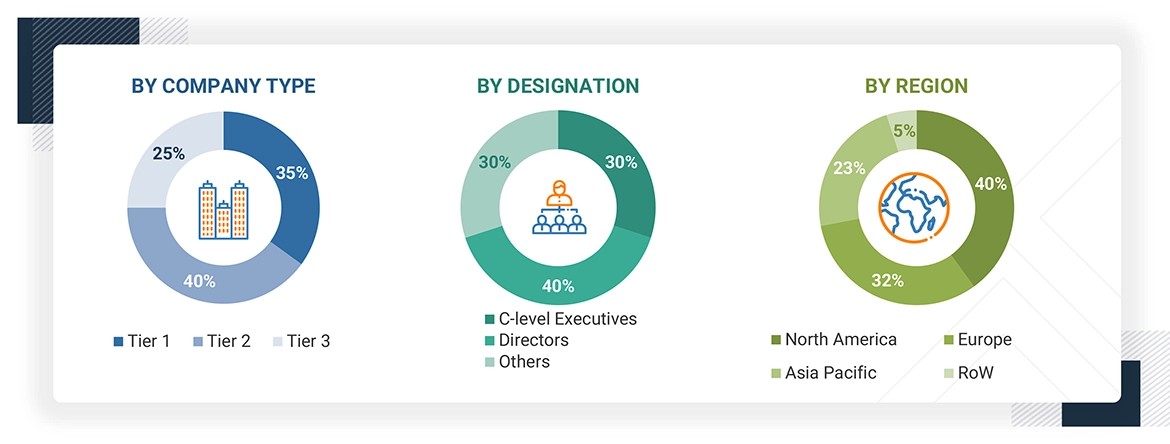
Notes: The RoW mainly comprises the Middle East, Africa, and South America.
Note: Tier 1 companies include market players with revenues above USD 500 million; tier 2 companies earn revenues between USD 100 million and USD 500 million; and tier 3 companies earn revenues of up to USD 100 million.
Other designations include sales, marketing, and product managers.
To know about the assumptions considered for the study, download the pdf brochure
Market Size Estimation
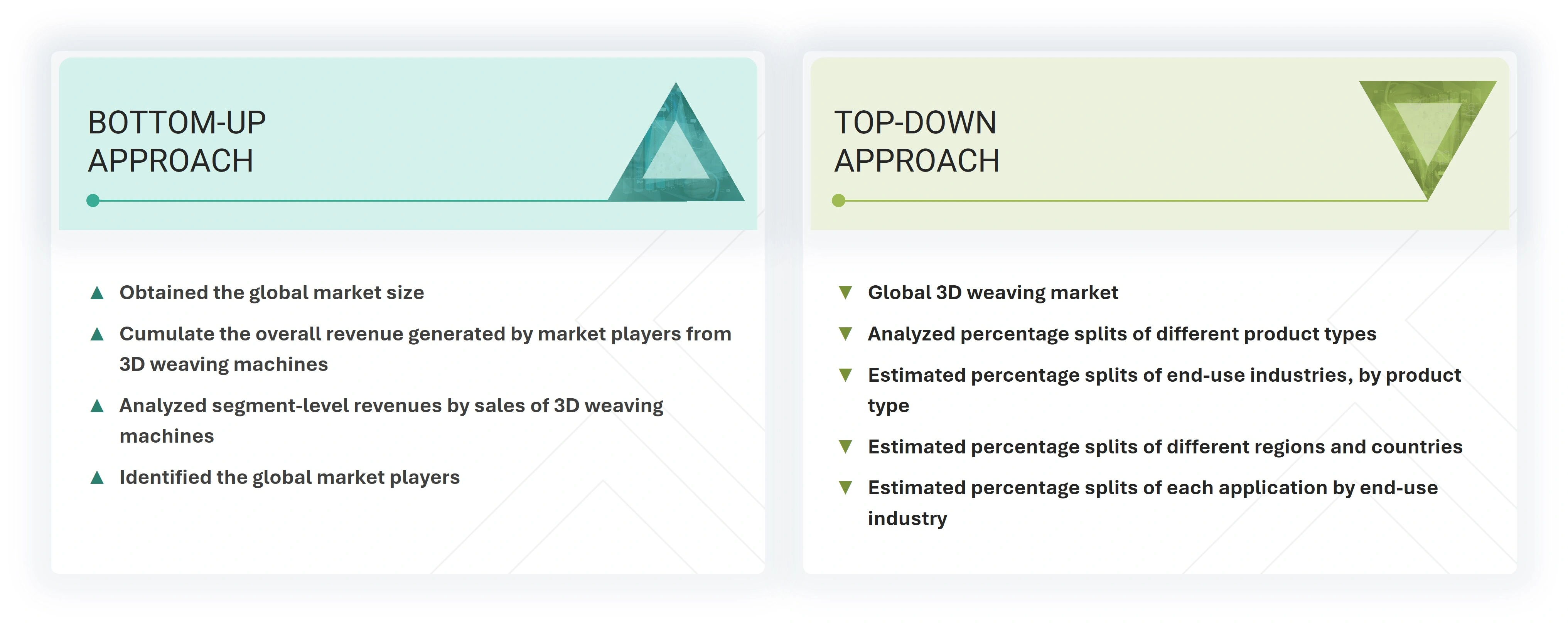
The bottom-up procedure has been employed to arrive at the overall size of the 3D weaving market.
- Analyzed major manufacturers of 3D weaving machines, studied their portfolios, and understood products based on their features and functions
- Analyzed the revenue of the companies profiled in the study
- Arrived at the global 3D weaving market size by adding the scope revenue of the key manufacturers in the market
- Conducted multiple discussions with key opinion leaders to understand different 3D weaving product types, applications, end-use industries, and current trends in the market, and analyzed the breakup of the scope of the study by major manufacturing companies.
The top-down approach has been used to estimate and validate the total size of the 3D weaving market.
- The global size of the 3D weaving market was estimated through the data sanity of major companies offering 3D weaving machines.
- The product type penetration splits were estimated using secondary sources, based on several factors, such as the number of companies offering specific types of 3D weaving machinery (such as glass fiber weaving machines, composite textile weaving machines, spacer weaving machines, carbon fiber weaving machines, and customized 3D weaving machines)
- The market size for the global end-use industries (aerospace & defense, automotive, construction & infrastructure, sporting goods, energy & goods, healthcare, and other end-use industries) was determined by understanding the penetration split of each end-use industry by each product type.
- The market size for global regions (North America, Europe, Asia Pacific, and the RoW) was estimated by analyzing the penetration split of each end-use industry by each region.
- The country-level penetration split was analyzed for each region to estimate the market size.
- The market sizes of application segments were estimated by analyzing the penetration split of each end-use industry by application.
3D Weaving Market : Top-Down and Bottom-Up Approach
Data Triangulation
After arriving at the overall market size using the market size estimation processes explained above, the market has been split into several segments and subsegments. Data triangulation and market breakdown procedures have been employed to complete the entire market engineering process and arrive at the exact statistics of each market segment and subsegment. The data has been triangulated by studying various factors and trends from the demand and supply sides in the 3D weaving market.
Market Definition
3D weaving machinery is advanced equipment designed to produce three-dimensional woven structures by interlacing yarns in warp, weft, and Z directions. Unlike traditional two-dimensional weaving machines, 3D machines create multi-layered, volumetric, or near-net-shape products with superior strength, delamination resistance, and structural integrity. They are used in aerospace, defense, automotive, marine, and construction industries to reinforce composite structures that require complex shapes and load capabilities. These machines can be jacquard-based, shuttleless, or custom-configured, often integrated with CAD/CAM software for precise design and production, supporting lightweight, durable, and efficient composite solutions.
Key Stakeholders
- Machinery Manufacturers
- Fiber & Yarn Suppliers
- Software Providers
- Composite Manufacturers
- OEMs (Original Equipment Manufacturers)
- End-Use Industries
- Research Institutions & Universities
- Regulatory Bodies & Standards Organizations
- Investors & Government Bodies
Report Objectives
- To define, describe, and forecast the size of the 3D weaving market, by product type, application, end-use industry, and region, in terms of value
-
To forecast the market for various segments concerning key regions, namely,
North America, Europe, the Asia Pacific, and the Rest of the World (RoW), in terms of value, and study the macroeconomic outlook for each region - To provide detailed information regarding the drivers, restraints, opportunities, and challenges influencing the market’s growth
- To analyze the market in terms of the trends/disruption impacting customers’ business, supply chain, ecosystem, technological landscape, patent scenario, trade, use cases, regulatory landscape, Porter’s five force analysis, key stakeholders & buying criteria, impact of AI/Gen AI, and the impact of the 2025 US tariffs
- To strategically analyze micromarkets1 concerning individual growth trends, prospects, and contributions to the total market
- To analyze the opportunities in the market for stakeholders by identifying high-growth segments and detailing the competitive landscape for market players
- To strategically profile key players and comprehensively analyze their market rankings, core competencies, market share analysis, company evaluation matrix, along with detailing the competitive landscape for the market leaders
- To analyze the competitive developments, such as partnerships carried out by market players
- To map competitive intelligence based on company profiles and key player strategies
- To benchmark players within the market using the proprietary competitive leadership mapping framework, which analyzes market players on various parameters within the broad categories of business strategy excellence and strength of product portfolio
Available customizations:
With the given market data, MarketsandMarkets offers customizations according to the company‘s specific needs. The following customization options are available for the report.
Company Information:
- Detailed analysis and profiling of additional market players (up to five)
Get the Full 3D Weaving Market Report
Full forecast, segment splits, and company analysis for all 3D Weaving Market.
- Canada 3D Weaving Market
- Mexico 3D Weaving Market
- Germany 3D Weaving Market
- UK 3D Weaving Market
- France 3D Weaving Market
- Spain 3D Weaving Market
- Italy 3D Weaving Market
- Rest Of Europe 3D Weaving Market
- China 3D Weaving Market
- Japan 3D Weaving Market
- India 3D Weaving Market
- Rest Of Asia Pacific 3D Weaving Market
Need a Tailored Report?
Customize this report to your needs
Get 10% FREE Customization
Customize This Report
