
Japan Aerospace Composites Market (2025-2030)

The Japan Aerospace Composites Market was valued at $815.2 Million in 2025 and projected to reach to $1384.3 Million by 2030, representing a compound annual growth rate of 11.2%. Japan's aerospace composites market is positioned for sustained expansion through 2030, driven by the country's strategic investments in next-generation aircraft development and defense capabilities.


| Market Size in | USD 26.32 MN |
| Market Forecast in | |
| CAGR | |
| Forecast Period | |
| Units Considered | Value (USD MN) |
Japan Aerospace Composites Market Trends and Insights
- Japan's aerospace sector, driven by both commercial aircraft manufacturing and defense modernization, is increasingly adopting advanced composite materials to reduce weight and improve fuel efficiency.
- The market in Japan benefits from the country's strong engineering capabilities, established supply chains, and partnerships with major global aerospace OEMs. During the 2025–2030 forecast period, Japan's aerospace composites market will grow at a compound annual growth rate (CAGR) of 11.2%, outpacing many mature markets.
- Japan's investment in next-generation aircraft platforms, coupled with rising demand for lightweight structural components, is accelerating composite adoption across commercial and military applications.
- The country's focus on sustainability and carbon reduction in aviation further supports market expansion, positioning Japan as a key regional hub for aerospace composite innovation and manufacturing..
Key Market Statistics
- CAGR (2025-2030) 11.2% CAGR
- Market Size, 2025 ~USD 815.2 Million
- Forecast, 2030 ~USD 1384.3 Million
- Country Japan
Japan Aerospace Composites Market Overview
Market Valuation Growth :
Japan's aerospace composites market is valued at USD 815.2 million in 2025, with a projected CAGR of 11.2% through 2030, reaching USD 1,384.3 million by forecast end.
Commercial & Defense Drivers :
Growth is fueled by Japan's commercial aircraft manufacturing sector and ongoing defense modernization initiatives, both prioritizing lightweight composite materials for enhanced performance.
Fuel Efficiency Focus :
Japanese aerospace manufacturers are increasingly adopting advanced composites to reduce aircraft weight, improve fuel efficiency, and lower operational costs in competitive global markets.
Domestic Supply Chain Strength :
Japan benefits from a robust domestic aerospace supply chain with established composite material producers and advanced manufacturing capabilities supporting regional demand.
Japan Aerospace Composites Market Dynamics
- The adoption of composite materials aligns with Japan's commitment to reducing carbon emissions and improving aircraft performance metrics.
- Major Japanese aerospace manufacturers are integrating advanced composites into both commercial and military platforms, creating consistent demand for specialized materials and processing technologies. The market outlook remains positive as Japan strengthens its position in global aerospace supply chains and pursues indigenous aircraft development programs.
- Government support for aerospace innovation, coupled with increasing international partnerships, will accelerate composite material adoption.
- Additionally, Japan's aging aircraft fleet modernization and emerging urban air mobility initiatives present new growth opportunities for composite material suppliers and manufacturers through 2030..
Market Ecosystem
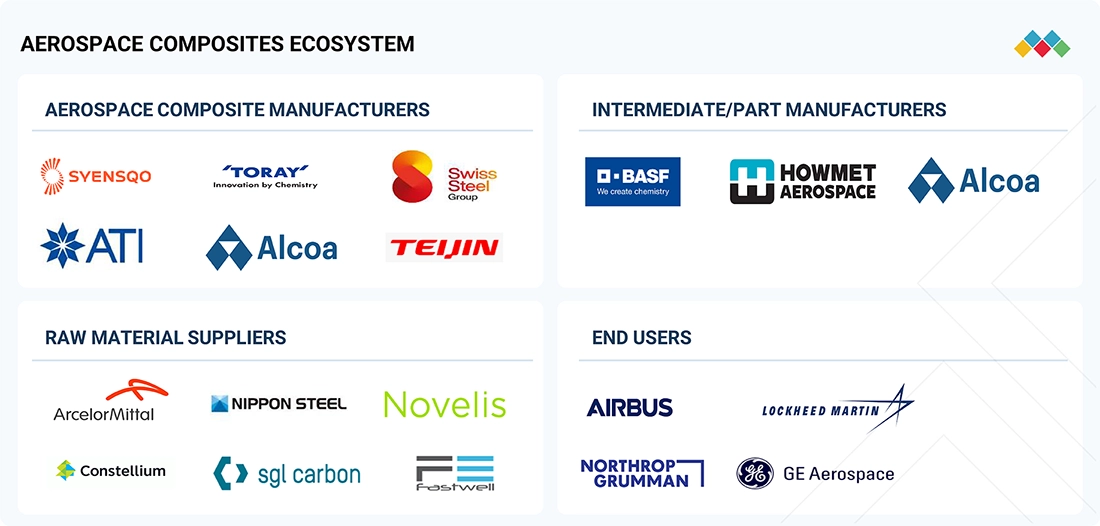
Aerospace Composites Market: COMMERCIAL USE CASES ACROSS INDUSTRIES
| COMPANY | USE CASE DESCRIPTION | BENEFITS |
|---|---|---|
 |
Use of advanced carbon fiber composites in 787 Dreamliner fuselage and wings | 20% weight reduction compared to traditional aluminum, improved fuel efficiency, and reduced maintenance cost |
 |
Carbon fiber composites in A350 aircraft structures and exterior body | High strength-to-weight ratio, superior corrosion resistance, extended service life |
 |
Ceramic matrix composites (CMCs) in jet engine components | Withstands higher operating temperatures, improves engine efficiency by 10–15%, reduces fuel burn |
 |
Advanced composites in military aircraft structures | Enhanced durability, lower structural weight, and improved payload capacity |
 |
Composite materials in unmanned aerial vehicles (UAVs) | Lightweight design, higher endurance, improved stealth capabilities |
Logos and trademarks shown above are the property of their respective owners. Their use here is for informational and illustrative purposes only.
Related Ecosystem
Defence Platforms And Systems
- Sensors
- Unmanned Ground Vehicles (UGV)
- Fighter Aircraft
- Special Mission Aircraft
- Antennas
- BAE Systems plc
- Thales group
- LOCKHEED MARTIN CORPORATION
- Northrop Grumman Corporation
- L3Harris Technologies, Inc.
Fibers And Composites
- Polyetheretherketone (PEEK)
- Polyphenylene Sulfide (PPS)
- Epoxy Resin
- Polycarbonate
- Polyester Resin
- Toray Industries, Inc.
- Teijin Limited
- Sgl carbon se
- Hexcel Corporation
- Solvay sa
Speciality Chemicals
- Corrosion Inhibitors
- Polyetheretherketone (PEEK)
- Acrylonitrile Butadiene Styrene (ABS)
- Epoxy Resin
- Polycarbonate
- Basf se
- DOW CHEMICAL COMPANY
- Evonik industries ag
- Clariant ag.
- Solvay sa
Key Takeaways
- Japan's aerospace composites market will grow from USD 815.2 million (2025) to USD 1,384.3 million (2030) at an 11.2% CAGR.
- Japan's strong aerospace manufacturing base and OEM partnerships drive sustained demand for advanced composite materials.
- Defense modernization and next-generation aircraft programs in Japan are key growth catalysts for composite adoption.
- Japan's commitment to sustainability and fuel efficiency standards accelerates the shift toward lightweight composite solutions in aviation.
Aerospace Composites Market Report Scope
| Report Metric | Details |
|---|---|
| Base Year | 2025 |
| Fastest Growing Segment | AFP/ATL (Manufacturing Process) |
| Forecast Period | 2025–2030 |
| Growth Rate | CAGR of 12% from 2025 to 2030 |
| Largest Segment | EXTERIOR (Application) |
| Market Size Base Year (Billions) | ~USD 30.3 (2025) |
| Revenue Forecast (Billions) | ~USD 53.4 (2030) |
| Segments Covered | Fiber Type, Matrix Type, Resin Type, Manufacturing Process, Aircraft Type, Application |
Japan Aerospace Composites Market Report Segmentation
6 segment dimensions are covered across the global market.
By Fiber Type
- Carbon Fiber Composites
- Ceramic Fiber Composites
- Glass Fiber Composites
- Other Fiber Types
By Matrix Type
- Ceramic Matrix
- Metal Matrix
- Polymer Matrix
By Resin Type
- Epoxy
- Peek
- Pei
- Phenolic
- Polyamide
- Thermoplastic Composites
- Thermoset Composites
By Manufacturing Process
- Afp/Atl
- Filament Winding
- Lay-Up
- Other Manufacturing Process
- Other Manufacturing Processes
- Resin Transfer Molding
By Aircraft Type
- Business & General Aviation
- Civil Helicopter
- Commercial Aircraft
- Military Aircraft
- Other Aircraft Types
By Application
- Exterior
- Interior
Target Audience
- Composite Material Manufacturers : Suppliers need Japan-specific demand forecasts and market sizing to optimize production capacity, plan supply chain investments, and identify growth opportunities in Japanese aerospace OEMs.
- Aerospace OEMs & Tier-1 Suppliers : Japanese and international aircraft manufacturers require market intelligence to guide composite material sourcing strategies, cost management, and technology adoption decisions for Japan operations.
- Investment & Private Equity Firms : Investors evaluating aerospace composite companies need Japan market data to assess portfolio company growth potential, market positioning, and expansion opportunities in this high-growth segment.
- Government & Defense Agencies : Japanese defense and aerospace policy makers need market insights to inform procurement strategies, industrial policy decisions, and support for domestic composite material capabilities.
- Strategic Consultants & Analysts : Business consultants advising aerospace clients require Japan-specific market data to develop competitive strategies, identify market gaps, and support client decision-making in this sector.
Key Companies in the Japan Aerospace Composites Market
| Company | HQ | Ownership | Strongest segments |
|---|---|---|---|
| HINDUSTAN AERONAUTICS LIMITED | India | Public Company | Polymer Matrix Composites – Airframe & Rotor Structures,Polymer Matrix Composites – Interiors, Fairings & Radomes,Metal Matrix & Ceramic Matrix Components (Engines & Thermal Structures), |
| COBHAM PLC | United Kingdom | Private Company | Carbon fiber–intensive avionics and radome integrations,Glass fiber composite antenna structures and housings,Ceramic matrix and high-temperature composite electronics packaging, |
| INTERTEK GROUP PLC | United Kingdom | Public Company | Polymer Matrix / Carbon Fiber Composite Testing & Certification,Glass Fiber & Interior Applications Testing,Ceramic Matrix & High-Temperature Materials Evaluation, |
| IMERYS SA | France | Public Company | Ceramic Matrix Composite-related minerals,Polymer Matrix Composite fillers and additives,Graphite and carbon minerals for composites, |
| TRIUMPH GROUP, INC | United States | Private Company | Carbon fiber composite structures and assemblies,Polymer matrix composite interiors and insulation,Composite-intensive landing gear and actuation systems, |
| MEGGITT PLC | United Kingdom | Private Company | Carbon fiber composites (engine, nacelle, ducting, structures),Glass fiber composites (radomes, secondary structures),Ceramic and ceramic matrix composites (high-temp components, sensors housings), |
| GODREJ GROUP | India | Private Company | Glass Fiber Composites,Carbon Fiber Composites,Ceramic Fiber Composites, |
| LG CHEM LTD. | South Korea | Public Company | Polymer Matrix Composites (resins and engineering plastics),Carbon-fiber-compatible intermediates and additives,Glass-fiber-compatible resins and modifiers, |
| REPSOL S.A. | Spain | Public Company | Polymer Matrix Composite (resins and intermediates),Metal Matrix Composite inputs,Ceramic Matrix Composite inputs, |
| HEXCEL CORPORATION | United States | Public Company | Carbon fiber & polymer matrix composites,Glass & other fiber reinforcements,Honeycomb, core, and engineered composite structures, |
| TORAY INDUSTRIES, INC. | Japan | Public Company | Carbon Fiber & CFRP (Polymer Matrix),Glass Fiber Composites,Ceramic Fiber & CMC-related Materials, |
| TEIJIN LIMITED | Japan | Public Company | Carbon fiber polymer matrix composites (CFRP),Glass fiber polymer matrix composites,Ceramic fiber and ceramic matrix composites, |
| SGL CARBON | Germany | Public Company | Carbon Fiber (including CFRP for aerospace),Composite Solutions for Aerospace Structures and Skins,Carbon-Ceramic and Friction Components (Aerospace Use), |
| MITSUBISHI CHEMICAL GROUP CORPORATION | Japan | Public Company | Carbon fiber and CFRP (polymer matrix composites),Glass fiber composites,Ceramic fiber and CMC-related materials, |
| COLLINS AEROSPACE | United States | Private Company | Carbon fiber – Polymer Matrix Composites (primary and secondary structures, interiors),Glass fiber – Polymer Matrix Composites (interiors, systems housings),Ceramic Matrix and Ceramic Fiber Composites (high-temp, de-icing, thermal protection), |
| SPIRIT AEROSYSTEMS, INC. | United States | Private Company | Carbon fiber polymer matrix aerostructures,Glass fiber polymer matrix components,Ceramic and metal matrix composites / thermal protection, |
| SYENSQO | Belgium | Public Company | Polymer Matrix Composites for Carbon Fiber Systems,Polymer Matrix Composites for Glass Fiber Systems,Ceramic and High-Temperature Matrix Solutions, |
| MATERION CORPORATION | United States | Public Company | Metal Matrix Composites (SupremEX and related),Beryllium and Beryllium-Containing Alloys,Ceramics and Ceramic Matrix Composites, |
| GENERAL DYNAMICS CORPORATION | United States | Public Company | Carbon Fiber / Polymer Matrix Composites in Business Jets,Glass Fiber Composites in Interiors and Radomes,Ceramic Matrix and Ceramic Fiber Armor / Thermal Systems, |
| 3M | United States | Public Company | Adhesives and bonding systems for composite structures,Surface protection films, tapes, and coatings,Abrasives, surface prep, and finishing systems, |
HINDUSTAN AERONAUTICS LIMITED
Hindustan Aeronautics Limited is a public company founded in 1940 in India and employs 22,033 people, operating in the aerospace and defense sectors.
COBHAM PLC
Cobham PLC is a private company established in 1889 in the United Kingdom with 10,037 employees, serving the aerospace and defense industries.
INTERTEK GROUP PLC
Intertek Group PLC is a public company founded in 1885 in the United Kingdom with 45,425 employees, providing testing, inspection, and certification services.
IMERYS SA
Imerys SA is a public company established in 1880 in France with 14,878 employees, specializing in mineral-based specialty products.
TRIUMPH GROUP, INC
Triumph Group, Inc. is a private company founded in 1993 in the United States with 3,696 employees, operating in the aerospace and defense sectors.
MEGGITT PLC
Meggitt PLC is a private company founded in 1947 in the United Kingdom with 9,270 employees, serving the aerospace and defense industries.
GODREJ GROUP
Godrej Group is a private company founded in 1897 in India with 13,316 employees, operating across multiple industrial and consumer sectors.
LG CHEM LTD.
LG Chem Ltd. is a public company founded in 1947 in South Korea with 14,019 employees, specializing in chemicals and advanced materials.
REPSOL S.A.
Repsol S.A. is a public company established in 1927 in Spain with 24,523 employees, operating in the energy and petrochemical sectors.
HEXCEL CORPORATION
Hexcel Corporation is a public company established in 1946 in the United States with 5,563 employees, manufacturing composite materials for aerospace and industrial applications.
TORAY INDUSTRIES, INC.
Toray Industries, Inc. is a public company founded in 1926 in Japan with 46,294 employees, producing advanced fibers, chemicals, and composite materials.
TEIJIN LIMITED
Teijin Limited is a public company established in 1918 in Japan with 15,689 employees, specializing in advanced fibers, chemicals, and healthcare products.
SGL CARBON
SGL Carbon is a public company founded in 1878 in Germany with 3,577 employees, manufacturing carbon and graphite products for various industries.
MITSUBISHI CHEMICAL GROUP CORPORATION
Mitsubishi Chemical Group Corporation is a public company established in 1933 in Japan with 56,678 employees, operating across chemicals, plastics, and specialty materials.
COLLINS AEROSPACE
Collins Aerospace is a private company established in 1933 in the United States with 31,200 employees, providing aerospace systems and components.
SPIRIT AEROSYSTEMS, INC.
Spirit AeroSystems, Inc. is a private company founded in 2005 in the United States with 20,370 employees, manufacturing structural components for commercial and defense aircraft.
SYENSQO
Syensqo is a public company established in 1863 in Belgium with 13,000 employees, specializing in advanced materials and specialty chemicals.
MATERION CORPORATION
Materion Corporation is a public company founded in 1921 in the United States with 2,880 employees, producing advanced materials and engineered products.
GENERAL DYNAMICS CORPORATION
General Dynamics Corporation is a public company founded in 1899 in the United States with 117,000 employees, operating in aerospace, defense, and information technology sectors.
3M
3M is a public company established in 1902 in the United States with 60,500 employees, manufacturing diversified products across industrial, healthcare, and consumer segments.
Reasons to Buy this Report
- Japan-Specific Market Sizing : Access precise valuation data for Japan's aerospace composites market with verified 2025 baseline (USD 815.2M) and 2030 forecasts, enabling accurate business planning and investment decisions.
- Competitive Landscape Intelligence : Understand Japan's unique competitive dynamics, including domestic manufacturers, supply chain players, and international competitors operating in the Japanese aerospace sector.
- Growth Driver Analysis : Identify key growth catalysts specific to Japan including commercial aircraft programs, defense modernization budgets, and fuel efficiency regulations driving composite adoption.
- Strategic Market Entry Guidance : Develop targeted market entry strategies for Japan with insights into regulatory requirements, manufacturing standards, and partnership opportunities with established Japanese aerospace players.
- Investment & Expansion Planning : Support capital allocation decisions and expansion plans with Japan-focused market trends, growth projections, and emerging opportunities in defense and commercial aviation segments.
Frequently asked questions
What is the current size of Japan's aerospace composites market?
Japan's aerospace composites market is valued at USD 815.2 million in 2025 and is expected to reach USD 1,384.3 million by 2030.
What is the projected growth rate for Japan's aerospace composites market?
Japan's aerospace composites market is projected to grow at a compound annual growth rate (CAGR) of 11.2% from 2025 to 2030.
What are the main drivers of growth in Japan's aerospace composites market?
Key drivers include Japan's defense modernization initiatives, commercial aircraft manufacturing expansion, demand for lightweight materials, and regulatory focus on fuel efficiency and carbon reduction.
Which applications dominate Japan's aerospace composites market?
Japan's aerospace composites market is primarily driven by commercial aircraft components, defense and military aircraft, and structural applications requiring weight reduction and enhanced performance.
How does Japan's market compare to the global aerospace composites market?
Japan's 11.2% CAGR is competitive with the global market's 12% CAGR, reflecting Japan's strong position as a regional aerospace manufacturing and innovation hub.
RESEARCH METHODOLOGY
The study to estimate the current size of the aerospace composites market involved two key steps. First, comprehensive secondary research was conducted to gather data on the market itself, as well as related and parent markets. This was followed by primary research, where insights, assumptions, and market estimates were validated through interviews with industry experts across the value chain. Both top-down and bottom-up methodologies were applied to determine the overall market size. Finally, the market was segmented, and data triangulation techniques were used to refine and validate the estimates for each segment and subsegment.
Secondary Research
Secondary sources consulted for this research included financial reports of aerospace composite manufacturers, along with data from trade organizations, business publications, and professional associations. This secondary research provided essential insights into the industry's value chain, identified key players, and helped classify and segment the market based on prevailing industry trends down to the regional and sub-regional levels. The information gathered was thoroughly analyzed to estimate the overall size of the aerospace composites market, which was then validated through primary research with industry experts.
Primary Research
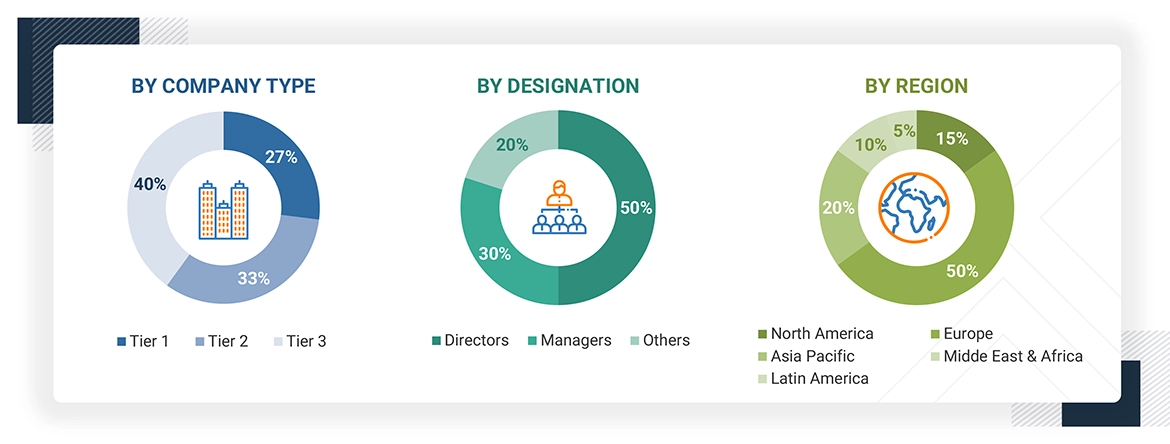
Extensive primary research was carried out following the collection of market insights through secondary research to validate the aerospace composites market scenario. Numerous interviews were conducted with industry experts from both the demand and supply sides across key regions, including North America, Europe, Asia Pacific, the Middle East & Africa, and Latin America. Primary data was gathered through structured questionnaires, emails, and telephonic interviews. On the supply side, respondents included industry professionals such as CXOs, Vice Presidents, Directors of business development, marketing, product innovation teams, system integrators, component suppliers, distributors, and key opinion leaders in the aerospace composites space. These interviews provided valuable insights into market statistics, revenue data, segmentation, size estimations, forecasts, and enabled data triangulation. On the demand side, stakeholders such as CIOs, CTOs, CSOs, and installation teams from end-user organizations were consulted to gain a better understanding of customer perspectives, current usage patterns, supplier evaluations, and the future outlook for aerospace composites, all of which influence the overall market dynamics.
Breakup of Primary Research:
To know about the assumptions considered for the study, download the pdf brochure
Market Size Estimation
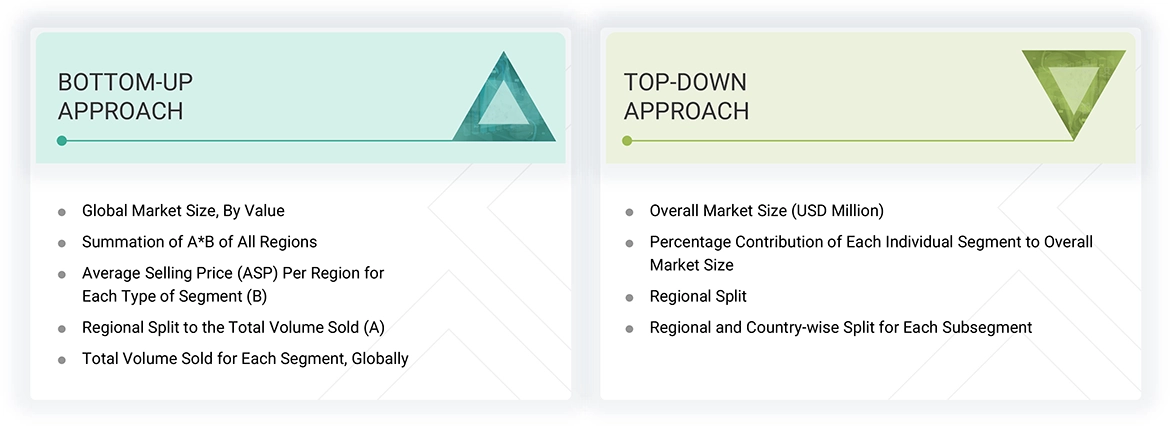
The research methodology used to estimate the size of the aerospace composites market primarily focused on a demand-side approach. Market sizing was conducted by analyzing procurement activities and modernization efforts involving aerospace composite products across various applications at the regional level. These procurement trends offered valuable insights into the demand patterns within the aerospace composites industry for each application segment. All relevant segments were thoroughly mapped and integrated to provide a comprehensive view of the market structure and size across different end-use applications.
Data Triangulation
After estimating the overall market size through the process described above, the total market was further segmented into various segments and subsegments. To ensure accuracy, data triangulation and market breakdown techniques were applied wherever relevant, forming a key part of the overall market engineering process. This involved analyzing multiple factors and trends from both the demand and supply sides. Additionally, the final market size and segment-level figures were validated using a combination of top-down and bottom-up approaches to ensure precision and reliability of the statistical estimates.
Market Definition
Aerospace composites are advanced materials used in the construction of aircraft and spacecraft, consisting of two or more distinct components, typically high-strength fibers and a matrix material. The fibers, such as carbon or glass, provide structural strength and rigidity, while the matrix binds the fibers together and transfers loads between them. The key benefit of using composites in aerospace applications is their exceptional strength-to-weight ratio, which significantly reduces the overall weight of the aircraft or spacecraft, enhancing fuel efficiency and performance. Common types include carbon fiber reinforced polymers (CFRP) and glass fiber reinforced polymers (GFRP), which are widely applied in critical areas such as fuselage structures, wings, interiors, and propulsion systems.
Stakeholders
- Aerospace composites manufacturers
- Aircraft manufacturers
- Universities, governments, and research organizations
- Aerospace composites and composite associations and industrial bodies
- Research and consulting firms
- R&D institutions
- Environmental support agencies
- Investment banks and private equity firms
Report Objectives
- To define, describe, and forecast the aerospace composites market size in terms of volume and value
- To provide detailed information regarding the key factors, such as drivers, restraints, opportunities, and challenges influencing market growth
- To analyze and project the global aerospace composites market by fiber type, matrix type, manufacturing process, aircraft type, application, and region
- To forecast the market size concerning five main regions (along with country-level data), namely, North America, Europe, Asia Pacific, Latin America, and the Middle East & Africa, and analyze the significant region-specific trends
- To strategically analyze micromarkets with respect to individual growth trends, prospects, and contributions of the submarkets to the overall market
- To analyze the market opportunities and the competitive landscape for stakeholders and market leaders
- To assess recent market developments and competitive strategies, such as agreements, contracts, acquisitions, and new product developments/new product launches, to draw the competitive landscape
- To strategically profile the key market players and comprehensively analyze their core competencies
Get the Full Aerospace Composites Market Report
Full forecast, segment splits, and company analysis for all Aerospace Composites Market.
- Canada Aerospace Composites Market
- US Aerospace Composites Market
- Germany Aerospace Composites Market
- France Aerospace Composites Market
- UK Aerospace Composites Market
- Spain Aerospace Composites Market
- Italy Aerospace Composites Market
- Russia Aerospace Composites Market
- China Aerospace Composites Market
- India Aerospace Composites Market
- Malaysia Aerospace Composites Market
- South Korea Aerospace Composites Market
- Australia Aerospace Composites Market
- Brazil Aerospace Composites Market
- Mexico Aerospace Composites Market
- Israel Aerospace Composites Market
- South Africa Aerospace Composites Market
- Rest Of Europe Aerospace Composites Market
- Rest Of Asia Pacific Aerospace Composites Market
- Rest Of Latin America Aerospace Composites Market
- GCC Countries Aerospace Composites Market
- –Rest Of GCC Aerospace Composites Market
Need a Tailored Report?
Customize this report to your needs
Get 10% FREE Customization
Customize This Report
