
Japan Agricultural Biotechnology Market (2025-2030)

The Japan Agricultural Biotechnology Market was valued at $758.1 Million in 2025 and projected to reach to $1218.8 Million by 2030, representing a compound annual growth rate of 10.0%. Japan's agricultural biotechnology market is poised for significant expansion through 2030, driven by government initiatives, technological advancement, and the nation's commitment to sustainable agriculture.


| Market Size in | USD 26.32 MN |
| Market Forecast in | |
| CAGR | |
| Forecast Period | |
| Units Considered | Value (USD MN) |
Japan Agricultural Biotechnology Market Trends and Insights
- This expansion reflects Japan's commitment to advancing sustainable farming practices and addressing food security challenges through biotechnological innovation.
- Japan's market growth outpaces the global average, driven by strong government support for agricultural modernization and increasing adoption of genetically modified crops and precision farming technologies. The 10.0% compound annual growth rate (CAGR) demonstrates Japan's strategic focus on biotechnology as a cornerstone of agricultural competitiveness.
- Japan's investment in research and development, coupled with regulatory frameworks that encourage innovation, positions the nation as a key player in Asia Pacific's agricultural biotechnology landscape.
- By 2030, Japan is expected to leverage biotechnology solutions to enhance crop yields, reduce environmental impact, and strengthen its position in global agricultural markets..
Key Market Statistics
- CAGR (2025-2030) 10.0% CAGR
- Market Size, 2025 ~USD 758.1 Million
- Forecast, 2030 ~USD 1218.8 Million
- Country Japan
Japan Agricultural Biotechnology Market Overview
Market Valuation Growth :
Japan's agricultural biotechnology market is valued at USD 758.1 million in 2025, with a projected expansion to USD 1,218.8 million by 2030, representing a robust 10% CAGR that exceeds the global average of 9.4%.
Government Support & Policy :
Japan's government has implemented strong policies and incentives to promote biotechnological innovation in agriculture, positioning the nation as a leader in sustainable farming practices and food security solutions.
Sustainable Agriculture Focus :
Japanese agricultural biotechnology is increasingly focused on developing climate-resilient crops and precision farming technologies to address environmental challenges and optimize resource efficiency.
Food Security & Innovation :
Japan's aging population and limited arable land drive demand for advanced biotechnological solutions that enhance crop yields, reduce dependency on imports, and ensure long-term food security.
Japan Agricultural Biotechnology Market Dynamics
- The market's 10% CAGR reflects strong investment in research and development, coupled with increasing adoption of genetically modified crops and precision farming technologies.
- Japan's focus on addressing food security challenges and reducing environmental impact positions it as a key growth market in Asia-Pacific.
- Continued collaboration between government agencies, research institutions, and private enterprises will further accelerate market penetration and innovation in biotechnological solutions tailored to Japan's unique agricultural landscape..
Market Ecosystem
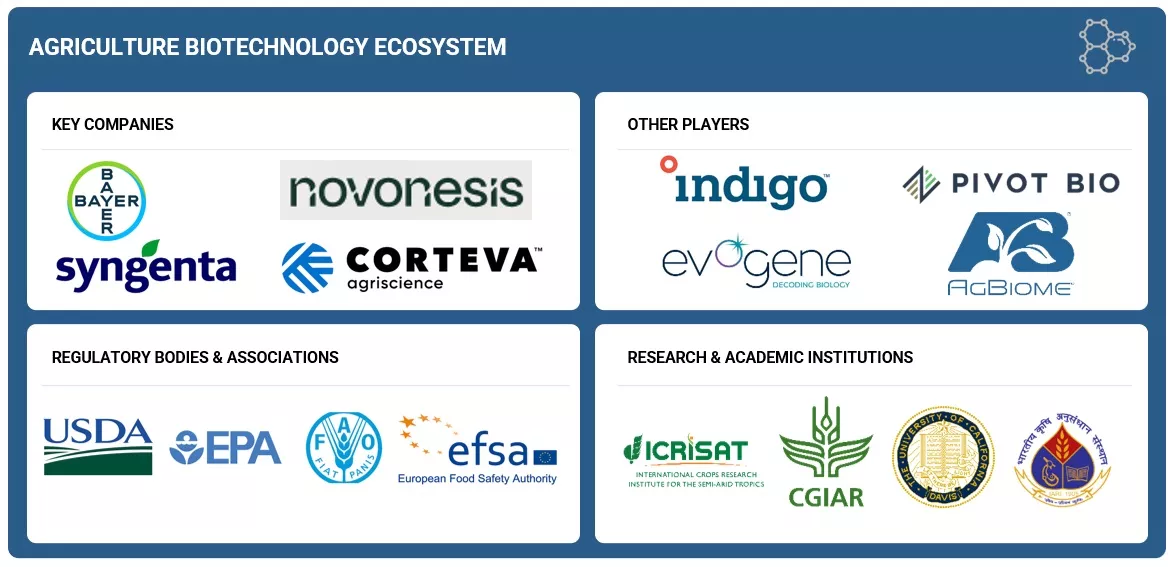
agricultural biotechnology market: COMMERCIAL USE CASES ACROSS INDUSTRIES
| COMPANY | USE CASE DESCRIPTION | BENEFITS |
|---|---|---|
 |
Development of next-generation genetically engineered seeds with enhanced drought and pest resistance for major crops such as maize and soybean | Improved yield stability under climate stress, reduced pesticide use, and greater profitability for farmers |
 |
Large-scale production of microbial biofertilizers and biocontrol agents to improve soil microbiota and crop vigor | Enhanced nutrient uptake, improved soil health, and sustainable crop growth with lower chemical dependency |
 |
Integration of biotechnology into hybrid seed and crop protection portfolio with biological pest resistance and CRISPR-based R&D | Reduced pest losses, increased productivity, and strengthened sustainability compliance |
 |
Advancing animal biotechnology through vaccines and genomic tools to prevent livestock diseases and enhance reproduction efficiency | Better herd health, higher productivity, and lower veterinary costs through preventive care |
Logos and trademarks shown above are the property of their respective owners. Their use here is for informational and illustrative purposes only.
Related Ecosystem
Agricultural Biologicals
Key Takeaways
- Japan's agricultural biotechnology market is valued at USD 758.1 million in 2025 and is forecast to reach USD 1,218.8 million by 2030.
- Japan's market is growing at a 10.0% CAGR, outpacing the global average of 9.4%, reflecting strong regional demand and innovation.
- Japan's government support and R&D investments are driving adoption of advanced biotechnology solutions in crop improvement and sustainable farming.
- By 2030, Japan is positioned to become a leading biotechnology hub in Asia Pacific, addressing food security and environmental sustainability.
Agricultural Biotechnology Market Report Scope
| Report Metric | Details |
|---|---|
| Base Year | 2025 |
| Fastest Growing Segment | MICROBES (Type Of Organism) |
| Forecast Period | 2025–2030 |
| Growth Rate | CAGR of 9.4% from 2025 to 2030 |
| Largest Segment | PLANTS (Type Of Organism) |
| Market Size Base Year (Billions) | ~USD 92.05 (2025) |
| Revenue Forecast (Billions) | ~USD 144.25 (2030) |
| Segments Covered | Type Of Organism |
Japan Agricultural Biotechnology Market Report Segmentation
1 segment dimensions are covered across the global market.
By Type Of Organism
- Animals
- Microbes
- Plants
JAPAN: MICROBIAL BIOTECHNOLOGY MARKET, BY APPLICATION, 2025–2030
| Segment | 2025 | 2026 | 2027 | 2028 | 2029 | 2030 | CAGR (%) |
|---|---|---|---|---|---|---|---|
| BIOREMEDIATION & WASTE UTILIZATION | 27.4 | 32.8 | 38 | 43.2 | 48.2 | 53 | 14.1 |
| PEST & DISEASE CONTROL | 26.4 | 31.1 | 35.6 | 39.9 | 43.9 | 47.7 | 12.6 |
| SOIL HEALTH MANAGEMENT | 23.7 | 28.1 | 32.4 | 36.5 | 40.4 | 44 | 13.2 |
| SUSTAINABLE NUTRIENT CYCLING | 36 | 43.2 | 50.3 | 57.3 | 64.2 | 70.8 | 14.5 |
| TOTAL | 113.6 | 135.2 | 156.4 | 176.9 | 196.6 | 215.5 | 13.7 |
JAPAN: PLANT BIOTECHNOLOGY MARKET, BY APPLICATION, 2025–2030
| Segment | 2025 | 2026 | 2027 | 2028 | 2029 | 2030 | CAGR (%) |
|---|---|---|---|---|---|---|---|
| CLIMATE-RESILIENT CROPS | 29.5 | 32 | 34.4 | 36.7 | 39 | 41.2 | 6.9 |
| CROP PROTECTION | 56.9 | 60.7 | 64.2 | 67.4 | 70.4 | 73.1 | 5.1 |
| NUTRITIONAL QUALITY IMPROVEMENT | 62.1 | 69 | 76 | 83.1 | 90.2 | 97.4 | 9.4 |
| YIELD ENHANCEMENT | 65.8 | 71 | 76.1 | 80.9 | 85.5 | 89.9 | 6.4 |
| TOTAL | 214.3 | 232.7 | 250.6 | 268.1 | 285.1 | 301.5 | 7.1 |
Target Audience
- Agricultural Biotechnology Companies : Biotech firms need Japan-specific market data to assess expansion opportunities, understand competitive positioning, and develop localized product strategies for this high-growth market outpacing global averages.
- Investment & Venture Capital Firms : Investors require detailed Japan market insights to identify promising startups, evaluate portfolio companies' growth potential, and make informed funding decisions in the region's thriving agribiotech sector.
- Government & Policy Makers : Japanese agricultural and technology officials need market analysis to evaluate policy effectiveness, benchmark against global trends, and refine incentive programs supporting biotechnology innovation and food security.
- Agricultural Producers & Cooperatives : Farmers and agricultural organizations require market intelligence on available biotechnologies, adoption trends, and ROI potential to make informed decisions about implementing advanced farming solutions.
- Research Institutions & Universities : Academic and research organizations need market data to align research initiatives with commercial opportunities, secure funding, and collaborate with industry partners on Japan-relevant biotechnology innovations.
Reasons to Buy this Report
- Market Size & Growth Trajectory : Access comprehensive data on Japan's USD 758.1M market in 2025 expanding to USD 1,218.8M by 2030, enabling accurate forecasting and strategic investment planning in the region's high-growth biotechnology sector.
- Competitive Intelligence : Gain insights into Japan's unique market dynamics, government policies, and regulatory environment that differentiate it from global markets, helping you identify competitive advantages and market entry strategies.
- Investment & Partnership Opportunities : Identify key growth drivers, emerging technologies, and stakeholder networks within Japan's agricultural biotechnology ecosystem to inform partnership decisions and capital allocation strategies.
- Regulatory & Policy Landscape : Understand Japan's government support mechanisms, incentive programs, and biotechnology regulations that shape market opportunities and influence product development and commercialization timelines.
- Demand Forecasting & Risk Mitigation : Leverage detailed market projections and trend analysis specific to Japan to optimize supply chain planning, resource allocation, and risk management in this strategically important Asian market.
Frequently asked questions
What is the current size of Japan's agricultural biotechnology market?
Japan's agricultural biotechnology market is valued at USD 758.1 million in 2025, with expectations to grow significantly by 2030.
What is the projected market size for Japan's agricultural biotechnology sector by 2030?
Japan's agricultural biotechnology market is forecast to reach USD 1,218.8 million by 2030, representing substantial growth over the forecast period.
What is the CAGR for Japan's agricultural biotechnology market?
Japan's agricultural biotechnology market is growing at a compound annual growth rate of 10.0% from 2025 to 2030.
What factors are driving growth in Japan's agricultural biotechnology market?
Growth in Japan's market is driven by government support for agricultural modernization, increased R&D investments, adoption of genetically modified crops, and precision farming technologies.
How does Japan's agricultural biotechnology market compare to global trends?
Japan's 10.0% CAGR exceeds the global average of 9.4%, indicating stronger regional growth momentum and market opportunity in the Asia Pacific region.
RESEARCH METHODOLOGY
The study used two main methods to estimate the current size of the agriculture biotechnology market. Extensive secondary research gathered information on organism types, technologies, types, applications, and end users. The next step was to verify these findings, assumptions, and size estimates with industry experts across the value chain through primary research. Both top-down and bottom-up approaches were used to determine the overall market size. Data triangulation helped estimate the size of segments and subsegments.
Secondary Research
This research involved extensive secondary sources, including directories and databases like Bloomberg Businessweek and Factiva, to gather valuable information for a technical, market-oriented, and commercial study. During the secondary research process, sources such as annual reports, press releases and investor presentations, white papers, food journals, certified publications, articles by recognized authors, directories, and databases were used to identify and collect information. Secondary research primarily aimed to gather key details about the industry’s supply chain, the main players, and market classification and segmentation based on industry trends, regional markets, and key developments from both market and technology perspectives.
Primary Research
Extensive primary research was carried out after gathering information about the agriculture biotechnologies landscape through secondary research. Several primary interviews were conducted with market experts from both demand and supply sides across major countries in North America, Europe, Asia Pacific, South America, and the Rest of the World. Data was collected via questionnaires, emails, and phone interviews. The primary sources from the supply side included industry experts such as chief officers (CXOs), vice presidents (VPs), directors from business development, marketing, research, and development teams, and other key executives from distributors and opinion leaders.
Primary interviews were conducted to gather insights such as market statistics, data on revenue from products and services, market breakdowns, market size estimations, market forecasts, and data triangulation. They also helped understand trends related to solution types, technology, crop types, end users, and regions. Stakeholders from the demand side, such as farmers and growers, food processing companies, and cold chain logistics providers, were interviewed to gain the buyers’ perspective on suppliers, products, and their business outlook, which will influence the overall market.
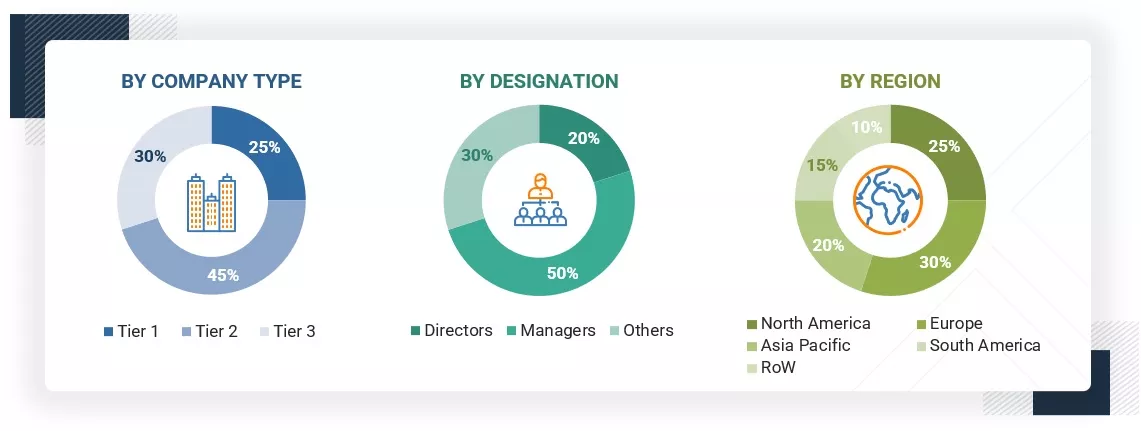
Note: The three tiers of the companies are defined based on their total revenue in 2023 or 2024, as per the
availability of financial data: Tier 1: Revenue > USD 1 billion; Tier 2: USD 100 million = revenue = USD 1 billion; Tier 3: Revenue < USD 100 million
To know about the assumptions considered for the study, download the pdf brochure
|
COMPANY NAME |
DESIGNATION |
|
Deere & Company (US) |
Product Development Manager |
|
DJI (China) |
Senior R&D Scientist |
|
AGCO (US) |
Marketing Director |
|
CNH Industrial (UK) |
Sales Head |
|
Hexagon AB (US) |
Senior Research Executive |
Market Size Estimation
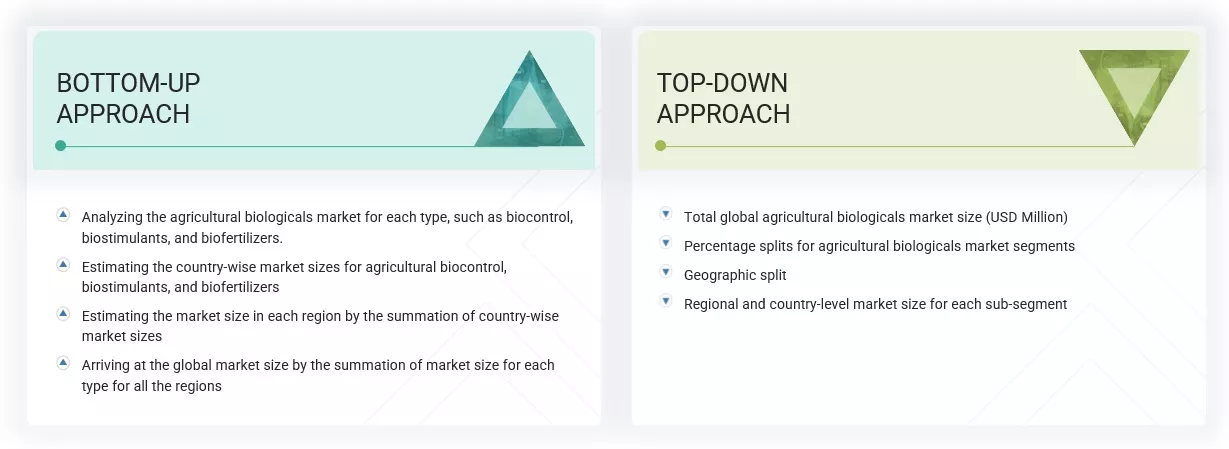
The top-down and bottom-up approaches were used to estimate and validate the overall size of the agriculture biotechnology market. These approaches were also extensively employed to determine the size of various market subsegments. The research methodology used for estimating the market size includes the following details.
- The key players in the industry and the overall markets were identified through extensive secondary research.
- All shares, splits, and breakdowns were determined using secondary sources and verified through primary sources.
- All possible parameters that affect the market covered in this research study were accounted for, viewed in extensive detail, verified through primary research, and analyzed to obtain final quantitative and qualitative data.
- The research included the study of reports, reviews, and newsletters of top market players, along with extensive interviews for opinions from leaders, such as CEOs, directors, and marketing executives.
Agriculture Biotechnology Market : Top-Down and Bottom-Up Approach
Data Triangulation
After estimating the overall market size using the method described above, the total market was divided into several segments and subsegments. The data triangulation process was used, where applicable, to estimate the total Agriculture biotechnologies market and to determine precise statistics for all segments and subsegments. The data was triangulated by analyzing various demand and supply factors and trends. Additionally, the market size was confirmed using both top-down and bottom-up approaches.
Market Definition
Agricultural biotechnology, as defined by the Food and Agriculture Organization (FAO), refers to “any technological application that uses biological systems, living organisms or derivatives thereof, to make or modify products or processes for specific use.”
In the agriculture biotechnology market, this concept involves the development, commercialization, and adoption of technologies used in plants, animals, and microbes—such as genetic modification, genome editing, biofertilizers, biopesticides, enzyme-based solutions, animal vaccines, and diagnostics—aiming to boost productivity, enhance crop and livestock traits, reduce resource use, and support sustainability in global agriculture.
Therefore, the agriculture biotechnology market includes the total economic value of all biotechnology-enabled products and services in agriculture — covering seeds and traits for crops; microbial and enzyme inputs for soil and plants; animal health and reproductive biotechnology products; and related support technologies and tools.
Stakeholders
- Seed and Trait Developers
- Animal Biotechnology Firms
- Microbial Biotech and Biofertilizer Companies
- Research and Academic Institutions
- Public and Private Entities driving Fundamental Research
- Genetic Improvement Institutes
- Biosafety Assessment Institutes
- CGIAR Centers (e.g., CIMMYT, IRRI)
- FAO
- USDA Agricultural Research Service (ARS)
- ICAR (India)
- EMBRAPA (Brazil)
- Chinese Academy of Agricultural Sciences (CAAS)
- University-based Biotechnology Programs
- Regulatory and Government Bodies
- Entities overseeing Biosafety
- GMO Regulation Bodies
- Trade Compliance Bodies
- International Service for the Acquisition of Agri-biotech Applications (ISAAA)
- International Biocontrol Manufacturers Association (IBMA)
- Biotechnology Innovation Organization (BIO)
- European Biostimulants Industry Council (EBIC)
- Farmers and Cooperatives
- Agribusinesses and Food Processors
- Feed Producers and Livestock Companies
- Retailers and Exporters focused on Sustainable and Traceable Sourcing
Report Objectives
- To determine and project the size of the agriculture biotechnologies based on organism type, technology, type, application, end user, and region from 2025 to 2030
- To identify attractive opportunities in the market by determining the largest and fastest-growing segments across regions
- To provide detailed information about the key factors influencing market growth (drivers, restraints, opportunities, and challenges)
- To analyze opportunities in the market for stakeholders and provide details of the competitive landscape for market leaders
- To analyze micromarkets concerning individual growth trends, prospects, and their contribution to the total market
- To identify and profile key players in the agriculture biotechnology market
- To understand the competitive landscape and identify the major growth strategies adopted by players across the key regions
Available Customizations
With the given market data, MarketsandMarkets offers customizations according to company-specific scientific needs.
The following customization options are available for the report:
Product Analysis
- A product matrix, which gives a detailed comparison of the product portfolio of each company.
Geographic Analysis as per Feasibility
With the given market data, MarketsandMarkets offers customizations according to company-specific scientific needs.
- Further breakdown of the Rest of the European Agriculture biotechnologies into key countries
- Further breakdown of the Rest of Asia Pacific Agriculture biotechnologies into key countries
- Further breakdown of the Rest of the South American Agriculture biotechnologies into key countries
Company Information
- Detailed analyses and profiling of additional market players (up to five)
Get the Full Agricultural Biotechnology Market Report
Full forecast, segment splits, and company analysis for all Agricultural Biotechnology Market.
- US Agricultural Biotechnology Market
- Canada Agricultural Biotechnology Market
- Mexico Agricultural Biotechnology Market
- Germany Agricultural Biotechnology Market
- France Agricultural Biotechnology Market
- UK Agricultural Biotechnology Market
- Italy Agricultural Biotechnology Market
- Spain Agricultural Biotechnology Market
- China Agricultural Biotechnology Market
- India Agricultural Biotechnology Market
- Brazil Agricultural Biotechnology Market
- Argentina Agricultural Biotechnology Market
Need a Tailored Report?
Customize this report to your needs
Get 10% FREE Customization
Customize This Report
