
Brazil Agricultural Food Loss Reduction Solutions Market (2025-2030)

The Brazil Agricultural Food Loss Reduction Solutions Market was valued at $833.9 Million in 2025 and projected to reach to $1319.3 Million by 2030, representing a compound annual growth rate of 9.6%. Brazil's agricultural food loss reduction solutions market is experiencing accelerated growth as the country's large-scale farming operations increasingly prioritize efficiency and sustainability.


| Market Size in | USD 26.32 MN |
| Market Forecast in | |
| CAGR | |
| Forecast Period | |
| Units Considered | Value (USD MN) |
Brazil Agricultural Food Loss Reduction Solutions Market Trends and Insights
- Brazil's large-scale agricultural sector, combined with increasing pressure to reduce post-harvest losses across crops, grains, and perishables, is driving adoption of advanced technologies and supply chain solutions.
- The market in Brazil reflects growing investment in cold chain infrastructure, digital monitoring systems, and sustainable packaging innovations tailored to the country's diverse agricultural landscape. Brazil's position as a global agricultural powerhouse creates both significant food loss challenges and substantial opportunities for solution providers.
- Between 2025 and 2030, Brazil is expected to see accelerated deployment of IoT-enabled storage systems, AI-driven demand forecasting, and traceability platforms across its major production regions.
- Government initiatives promoting agricultural modernization and export competitiveness are reinforcing market growth in Brazil, while rising consumer awareness of food waste sustainability is further catalyzing demand for loss reduction technologies..
Key Market Statistics
- CAGR (2025-2030) 9.6% CAGR
- Market Size, 2025 ~USD 833.9 Million
- Forecast, 2030 ~USD 1319.3 Million
- Country Brazil
Brazil Agricultural Food Loss Reduction Solutions Market Overview
Market Valuation :
Brazil's agricultural food loss reduction solutions market is valued at USD 833.9 million in 2025, with strong growth trajectory driven by the country's expansive agricultural sector and increasing focus on sustainability.
Robust Growth Rate :
The Brazilian market is expanding at a CAGR of 9.6% from 2025 to 2030, outpacing the global average of 9.2%, reflecting accelerated adoption of food loss reduction technologies across the region.
Post-Harvest Loss Reduction :
Brazil's agricultural sector faces significant post-harvest losses in crops, grains, and perishables. Advanced technological solutions are being rapidly adopted to minimize waste and improve supply chain efficiency.
Projected Market Expansion :
The market is forecasted to reach USD 1,319.3 million by 2030, representing a 58% increase over five years, driven by regulatory pressures, export demands, and investment in agricultural innovation.
Brazil Agricultural Food Loss Reduction Solutions Market Dynamics
- The 9.6% CAGR reflects growing adoption of technologies addressing post-harvest losses in grains, fruits, and vegetables—critical segments for Brazil's export-oriented agriculture.
- Regulatory frameworks promoting food security and environmental responsibility are compelling agribusinesses to invest in advanced solutions. By 2030, the market expansion to USD 1.3 billion will be fueled by technological innovations, rising consumer demand for sustainable practices, and integration of digital tools in supply chains.
- Brazil's position as a global agricultural powerhouse creates significant opportunities for solution providers targeting mechanization, storage optimization, and real-time monitoring systems that reduce waste across production and distribution networks..
Market Ecosystem
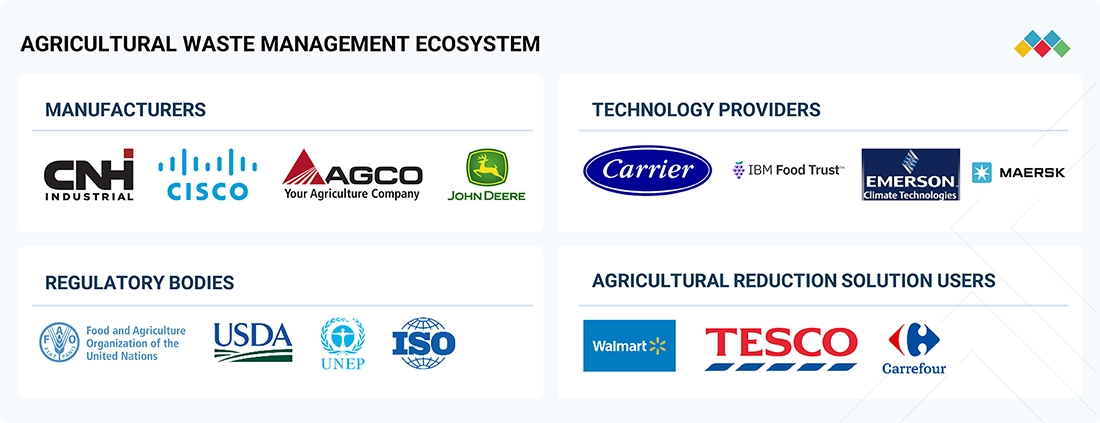
Agriculture Waste Management Market: COMMERCIAL USE CASES ACROSS INDUSTRIES
| COMPANY | USE CASE DESCRIPTION | BENEFITS |
|---|---|---|
 |
Smart harvesting and precision agriculture equipment for cereals and grains | Reduced field-level losses, enhanced harvesting efficiency, and better preservation of yields |
 |
Mechanized harvesting and baling solutions for horticultural and specialty crops | Minimized crop handling damage, faster harvesting, and reduced perishability |
 |
Post-harvest grain handling and storage systems | Improved storage efficiency, reduced moisture-related spoilage, and maintained grain quality |
 |
IoT and sensor-based monitoring systems for cold chain and storage infrastructure | Real-time temperature/humidity tracking, reduced spoilage, and improved traceability |
Logos and trademarks shown above are the property of their respective owners. Their use here is for informational and illustrative purposes only.
Related Ecosystem
Agricultural Biologicals
- Bionematicides
- Auxins
- Cytokinins
- Ethylene
- Humic Substances
- NICHINO INDIA PVT LTD.
- Corteva, Inc.
- Basf se
- AZELIS HOLDINGS SA
- BAYER AG
Key Takeaways
- Brazil's agricultural food loss reduction solutions market reaches USD 833.9 million in 2025 and is forecast to grow to USD 1,319.3 million by 2030 at a 9.6% CAGR.
- Cold chain infrastructure and digital monitoring technologies are becoming critical investments across Brazil's agricultural supply chains to minimize post-harvest losses.
- Government modernization initiatives and export-driven competitiveness are accelerating adoption of advanced loss reduction solutions throughout Brazil.
- Brazil's market growth is supported by rising sustainability awareness and the need to protect agricultural yields in a globally competitive environment.
Agricultural Food Loss Reduction Solutions Market Report Scope
| Report Metric | Details |
|---|---|
| Base Year | 2025 |
| Fastest Growing Segment | LOGISTICS & WAREHOUSING PROVIDERS (End User) |
| Forecast Period | 2025–2030 |
| Growth Rate | CAGR of 9.2% from 2025 to 2030 |
| Largest Segment | CEREALS & GRAINS (Crop Type) |
| Market Size Base Year (Billions) | ~USD 14.49 (2025) |
| Revenue Forecast (Billions) | ~USD 22.5 (2030) |
| Segments Covered | Solution Type, Sub-Segment, Technology, Crop Type, End User |
Brazil Agricultural Food Loss Reduction Solutions Market Report Segmentation
5 segment dimensions are covered across the global market.
By Solution Type
- Harvest Technologies
- Post-Harvest Loss Reduction Technologies
- Pre-Harvest Loss Prevention Technologies
- Service & Software Solutions
By Sub-Segment
- AI-Based Farm Advisory And Decision Support
- Automated Harvesting Systems
- Bio-Preservation And Treatment Technologies
- Cold Chain & Logistics Infrastructure
- Controlled Atmosphere Storage
- Data Analytics And Forecasting Tools
- Drying, Curing, & Evaporative Cooling Technologies
- Hermetic Storage Solutions
- IoT Sensors
- Machine Learning And Big Data Analytics
- Manual Harvesting Tools
- Mechanized Harvesters
- Modified Atmosphere Packaging
- Nutrient Management Solutions
- Pest And Disease Forecasting Systems
- Precision Agriculture Tools
- Predictive Modeling And Yield Forecasting
- Remote Sensing And IoT-Based Loss Detection Systems
- Rfid And Qr Code Systems
- Ripeness And Maturity Detectors
- Satellite And Drone Imaging
- Soil Health Monitoring Sensors
- Sorting And Grading Robots
- Supply Chain Traceability Platforms
By Technology
- Cold Chain And Refrigeration Technologies
- Data & Analytics Technologies
- Robotics And Automation
- Sensor Technologies
By Crop Type
- Cereals & Grains
- Fruits & Vegetables
- Horticultural & Specialty Crops
- Horticultural & Specialty Crops (E.G., Herbs, Flowers)
- Oilseeds & Pulses
- Other Crop Types
By End User
- Agricultural Co-Operatives
- Commercial Farmers & Agribusinesses
- Food Processors & Manufacturers
- Individual/Small Holder Farmers
- Logistics & Warehousing Providers
Target Audience
- Agricultural Technology Providers : Companies developing food loss reduction solutions need Brazil-specific market data to tailor products for local post-harvest challenges, optimize pricing strategies, and identify distribution partnerships in this high-growth market.
- Agribusiness Investors : Investment firms evaluating opportunities in Brazil's agricultural sector require detailed market sizing and growth projections to assess portfolio potential and allocate capital to emerging food loss reduction technology companies.
- Large-Scale Farming Operations : Brazilian agricultural enterprises need market intelligence on available solutions, competitive offerings, and ROI benchmarks to make informed technology adoption decisions that reduce post-harvest losses and improve profitability.
- Supply Chain and Logistics Companies : Organizations managing agricultural supply chains in Brazil require insights into food loss reduction market trends to identify partnership opportunities and integrate advanced solutions into their operations.
- Government and Policy Makers : Brazilian agricultural and environmental agencies need market data to develop informed policies, incentive programs, and sustainability initiatives that support food security and reduce agricultural waste across the nation.
Key Companies in the Brazil Agricultural Food Loss Reduction Solutions Market
| Company | HQ | Ownership | Strongest segments |
|---|---|---|---|
| DEERE & COMPANY | United States | Public Company | Production and Precision Agriculture equipment and embedded technologies,Small Agriculture and Turf equipment for specialty and high-value crops,Construction and Forestry equipment used in on-farm infrastructure and logistics, |
| CNH INDUSTRIAL N.V. | United Kingdom | Public Company | Agriculture equipment and precision agriculture solutions,Construction equipment,Financial Services, |
| AGCO | United States | Public Company | Tractors (high-horsepower, utility, compact),Combines and Harvesting Equipment,Grain Storage, Drying, Handling & Seed Processing Systems, |
| CARRIER | United States | Public Company | Other non-agrifood climate and energy solutions, |
| CISCO SYSTEMS, INC. | United States | Public Company | |
| ORBCOMM | United States | Private Company | Cold chain monitoring and temperature-tracking solutions for agricultural logistics,Asset tracking and management for trailers, trucks, rail cars, and sea containers carrying crops,Satellite AIS and maritime visibility services for agricultural exports, |
| HEXAGON AB AND/OR ITS SUBSIDIARIES | Sweden | InvalidIdentifier | Cereals & Grains Solutions,Oilseeds & Pulses Solutions,Fruits & Vegetables Solutions, |
| AGEAGLE AERIAL SYSTEMS INC. | United States | Public Company | Drones (eBee TAC, eBee X, eBee VISION and related UAS platforms),Sensors (MicaSense multispectral and advanced payloads),Software & Services (Ground Control and related cloud solutions), |
| SAP SE OR AN SAP AFFILIATE COMPANY | Germany | InvalidIdentifier | Core ERP and Supply Chain (SAP S/4HANA, SAP IBP, SAP EWM),Business Network and Traceability Solutions,Analytics, Sustainability, and Industry Cloud for Agribusiness and Food, |
DEERE & COMPANY
Deere & Company is a United States-based public company founded in 1837 with 73,100 employees. The company is a global leader in manufacturing agricultural, construction, and forestry equipment.
CNH INDUSTRIAL N.V.
CNH Industrial N.V. is a United Kingdom-based public company founded in 1842 with 34,197 employees. The company designs, produces, and sells agricultural and construction equipment worldwide.
AGCO
AGCO is a United States-based public company founded in 1990 with 22,000 employees. The company manufactures and distributes agricultural equipment and related replacement parts globally.
CARRIER
Carrier is a United States-based public company founded in 2019 with 47,000 employees. The company provides heating, ventilation, air conditioning, and refrigeration solutions.
CISCO SYSTEMS, INC.
Cisco Systems, Inc. is a United States-based public company founded in 1984 with 86,200 employees. The company designs, manufactures, and sells networking equipment and software solutions.
ORBCOMM
ORBCOMM is a United States-based private company founded in 1993 with 739 employees. The company provides satellite communication and Internet of Things solutions.
HEXAGON AB AND/OR ITS SUBSIDIARIES
Hexagon AB and/or its subsidiaries is a Sweden-based company. Insufficient data is available to provide a complete business description.
AGEAGLE AERIAL SYSTEMS INC.
AgeAgle Aerial Systems Inc. is a United States-based public company founded in 2010 with 59 employees. The company provides aerial imagery and data analytics services.
SAP SE OR AN SAP AFFILIATE COMPANY
SAP SE or an SAP affiliate company is a Germany-based company. Insufficient data is available to provide a complete business description.
Reasons to Buy this Report
- Market-Specific Growth Data : Access precise valuation metrics for Brazil's market (USD 833.9M in 2025) with country-specific CAGR of 9.6%, enabling accurate forecasting and investment planning tailored to regional dynamics.
- Competitive Positioning Insights : Understand Brazil's market performance relative to global trends (9.2% global CAGR) to identify competitive advantages and market gaps specific to the Brazilian agricultural landscape.
- Sector-Specific Opportunity Analysis : Gain detailed intelligence on post-harvest loss challenges in Brazil's crops, grains, and perishables sectors, enabling targeted product development and market entry strategies.
- Investment Decision Support : Leverage 2030 forecast data (USD 1,319.3M) to evaluate ROI potential, identify high-growth segments, and make informed capital allocation decisions for Brazil operations.
- Regulatory and Sustainability Context : Understand Brazil-specific drivers including export requirements, sustainability mandates, and local regulatory pressures shaping technology adoption and market expansion opportunities.
Frequently asked questions
What is the current market size of agricultural food loss reduction solutions in Brazil?
Brazil's agricultural food loss reduction solutions market is valued at USD 833.9 million in 2025 and is expected to reach USD 1,319.3 million by 2030.
What is the projected growth rate for Brazil's food loss reduction market?
Brazil's market is projected to grow at a compound annual growth rate (CAGR) of 9.6% from 2025 to 2030.
Which technologies are driving growth in Brazil's food loss reduction market?
Key technologies driving Brazil's market include IoT-enabled storage systems, AI-driven demand forecasting, cold chain infrastructure, digital monitoring platforms, and sustainable packaging solutions.
What factors are accelerating food loss reduction solution adoption in Brazil?
Government agricultural modernization initiatives, export competitiveness pressures, rising sustainability awareness, and the need to protect agricultural yields are primary drivers in Brazil.
How does Brazil's market compare to the global agricultural food loss reduction market?
Brazil's 9.6% CAGR slightly outpaces the global market CAGR of 9.2%, reflecting strong regional demand and agricultural sector dynamics specific to Brazil.
RESEARCH METHODOLOGY
The study involved two major approaches in estimating the current size of the agricultural food loss reduction solutions market. Exhaustive secondary research collected information on the market, crop type, by technology, solution type, and end user. The next step was to validate these findings, assumptions, and sizing with industry experts across the value chain through primary research. The top-down and bottom-up approaches were employed to estimate the complete market size. Data triangulation was used to estimate the market size of segments and subsegments.
Secondary Research
This research study involved extensive secondary sources—directories and databases such as Bloomberg Businessweek and Factiva—to identify and collect valuable information for a technical, market-oriented, and commercial market study. In the secondary research process, sources such as annual reports, press releases & investor presentations of companies, white papers, food journals, certified publications, articles from recognized authors, directories, and databases were referred to identify and collect information. Secondary research was mainly used to obtain key information about the industry’s supply chain, the pool of key players, and market classification and segmentation based on the industry trends to the bottom-most level, regional markets, and key developments from market- and technology-oriented perspectives.
Primary Research
Extensive primary research was conducted after obtaining information regarding the agricultural food loss reduction solutions scenario through secondary research. Several primary interviews were conducted with market experts from the demand and supply sides across major countries of North America, Europe, Asia Pacific, South America, and the Rest of the World. Primary data was collected through questionnaires, emails, and telephonic interviews. The primary sources from the supply side included various industry experts, such as chief officers (CXOs), vice presidents (VPs), directors from business development, marketing, research, and development teams, and related key executives from distributors and key opinion leaders.
Primary interviews were conducted to gather insights such as market statistics, data on revenue collected from the products and services, market breakdowns, market size estimations, market forecasting, and data triangulation. It also helped understand the solution type, technology, crop type, end user, and region trends. Stakeholders from the demand side, such as farmers & growers, food processing companies, and cold chain logistics providers, were interviewed to understand the buyers’ perspective on the suppliers, products, and their business outlook, which will affect the overall market.
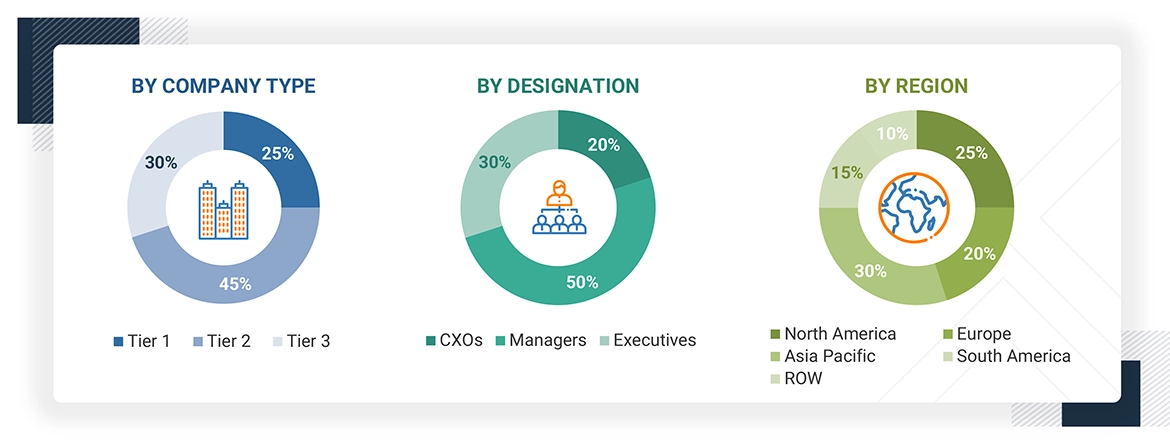
Note: The three tiers of the companies are defined based on their total revenues in 2023 or 2024,
as per the availability of financial data: Tier 1: Revenue > USD 1 billion; Tier 2: USD 100 million = revenue = USD 1
billion; Tier 3: Revenue < USD 100 million
To know about the assumptions considered for the study, download the pdf brochure
|
COMPANY NAME |
DESIGNATION |
|
Deere & Company (US) |
Product Development Manager |
|
DJI (China) |
Senior R&D Scientist |
|
AGCO (US) |
Marketing Director |
|
CNH Industrial (UK) |
Sales Head |
|
Hexagon AB (US) |
Senior Research Executive |
Market Size Estimation
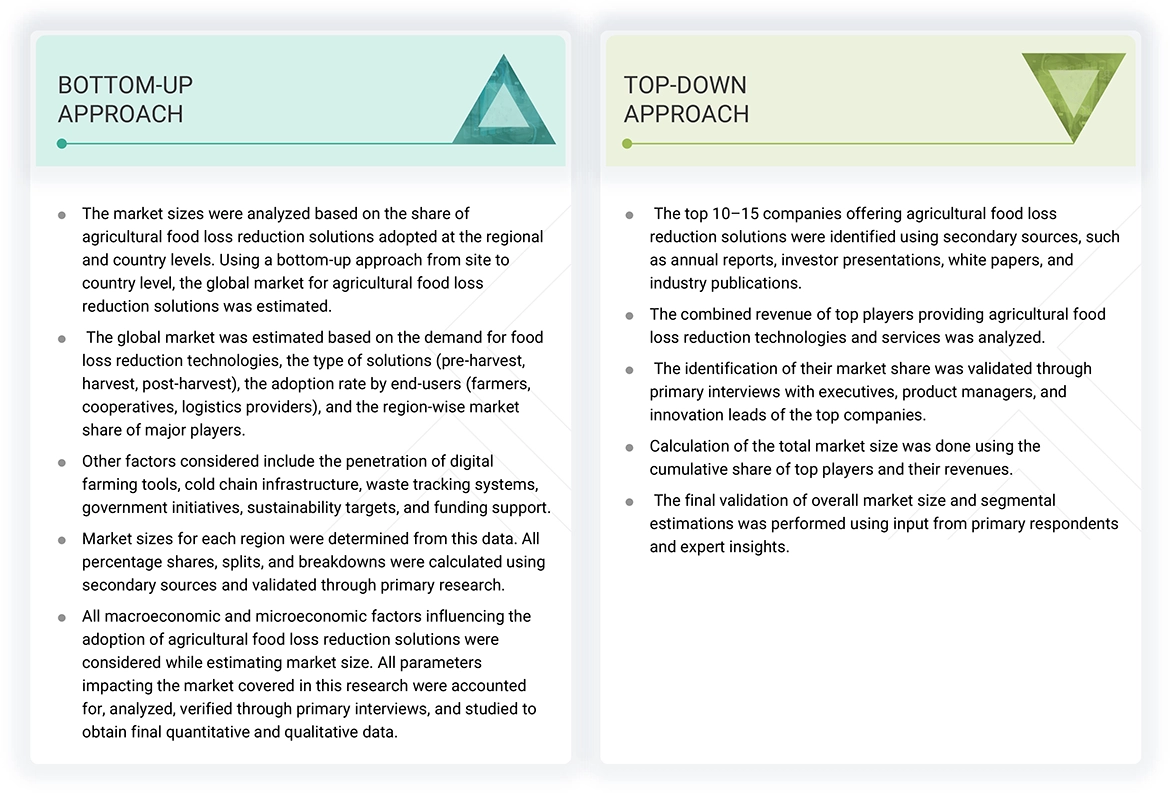
The top-down and bottom-up approaches were used to estimate and validate the total size of the agricultural food loss reduction solutions market. These approaches were also used extensively to determine the size of various subsegments in the market. The research methodology used to estimate the market size includes the following details:
- The key players in the industry and the overall markets were identified through extensive secondary research.
- All shares, splits, and breakdowns were determined using secondary sources and verified through primary sources.
- All possible parameters that affect the market covered in this research study were accounted for, viewed in extensive detail, verified through primary research, and analyzed to obtain final quantitative and qualitative data.
- The research included the study of reports, reviews, and newsletters of top market players, along with extensive interviews for opinions from leaders, such as CEOs, directors, and marketing executives.
Agricultural Food Loss Reduction Solutions Market : Top-Down and Bottom-Up Approach
Data Triangulation
After determining the overall market size from the estimation process explained above, the total market was split into several segments and subsegments. The data triangulation procedure was employed, wherever applicable, to estimate the overall agricultural food loss reduction solutions market and determine the exact statistics for all segments and subsegments. The data was triangulated by studying various factors and trends from the demand and supply sides. The market size was also validated using the top-down and bottom-up approaches.
Market Definition
According to the FAO, Food losses refer to the decrease in edible food mass throughout the part of the supply chain that specifically leads to edible food for human consumption. Food losses occur at production, postharvest, and processing stages in the food supply chain. Food losses occurring at the end of the food chain (retail and final consumption) are often called “food waste,” which relates to retailers’ and consumers’ behavior.
The agricultural food loss reduction solutions market refers to the collection of technologies, equipment, services, and practices aimed at minimizing food loss during pre-harvest, harvest, post-harvest, storage, processing, and transportation stages of the agricultural supply chain.
Stakeholders
- Farmers & Growers
- Agri-tech Companies
- Equipment & Machinery Manufacturers
- Cold Chain Logistics Providers
- Food Processing Companies
- Government & Regulatory Bodies
- NGOs & International Agencies
- Research & Academic Institutions
- Investors & Funding Agencies
- Retailers & Wholesalers
Report Objectives
- To determine and project the size of the agricultural food loss reduction solutions market based on solution type, crop type, technology, end user, and region over five years, ranging from 2025 to 2030
- To identify the attractive opportunities in the market by determining the largest and fastest-growing segments across regions
- To provide detailed information about the key factors influencing market growth (drivers, restraints, opportunities, and challenges)
- To analyze the opportunities in the market for stakeholders and provide details of the competitive landscape for market leaders
- To analyze the micro markets concerning individual growth trends, prospects, and their contribution to the total market
- To identify and profile the key players in the agricultural food loss reduction solutions market
- To understand the competitive landscape and identify the major growth strategies adopted by players across the key regions
Available Customizations
With the given market data, MarketsandMarkets offers customizations according to company-specific scientific needs.
The following customization options are available for the report:
Product Analysis
- A product matrix, which gives a detailed comparison of the product portfolio of each company.
Geographic Analysis as per Feasibility
With the given market data, MarketsandMarkets offers customizations according to company-specific scientific needs.
- Further breakdown of the Rest of the European agricultural food loss reduction solutions into key countries
- Further breakdown of the Rest of Asia Pacific agricultural food loss reduction solutions into key countries
- Further breakdown of the Rest of the South American agricultural food loss reduction solutions into key countries
Company Information
- Detailed analyses and profiling of additional market players (up to five)
Get the Full Agricultural Food Loss Reduction Solutions Market Report
Full forecast, segment splits, and company analysis for all Agricultural Food Loss Reduction Solutions Market.
- US Agricultural Food Loss Reduction Solutions Market
- Canada Agricultural Food Loss Reduction Solutions Market
- Mexico Agricultural Food Loss Reduction Solutions Market
- Germany Agricultural Food Loss Reduction Solutions Market
- UK Agricultural Food Loss Reduction Solutions Market
- France Agricultural Food Loss Reduction Solutions Market
- Spain Agricultural Food Loss Reduction Solutions Market
- Italy Agricultural Food Loss Reduction Solutions Market
- China Agricultural Food Loss Reduction Solutions Market
- India Agricultural Food Loss Reduction Solutions Market
- Japan Agricultural Food Loss Reduction Solutions Market
- Argentina Agricultural Food Loss Reduction Solutions Market
- Rest Of Europe Agricultural Food Loss Reduction Solutions Market
- Rest Of Asia Pacific Agricultural Food Loss Reduction Solutions Market
- Rest Of South America Agricultural Food Loss Reduction Solutions Market
Need a Tailored Report?
Customize this report to your needs
Get 10% FREE Customization
Customize This Report
