
CANADA AI Assistant Market (2025-2030)

The CANADA AI Assistant Market was valued at $217.8 Million in 2025 and projected to reach to $1293.9 Million by 2030, representing a compound annual growth rate of 42.8%. Canada's AI Assistant Market is poised for exceptional growth over the next five years, driven by strong enterprise digital transformation initiatives and consumer adoption of intelligent automation.


| Market Size in | USD 26.32 MN |
| Market Forecast in | |
| CAGR | |
| Forecast Period | |
| Units Considered | Value (USD MN) |
CANADA AI Assistant Market Trends and Insights
- This robust growth trajectory reflects Canada's strong technology infrastructure, increasing enterprise adoption of conversational AI, and rising consumer demand for intelligent automation solutions.
- Canada is positioning itself as a key hub for AI innovation in North America, with significant investments from both domestic and international technology firms. The Canadian market benefits from a highly educated workforce, supportive regulatory environment, and substantial government initiatives promoting AI development.
- Between 2025 and 2030, Canada's AI Assistant Market is expected to expand at a compound annual growth rate of 42.8%, outpacing many global peers.
- This acceleration is driven by widespread deployment across customer service, healthcare, financial services, and enterprise productivity sectors, where Canadian organizations are increasingly leveraging AI assistants to enhance operational efficiency and customer engagement..
Key Market Statistics
- CAGR (2025-2030) 42.8% CAGR
- Market Size, 2025 ~USD 217.8 Million
- Forecast, 2030 ~USD 1293.9 Million
- Country CANADA
CANADA AI Assistant Market Overview
Explosive Growth Trajectory :
Canada's AI Assistant Market is projected to grow from $217.8 million in 2025 to $1,293.9 million by 2030, representing a CAGR of 42.8%, outpacing many global peers and demonstrating strong market momentum.
Enterprise Adoption Surge :
Canadian enterprises are rapidly integrating conversational AI solutions across customer service, operations, and knowledge management, driven by labor shortages and the need for operational efficiency in competitive markets.
Tech Hub Innovation :
Canada's established technology infrastructure, coupled with significant AI research capabilities in Toronto, Vancouver, and Montreal, positions the country as a regional innovation leader attracting both domestic and international AI investments.
Consumer Demand Acceleration :
Rising consumer familiarity with AI assistants and increasing smartphone penetration across Canada are fueling demand for intelligent automation solutions in retail, banking, and healthcare sectors.
CANADA AI Assistant Market Dynamics
- The market's 42.8% CAGR reflects Canada's competitive advantage in AI talent, robust regulatory frameworks, and strategic positioning within North American technology ecosystems.
- Canadian organizations are increasingly recognizing AI assistants as critical tools for enhancing customer experiences and reducing operational costs.
- Government support for AI research and development, combined with private sector investment, will continue to accelerate market expansion.
- By 2030, Canada is expected to establish itself as a significant player in the global AI Assistant Market, with widespread deployment across financial services, healthcare, e-commerce, and public sector institutions..
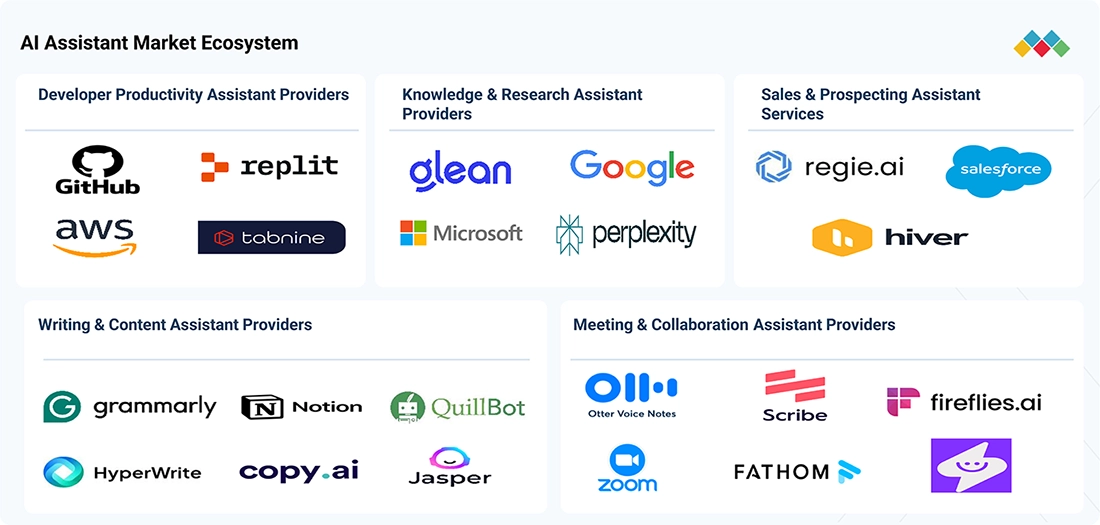
Market Ecosystem
AI ASSISTANT MARKET: COMMERCIAL USE CASES ACROSS INDUSTRIES
| COMPANY | USE CASE DESCRIPTION | BENEFITS |
|---|---|---|
 |
CBA deployed ChatGPT Enterprise across nearly 50,000 employees to strengthen enterprise AI adoption. Teams use assistants within everyday workflows while maintaining security, consistency, and controlled organizational access. The initiative supports customer service, fraud response, knowledge work, and improved employee productivity. | Nearly 50,000 employees gained access to enterprise AI across banking operations. | AI supports customer service and fraud-response workflows across high-impact customer interactions. | Enterprise-wide deployment strengthens workforce AI fluency and improves customer-focused operational outcomes. |
 |
TELUS deployed Gemini-powered agentic AI to automate customer service across telecommunications operations. AI analyzes customer interactions, identifies service needs, and supports proactive issue resolution workflows. The platform also improves frontline productivity while expanding automated assistance across customer service environments. | Customer issues are resolved 87% faster using agentic AI capabilities. | 30% of customer calls are resolved proactively using AI agents. | TELUS achieved USD 53.9 million in annual operational cost savings. |
 |
ENEOS Materials deployed ChatGPT Enterprise across the company to boost productivity and support knowledge-intensive manufacturing workflows. Teams use assistants for research, analysis, information aggregation, and specialized operational problem-solving activities. More than 1,000 custom GPTs support department-specific workflows across the organization. | After enterprise deployment, 90%+ of employees used ChatGPT at least weekly. | 80% of employees reported significant workflow improvements during the pilot phase. | HR data aggregation and analysis time declined by approximately 90%. |
Logos and trademarks shown above are the property of their respective owners. Their use here is for informational and illustrative purposes only.
Related Ecosystem
Analytics
- Natural Language Processing (NLP)
- Machine Learning
- Supply Chain Management
- Predictive Analytics
- Image Sensors
- International Business Machines Corporation
- MICROSOFT CORPORATION
- Oracle Corporation
- SAP SE
Software And Services
- Natural Language Processing (NLP)
- Machine Learning
- Supply Chain Management
- Predictive Analytics
- Image Sensors
- International Business Machines Corporation
- MICROSOFT CORPORATION
- Oracle Corporation
- SAP SE
- Amazon.com, Inc.
Key Takeaways
- Canada's AI Assistant Market will grow from $217.8M (2025) to $1,293.9M (2030), representing a 42.8% CAGR.
- Canada's market growth is driven by enterprise adoption across healthcare, finance, and customer service sectors.
- Canada benefits from strong AI talent, supportive policies, and proximity to North American technology ecosystems.
- By 2030, Canada's AI Assistant Market will represent a significant portion of North American AI infrastructure investment.
AI Assistant Market Report Scope
| Report Metric | Details |
|---|---|
| Base Year | 2025 |
| Fastest Growing Segment | CODING & SOFTWARE DEVELOPMENT (Agent Role) |
| Forecast Period | 2025–2030 |
| Growth Rate | CAGR of 44.5% from 2025 to 2030 |
| Largest Segment | MARKETING & SALES (Business Function) |
| Market Size Base Year (Billions) | ~USD 3.35 (2025) |
| Revenue Forecast (Billions) | ~USD 21.11 (2030) |
| Segments Covered | Offering, Integration Type, Application, End User, Enterprise, Agent System, Product Type, Agent Role, Business Function |
CANADA AI Assistant Market Report Segmentation
9 segment dimensions are covered across the global market.
By Offering
- Analytical & Spreadsheet Assistants
- Developer Productivity Assistants
- Horizontal AI Agents
- Knowledge & Research Assistants
- Meeting & Collaboration Assistants
- Presentation & Design Assistants
- Sales & Prospecting Assistants
- Scheduling & Calendar Optimization Assistants
- Vertical AI Agents
- Writing & Content Assistants
By Integration Type
- Api-Based Assistants
- Browser Extensions/Plug-Ins
- SaaS-Native Assistants
- Standalone Assistants
- Workspace Add-Ons
By Application
- AI-Powered Writing & Editing
- Code Completion & Review
- Data Exploration & Spreadsheet AI
- Knowledge Retrieval & Document Search
- Lead Engagement & Email Sequencing
- Meeting Transcription & Follow-Up
- Other Applications
- Presentation & Narrative Design
- Scheduling & Work Prioritization
By End User
- Consumers
- Enterprises
- Individual End Users
By Enterprise
- Bfsi
- Education
- Government & Public Sector
- Healthcare & Life Sciences
- Manufacturing
- Media & Entertainment
- Other Enterprises
- Professional Service Providers
- Retail & E-Commerce
- Technology Providers
- Telecommunications
By Agent System
- Multi-Agent Systems
- Single-Agent Systems
By Product Type
- Build-Your-Own Agents
- Ready-To-Deploy Agents
By Agent Role
- Accounting
- Business Intelligence
- Coding & Software Development
- Customer Service & Support
- Human Resources
- Legal
- Marketing
- Operations & Supply Chain
- Product Management
- Productivity & Personal Assistants
- Sales
- Security & Risk Management
By Business Function
- Finance & Accounting
- Human Resources
- Marketing & Sales
- Operations & Supply Chain
- Other Business Functions
Target Audience
- AI Solution Providers : Companies developing or selling AI assistants need Canada-specific market data to identify growth opportunities, understand competitive dynamics, and develop localized go-to-market strategies for this high-growth market.
- Enterprise Technology Leaders : CIOs and digital transformation executives in Canadian organizations require market insights to justify AI Assistant investments, benchmark adoption rates, and align technology roadmaps with market trends.
- Investment & Private Equity Firms : Investors evaluating opportunities in Canada's AI sector need comprehensive market sizing and forecasts to assess portfolio companies, identify acquisition targets, and allocate capital effectively.
- Management Consultants : Strategy consultants advising Canadian clients on digital transformation and AI adoption require credible market data and forecasts to support recommendations and validate business cases.
- Government & Policy Makers : Canadian government agencies and policy organizations need market intelligence to inform AI strategy, support innovation initiatives, and understand the economic impact of the rapidly growing AI Assistant sector.
Key Companies in the CANADA AI Assistant Market
| Company | HQ | Ownership | Strongest segments |
|---|---|---|---|
| MICROSOFT | United States | ||
| United States | |||
| SAP | Germany | ||
| ORACLE | United States | ||
| ADOBE | United States | ||
| AWS | United States | ||
| CISCO | United States | ||
| SERVICENOW | United States | ||
| ZOOM | United States | ||
| BOX | United States | ||
| ATLASSIAN | Australia | ||
| ASANA | United States | Public Company | Research Assistants,Sales Assistants,Presentation Assistants, |
MICROSOFT
Microsoft is a multinational technology company headquartered in the United States that develops, manufactures, and sells computer software, consumer electronics, and personal computers.
Google is a United States-based multinational technology company known for its search engine, online advertising platform, and a wide range of software and hardware products.
SAP
SAP is a German multinational software corporation that develops enterprise resource planning (ERP) software and cloud-based business solutions for organizations globally.
ORACLE
Oracle is a United States-based technology company that specializes in database software, cloud computing services, and enterprise software solutions.
ADOBE
Adobe is a United States-based software company that develops and distributes multimedia and creativity software, including design, video, and digital marketing tools.
AWS
AWS (Amazon Web Services) is a United States-based cloud computing platform that provides on-demand computing resources, storage, and services to businesses and developers.
CISCO
Cisco is a United States-based networking and technology company that designs, manufactures, and sells networking equipment, software, and services for enterprises and service providers.
SERVICENOW
ServiceNow is a United States-based cloud computing company that provides workflow automation and IT service management software solutions for enterprises.
ZOOM
Zoom is a United States-based video communications platform that provides video conferencing, webinar, and collaboration tools for businesses and individuals.
BOX
Box is a United States-based cloud content management platform that enables secure file sharing, collaboration, and workflow automation for enterprises.
ATLASSIAN
Atlassian is an Australian software company that develops collaboration and productivity tools, including project management, issue tracking, and team communication software.
ASANA
Asana is a United States-based public company founded in 2008 with 1,767 employees that offers a work management platform designed to help teams organize, track, and manage their projects and tasks.
Reasons to Buy this Report
- Market Size & Growth Validation : Obtain precise market valuation data for Canada ($217.8M in 2025) and verified forecasts through 2030, enabling accurate business planning and investment decisions specific to the Canadian market landscape.
- Competitive Intelligence : Understand Canada's market dynamics relative to global trends (44.5% global CAGR vs. 42.8% Canadian CAGR), identify competitive positioning opportunities, and benchmark performance against regional peers.
- Sector-Specific Insights : Access detailed analysis of AI Assistant adoption across Canadian industries including financial services, healthcare, retail, and public sector, enabling targeted go-to-market strategies for your solutions.
- Investment & Expansion Planning : Make informed decisions about market entry, resource allocation, and expansion strategies in Canada with comprehensive data on enterprise adoption rates, consumer demand patterns, and growth drivers.
- Regulatory & Infrastructure Context : Gain insights into Canada's technology infrastructure, AI governance frameworks, and innovation ecosystem that impact market development and create opportunities for strategic partnerships and growth.
Frequently asked questions
What is the current size of Canada's AI Assistant Market?
Canada's AI Assistant Market is valued at $217.8 million in 2025 and is projected to reach $1,293.9 million by 2030.
What is the growth rate of Canada's AI Assistant Market?
Canada's AI Assistant Market is expected to grow at a compound annual growth rate (CAGR) of 42.8% from 2025 to 2030.
Which industries are driving Canada's AI Assistant Market growth?
Key growth drivers in Canada include customer service automation, healthcare applications, financial services, and enterprise productivity solutions.
Why is Canada's AI Assistant Market growing faster than some other regions?
Canada's growth is supported by a highly skilled workforce, favorable regulatory environment, government AI initiatives, and strong technology infrastructure.
What factors will influence Canada's AI Assistant Market through 2030?
Key factors include enterprise digital transformation, increasing AI talent availability, regulatory clarity, competitive pressure from global vendors, and rising consumer adoption of AI-powered services.
RESEARCH METHODOLOGY
The research study on the AI assistant market relied heavily on secondary sources, including directories, journals, and paid databases. Primary sources included industry experts from core and related industries, preferred AI assistant providers, third-party service providers, consulting service providers, end users from various vertical industries, and other commercial enterprises. In-depth interviews with primary respondents, including key industry participants and subject matter experts, were conducted to gather and verify critical qualitative and quantitative information and assess the market’s prospects.
Secondary Research
In the secondary research process, various sources were referred to identify and collect information for the study. Secondary sources included annual reports, press releases, investor presentations, white papers, journals, certified publications, articles from recognized authors, and directories and databases. The data was also collected from other secondary sources, such as conferences and related magazines. Additionally, the AI assistant spending of various countries was extracted from respective sources. Secondary research was used to obtain key information about the industry’s supply chain to identify key players by solution, service, market classification, and segmentation according to the offerings of major players and industry trends related to the offering, integration type, application, end user, regions, and key developments from both market- and technology-oriented perspectives.
Primary Research
In the primary research process, various primary sources from both the supply and demand sides were interviewed to obtain qualitative and quantitative information on the market. The primary sources from the supply side included various industry experts, including Chief Experience Officers (CXOs); Vice Presidents (VPs); directors from business development, marketing, and AI assistant expertise; related key executives from AI assistant offering vendors, SIs, managed service providers, and industry associations; and key opinion leaders.
Primary interviews gathered insights, including market statistics, revenue data from solutions and services, market segmentation, market size estimates, market forecasts, and data triangulation. Primary research also helped understand various trends related to use cases, offerings, document types, verticals, and regions. Stakeholders from the demand side, such as Chief Information Officers (CIOs), Chief Technology Officers (CTOs), Chief Strategy Officers (CSOs), and end users in verticals using AI Assistant solutions, were interviewed to understand the buyer’s perspective on suppliers, products, and their current usage of AI assistant solutions, which would impact the overall AI assistant market.
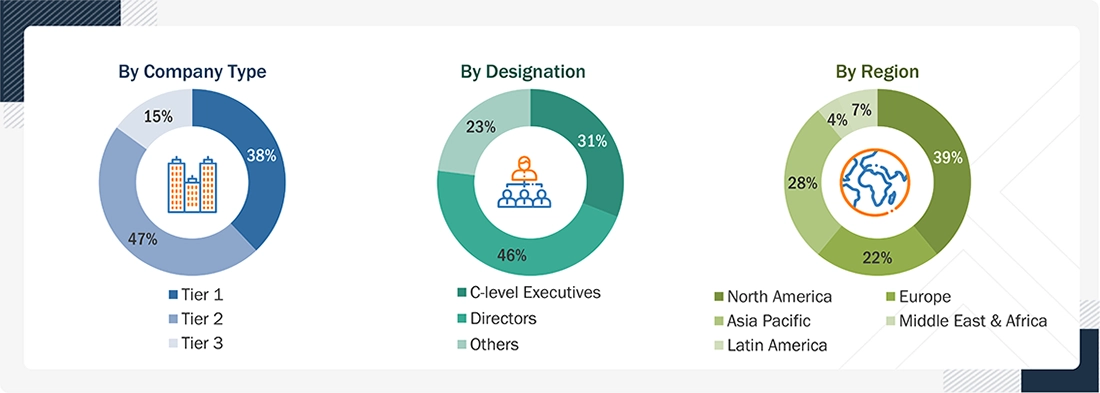
Note: Others include sales, marketing, and product managers; tier 1 companies’ revenues are more than USD 500 million, tier 2 companies’ revenues range between USD 500 and 100 million, and tier 3 companies’ revenues are equal to or less than USD 100 million.
Source: Industry Experts
To know about the assumptions considered for the study, download the pdf brochure
Market Size Estimation
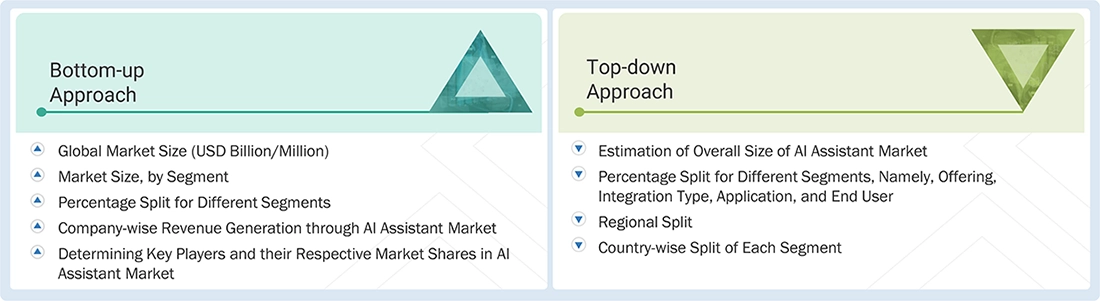
The top-down and bottom-up approaches were employed to estimate and forecast the AI assistant market, as well as its dependent submarkets. This multi-layered analysis was further reinforced through data triangulation, which incorporated primary and secondary research inputs. The market figures were also validated against the existing MarketsandMarkets repository for accuracy.
AI Assistant Market: Top-Down and Bottom-Up Approach
Data Triangulation
The market was divided into several segments and subsegments after determining the overall market size using the market size estimation processes described above. To complete the overall market engineering process and determine the exact statistics for each market segment and subsegment, data triangulation and market segmentation procedures were employed, wherever applicable. The overall market size was then used in the top-down approach to estimate the size of other individual markets by applying percentage splits to the market segmentation.
Market Definition
AI assistant refers to a set of artificial intelligence technologies that support users across digital tasks and workflows. These systems combine natural language interaction, contextual reasoning, memory, search, content generation, and task execution capabilities. AI assistants can support writing, research, coding, meetings, scheduling, customer interactions, data analysis, and knowledge retrieval. Enterprise assistants also connect with documents, emails, applications, calendars, repositories, and business systems for context-aware assistance. Microsoft defines Copilot as an AI assistant for work that combines language models with organizational data. OpenAI similarly positions ChatGPT Enterprise as an AI assistant supporting work while protecting organizational data and context. Together, these capabilities enable individuals and enterprises to improve productivity, automate repetitive activities, access information, and complete complex workflows more efficiently.
Key Stakeholders
- AI assistant software providers
- Third-party administrators
- Business analysts
- Cloud service providers
- Consulting service providers
- Enterprise end users
- Distributors and value-added resellers (VARs)
- Government agencies
- Independent software vendors (ISVs)
- Market research and consulting firms
- Support & maintenance service providers
- System integrators (SIs)/Migration service providers
- Technology providers
Report Objectives
- To define, describe, and forecast the AI assistant market by offering, integration type, application, end user, and region.
- To provide detailed information related to major factors (drivers, restraints, opportunities, and industry-specific challenges) influencing market growth
- To analyze opportunities in the market and provide details of the competitive landscape for stakeholders and market leaders
- To forecast the market size of segments with respect to five main regions: North America, Europe, Asia Pacific, the Middle East & Africa, and Latin America
- To analyze each submarket with respect to individual growth trends, prospects, and contributions to the overall AI assistant market
- To analyze competitive developments, such as partnerships, new product launches, mergers & acquisitions, in the AI assistant market
- To analyze the impact of macroeconomic factors on the AI assistant market across all regions
Available customizations:
Using the provided market data, MarketsandMarkets offers customizations tailored to the company’s specific needs. The following customization options are available for the report.
Product Analysis
- Product comparative analysis, which gives a detailed comparison of innovative products being offered by prominent vendors
Geographic Analysis
- Further breakdown of additional European countries by offering, integration type, application, and end user
- Further breakdown of additional Asia Pacific countries by offering, integration type, application, and end user
- Further breakdown of additional Middle Eastern & African countries by offering, integration type, application, and end user
- Further breakdown of additional Latin American countries by offering, integration type, application, and end user
Company Information
-
Detailed analysis and profiling of additional market players (up to five)
Get the Full AI Assistant Market Report
Full forecast, segment splits, and company analysis for all AI Assistant Market.
- UK AI Assistant Market
- GERMANY AI Assistant Market
- FRANCE AI Assistant Market
- ITALY AI Assistant Market
- SPAIN AI Assistant Market
- NETHERLANDS AI Assistant Market
- CHINA AI Assistant Market
- INDIA AI Assistant Market
- JAPAN AI Assistant Market
- SOUTH KOREA AI Assistant Market
- SINGAPORE AI Assistant Market
- SAUDI ARABIA AI Assistant Market
- UAE AI Assistant Market
- QATAR AI Assistant Market
- TURKEY AI Assistant Market
- SOUTH AFRICA AI Assistant Market
- BRAZIL AI Assistant Market
- MEXICO AI Assistant Market
- ARGENTINA AI Assistant Market
- US AI Assistant Market
- Rest Of Europe AI Assistant Market
- Rest Of Asia Pacific AI Assistant Market
- Rest Of Latin America AI Assistant Market
Need a Tailored Report?
Customize this report to your needs
Get 10% FREE Customization
Customize This Report
