
Japan Al-based Image Analysis Market (2025-2030)

The Japan Al-based Image Analysis Market was valued at $791.8 Million in 2025 and projected to reach to $2434.1 Million by 2030, representing a compound annual growth rate of 25.2%. Japan's AI-based Image Analysis Market is poised for substantial growth, expanding from $791.8 million in 2025 to $2,434.1 million by 2030.


| Market Size in | USD 26.32 MN |
| Market Forecast in | |
| CAGR | |
| Forecast Period | |
| Units Considered | Value (USD MN) |
Japan Al-based Image Analysis Market Trends and Insights
- Japan's advanced semiconductor ecosystem and manufacturing expertise position the country as a critical hub for AI-powered visual intelligence solutions.
- The market in Japan is driven by strong demand across automotive, robotics, healthcare, and industrial automation sectors, where precision image recognition is essential for operational efficiency and safety compliance. The 25.2% compound annual growth rate reflects Japan's commitment to digital transformation and Industry 4.0 initiatives.
- Japan's leadership in robotics and autonomous systems creates substantial opportunities for AI-based image analysis deployment.
- By 2030, Japan is expected to capture significant market share within the Asia Pacific region, supported by investments in AI infrastructure, government support for technology innovation, and the integration of image analysis into next-generation manufacturing and consumer electronics applications..
Key Market Statistics
- CAGR (2025-2030) 25.2% CAGR
- Market Size, 2025 ~USD 791.8 Million
- Forecast, 2030 ~USD 2434.1 Million
- Country Japan
Japan Al-based Image Analysis Market Overview
Market Valuation Growth :
Japan's AI-based Image Analysis Market is valued at $791.8 million in 2025, with a robust CAGR of 25.2%, significantly outpacing the global growth rate of 22.7%, demonstrating Japan's accelerating adoption of AI visual intelligence technologies.
Semiconductor Leadership :
Japan's advanced semiconductor ecosystem and manufacturing expertise provide a competitive advantage, positioning the country as a critical hub for developing and deploying AI-powered image analysis solutions across multiple industries.
Automotive & Robotics Dominance :
Strong demand from Japan's automotive and robotics sectors drives market expansion, leveraging AI-based image analysis for autonomous vehicles, quality control, and industrial automation applications.
Healthcare Integration :
Japan's aging population and advanced healthcare infrastructure create significant opportunities for AI-based image analysis in medical diagnostics, imaging analysis, and clinical decision support systems.
Japan Al-based Image Analysis Market Dynamics
- This 25.2% CAGR reflects Japan's strategic investments in AI technology, coupled with strong demand from automotive, robotics, and healthcare sectors.
- The country's established semiconductor manufacturing base and technological expertise create a favorable environment for innovation and market penetration. The market outlook remains highly positive as Japanese enterprises increasingly integrate AI-powered visual intelligence into manufacturing processes, autonomous systems, and medical applications.
- Government support for AI development, combined with private sector innovation, will continue to drive market expansion.
- Japan's focus on quality and precision manufacturing positions it as a leader in deploying sophisticated image analysis solutions across industrial and healthcare verticals..
Market Ecosystem
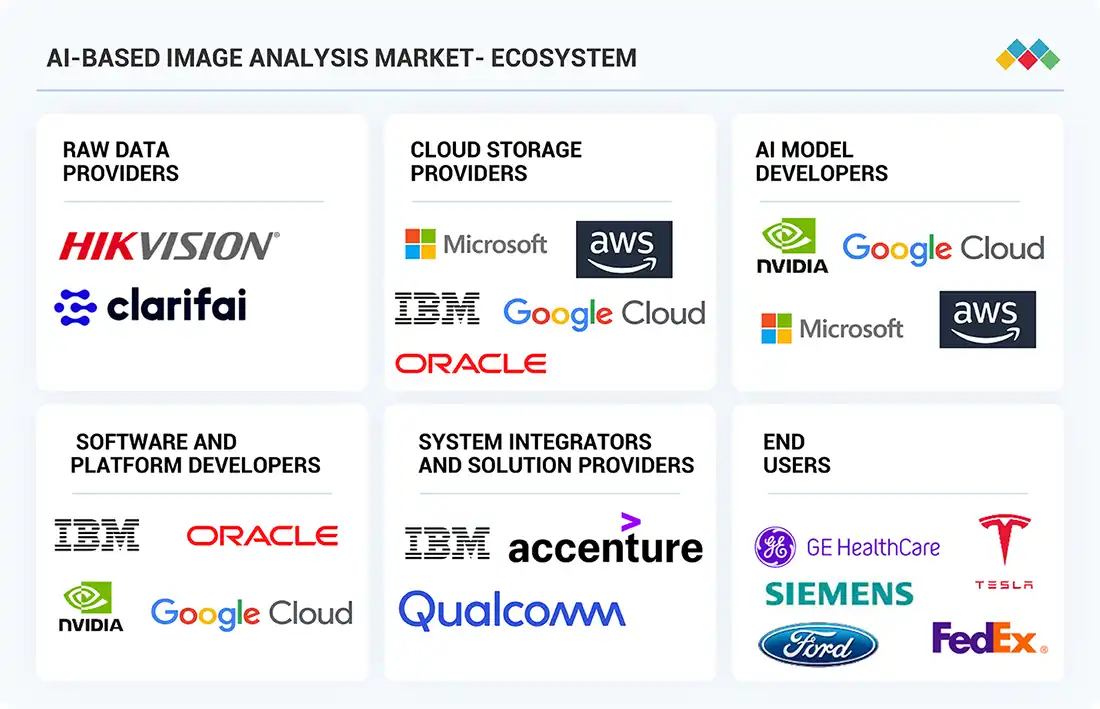
AI-based Image Analysis Market: COMMERCIAL USE CASES ACROSS INDUSTRIES
| COMPANY | USE CASE DESCRIPTION | BENEFITS |
|---|---|---|
 |
AI vision solutions and software for various industries, such as manufacturing, automotive & transportation, and telecommunication, among others | Image comparison & analysis suitable for vision AI developers, software partners, startups, and OEMs creating IVA applications and services |
 |
AI vision services for BFSI, healthcare, and manufacturing, among others | Analyze visual content in various ways, such as image analysis, spatial analysis, optical character recognition, and facial recognition based on inputs and user preferences |
 |
AI vision software for aerospace, retail, and healthcare, among others | Simplifies data labeling, model training, optimization, and speeds up data upload, model training, and inference workflows |
 |
AI vision software & services for manufacturing, retail, and healthcare, among others | Support real-time video data and store insights in vision warehouse for querying and metadata access |
 |
Amazon Rekognition for retail, healthcare, BFSI, and telecommunications, among others | Reduces costs and automates image recognition and video analysis using machine learning |
Logos and trademarks shown above are the property of their respective owners. Their use here is for informational and illustrative purposes only.
Related Ecosystem
Internet Of Things And M2M
- Sensors
- Cellular Network
- Digital Signal Processor (DSP)
- Global Positioning System (GPS)
- Image Sensors
- MITSUI ELECTRONICS INC
- MICROSOFT CORPORATION
- INTEL CORPORATION
- Amazon.com, Inc.
- Cisco Systems, Inc.
Key Takeaways
- Japan's AI-based Image Analysis Market is valued at $791.8 million in 2025 and will grow to $2,434.1 million by 2030, representing a 25.2% CAGR.
- Japan's advanced robotics and automotive sectors are primary drivers of AI image analysis adoption and market expansion.
- Japan's semiconductor manufacturing leadership provides a competitive advantage for developing and deploying AI vision technologies domestically.
- Government initiatives and Industry 4.0 investments in Japan are accelerating the integration of AI-based image analysis across industrial and consumer applications.
Al-based Image Analysis Market Report Scope
| Report Metric | Details |
|---|---|
| Base Year | 2025 |
| Fastest Growing Segment | CLOUD-BASED (Deployment Mode) |
| Forecast Period | 2025-2030 |
| Growth Rate | CAGR of 22.7% from 2025 to 2030 |
| Largest Segment | DEEP LEARNING (Technology) |
| Market Size Base Year (Billions) | ~USD 13.07 (2025) |
| Revenue Forecast (Billions) | ~USD 36.36 (2030) |
| Segments Covered | Technology, Deployment Mode, End-Use Industry |
Japan Al-based Image Analysis Market Report Segmentation
3 segment dimensions are covered across the global market.
By Technology
- Deep Learning
- Hybrid And Other AI Technologies
- Traditional Machine Learning
By Deployment Mode
- Cloud-Based
- On-Premises
By End-Use Industry
- Automotive & Transportation
- GCC Countries
- Healthcare
- Manufacturing
- Other End-Use Industries
- Rest Of Middle East
- Retail & E-Commerce
JAPAN: AI-BASED IMAGE ANALYSIS MARKET, BY END-USE INDUSTRY, 2025–2030
| Segment | 2025 | 2026 | 2027 | 2028 | 2029 | 2030 | CAGR (%) |
|---|---|---|---|---|---|---|---|
| AUTOMOTIVE & TRANSPORTATION | 187 | 233.5 | 292.8 | 368.5 | 465.5 | 589 | 25.8 |
| HEALTHCARE | 204.9 | 257.5 | 324.7 | 411 | 522.2 | 664.5 | 26.5 |
| MANUFACTURING | 251.7 | 311.6 | 387.3 | 483.3 | 605.4 | 759.4 | 24.7 |
| OTHER END-USE INDUSTRIES | 81.4 | 99 | 120.9 | 148.1 | 182 | 223.9 | 22.4 |
| RETAIL & E-COMMERCE | 66.8 | 82.3 | 101.9 | 126.6 | 157.9 | 197.2 | 24.2 |
| TOTAL | 791.8 | 983.9 | 1227.5 | 1537.4 | 1933.1 | 2434.1 | 25.2 |
Target Audience
- Japanese Technology Manufacturers : Semiconductor and electronics companies need detailed market insights to identify growth opportunities, optimize product development, and align manufacturing capabilities with rising demand for AI image analysis solutions.
- Automotive & Robotics OEMs : Japanese automotive and robotics manufacturers require market intelligence to integrate AI-based image analysis into autonomous vehicles and industrial automation systems, maintaining competitive advantage.
- Healthcare & Medical Device Companies : Medical device manufacturers and healthcare providers need market data to understand adoption trends and develop AI-powered diagnostic imaging solutions tailored to Japan's aging population needs.
- Investment & Private Equity Firms : Investors targeting Japan's technology sector need comprehensive market forecasts and growth projections to identify promising AI image analysis startups and acquisition opportunities.
- Government & Policy Makers : Japanese government agencies and policy makers require market research to inform AI technology initiatives, funding decisions, and regulatory frameworks supporting the country's AI leadership position.
Reasons to Buy this Report
- Market Size & Growth Validation : Obtain precise valuation data for Japan's AI-based Image Analysis Market with verified CAGR of 25.2%, enabling accurate financial forecasting and investment decision-making for the 2025-2030 period.
- Sector-Specific Opportunity Mapping : Identify high-growth segments within Japan's automotive, robotics, and healthcare industries where AI image analysis solutions are experiencing accelerated adoption and revenue generation.
- Competitive Landscape Intelligence : Understand Japan's semiconductor ecosystem advantages and manufacturing expertise to benchmark competitive positioning and identify partnership opportunities with local technology leaders.
- Regional Market Differentiation : Distinguish Japan's market dynamics from global trends with country-specific insights on regulatory environment, consumer preferences, and technology adoption patterns unique to the Japanese market.
- Strategic Investment Planning : Leverage comprehensive Japan market data to develop targeted go-to-market strategies, resource allocation plans, and expansion roadmaps for AI image analysis product launches and partnerships.
Frequently asked questions
What is the current market size of AI-based Image Analysis in Japan?
Japan's AI-based Image Analysis Market is valued at $791.8 million in 2025 and is projected to reach $2,434.1 million by 2030.
What is the expected growth rate for Japan's AI-based Image Analysis Market?
Japan's AI-based Image Analysis Market is expected to grow at a compound annual growth rate (CAGR) of 25.2% from 2025 to 2030.
Which industries in Japan are driving AI-based Image Analysis adoption?
Key industries in Japan driving adoption include automotive, robotics, healthcare, industrial automation, and consumer electronics manufacturing.
Why is Japan a significant market for AI-based Image Analysis?
Japan's advanced semiconductor ecosystem, robotics leadership, manufacturing expertise, and government support for digital transformation make it a critical hub for AI vision technology development and deployment.
What factors will influence Japan's AI-based Image Analysis Market growth through 2030?
Growth factors include Industry 4.0 initiatives, autonomous vehicle development, robotics innovation, healthcare digitalization, and increased investment in AI infrastructure across Japan.
RESEARCH METHODOLOGY
The study involved major activities in estimating the current size of the AI-based image analysis market. Exhaustive secondary research was done to collect information on the AI-based image analysis market. The next step was to validate these findings, assumptions, and sizing with industry experts across the value chain using primary research. Different approaches, such as top-down and bottom-up, were employed to estimate the total market size. After that, the market breakup and data triangulation procedures were used to estimate the market size of the segments and subsegments of the AI-based image analysis market.
Secondary Research
In the secondary research process, various secondary sources were referred to identify and collect information relevant to this study. Secondary sources included annual reports, press releases, and investor presentations of companies; white papers, certified publications, and articles from recognized authors; directories; and databases. Secondary research was mainly carried out to obtain critical information about the industry's supply chain, value chain, the total pool of key players, and market classification and segmentation according to industry trends, geographic markets, and key developments from both market- and technology-oriented perspectives. Secondary data has been gathered and analyzed to determine the overall market size, which has also been validated through primary research.
Primary Research
Extensive primary research was conducted after understanding and analyzing the current scenario of the AI-based image analysis market through secondary research. Several primary interviews were held with key opinion leaders from the demand and supply sides in four key regions: North America, Europe, Asia Pacific, and the rest of the world. Nearly 25% of the primary interviews were held with the demand side and 75% with the supply side. The primary data was gathered primarily through telephonic interviews, which were 80% of the total primary interviews. Surveys and e-mails were also utilized to gather data.
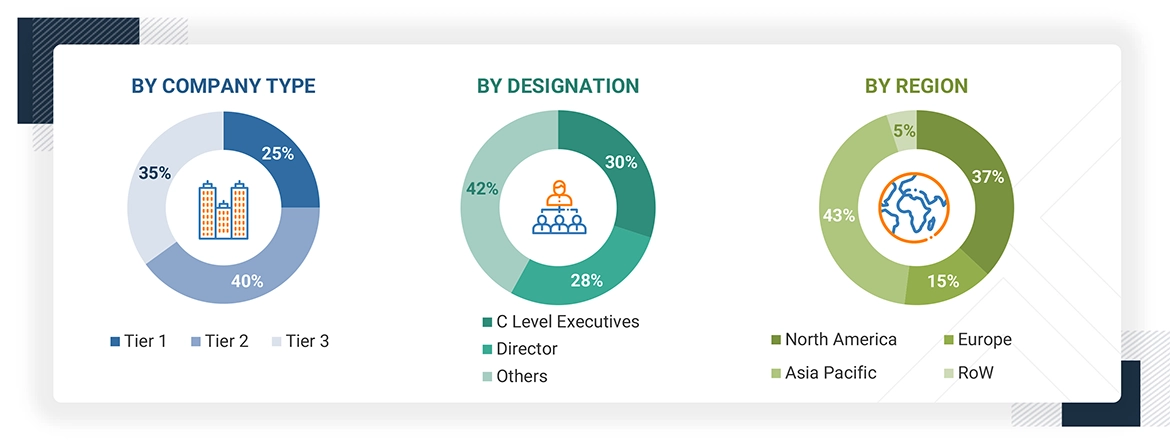
Note: The three tiers of companies are defined based on their total revenue as of 2024; tier 1: revenue more than or equal to USD 500 million, tier 2: revenue between USD 100 million and USD 500 million, and tier 3: revenue less than or equal to USD 100 million. Other designations include sales and marketing executives and researchers, as well as members of various AI-based image analysis organizations.
To know about the assumptions considered for the study, download the pdf brochure
Market Size Estimation
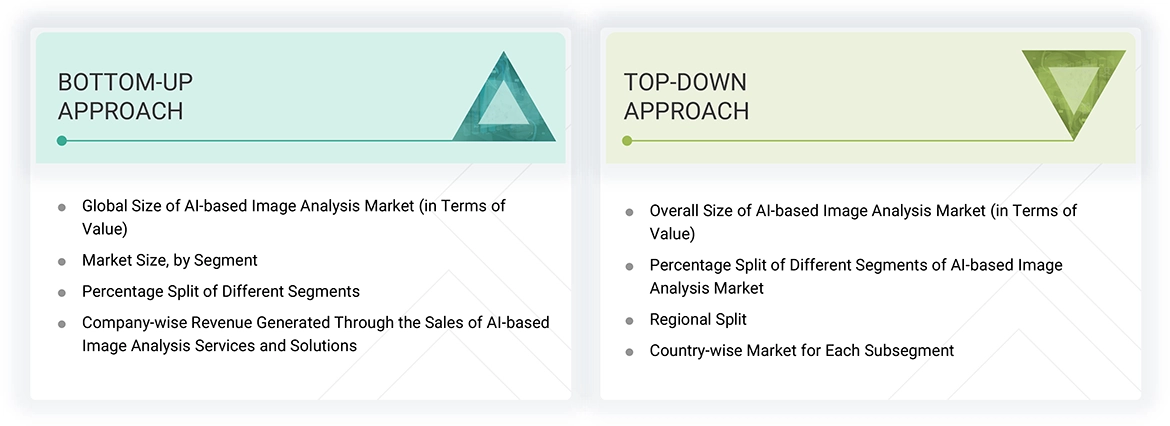
This report implemented both the top-down and bottom-up approaches to estimate and validate the size of the AI-based image analysis market and various other dependent submarkets. Secondary research identified key players in this market, and their market shares in the respective regions were determined through primary and secondary research.
This entire research methodology included the study of annual and financial reports of top companies, as well as interviews with experts (such as CEOs, VPs, directors, and marketing executives) for key insights (both quantitative and qualitative). All percentage shares, splits, and breakdowns were determined using secondary sources and verified through primary sources. All the possible parameters that affect the market covered in this research study were accounted for, viewed in detail, verified through primary research, and analyzed to obtain the final quantitative and qualitative data. This data was consolidated and supplemented with detailed inputs and analysis from MarketsandMarkets and presented in this report. The figures given below show the overall market size estimation process employed for this study.
Bottom-Up Approach
- The first step involved identifying companies that offer AI-based image analysis services and solutions, followed by mapping their products according to various parameters, such as technology, deployment mode, end-use industry, and region.
- The size of the AI-based image analysis market has been calculated based on the demand from various end-use industries and the revenue generated by companies within the AI-based image analysis ecosystem.
- To confirm the global market size, primary interviews have been conducted with a few major players in the AI-based image analysis market.
- The market size has also been cross-checked using secondary sources, which included the Institute of Electrical and Electronics Engineers (IEEE), Edge AI and Vision Alliance, International Society of Automation (ISA), Microsoft, General Data Protection Regulation (GDPR), and Partnership on AI. Other secondary sources comprised company websites, press releases, and research journals.
- To determine the compound annual growth rate (CAGR) of the AI vision market, both historical and projected market trends have been analyzed by examining the industry's penetration rate, as well as the supply and demand from various verticals.
- All estimates at each stage have been confirmed through discussions with key opinion leaders, including corporate executives (CXOs), directors, and sales heads, as well as industry experts from MarketsandMarkets.
- Several paid and unpaid information sources, such as annual reports, press releases, white papers, and databases, have also been reviewed during the research process.
Top-Down Approach
- To estimate the global size of the AI-based image analysis market, revenue information from leading manufacturers and providers of AI-based image analysis systems and solutions has been gathered and analyzed.
- The AI-based image analysis market is projected to exhibit a steady growth trend during the forecast period, reflecting its maturity and the presence of numerous well-established players across various sectors.
- The revenues, geographic footprint, key market sectors, and product offerings of all identified players in the AI-based image analysis market have been studied to estimate the percentage distribution of different market segments.
- Major players in each category in the AI-based image analysis market have been identified through secondary research, and information has been confirmed through brief discussions with industry experts.
- Several discussions with key opinion leaders from leading companies involved in developing AI-based image analysis systems have been conducted to validate the market segmentation based on technologies, deployment mode, end-use industry, and region.
- Geographic splits have been estimated using secondary sources, considering various factors, such as the number of companies offering AI-based image analysis solutions in a specific country or region and the types of AI-based image analysis services provided by these players.
AI-based Image Analysis Market : Top-Down and Bottom-Up Approach
Data Triangulation
After arriving at the overall size of the AI-based image analysis market from the estimation process explained above, the market was split into several segments and subsegments. The data triangulation and market breakdown procedures were employed (wherever applicable) to complete the overall market engineering process and arrive at the exact statistics for all segments and subsegments. The data was triangulated by studying various factors and trends from both the demand and supply sides. The size of the AI-based image analysis market was validated using both top-down and bottom-up approaches.
Market Definition
The AI-based image analysis refers to the use of machine learning (ML) and deep learning (DL), which automatically process and interpret data from visuals. It involves extracting information automatically to identify objects, recognize patterns, and make decisions based on visual data. It has a wide range of applications, including medical diagnosis, facial identification, and quality inspection, in the healthcare, manufacturing, automotive, retail, and agriculture sectors. This technique enables machines to recognize patterns, classify items, detect discrepancies, and make data-driven decisions based on visual input.
The AI-based Image Analysis Market is segmented based on sensor technology, implementation type, detection range, process stage, application, and region. The market comprises electrochemical, catalytic, metal-oxide-semiconductor (MOS), thermal conductivity, and micro-electromechanical systems (MEMS) by sensor technology. Each sensor type offers unique advantages, such as fast response time, high sensitivity, and cost-efficiency, making them suitable for various industrial requirements. In terms of implementation type, hydrogen detectors are available as fixed and portable systems, with fixed systems deployed in industrial plants and portable units used for field inspections or emergency response. The market is also categorized by detection range, including 0–1,000 ppm, 0–5,000 ppm, 0–20,000 ppm, and beyond 20,000 ppm, based on the safety threshold and detection needs of different environments. The hydrogen lifecycle is addressed across four process stages: generation, storage, transportation, and usage, each requiring real-time leak monitoring and safety assurance. Key application areas include oil & gas, automotive & transportation, chemicals, metals & mining, power & energy, and other sectors such as semiconductors, food & beverage, and medical industries. Each segment demands tailored detection technologies to meet compliance, safety, and operational efficiency standards.
Key Stakeholders
- Government and financial institutions and investment communities
- Raw data providers
- Cloud storage service providers
- AI-based image analysis system providers
- AI-based image analysis software providers
- Integrators and solution providers
- Professional service/solution providers
- Research institutions and organizations
Report Objectives
- To define, describe, segment, and forecast the AI-based image analysis market size, by technology, deployment mode, and end-use Industry, in terms of value
- To forecast the market size of four key regions, namely, North America, Europe, Asia Pacific, and the RoW, in terms of value
- To present detailed information regarding the major factors influencing the growth of the market (drivers, restraints, opportunities, and challenges)
- To provide an ecosystem analysis, investment and funding analysis, case study analysis, patent analysis, technology analysis, key conferences and events, ASP analysis, Porter's Five Forces analysis, key stakeholders and buying criteria, and regulations pertaining to the market
- To offer a comprehensive overview of the value chain of the AI-based image analysis market ecosystem
- To critically analyze micromarkets1 with respect to individual growth trends, prospects, and contributions to the total market
- To strategically profile the key players and comprehensively analyze their market shares and core competencies
- To assess the opportunities in the market for stakeholders and describe the competitive landscape of the market
- To analyze competitive developments in the market, such as collaborations, partnerships, product developments, and research and development (R&D)
Available customizations:
With the market data given, MarketsandMarkets offers customizations according to the company's specific needs. The following customization options are available for the report:
Company Information
- Detailed analysis and profiling of additional market players (up to 7)
Get the Full AI-based Image Analysis Market Report
Full forecast, segment splits, and company analysis for all AI-based Image Analysis Market.
- Canada Al-based Image Analysis Market
- Mexico Al-based Image Analysis Market
- US Al-based Image Analysis Market
- Germany Al-based Image Analysis Market
- UK Al-based Image Analysis Market
- France Al-based Image Analysis Market
- Italy Al-based Image Analysis Market
- Spain Al-based Image Analysis Market
- Belgium Al-based Image Analysis Market
- Netherlands Al-based Image Analysis Market
- China Al-based Image Analysis Market
- South Korea Al-based Image Analysis Market
- India Al-based Image Analysis Market
- Taiwan Al-based Image Analysis Market
- Australia Al-based Image Analysis Market
- Indonesia Al-based Image Analysis Market
- Rest Of Europe Al-based Image Analysis Market
- Rest Of Asia Pacific Al-based Image Analysis Market
- GCC Countries Al-based Image Analysis Market
- Rest Of Middle East Al-based Image Analysis Market
- Rest Of GCC Al-based Image Analysis Market
- UAE Al-based Image Analysis Market
Need a Tailored Report?
Customize this report to your needs
Get 10% FREE Customization
Customize This Report
