
Canada Al Driven Predictive Maintenance Market (2026-2031)

The Canada Al Driven Predictive Maintenance Market was valued at $117.41 Million in 2026 and projected to reach to $891.93 Million by 2031, representing a compound annual growth rate of 40.2%. Canada's AI-driven predictive maintenance market is positioned for exceptional growth through 2031, fueled by the semiconductor and electronics industry's digital transformation initiatives.


| Market Size in | USD 26.32 MN |
| Market Forecast in | |
| CAGR | |
| Forecast Period | |
| Units Considered | Value (USD MN) |
Canada Al Driven Predictive Maintenance Market Trends and Insights
- Valued at $117.41 million in 2026, Canada's market is forecast to grow substantially to $891.93 million by 2031, driven by increasing adoption of machine learning and IoT technologies across Canadian manufacturing facilities.
- Canada's strong technology infrastructure and investment in digital transformation are positioning the country as a key player in predictive maintenance innovation. The acceleration of Canada's market reflects broader North American trends toward operational efficiency and reduced downtime in semiconductor production.
- Canadian enterprises are increasingly deploying AI-powered solutions to optimize equipment performance and extend asset lifecycles.
- Canada's growth trajectory at 40.2% CAGR significantly outpaces global benchmarks, indicating robust demand for intelligent maintenance systems among Canadian industrial operators and semiconductor manufacturers..
Key Market Statistics
- CAGR (2026-2031) 40.2% CAGR
- Market Size, 2026 ~USD 117.41 Million
- Forecast, 2031 ~USD 891.93 Million
- Country Canada
Canada Al Driven Predictive Maintenance Market Overview
Explosive Growth Trajectory :
Canada's AI-driven predictive maintenance market is projected to grow from $117.41 million in 2026 to $891.93 million by 2031, representing a robust 40.2% CAGR, outpacing the global average of 39.5%.
IoT and Machine Learning Adoption :
Canadian semiconductor and electronics manufacturers are rapidly integrating IoT sensors and machine learning algorithms into their operations, reducing downtime and optimizing production efficiency across facilities.
Strong Technology Infrastructure :
Canada's advanced digital infrastructure, skilled workforce, and investment in emerging technologies create a favorable environment for AI-driven predictive maintenance solutions in the electronics sector.
Manufacturing Sector Modernization :
Canadian electronics and semiconductor manufacturers are prioritizing digital transformation initiatives, driving demand for predictive maintenance platforms that minimize unplanned equipment failures and operational costs.
Canada Al Driven Predictive Maintenance Market Dynamics
- Manufacturing facilities across Canada are increasingly deploying machine learning and IoT technologies to enhance operational efficiency, reduce maintenance costs, and minimize production downtime.
- The country's robust technology ecosystem and skilled workforce provide a competitive advantage for solution providers. The market expansion is supported by growing awareness of predictive maintenance benefits, including extended equipment lifespan and improved asset utilization.
- Canadian enterprises are investing heavily in AI capabilities to gain competitive advantages in global markets.
- Strategic partnerships between technology providers and local manufacturers are accelerating adoption rates, positioning Canada as a key growth market within North America's predictive maintenance landscape..
Market Ecosystem
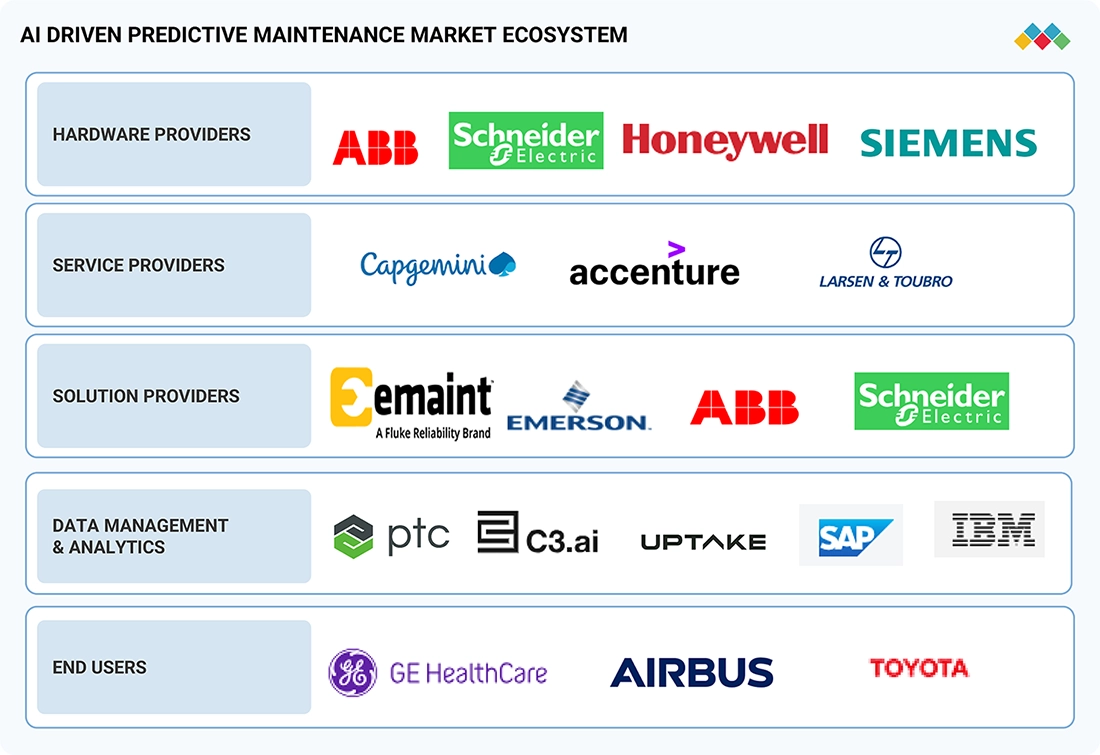
AI DRIVEN PREDICTIVE MAINTENANCE MARKET: COMMERCIAL USE CASES ACROSS INDUSTRIES
| COMPANY | USE CASE DESCRIPTION | BENEFITS |
|---|---|---|
 |
Siemens implemented an AI-driven predictive maintenance solution to address challenges such as unplanned downtime and inefficient manual inspections. The solution integrated real-time monitoring, predictive analytics, and digital twin technology to detect potential equipment failures early and optimize maintenance processes across manufacturing operations. | Improved equipment performance, reduced downtime, increased product quality, lower scrap rates, and enhanced overall operational efficiency through proactive and data-driven maintenance strategies |
 |
GE Aviation implemented an AI-driven predictive maintenance solution to address unexpected equipment failures in jet engine manufacturing. The system used machine learning models and IoT sensor data to monitor equipment performance, detect early signs of failure, and enable proactive maintenance, improving production efficiency and reducing operational disruptions. | Reduced unplanned downtime, improved equipment uptime, fewer emergency repairs, enhanced production efficiency, and lower operational costs through proactive and data-driven maintenance planning |
 |
IBM implemented an AI-enabled predictive maintenance solution using machine learning, IoT sensors, and enterprise asset management platforms to monitor industrial equipment. The system analyzes real-time data to detect early signs of failure, enabling proactive maintenance and reducing disruptions across industrial operations. | Reduced unplanned downtime, improved asset reliability, optimized maintenance schedules, lower maintenance costs, and enhanced operational efficiency through early fault detection and proactive maintenance actions |
Logos and trademarks shown above are the property of their respective owners. Their use here is for informational and illustrative purposes only.
Related Ecosystem
Electrical System And Components
- Natural Language Processing (NLP)
- Sensors
- Machine Learning
- Temperature Sensors
- Actuators
- ABB India Limited
- Siemens ag
- SCHNEIDER ELECTRIC SE
- Eaton Corporation plc
- General Electric Company
Key Takeaways
- Canada's AI-driven predictive maintenance market will expand from $117.41M (2026) to $891.93M (2031), representing a 40.2% CAGR.
- Canada's semiconductor and electronics sector is rapidly adopting AI-powered maintenance solutions to enhance operational efficiency.
- Canada's market growth rate exceeds global averages, reflecting strong regional demand and digital transformation initiatives.
- Canadian manufacturers are leveraging predictive maintenance to reduce equipment downtime and optimize asset performance across production lines.
Al Driven Predictive Maintenance Market Report Scope
| Report Metric | Details |
|---|---|
| Base Year | 2026 |
| Fastest Growing Segment | HEALTHCARE (Industry) |
| Forecast Period | 2026–2031 |
| Growth Rate | CAGR of 39.5% from 2026 to 2031 |
| Largest Segment | SOFTWARE (Offering) |
| Market Size Base Year (Billions) | ~USD 2.61 (2026) |
| Revenue Forecast (Billions) | ~USD 13.81 (2031) |
| Segments Covered | Offering, Solution, Deployment Mode, Organization Size, Technique, Industry |
Canada Al Driven Predictive Maintenance Market Report Segmentation
6 segment dimensions are covered across the global market.
By Offering
- Services
- Software
By Solution
- Integrated Solutions
- Standalone Solutions
By Deployment Mode
- Cloud-Based
- On-Premises
By Organization Size
- Large Enterprises
- Smes
By Technique
- Acoustic Monitoring
- Infrared Thermography
- Motor Circuit Analysis
- Oil Analysis
- Other Techniques
- Vibration Analysis
By Industry
- Aerospace & Defense
- Energy & Utilities
- Healthcare
- Manufacturing
- Mining & Heavy Equipment
- Other Industries
- Telecommunications
- Transportation
CANADA: AI-DRIVEN PREDICTIVE MAINTENANCE MARKET, BY INDUSTRY, 2026–2032
| Segment | 2026 | 2027 | 2028 | 2029 | 2030 | 2031 | 2032 | CAGR (%) |
|---|---|---|---|---|---|---|---|---|
| AEROSPACE & DEFENSE | 9.43 | 13.76 | 19.51 | 27.53 | 37.98 | 51.41 | 69.03 | 39.3 |
| ENERGY & UTILITIES | 23.03 | 34.56 | 50.36 | 72.99 | 103.43 | 143.75 | 198.18 | 43.1 |
| HEALTHCARE | 9.15 | 13.83 | 20.29 | 29.61 | 42.24 | 59.11 | 82.05 | 44.1 |
| MANUFACTURING | 32.83 | 47.7 | 67.38 | 94.75 | 130.37 | 176.12 | 236.17 | 38.9 |
| MINING & HEAVY EQUIPMENT | 15.49 | 22.3 | 31.2 | 43.48 | 59.28 | 79.34 | 105.43 | 37.7 |
| OTHER INDUSTRIES | 6.27 | 8.98 | 12.51 | 17.34 | 23.49 | 31.23 | 41.19 | 36.9 |
| TELECOMMUNICATIONS | 7.26 | 10.89 | 15.86 | 22.98 | 32.56 | 45.26 | 62.43 | 43.1 |
| TRANSPORTATION | 13.93 | 20.16 | 28.36 | 39.71 | 54.37 | 73.07 | 97.44 | 38.3 |
| TOTAL | 117.41 | 172.19 | 245.49 | 348.38 | 483.72 | 659.29 | 891.93 | 40.2 |
Target Audience
- Technology Solution Providers : AI and IoT software vendors need Canada-specific market data to develop localized solutions, identify customer segments, and establish distribution channels within the semiconductor and electronics industries.
- Manufacturing & Electronics Companies : Canadian semiconductor and electronics manufacturers require market insights to benchmark their predictive maintenance investments, evaluate vendor solutions, and optimize operational efficiency strategies.
- Investment & Private Equity Firms : Investors evaluating opportunities in Canada's AI and industrial tech sectors need quantified market data to assess growth potential, identify acquisition targets, and structure funding decisions.
- Consulting & Systems Integrators : Professional services firms advising Canadian manufacturers on digital transformation need market-specific data to validate recommendations, scope projects, and demonstrate ROI to clients.
- Government & Economic Development Agencies : Canadian economic development organizations and policymakers require market intelligence to support industry growth initiatives, attract investment, and develop technology sector strategies.
Key Companies in the Canada Al Driven Predictive Maintenance Market
| Company | HQ | Ownership | Strongest segments |
|---|---|---|---|
| IBM | United States | Public Company | Software (Hybrid Cloud & AI Platforms),Consulting (Strategy, Technology, Managed Services),Infrastructure (Servers, Storage, Hybrid Cloud Infrastructure Services), |
| SIEMENS | Germany | Public Company | Digital Industries (automation, controls, PLM and simulation software),Smart Infrastructure (electrification, buildings, grid solutions),Mobility (rail systems, automation, services, digital platforms), |
| SAP SE | Germany | Public Company | SAP S/4HANA and core ERP,SAP SuccessFactors and HR solutions,Spend management and Business Network, |
| GE VERNOVA | United States | Public Company | Power (Gas, Nuclear, Hydro, Steam),Wind (Onshore and Offshore),Electrification (Grid, Power Conversion, Solar and Storage, Software), |
| C3.AI | United States | Public Company | C3 Agentic AI Platform (incl. C3 AI Studio and runtime),C3 AI Applications (industry-specific enterprise AI apps),C3 Generative AI (agentic AI application library), |
| ABB | Switzerland | Public Company | Electrification,Motion,Automation, |
| SCHNEIDER ELECTRIC | France | Public Company | Low- and medium-voltage products and systems,Building management, power metering, and cooling,Industrial automation, drives, and control, |
| HITACHI, LTD. | Japan | Public Company | Digital Systems & Services,Green Energy & Mobility,Connective Industries, |
| L&T TECHNOLOGY SERVICES LIMITED | India | Public Company | Mobility,Sustainability,Tech, |
| KONE | Finland | Public Company | New equipment (elevators, escalators, automatic doors),Maintenance and repair services,Modernization and upgrades, |
| PTC | United States | Public Company | PLM (Windchill, Arena, FlexPLM),CAD and Product Development (Creo, Onshape, Mathcad),Industrial IoT and Connectivity (ThingWorx, Kepware, Kepware Edge, KEPServerEX), |
| EMERSON ELECTRIC CO. | United States | Public Company | Final Control,Measurement & Analytical,Discrete Automation, |
| HONEYWELL INTERNATIONAL INC. | United States | Public Company | Industrial Automation (controls, sensing, PPE, software and analytics),Building Automation (building control software, energy management, fire and security),Energy and Sustainability Solutions / UOP (licensed process tech, equipment, catalysts, software), |
IBM
IBM is a United States-based public company founded in 1911 with 264,300 employees. The company is a global technology and consulting enterprise.
SIEMENS
Siemens is a German public company founded in 1847 with 310,312 employees. The company operates as a diversified industrial conglomerate.
SAP SE
SAP SE is a German public company founded in 1972 with 111,038 employees. The company is a leading provider of enterprise resource planning software.
GE VERNOVA
GE Vernova is a United States-based public company founded in 2023 with 78,000 employees. The company operates in the energy and industrial sectors.
C3.AI
C3.AI is a United States-based public company founded in 2009 with 764 employees. The company provides artificial intelligence software solutions for enterprises.
ABB
ABB is a Swiss public company founded in 1883 with 111,900 employees. The company operates as a global leader in robotics, power, and automation technologies.
SCHNEIDER ELECTRIC
Schneider Electric is a French public company founded in 1836 with 158,122 employees. The company specializes in energy management and automation solutions.
HITACHI, LTD.
Hitachi, Ltd. is a Japanese public company founded in 1910 with 287,901 employees. The company operates as a diversified conglomerate across multiple industrial sectors.
L&T TECHNOLOGY SERVICES LIMITED
L&T Technology Services Limited is an Indian public company founded in 2012 with 21,039 employees. The company provides technology and engineering services.
KONE
KONE is a Finnish public company founded in 1908 with 64,907 employees. The company is a leading provider of elevators, escalators, and building solutions.
PTC
PTC is a United States-based public company founded in 1985 with 7,000 employees. The company provides software solutions for product lifecycle management and industrial innovation.
EMERSON ELECTRIC CO.
Emerson Electric Co. is a United States-based public company founded in 1890 with 71,000 employees. The company provides technology and engineering services for industrial and commercial customers.
HONEYWELL INTERNATIONAL INC.
Honeywell International Inc. is a United States-based public company founded in 1885 with 101,000 employees. The company operates as a diversified technology and manufacturing conglomerate.
Reasons to Buy this Report
- Market Size & Growth Validation : Quantified market data specific to Canada demonstrates the 40.2% CAGR opportunity, enabling confident investment decisions and resource allocation for market entry or expansion strategies.
- Competitive Intelligence : Understand Canada's market dynamics relative to global trends (39.5% CAGR), identifying competitive advantages and positioning opportunities within the semiconductor and electronics sector.
- Sector-Specific Insights : Gain detailed understanding of how Canadian semiconductor and electronics manufacturers are adopting AI-driven predictive maintenance, informing product development and go-to-market strategies.
- Investment & Partnership Opportunities : Identify high-growth segments and key stakeholders within Canada's predictive maintenance ecosystem to guide M&A, partnerships, and capital allocation decisions through 2031.
- Strategic Planning & Forecasting : Leverage Canada-specific market projections and infrastructure insights to develop accurate business plans, revenue forecasts, and long-term strategic roadmaps for the North American market.
Frequently asked questions
What is the current market size of AI-driven predictive maintenance in Canada?
Canada's AI-driven predictive maintenance market was valued at $117.41 million in 2026 and is projected to reach $891.93 million by 2031.
What is the expected growth rate for Canada's predictive maintenance market?
Canada's market is expected to grow at a compound annual growth rate (CAGR) of 40.2% between 2026 and 2031.
Which industries in Canada are driving predictive maintenance adoption?
Canada's semiconductor and electronics industries are the primary drivers of AI-driven predictive maintenance adoption, supported by manufacturing and industrial sectors.
Why is Canada's predictive maintenance market growing faster than the global average?
Canada's 40.2% CAGR exceeds the global 39.5% CAGR due to strong digital transformation initiatives, robust technology infrastructure, and high investment in operational efficiency among Canadian enterprises.
What factors are contributing to market expansion in Canada?
Key drivers include increasing IoT adoption, machine learning integration, demand for reduced downtime, asset lifecycle optimization, and Canadian manufacturers' focus on competitive advantage through digital innovation.
RESEARCH METHODOLOGY
The research process for this technical, market-oriented, and commercial study of the AI-driven predictive maintenance market included the systematic gathering, recording, and analysis of data about companies operating in the market. It involved the extensive use of secondary sources, directories, and databases (Factiva, OANDA) to identify and collect relevant information. In-depth interviews were conducted with various primary respondents, including experts from core and related industries and preferred manufacturers, to obtain and verify critical qualitative and quantitative information as well as to assess the growth prospects of the market. Key players in the market were identified through secondary research, and their market rankings were determined through primary and secondary research. This included studying annual reports of top players and interviewing key industry experts, such as CEOs, directors, and marketing executives.
Secondary Research
In the secondary research process, various sources have been consulted to identify and collect information relevant to this study. Secondary sources include annual reports, press releases, and investor presentations of companies; white papers, certified publications, and articles from recognized authors; directories; and databases. Secondary research has mainly been conducted to obtain key information about the industry's supply chain and value chain; a comprehensive list of key players; and market segmentation by industry trends, geographic markets, and key developments from market- and technology-oriented perspectives.
Primary Research
In the primary research process, primary sources from the supply and demand sides have been interviewed to obtain qualitative and quantitative information for this report. Primary sources from the supply side include experts, such as CEOs, vice presidents, marketing directors, technology and innovation directors, subject-matter experts, consultants, and related key executives from major companies and organizations operating in the AI-driven predictive maintenance market.
After the complete market engineering process (market statistics calculations, market breakdown, market size estimations, market forecasting, and data triangulation), extensive primary research has been conducted to gather information and verify and validate the critical market numbers.
Several primary interviews have been conducted with experts from the demand and supply sides across four major regions: North America, Europe, Asia Pacific, and RoW. Approximately 25% of the primary interviews were conducted with the demand side and 75% with the supply side. This primary data has been collected through questionnaires, emails, and telephonic interviews.
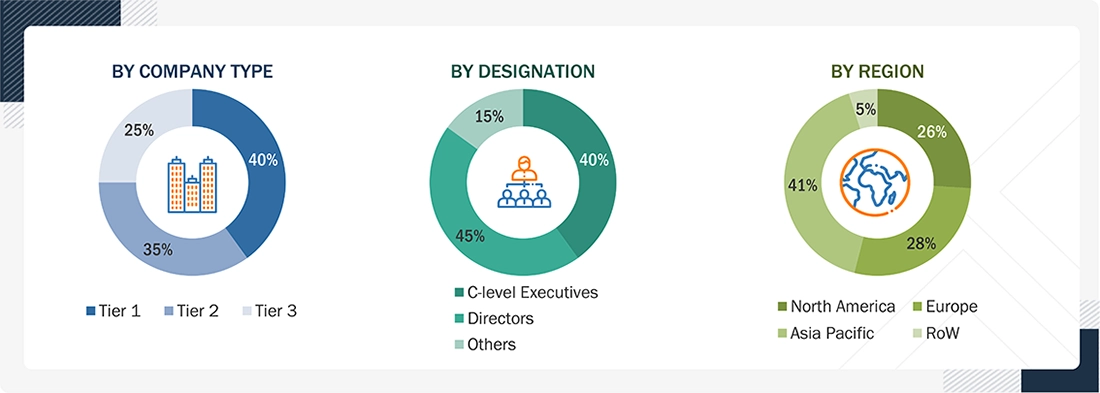
Notes: Other designations include technology heads, media analysts, sales managers, marketing managers, and product managers.
The three tiers of the companies are based on their total revenue as of 2025: Tier 1: >USD 1 billion; Tier 2: USD 500 million–1 billion; and Tier 3: <USD 500 million.
To know about the assumptions considered for the study, download the pdf brochure
Market Size Estimation
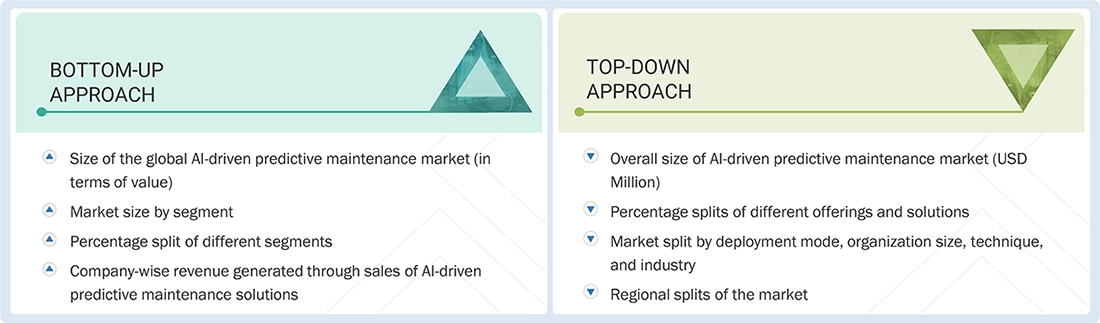
The bottom-up and top-down approaches were used to estimate and validate the total size of the automotive radar market. This method was also used extensively to estimate the size of various subsegments in the market. The research methodology used to estimate the market size includes the following:
BOTTOM-UP APPROACH
- More than 25 companies were identified, and their offerings were mapped based on their offering, solution, deployment mode, organization size, technique, industry, and region.
- The global market size was derived through the data sanity method. The revenues of software providers were analyzed from their company websites, including annual reports and press releases, and summed to derive the overall market size.
- For each company, a percentage was assigned to the overall revenue or segment revenue, wherever applicable, to derive the revenues from the AI-driven predictive maintenance segment.
- Each company’s percentage was assigned after analyzing various factors, including its product offerings, geographical presence, R&D expenditures and initiatives, and recent developments/strategies adopted for growth in the market.
- For the CAGR, the market trend analysis was carried out by understanding the industry penetration rate and the demand and supply of offerings in different sectors.
- Estimates at every level were verified and cross-checked by discussing them with key opinion leaders, including sales heads, directors, operation managers, and market domain experts of MarketsandMarkets.
- Various paid and unpaid information sources, such as annual reports, press releases, white papers, and databases, were studied.
TOP-DOWN APPROACH
- Focusing initially on the top-line investments and expenditures being made in the ecosystem of AI-driven predictive maintenance
- Splitting the market based on offering, solution, deployment mode, organization size, technique, and industry, and listing key developments in key market areas
- Identifying all major players by offering, solution, deployment mode, and their penetration in various end-user segments through secondary research and verifying the information with industry experts
- Analyzing revenues, product mix, geographic presence, and key applications for which all identified players offer AI-driven predictive maintenance to estimate and arrive at percentage splits for all key segments
- Discussing these splits with the industry experts to validate the information and identify key growth pockets across all key segments
- Breaking down the global market based on verified splits and key growth pockets across all segments
Data Triangulation
After arriving at the overall market size, the market was split into several segments and subsegments using the market size estimation processes as explained above. Data triangulation and market breakdown procedures were employed to complete the market engineering process and determine the exact statistics for each market segment and subsegment. The data was triangulated by examining various factors and trends on both the demand and supply sides of the market.
Market Definition
AI-driven predictive maintenance refers to the global market for software platforms and associated services that utilize artificial intelligence to predict equipment failures and optimize asset performance. These solutions leverage machine learning, advanced analytics, and operational data, often sourced from connected assets, to enable early fault detection, condition monitoring, and data-driven maintenance decisions. By improving maintenance accuracy and reducing unplanned downtime, AI-driven predictive maintenance helps organizations lower operational costs and enhance asset reliability. The market scope includes software and services, while excluding underlying hardware components such as sensors and connectivity infrastructure.
Key Stakeholders
- Predictive maintenance service providers
- Predictive maintenance vendors
- System integrators
- Value-added resellers
- IoT platform providers
- AI solution developers
- Information Technology (IT) service providers
Report Objectives
- To describe and forecast the AI-driven predictive maintenance market by offering, solution, deployment mode, organization size, technique, industry, and region, in terms of value
- To forecast the market size for various segments across the main regions: North America, Europe, Asia Pacific, and the Rest of the World
- To provide industry-specific information regarding the major drivers, restraints, opportunities, and challenges influencing the market’s growth
- To study the complete supply chain and related industry segments for the AI-driven predictive maintenance market
- To identify key AI-driven predictive maintenance providers and analyze their product offerings in the market
- To strategically analyze the micromarkets concerning individual growth trends, prospects, and contributions to the total market
- To analyze trends/disruptions impacting customer business; interconnected markets and cross-sector opportunities; strategic moves by tier-1/2/3 players; pricing analysis; patents analysis; trade analysis (export and import scenario); Porter's five forces analysis; macroeconomic indicators; case studies; investment and funding scenario; decision-making process; buyer stakeholders and buying evaluation criteria; adoption barriers & internal challenges; unmet needs from various industries; technology analysis; technology roadmap; ecosystem analysis; regional regulations and compliance; impact of 2025 US tariffs; and key conferences and events related to the market
- To analyze opportunities in the market for various stakeholders by identifying the high-growth segments of the market
- To strategically profile the key players and comprehensively analyze their market position regarding ranking and core competencies, along with detailing the competitive landscape for the market leaders
- To analyze competitive developments, such as product launches/enhancements, partnerships, and research and development activities carried out by players in the market
Available customizations:
With the given market data, MarketsandMarkets offers customizations according to the company’s specific needs. The following customization options are available for the report:
COMPANY INFORMATION
- Detailed analysis and profiling of additional market players (up to 5)
Get the Full AI Driven Predictive Maintenance Market Report
Full forecast, segment splits, and company analysis for all AI Driven Predictive Maintenance Market.
- US Al Driven Predictive Maintenance Market
- Mexico Al Driven Predictive Maintenance Market
- Germany Al Driven Predictive Maintenance Market
- UK Al Driven Predictive Maintenance Market
- France Al Driven Predictive Maintenance Market
- Italy Al Driven Predictive Maintenance Market
- China Al Driven Predictive Maintenance Market
- Japan Al Driven Predictive Maintenance Market
- South Korea Al Driven Predictive Maintenance Market
- India Al Driven Predictive Maintenance Market
- Rest Of Europe Al Driven Predictive Maintenance Market
- Rest Of Asia Pacific Al Driven Predictive Maintenance Market
Need a Tailored Report?
Customize this report to your needs
Get 10% FREE Customization
Customize This Report
