
North America AI EDA Market (2026-2031)

The North America AI EDA Market was valued at $1782.8 Million in 2026 and projected to reach to $6418.7 Million by 2031, representing a compound annual growth rate of 23.8%. North America's AI EDA market is poised for exceptional growth, driven by the region's leadership in semiconductor manufacturing and design innovation.


| Market Size in | USD 26.32 MN |
| Market Forecast in | |
| CAGR | |
| Forecast Period | |
| Units Considered | Value (USD MN) |
North America AI EDA Market Trends and Insights
- The region is projected to experience robust growth, reaching $6,418.7 million by 2031, driven by accelerating semiconductor design innovation and increased adoption of AI-powered electronic design automation tools.
- North America's leadership in semiconductor manufacturing and design, combined with substantial R&D investments from major technology companies, positions the region as a critical growth engine for AI EDA solutions. The North America AI EDA market's 23.8% compound annual growth rate reflects strong demand from both established semiconductor firms and emerging fabless design companies.
- North America benefits from a mature ecosystem of EDA vendors, design service providers, and semiconductor manufacturers who are rapidly integrating artificial intelligence into their workflows.
- Between 2026 and 2031, North America is expected to capture increasing market share as enterprises prioritize AI-driven design automation to accelerate time-to-market and improve chip performance. Key factors driving North America's expansion include rising complexity in chip design, the proliferation of AI applications requiring specialized semiconductors, and substantial venture capital funding for AI EDA startups.
- North America's regulatory environment and intellectual property protections further strengthen the region's attractiveness for innovation in AI-enabled design tools..
Key Market Statistics
- CAGR (2026-2031) 23.8% CAGR
- Market Size, 2026 ~USD 1782.8 Million
- Forecast, 2031 ~USD 6418.7 Million
- Geography North America
North America AI EDA Market Overview
Market Leadership Position :
North America holds a commanding 26.8% share of the global AI EDA market, with an estimated size of $1,782.8 million in 2026, reflecting the region's dominance in semiconductor design and innovation.
Accelerated Growth Trajectory :
The North American AI EDA market is projected to grow at a CAGR of 23.8% from 2026 to 2031, reaching $6,418.7 million, outpacing many global regions due to sustained R&D investments and digital transformation initiatives.
US Market Dominance :
The United States represents the largest segment within North America at $975.6 million in 2026, driven by major semiconductor manufacturers, fabless design companies, and leading EDA tool providers headquartered in Silicon Valley and beyond.
Regional Innovation Ecosystem :
North America's robust ecosystem of semiconductor companies, AI startups, and established EDA vendors creates a competitive advantage, fostering rapid adoption of AI-powered design automation tools and methodologies.
North America AI EDA Market Dynamics
- The increasing complexity of chip architectures, coupled with the critical need to accelerate time-to-market, is propelling demand for AI-powered electronic design automation solutions across the region.
- Major semiconductor companies and fabless designers are investing heavily in AI EDA tools to optimize design efficiency and reduce development cycles. The forecast period through 2031 will witness sustained expansion as North American enterprises leverage AI capabilities to address advanced node challenges, power consumption optimization, and design verification.
- Strategic partnerships between semiconductor firms and EDA vendors, combined with growing venture capital funding for AI-driven design solutions, will further accelerate market penetration.
- The region's commitment to semiconductor self-sufficiency and advanced manufacturing will continue to fuel demand for cutting-edge AI EDA technologies..
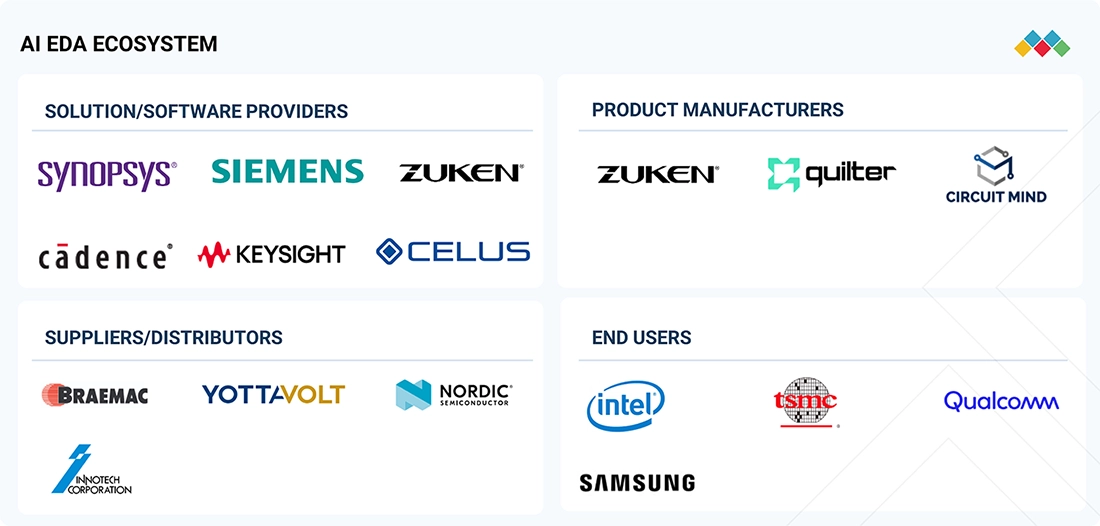
Market Ecosystem
AI EDA MARKET: COMMERCIAL USE CASES ACROSS INDUSTRIES
| COMPANY | USE CASE DESCRIPTION | BENEFITS |
|---|---|---|
 |
Synopsys, Inc. (US) deployed its AI-driven EDA solution to support analog design migration for SAMSUNG (South Korea). The solution automated schematic migration, layout optimization, and design mapping across technology nodes. This reduced manual work, improved convergence across process conditions, and shortened design cycles for advanced analog integrated circuit designs. | Reduced design time from days to hours | Improved productivity | Lowered manual effort | Verified performance across multiple process conditions in advanced analog design migration |
 |
Cadence Design Systems, Inc. (US) provided its AI-enabled EDA solution, Cerebrus, to Imagination Technologies Group plc (UK) through a Software-as-a-Service (SaaS) model. The solution used reinforcement learning to explore thousands of design options, optimize tool settings, and improve power, performance, and area outcomes for advanced semiconductor designs. | Improved power, performance, and area results | Reduced design turnaround time | Lowered infrastructure complexity | Increased engineering productivity through scalable cloud-based AI-driven design optimization |
|
|
Synopsys, Inc. (US) delivered an integrated AI driven EDA platform to support SAMSUNG (South Korea) in advanced multi-die and sub-5 nanometer designs. The solution automated optimization, routing, and placement, improved power, performance, and area outcomes, and supported faster and lower-risk system-on-chip development. | Reduced design turnaround time | Improved power, performance, and area results | Enhanced design quality | Lowered integration risk for advanced multi-die and leading-edge semiconductor designs |
Logos and trademarks shown above are the property of their respective owners. Their use here is for informational and illustrative purposes only.
Related Ecosystem
Electronics System And Components
- Sensors
- Temperature Sensors
- Pressure Sensors
- Actuators
- Image Sensors
- Lenovo
- Samsung
- Texas Instruments Incorporated
- HONEYWELL INTERNATIONAL INC.
- Teledyne Technologies Incorporated
Key Takeaways
- North America's AI EDA market is valued at $1,782.8 million in 2026 and projected to reach $6,418.7 million by 2031, representing a 23.8% CAGR.
- North America leads in semiconductor design innovation, with major technology companies and fabless designers rapidly adopting AI-powered EDA tools.
- Strong venture capital investment and a mature EDA vendor ecosystem position North America as the primary driver of AI EDA market expansion.
- Rising chip design complexity and demand for specialized AI semiconductors are accelerating North America's adoption of intelligent design automation solutions.
AI EDA Market Report Scope
| Report Metric | Details |
|---|---|
| Base Year | 2026 |
| Fastest Growing Segment | CLOUD-BASED (Deployment Mode) |
| Forecast Period | 2026–2031 |
| Growth Rate | CAGR of 24.4% from 2026 to 2031 |
| Largest Segment | MICROPROCESSORS & CONTROLLERS (Application) |
| Market Size Base Year (Billions) | ~USD 4.28 (2026) |
| Revenue Forecast (Billions) | ~USD 12.74 (2031) |
| Segments Covered | Product Category, Deployment Mode, Application, End Use |
North America AI EDA Market Report Segmentation
4 segment dimensions are covered across the global market.
By Product Category
- Computer-Aided Engineering (Cae)
- Integrated Circuit (Ic) Physical Design Verification
- Printed Circuit Board (Pcb) & Multi-Chip Module (Mcm)
- Services
By Deployment Mode
- Cloud-Based
- Hybrid
- On-Premises
By Application
- Memory Management Units
- Microprocessors & Controllers
- Other Applications
By End Use
- Aerospace & Defense
- Automotive
- Consumer Electronics
- Healthcare
- Industrial
- Other End Uses
- Telecom & Data Centers
Target Audience
- EDA Software Vendors : Leverage North America market intelligence to refine product strategies, identify expansion opportunities, and benchmark performance against competitors in the region's high-value semiconductor design market.
- Semiconductor Manufacturers & Fabless Companies : Utilize regional market data to evaluate AI EDA tool investments, assess competitive positioning, and make informed decisions on design automation technology adoption for advanced chip development.
- Investment & Private Equity Firms : Access comprehensive North America market analysis to identify acquisition targets, evaluate portfolio company growth potential, and assess investment opportunities in the high-growth AI EDA sector.
- Technology Consultants & System Integrators : Gain regional insights to advise clients on AI EDA implementation strategies, vendor selection, and technology roadmaps aligned with North American semiconductor industry trends and requirements.
- Government & Policy Organizations : Understand North America's AI EDA market dynamics to inform semiconductor policy, funding initiatives, and strategic programs supporting domestic chip design innovation and manufacturing competitiveness.
Key Companies in the North America AI EDA Market
| Company | HQ | Ownership | Strongest segments |
|---|---|---|---|
| SYNOPSYS, INC. | United States | Public Company | Digital and Custom IC Design,Verification and Hardware-Assisted Verification,Design IP (logic libraries, embedded memories, processors, security, SoC IP), |
| CADENCE DESIGN SYSTEMS, INC. | United States | Public Company | Digital and Custom IC Design (Innovus, Virtuoso, related signoff),Verification, Emulation, and Prototyping (Jasper, Xcelium, Verisium, Palladium, Protium),System Design and Analysis (Allegro X, Sigrity X, Clarity, Celsius, Fidelity, Integrity 3D-IC, Optimality, Reality, Millennium), |
| SIEMENS | Germany | Public Company | Digital Industries (automation, controls, industrial software),Smart Infrastructure (electrification, building technologies, grid),Mobility (rolling stock, rail automation, services), |
| KEYSIGHT TECHNOLOGIES | United States | Public Company | Communications Solutions Group (wireless, network, aerospace-defense test),Electronic Industrial Solutions Group (automotive, energy, semiconductor, general electronics),Services and Support (KeysightCare, calibration, test-as-a-service, consulting), |
| ZUKEN | Japan | Public Company | CR-8000 advanced PCB design,E3.series electrical, harness, and cabinet design,Data and workflow management (DS-2 and related), |
| QUILTER AI | United Kingdom | Public Company | High Net Worth discretionary investment management,Affluent investment platform (Quilter Investment Platform),Investment solutions (Quilter Investor funds), |
| ADVANCED MICRO DEVICES, INC. | United States | Public Company | Data Center (EPYC, Instinct, Pensando, Alveo),Client (Ryzen, Ryzen AI, Athlon),Gaming (Radeon, semi-custom console SoCs), |
| SILVACO GROUP, INC. | United States | Public Company | TCAD software,EDA software (SPICE, extraction, OPC, standard cell tools),Semiconductor IP (SIP) and compilers, |
| FLUX | United States | Public Company | Lift truck lithium-ion packs,Airport ground support equipment solutions,Chargers (onboard and wall-mounted), |
SYNOPSYS, INC.
Synopsys, Inc. is a United States-based public company founded in 1986 that employs 28,000 people. The company operates in the semiconductor and electronic design automation industry.
CADENCE DESIGN SYSTEMS, INC.
Cadence Design Systems, Inc. is a United States-based public company founded in 1987 with 13,800 employees. The company provides software and hardware design solutions for the semiconductor and electronics industries.
SIEMENS
Siemens is a German multinational public company founded in 1847 with 310,312 employees. The company operates across multiple sectors including industrial automation, digitalization, and infrastructure.
KEYSIGHT TECHNOLOGIES
Keysight Technologies is a United States-based public company founded in 1939 with 16,500 employees. The company provides electronic measurement and testing solutions for communications, aerospace, and industrial markets.
ZUKEN
Zuken is a Japanese public company founded in 1976 with 1,656 employees. The company specializes in electronic design automation and manufacturing solutions.
QUILTER AI
Quilter AI is a United Kingdom-based public company founded in 2007 with 3,207 employees. The company provides artificial intelligence and technology solutions.
ADVANCED MICRO DEVICES, INC.
Advanced Micro Devices, Inc. is a United States-based public company founded in 1969 with 31,000 employees. The company designs and manufactures semiconductor products and processors.
SILVACO GROUP, INC.
Silvaco Group, Inc. is a United States-based public company founded in 1984 with 406 employees. The company provides electronic design automation and semiconductor simulation software.
FLUX
Flux is a United States-based public company with 101 employees. The company operates in the technology sector.
Countries within North America - compare and drill down
| Country | 2025 size (native) |
|---|---|
| US | USD 975.6 Million |
| Canada | USD 722.8 Million |
| Mexico | USD 599.4 Million |
Country market size visualization
Reasons to Buy this Report
- Regional Market Sizing & Forecasts : Obtain precise market size data for North America ($1,782.8M in 2026) and detailed country-level breakdowns for the US, Canada, and Mexico to support strategic planning and investment decisions.
- Competitive Landscape Analysis : Understand the competitive positioning of major EDA vendors and semiconductor companies operating in North America, including market share dynamics and strategic initiatives specific to the region.
- Growth Driver Identification : Identify key growth catalysts unique to North America, including semiconductor manufacturing expansion, AI adoption rates, and regulatory factors driving the 23.8% CAGR through 2031.
- Investment & Expansion Opportunities : Discover high-potential market segments and geographic pockets within North America for product launches, partnerships, and M&A activities in the rapidly expanding AI EDA sector.
- Technology Trend Insights : Access detailed analysis of emerging AI EDA technologies, adoption patterns, and innovation trends specific to North American semiconductor design practices and industry requirements.
Frequently asked questions
What is the current size of the North America AI EDA market?
The North America AI EDA market is estimated at $1,782.8 million in 2026 and is projected to grow to $6,418.7 million by 2031.
What is the growth rate for AI EDA in North America?
North America's AI EDA market is expected to grow at a compound annual growth rate (CAGR) of 23.8% from 2026 to 2031.
Why is North America a key market for AI EDA solutions?
North America leads in semiconductor design innovation, has a mature EDA vendor ecosystem, substantial R&D investments, and strong venture capital support for AI EDA startups.
What factors are driving growth in North America's AI EDA market?
Key drivers include increasing chip design complexity, demand for AI-specialized semiconductors, accelerated time-to-market requirements, and significant technology company investments in AI-powered design automation.
Which industries in North America are adopting AI EDA tools most rapidly?
Semiconductor manufacturers, fabless design companies, and technology firms developing AI chips and advanced processors are leading adoption of AI EDA solutions in North America.
RESEARCH METHODOLOGY
The research process for this technical, market-oriented, and commercial study of the AI EDA market included the systematic gathering, recording, and analysis of data about companies operating in the market. It involved the extensive use of secondary sources, directories, and databases (Factiva and Oanda) to identify and collect relevant information. In-depth interviews were conducted with various primary respondents, including experts from core and related industries and preferred manufacturers, to obtain and verify critical qualitative and quantitative information as well as assess the growth prospects of the market. Key players were identified through secondary research, and their market rankings were determined through primary and secondary research. This included studying annual reports of top players and interviewing key industry experts, such as CEOs, directors, and marketing executives.
Secondary Research
In the secondary research process, various secondary sources have been referred to for identifying and collecting information relevant to this study. Secondary sources include annual reports, press releases, and investor presentations of companies; white papers, certified publications, and articles from recognized authors; directories; and databases. Secondary research has been mainly conducted to obtain key information about the supply chain and value chain of the industry, a total pool of key players, segmentation of the market according to the industry trends, geographic markets, and key developments from market- and technology-oriented perspectives.
Primary Research
In the primary research process, primary sources from the supply and demand sides have been interviewed to obtain qualitative and quantitative information for this report. Primary sources from the supply side include experts, such as CEOs, vice presidents, marketing directors, technology and innovation directors, subject-matter experts, consultants, and related key executives from major companies and organizations operating in the AI EDA market.
After the complete market engineering process (market statistics calculations, market breakdown, market size estimations, market forecasting, and data triangulation), extensive primary research has been conducted to gather information and verify and validate the critical market numbers.
Several primary interviews have been conducted with experts from the demand and supply sides across four major regions—North America, Europe, Asia Pacific, and RoW. Approximately 25% of the primary interviews have been conducted with the demand side and 75% with the supply side. This primary data has been collected through questionnaires, emails, and telephonic interviews.
BREAKDOWN OF PRIMARY INTERVIEW PARTICIPANTS
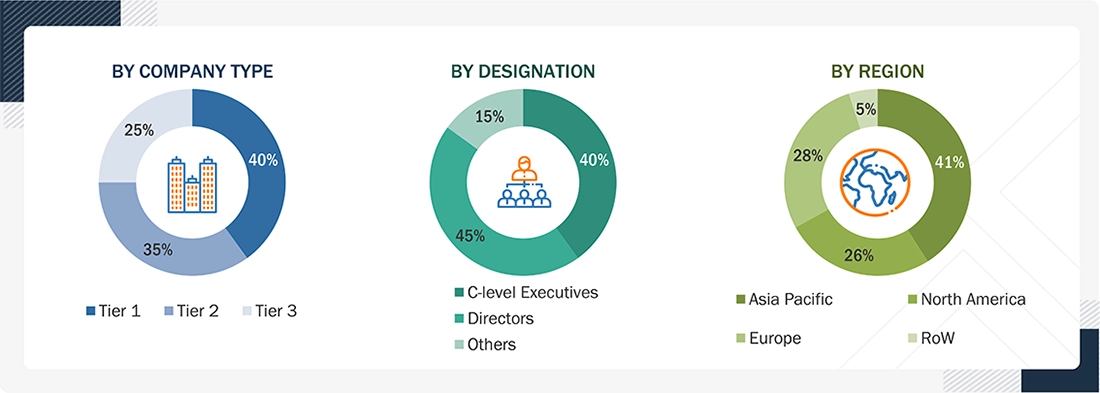
Notes: Tier 1 companies include market players with revenues above USD 500 million; tier 2 companies earn revenues between USD 100 million and USD 500 million; and tier 3 companies earn revenues up to USD 100 million.
Other designations include sales, marketing, and product managers.
To know about the assumptions considered for the study, download the pdf brochure
Market Size Estimation
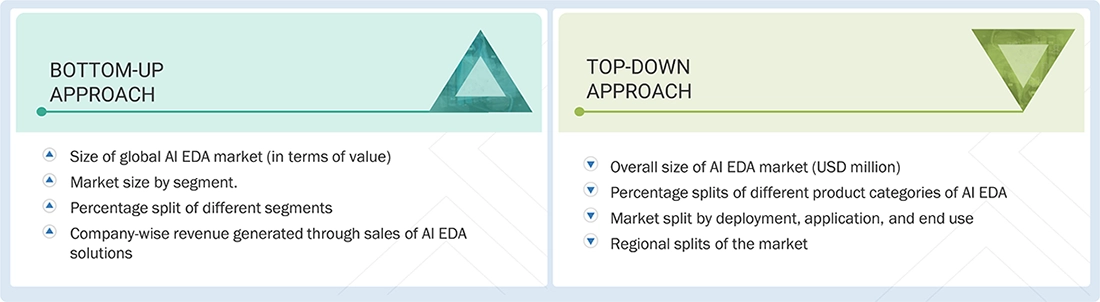
In the complete market estimation process, the top-down and bottom-up approaches have been used, along with several data triangulation methods, to estimate and forecast the size of the market and its segments and subsegments listed in the report. Extensive qualitative and quantitative analyses have been carried out on the complete market engineering process to list the key information/insights pertaining to the AI EDA market.
Key players in the AI EDA market have been identified through secondary research, and their rankings in the respective regions have been determined through primary and secondary research. This entire procedure involved the study of the annual and financial reports of top players and interviews with industry experts, such as chief executive officers, vice presidents, directors, and marketing executives, for quantitative and qualitative insights. All percentage shares, splits, and breakdowns have been determined using secondary sources and verified through primary sources. All parameters that affect the markets covered in this research study have been accounted for, viewed in extensive detail, verified through primary research, and analyzed to obtain the final quantitative and qualitative data. This data has been consolidated and enhanced with detailed inputs and analysis from MarketsandMarkets and presented in this report.
BOTTOM-UP APPROACH
- More than 25 companies in the AI EDA market were identified, and their offerings were mapped based on their product category, deployment mode, application, end use, and region.
- The global AI EDA market size was derived through the data sanity method. The revenues of AI EDA software providers were analyzed through annual reports and press releases and summed up to derive the overall market size.
- For each company, a percentage was assigned to the overall revenue to derive the revenues from the AI EDA segment.
- Each company’s percentage was assigned after analyzing various factors, including its product offerings, geographical presence, R&D expenditures and initiatives, and recent developments/strategies adopted for growth in the AI EDA market.
- For the CAGR, the market trend analysis of AI EDA solutions was carried out by understanding the industry penetration rate and the demand and supply of AI EDA offerings in different sectors.
- Estimates at every level were verified and cross-checked by discussing them with key opinion leaders, including sales heads, directors, operation managers, and market domain experts of MarketsandMarkets.
- Various paid and unpaid information sources, such as annual reports, press releases, white papers, and databases, were studied.
TOP-DOWN APPROACH
- Focusing initially on the top-line investments and expenditures being made in the ecosystem of AI-based EDA solutions
- Splitting the market based on product category, deployment mode, application, and end use, and listing key developments in key market areas
- Identifying all major players in the AI EDA market by product category, deployment mode, application, and their penetration in various end use segments through secondary research and verifying the information with industry experts
- Analyzing revenues, product mix, geographic presence, and key applications for which AI-based EDA solutions are offered by all identified players to estimate and arrive at the percentage splits for all key segments
- Discussing these splits with the industry experts to validate the information and identify key growth pockets across all key segments
- Breaking down the global market based on verified splits and key growth pockets across all segments
Data Triangulation
After arriving at the overall market size from the market size estimation process explained above, the total market has been split into several segments and subsegments. To complete the overall market engineering process and arrive at the exact statistics for all segments and subsegments, the market breakdown and data triangulation procedures have been employed, wherever applicable. The data has been triangulated by studying various factors and trends from both the demand and supply sides. Along with this, the market size has been validated using the top-down and bottom-up approaches.
Market Definition
The AI EDA market refers to the global market for software tools and related services that embed AI into electronic design processes. EDA itself represents a set of software solutions used to design, simulate, analyze, verify, and validate electronic systems and semiconductor devices, enabling engineers to manage design complexity and ensure functional and performance accuracy prior to manufacturing. The integration of AI into EDA introduces data-driven intelligence through techniques such as machine learning and predictive analytics. They analyze large volumes of design data to automate repetitive tasks, identify potential design issues early, and optimize key parameters, such as power, performance, and area. As a result, AI EDA improves design efficiency, reduces manual effort and error rates, shortens development cycles, and supports faster time-to-market, making it a critical enabler for advanced and complex electronic system development across global industries.
Key Stakeholders
- EDA Software and Providers
- Semiconductor Companies and Integrated Device Manufacturers
- Fabless Semiconductor Design Companies
- Foundries and Semiconductor Manufacturing Partners
- System-on-Chip (SoC) and Electronic System Designers
- Original Equipment Manufacturers (OEM)
- Design Services and Engineering Consulting Providers
- Cloud Infrastructure and Computing Service Providers
- Data Center and High-Performance Computing Operators
- Semiconductor Intellectual Property (IP) Core Providers
- Government Agencies and Regulatory Bodies
- Industry Standards and Compliance Organizations
- Investors and Financial Institutions
Report Objectives
- To describe and forecast the AI EDA market, by product category, deployment mode, application, and end use, in terms of value
- To forecast the market size for various segments across the main regions: North America, Europe, Asia Pacific, and RoW, in terms of value
- To define various AI integration levels in EDA
- To provide industry-specific information regarding the major drivers, restraints, opportunities, and challenges influencing the growth of the AI EDA market
- To study the complete supply chain and related industry segments for the AI EDA market
- To identify key AI EDA providers and analyze their product offerings in the market
- To strategically analyze the micromarkets concerning individual growth trends, prospects, and contributions to the total market
- To analyze trends/disruptions impacting customer business, interconnected markets and cross-sector opportunities, strategic moves by tier-1/2/3 players, pricing analysis, patents analysis, trade analysis (export and import scenario), Porter's five forces analysis, macroeconomic outlook, case studies, investment and funding scenario, decision-making process, key stakeholders involved in buying process and evaluation criteria, adoption barriers & internal challenges, unmet needs from various industries, technology analysis, technology roadmap, ecosystem analysis, regional regulations and compliance, the impact of 2025 US tariff, and key conferences and events related to the AI EDA market
- To analyze opportunities in the market for various stakeholders by identifying the high-growth segments of the market
- To strategically profile the key players and comprehensively analyze their market position regarding ranking and core competencies, along with detailing the competitive landscape for the market leaders
- To analyze competitive developments, such as product launches/enhancements, partnerships, and research and development (R&D) activities carried out by players in the AI EDA market.
Available customizations:
With the given market data, MarketsandMarkets offers customizations according to the company’s specific needs. The following customization options are available for the report:
COMPANY INFORMATION
- Detailed analysis and profiling of additional market players (up to 7)
Get the Full AI EDA Market Report
Full forecast, segment splits, and company analysis for all AI EDA Market.
- US AI EDA Market
- Canada AI EDA Market
- Mexico AI EDA Market
- Germany AI EDA Market
- China AI EDA Market
- Japan AI EDA Market
- South Korea AI EDA Market
- India AI EDA Market
- Taiwan AI EDA Market
- Automotive AI EDA Market
- Consumer Electronics AI EDA Market
- Healthcare AI EDA Market
- Rest Of Asia Pacific AI EDA Market
Need a Tailored Report?
Customize this report to your needs
Get 10% FREE Customization
Customize This Report
