
CHINA Artificial Intelligence (AI) in Finance Market (2024-2029)

The CHINA Artificial Intelligence (AI) in Finance Market was valued at $2518.3 Million in 2024 and projected to reach to $14069 Million by 2029, representing a compound annual growth rate of 33.2%. China's AI in finance market is poised for unprecedented growth, driven by government initiatives promoting financial technology innovation and the country's competitive advantage in AI research and development.


| Market Size in | USD 26.32 MN |
| Market Forecast in | |
| CAGR | |
| Forecast Period | |
| Units Considered | Value (USD MN) |
CHINA Artificial Intelligence (AI) in Finance Market Trends and Insights
- This represents a compound annual growth rate of 33.2%, significantly outpacing global trends as China leverages AI technologies for algorithmic trading, risk management, fraud detection, and personalized financial services.
- The market's acceleration reflects China's strategic investments in fintech infrastructure, regulatory support for innovation, and the integration of AI across banking, insurance, and wealth management sectors. China's dominance in the AI-in-finance space is driven by the country's large digital population, advanced cloud computing capabilities, and competitive pressure among major financial institutions to adopt cutting-edge technologies.
- Between 2024 and 2029, China is expected to consolidate its position as a global leader in AI-powered financial solutions, with applications spanning from robo-advisory platforms to intelligent compliance systems.
- The forecast period will witness substantial capital deployment in machine learning models, natural language processing, and predictive analytics tailored to China's unique regulatory environment and market dynamics..
Key Market Statistics
- CAGR (2024-2029) 33.2% CAGR
- Market Size, 2024 ~USD 2518.3 Million
- Forecast, 2029 ~USD 14069 Million
- Country CHINA
CHINA Artificial Intelligence (AI) in Finance Market Overview
Exceptional Growth Trajectory :
China's AI in finance market is expanding at 33.2% CAGR, significantly exceeding the global rate of 30.6%, driven by massive investments in fintech infrastructure and regulatory support for AI adoption across banking and insurance sectors.
Market Valuation Surge :
The market is projected to grow from USD 2,518.3 million in 2024 to USD 14,069.0 million by 2029, representing a 459% increase over five years as Chinese financial institutions accelerate digital transformation initiatives.
AI Application Dominance :
Chinese financial institutions are leveraging AI for algorithmic trading, sophisticated risk management systems, advanced fraud detection mechanisms, and hyper-personalized financial services tailored to consumer preferences and behaviors.
Strategic Market Position :
China's robust tech ecosystem, government backing through digital economy initiatives, and large fintech talent pool position the country as a global leader in AI-driven financial innovation and implementation.
CHINA Artificial Intelligence (AI) in Finance Market Dynamics
- Major Chinese banks and fintech companies are rapidly deploying machine learning algorithms for trading optimization, credit risk assessment, and customer intelligence platforms.
- The regulatory environment continues to evolve favorably, encouraging responsible AI adoption while maintaining financial stability oversight. By 2029, China is expected to capture a substantial share of global AI finance spending, with emerging applications in blockchain integration, quantum computing for portfolio optimization, and autonomous financial advisory systems.
- The convergence of 5G infrastructure, cloud computing capabilities, and massive datasets will enable Chinese institutions to develop proprietary AI models that enhance competitive advantages in both domestic and international markets..
Market Ecosystem

AI in Finance Market: COMMERCIAL USE CASES ACROSS INDUSTRIES
| COMPANY | USE CASE DESCRIPTION | BENEFITS |
|---|---|---|
 |
H2O.ai provided PayPal with a solution utilizing H2O Driverless AI, which enhanced fraud detection capabilities. By combining advanced ML with graph database techniques, PayPal was able to identify complex fraud patterns, such as collusion among buyers and sellers. | Improved fraud detection model accuracy by ~6%, strengthening PayPal’s fraud prevention capabilities and reducing financial exposure. |
 |
Vena Solutions provided Shift4 Payments with a comprehensive financial planning platform that transformed their reporting and planning processes. By automating data flows from Shift4’s Oracle ERP Suite into a central database, Vena enabled the finance team to streamline monthly reporting and enhance flexibility in planning. | Supported scalable financial planning, enhancing adaptability to business growth and dynamic market conditions. |
 |
Investa implemented Workiva's cloud-based platform, which facilitated real-time data collaboration and streamlined the reporting process. This transformation allowed Investa to produce timely and reliable reports, improving efficiency and reducing the workload for its finance team. | Boosted operational efficiency by automating workflows, allowing finance teams to focus on strategic analysis and decision-making. |
 |
DataVisor and Microsoft azure collaborate to enhance real-time fraud detection. This architecture supports both public and private Azure deployments, ensuring comprehensive protection against sophisticated attacks. | Achieved 35%+ uplift in threat detection, enabling proactive fraud prevention and minimizing financial losses. |
Logos and trademarks shown above are the property of their respective owners. Their use here is for informational and illustrative purposes only.
Related Ecosystem
Software And Services
- Natural Language Processing (NLP)
- Machine Learning
- Supply Chain Management
- Predictive Analytics
- Image Sensors
- International Business Machines Corporation
- MICROSOFT CORPORATION
- Oracle Corporation
- SAP SE
- Amazon.com, Inc.
Analytics
- Natural Language Processing (NLP)
- Machine Learning
- Supply Chain Management
- Predictive Analytics
- Image Sensors
- International Business Machines Corporation
- MICROSOFT CORPORATION
- Oracle Corporation
- SAP SE
Cloud Computing
- Software as A Service (SaaS)
- Natural Language Processing (NLP)
- Platform as A Service (PaaS)
- Machine Learning
- Supply Chain Management
- International Business Machines Corporation
- MICROSOFT CORPORATION
- Oracle Corporation
- Amazon.com, Inc.
Key Takeaways
- China's AI in finance market will grow from USD 2,518.3M (2024) to USD 14,069.0M (2029) at a 33.2% CAGR, driven by fintech innovation and regulatory support.
- China's large digital population and advanced cloud infrastructure position the country as a global leader in AI-powered financial solutions.
- Key applications in China include algorithmic trading, fraud detection, risk management, and robo-advisory platforms across banking and insurance sectors.
- Between 2024 and 2029, China will see substantial investment in machine learning and NLP technologies tailored to its unique regulatory environment.
Artificial Intelligence (AI) in Finance Market Report Scope
| Report Metric | Details |
|---|---|
| Base Year | 2024 |
| Fastest Growing Segment | GENERATIVE AI (Technology) |
| Forecast Period | 2024-2029 |
| Growth Rate | CAGR of 30.6% from 2024 to 2029 |
| Largest Segment | SOFTWARE (Offering) |
| Market Size Base Year (Billions) | ~USD 38.36 (2024) |
| Revenue Forecast (Billions) | ~USD 145.74 (2029) |
| Segments Covered | Product, Deployment Mode, Technology, Application, End User, Type, Offering, Business Function, Vertical |
CHINA Artificial Intelligence (AI) in Finance Market Report Segmentation
9 segment dimensions are covered across the global market.
By Product
- Accounts Payable/Receivable Automation Software
- Algorithmic Trading Platforms
- Automated Reconciliation Solutions
- Chatbots & Virtual Assistants
- Compliance Automation Platforms
- Erp & Financial Systems
- Expense Management Systems
- Governance, Risk, And Compliance (Grc) Software
- Intelligent Document Processing (Idp)
- Other Product Types
- Robo-Advisors
- Underwriting Engines/Platforms
By Deployment Mode
- Cloud
- On-Premises
By Technology
- Computer Vision
- Context-Aware AI
- Deep Learning
- Emotion Detection
- Generative AI
- Machine Learning
- Natural Language Generation
- Natural Language Processing
- Other AI
- Other AI Technologies
- Text Classification
- Topic Modeling
By Application
- Automated Bookkeeping & Reconciliation
- Compliance Monitoring
- Customer Service & Engagement
- Customer Service And Support
- Document And Contract Analysis
- Financial Compliance & Regulatory Reporting
- Financial News And Market Analysis
- Financial Planning & Forecasting
- Fraud Detection & Prevention
- Investment & Portfolio Management
- Investment Analysis
- Language Translation
- Procurement & Supply Chain Finance
- Revenue Cycle Management
- Risk Management
- Risk Management And Fraud Detection
- Sentiment Analysis
- Speech Recognition And Transcription
By End User
- Banking
- Capital Markets/Regtech
- Education
- Finance As Business Functions
- Finance As Business Operations
- Fintech
- Government & Public Sector
- Healthcare & Pharma
- Insurance
- Investment & Asset Management
- Manufacturing
- Other End Users
- Real Estate
- Retail & E-Commerce
- Retail & Ecommerce
- Technology & Software
- Telecom & Media
- Utilities
By Type
- Banking
- Capital Markets/ Regtech
- Capital Markets/Regtech
- Education
- Fintech
- Government & Public Sector
- Healthcare & Pharma
- Insurance
- Investment & Asset Management
- Manufacturing
- Other End Users
- Real Estate
- Retail & E-Commerce
- Retail & Ecommerce
- Technology & Software
- Telecom & Media
- Utilities
By Offering
- Hardware
- Services
- Software
By Business Function
- Cybersecurity
- Finance & Accounting
- Human Resources
- Marketing & Sales
- Operations
By Vertical
- Agriculture
- Automotive, Transportation & Logistics
- Banking
- Bfsi
- Energy & Utilities
- Financial Services
- Government & Defense
- Healthcare& Life Sciences
- Insurance
- It/Ites
- Manufacturing
- Media & Entertainment
- Other Enterprise Verticals
- Other Verticals
- Retail & Ecommerce
- Telecommunications
CHINA: AI IN FINANCE MARKET, BY END USER, 2024–2030
| Segment | 2024 | 2025 | 2026 | 2027 | 2028 | 2029 | 2030 | CAGR (%) |
|---|---|---|---|---|---|---|---|---|
| FINANCE AS BUSINESS FUNCTIONS | 491.9 | 637.2 | 796.8 | 958.2 | 1118.5 | 1267.6 | 1438.3 | 19.6 |
| FINANCE AS BUSINESS OPERATIONS | 2026.4 | 2919.6 | 4102 | 5613.2 | 7576.3 | 10139.8 | 12630.8 | 35.7 |
| TOTAL | 2518.3 | 3556.8 | 4898.8 | 6571.4 | 8694.8 | 11407.4 | 14069 | 33.2 |
Target Audience
- Financial Institution Executives : C-suite leaders in Chinese banks, insurance companies, and asset managers need this data to justify AI investments, benchmark against competitors, and align digital transformation roadmaps with market growth opportunities.
- Fintech Entrepreneurs & Startups : Founders and investors in China's fintech ecosystem require market sizing and growth projections to secure funding, identify white-space opportunities, and validate business models in high-growth AI finance segments.
- Technology Solution Providers : AI software vendors, cloud providers, and consulting firms targeting Chinese financial institutions need market intelligence to develop localized offerings, identify customer segments, and forecast revenue potential.
- Investment & Private Equity Firms : PE investors and venture capitalists evaluating opportunities in China's fintech sector require detailed market analysis to assess portfolio company growth potential and identify acquisition targets in AI finance.
- Regulatory & Policy Advisors : Government agencies, compliance consultants, and policy think tanks need comprehensive market data to understand AI adoption trends, assess systemic risks, and develop appropriate regulatory frameworks for China's financial sector.
Reasons to Buy this Report
- Competitive Intelligence on China's Market : Gain detailed insights into China's 33.2% CAGR growth rate and understand how it outpaces global competitors, enabling strategic positioning in the world's fastest-growing AI finance market.
- Investment Decision Support : Access comprehensive market sizing data (USD 2.5B to USD 14.1B projection) to identify high-potential investment opportunities in Chinese fintech, banking, and insurance AI solutions.
- Technology Adoption Roadmap : Understand which AI applications (algorithmic trading, risk management, fraud detection) are driving growth in China, helping you prioritize technology development and deployment strategies.
- Market Entry Strategy : Leverage China-specific market analysis to develop localized go-to-market strategies, identify key stakeholders, and navigate regulatory requirements for AI finance solutions in this critical market.
- Competitive Benchmarking : Compare your organization's AI finance capabilities against China's market leaders and understand emerging trends in personalized financial services and risk management innovation.
Frequently asked questions
What is the market size of AI in finance in China in 2024?
China's AI in finance market was valued at USD 2,518.3 million in 2024, reflecting strong adoption across banking, insurance, and fintech sectors.
What is the projected market size for AI in finance in China by 2029?
China's AI in finance market is forecast to reach USD 14,069.0 million by 2029, representing a 33.2% compound annual growth rate.
What are the primary drivers of AI adoption in China's financial sector?
China's AI adoption is driven by strategic government support, large digital populations, competitive fintech ecosystems, and regulatory frameworks encouraging innovation in financial services.
Which AI applications are most prevalent in China's finance market?
China's financial institutions are deploying AI for algorithmic trading, fraud detection, risk assessment, credit scoring, robo-advisory services, and intelligent compliance monitoring.
How does China's AI in finance market compare to global growth rates?
China's 33.2% CAGR significantly exceeds the global average of 30.6%, reflecting the country's accelerated digital transformation and fintech innovation.
RESEARCH METHODOLOGY
The study involved major activities in estimating the current market size for the AI in Finance market. Exhaustive secondary research was done to collect information on the AI in Finance market. The next step was to validate these findings, assumptions, and sizing with industry experts across the value chain using primary research. Different approaches, such as top-down and bottom-up, were employed to estimate the total market size. After that, the market breakup and data triangulation procedures were used to estimate the market size of the segments and subsegments of the AI in Finance market.
Secondary Research
The market for the companies offering AI in Finance solutions is arrived at by secondary data available through paid and unpaid sources, analyzing the product portfolios of the major companies in the ecosystem, and rating the companies by their performance and quality. Various sources were referred to in the secondary research process to identify and collect information for this study. The secondary sources include annual reports, press releases, investor presentations of companies, white papers, journals, certified publications, and articles from recognized authors, directories, and databases.
In the secondary research process, various secondary sources were referred to for identifying and collecting information related to the study. Secondary sources included annual reports, press releases, and investor presentations of AI in Finance vendors, forums, certified publications, and whitepapers. The secondary research was used to obtain critical information on the industry’s value chain, the total pool of key players, market classification, and segmentation from the market and technology-oriented perspectives.
Primary Research
In the primary research process, various primary sources from both the supply and demand sides were interviewed to obtain qualitative and quantitative information for this report. The primary sources from the supply side included industry experts, such as Chief Executive Officers (CEOs), Vice Presidents (VPs), marketing directors, technology and innovation directors, and related key executives from various key companies and organizations operating in the AI in Finance market. After the complete market engineering (calculations for market statistics, market breakdown, market size estimations, market forecasting, and data triangulation), extensive primary research was conducted to gather information and verify and validate the critical numbers arrived at. Primary research was also conducted to identify the segmentation types, industry trends, competitive landscape of AI in Finance solutions offered by various market players, and key market dynamics, such as drivers, restraints, opportunities, challenges, industry trends, and key player strategies. In the complete market engineering process, the top-down and bottom-up approaches were extensively used, along with several data triangulation methods, to perform the market estimation and market forecasting for the overall market segments and subsegments listed in this report. Extensive qualitative and quantitative analysis was performed on the complete market engineering process to list the key information/insights throughout the report.
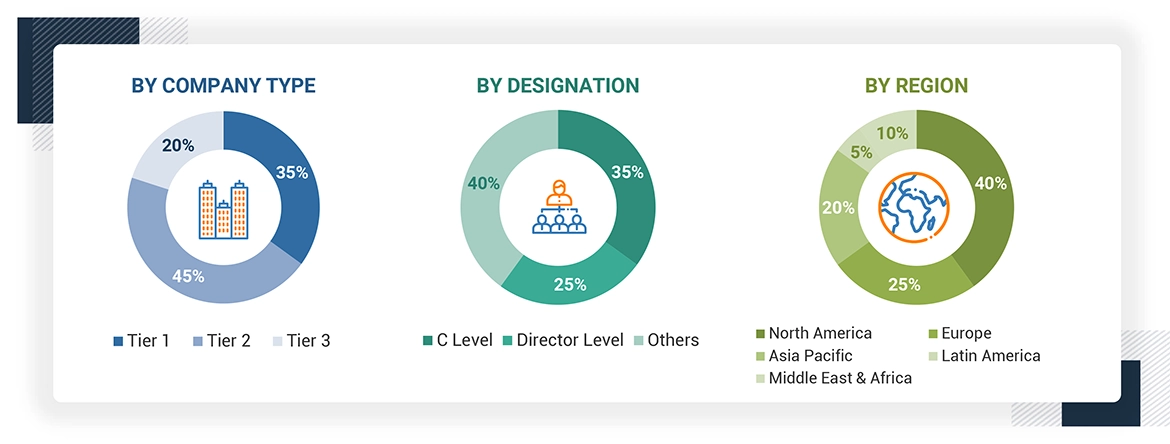
Note: Tier 1 companies account for annual revenue of >USD 10 billion; tier 2 companies’ revenue ranges
between USD 1 and 10 billion; and tier 3 companies’ revenue ranges between USD 500 million–USD 1 billion
To know about the assumptions considered for the study, download the pdf brochure
Market Size Estimation
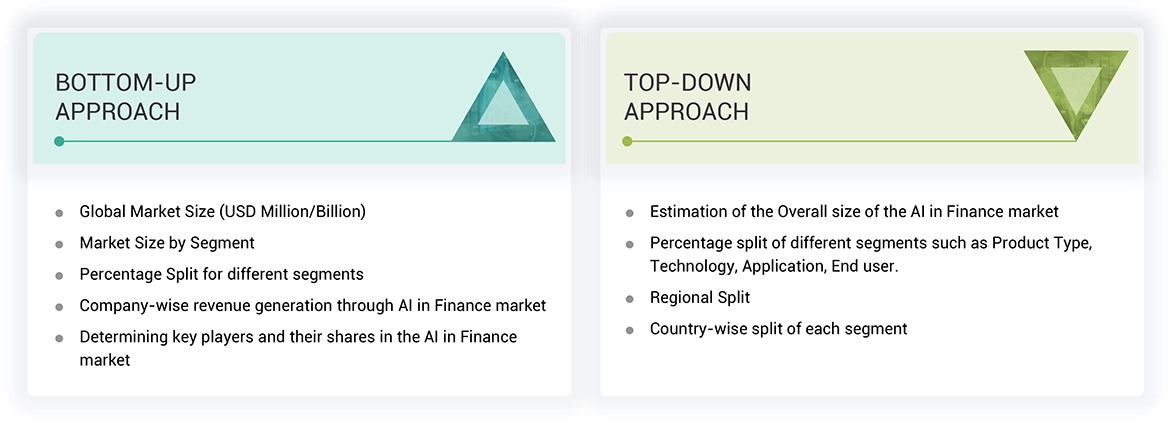
Both top-down and bottom-up approaches were used to estimate and validate the total size of the cell culture market. These methods were also used extensively to estimate the size of various subsegments in the market. The research methodology used to estimate the market size includes the following:
AI In Finance Market : Top-Down and Bottom-Up Approach
Data Triangulation
After arriving at the overall market size using the market size estimation processes explained above, the market was split into various segments and subsegments. The data triangulation and market breakup procedures were employed, wherever applicable, to complete the overall market engineering process and arrive at the exact statistics of each market segment and subsegment. The data was triangulated by studying various factors and trends from both the demand and supply sides.
Market Definition
Artificial intelligence (AI) in finance helps drive insights for data analytics, performance measurement, predictions and forecasting, real-time calculations, customer servicing, intelligent data retrieval, and more. It is a set of technologies that enables financial services organizations to better understand markets and customers, analyze and learn from digital journeys, and engage in a way that mimics human intelligence and interactions at scale.
Stakeholders
- Risk Assessment and Compliance Software Developers
- AI in Finance Software Vendors
- Financial Analysts and Managers
- AI in Finance Service Providers
- Financial Marketers
- Business Owners and Executives
- Distributors and Value-Added Resellers (VARs)
- Independent Software Vendors (ISVs)
- Managed Service Providers
- Support and Maintenance Service Providers
- System Integrators (SIs)/Migration Service Providers
- Original Equipment Manufacturers (OEMs)
- Technology Providers
Report Objectives
- To define, describe, and predict the AI in Finance market by product (by type and deployment mode), technology, application (by business operation and business function), end user (by business function and business operation) and region
- To provide detailed information related to major factors (drivers, restraints, opportunities, and industry-specific challenges) influencing the market growth
- To analyze the micro markets with respect to individual growth trends, prospects, and their contributions to the total market
- To analyze the opportunities in the market for stakeholders by identifying the high-growth segments of the AI in Finance market
- To analyze opportunities in the market and provide details of the competitive landscape for stakeholders and market leaders
- To forecast the market size of five main regions: North America, Europe, Asia Pacific, the Middle East & Africa, and Latin America
- To profile key players and comprehensively analyze their market rankings and core competencies
- To analyze competitive developments, such as partnerships, new product launches, and mergers & acquisitions, in the market
- To analyze the impact of the recession across all regions in the AI in Finance market
Available Customizations
With the given market data, MarketsandMarkets offers customizations as per your company’s specific needs. The following customization options are available for the report:
Product Analysis
- Product quadrant, which gives a detailed comparison of the product portfolio of each company.
Geographic Analysis as per Feasibility
- Further breakup of the North American AI in Finance market
- Further breakup of the European market
- Further breakup of the Asia Pacific market
- Further breakup of the Middle Eastern & African market
- Further breakup of the Latin America AI in Finance market
Company Information
- Detailed analysis and profiling of additional market players (up to five)
Get the Full Artificial Intelligence (AI) in Finance Market Report
Full forecast, segment splits, and company analysis for all Artificial Intelligence (AI) in Finance Market.
- CANADA Artificial Intelligence (AI) in Finance Market
- UK Artificial Intelligence (AI) in Finance Market
- GERMANY Artificial Intelligence (AI) in Finance Market
- FRANCE Artificial Intelligence (AI) in Finance Market
- ITALY Artificial Intelligence (AI) in Finance Market
- SPAIN Artificial Intelligence (AI) in Finance Market
- JAPAN Artificial Intelligence (AI) in Finance Market
- INDIA Artificial Intelligence (AI) in Finance Market
- SOUTH KOREA Artificial Intelligence (AI) in Finance Market
- UAE Artificial Intelligence (AI) in Finance Market
- KUWAIT Artificial Intelligence (AI) in Finance Market
- BRAZIL Artificial Intelligence (AI) in Finance Market
- MEXICO Artificial Intelligence (AI) in Finance Market
- ARGENTINA Artificial Intelligence (AI) in Finance Market
- US Artificial Intelligence (AI) in Finance Market
- BAHRAIN Artificial Intelligence (AI) in Finance Market
- Rest Of Europe Artificial Intelligence (AI) in Finance Market
- Anz Artificial Intelligence (AI) in Finance Market
- Asean Artificial Intelligence (AI) in Finance Market
- Rest Of Asia Pacific Artificial Intelligence (AI) in Finance Market
- Rest Of Latin America Artificial Intelligence (AI) in Finance Market
- Indonesia Artificial Intelligence (AI) in Finance Market
- Malaysia Artificial Intelligence (AI) in Finance Market
- Rest Of Asean Artificial Intelligence (AI) in Finance Market
- Singapore Artificial Intelligence (AI) in Finance Market
- Ksa Artificial Intelligence (AI) in Finance Market
- Rest Of Middle East Artificial Intelligence (AI) in Finance Market
Need a Tailored Report?
Customize this report to your needs
Get 10% FREE Customization
Customize This Report
