
China AI in Telehealth & Telemedicine Market (2025-2030)

The China AI in Telehealth & Telemedicine Market was valued at $431.7 Million in 2025 and projected to reach to $2289.6 Million by 2030, representing a compound annual growth rate of 41.6%. China's AI in telehealth market is poised for exceptional growth through 2030, driven by government digital health mandates, increasing smartphone penetration, and rising healthcare costs.


| Market Size in | USD 26.32 MN |
| Market Forecast in | |
| CAGR | |
| Forecast Period | |
| Units Considered | Value (USD MN) |
China AI in Telehealth & Telemedicine Market Trends and Insights
- China's healthcare infrastructure modernization and government digital health initiatives are driving adoption of AI-powered remote consultation platforms, diagnostic tools, and patient management systems.
- The market in China is benefiting from high smartphone penetration, increasing healthcare costs, and regulatory support for digital health innovation. By 2030, China is expected to solidify its position as a leading market for AI-enabled telehealth solutions, with a compound annual growth rate of 41.6%.
- China's large population base and rising demand for accessible healthcare services are accelerating investment in AI algorithms for disease detection, virtual triage, and personalized treatment recommendations.
- The competitive landscape in China includes both domestic tech giants and specialized healthcare AI startups, positioning China as a critical hub for telehealth innovation in the Asia Pacific region..
Key Market Statistics
- CAGR (2025-2030) 41.6% CAGR
- Market Size, 2025 ~USD 431.7 Million
- Forecast, 2030 ~USD 2289.6 Million
- Country China
China AI in Telehealth & Telemedicine Market Overview
Rapid Market Expansion :
China's AI in telehealth market is projected to grow from $431.7 million in 2025 to $2,289.6 million by 2030, representing a robust 41.6% CAGR, significantly outpacing the global average of 36.4%.
Government Digital Health Initiatives :
China's healthcare infrastructure modernization and state-backed digital health policies are accelerating adoption of AI-powered remote consultation platforms, diagnostic tools, and integrated patient management systems across urban and rural regions.
AI-Powered Clinical Solutions :
The market is driven by deployment of intelligent diagnostic algorithms, AI-enabled remote consultations, and automated patient triage systems that enhance healthcare accessibility and reduce burden on traditional medical facilities.
Healthcare Accessibility Gap :
China's vast population and uneven distribution of medical resources create significant demand for telemedicine solutions, positioning AI-driven platforms as critical infrastructure for bridging urban-rural healthcare disparities.
China AI in Telehealth & Telemedicine Market Dynamics
- The integration of AI with telemedicine platforms addresses critical challenges in patient accessibility and diagnostic accuracy across China's diverse geography.
- Major investments in healthcare IT infrastructure and regulatory frameworks supporting digital health innovation will accelerate market penetration.
- Additionally, the growing middle class and heightened health consciousness post-pandemic are fueling demand for convenient, AI-assisted remote healthcare services.
- Strategic partnerships between tech companies and healthcare providers will further expand service offerings and market reach..
Market Ecosystem
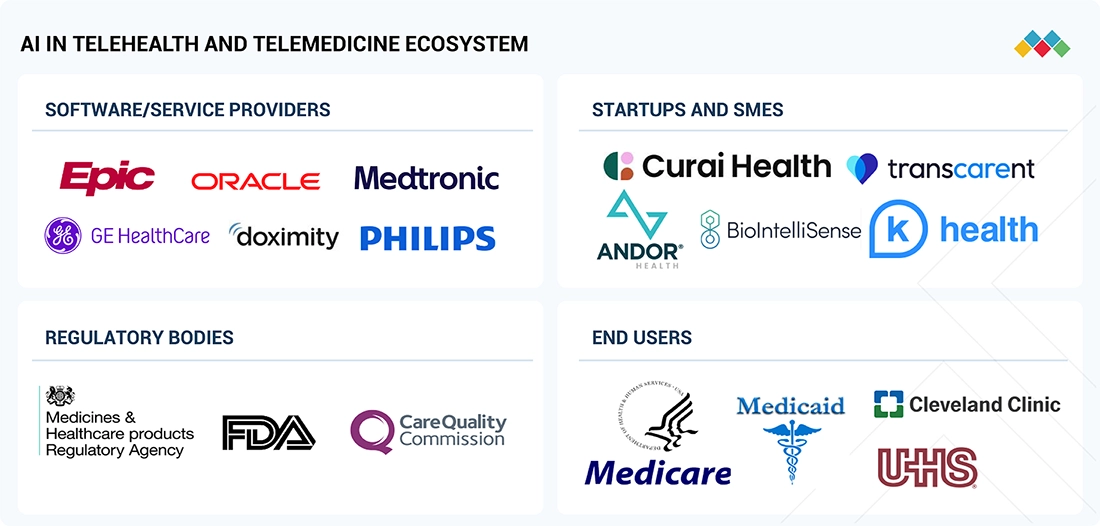
AI in Telehealth & Telemedicine Market: COMMERCIAL USE CASES ACROSS INDUSTRIES
| COMPANY | USE CASE DESCRIPTION | BENEFITS |
|---|---|---|
 |
Deploys AI-enabled remote diagnostics and imaging-as-a-service platforms that help healthcare enterprises and clinics access advanced imaging analytics. | Enables faster, more accurate diagnostic decisions while reducing dependence on in-person imaging specialists and optimizing resource use |
 |
Offers end-to-end telehealth platforms and connected monitoring devices for hospitals and home care settings to support hybrid care delivery | Expands patient access to care, boosts engagement and adherence, and reduces hospital burden through remote service delivery |
 |
Provides a cloud-based clinical and claims data platform to enable virtual care management, payer analytics, and telehealth integration | Streamlines reimbursement, improves interoperability, and accelerates data-driven decisions across payers and providers |
 |
Uses connected medical devices and AI analytics for continuous remote patient monitoring across cardiac, diabetic, and respiratory conditions | Enhances chronic disease management, reduces emergency visits, and enables proactive care through predictive insights |
Logos and trademarks shown above are the property of their respective owners. Their use here is for informational and illustrative purposes only.
Related Ecosystem
Cardiovascular Devices
- External Defibrillators
- Implantable Cardioverter Defibrillators
- Pulse Oximeters
- Robotic Systems
- 3-Lead ECG Leadwires
- Medtronic plc
- Boston Scientific Corporation
- Abbott Laboratories
- CONMED Corporation
- KONINKLIJKE PHILIPS N.V.
Healthcare It
- Computed Tomography (CT)
- Machine Learning
- Magnetic Resonance Imaging (MRI)
- Natural Language Processing (NLP)
- Predictive Analytics
- CERNER CORPORATION
- PHILIPS HEALTHCARE
- Oracle Corporation
- GE HealthCare Technologies Inc.
- Siemens healthineers
Medical Devices
- Polymerase Chain Reaction (PCR)
- Magnetic Resonance Imaging (MRI)
- Disposable Autoinjectors
- Pulse Oximeters
- Blood Pressure Monitors
- Medtronic plc
- Abbott Laboratories
- Stryker Corporation
- Becton, Dickinson and Company
- JOHNSON & JOHNSON
Key Takeaways
- China's AI telehealth market will grow from $431.7M (2025) to $2,289.6M (2030) at a 41.6% CAGR, outpacing global growth.
- China's government digital health policies and healthcare modernization initiatives are primary catalysts for market expansion.
- China's large population and rising healthcare demand create significant opportunities for AI-driven remote diagnostics and virtual care.
- China's competitive ecosystem of tech giants and specialized startups positions the country as a regional innovation leader.
AI in Telehealth & Telemedicine Market Report Scope
| Report Metric | Details |
|---|---|
| Base Year | 2025 |
| Fastest Growing Segment | TELEPSYCHIATRY (Type) |
| Forecast Period | 2025-2030 |
| Growth Rate | CAGR of 36.4% from 2025 to 2030 |
| Largest Segment | SOFTWARE (Component) |
| Market Size Base Year (Billions) | ~USD 5.75 (2025) |
| Revenue Forecast (Billions) | ~USD 27.14 (2030) |
| Segments Covered | Component, Modality, Integration Type, Deployment, Function, Application, Type, End User |
China AI in Telehealth & Telemedicine Market Report Segmentation
8 segment dimensions are covered across the global market.
By Component
- Hardware
- Services
- Software
By Modality
- Ehr-Centric Software
- Non-Ehr-Centric Software
By Integration Type
- Integrated Software
- Standalone Software
By Deployment
- Cloud-Based Deployment
- On-Premises Deployment
By Function
- Administrative Workflow
- Analytics & Reporting
- Chatbots & Virtual Assistants
- Clinical Documentation
- Other Functions
- Patient Engagement
- Remote Patient Monitoring
- Virtual Care Consultations
- Virtual Nursing Care Platform
- Virtual Nursing Care Platforms
By Application
- Other Applications
- Primary Care Applications
- Specialty Care Applications
- Teleicu
By Type
- Ambulatory Surgery Centers, Ambulatory Care Centers, And Other Outpatient Settings
- Ambulatory Surgical Centers, Ambulatory Care Centers, And Other Outpatient Settings
- Diabetes
- Home Healthcare
- Hospitals
- Hypertension
- Long-Term Care & Assisted Living Facilities
- Other Healthcare Providers
- Other Specialty Care Applications
- Respiratory Disorders
- Telecardiology
- Teledermatology
- Teleneurology
- Telepsychiatry
- Teleradiology
By End User
- Healthcare Payers
- Healthcare Providers
- Medtech Companies
- Other End Users
- Patients
- Pharmaceutical & Biotechnology Companies
CHINA: AI IN TELEHEALTH & TELEMEDICINE MARKET, BY END USER, 2022–2030
| Segment | 2022 | 2023 | 2024 | 2025 | 2026 | 2027 | 2028 | 2030 | CAGR (%) |
|---|---|---|---|---|---|---|---|---|---|
| HEALTHCARE PAYERS | 22.6 | 35.1 | 54.2 | 82.6 | 123 | 173.7 | 243.9 | 446 | 42.1 |
| HEALTHCARE PROVIDERS | 56.3 | 87.2 | 134.1 | 203.5 | 301.8 | 424.4 | 593.6 | 1076.8 | 41.5 |
| MEDTECH COMPANIES | 3.5 | 5.3 | 8.1 | 12.2 | 17.8 | 24.8 | 34.3 | 60.7 | 39.9 |
| OTHER END USERS | 3.5 | 5.3 | 7.8 | 11.4 | 16.2 | 21.9 | 29.2 | 47.8 | 35.2 |
| PATIENTS | 25.5 | 39.8 | 61.6 | 94.1 | 140.5 | 198.9 | 280 | 514.5 | 42.4 |
| PHARMACEUTICAL & BIOTECHNOLOGY COMPANIES | 7.8 | 12 | 18.4 | 27.8 | 41.1 | 57.5 | 80 | 143.9 | 40.9 |
| TOTAL | 119.3 | 184.8 | 284.3 | 431.7 | 640.5 | 901.1 | 1260.9 | 2289.6 | 41.6 |
Target Audience
- Healthcare Technology Investors : Investment firms and venture capitalists need China-specific market data to evaluate funding opportunities, assess portfolio companies' competitive positioning, and identify emerging growth segments in AI telehealth.
- Medical Device & Software Companies : Manufacturers and developers require detailed market insights to guide product development, localization strategies, and market entry planning for China's rapidly expanding AI-powered telemedicine ecosystem.
- Healthcare Providers & Hospital Networks : Chinese hospitals and healthcare systems need market intelligence to benchmark digital transformation initiatives, evaluate AI solution providers, and optimize telemedicine platform investments.
- Telecom & Tech Corporations : Telecommunications and technology companies expanding into healthcare need China market data to identify partnership opportunities, assess competitive threats, and develop integrated digital health offerings.
- Government & Policy Makers : Healthcare regulators and government agencies require market analysis to inform digital health policy development, infrastructure planning, and resource allocation for telemedicine expansion initiatives.
Reasons to Buy this Report
- Market Size & Growth Validation : Obtain precise valuation data for China's AI telehealth market with verified 41.6% CAGR, enabling accurate financial forecasting and investment decision-making for market entry or expansion strategies.
- Competitive Landscape Intelligence : Understand China-specific market dynamics, key players, and competitive positioning to identify partnership opportunities, acquisition targets, and differentiation strategies in this high-growth segment.
- Regulatory & Policy Insights : Access detailed analysis of China's government digital health initiatives, compliance requirements, and policy frameworks that directly impact market opportunities and operational strategies.
- Segment & Application Analysis : Gain granular insights into AI telehealth applications in China including remote consultations, diagnostic tools, and patient management systems to identify highest-ROI market segments.
- Strategic Market Positioning : Leverage China-specific market data to develop targeted go-to-market strategies, pricing models, and product positioning that align with local healthcare infrastructure and consumer preferences.
Frequently asked questions
What is the projected market size of AI in telehealth in China by 2030?
China's AI telehealth market is projected to reach $2,289.6 million by 2030, growing from $431.7 million in 2025.
What is the CAGR for China's AI telehealth market?
China's AI in telehealth and telemedicine market is expected to grow at a compound annual growth rate of 41.6% from 2025 to 2030.
What factors are driving growth in China's telehealth AI market?
Growth in China is driven by government digital health initiatives, healthcare infrastructure modernization, high smartphone penetration, and increasing demand for accessible healthcare services.
Who are the key players in China's AI telehealth market?
China's market includes major tech companies and specialized healthcare AI startups competing to develop remote consultation platforms, diagnostic tools, and patient management systems.
How does China's market compare to global AI telehealth growth?
China's 41.6% CAGR significantly exceeds the global average of 36.4%, reflecting stronger market momentum and adoption rates in the country.
RESEARCH METHODOLOGY
The study involved significant activities to estimate the current size of the AI in telehealth & telemedicine market. Exhaustive secondary research was done to collect information on the market. The next step was to validate these findings, assumptions, and sizing with industry experts across the value chain using primary research. Different approaches, such as top-down and bottom-up, were employed to estimate the total market size. After that, the market breakup and data triangulation procedures were used to estimate the market size of the segments and subsegments of the AI in telehealth & telemedicine market.
Secondary Research
This research study used secondary sources, directories, and databases such as Dun & Bradstreet, Bloomberg Businessweek, and Factiva; white papers, annual reports, and companies’ house documents; investor presentations; and the SEC filings of companies. The companies offering AI-based telehealth & telemedicine solutions were determined at by secondary data available through paid and unpaid sources, analyzing the product portfolios of the major companies in the ecosystem, and rating the companies by their performance and quality. Various sources were referred to in the secondary research process to identify and collect information for this study. The secondary sources include annual reports, press releases, investor presentations of companies, white papers, journals, certified publications, and articles from recognized authors, directories, and databases.
The secondary research process referred to various secondary sources to identify and collect information related to the study. These sources included annual reports, press releases, investor presentations of AI in telehealth & telemedicine vendors, forums, certified publications, and whitepapers. The secondary research was used to obtain critical information on the industry’s value chain, the total pool of key players, market classification, and segmentation from the market and technology-oriented perspectives.
Primary Research
In the primary research process, various primary sources from both the supply and demand sides were interviewed to obtain qualitative and quantitative information for this report. The primary sources from the supply side included industry experts, such as CEOs, VPs, marketing directors, technology and innovation directors, and related key executives from various key companies and organizations operating in the AI in telehealth market.
After the complete market engineering (calculations for market statistics, market breakdown, market size estimations, market forecasting, and data triangulation), extensive primary research was conducted to gather information and verify and validate the critical numbers arrived at. Primary research was also undertaken to identify the segmentation types, industry trends, competitive landscape of AI-based telemedicine solutions offered by various market players, and key market dynamics, such as drivers, restraints, opportunities, challenges, industry trends, and key player strategies.
In the complete market engineering process, the top-down and bottom-up approaches and several data triangulation methods were extensively used to perform the market estimation and market forecasting for the overall market segments and subsegments listed in this report. Extensive qualitative and quantitative analysis was performed on the complete market engineering process to list the key information/insights throughout the report.
Breakdown Of Primary Participants
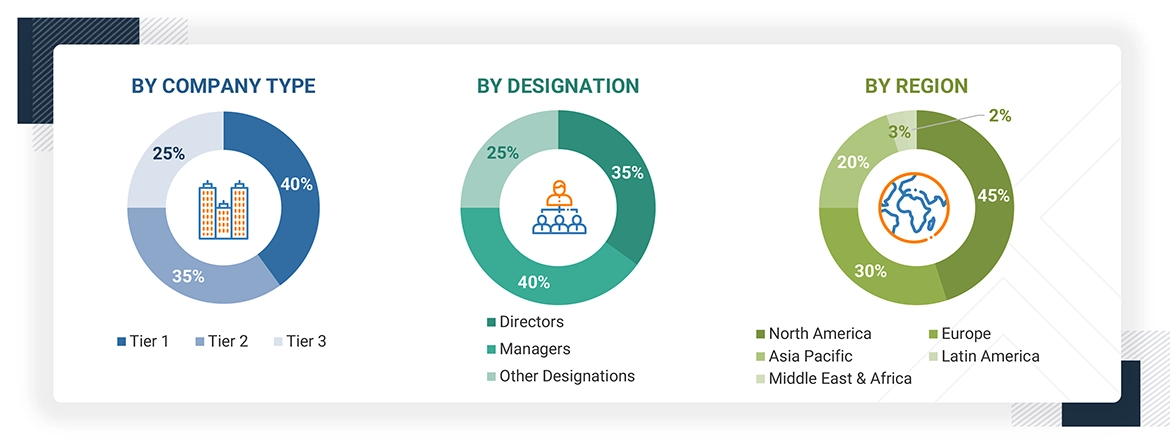
Note 1: Other designations include sales, marketing, and product managers.
Note 2: Tiers of companies are defined based on their total revenues in 2023. Tier 1 = >USD 1 billion, Tier 2 = USD 500 million to USD 1 billion, and Tier 3 = < USD 500 million.
To know about the assumptions considered for the study, download the pdf brochure
Market Size Estimation
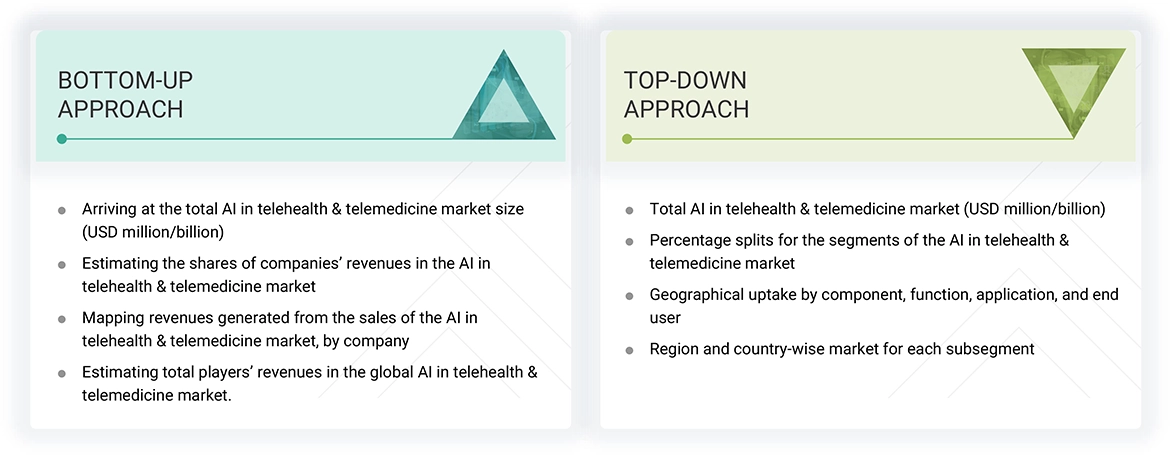
Both top-down and bottom-up approaches were used to estimate and validate the total size of the AI in telehealth & telemedicine market. These methods were also used extensively to estimate the size of various subsegments in the market. The research methodology used to estimate the market size includes the following:
- The key players in the industry and markets have been identified through extensive secondary research.
- In terms of value, the industry’s supply chain and market size have been determined through primary and secondary research processes.
- All percentage shares, splits, and breakdowns have been determined using secondary sources and verified through primary sources.
Data Triangulation
The market was split into several segments and subsegments after arriving at the overall market size using the market size estimation processes explained above. The data triangulation and market breakup procedures were employed, wherever applicable, to complete the overall market engineering process and arrive at the exact statistics of each market segment and subsegment. The data was triangulated by studying various factors and trends from both the demand and supply sides.
Market Definition
Telehealth:Telehealth represents a broad group of healthcare services, including care, education, and other services, made possible through various digital communication technologies; these services are facilitated by telecommunications equipment such as video conferencing, mobile applications, RPM devices, and wearable health technologies. Telehealth offers various services, including preventive care, chronic disease management, mental health support, and virtual consultations. The integration of AI in telehealth enhances remote care by enabling real-time monitoring, virtual assistants, diagnostics, personalized treatment, and predictive analytics.
Telemedicine: Telemedicine is a specific subset of telehealth focused exclusively on remote clinical services. It involves using electronic communications to diagnose, treat, and manage patients without requiring in-person visits. Telemedicine includes real-time video consultations, remote health data monitoring, and the store-and-forward method, where medical information is collected and sent to specialists for evaluation. NLP automates medical documentation and supports AI-powered virtual consultations, reducing administrative burdens on healthcare professionals.
Stakeholders
- Pharmaceutical & Biotechnology Companies
- CROs
- Technology & AI Companies
- Regulatory Authorities
- Hospitals & Healthcare Providers
- Patients & Patient Advocacy Groups
- Clinical Trial Investigators & Site Coordinators
- Data Management & Analytics Firms
- Academic Institutions & Research Organizations
- Investors & Venture Capital Firms
- Clinical Trial Software Providers
- Ethics Committees and Institutional Review Boards (IRBs)
- Insurance Companies
- Telehealth Software Providers
- RPM Solutions
- Healthcare IT Service Providers
Report Objectives
- To define, describe, and forecast the AI in telehealth & telemedicine market based on component, function, application, end user, and region
- To provide detailed information about the major factors (drivers, opportunities, restraints, and challenges) influencing the market growth
- To analyze opportunities for stakeholders by identifying the high-growth market segments
- To forecast the size of the market segments with respect to the five main regions: North America, Europe, the Asia Pacific, the Middle East & Africa, and Latin America
- To analyze subsegments of the market concerning individual growth trends, prospects, and contributions to the overall market
- To profile the key players and comprehensively analyze their market sizes and core competencies.
- To track and analyze competitive developments such as acquisitions, collaborations, agreements, mergers, product approvals, product launches & updates, partnerships, expansions, and other recent developments in the global market.
Get the Full AI in Telehealth & Telemedicine Market Report
Full forecast, segment splits, and company analysis for all AI in Telehealth & Telemedicine Market.
- US AI in Telehealth & Telemedicine Market
- Canada AI in Telehealth & Telemedicine Market
- Germany AI in Telehealth & Telemedicine Market
- UK AI in Telehealth & Telemedicine Market
- France AI in Telehealth & Telemedicine Market
- Italy AI in Telehealth & Telemedicine Market
- Spain AI in Telehealth & Telemedicine Market
- Japan AI in Telehealth & Telemedicine Market
- India AI in Telehealth & Telemedicine Market
- Brazil AI in Telehealth & Telemedicine Market
- Mexico AI in Telehealth & Telemedicine Market
- Rest Of Europe AI in Telehealth & Telemedicine Market
- Rest Of Asia Pacific AI in Telehealth & Telemedicine Market
- Rest Of Latin America AI in Telehealth & Telemedicine Market
Need a Tailored Report?
Customize this report to your needs
Get 10% FREE Customization
Customize This Report
