
South Africa AI Orchestration Market (2025-2030)

The South Africa AI Orchestration Market was valued at $59.7 Million in 2025 and projected to reach to $159.3 Million by 2030, representing a compound annual growth rate of 21.7%. South Africa's AI Orchestration Market is positioned for significant expansion as enterprises prioritize digital transformation and operational excellence.


| Market Size in | USD 26.32 MN |
| Market Forecast in | |
| CAGR | |
| Forecast Period | |
| Units Considered | Value (USD MN) |
South Africa AI Orchestration Market Trends and Insights
- This growth trajectory reflects South Africa's increasing adoption of intelligent automation technologies across enterprise sectors, driven by digital transformation initiatives and the need for operational efficiency.
- South Africa is positioning itself as a regional hub for AI-driven solutions, with organizations leveraging orchestration platforms to streamline complex workflows and enhance decision-making capabilities. The market dynamics in South Africa are shaped by rising cloud adoption, growing investment in AI infrastructure, and heightened demand from financial services, telecommunications, and manufacturing sectors.
- South Africa's enterprises are recognizing the strategic value of AI orchestration in reducing manual processes and accelerating time-to-market for digital services.
- Between 2025 and 2030, South Africa is expected to witness accelerated vendor competition and increased localization of AI orchestration solutions tailored to regional compliance and operational requirements..
Key Market Statistics
- CAGR (2025-2030) 21.7% CAGR
- Market Size, 2025 ~USD 59.7 Million
- Forecast, 2030 ~USD 159.3 Million
- Country South Africa
South Africa AI Orchestration Market Overview
Market Valuation Growth :
South Africa's AI Orchestration Market is valued at USD 59.7 million in 2025, with projections reaching USD 159.3 million by 2030, representing a robust 21.7% CAGR over the forecast period.
Digital Transformation Catalyst :
South African enterprises are increasingly adopting intelligent automation technologies to enhance operational efficiency and streamline complex business processes across banking, retail, and manufacturing sectors.
Competitive CAGR Performance :
South Africa's 21.7% CAGR is competitive relative to the global market growth rate of 22.3%, indicating strong regional momentum in AI orchestration adoption and investment.
Enterprise Automation Demand :
Growing demand for workflow automation, process optimization, and intelligent decision-making systems is driving South African organizations to invest in AI orchestration platforms and solutions.
South Africa AI Orchestration Market Dynamics
- The market's 21.7% CAGR reflects increasing recognition of AI orchestration's value in automating complex workflows, reducing operational costs, and improving decision-making capabilities across key sectors including financial services, telecommunications, and manufacturing. The trajectory from USD 59.7 million to USD 159.3 million by 2030 demonstrates sustained investment momentum in intelligent automation technologies.
- South African organizations are leveraging AI orchestration to address skills gaps, enhance productivity, and maintain competitive advantage in an increasingly digital economy.
- Government initiatives supporting digital innovation and enterprise modernization further support market growth prospects..
Market Ecosystem
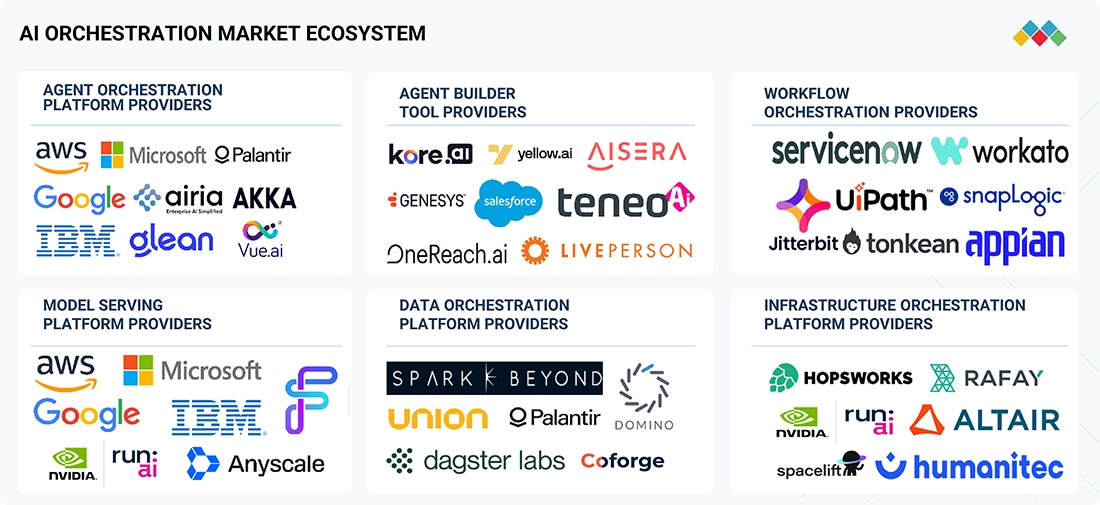
AI orchestration market: COMMERCIAL USE CASES ACROSS INDUSTRIES
| COMPANY | USE CASE DESCRIPTION | BENEFITS |
|---|---|---|
 |
Booking.com adopted Glean as its first company-wide AI platform to accelerate task automation, prompt creation, and agent customization to improve early AI literacy across functions. | 60% reduction in video-content creation timings, over 10 minutes saved by IT technicians per ticket resolution |
 |
Omega Healthcare partnered with UiPath to automate medical billing and other administrative tasks through AI-based enterprise search. | 15,000 hours/month saved, 50% faster turnaround, 40% less documentation time, 99.5% accuracy, 30% ROI for clients |
 |
Ma’aden used Microsoft’s agentic orchestration for content and knowledge tasks (drafting, analysis, internal comms) with enterprise controls. | Enhanced productivity, with users saving up to 2,200 hours monthly by drafting emails, creating documents, and data analysis became more efficient |
 |
United Airlines partnered with Palantir to build the Log Page Object, a compounding data asset that serves as foundation for maintenance actions, ranging from alerts to work decisions across fleet systems. | Saved 300 flight delays and 20 cancellations over the period reported, representing millions of dollars avoided impact |
 |
Deutsche Telekom partnered with Glean to develop an AI-powered employee concierge for secure, instant access to enterprise knowledge across customer support tickets. | Search time reduced from more than 2 minutes to approximately 18 seconds; auto-summarize 153 documents in 3.8 seconds; improved customer, HR, and internal workflows |
Logos and trademarks shown above are the property of their respective owners. Their use here is for informational and illustrative purposes only.
Related Ecosystem
Analytics
- Natural Language Processing (NLP)
- Machine Learning
- Supply Chain Management
- Predictive Analytics
- Image Sensors
- International Business Machines Corporation
- MICROSOFT CORPORATION
- Oracle Corporation
- SAP SE
Cloud Computing
- Software as A Service (SaaS)
- Natural Language Processing (NLP)
- Platform as A Service (PaaS)
- Machine Learning
- Supply Chain Management
- International Business Machines Corporation
- MICROSOFT CORPORATION
- Oracle Corporation
- Amazon.com, Inc.
Software And Services
- Natural Language Processing (NLP)
- Machine Learning
- Supply Chain Management
- Predictive Analytics
- Image Sensors
- International Business Machines Corporation
- MICROSOFT CORPORATION
- Oracle Corporation
- SAP SE
- Amazon.com, Inc.
Key Takeaways
- South Africa's AI Orchestration Market is projected to grow from USD 59.7M (2025) to USD 159.3M (2030) at a 21.7% CAGR.
- South Africa's financial services and telecommunications sectors are primary drivers of AI orchestration adoption and investment.
- South Africa is experiencing increased cloud infrastructure investment, enabling broader deployment of AI orchestration platforms.
- South Africa's regulatory environment and data localization requirements are shaping vendor strategies and solution customization.
AI Orchestration Market Report Scope
| Report Metric | Details |
|---|---|
| Base Year | 2025 |
| Fastest Growing Segment | ENTERPRISE KNOWLEDGE SEARCH (Application) |
| Forecast Period | 2025–2030 |
| Growth Rate | CAGR of 22.3% from 2025 to 2030 |
| Largest Segment | SOFTWARE (Offering) |
| Market Size Base Year (Billions) | ~USD 11.05 (2025) |
| Revenue Forecast (Billions) | ~USD 30.23 (2030) |
| Segments Covered | Offering, Software, Service, Orchestration Architecture, Deployment Model, Application, End User, Professional Service |
South Africa AI Orchestration Market Report Segmentation
8 segment dimensions are covered across the global market.
By Offering
- Services
- Software
By Software
- Agent Builder Tools
- Agent Orchestration Platforms
- Data Orchestration Platforms
- Infrastructure Orchestration Platforms
- Model Serving Platforms
- Workflow Orchestration Platforms
By Service
- Managed Services
- Professional Services
By Orchestration Architecture
- Centralized Orchestration
- Decentralized Orchestration
- Distributed Orchestration
- Hybrid Orchestration
By Deployment Model
- Customer Managed Cloud
- Multi-Tenant SaaS
- On-Premises & Air Gapped
- On-Premises & Air-Gapped
- Single Tenant SaaS
By Application
- Customer Service Automation
- Enterprise Knowledge Search
- Field Service & Asset Operations
- Finance & Procurement Automation
- Hr & Employee Service Desk
- It Service Management
- Marketing Automation
- Other Applications
- Sales & Revenue Automation
- Security Operations
- Software Engineering & Coding Automation
- Supply Chain Automation
By End User
- Automotive
- Bfsi
- Energy & Utilities
- Government & Defense
- Healthcare & Life Sciences
- Logistics & Transportation
- Manufacturing
- Media & Entertainment
- Other End Users
- Professional Service Providers
- Retail & Cpg
- Software & Technology Providers
- Telecommunications
By Professional Service
- Support & Maintenance
- System Integration & Implementation
- Training & Consulting
Target Audience
- Enterprise Technology Leaders : CIOs and IT directors in South African organizations need market data to justify AI orchestration investments, evaluate vendor solutions, and align automation strategies with business objectives.
- Solution Providers & Vendors : AI orchestration platform providers require South Africa-specific market intelligence to identify growth opportunities, assess competitive landscape, and develop localized go-to-market strategies.
- Management Consultants : Consulting firms advising South African enterprises on digital transformation need credible market data to support recommendations, validate business cases, and guide client investments.
- Investment & Financial Analysts : Investors, private equity firms, and financial analysts evaluating South African tech market opportunities require detailed market forecasts to assess growth potential and investment returns.
- Government & Policy Makers : South African government agencies and economic development bodies need market insights to inform digital economy policies, innovation initiatives, and technology sector development strategies.
Key Companies in the South Africa AI Orchestration Market
| Company | HQ | Ownership | Strongest segments |
|---|---|---|---|
| IBM | United States | Public Company | Software (Hybrid Cloud and AI Platforms),Consulting (Strategy, Technology, Intelligent Operations),Infrastructure (Servers, Storage, Lifecycle Services), |
| SALESFORCE | United States | Public Company | Sales Cloud and Agentforce Sales,Service Cloud and Agentforce Service / Field Service,Platform, Data 360, Informatica, Integration & Analytics, |
| ADOBE | United States | Public Company | Digital Media (Creative Cloud & Document Cloud),Digital Experience (Experience Cloud & Advertising),Publishing and Other, |
| MICROSOFT | United States | Public Company | Productivity and Business Processes,Intelligent Cloud,Personal Computing, |
| SAP | Germany | Public Company | SAP S/4HANA and core ERP,Human Experience Management (SuccessFactors and related),Spend Management and Business Network, |
| COFORGE | India | Public Company | Application Development & Maintenance / Managed Services,AI, ML & Intelligent Automation,Data & Analytics (incl. cloud data engineering), |
| SERVICENOW | United States | Public Company | IT Service Management & IT Operations Management,Security Operations & Integrated Risk Management,Customer & Field Service Management, |
| UIPATH | United States | Public Company | Core RPA and API Automation Platform,Process Orchestration and Intelligence (incl. Maestro),AI Agents, Intelligent Extraction, and Packaged Agentic Solutions, |
| NVIDIA | United States | Public Company | Data Center Accelerated Computing & AI Platforms,Networking Platforms,Gaming GPUs (GeForce), |
| LIVEPERSON | United States | Public Company | Core messaging and real-time chat platform,Conversational AI and automation (LLM-powered tools, conversation builder/manager),Professional services and hosted services, |
| GENESYS | United States | Private Company | Genesys Cloud CX (omnichannel engagement and routing),Workforce engagement and journey management,Professional and managed services, |
| PALANTIR | United States | Public Company | Gotham (defense, intelligence, ISR, mission systems),Foundry (government and critical-infrastructure data OS),Apollo (deployment and DevSecOps for mission software), |
IBM
IBM is a publicly traded American technology company founded in 1911 with 264,300 employees. It operates globally in computing, software, and IT services.
SALESFORCE
Salesforce is a publicly traded American software company founded in 1999 with 83,334 employees. It specializes in customer relationship management and cloud-based business solutions.
ADOBE
Adobe is a publicly traded American software company founded in 1982 with 31,360 employees. It develops creative, marketing, and document management applications.
MICROSOFT
Microsoft is a publicly traded American technology company founded in 1975 with 228,000 employees. It develops software, cloud services, and hardware products globally.
SAP
SAP is a publicly traded German software company founded in 1972 with 111,038 employees. It provides enterprise resource planning and business management solutions.
COFORGE
Coforge is a publicly traded Indian IT services company founded in 1992 with 25,620 employees. It provides digital transformation and technology consulting services.
SERVICENOW
ServiceNow is a publicly traded American software company founded in 2004 with 29,187 employees. It develops cloud-based workflow and IT service management solutions.
UIPATH
UiPath is a publicly traded American software company founded in 2005 with 3,981 employees. It specializes in robotic process automation and intelligent automation solutions.
NVIDIA
NVIDIA is a publicly traded American technology company founded in 1993 with 42,000 employees. It designs and manufactures graphics processing units and AI computing platforms.
LIVEPERSON
LivePerson is a publicly traded American software company founded in 1995 with 606 employees. It provides conversational AI and customer engagement solutions.
GENESYS
Genesys is a private American software company founded in 1990 with 730 employees. It develops customer experience and contact center solutions.
PALANTIR
Palantir is a publicly traded American software company founded in 2003 with 4,395 employees. It provides data integration, analytics, and artificial intelligence platforms.
Reasons to Buy this Report
- Market Size & Growth Validation : Obtain precise market valuation data for South Africa (USD 59.7M in 2025) with verified 5-year forecasts to support investment decisions, business planning, and competitive positioning strategies.
- Regional Opportunity Assessment : Understand South Africa-specific growth drivers, adoption patterns, and sector-wise demand to identify high-potential market segments and tailor go-to-market strategies for local enterprises.
- Competitive Intelligence : Benchmark South Africa's 21.7% CAGR against global performance (22.3%) to assess regional competitiveness, market maturity, and investment attractiveness compared to other emerging markets.
- Enterprise Decision Support : Leverage detailed South African market insights to guide technology investments, vendor selection, and digital transformation roadmaps aligned with regional market dynamics and growth trajectories.
- Strategic Planning & Forecasting : Access comprehensive 2025-2030 projections specific to South Africa to inform long-term business strategy, resource allocation, and revenue forecasting for AI orchestration initiatives.
Frequently asked questions
What is the current market size of AI Orchestration in South Africa?
South Africa's AI Orchestration Market was valued at USD 59.7 million in 2025 and is expected to grow significantly through 2030.
What is the projected growth rate for AI Orchestration in South Africa?
South Africa's AI Orchestration Market is expected to grow at a compound annual growth rate (CAGR) of 21.7% from 2025 to 2030.
Which industries are driving AI Orchestration adoption in South Africa?
South Africa's financial services, telecommunications, and manufacturing sectors are leading the adoption of AI orchestration solutions for workflow automation and operational efficiency.
What factors are accelerating AI Orchestration growth in South Africa?
South Africa's market growth is driven by digital transformation initiatives, cloud adoption, enterprise automation demands, and the need for competitive operational advantages.
What is the forecast market size for AI Orchestration in South Africa by 2030?
South Africa's AI Orchestration Market is projected to reach USD 159.3 million by 2030, representing significant expansion from 2025 levels.
RESEARCH METHODOLOGY
The research methodology for the global AI orchestration market report involved the use of extensive secondary sources and directories, as well as various reputed open-source databases, to identify and collect useful information for this technical and market-oriented study. In-depth interviews were conducted with various primary respondents, including agent orchestration platform providers, agent builder tool vendors, workflow orchestration platform providers, data orchestration platform providers, model serving platform providers, and infrastructure orchestration platform providers; enterprise end users; high-level executives of multiple companies offering AI orchestration software & services; and industry consultants to obtain and verify critical qualitative and quantitative information and assess the market prospects and industry trends.
Secondary Research
During the secondary research process, various secondary sources were consulted to identify and collect information for the study. The secondary sources included annual reports; press releases and investor presentations of companies; white papers; and certified publications such as Journal of Artificial Intelligence Research (JAIR), Transactions of the Association for Computational Linguistics (TACL), Journal of Machine Learning Research (JMLR), IEEE Transactions on Neural Networks and Learning Systems, Nature Machine Intelligence, Artificial Intelligence Journal (AIJ), ACM Transactions on Information Systems (TOIS), Pattern Recognition Journal, and Neural Computation (MIT Press); and articles from recognized associations and government publishing sources including but not limited to Association for Computational Linguistics (ACL), International Association for Machine Learning (IAMLE), Artificial Intelligence Industry Association (AIIA), International Speech Communication Association (ISCA), Natural Language Processing Association (NLPA), Machine Learning and AI Industry Research Association (MLAIRA), and AI Infrastructure Alliance (AIIA).
The secondary research was used to obtain key information about the industry’s value chain, the market’s monetary chain, the overall pool of key players, market classification and segmentation according to industry trends, and regional markets, as well as key developments from both market and technology-oriented perspectives.
Primary Research
In the primary research process, a diverse range of stakeholders from the supply and demand sides of the AI orchestration ecosystem were interviewed to gather qualitative and quantitative insights specific to this market. Key industry experts, including chief executive officers (CEOs), vice presidents (VPs), marketing directors, technology & innovation directors, as well as technical leads from vendors offering AI orchestration software & services, were consulted on the supply side. Additionally, system integrators, service providers, and IT service firms that implement and support AI orchestration were included in the study. On the demand side, input was collected from IT decision-makers, infrastructure managers, and business heads of prominent enterprise end-users to understand user perspectives and adoption challenges within targeted industries.
The primary research ensured that all crucial parameters affecting the AI orchestration market, from technological advancements and evolving use cases (customer service automation, sales & revenue automation, marketing automation, IT service management, security operations, etc.) to regulatory and compliance needs (GDPR, CCPA, Europe AI Act, AIDA, etc.) were considered. Each factor was thoroughly analyzed, verified through primary research, and evaluated to obtain precise quantitative and qualitative data for this market.
Once the initial phase of market engineering was completed, including detailed calculations for market statistics, segment-specific growth forecasts, and data triangulation, an additional round of primary research was undertaken. This step was crucial for refining and validating critical data points, such as AI orchestration offerings (software & services), industry adoption trends, the competitive landscape, and key market dynamics, such as demand drivers (enterprise shift from reactive chat to governed, outcome-linked automation, AI orchestration reducing cost-to-serve and time-to-resolution by executing system actions, need for a common governance layer across apps to centralize approvals, lineage, and policy enforcement, stringent focus on regulatory compliance pushing buyers toward governed AI orchestration), challenges (enterprise app sprawl across multi-cloud environments causing vendor lock-in concerns, end-to-end observability across multi-agent orchestration remains complex), and opportunities (demand for sovereign and air-gapped AI orchestration in public sector and regulated industries, replacement of overlapping RPA, iPaaS, and workflow stacks with AI orchestration suites, prebuilt template libraries and certified action packs accelerating ROI cycles for mid-market).
In the comprehensive market engineering process, the top-down and bottom-up approaches, along with several data triangulation methods, were extensively employed to perform market estimation and forecasting for the overall market segments and subsegments listed in this report. Extensive qualitative and quantitative analysis was performed on the complete market engineering process to record the critical information/insights throughout the report.
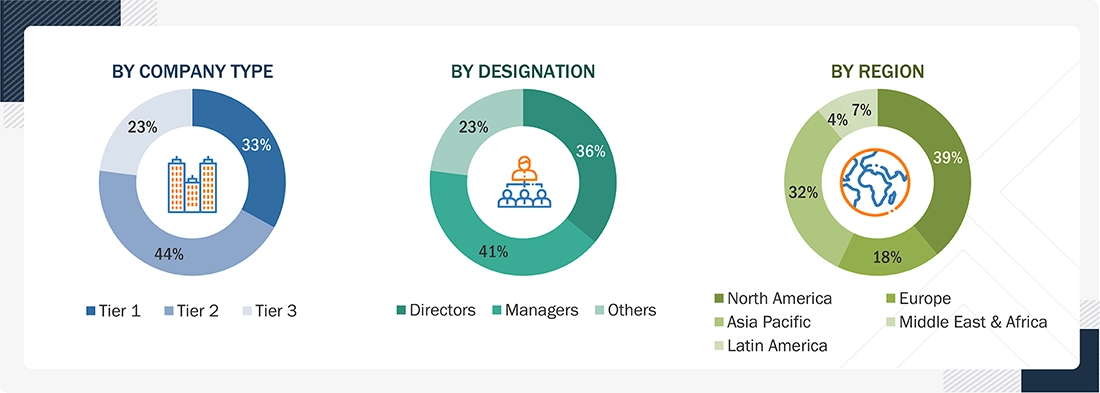
Note: Three tiers of companies are defined based on their total revenue as of 2024; tier 1 = revenue more than USD
500 million, tier 2 = revenue between USD 500 million and 100 million, tier 3 = revenue less than USD 100 million
Source: MarketsandMarkets Analysis
To know about the assumptions considered for the study, download the pdf brochure
Market Size Estimation
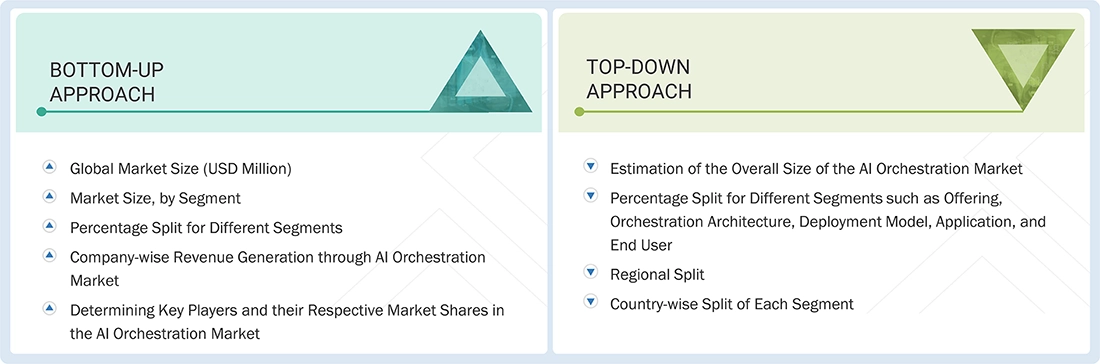
The top-down and bottom-up approaches were employed to estimate and forecast the AI orchestration market, as well as its dependent submarkets. This multi-layered analysis was further reinforced through data triangulation, which incorporated primary and secondary research inputs. The market figures were also validated against the existing MarketsandMarkets repository for accuracy.
AI Orchestration Market : Top-Down and Bottom-Up Approach
Data Triangulation
The market was divided into several segments and subsegments after determining the overall market size using the market size estimation processes described above. To complete the overall market engineering process and determine the exact statistics for each market segment and subsegment, data triangulation and market segmentation procedures were employed, wherever applicable. The overall market size was then used in the top-down approach to estimate the size of other individual markets by applying percentage splits to the market segmentation.
Market Definition
AI orchestration is defined as the policy-driven coordination of models, data services, tools, and workflows across the AI lifecycle, enabling composite systems to plan, execute, and improve business tasks with reliability, control, and scale. It spans ingestion and permissions-aware retrieval, model and tool selection, multi-step workflow routing, governed writebacks to enterprise systems, and continuous monitoring for quality, cost, and risk. AI orchestration covers assistant and agent control planes, workflow engines and schedulers, tool and action catalogs, observability and evaluation layers, and connectors into CRM, ERP, ITSM, data warehouses, and developer platforms.
Stakeholders
- AI orchestration software providers
- AI orchestration service providers
- AI dataset providers
- AI agent vendors
- iPaaS vendors
- Generative AI solution providers
- Business analysts
- Cloud service providers
- Enterprise end users
- Distributors and value-added resellers (VARs)
- Government agencies
- Independent software vendors (ISV)
- Managed service providers
- Market research and consulting firms
- Support & maintenance service providers
- System integrators (SIs)/migration service providers
- Technology providers
- Academia & research institutions
- Investors & venture capital firms
Report Objectives
- To define, describe, and forecast the AI orchestration market, by offering, orchestration architecture, application, deployment model, and end user
- To provide detailed information related to major factors (drivers, restraints, opportunities, and industry-specific challenges) influencing market growth
- To analyze the micro markets concerning the individual growth trends, prospects, and their contribution to the total market
- To analyze the opportunities in the market for stakeholders by identifying the high-growth segments of the AI orchestration market
- To assess opportunities in the market and provide details of the competitive landscape for stakeholders and market leaders
- To forecast the market size of segments for five main regions: North America, Europe, Asia Pacific, the Middle East & Africa, and Latin America
- To profile the key players and comprehensively analyze their market ranking and core competencies
- To analyze competitive developments, such as partnerships, product launches, and mergers & acquisitions, in the AI orchestration market
- To analyze the impact of macroeconomic factors on the AI orchestration market across all regions
Available Customizations
With the given market data, MarketsandMarkets offers customizations based on the company’s specific needs. The following customization options are available for the report.
Product Analysis
- Product comparative analysis, which gives a detailed comparison of innovative products being offered by prominent vendors
Geographic Analysis as per Feasibility
- Further breakup of additional countries in Europe AI orchestration market, by offering, orchestration architecture, deployment model, application, and end user
- Further breakup of additional countries in Asia Pacific AI orchestration market, by offering, orchestration architecture, deployment model, application, and end user
- Further breakup of additional countries in Middle East & Africa AI orchestration market, by offering, orchestration architecture, deployment model, application, and end user
- Further breakup of additional countries in Latin American AI orchestration market, by offering, orchestration architecture, deployment model, application, and end user
Company Information
- Detailed analysis and profiling of additional market players (up to five)
Get the Full AI Orchestration Market Report
Full forecast, segment splits, and company analysis for all AI Orchestration Market.
- France AI Orchestration Market
- Italy AI Orchestration Market
- Spain AI Orchestration Market
- Netherlands AI Orchestration Market
- China AI Orchestration Market
- India AI Orchestration Market
- Japan AI Orchestration Market
- South Korea AI Orchestration Market
- Singapore AI Orchestration Market
- Saudi Arabia AI Orchestration Market
- UAE AI Orchestration Market
- Turkey AI Orchestration Market
- Qatar AI Orchestration Market
- Brazil AI Orchestration Market
- Mexico AI Orchestration Market
- Argentina AI Orchestration Market
- Rest Of Europe AI Orchestration Market
- Anz AI Orchestration Market
- Rest Of Asia Pacific AI Orchestration Market
- Canada AI Orchestration Market
- US AI Orchestration Market
- UK AI Orchestration Market
- Germany AI Orchestration Market
Need a Tailored Report?
Customize this report to your needs
Get 10% FREE Customization
Customize This Report
