
Asia Pacific AI SDR Market (2025-2030)

The Asia Pacific AI SDR Market was valued at $1011.6 Million in 2025 and projected to reach to $4298 Million by 2030, representing a compound annual growth rate of 33.6%. Asia Pacific is positioned as a high-growth epicenter for AI Sales Development Representative solutions, driven by accelerating digital transformation across enterprise sales functions and increasing AI adoption rates.


| Market Size in | USD 26.32 MN |
| Market Forecast in | |
| CAGR | |
| Forecast Period | |
| Units Considered | Value (USD MN) |
Asia Pacific AI SDR Market Trends and Insights
- The region is experiencing accelerated digital transformation across enterprise sales functions, driven by increasing adoption of AI-powered automation and the rising demand for scalable sales infrastructure.
- Asia Pacific's AI SDR market is projected to expand significantly to $4,298 million by 2030, representing a compound annual growth rate of 33.6%—substantially outpacing global growth trends. The expansion of Asia Pacific's AI SDR market is fueled by rapid economic growth, expanding software-as-a-service (SaaS) adoption, and the region's large pool of technology-forward enterprises.
- Asia Pacific organizations are increasingly investing in AI-driven sales tools to enhance productivity, reduce customer acquisition costs, and compete in fast-moving digital markets.
- The region's diverse market landscape—spanning developed economies like Singapore and Australia alongside high-growth markets such as India and Southeast Asia—creates varied opportunities for AI SDR solution providers. By 2030, Asia Pacific is expected to solidify its position as a critical growth engine within the global AI SDR ecosystem.
- The region's combination of digital infrastructure maturity, venture capital investment, and enterprise modernization initiatives positions Asia Pacific as a strategic priority for vendors and investors seeking exposure to next-generation sales technology markets..
Key Market Statistics
- CAGR (2025-2030) 33.6% CAGR
- Market Size, 2025 ~USD 1011.6 Million
- Forecast, 2030 ~USD 4298 Million
- Geography Asia Pacific
Asia Pacific AI SDR Market Overview
Rapid Market Expansion :
Asia Pacific's AI SDR market is projected to grow from $1,011.6 million in 2025 to $4,298 million by 2030, representing a robust 33.6% CAGR—outpacing the global average of 29.5%.
Digital Transformation Momentum :
Enterprise organizations across Asia Pacific are accelerating digital transformation initiatives in sales functions, driving widespread adoption of AI-powered automation and intelligent sales infrastructure.
Scalability Demand :
Rising demand for scalable sales infrastructure is fueling AI SDR adoption as companies seek cost-effective solutions to manage growing sales pipelines and improve operational efficiency.
Regional Growth Leaders :
China ($970.9M), Japan ($741.3M), and South Korea ($490.3M) represent the largest individual markets, while ASEAN nations and ANZ regions contribute significantly to regional expansion.
Asia Pacific AI SDR Market Dynamics
- The region's 33.6% CAGR significantly exceeds global growth, reflecting strong market fundamentals and enterprise investment in sales automation technologies. Key growth catalysts include rising demand for scalable sales infrastructure, competitive pressures driving automation adoption, and the emergence of AI-native sales practices across major economies.
- As organizations prioritize efficiency and revenue growth, AI SDR solutions are becoming critical components of modern sales stacks throughout Asia Pacific..
Market Ecosystem
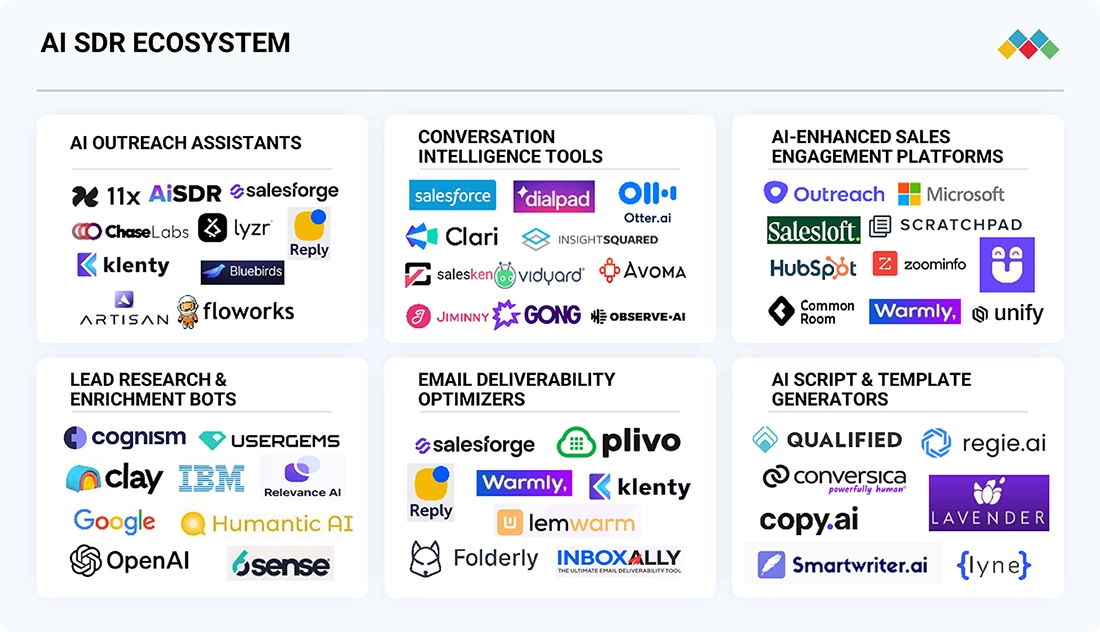
AI SDR Market: COMMERCIAL USE CASES ACROSS INDUSTRIES
| COMPANY | USE CASE DESCRIPTION | BENEFITS |
|---|---|---|
 |
Keatext boosts lead quality and sales alignment using HubSpot Sales Hub Integration | Increased sales demos by 50%, driven by better workflows and integration, which enhanced marketing team’s key performance metrics. |
 |
Artisan empowers BioAccess to overcome manual outreach challenges with AI-driven sales automation | Automated 80% of outbound sales tasks, allowing team to focus on building customer relationships and closing deals. |
 |
Spendesk supercharges outreach with Salesloft platform for 10x response boost | By organizing and personalizing outreach, Spendesk achieved 10x increase in reply rates to its prospecting emails. |
 |
Netskope SDRs transform prospecting with 6Sense contact data and insights | Real-time insights into prospect research enable SDRs to tailor messaging, leading to more relevant and effective initial conversations with potential buyers. |
Logos and trademarks shown above are the property of their respective owners. Their use here is for informational and illustrative purposes only.
Related Ecosystem
Analytics
- Natural Language Processing (NLP)
- Machine Learning
- Supply Chain Management
- Predictive Analytics
- Image Sensors
- International Business Machines Corporation
- MICROSOFT CORPORATION
- Oracle Corporation
- SAP SE
Software And Services
- Natural Language Processing (NLP)
- Machine Learning
- Supply Chain Management
- Predictive Analytics
- Image Sensors
- International Business Machines Corporation
- MICROSOFT CORPORATION
- Oracle Corporation
- SAP SE
- Amazon.com, Inc.
Marketing
- Machine Learning
- Natural Language Processing (NLP)
- Predictive Analytics
- SAP SE
- Oracle Corporation
- MICROSOFT CORPORATION
- Adobe Inc.
- Salesforce, Inc.
Key Takeaways
- Asia Pacific's AI SDR market is valued at $1,011.6 million in 2025 and is forecast to reach $4,298 million by 2030, growing at a 33.6% CAGR.
- Asia Pacific is outpacing global AI SDR growth, driven by rapid digital transformation, SaaS adoption, and enterprise modernization across the region.
- The region's diverse economic landscape—from mature markets like Singapore and Australia to high-growth economies like India—creates differentiated opportunities for AI SDR vendors.
- Asia Pacific enterprises are prioritizing AI-driven sales automation to enhance productivity, reduce customer acquisition costs, and maintain competitive advantage in digital-first markets.
AI SDR Market Report Scope
| Report Metric | Details |
|---|---|
| Base Year | 2025 |
| Fastest Growing Segment | PROFESSIONAL SERVICE PROVIDERS (Enterprise End User) |
| Forecast Period | 2025–2030 |
| Growth Rate | CAGR of 29.5% from 2025 to 2030 |
| Largest Segment | MARKETING APPLICATIONS (Application) |
| Market Size Base Year (Billions) | ~USD 4.12 (2025) |
| Revenue Forecast (Billions) | ~USD 15.01 (2030) |
| Segments Covered | Offering, Software, Service, Deployment Model, Sales Channel, Use Case, Enterprise Type, Industry Vertical, End User, Enterprise End User, Application |
Asia Pacific AI SDR Market Report Segmentation
11 segment dimensions are covered across the global market.
By Offering
- `Software
- Horizontal AI Agents
- Marketing
- Sales
- Services
- Software
- Vertical AI Agents
By Software
- AI Outreach Assistants
- AI Script & Template Generators
- AI-Enhanced Sales Engagement Platforms
- Conversation Intelligence Tools
- Email Deliverability Optimizers
- Lead Research & Enrichment Bots
By Service
- AI Personalization & Prompt Consulting
- Delivery & Spam Audit Services
- Workflow Automation Setup & Integration
By Deployment Model
- Api-First Modular Embeds
- Chrome Extensions
- Cloud-Native SaaS
By Sales Channel
- Hybrid
- Inbound
- Outbound
By Use Case
- Crm Integration & Data Management
- Follow-Up & Nurturing
- Integration Environment
- Lead Generation & Qualification
- Meeting & Appointment Scheduling
- Prospecting & Outreach
- Research, Coaching, & Sdr Enablement
- Sales Reporting & Analytics
By Enterprise Type
- Enterprise Sdr Teams
- Mid-Market Sales Organizations
- Startups & Smbs
By Industry Vertical
- Automotive, Transportation, & Logistics
- Bfsi
- Education
- Healthcare & Life Sciences
- Manufacturing
- Media & Entertainment
- Other Industry Verticals
- Real Estate & Construction
- Retail & E-Commerce
- Telecommunications
- Travel & Hospitality
By End User
- Consumers
- Enterprises
- Individual Users
By Enterprise End User
- Automotive
- Bfsi
- Education
- Government & Public Sector
- Healthcare & Life Sciences
- Law Firms
- Manufacturing
- Media & Entertainment
- Other Enterprise End Users
- Other Enterprises
- Professional Service Providers
- Retail & E-Commerce
- Technology & Software
- Technology Providers
- Telecommunications
- Travel & Hospitality
By Application
- Marketing Applications
- Sales Applications
Target Audience
- AI SDR Solution Providers : Vendors and SaaS companies need Asia Pacific market intelligence to identify expansion opportunities, understand regional demand drivers, and develop localized go-to-market strategies.
- Enterprise Sales Leaders : CROs and VP Sales require insights into AI SDR adoption trends and competitive landscape to evaluate technology investments and optimize sales infrastructure decisions.
- Investment & Private Equity Firms : Investors evaluating AI sales technology companies need regional market data to assess growth potential, market sizing, and investment thesis validation for Asia Pacific expansion.
- Management Consultants : Consulting firms advising enterprises on digital transformation require detailed market analysis to support client recommendations on sales automation and AI technology adoption.
- Market Researchers & Analysts : Research professionals and business intelligence teams need comprehensive Asia Pacific data to support competitive analysis, trend forecasting, and strategic planning initiatives.
Key Companies in the Asia Pacific AI SDR Market
| Company | HQ | Ownership | Strongest segments |
|---|---|---|---|
| HUBSPOT | United States | Public Company | Email Generators & Template Generators,AI Script & Sales Engagement Automation,Enrichment & Data Management, |
| SALESFORCE | United States | Public Company | Email Generators & Template Generators,Enrichment & Data Management,AI Script & Sales Engagement Automation, |
| ZOOMINFO | United States | Public Company | Enrichment & Data Management for SDR,Prospecting & Research (Copilot, Sales),Email, Script & Template Generators, |
| CLARI | United Kingdom | Public Company | Enrichment,Research,CRMs & Data Management, |
| MICROSOFT | United States | Public Company | Email Generators & Template Generators,Enrichment & Data Management,AI Script & Sales Engagement, |
HUBSPOT
HubSpot is a publicly traded American software company founded in 2005 that employs 9,021 people. The company provides customer relationship management and marketing automation solutions.
SALESFORCE
Salesforce is a publicly traded American cloud computing company founded in 1999 with 83,334 employees. It is a leading provider of customer relationship management and enterprise cloud solutions.
ZOOMINFO
ZoomInfo is a publicly traded American software company founded in 2007 with 3,180 employees. It provides B2B contact and company intelligence data and sales acceleration software.
CLARI
Clari is a publicly traded company based in the United Kingdom founded in 1864 with 12,000 employees. The company provides revenue intelligence and forecasting solutions for enterprises.
MICROSOFT
Microsoft is a publicly traded American technology company founded in 1975 with 228,000 employees. It is a global leader in software, cloud computing, and enterprise solutions.
Countries within Asia Pacific - compare and drill down
| Country | 2025 size (native) |
|---|---|
| China | USD 970.9 Million |
| Japan | USD 741.3 Million |
| India | USD 385 Million |
| South Korea | USD 490.3 Million |
| Anz | USD 540.3 Million |
| Asean | USD 1051.2 Million |
| Indonesia | USD 145.9 Million |
| Malaysia | USD 277.1 Million |
| Singapore | USD 410.8 Million |
| Rest Of Asia Pacific | USD 119.2 Million |
Country market size visualization
Reasons to Buy this Report
- Regional Growth Intelligence : Gain comprehensive insights into Asia Pacific's 33.6% CAGR trajectory and understand market dynamics specific to the region's fastest-growing economies and emerging markets.
- Country-Level Granularity : Access detailed market sizing for China, Japan, India, South Korea, and ASEAN nations to identify high-potential markets and tailor go-to-market strategies by geography.
- Competitive Positioning : Benchmark your organization against regional competitors and understand how Asia Pacific's market growth outpaces global averages, informing strategic expansion decisions.
- Investment Decision Support : Make data-driven investment and resource allocation decisions with forecasts extending to 2030, enabling long-term strategic planning for Asia Pacific operations.
- Enterprise Adoption Trends : Understand digital transformation momentum and AI adoption patterns across Asia Pacific enterprises to identify customer segments and tailor solution positioning effectively.
Frequently asked questions
What is the current size of the Asia Pacific AI SDR market?
The Asia Pacific AI SDR market is valued at $1,011.6 million in 2025 and is projected to grow to $4,298 million by 2030.
What is the growth rate of the Asia Pacific AI SDR market?
Asia Pacific's AI SDR market is growing at a compound annual growth rate (CAGR) of 33.6% from 2025 to 2030.
Which countries in Asia Pacific are driving AI SDR adoption?
Key markets include India, Singapore, Australia, Japan, and Southeast Asian nations, which are experiencing rapid SaaS adoption and enterprise digital transformation.
What factors are accelerating AI SDR adoption in Asia Pacific?
Key drivers include rapid economic growth, increasing SaaS penetration, enterprise modernization initiatives, rising labor costs, and competitive pressure to adopt AI-powered sales automation.
How does Asia Pacific's AI SDR growth compare to global trends?
Asia Pacific's 33.6% CAGR significantly exceeds the global AI SDR market CAGR of 29.5%, positioning the region as a high-growth market within the global ecosystem.
RESEARCH METHODOLOGY
This research study on the AI SDR market involved extensive secondary sources, directories, IEEE Communication-efficient Algorithms and Systems, International Journal of Innovation and Technology Management, and paid databases. Primary sources were mainly industry experts from the core and related industries, preferred AI SDR providers, third-party service providers, consulting service providers, end users, and other commercial enterprises. In-depth interviews with primary respondents, including key industry participants and subject matter experts, were conducted to obtain and verify critical qualitative and quantitative information and assess the market’s prospects.
Secondary Research
In the secondary research process, various sources were referred to identify and collect information for this study. Secondary sources included annual reports, press releases, and investor presentations of companies; white papers, journals, and certified publications; and articles from recognized authors, directories, and databases. The data was also collected from other secondary sources, such as journals, government websites, blogs, and vendors’ websites. Additionally, the AI SDR spending of various countries was extracted from the respective sources.
Primary Research
In the primary research process, various sources from the supply and demand sides were interviewed to obtain qualitative and quantitative information on the market. The primary sources from the supply side included various industry experts, such as Chief Experience Officers (CXOs), Vice Presidents (VPs), and directors specializing in business development, marketing, and AI SDR providers. It also included key executives from AI SDR software and service vendors, system integrators (SIs), professional service providers, industry associations, and other key opinion leaders.
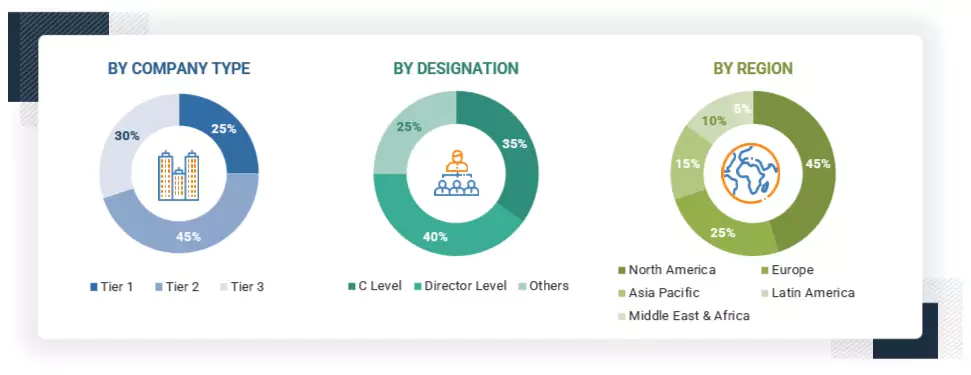
Note: Tier 1 companies’ revenues are more than USD 10 billion; tier 2 companies’ revenues range between
USD 1 and 10 billion; and tier 3 companies’ revenues range between USD 500 million and USD 1 billion.
Other designations include sales managers, marketing managers, and product managers.
Source: Industry Experts
To know about the assumptions considered for the study, download the pdf brochure
Market Size Estimation
Multiple approaches were adopted to estimate and forecast the AI SDR market. The first approach involved estimating the market size by companies’ revenue generated through the sale of AI SDR products.
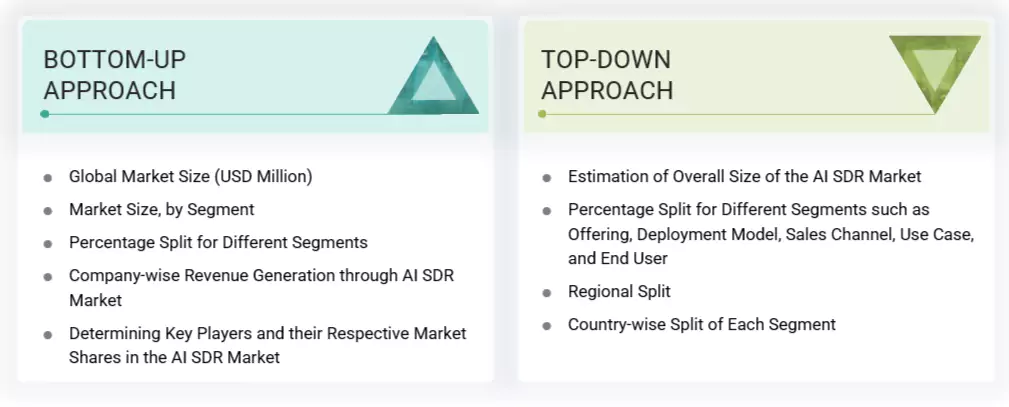
Market Size Estimation Methodology- Top-down approach
In the top-down approach, an exhaustive list of all the vendors offering products in the AI SDR market was prepared. The revenue contribution of the market vendors was estimated through annual reports, press releases, funding, investor presentations, paid databases, and primary interviews. Each vendor’s offerings were evaluated based on platform, degree of customization, type, application, end user, and region. The markets were triangulated through primary and secondary research. The primary procedure included extensive interviews for key insights from industry leaders, such as CIOs, CEOs, VPs, directors, and marketing executives. The market numbers were further triangulated with the existing MarketsandMarkets’ repository for validation.
Market Size Estimation Methodology-Bottom-up approach
In the bottom-up approach, the adoption rate of AI SDR products across various verticals in key countries within their respective regions was identified as the main contributor to the market share. Cross-validation revealed the adoption of AI SDR products among enterprises, along with various use cases by region. Weightage was given to use cases identified in different regions for the market size calculation. Based on the market numbers, the regional split was determined by primary and secondary sources. The procedure included analyzing the AI SDR market’s regional penetration. Based on secondary research, the regional spending on Information and Communications Technology (ICT), socio-economic analysis of each country, strategic vendor analysis of major AI SDR providers, and organic and inorganic business development activities of regional and global players were estimated.
AI SDR Market : Top-Down and Bottom-Up Approach
Data Triangulation
After determining the overall market size using the market size estimation processes as explained above, the market was split into several segments and subsegments. Data triangulation and market breakup procedures were employed, wherever applicable, to complete the overall market engineering process and determine the exact statistics of each market segment and subsegment. The overall market size was used in the top-down procedure to estimate the size of other individual markets via percentage splits of the market segmentation.
Market Definition
According to Salesforce, an AI SDR (AI-powered Sales Development Representative) is an autonomous agent that uses machine learning, natural language processing, and automation to handle top-of-funnel sales tasks. These include automating outreach, qualifying leads, engaging prospects, and scheduling meetings, all in real-time and at scale. By managing repetitive, data-driven activities 24/7, AI SDRs free up human sales teams to focus on creative problem-solving and relationship-building, enhancing overall sales productivity and efficiency.
Stakeholders
- AI SDR providers
- Distributors and value-added resellers (VARs)
- Independent software vendors (ISVs)
- Service providers
- Support & maintenance service providers
- System integrators (SIs)
- Technology providers
- Sales teams & SDR managers
- Sales enablement teams
- Revenue operations teams
Report Objectives
- To define, describe, and forecast the AI SDR market by offering, deployment model, sales channel, use case, end user, and region
- To provide detailed information about major factors (drivers, restraints, opportunities, and industry-specific challenges) influencing market growth
- To analyze opportunities in the market and provide details of the competitive landscape for stakeholders and market leaders
- To forecast the market size of segments for North America, Europe, Asia Pacific, the Middle East & Africa, and Latin America
- To profile key players and comprehensively analyze their market rankings and core competencies
- To analyze competitive developments, such as partnerships, product launches, and mergers & acquisitions, in the AI SDR market
Available Customizations
With the given market data, MarketsandMarkets offers customizations to meet the company’s specific needs. The following customization options are available for the report:
Product Analysis
- The product matrix provides a detailed comparison of each company's product portfolio.
Geographic Analysis as per Feasibility
- Further breakup of the North American AI SDR market
- Further breakup of the European AI SDR market
- Further breakup of the Asia Pacific AI SDR market
- Further breakup of the Middle East & African AI SDR market
- Further breakup of the Latin American AI SDR market
Company Information
- Detailed analysis and profiling of additional market players (up to five)
Get the Full AI SDR Market Report
Full forecast, segment splits, and company analysis for all AI SDR Market.
- US AI SDR Market
- Canada AI SDR Market
- UK AI SDR Market
- Germany AI SDR Market
- France AI SDR Market
- Italy AI SDR Market
- Spain AI SDR Market
- China AI SDR Market
- Japan AI SDR Market
- India AI SDR Market
- South Korea AI SDR Market
- Saudi Arabia AI SDR Market
- UAE AI SDR Market
- Qatar AI SDR Market
- Turkey AI SDR Market
- Brazil AI SDR Market
- Mexico AI SDR Market
- Argentina AI SDR Market
- Rest Of Europe AI SDR Market
- Anz AI SDR Market
- Asean AI SDR Market
- Rest Of Asia Pacific AI SDR Market
- Rest Of Latin America AI SDR Market
- Rest Of Middle East AI SDR Market
- Indonesia AI SDR Market
- Malaysia AI SDR Market
- Rest Of Asean AI SDR Market
- Singapore AI SDR Market
Need a Tailored Report?
Customize this report to your needs
Get 10% FREE Customization
Customize This Report
