
US Airport Navigational Aids (NAVAIDs) Market (2026-2031)

The US Airport Navigational Aids (NAVAIDs) Market was valued at $724.1 Million in 2026 and projected to reach to $880.5 Million by 2031, representing a compound annual growth rate of 4.0%. The US Airport NAVAIDs market is positioned for steady growth through 2031, driven by mandatory FAA infrastructure modernization programs and the aging fleet of navigation systems requiring replacement.


| Market Size in | USD 26.32 MN |
| Market Forecast in | |
| CAGR | |
| Forecast Period | |
| Units Considered | Value (USD MN) |
US Airport Navigational Aids (NAVAIDs) Market Trends and Insights
- The US market benefits from aging infrastructure modernization initiatives, increased air traffic demand, and regulatory compliance requirements mandated by the Federal Aviation Administration (FAA).
- The US represents a mature but steadily expanding market driven by capital investments in airport terminal upgrades and precision landing system enhancements. Growth in the US market is supported by the nation's extensive network of commercial and regional airports requiring continuous NAVAID system upgrades and maintenance.
- The US government's commitment to NextGen air traffic management systems and safety modernization programs continues to fuel demand for advanced navigational equipment.
- Between 2026 and 2031, the US market will experience incremental expansion as airports prioritize operational efficiency and safety compliance..
Key Market Statistics
- CAGR (2026-2031) 4.0% CAGR
- Market Size, 2026 ~USD 724.1 Million
- Forecast, 2031 ~USD 880.5 Million
- Country US
US Airport Navigational Aids (NAVAIDs) Market Overview
Market Size & Growth :
The US Airport NAVAIDs market is valued at $724.1 million in 2026 and is projected to reach $880.5 million by 2031, representing a steady CAGR of 4.0% over the forecast period.
FAA Regulatory Drivers :
Federal Aviation Administration (FAA) compliance requirements and modernization mandates are primary growth catalysts, compelling US airports to upgrade aging navigation infrastructure to meet current safety and operational standards.
Infrastructure Modernization :
Aging airport infrastructure across the US is undergoing significant modernization initiatives, with NAVAIDs replacement and upgrades representing critical investments in NextGen aviation technology implementation.
Air Traffic Demand :
Increased domestic and international air traffic demand in the US is driving the need for enhanced navigational aid systems to support higher operational capacity and improved safety protocols at commercial and regional airports.
US Airport Navigational Aids (NAVAIDs) Market Dynamics
- Regional airports and major hubs are prioritizing upgrades to support NextGen implementation and enhanced operational efficiency.
- Investment in advanced landing systems, precision approach aids, and integrated navigation solutions will accelerate as airports compete for capacity and safety improvements.
- The market will benefit from federal funding initiatives and private airport investments aimed at maintaining competitive advantage in the evolving aviation landscape..
Market Ecosystem
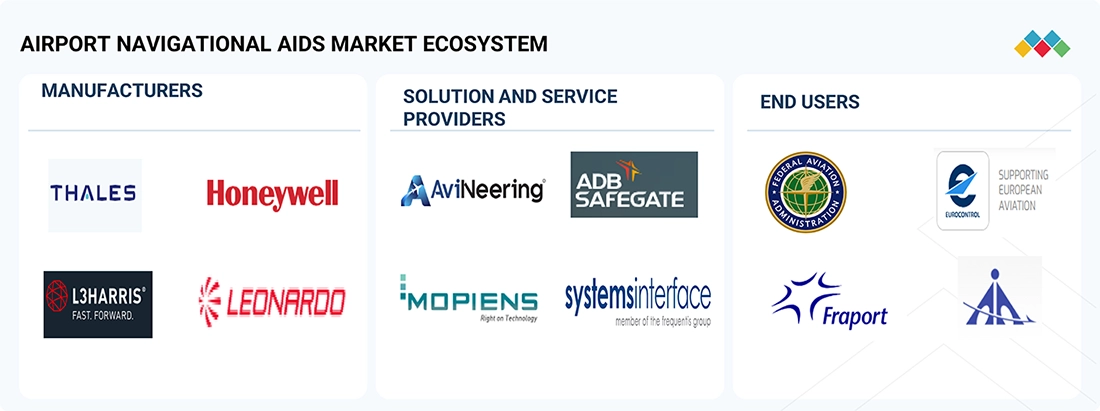
AIRPORT NAVIGATION AIDS (NAVAIDS) MARKET: COMMERCIAL USE CASES ACROSS INDUSTRIES
| COMPANY | USE CASE DESCRIPTION | BENEFITS |
|---|---|---|
 |
Supply of Instrument Landing Systems (ILS), Distance Measuring Equipment (DME), Very High Frequency Omnidirectional Range (VOR), and Tactical Air Navigation (TACAN) systems for airport navigation and landing operations | Improves landing accuracy, supports aircraft operations during low-visibility conditions, enhances flight safety, and strengthens airport operational reliability |
 |
Provision of navigation aid systems and air traffic management solutions for commercial airports and military airbases | Improves airspace management, supports efficient aircraft movements, enhances airport operational efficiency, and strengthens navigation performance |
 |
Supply of navigation, landing, and airfield systems for airport infrastructure and aviation operations | Supports safe aircraft approach and landing, improves operational continuity, and enhances navigation accuracy, reduces operational disruptions |
 |
Development and integration of navigation, surveillance, and airport infrastructure systems for civil and defense aviation applications | Improves situational awareness, supports safe aircraft operations, enhances airport monitoring capabilities, and strengthens air traffic management functions |
 |
Provision of air traffic management and navigation infrastructure solutions for airports and defense aviation facilities | Improves air traffic flow, supports efficient airport operations, enhances navigation system reliability, and strengthens coordination between aircraft and air traffic controllers |
Logos and trademarks shown above are the property of their respective owners. Their use here is for informational and illustrative purposes only.
Related Ecosystem
Key Takeaways
- The US NAVAID market is valued at $724.1 million in 2026 and will reach $880.5 million by 2031, representing a 4.0% CAGR.
- US airport infrastructure modernization and FAA regulatory mandates are primary growth drivers for NAVAID system investments.
- The US NextGen air traffic management initiative continues to accelerate demand for advanced navigational aids across commercial and regional airports.
- The US market demonstrates steady, predictable growth supported by consistent capital expenditure cycles and safety compliance requirements.
Airport Navigational Aids (NAVAIDs) Market Report Scope
| Report Metric | Details |
|---|---|
| Base Year | 2026 |
| Fastest Growing Segment | VERTIPORTS & ADVANCED AIR MOBILITY (AAM) LANDING FACILITIES (End User) |
| Forecast Period | 2026–2031 |
| Growth Rate | CAGR of 4.5% from 2026 to 2031 |
| Largest Segment | REPLACEMENT, UPGRADE & MODERNIZATION (Deployment) |
| Market Size Base Year (Billions) | ~USD 3.54 (2026) |
| Revenue Forecast (Billions) | ~USD 4.41 (2031) |
| Segments Covered | Technology, Instrument Landing System, Distance Measuring Equipment, Vhf Omnidirectional Range, Visual Landing Aids, Deployment, End User |
US Airport Navigational Aids (NAVAIDs) Market Report Segmentation
7 segment dimensions are covered across the global market.
By Technology
- Distance Measuring Equipment (Dme)
- Ground-Based Augmentation System (Gbas)/Gls
- Ground-Based Augmentation Systems (Gbas)/Gbas Landing Systems (Gls)
- Instrument Landing Systems (Ils)
- Non-Directional Beacons (Ndb)
- Tactical Air Navigation (Tacan) Systems
- Tactical Air Navigation Systems
- Vhf Omnidirectional Range (Vor)
- Visual Landing Aids (Vla)
By Instrument Landing System
- Category I
- Category Ii
- Category Iii
By Distance Measuring Equipment
- Ils/Vor Associated Dme
- Standalone Dme
By Vhf Omnidirectional Range
- Conventional Vor
- Doppler Vor
By Visual Landing Aids
- Aerodrome Beacons & Visual Navigation Markers
- Approach Lighting Systems
- Heliport & Vertiport Visual Landing Aids
- Runway Guidance & Identification Lights
- Visual Approach Slope Indicator Systems
By Deployment
- New Installation
- Replacement, Upgrade & Modernization
By End User
- Commercial Service Airports
- General Aviation Airports & Aerodromes
- Heliports & Helipads
- Military Airbases & Defense Airports
- Vertiports & Advanced Air Mobility (Aam) Landing Facilities
Target Audience
- Airport Operators & Authorities : US airport operators need market intelligence to plan NAVAID modernization budgets, prioritize infrastructure investments, and ensure FAA compliance while managing operational costs.
- Aviation Equipment Manufacturers : Equipment suppliers require detailed US market data to identify growth opportunities, forecast demand for navigation systems, and develop targeted sales strategies for airport modernization projects.
- System Integrators & Consultants : Integration firms need comprehensive market insights to advise clients on NextGen implementation, technology selection, and project timelines aligned with FAA regulatory requirements.
- Investment & Private Equity Firms : Investors evaluating opportunities in US aviation infrastructure require market sizing, growth projections, and regulatory drivers to assess portfolio companies and acquisition targets.
- Government & Policy Makers : FAA officials and transportation policymakers need market data to inform funding allocations, infrastructure investment priorities, and regulatory frameworks supporting US aviation modernization.
Key Companies in the US Airport Navigational Aids (NAVAIDs) Market
| Company | HQ | Ownership | Strongest segments |
|---|---|---|---|
| THALES | France | Public Company | Defence systems & C4ISR (air, land, joint, EW, protection),Aerospace & air traffic management,Digital identity, cybersecurity & secure IoT, |
| INDRA | Spain | Public Company | Defense (radars, C2, air defense, simulators, land vehicles, UAS, satcom),Air Traffic Management (ATM systems, equipment, training),Mobility and Transport Systems (ticketing, tolling, rail signaling, infrastructure control), |
| HONEYWELL INTERNATIONAL INC. | United States | Public Company | Industrial Automation,Building Automation,Energy and Sustainability Solutions (UOP and related), |
| LEONARDO S.P.A | Italy | Public Company | Helicopters and rotorcraft services,Defense electronics, C2, radars, and avionics,Aircraft, trainers, and multi-mission platforms, |
| SAAB AB | Sweden | Public Company | Surveillance (radar, EW, C4I, combat systems),Aeronautics (manned and unmanned aircraft, aviation tech),Dynamics (missiles, combat weapons, training & simulation), |
| IACIT | Brazil | Private Company | Air navigation aids and air traffic control/communication systems,Maritime protection radars and surveillance systems,Electronic countermeasure systems for terrestrial and aerial defense, |
| BHARAT ELECTRONICS LIMITED | India | Public Company | Defense communication, C4I, and land-based radars,Naval, electronic warfare, avionics, and weapon systems electronics,Electro-optics, unmanned systems, and advanced components (MEMS, microwave, hybrids), |
| NEC CORPORATION | Japan | Public Company | Systems Integration & Outsourcing (incl. DX consulting, ERP, MasterScope, Obbligato),Telecom Networks & Carrier Solutions (core, Open RAN, optical, submarine, Netcracker),Enterprise IT Infrastructure & HPC (computers, NEC HPC, network solutions), |
| RTX | United States | Public Company | Collins Aerospace (avionics, interiors, mission systems, aftermarket),Pratt & Whitney (commercial and military engines, APU, MRO),Raytheon (sensors, effectors, C2, space solutions), |
THALES
Thales is a French public company founded in 1893 that employs 82,111 people. The company operates as a major industrial enterprise with significant global operations.
INDRA
Indra is a Spanish public company established in 1921 with 62,689 employees. The company operates as a significant industrial and technology enterprise.
HONEYWELL INTERNATIONAL INC.
Honeywell International Inc. is a United States-based public company founded in 1885 with 101,000 employees. The company is a major multinational industrial conglomerate.
LEONARDO S.P.A
Leonardo S.p.A. is an Italian public company founded in 1948 employing 65,455 people. The company operates as a significant industrial enterprise.
SAAB AB
Saab AB is a Swedish public company established in 1937 with 28,667 employees. The company operates as an industrial enterprise with international operations.
IACIT
IACIT is a Brazilian private company established in 1986. Limited operational details are available for this organization.
BHARAT ELECTRONICS LIMITED
Bharat Electronics Limited is an Indian public company established in 1954 with 11,199 employees. The company operates as a significant industrial enterprise.
NEC CORPORATION
NEC Corporation is a Japanese public company founded in 1899 with 101,800 employees. The company is a major multinational technology and industrial enterprise.
RTX
RTX is a United States-based public company founded in 1934 with 180,000 employees. The company is a major multinational industrial conglomerate.
Reasons to Buy this Report
- Regulatory Compliance Intelligence : Understand FAA mandates and compliance requirements driving NAVAID upgrades across US airports, enabling strategic planning for equipment procurement and modernization timelines.
- Market Sizing & Forecasting : Access precise market valuation ($724.1M in 2026) and growth projections through 2031, supporting investment decisions and revenue forecasting for US airport navigation solutions.
- Infrastructure Investment Opportunities : Identify high-priority modernization projects and aging infrastructure replacement cycles across US airports, revealing procurement opportunities and competitive positioning strategies.
- Regional Market Dynamics : Gain insights into US-specific air traffic patterns, airport capacity constraints, and regional investment priorities that differentiate the American market from global trends.
- Competitive Landscape Analysis : Benchmark against competitors in the US market, understand vendor positioning, and identify gaps in service delivery for NextGen navigation technology adoption.
Frequently asked questions
What is the current size of the US Airport NAVAIDs market?
The US Airport NAVAIDs market is valued at $724.1 million in 2026 and is expected to grow to $880.5 million by 2031.
What is the growth rate of the US NAVAID market?
The US NAVAID market is projected to grow at a compound annual growth rate (CAGR) of 4.0% from 2026 to 2031.
What are the main drivers of growth in the US NAVAID market?
Key drivers include FAA regulatory compliance requirements, aging infrastructure modernization, NextGen air traffic management initiatives, and increased air traffic demand across US airports.
Which airports in the US are investing most heavily in NAVAID upgrades?
Major commercial hubs and regional airports across the US are prioritizing NAVAID modernization to meet FAA standards and support NextGen implementation.
How does the US NAVAID market compare to global trends?
The US market grows at 4.0% CAGR, slightly below the global average of 4.5%, reflecting the mature state of US airport infrastructure and steady modernization cycles.
RESEARCH METHODOLOGY
The study followed four main steps to estimate the size of the airport navigational aids market. Secondary research was conducted to collect data on airport navigation systems, landing guidance equipment, air traffic management infrastructure, airport modernization projects, and aviation safety programs across major countries. These findings were validated through primary interviews with airport operators, air navigation service providers, navigation equipment manufacturers, original equipment manufacturers (OEMs), and industry experts. The research team analyzed airport development projects, air traffic growth trends, aviation infrastructure investments, and regulatory developments to assess market demand. Market estimates were then segmented by technology, deployment, and end user. Data triangulation was applied to validate the final figures for each segment and subsegment.
Secondary Research
Secondary research was conducted to build the foundation for this study. Data was collected from aviation authority publications, airport infrastructure reports, air navigation service providers, and government aviation programs across major regions. Company information was reviewed through annual reports, product documents, press releases, and investor presentations of airport navigational aid manufacturers. The study also examined industry articles, white papers, and research studies related to navigation systems, landing guidance technologies, air traffic management infrastructure, and airport modernization initiatives. Additional insights were gathered from aviation associations and industry platforms to assess market trends, technology developments, regulatory changes, and regional adoption patterns.
Primary Research
Primary research was conducted after key findings from the secondary analysis were identified. The study team engaged with airport operators, air navigation service providers, aviation authorities, navigation equipment manufacturers, and industry experts involved in the airport navigational aids market. Discussions included OEMs, airport infrastructure providers, system integrators, and aviation consultants across major regions. Interviews were conducted through telephone calls and written correspondence to validate market size estimates and customer requirements. These interactions helped refine perspectives on market competition, technology adoption, infrastructure investment priorities, and deployment trends. Feedback obtained during the process was used to validate assumptions and improve the accuracy of the market estimates.
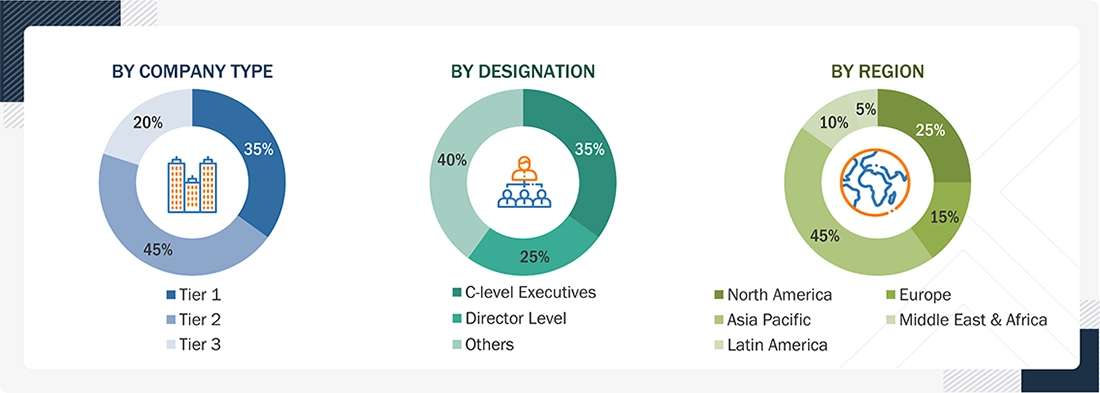
To know about the assumptions considered for the study, download the pdf brochure
Market Size Estimation
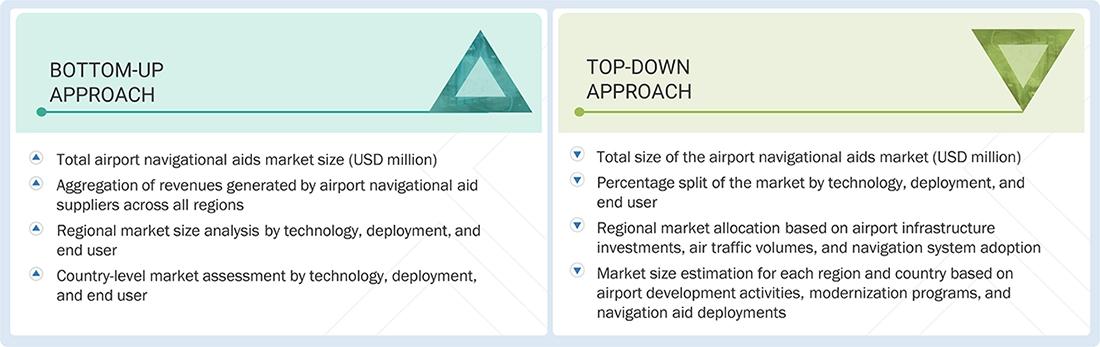
The top-down and bottom-up methods were used to estimate and validate the size of the airport navigational aids market. The research process involved several steps to ensure accuracy.
- Key companies active in the airport navigational aids market were identified through secondary research. Their market share was evaluated using a combination of primary inputs and published data. This included reviewing annual reports, financial disclosures, certification updates, and public filings from various organizations. Interviews were also conducted with industry participants such as company executives, program managers, operators, infrastructure providers, and aviation experts. These inputs were used to validate assumptions and refine market size estimates across regions.
- All percentage shares, segment splits, and market breakdowns were first developed using secondary information. These values were then verified through primary discussions with industry participants.
- The analysis evaluated key factors shaping the airport navigational aids market, including defense spending trends, airport navigational aids procurement programs, autonomous technology developments, payload integration capabilities, and surveillance requirements. Each factor was assessed through primary research and used to develop both quantitative and qualitative market estimates for this report.
Airport Navigation Aids (NAVAIDs) Market : Top-Down and Bottom-Up Approach
Data Triangulation
After determining the overall market size, the total market was divided into multiple segments and subsegments. The data triangulation and market breakdown procedures described below were carried out, where applicable, to complete the overall market analysis and determine the estimated market figures for the segments and subsegments. The data was triangulated by examining various factors and trends from both demand and supply sides. Additionally, the market size was validated using the top-down and bottom-up approaches.
Market Definition
The airport navigational aids market encompasses airport-side, ground-based, and visual navigation systems that support safe aircraft approach, landing, runway alignment, terminal-area navigation, and airfield movement guidance. These systems are installed at commercial service airports, military airbases, general aviation airports, aerodromes, heliports, helipads, vertiports, and advanced air mobility landing facilities. The market includes equipment and associated ground infrastructure used by airport operators, civil aviation authorities, air navigation service providers, defense airport authorities, and aviation infrastructure developers to improve landing accuracy, low-visibility operations, runway safety, and operational continuity.
Key Stakeholders
- Airport operators responsible for procurement, installation, and operation of airport navigational aid systems
- Air navigation service providers (ANSPs) managing airspace operations and navigation infrastructure
- Airport navigational aid manufacturers developing navigation, landing, and guidance systems
- OEMs supplying instrument landing systems (ILS), Distance Measuring Equipment (DME), very high frequency omnidirectional range (VOR), and related technologies
- System integrators supporting deployment and integration of navigation aids with airport and air traffic management infrastructure
- Defense organizations operating navigational aid systems at military airbases and defense aviation facilities
- Component suppliers providing antennas, transmitters, receivers, power systems, and electronic equipment
- Maintenance, Repair, and Overhaul (MRO) service providers supporting navigation system maintenance and lifecycle management
- Government aviation authorities responsible for aviation regulations, certification, and navigation infrastructure programs
- Airport engineering and infrastructure companies involved in airport expansion and modernization projects
- Aviation industry associations and research institutions supporting navigation technology development and operational standards
- Civil aviation agencies overseeing air navigation safety and infrastructure planning
- Consulting and technology service providers supporting airport modernization and digital transformation initiatives.
Report Objectives
- To define, describe, and forecast the size of the airport navigational aids market based on by technology, by deployment, and by end user
- To forecast the size of market segments with respect to key countries in the following regions: North America, Europe, Asia Pacific, the Middle East & Africa, and Latin America.
- To identify and analyze drivers, restraints, opportunities, and challenges influencing the growth of the market
- To identify industry trends, market trends, and technology trends currently prevailing in the market
- To provide an overview of the regulatory landscape with respect to global airport navigational aids Market regulations
- To analyze micromarkets with respect to individual growth trends, prospects, and their contribution to the overall market
- To analyze opportunities in the market for stakeholders by identifying key market trends
- To profile key market players and comprehensively analyze their market share and core competencies
- To analyze the degree of competition in the market by identifying growth strategies, such as agreements, acquisitions, partnerships, collaborations, and product launches, adopted by leading market players
- To identify detailed financial positions, key products, and unique selling points of leading market players
Available customizations:
MarketsandMarkets offers the following customizations for this market report:
- Additional country-level analysis of the airport navigational aids market
- Profiling of other market players (up to 5)
Product Analysis
- Product matrix, which provides a detailed comparison of the product portfolio of each company in the airport navigational aids market
Get the Full Airport Navigational Aids (NAVAIDs) Market Report
Full forecast, segment splits, and company analysis for all Airport Navigational Aids (NAVAIDs) Market.
- Canada Airport Navigational Aids (NAVAIDs) Market
- UK Airport Navigational Aids (NAVAIDs) Market
- Germany Airport Navigational Aids (NAVAIDs) Market
- France Airport Navigational Aids (NAVAIDs) Market
- Sweden Airport Navigational Aids (NAVAIDs) Market
- Italy Airport Navigational Aids (NAVAIDs) Market
- Spain Airport Navigational Aids (NAVAIDs) Market
- China Airport Navigational Aids (NAVAIDs) Market
- India Airport Navigational Aids (NAVAIDs) Market
- Japan Airport Navigational Aids (NAVAIDs) Market
- South Korea Airport Navigational Aids (NAVAIDs) Market
- Australia Airport Navigational Aids (NAVAIDs) Market
- UAE Airport Navigational Aids (NAVAIDs) Market
- Saudi Arabia Airport Navigational Aids (NAVAIDs) Market
- South Africa Airport Navigational Aids (NAVAIDs) Market
- Brazil Airport Navigational Aids (NAVAIDs) Market
- Mexico Airport Navigational Aids (NAVAIDs) Market
- Argentina Airport Navigational Aids (NAVAIDs) Market
- Rest Of Europe Airport Navigational Aids (NAVAIDs) Market
- Rest Of Asia Pacific Airport Navigational Aids (NAVAIDs) Market
Need a Tailored Report?
Customize this report to your needs
Get 10% FREE Customization
Customize This Report
