
Australia Anti-Drone Market (2025-2030)

The Australia Anti-Drone Market was valued at $63.8 Million in 2025 and projected to reach to $238.2 Million by 2030, representing a compound annual growth rate of 30.2%. Australia's anti-drone market is poised for substantial growth through 2030, with the market expanding from USD 63.8 million in 2025 to USD 238.2 million by 2030.


| Market Size in | USD 26.32 MN |
| Market Forecast in | |
| CAGR | |
| Forecast Period | |
| Units Considered | Value (USD MN) |
Australia Anti-Drone Market Trends and Insights
- This represents a compound annual growth rate of 30.2%, significantly outpacing global trends.
- Australia's strategic location, increasing security concerns, and investment in critical infrastructure protection are driving demand for advanced counter-UAS technologies across government, defense, and commercial sectors. The Australian anti-drone market is being shaped by regulatory frameworks, airport security requirements, and growing threats from unauthorized drone operations.
- Australia's focus on border security and critical asset protection has accelerated adoption of detection and neutralization systems.
- Between 2025 and 2030, Australia is expected to see substantial growth in both hardware and software solutions, with increasing participation from domestic and international vendors targeting the Asia-Pacific region's fastest-growing markets. Australia's position as a technology hub and defense innovator positions it as a key market for anti-drone solutions.
- Government initiatives and private sector investments are expected to sustain the 30.2% CAGR through 2030, making Australia a critical growth market within the broader Asia-Pacific anti-drone landscape..
Key Market Statistics
- CAGR (2025-2030) 30.2% CAGR
- Market Size, 2025 ~USD 63.8 Million
- Forecast, 2030 ~USD 238.2 Million
- Country Australia
Australia Anti-Drone Market Overview
Exceptional Growth Trajectory :
Australia's anti-drone market is expanding at 30.2% CAGR, significantly exceeding the global rate of 26.5%, driven by heightened security awareness and regulatory frameworks specific to Australian airspace.
Critical Infrastructure Protection :
Australian airports, ports, and energy facilities are increasingly deploying counter-UAS solutions to protect against unauthorized drone incursions, creating sustained demand across government and private sectors.
Strategic Geographic Position :
Australia's isolated geography and expanding maritime boundaries necessitate advanced anti-drone capabilities, positioning the nation as a key market for sophisticated detection and neutralization technologies.
Government Investment & Regulation :
Federal and state governments are implementing stricter drone regulations and allocating budgets for counter-UAS infrastructure, particularly around major cities and sensitive installations.
Australia Anti-Drone Market Dynamics
- This robust expansion reflects increasing security threats, regulatory compliance requirements, and infrastructure protection initiatives across both public and private sectors.
- Government agencies, defense departments, and critical infrastructure operators are prioritizing counter-UAS investments to safeguard Australian airspace. The market will be shaped by technological advancements in detection systems, regulatory developments from the Civil Aviation Safety Authority, and growing partnerships between local integrators and international technology providers.
- Emerging applications in urban air mobility management and event security will further accelerate adoption, positioning Australia as a regional hub for anti-drone innovation and deployment..
Market Ecosystem
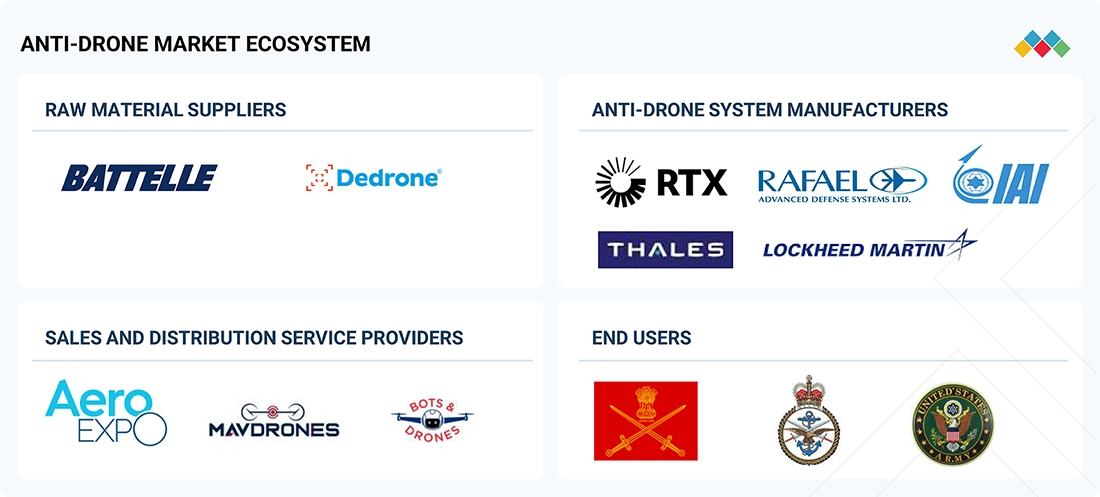
Anti-Drone Market Growth: COMMERCIAL USE CASES ACROSS INDUSTRIES
| COMPANY | USE CASE DESCRIPTION | BENEFITS |
|---|---|---|
 |
Counter-drone systems for military and critical infrastructure, focusing on radar-based detection and jamming solutions | Enhanced situational awareness, rapid drone threat neutralization, and protection of critical assets |
 |
Integrated anti-UAS solutions combining sensors, command-and-control systems, and neutralization technologies for defense applications | Comprehensive detection-to-neutralization coverage, seamless integration with existing defense systems, and scalable deployment |
 |
Multi-layered drone defense systems targeting urban environments and high-risk facilities, offering both detection and interception | Improved urban airspace safety, reduced collateral risk, and effective multi-threat management |
 |
Advanced C-UAS platforms for military and commercial use, emphasizing AI-based threat detection and electronic countermeasures | Faster threat response, intelligent detection algorithms, and adaptable countermeasure options for diverse scenarios |
 |
Modular counter-UAS solutions designed for battlefield and strategic asset protection, supporting kinetic and non-kinetic neutralization | Flexible deployment, reduced operational complexity, and protection of strategic sites from aerial threats |
Logos and trademarks shown above are the property of their respective owners. Their use here is for informational and illustrative purposes only.
Related Ecosystem
Aviation
Drones And Robotics
Security And Surveillance
Key Takeaways
- Australia's anti-drone market will grow from USD 63.8M (2025) to USD 238.2M (2030) at a 30.2% CAGR, outpacing global growth rates.
- Australia's regulatory environment and critical infrastructure protection needs are primary drivers of counter-UAS technology adoption.
- Government defense spending and airport security mandates in Australia are accelerating investment in detection and neutralization systems.
- Australia represents a strategic growth opportunity within Asia-Pacific, attracting both domestic innovators and international anti-drone vendors.
Anti-Drone Market Report Scope
| Report Metric | Details |
|---|---|
| Base Year | 2025 |
| Fastest Growing Segment | UAV-BASED (Platform Type) |
| Forecast Period | 2025–2030 |
| Growth Rate | CAGR of 26.5% from 2025 to 2030 |
| Largest Segment | DETECTION & DISRUPTION (Application) |
| Market Size Base Year (Billions) | ~USD 4.48 (2025) |
| Revenue Forecast (Billions) | ~USD 14.51 (2030) |
| Segments Covered | Range, System Type, Vertical, Application, Platform Type, Deployment Type, Frequency Band, Type, Vertical Type |
Australia Anti-Drone Market Report Segmentation
9 segment dimensions are covered across the global market.
By Range
- Long-Range (>5 Km)
- Medium-Range (2–5 Km)
- Short-Range (<2 Km)
By System Type
- Electronic Systems
- Hybrid Systems
- Kinetic Systems
- Laser Systems
By Vertical
- Commercial
- Homeland Security
- Military & Defense
By Application
- Detection
- Detection & Disruption
By Platform Type
- Ground-Based
- Handheld
- Uav-Based
By Deployment Type
- Fixed Radar
- Portable Radar
- Vehicle-Mounted Radar
By Frequency Band
- C-Band
- Ku-Band
- L-Band
- Other Frequency Bands
- S-Band
- X-Band
By Type
- Active Electronically Scanned Array (Aesa)
- Conventional Radar
- Mechanically Scanned Array
- Passive Electronically Scanned Array (Pesa)
- Phased Array
By Vertical Type
- Critical Infrastructure
- Public Venues
AUSTRALIA: ANTI-DRONE MARKET, BY VERTICAL, 2025–2030
| Segment | 2025 | 2026 | 2027 | 2028 | 2029 | 2030 | CAGR (%) |
|---|---|---|---|---|---|---|---|
| COMMERCIAL | 6.67 | 8.96 | 12.25 | 16.8 | 22.8 | 30.55 | 35.6 |
| HOMELAND SECURITY | 4.52 | 5.95 | 7.97 | 10.73 | 14.3 | 18.83 | 33 |
| MILITARY & DEFENSE | 52.58 | 66.99 | 87.06 | 113.74 | 147.33 | 188.87 | 29.1 |
| TOTAL | 63.76 | 81.9 | 107.28 | 141.28 | 184.43 | 238.24 | 30.2 |
Target Audience
- Defense & Government Agencies : Australian defense departments and government bodies require detailed market intelligence to justify budget allocations, evaluate vendor capabilities, and plan counter-UAS infrastructure investments.
- Critical Infrastructure Operators : Airport authorities, port operators, and energy companies need market data to assess anti-drone solutions, understand competitive offerings, and implement security protocols compliant with Australian regulations.
- Technology & Systems Integrators : Local and international integrators operating in Australia require market insights to identify growth opportunities, understand customer requirements, and develop tailored counter-UAS solutions.
- Investment & Private Equity Firms : Investors evaluating opportunities in Australian defense tech and security sectors need comprehensive market analysis to assess growth potential, competitive dynamics, and exit opportunities.
- International Anti-Drone Vendors : Global manufacturers and solution providers entering or expanding in Australia require localized market intelligence to understand demand drivers, regulatory requirements, and customer preferences.
Key Companies in the Australia Anti-Drone Market
| Company | HQ | Ownership | Strongest segments |
|---|---|---|---|
| TRIMBLE INC | United States | Public Company | Construction lifecycle software and machine control,Positioning services (VRSNow, RTX, xFill, related),Transportation and logistics platforms (TMS, Transporeon, MAPS), |
| AIRBUS GROUP SE | United States | Public Company | Commercial aircraft (Airbus segment),Helicopters,Defence and military air systems, |
| JABIL | United States | Public Company | Regulated Industries (Healthcare, Medical Devices, Automotive, Industrial & Semi-cap),Intelligent Infrastructure (5G, Wireless & Cloud, Networking & Storage, Digital Building),Connected Living & Digital Commerce (Mobility, Consumer Devices, Digital Retail), |
| LEIDOS | United States | Public Company | National Security & Digital (AI/ML mission systems, cyber, digital modernization),Defense Systems (air and missile defense, ISR, space payloads),Health & Civil (air traffic control, health mission IT, civil infrastructure), |
| LENOVO | China | Public Company | |
| RTX | United States | Public Company | |
| LOCKHEED MARTIN CORPORATION | United States | Public Company | |
| LEONARDO S.P.A. | Italy | Public Company | |
| THALES | France | Public Company | |
| IAI | Israel | Private Company | |
| DRONESHIELD LTD | Australia | Public Company | |
| MOOG INC. | United States | Public Company | |
| ASELSAN A.S. | Turkey | Public Company | Military communication & information / C4I systems,Radar and electronic warfare systems,Avionics, navigation, and guidance systems, |
| SAAB AB | Sweden | Public Company | Aeronautics (manned and unmanned aircraft, aviation technology),Dynamics (combat weapons, missiles, training & simulation),Surveillance (radar, EW, combat systems, C4I), |
TRIMBLE INC
Trimble Inc. is a U.S.-based public company founded in 1978 with 11,500 employees. The company operates in positioning, navigation, and related technology sectors.
AIRBUS GROUP SE
Airbus Group SE is a major aerospace and defense public company founded in 1998 with 166,876 employees. Based in the United States, it is one of the world's largest aircraft manufacturers.
JABIL
Jabil is a U.S.-based public company founded in 1966 with 135,000 employees. The company provides electronics manufacturing services and solutions.
LEIDOS
Leidos is a U.S.-based public company founded in 1969 with 50,000 employees. The company operates in defense, intelligence, and civil government sectors.
LENOVO
Lenovo is a public company based in China founded in 1984. The company is a leading global manufacturer of computing devices and technology solutions.
RTX
RTX is a U.S.-based public company founded in 1934 with 180,000 employees. The company operates in aerospace, defense, and related technology sectors.
LOCKHEED MARTIN CORPORATION
Lockheed Martin Corporation is a U.S.-based public company founded in 1912 with 123,000 employees. The company is a major defense and aerospace contractor.
LEONARDO S.P.A.
Leonardo S.p.A. is an Italian public company founded in 1948 with 65,455 employees. The company operates in defense, aerospace, and security sectors.
THALES
Thales is a French public company founded in 1893 with 82,111 employees. The company provides defense, aerospace, and digital security solutions.
IAI
IAI is an Israeli private company founded in 1953 with 15,151 employees. The company specializes in aerospace and defense technologies.
DRONESHIELD LTD
DroneShield Ltd. is an Australian public company founded in 2014 with 450 employees. The company develops counter-drone and drone detection systems.
MOOG INC.
Moog Inc. is a U.S.-based public company founded in 1951 with 13,500 employees. The company manufactures motion control products and systems for aerospace and defense.
ASELSAN A.S.
Aselsan A.S. is a Turkish public company founded in 1975 with 16,243 employees. The company develops defense electronics and systems.
SAAB AB
Saab AB is a Swedish public company founded in 1937 with 28,667 employees. The company operates in aerospace, defense, and security sectors.
Reasons to Buy this Report
- Market-Specific Growth Data : Access detailed forecasts and historical data exclusive to Australia's anti-drone market, enabling accurate business planning and investment decisions tailored to regional dynamics.
- Competitive Landscape Analysis : Identify key players, market share distribution, and competitive strategies specific to Australia, helping you position offerings effectively against local and international competitors.
- Regulatory & Policy Insights : Understand Australian government regulations, CASA guidelines, and compliance requirements shaping the anti-drone market, ensuring your solutions meet local standards.
- Sector-Specific Opportunities : Discover high-growth segments within Australia including airport security, maritime protection, critical infrastructure, and event management with quantified demand projections.
- Strategic Market Entry Planning : Leverage Australia-focused intelligence to develop go-to-market strategies, identify partnership opportunities, and allocate resources efficiently in this high-growth regional market.
Frequently asked questions
What is the current size of Australia's anti-drone market?
Australia's anti-drone market was valued at USD 63.8 million in 2025 and is expected to grow to USD 238.2 million by 2030.
What is the projected growth rate for Australia's anti-drone market?
Australia's anti-drone market is projected to grow at a compound annual growth rate (CAGR) of 30.2% from 2025 to 2030.
What factors are driving growth in Australia's anti-drone market?
Key drivers include regulatory compliance requirements, airport security mandates, critical infrastructure protection needs, border security concerns, and government defense investments.
Which sectors are adopting anti-drone solutions in Australia?
Government agencies, defense departments, airports, critical infrastructure operators, and commercial enterprises are primary adopters of anti-drone technologies in Australia.
How does Australia's anti-drone market compare to global trends?
Australia's 30.2% CAGR significantly exceeds the global anti-drone market CAGR of 26.5%, positioning Australia as a high-growth regional market within Asia-Pacific.
RESEARCH METHODOLOGY
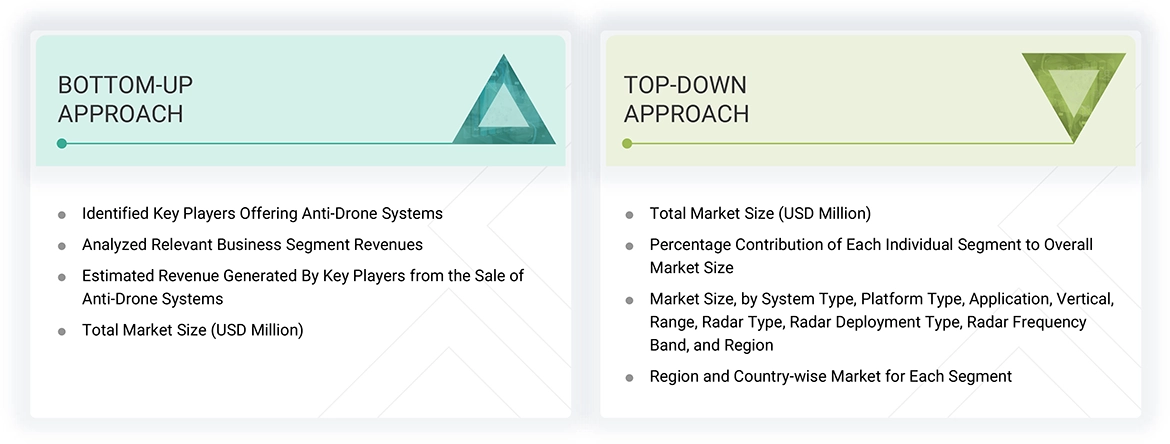
The study involved major activities in estimating the current market size for the anti-drone market. Exhaustive secondary research was done to collect information on the market. The next step was to validate these findings, assumptions, and sizing with industry experts across the value chain using primary research. Different approaches, such as top-down and bottom-up, were employed to estimate the total market size. After that, the market breakup and data triangulation procedures were used to estimate the market size of the segments and subsegments of the anti-drone market.
Secondary Research
The secondary research for this study involved gathering information from various credible sources. These included company annual reports, investor presentations, press releases, whitepapers, certified publications, and articles from reputable associations and government publications. Additional data was obtained from corporate filings, professional and trade associations, journals, and industry-recognized authors. Research from consortia, councils, and gold- and silver-standard websites, directories, and databases also contributed to the qualitative framework. Key global sources, such as the International Trade Centre (ITC) and the International Monetary Fund (IMF), were consulted to support and validate the market analysis.
Primary Research
Extensive primary research was conducted after understanding and analyzing the anti-drone market scenario through secondary research. Several primary interviews were conducted with key opinion leaders from demand- and supply-side vendors across four major regions—Americas, Europe, Asia Pacific, and RoW. Approximately 20% of the primary interviews were conducted with the demand side and 80% with the supply side. Primary data was collected through questionnaires, e-mails, and telephonic interviews. Various departments within organizations, such as sales, operations, and administration, were contacted to provide a holistic viewpoint in the report..
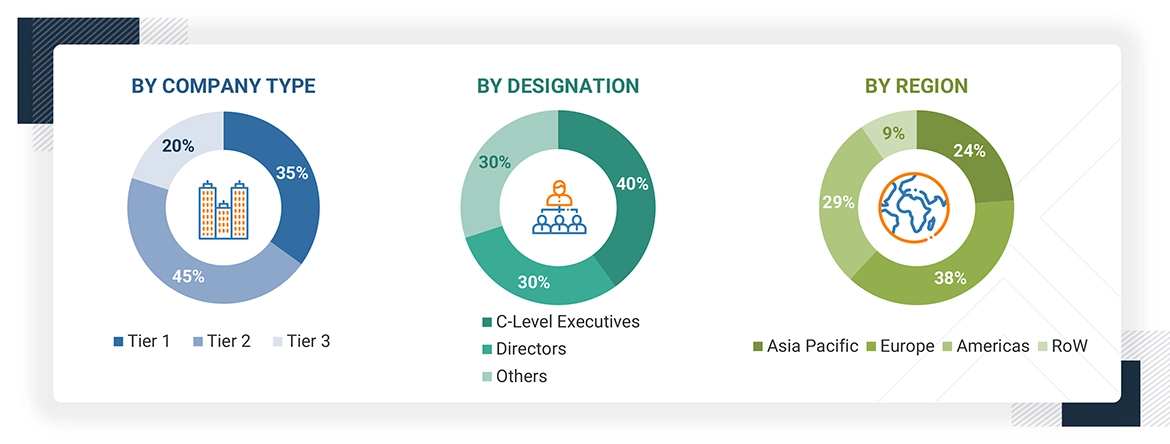
To know about the assumptions considered for the study, download the pdf brochure
Market Size Estimation
Both top-down and bottom-up approaches were used to estimate and validate the total size of the anti-drone market. These methods were also used extensively to estimate the size of various subsegments in the market. The research methodology used to estimate the market size includes the following:
Anti-Drone Market : Top-Down and Bottom-Up Approach
Data Triangulation
After arriving at the overall size of the anti-drone market through the process explained above, the overall market has been split into several segments. Data triangulation procedures have been employed to complete the overall market engineering process and arrive at the exact statistics for all the segments, wherever applicable. The data has been triangulated by studying various factors and trends from the demand and supply sides. The market has also been validated using top-down and bottom-up approaches.
Market Definition
An anti-drone system refers to a comprehensive set of technologies and solutions designed to detect, monitor, identify, and mitigate threats posed by unauthorized or hostile drones. These systems are increasingly essential as the use of drones grows across various sectors, raising concerns over security, privacy, and safety. Anti-drone technologies employ a combination of sensors such as radar, radio frequency (RF) detectors, electro-optical and infrared cameras, and acoustic sensors to detect and track drones in real time accurately. Once detected, these systems can neutralize the threat through various disruption methods, including RF jamming, GPS spoofing, directed energy weapons such as lasers, or physical interception. Anti-drone solutions safeguard critical infrastructure, military installations, airports, public gatherings, and sensitive government or commercial sites from potential risks, such as espionage, smuggling, sabotage, or attacks.
Key Stakeholders
- Brand Product Manufacturers/Original Equipment Manufacturers (OEMs)/Original Device Manufacturers (ODMs)
- Anti-drones Product Manufacturers
- Anti-Drone Material and Component Suppliers
- Manufacturing Equipment Suppliers
- System Integrators
- Technology/IP Developers
- Consulting and Market Research Service Providers
- Government and Military Agencies
- Anti-drones-related Associations, Organizations, Forums, and Alliances
- Venture Capitalists and Startups
- Research and Educational Institutes
- Distributors and Resellers
- End Users
Report Objectives
- To define, describe, and forecast the anti-drone market size, by system type, platform type, application, vertical, range, radar type, radar deployment type, and radar frequency band, in terms of value
- To describe and forecast the market size for four key regions: the Americas, Europe, Asia Pacific, and the Rest of the World (RoW), in terms of value
- To define, describe, and forecast the anti-drone market size, by vertical, in terms of volume
- To provide detailed insights regarding drivers, restraints, opportunities, and challenges influencing the growth of the market
- To analyze emerging applications and standards in the anti-drone market
- To examine manufacturers of anti-drone solutions, their strategies, production plans, and the overall value chain, including material and component suppliers
- To strategically analyze the micromarkets1 with respect to individual growth trends, prospects, and contributions to the overall market
- To analyze the market opportunities for stakeholders and provide a comprehensive competitive landscape analysis
- To provide a detailed overview of the anti-drone ecosystem
- To provide a detailed overview of the impact of AI/Gen AI, the macroeconomic outlook for all regions, and the 2025 US tariff impact on the anti-drone market
- To provide information about the key technology trends, trade analysis, and patents related to the anti-drone market
- To strategically analyze average selling price trends, trends impacting customer business, regulatory landscape, patent landscape, Porter’s five forces, import and export scenarios, trade landscape, and case studies pertaining to the market under study
- To benchmark the market players using the proprietary company evaluation matrix framework, which analyzes them on various parameters within the broad categories of market ranking/share and product portfolio
- To analyze competitive developments, such as partnerships, acquisitions, expansions, collaborations, and product launches, in the market
- To strategically profile key players and analyze their market share, ranking, and core competencies
Customization Options
With the market data given, MarketsandMarkets offers customizations according to the company’s specific needs. The following customization options are available for the report:
Company Information
- Detailed analysis and profiling of additional market players (up to 7)
Get the Full Anti-Drone Market Report
Full forecast, segment splits, and company analysis for all Anti-Drone Market.
- US Anti-Drone Market
- Canada Anti-Drone Market
- Mexico Anti-Drone Market
- UK Anti-Drone Market
- Germany Anti-Drone Market
- France Anti-Drone Market
- Italy Anti-Drone Market
- Spain Anti-Drone Market
- Russia Anti-Drone Market
- Poland Anti-Drone Market
- China Anti-Drone Market
- Japan Anti-Drone Market
- India Anti-Drone Market
- South Korea Anti-Drone Market
- Indonesia Anti-Drone Market
- Malaysia Anti-Drone Market
- Thailand Anti-Drone Market
- Vietnam Anti-Drone Market
- Nordics Anti-Drone Market
- Rest Of Europe Anti-Drone Market
- Rest Of Asia Pacific Anti-Drone Market
- Bahrain Anti-Drone Market
Need a Tailored Report?
Customize this report to your needs
Get 10% FREE Customization
Customize This Report
