
South Africa Antimony-free Polyesters Market (2025-2030)

The South Africa Antimony-free Polyesters Market was valued at $6.8 Million in 2025 and projected to reach to $9.1 Million by 2030, representing a compound annual growth rate of 6.1%. South Africa's antimony-free polyesters market is poised for steady expansion through 2030, supported by strengthening regulatory frameworks and growing consumer awareness of product safety.


| Market Size in | USD 26.32 MN |
| Market Forecast in | |
| CAGR | |
| Forecast Period | |
| Units Considered | Value (USD MN) |
South Africa Antimony-free Polyesters Market Trends and Insights
- South Africa is experiencing steady demand for antimony-free polyester solutions driven by regulatory compliance, sustainability initiatives, and the textile and packaging industries' shift toward safer flame-retardant alternatives.
- The market in South Africa reflects broader regional trends in the Middle East Africa segment, where environmental consciousness and stricter chemical regulations are reshaping material specifications. South Africa's growth trajectory is supported by increasing adoption in automotive, electronics, and consumer goods sectors seeking non-toxic polyester formulations.
- South Africa's manufacturers are investing in R&D to develop cost-effective antimony-free alternatives that meet international standards while maintaining performance characteristics.
- By 2030, South Africa is expected to capture greater market share as supply chain localization and regulatory frameworks continue to favor safer polyester chemistries across the region..
Key Market Statistics
- CAGR (2025-2030) 6.1% CAGR
- Market Size, 2025 ~USD 6.8 Million
- Forecast, 2030 ~USD 9.1 Million
- Country South Africa
South Africa Antimony-free Polyesters Market Overview
Market Size & Growth :
South Africa's antimony-free polyesters market is valued at USD 6.8 million in 2025, with projected growth to USD 9.1 million by 2030, reflecting a steady CAGR of 6.1% driven by regulatory compliance and sustainability demands.
Regulatory Drivers :
South African manufacturers are increasingly adopting antimony-free polyester formulations to comply with stringent environmental regulations and international standards, positioning the country as a responsible producer in the global supply chain.
Industry Adoption :
The textile and packaging sectors in South Africa are leading the transition toward antimony-free solutions, driven by consumer demand for safer products and corporate sustainability commitments aligned with global ESG initiatives.
Regional Opportunity :
South Africa's strategic position in Africa presents significant opportunities for antimony-free polyester manufacturers to serve regional markets while establishing competitive advantages in emerging African economies.
South Africa Antimony-free Polyesters Market Dynamics
- The textile and packaging industries are primary growth catalysts, as manufacturers seek compliant alternatives to traditional antimony-catalyzed polyesters.
- Local producers are investing in sustainable manufacturing practices to meet both domestic and export market requirements. The market outlook remains positive as South African companies leverage their manufacturing capabilities to capture regional demand across Africa.
- Government sustainability initiatives and corporate ESG commitments will continue driving adoption.
- However, competition from established global suppliers and raw material cost fluctuations present challenges.
- Strategic partnerships and technological innovation will be critical for local players to maintain market share and achieve the projected 6.1% CAGR through 2030..
Market Ecosystem
Related Ecosystem
Resins And Polymers
- Polycarbonate
- Acrylonitrile Butadiene Styrene (ABS)
- Epoxy Resin
- Light Commercial Vehicles (LCVs)
- Polypropylene (PP)
- Basf se
- DOW CHEMICAL COMPANY
- Solvay sa
- Saudi arabia basic industries corporation (sabic)
- DuPont de Nemours, Inc.
Yarns Fabric And Textile
- Agrotech
- Clothtech
- Indutech
- Oekotech
- Packtech
- MILLIKEN & COMPANY
- Toray Industries, Inc.
- 3M COMPANY
- DuPont de Nemours, Inc.
- Kimberly-Clark Corporation
Key Takeaways
- South Africa's antimony-free polyesters market is valued at USD 6.8 million in 2025 and will reach USD 9.1 million by 2030 at a 6.1% CAGR.
- South Africa's market growth is driven by regulatory compliance, sustainability mandates, and demand from automotive, electronics, and packaging sectors.
- South Africa's manufacturers are investing in localized R&D to develop cost-competitive antimony-free polyester alternatives meeting international standards.
- South Africa's market expansion reflects broader Middle East Africa regional trends toward safer, non-toxic flame-retardant polyester chemistries.
Antimony-free Polyesters Market Report Scope
| Report Metric | Details |
|---|---|
| Base Year | 2025 |
| Fastest Growing Segment | POLYTRIMETHYLENE TEREPHTHALATE (PTT) (Product Type) |
| Forecast Period | 2025–2030 |
| Growth Rate | CAGR of 6.6% from 2025 to 2030 |
| Largest Segment | POLYETHYLENE TEREPHTHALATE (PET) (Product Type) |
| Market Size Base Year (Billions) | ~USD 0.78 (2025) |
| Revenue Forecast (Billions) | ~USD 1.07 (2030) |
| Segments Covered | Product Type, Catalyst, End-Use Industry |
South Africa Antimony-free Polyesters Market Report Segmentation
3 segment dimensions are covered across the global market.
By Product Type
- Polybutylene Terephthalate (Pbt)
- Polyethylene Terephthalate (Pet)
- Polytrimethylene Terephthalate (Ptt)
By Catalyst
- Aluminum-Based Catalysts
- Other Catalysts
- Titanium-Based Catalysts
- Titanium-Magnesium-Based Catalysts
By End-Use Industry
- Automotive
- Construction
- Other End-Use Industries
- Packaging
- Textile
Target Audience
- Polyester Manufacturers : South African and regional polyester producers need market data to optimize production capacity, develop antimony-free formulations, and identify growth opportunities in compliant product segments.
- Textile & Apparel Companies : South African textile manufacturers require insights into antimony-free polyester availability and pricing to source sustainable materials, meet customer demands, and ensure regulatory compliance.
- Packaging Industry Players : Packaging manufacturers in South Africa need market intelligence to transition toward antimony-free polyesters, reduce environmental impact, and meet corporate sustainability commitments.
- Chemical Distributors & Suppliers : Regional distributors and chemical suppliers need South Africa-specific market data to forecast demand, optimize inventory, and develop targeted sales strategies for antimony-free polyester products.
- Investment & Strategy Consultants : Business consultants and investment firms require detailed South African market analysis to advise clients on market entry, expansion strategies, and investment opportunities in the antimony-free polyesters sector.
Key Companies in the South Africa Antimony-free Polyesters Market
| Company | HQ | Ownership | Strongest segments |
|---|---|---|---|
| INDORAMA VENTURES PUBLIC COMPANY LIMITED | Thailand | Public Company | Antimony-free PET,Antimony-free PTT,Antimony-free PBT, |
| TORAY ADVANCED MATERIALS KOREA INC. | South Korea | Private Company | Polyethylene Terephthalate (PET),Polytrimethylene Terephthalate (PTT),Polybutylene Terephthalate (PBT), |
| TEIJIN LIMITED | Japan | Public Company | Polytrimethylene Terephthalate (PTT),Polyethylene Terephthalate (PET),Polybutylene Terephthalate (PBT), |
| RELIANCE INDUSTRIES LIMITED | United States | Public Company | Polyethylene Terephthalate (PET),Polytrimethylene Terephthalate (PTT),Polybutylene Terephthalate (PBT), |
| POLYPLEX | India | Public Company | Antimony-free PET films (BOPET and coated PET),Antimony-free PET for textile and industrial uses,Other antimony-free polyesters (PTT, PBT-related films and blends), |
| NAN YA PLASTICS CORPORATION | Taiwan | Public Company | Antimony-free PET,Antimony-free PBT,Antimony-free PTT and specialty polyesters, |
| UFLEX LIMITED | India | Public Company | Antimony-free PET (films, resins, laminates),Antimony-free PBT,Antimony-free PTT and specialty polyesters, |
| PT ASIA PACIFIC FIBERS TBK. | Indonesia | Public Company | Antimony-free PET fibers,Antimony-free polyester chips (PET),Antimony-free specialty fibers (e.g., antimicrobial, hygiene, geotextile), |
INDORAMA VENTURES PUBLIC COMPANY LIMITED
Indorama Ventures Public Company Limited is a Thai public company founded in 1994 with 22,027 employees, operating in the petrochemicals and polymers industry.
TORAY ADVANCED MATERIALS KOREA INC.
Toray Advanced Materials Korea Inc. is a South Korean private company established in 1999 with 1,190 employees, focusing on advanced materials production.
TEIJIN LIMITED
Teijin Limited is a Japanese public company founded in 1918 with 15,689 employees, engaged in advanced fibers, composites, and specialty chemicals.
RELIANCE INDUSTRIES LIMITED
Reliance Industries Limited is a United States-based public company founded in 1957 with 404,501 employees, operating across energy, petrochemicals, and materials sectors.
POLYPLEX
Polyplex is an Indian public company founded in 1984 with 935 employees, primarily engaged in polyester film manufacturing.
NAN YA PLASTICS CORPORATION
Nan Ya Plastics Corporation is a Taiwanese public company founded in 1958 with 32,271 employees, producing plastics, chemicals, and related materials.
UFLEX LIMITED
Uflex Limited is an Indian public company established in 1983 with 7,619 employees, specializing in flexible packaging and polymer films.
PT ASIA PACIFIC FIBERS TBK.
PT Asia Pacific Fibers Tbk. is an Indonesian public company founded in 1984 with 711 employees, engaged in polyester fiber production.
Reasons to Buy this Report
- Market-Specific Sizing & Forecasts : Access precise valuation data for South Africa's antimony-free polyesters market with detailed 2025-2030 projections, enabling accurate budgeting and investment planning tailored to the local market landscape.
- Regulatory & Compliance Insights : Understand South Africa-specific regulatory drivers and compliance requirements shaping antimony-free polyester adoption, helping manufacturers and suppliers align products with local and international standards.
- Industry-Specific Demand Analysis : Gain detailed insights into South African textile and packaging sector dynamics, identifying key growth opportunities and customer segments driving antimony-free polyester adoption in the region.
- Competitive Landscape Assessment : Evaluate local and international competitors operating in South Africa's market, understand market positioning strategies, and identify gaps for differentiation and market entry opportunities.
- Strategic Growth Planning : Leverage South Africa-focused market intelligence to develop targeted expansion strategies, optimize product portfolios, and capitalize on the 6.1% CAGR growth trajectory through 2030.
Frequently asked questions
What is the current market size of antimony-free polyesters in South Africa?
South Africa's antimony-free polyesters market is estimated at USD 6.8 million in 2025.
What is the projected market size for antimony-free polyesters in South Africa by 2030?
South Africa's antimony-free polyesters market is forecast to reach USD 9.1 million by 2030.
What is the CAGR for South Africa's antimony-free polyesters market?
South Africa's antimony-free polyesters market is expected to grow at a CAGR of 6.1% from 2025 to 2030.
Which industries are driving demand for antimony-free polyesters in South Africa?
South Africa's demand is primarily driven by automotive, electronics, consumer goods, textile, and packaging industries seeking safer flame-retardant polyester solutions.
Why is South Africa shifting toward antimony-free polyesters?
South Africa is adopting antimony-free polyesters due to stricter environmental regulations, sustainability initiatives, and industry demand for non-toxic alternatives that maintain performance standards.
RESEARCH METHODOLOGY
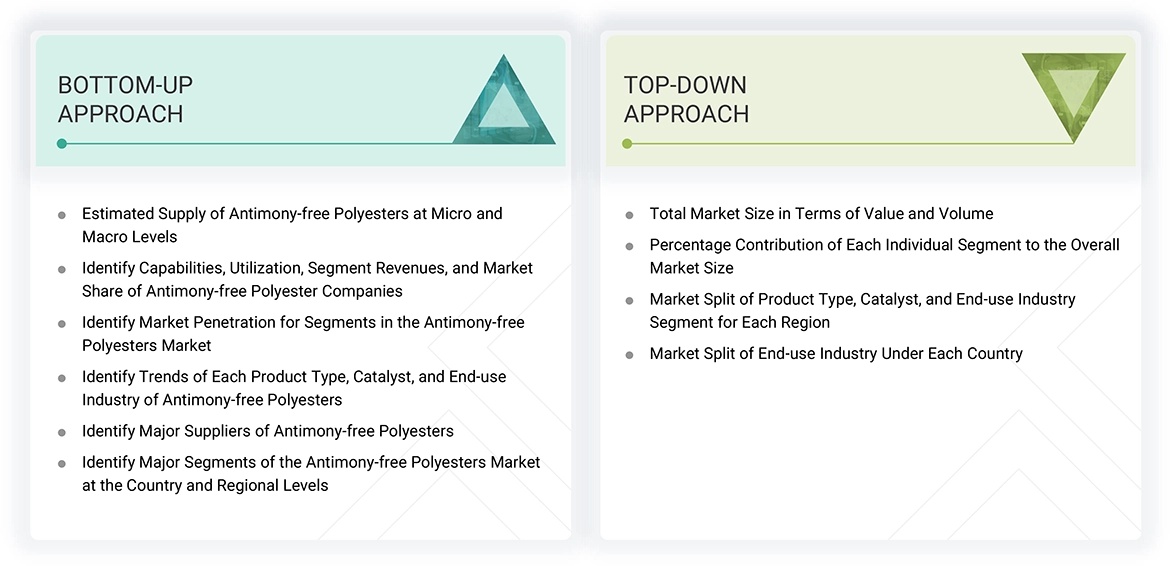
The study involved four major activities in estimating the market size of the antimony-free polyesters market. Exhaustive secondary research was done to collect information on the market, the peer market, and the parent market. The next step was to validate these findings, assumptions, and sizing with industry experts across the value chain through primary research. Both top-down and bottom-up approaches were employed to estimate the complete market size. Thereafter, the market breakdown and data triangulation procedures were used to estimate the market size of the segments and subsegments.
Secondary Research
In the secondary research process, various secondary sources have been referred to for identifying and collecting information for this study. These secondary sources include annual reports, press releases, investor presentations of companies, white papers, certified publications, trade directories, certified publications, articles from recognized authors, gold standard and silver standard websites, and databases.
Secondary research has been used to obtain key information about the value chain of the industry, monetary chain of the market, the total pool of key players, market classification and segmentation according to industry trends to the bottom-most level, and regional markets. It was also used to obtain information about key developments from a market-oriented perspective.
Primary Research
The antimony-free polyesters market comprises several stakeholders in the value chain, which include raw material suppliers, manufacturers, and end users. Various primary sources from the supply and demand sides of the antimony-free polyesters market have been interviewed to obtain qualitative and quantitative information. The primary interviewees from the demand side include key opinion leaders in end-use sectors. The primary sources from the supply side include manufacturers, associations, and institutions involved in the antimony-free polyesters market industry.
Primary interviews were conducted to gather insights such as market statistics, data of revenue collected from the products and services, market breakdowns, market size estimations, market forecasting, and data triangulation. Primary research also helped in understanding the various trends related to product type, catalyst, end-use industry, and region. Stakeholders from the demand side, such as CIOs, CTOs, and CSOs, were interviewed to understand the buyers’ perspective on the suppliers, products, component providers, and their current usage of antimony-free polyesters in the market and future outlook of their business, which will affect the overall market.
The breakdown of profiles of the primary interviewees is illustrated in the figure below:
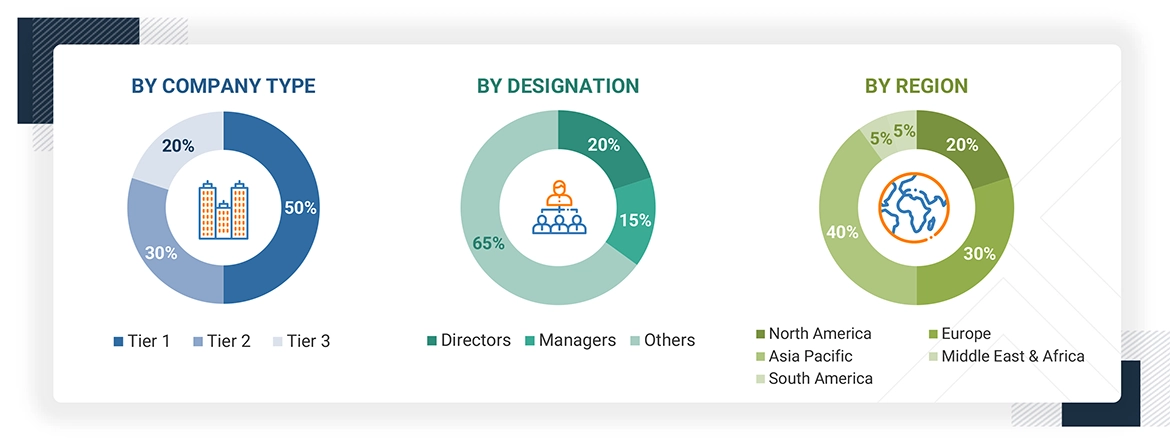
Note: Tier 1, Tier 2, and Tier 3 companies are classified based on their market revenue in 2024 available in the public domain, product portfolios, and geographical presence.
Other designations include sales representatives, production heads, and technicians.
To know about the assumptions considered for the study, download the pdf brochure
Market Size Estimation
The top-down approach was used to estimate and validate the size of various submarkets for the antimony-free polyesters market for the region. The research methodology used to estimate the market size included the following steps:
- The key players in the industry have been identified through extensive secondary research.
- The supply chain of the industry has been determined through primary and secondary research.
- All percentage shares, splits, and breakdowns based on product type, catalyst, end-use industry, and region were determined using secondary sources and verified through primary sources.
- All possible parameters that affect the markets covered in this research study were accounted for, viewed in extensive detail, verified through primary research, and analyzed to get the final quantitative and qualitative data. This data was consolidated and added with detailed inputs and analysis, and presented in this report.
Data Triangulation
After arriving at the total market size from the estimation process above, the overall market has been split into several segments and subsegments. To complete the overall market engineering process and arrive at the exact statistics for all the segments and subsegments, the data triangulation and market breakdown procedures have been employed, wherever applicable. The data has been triangulated by studying various factors and trends from both the demand and supply sides. Along with this, the market size has been validated by using both the top-down and bottom-up approaches and primary interviews. Hence, for every data segment, there have been three sources: the top-down approach, the bottom-up approach, and expert interviews. The data was assumed correct when the values arrived from the three sources matched.
Market Definition
Antimony-free polyester identifies a class of polyester products that are manufactured without antimony-based catalysts. Antimony-based catalysts were commonly used as catalysts in the polymerization of polyesters such as polyethylene terephthalate (PET), polybutylene terephthalate (PBT), and polytrimethylene terephthalate (PTT). While antimony trioxide is synthesized from the ore antimony, polyesters can be produced using titanium, aluminum, or tin-based catalysts to manufacture comparable polymer material with less residual toxic material and with less environmental impact. The move away from antimony-based polyesters is being fueled by health and environmental concerns, specifically in food packaging and textiles, as well as medical and consumer applications. Antimony-free polyester offers recyclability, and meets global safety standards and the demands of responsible consumers for safer and more sustainable products, making an antimony-free polyester important across the many sectors by offering products and performance that can compete in green and regulated markets without compromising product performance or quality.
Stakeholders
- Antimony-free Polyester Manufacturers
- Antimony-free Polyester Traders, Distributors, and Suppliers
- Raw Material Suppliers
- Government and Private Research Organizations
- Associations and Industrial Bodies
- R&D Institutes
- Environmental Support Agencies
Report Objectives
- To define, describe, and forecast the size of the antimony-free polyesters, in terms of value and volume
- To provide detailed information regarding the major factors (drivers, opportunities, restraints, and challenges) influencing the market growth
- To estimate and forecast the market size based on product type, catalyst, end-use industry, and region
- To forecast the size of the market with respect to major regions, namely, North America, Europe, Asia Pacific, the Middle East & Africa, and South America, along with their key countries
- To strategically analyze micromarkets with respect to individual growth trends, prospects, and their contribution to the overall market
- To analyze opportunities in the market for stakeholders and provide a competitive landscape of market leaders
- To track and analyze recent development such as expansions, investments, collaborations, and partnerships in the market
- To strategically profile the key market players and comprehensively analyze their core competencies
Get the Full Antimony-free Polyesters Market Report
Full forecast, segment splits, and company analysis for all Antimony-free Polyesters Market.
- China Antimony-free Polyesters Market
- Japan Antimony-free Polyesters Market
- India Antimony-free Polyesters Market
- South Korea Antimony-free Polyesters Market
- Canada Antimony-free Polyesters Market
- Mexico Antimony-free Polyesters Market
- US Antimony-free Polyesters Market
- Germany Antimony-free Polyesters Market
- Italy Antimony-free Polyesters Market
- France Antimony-free Polyesters Market
- UK Antimony-free Polyesters Market
- Spain Antimony-free Polyesters Market
- Brazil Antimony-free Polyesters Market
- Argentina Antimony-free Polyesters Market
- Rest Of Europe Antimony-free Polyesters Market
- Rest Of Asia Pacific Antimony-free Polyesters Market
- GCC Countries Antimony-free Polyesters Market
- –Rest Of GCC Countries Antimony-free Polyesters Market
- Rest Of South America Antimony-free Polyesters Market
Need a Tailored Report?
Customize this report to your needs
Get 10% FREE Customization
Customize This Report
