
France AR Glass Market (2025-2030)

The France AR Glass Market was valued at $49.1 Million in 2025 and projected to reach to $466.4 Million by 2030, representing a compound annual growth rate of 56.8%. France's AR glass market is poised for transformative growth through 2030, driven by increasing enterprise digitalization initiatives and consumer technology adoption.


| Market Size in | USD 26.32 MN |
| Market Forecast in | |
| CAGR | |
| Forecast Period | |
| Units Considered | Value (USD MN) |
France AR Glass Market Trends and Insights
- This exceptional growth trajectory reflects France's strategic position within Europe's technology sector and increasing adoption of AR solutions across enterprise and consumer segments.
- France is capitalizing on strong digital infrastructure and innovation ecosystems to drive AR glass penetration across manufacturing, healthcare, retail, and defense applications. The 56.8% compound annual growth rate (CAGR) positions France as a high-growth market within the European AR landscape.
- Between 2025 and 2030, France is expected to witness accelerating demand driven by enterprise digitalization initiatives, government support for advanced technologies, and rising consumer interest in immersive experiences.
- France's robust semiconductor and electronics sector provides a competitive advantage, enabling local development of AR glass solutions and attracting international investment in the region..
Key Market Statistics
- CAGR (2025-2030) 56.8% CAGR
- Market Size, 2025 ~USD 49.1 Million
- Forecast, 2030 ~USD 466.4 Million
- Country France
France AR Glass Market Overview
Explosive Growth Trajectory :
France's AR glass market is projected to grow from $49.1 million in 2025 to $466.4 million by 2030, representing a remarkable 56.8% CAGR, outpacing many European counterparts and reflecting strong domestic demand.
Enterprise Adoption Leadership :
French enterprises across manufacturing, healthcare, and logistics sectors are rapidly deploying AR glass solutions for workforce training, remote assistance, and operational efficiency, driving significant market expansion.
Tech Hub Innovation Ecosystem :
France's established technology infrastructure, including Paris-Saclay and other innovation clusters, is fostering local AR glass development and attracting international investment in augmented reality hardware and software.
Consumer Market Penetration :
Growing consumer interest in AR-enabled wearables and gaming applications is complementing enterprise adoption, creating a dual-market opportunity that positions France as a key European AR glass destination.
France AR Glass Market Dynamics
- The country's strong manufacturing base and healthcare sector are particularly well-positioned to leverage AR glass solutions for enhanced productivity and patient outcomes.
- Government support for digital innovation and substantial R&D investments from both domestic and international players are accelerating market maturation.
- By 2030, France is expected to establish itself as a leading European hub for AR glass deployment, with expanding applications across industrial, medical, and consumer segments creating sustained momentum..
Market Ecosystem
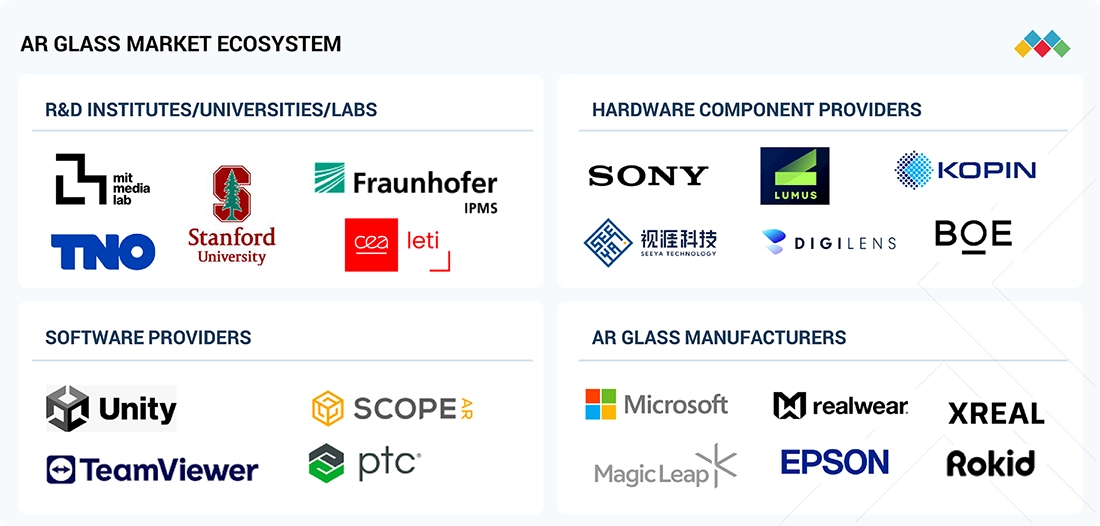
AR Glass Market: COMMERCIAL USE CASES ACROSS INDUSTRIES
| COMPANY | USE CASE DESCRIPTION | BENEFITS |
|---|---|---|
 |
Uses AR glasses to guide technicians during complex aircraft wire assembly, displaying 3D wiring diagrams and step-by-step instructions directly in the worker’s field of view | Reduces wiring time by up to 25%, minimizes human error, and enhances worker efficiency and training accuracy |
 |
Employs AR glasses for remote maintenance and quality inspections in manufacturing plants, allowing experts to assist on-site technicians through live AR annotations | Decreases machine downtime, improves inspection precision, and reduces travel costs for technical support teams. |
 |
Integrates AR glasses for vehicle assembly and logistics operations, providing visual instructions and real-time component positioning to line workers | Improves assembly accuracy, reduces rework, and enhances production line throughput and safety |
 |
Deploys AR smartglasses in warehouses for “vision picking,” where workers receive item locations and picking lists through head-up displays | Increases order-picking speed by 15–20%, minimizes manual errors, and improves worker ergonomics |
 |
Uses AR glasses for remote client demonstrations and immersive training sessions, allowing teams to visualize digital twins and simulated environments in real-time | Boosts client engagement, reduces training costs, and enables interactive collaboration across global teams |
Logos and trademarks shown above are the property of their respective owners. Their use here is for informational and illustrative purposes only.
Related Ecosystem
Augmented Virtual Reality
- Sensors
- Virtual Reality Devices
- Augmented Reality
- Virtual Reality
- Augmented Reality Devices
- MICROSOFT CORPORATION
- Lenovo
- VIVITEK CORPORATION
- Apple Inc.
Communication And Connectivity Technology
- Sensors
- Smart Card & Readers
- Cellular Network
- Femtocell
- Image Sensors
- Cisco Systems, Inc.
- HUAWEI TECHNOLOGIES CO LTD
- Lenovo
- CommScope Holding Company, Inc.
- Nokia corporation
Display Technology
- Augmented Reality
- Liquid Crystal Display (LCD)
- Sensors
- Virtual Reality Devices
- Liquid Crystal on Silicon (LCOS)
- VIVITEK CORPORATION
- Samsung
- Lenovo
- Panasonic Holdings Corporation
- Lg corp
Key Takeaways
- France's AR glass market is valued at $49.1 million in 2025 and is forecast to reach $466.4 million by 2030, representing a 56.8% CAGR.
- France is emerging as a high-growth AR glass hub in Europe, driven by strong digital infrastructure and enterprise adoption across multiple sectors.
- Enterprise applications in manufacturing, healthcare, and defense are primary growth drivers for France's AR glass market expansion.
- France's semiconductor and electronics expertise positions the country as a competitive center for AR glass innovation and development through 2030.
AR Glass Market Report Scope
| Report Metric | Details |
|---|---|
| Base Year | 2025 |
| Fastest Growing Segment | TETHERED (Connectivity) |
| Forecast Period | 2025–2030 |
| Growth Rate | CAGR of 59% from 2025 to 2030 |
| Largest Segment | MARKERLESS AR (Technology) |
| Market Size Base Year (Billions) | ~USD 0.98 (2025) |
| Revenue Forecast (Billions) | ~USD 9.98 (2030) |
| Segments Covered | Connectivity, Component, Technology, Application |
France AR Glass Market Report Segmentation
4 segment dimensions are covered across the global market.
By Connectivity
- Standalone
- Tethered
By Component
- Cameras
- Cases & Connectors
- Controllers
- Displays
- Lenses
- Other Components
- Processors & Memory
- Sensors
By Technology
- Marker-Based Ar
- Markerless Ar
By Application
- Aerospace & Defense
- Automotive
- Commercial
- Consumer
- Energy
- Enterprise & Industrial
- Healthcare
- Other Applications
FRANCE: AR GLASS MARKET, BY APPLICATION, 2025–2030
| Segment | 2025 | 2026 | 2027 | 2028 | 2029 | 2030 | CAGR (%) |
|---|---|---|---|---|---|---|---|
| AEROSPACE & DEFENSE | 0.98 | 1.31 | 1.86 | 2.81 | 4.53 | 7.89 | 51.8 |
| AUTOMOTIVE | 7.3 | 10.69 | 16.53 | 27.19 | 47.89 | 90.97 | 65.6 |
| COMMERCIAL | 8.68 | 12.51 | 19.04 | 30.8 | 53.36 | 99.73 | 62.9 |
| CONSUMER | 1.95 | 2.6 | 3.67 | 5.5 | 8.84 | 15.31 | 51.1 |
| ENERGY | 2.4 | 3.23 | 4.57 | 6.89 | 11.12 | 19.35 | 51.8 |
| ENTERPRISE & INDUSTRIAL | 22.45 | 30.57 | 43.97 | 67.22 | 110.06 | 194.38 | 54 |
| HEALTHCARE | 2.57 | 3.52 | 5.08 | 7.8 | 12.83 | 22.76 | 54.7 |
| OTHER APPLICATIONS | 2.8 | 3.6 | 4.83 | 6.82 | 10.14 | 15.96 | 41.6 |
| TOTAL | 49.13 | 68.02 | 99.55 | 155.03 | 258.76 | 466.36 | 56.8 |
Target Audience
- French Technology Companies : AR glass manufacturers and software developers need France-specific market data to identify growth opportunities, understand competitive positioning, and develop localized product strategies for domestic expansion.
- Enterprise Solution Providers : B2B service providers targeting French manufacturing, healthcare, and logistics sectors require detailed market insights to identify customer segments, quantify opportunity size, and tailor AR solutions to French business needs.
- Investment & Private Equity Firms : Investors evaluating opportunities in French AR technology ecosystem need comprehensive market analysis, growth forecasts, and competitive intelligence to make informed funding and acquisition decisions.
- International AR Hardware Vendors : Global AR glass manufacturers seeking to expand into France require localized market data, adoption trends, and channel insights to develop effective market entry and distribution strategies.
- Government & Policy Organizations : French government agencies and economic development bodies need market intelligence to inform digital innovation policies, funding initiatives, and strategic positioning of France in the European AR technology landscape.
Key Companies in the France AR Glass Market
| Company | HQ | Ownership | Strongest segments |
|---|---|---|---|
| MICROSOFT | United States | Public Company | Azure and other cloud services,Microsoft 365 commercial (including Teams, security, compliance, Copilot),LinkedIn and Dynamics products and cloud services, |
| SEIKO EPSON CORPORATION | Japan | Public Company | Home and Office Inkjet Printers & Consumables,Commercial & Industrial Inkjet, Label, POS, and Printheads,Visual Communications (LCD Projectors, Smart Glasses), |
| VUZIX CORPORATION | United States | Public Company | M Series smart glasses,Vuzix Blade and Shield,Vuzix Ultralite Z100 and consumer-oriented devices, |
| LENOVO | China | Public Company | Small form factor PCs and embedded signage controllers,Thin clients and dedicated media players,Tablets and smart devices for kiosks/PoS, |
MICROSOFT
Microsoft is a public technology company founded in 1975 in the United States, employing 228,000 people and operating globally across software, cloud computing, and hardware sectors.
SEIKO EPSON CORPORATION
Seiko Epson Corporation is a Japanese public company founded in 1942 with 74,619 employees, specializing in imaging and printing technologies.
VUZIX CORPORATION
Vuzix Corporation is a public technology company founded in 1997 in the United States with 88 employees, specializing in augmented reality and wearable display technologies.
LENOVO
Lenovo is a public technology company founded in 1984 in China, operating as a global manufacturer of computing devices and IT solutions.
Reasons to Buy this Report
- Market-Specific Growth Intelligence : Gain detailed insights into France's unique 56.8% CAGR trajectory and understand the specific drivers differentiating the French market from broader European trends and global benchmarks.
- Enterprise Opportunity Mapping : Identify high-potential French enterprise segments in manufacturing, healthcare, and logistics with detailed adoption patterns, investment priorities, and competitive landscapes specific to France.
- Localized Investment Strategy : Access France-specific market data to inform investment decisions, partnership strategies, and go-to-market approaches tailored to French regulatory environment and business culture.
- Competitive Landscape Analysis : Understand key French and international players operating in the market, their market positioning, product offerings, and strategic initiatives specific to the French AR glass ecosystem.
- Forecast-Driven Planning : Leverage detailed 2025-2030 projections for France to develop accurate business plans, resource allocation strategies, and revenue forecasts with country-level precision and confidence.
Frequently asked questions
What is the current size of France's AR glass market in 2025?
France's AR glass market is valued at $49.1 million in 2025, establishing a strong foundation for growth through the forecast period.
What is the projected market size for France's AR glass market by 2030?
France's AR glass market is projected to reach $466.4 million by 2030, representing nearly a tenfold increase from 2025 levels.
What is the CAGR for France's AR glass market?
France's AR glass market is expected to grow at a compound annual growth rate of 56.8% between 2025 and 2030.
Which industries are driving AR glass adoption in France?
Manufacturing, healthcare, retail, and defense sectors are primary drivers of AR glass adoption in France, with enterprise applications leading growth.
Why is France positioned as a key AR glass market in Europe?
France benefits from advanced semiconductor and electronics capabilities, strong digital infrastructure, government technology support, and a robust innovation ecosystem that accelerates AR glass development and deployment.
RESEARCH METHODOLOGY
The research study involved four major activities in estimating the size of the AR glass market. Exhaustive secondary research has been done to collect important information about the market and peer markets. The validation of these findings, assumptions, and sizing with the help of primary research with industry experts across the value chain has been the next step. Both top-down and bottom-up approaches have been used to estimate the market size. Post which the market breakdown and data triangulation have been adopted to estimate the market sizes of segments and subsegments.
Secondary Research
In the secondary research process, various secondary sources were referred to to identify and collect information required for this study. The secondary sources include annual reports, press releases, investor presentations of companies, white papers, and articles from recognized authors. Secondary research has been mainly done to obtain key information about the market’s value chain, the pool of key market players, market segmentation according to industry trends, regional outlook, and developments from market and technology perspectives.
In the AR glass market report, the global market size has been estimated using the top-down and bottom-up approaches, along with several other dependent submarkets. Major players in the market were identified using extensive secondary research, and their presence in the market was determined using secondary and primary research. All the percentage shares splits, and breakdowns have been determined using secondary sources and verified through primary sources.
Primary Research
Extensive primary research has been conducted after understanding the AR glass market scenario through secondary research. Several primary interviews have been conducted with key opinion leaders from the demand- and supply-side vendors across four major regions—North America, Europe, Asia Pacific, and RoW. Approximately 25% of the primary interviews have been conducted with the demand-side vendors and 75% with the supply-side vendors. Primary data was collected mainly through telephonic interviews, which comprised 80% of the total primary interviews; questionnaires and emails were also used to collect the data.
After successful interaction with industry experts, brief sessions were conducted with highly experienced independent consultants to reinforce the primary research findings. This, along with the in-house subject matter experts’ opinions, has led us to the findings as described in the report.
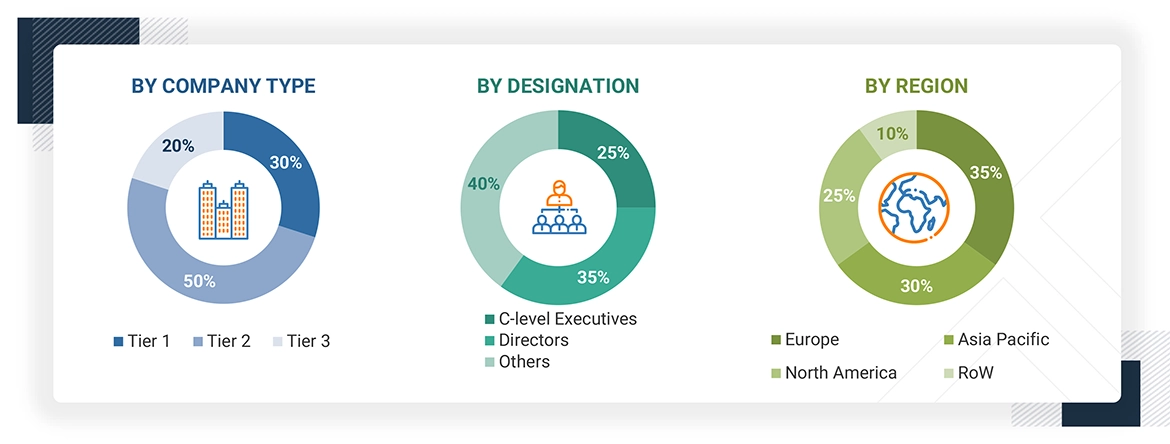
Note: “Others” includes sales, marketing, and product managers
To know about the assumptions considered for the study, download the pdf brochure
Market Size Estimation
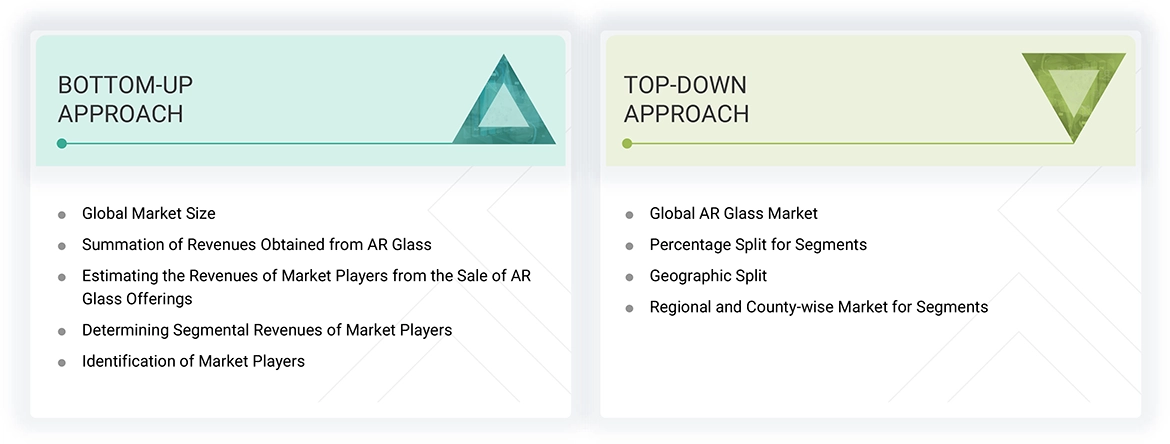
In the market engineering process, both top-down and bottom-up approaches and data triangulation methods have been used to estimate and validate the size of the AR glass market and other dependent submarkets. The research methodology used to estimate the market sizes includes the following:
- Identifying top-line investments and spending in the ecosystem, and considering segment-level splits and major market developments
- Identifying different stakeholders in the AR glass market that influence the entire market, along with participants across the supply chain
- Analyzing major manufacturers in the AR glass market and studying their product portfolio
- Analyzing trends related to the adoption of AR glass products
- Tracking recent and upcoming market developments, including investments, R&D activities, product launches, expansions, acquisitions, partnerships, collaborations, agreements, and investments, as well as forecasting the market size based on these developments and other critical parameters
- Carrying out multiple discussions with key opinion leaders to identify the adoption trends of AR glasses.
- Segmenting the overall market into various other market segments
- Validating the estimates at every level through discussions with key opinion leaders, such as chief executives (CXOs), directors, and operation managers, and finally with the domain experts at MarketsandMarkets
AR Glass Market : Top-Down and Bottom-Up Approach
Data Triangulation
After arriving at the overall market size by the market size estimation process explained in the earlier section, the overall AR glass market has been divided into several segments and subsegments. To complete the overall market engineering process and arrive at the exact statistics for all segments, the data triangulation and market breakdown procedures have been used, wherever applicable. The data was triangulated by studying various factors and trends from the perspectives of demand and supply. Along with data triangulation and market breakdown, the market has been validated by top-down and bottom-up approaches.
Market Definition
Augmented reality (AR) glass encompasses wearable technology, such as smart eyewear or head-mounted displays (HMDs), designed to overlay digital elements onto the real-world environment. These devices offer interactive, real-time visualizations, enabling users to engage with their surroundings while seamlessly accessing digital content without using their hands.
The AR glass comprises eyewear, smart glasses, and HMDs, available as tethered or standalone systems. These solutions are deployed in diverse use cases, such as remote support, equipment maintenance, surgical procedures, warehouse operations, design validation, training environments, and defense applications. By improving operational efficiency, situational awareness, and decision-making, AR Glass is revolutionizing workflows across industries such as healthcare, manufacturing, logistics, retail, automotive, and defense. As organizations increasingly invest in digital transformation, AR glass is an essential interface bridging the physical and digital worlds.
The AR glass market is segmented based on connectivity, component, technology, application, and region. In terms of connectivity, AR glasses are categorized into tethered and standalone types. Tethered glasses rely on external devices such as smartphones or PCs, while standalone glasses have built-in processors and operate independently. The component segment includes displays, sensors, lenses, processors & memory, controllers, cameras, cases, connectors, and other related parts. For technology, the market is divided into marker-based AR and markerless AR. Marker-based AR uses visual markers to trigger digital content, whereas markerless AR operates without markers, using environmental understanding. The application segment covers various sectors, such as consumer, commercial, enterprise, healthcare, aerospace and defense, automotive, energy, and other fields. This segmentation helps understand how AR glasses are used across different industries and how their components and technologies vary based on specific needs.
Key Stakeholders
- AR Glass Manufacturers
- Component Suppliers
- Software & Platform Developers
- Application Developers & Integrators
- End-use Industries (Buyers/Users)
- Distributors & Channel Partners
- Research Institutions & Standard Bodies
- Technology Investors
- Government, Financial Institutions, and Investment Communities
Report Objectives
- To describe and forecast the overall AR glass market, by connectivity, component, technology, and application in terms of value
- To forecast the market, by connectivity, in terms of volume
- To describe different types of AR glasses, namely, head-mounted and eyewear
- To describe and forecast the market for four key regions: North America, Europe, Asia Pacific, and RoW, in terms of value
- To provide detailed information regarding drivers, restraints, opportunities, and challenges influencing the growth of the market
- To provide a detailed overview of the supply chain of the AR glass ecosystem, along with the average selling prices of the product type
- To strategically analyze the ecosystem, Porter’s five forces, key stakeholders & buying criteria, technology analysis, investment and funding scenario, key conferences & events, tariffs and regulations, patent landscape, trade landscape, and case studies pertaining to the market under study
- To strategically analyze micromarkets1 with regard to individual growth trends, prospects, and contributions to the overall market
- To analyze opportunities in the market for stakeholders and provide a competitive landscape of the market
- To analyze the impact of AI/Gen AI and the US tariff on the AR glass market
- To analyze competitive developments, such as product launches, expansions, partnerships, and collaborations, in the market
- To strategically profile the key players in the market and comprehensively analyze their market ranking and core competencies
Available customizations:
With the given market data, MarketsandMarkets offers customizations according to the specific requirements of companies. The following customization options are available for the report:
Country-wise Information:
- Country-wise breakdown for North America, Europe, Asia Pacific, and RoW
Company Information:
- Detailed analysis and profiling of additional market players (up to five)
Get the Full AR Glass Market Report
Full forecast, segment splits, and company analysis for all AR Glass Market.
- Germany AR Glass Market
- Italy AR Glass Market
- Poland AR Glass Market
- Spain AR Glass Market
- UK AR Glass Market
- Australia AR Glass Market
- China AR Glass Market
- India AR Glass Market
- Indonesia AR Glass Market
- Japan AR Glass Market
- Malaysia AR Glass Market
- South Korea AR Glass Market
- Thailand AR Glass Market
- Vietnam AR Glass Market
- Nordics AR Glass Market
- Rest Of Europe AR Glass Market
- Rest Of Asia Pacific AR Glass Market
- Bahrain AR Glass Market
- Kuwait AR Glass Market
- Oman AR Glass Market
- Qatar AR Glass Market
- Rest Of Middle East AR Glass Market
- Saudi Arabia AR Glass Market
- UAE AR Glass Market
- Other African Countries AR Glass Market
- South Africa AR Glass Market
- Canada AR Glass Market
- Mexico AR Glass Market
- US AR Glass Market
Need a Tailored Report?
Customize this report to your needs
Get 10% FREE Customization
Customize This Report
