
Asia Pacific Arc-based Plasma Lighting Market (2024-2029)

The Asia Pacific Arc-based Plasma Lighting Market was valued at $310.6 Million in 2024 and projected to reach to $347.6 Million by 2029, representing a compound annual growth rate of 2.3%. Asia Pacific's arc-based plasma lighting market is positioned for sustained growth through 2029, driven by rapid industrialization, infrastructure development, and increasing adoption of energy-efficient lighting technologies across manufacturing, entertainment, and specialty applications.


| Market Size in | USD 26.32 MN |
| Market Forecast in | |
| CAGR | |
| Forecast Period | |
| Units Considered | Value (USD MN) |
Asia Pacific Arc-based Plasma Lighting Market Trends and Insights
- This steady growth in Asia Pacific reflects increasing adoption of advanced lighting technologies across industrial, commercial, and specialty applications.
- Asia Pacific's market expansion is driven by rising demand for high-intensity discharge solutions in semiconductor manufacturing, entertainment venues, and outdoor lighting infrastructure. The arc-based plasma lighting sector in Asia Pacific benefits from rapid industrialization and infrastructure development across key economies.
- Asia Pacific's semiconductor and electronics industries are leveraging plasma lighting for precision applications, while entertainment and hospitality sectors in Asia Pacific continue to invest in advanced stage and venue lighting systems.
- Between 2024 and 2029, Asia Pacific is expected to maintain consistent market momentum, supported by technological innovation and regional manufacturing capabilities that position Asia Pacific as a critical hub for plasma lighting solutions..
Key Market Statistics
- CAGR (2024-2029) 2.3% CAGR
- Market Size, 2024 ~USD 310.6 Million
- Forecast, 2029 ~USD 347.6 Million
- Geography Asia Pacific
Asia Pacific Arc-based Plasma Lighting Market Overview
China Dominates Regional Market :
China leads Asia Pacific's arc-based plasma lighting market with USD 194.6 million in 2024, representing over 62% of the region's total market value and driving significant industrial adoption across manufacturing and specialty lighting applications.
India's Emerging Growth Opportunity :
India's market stands at USD 48.7 million in 2024, positioning it as the second-largest market in Asia Pacific with substantial growth potential driven by expanding industrial infrastructure and increasing demand for advanced lighting solutions in commercial sectors.
Steady Regional Expansion at 2.3% CAGR :
Asia Pacific's arc-based plasma lighting market is projected to grow from USD 310.6 million in 2024 to USD 347.6 million by 2029, outpacing the global CAGR of 1.9% and reflecting accelerating technology adoption across the region.
Diverse Market Composition :
Beyond China and India, Japan (USD 31.3 million) and Rest of Asia Pacific (USD 73 million) contribute significantly to regional growth, creating a diversified market landscape with varied adoption rates and industrial applications across multiple economies.
Asia Pacific Arc-based Plasma Lighting Market Dynamics
- China's dominance as the regional powerhouse, combined with India's emerging market potential, creates a compelling growth narrative for the region. The market's 2.3% CAGR reflects growing investments in advanced lighting infrastructure, particularly in semiconductor manufacturing, automotive, and entertainment venues.
- Rising awareness of plasma lighting's superior performance characteristics and expanding industrial applications in Asia Pacific are expected to accelerate market penetration, with emerging economies increasingly adopting these technologies to modernize their industrial and commercial lighting capabilities..
Market Ecosystem
Related Ecosystem
Smart Lighting
- Fiber Laser
- Fluorescent Lighting
- Gas Lasers
- Sensors
- 3D Sensors
- Zumtobel group ag
- Nedap n.v.
- Acuity Brands, Inc.
- OSRAM Licht AG
- Philips
Automotive Advance Technologies
- Battery Electric Vehicle (BEV)
- Light Commercial Vehicles (LCVs)
- Fuel Cell Electric Vehicle (FCEV)
- Hybrid Electric Vehicle (HEV)
- Internal Combustion Engine (ICE)
- BOSCH LIMITED
- Continental ag
- Visteon Corporation
- DENSO Corporation
- ZF FRIEDRICHSHAFEN AG
Battery And Wireless Charging
- Nickel-Cadmium Battery
- Battery Electric Vehicle (BEV)
- Energy Harvesting
- Hybrid Electric Vehicle (HEV)
- Smart Cards
- Panasonic Holdings Corporation
- MOMENTIVE PERFORMANCE MATERIALS INC.
- Lg corp
- FDK Corporation
- Samsung
Key Takeaways
- Asia Pacific arc-based plasma lighting market reaches USD 310.6 million in 2024 with projected growth to USD 347.6 million by 2029.
- Asia Pacific demonstrates a 2.3% CAGR, outpacing the global average of 1.9%, indicating stronger regional demand dynamics.
- Asia Pacific's semiconductor and industrial sectors drive adoption of high-intensity plasma lighting for precision manufacturing applications.
- Asia Pacific's entertainment and infrastructure sectors continue to invest in advanced plasma lighting technologies through 2029.
Arc-based Plasma Lighting Market Report Scope
| Report Metric | Details |
|---|---|
| Base Year | 2024 |
| Fastest Growing Segment | 501-1,500 W (Wattage Type) |
| Forecast Period | 2024-2029 |
| Growth Rate | CAGR of 1.9% from 2024 to 2029 |
| Largest Segment | BELOW 500 W (Wattage Type) |
| Market Size Base Year (Billions) | ~USD 0.62 (2024) |
| Revenue Forecast (Billions) | ~USD 0.68 (2029) |
| Segments Covered | Light Source, Application, Wattage Type, Sub-Application |
Asia Pacific Arc-based Plasma Lighting Market Report Segmentation
4 segment dimensions are covered across the global market.
By Light Source
- Deuterium Lamps
- Krypton Arc Lamps
- Mercury Vapor Lamps
- Metal Halide Lamps
- Xenon Arc Lamps
By Application
- Entertainment & Projection
- Laser Pumping
- Medical Lighting
- Microscopic Lighting
- Other Applications
- Other Applications (Capillary Electrophoresis & Photoionization)
- Searchlight & Spotlight
- Searchlight & Spotlights
- Solar Simulation & Environment Testing
- Spectroscopy
- Uv
By Wattage Type
- 501-1,500 W
- Above 1,500 W
- Below 500 W
By Sub-Application
- Absorptivity Measurements
- Additive Manufacturing
- Aerospace & Aeronautic
- Air & Runways
- Automotive
- Broadband Light Source
- Chemical & Photochemical Processes
- Cinema Projectors
- Civil & Land
- Dental Lighting
- Endoscopic Lighting
- Large Venue Lighting
- Large Venue Projectors
- Lithography
- Maritime & Ports
- Military
- Other Solar Simulation & Environment Testing Applications
- Outdoor Lighting
- Photography
- Photovoltaic
- Scenery Lighting
- Surgical Lighting
Target Audience
- Lighting Equipment Manufacturers : Manufacturers need Asia Pacific market data to identify regional demand patterns, competitive positioning, and growth opportunities in China, India, and emerging markets to optimize product development and distribution strategies.
- Industrial & Commercial Buyers : End-users in manufacturing, entertainment, and commercial sectors require market insights to understand technology trends, supplier landscapes, and adoption rates across Asia Pacific to make informed procurement decisions.
- Investment & Private Equity Firms : Investors need comprehensive regional analysis to evaluate market growth potential, identify acquisition targets, and assess the viability of lighting technology companies operating across Asia Pacific's diverse economies.
- Technology Distributors & Resellers : Distribution partners require country-level market data and growth forecasts to optimize inventory, identify high-potential markets, and develop targeted sales strategies across Asia Pacific regions.
- Market Strategists & Consultants : Strategic advisors need detailed Asia Pacific segmentation to provide clients with actionable market intelligence, competitive benchmarking, and regional expansion recommendations for lighting technology businesses.
Countries within Asia Pacific - compare and drill down
| Country | 2025 size (native) |
|---|---|
| China | USD 194.6 Million |
| Japan | USD 31.3 Million |
| India | USD 48.7 Million |
| Rest Of Asia Pacific | USD 73 Million |
Country market size visualization
Reasons to Buy this Report
- China Market Intelligence : Gain detailed insights into China's USD 194.6 million market, the region's largest segment, with analysis of industrial adoption patterns, competitive dynamics, and growth drivers specific to Asia's manufacturing powerhouse.
- India Growth Opportunity Assessment : Understand India's emerging USD 48.7 million market with forecasts through 2029, identifying expansion opportunities in industrial infrastructure, commercial applications, and technology adoption across this high-growth economy.
- Regional Competitive Landscape : Access comprehensive competitive analysis across Asia Pacific's diverse markets, including Japan, South Korea, and Southeast Asia, to benchmark performance and identify strategic positioning opportunities in key sub-regions.
- Technology Adoption Trends : Discover sector-specific adoption patterns for arc-based plasma lighting across industrial, commercial, and specialty applications unique to Asia Pacific's manufacturing and entertainment sectors.
- Strategic Market Forecasting : Leverage 5-year forecasts (2024-2029) with 2.3% CAGR projections to inform investment decisions, product development strategies, and market entry planning across Asia Pacific's high-potential regions.
Frequently asked questions
What is the current market size of arc-based plasma lighting in Asia Pacific?
Asia Pacific's arc-based plasma lighting market is valued at USD 310.6 million in 2024.
What is the projected market size for Asia Pacific arc-based plasma lighting by 2029?
Asia Pacific's arc-based plasma lighting market is forecast to reach USD 347.6 million by 2029.
What is the CAGR for arc-based plasma lighting in Asia Pacific?
Asia Pacific's arc-based plasma lighting market is expected to grow at a CAGR of 2.3% from 2024 to 2029.
Which industries in Asia Pacific are driving plasma lighting demand?
Asia Pacific's semiconductor manufacturing, entertainment venues, industrial applications, and outdoor infrastructure sectors are primary drivers of arc-based plasma lighting adoption.
How does Asia Pacific's growth compare to global market trends?
Asia Pacific's 2.3% CAGR exceeds the global average of 1.9%, demonstrating stronger regional market momentum and demand for plasma lighting technologies.
RESEARCH METHODOLOGY
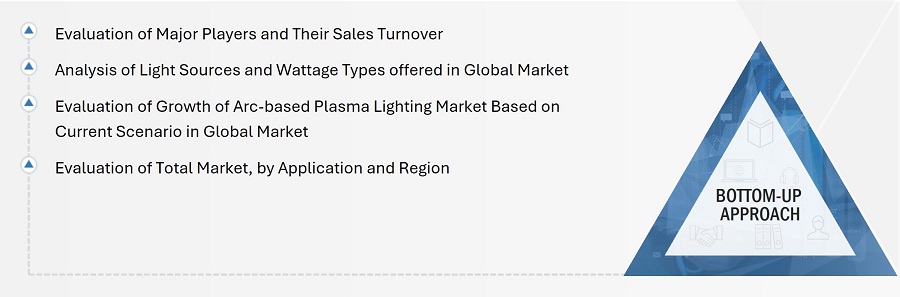
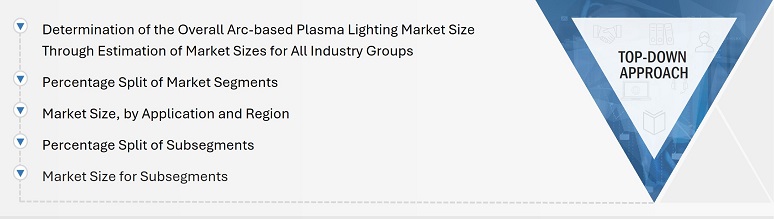
The study involved four major activities in estimating the arc-based plasma lighting market size. Exhaustive secondary research has been carried out to collect information on the market, the peer markets, and the parent market. Both top-down and bottom-up approaches have been employed to estimate the total market size. Market breakdown and data triangulation methods have also been used to estimate the market for segments and subsegments.
Secondary Research
In the secondary research process, various secondary sources have been referred to for identifying and collecting information relevant to this study on the arc-based plasma lighting market. The secondary sources included the Global Lighting Association, American Lighting Association (ALA), Illuminating Engineering Society (IES), The International Commission on Illumination (CIE), National Electrical Manufacturers Association (NEMA), annual reports, press releases, and investor presentations of companies; white papers, certified publications, and articles by recognized authors; directories; and databases.
The global size of the arc-based plasma lighting market has been obtained from the secondary data available through paid and unpaid sources. It has also been determined by analyzing the product portfolios of the leading companies and rating them based on the quality of their offerings.
Secondary research has been used to gather key information about the industry's supply chain, the market’s monetary chain, the total number of key players, and market segmentation according to the industry trends to the bottom-most level, geographic markets, and key developments from both the market- and technology-oriented perspectives. It has also been conducted to identify and analyze the industry trends and key developments undertaken from both the market- and technology perspectives.
Primary Research
In the primary research process, various primary sources have been interviewed to obtain qualitative and quantitative information about the market across four main regions-Asia Pacific, North America, Europe, and the Rest of the World (the Middle East & Africa, and South America). Primary sources from the supply side include industry experts such as CEOs, vice presidents, marketing directors, technology directors, and other related key executives from major companies and organizations operating in the arc-based plasma lighting market or related markets.
After completing market engineering, primary research was conducted to gather information and verify and validate critical numbers from other sources. Primary research has also been conducted to identify various market segments; industry trends; key players; competitive landscape; and key market dynamics, such as drivers, restraints, opportunities, and challenges, along with key strategies adopted by market players. Most primary interviews have been conducted with the market's supply side. This primary data has been collected through questionnaires, emails, and telephonic interviews.
The breakdown of primary respondents is as follows:
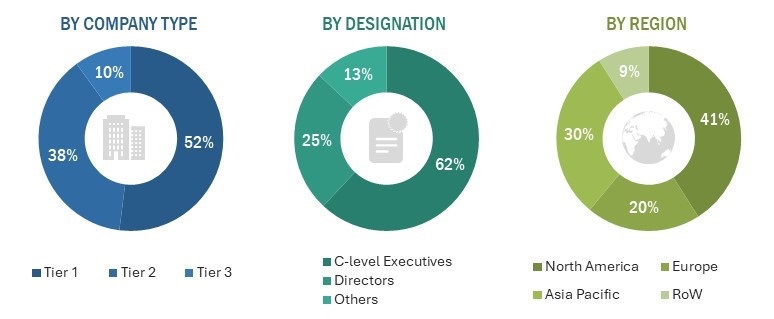
To know about the assumptions considered for the study, download the pdf brochure
Market Size Estimation
In the complete engineering process, both top-down and bottom-up approaches and several data triangulation methods have been used to estimate and validate the size of the overall arc-based plasma lighting market and other dependent submarkets. Key players in the market have been identified through secondary research, and their market positions in the respective geographies have been determined through both primary and secondary research. This entire procedure includes studying top market players’ annual and financial reports and extensive interviews with industry leaders such as CEOs, VPs, directors, and marketing executives for key insights (qualitative and quantitative).
All percentage shares and breakdowns have been determined using secondary sources and verified through primary sources. All the possible parameters that affect the markets covered in this research study have been accounted for, viewed in detail, verified through primary research, and analyzed to obtain the final quantitative and qualitative data. This data has been consolidated and supplemented with detailed inputs and analysis from MarketsandMarkets and presented in this report.
Global Arc-based plasma lighting Market Size: Bottom-Up Approach
Global Arc-based plasma lighting Market Size: Top-Down Approach
Data Triangulation
After arriving at the overall market size from the estimation process explained above, the overall market has been split into several segments and subsegments. To complete the overall market engineering process and arrive at the exact statistics for all segments and subsegments, the market breakdown and data triangulation procedures have been employed, wherever applicable. Data has been triangulated by studying various factors and trends from both the demand and supply sides. Along with this, the market size has been validated using top-down and bottom-up approaches.
Market Definition
Arc-based plasma lighting is a lighting technology that operates by creating a high-intensity electric arc within a sealed quartz bulb or other transparent enclosure filled with a noble gas or a mixture of gases. This arc generates a plasma, which is a highly ionized gas consisting of charged particles such as ions and free electrons. The plasma emits light across a broad spectrum, ranging from ultraviolet (UV) to visible and infrared (IR) wavelengths, depending on the specific gas mixture and operating conditions. The arc is typically initiated and maintained by an electrical discharge between two electrodes, which may be made of tungsten, molybdenum, or other refractory materials. As the arc current passes through the gas, it ionizes the gas molecules, causing them to emit photons of light. This process produces an intense and uniform illumination characterized by high brightness and excellent color rendering properties.
Key Stakeholders
- Raw material suppliers
- Research organizations
- Original equipment manufacturers (OEMs)
- Technology investors
- Analysts and strategic business planners
- Government bodies, venture capitalists, and private equity firms
- End users
Report Objectives
- To define and forecast the arc-based plasma lighting market based on light source, wattage type, and application, in terms of value
- To forecast the market size of various segments with respect to four main regions: North America, Europe, Asia Pacific, and the Rest of the World (RoW), in terms of value
- To provide detailed information regarding the drivers, restraints, opportunities, and challenges influencing the market growth
- To understand and analyze the impact of evolving technologies on the arc-based plasma lighting value chain and upcoming trends in the ecosystem
- To highlight the impact of Porter’s five forces on the arc-based plasma lighting ecosystem and analyze the underlying market opportunities
- To analyze the associated use cases in the arc-based plasma lighting business and their impact on the business strategies adopted by key players
- To provide key industry trends and associated important regulations impacting the global market
- To strategically analyze micromarkets with respect to individual growth trends, prospects, and contributions to the total market
- To strategically profile key players and comprehensively analyze their market share and core competencies, along with detailing the competitive landscape for market leaders
- To analyze competitive developments such as agreements, partnerships, acquisitions, and product launches in the arc-based plasma lighting market
Available customizations:
With the given market data, MarketsandMarkets offers customizations according to the specific requirements of companies. The following customization options are available for the report:
- Detailed analysis and profiling of additional market players (up to 5 players) based on various blocks of the supply chain
Get the Full Arc-based Plasma Lighting Market Report
Full forecast, segment splits, and company analysis for all Arc-based Plasma Lighting Market.
- US Arc-based Plasma Lighting Market
- Canada Arc-based Plasma Lighting Market
- Mexico Arc-based Plasma Lighting Market
- Germany Arc-based Plasma Lighting Market
- UK Arc-based Plasma Lighting Market
- France Arc-based Plasma Lighting Market
- Rest Of Europe Arc-based Plasma Lighting Market
- China Arc-based Plasma Lighting Market
- Japan Arc-based Plasma Lighting Market
- India Arc-based Plasma Lighting Market
- Rest Of Asia Pacific Arc-based Plasma Lighting Market
- GCC Countries Arc-based Plasma Lighting Market
Need a Tailored Report?
Customize this report to your needs
Get 10% FREE Customization
Customize This Report
