
Saudi Arabia Artificial Intelligence in Retail Market (2024-2029)

The Saudi Arabia Artificial Intelligence in Retail Market was valued at $241.1 Million in 2024 and projected to reach to $1738.3 Million by 2029, representing a compound annual growth rate of 39.0%. Saudi Arabia's AI in retail market is poised for transformative growth through 2029, driven by government-backed digital initiatives and substantial private sector investments.


| Market Size in | USD 26.32 MN |
| Market Forecast in | |
| CAGR | |
| Forecast Period | |
| Units Considered | Value (USD MN) |
Saudi Arabia Artificial Intelligence in Retail Market Trends and Insights
- This remarkable 39% compound annual growth rate reflects Saudi Arabia's strategic investments in digital transformation and retail modernization as part of Vision 2030 initiatives.
- Saudi Arabia is rapidly adopting AI-powered solutions including personalized customer experiences, inventory optimization, and automated checkout systems across its retail sector. The acceleration of AI adoption in Saudi Arabia's retail landscape is driven by increasing consumer expectations for seamless omnichannel experiences and operational efficiency demands.
- Saudi Arabia's retail enterprises are leveraging machine learning and computer vision technologies to enhance customer engagement and reduce operational costs.
- Between 2024 and 2029, Saudi Arabia is positioned to become a regional leader in AI-enabled retail innovation, with significant investments from both domestic retailers and international technology providers establishing operations within the kingdom..
Key Market Statistics
- CAGR (2024-2029) 39.0% CAGR
- Market Size, 2024 ~USD 241.1 Million
- Forecast, 2029 ~USD 1738.3 Million
- Country Saudi Arabia
Saudi Arabia Artificial Intelligence in Retail Market Overview
Explosive Growth Trajectory :
Saudi Arabia's AI in retail market is projected to grow from $241.1 million in 2024 to $1,738.3 million by 2029, representing a 39% CAGR—significantly outpacing the global average of 32%.
Vision 2030 Digital Transformation :
The Saudi government's Vision 2030 initiative is driving substantial investments in digital infrastructure and retail modernization, positioning AI adoption as a critical component of economic diversification.
Retail Sector Modernization :
Major Saudi retailers are rapidly implementing AI-powered solutions for inventory management, personalized customer experiences, and supply chain optimization to enhance competitiveness in the regional market.
Strategic Regional Hub Status :
Saudi Arabia is emerging as the Gulf region's AI retail innovation leader, attracting international technology providers and creating opportunities for localized AI solutions tailored to Middle Eastern consumer behaviors.
Saudi Arabia Artificial Intelligence in Retail Market Dynamics
- The kingdom's strategic focus on reducing oil dependency and modernizing retail infrastructure creates a favorable ecosystem for AI adoption across e-commerce, brick-and-mortar stores, and omnichannel retail operations.
- Major retailers are increasingly deploying AI for demand forecasting, customer analytics, and automated checkout systems. The market will be further accelerated by growing smartphone penetration, rising digital payment adoption, and increasing consumer expectations for personalized shopping experiences.
- Saudi Arabia's young, tech-savvy population and high disposable incomes support rapid AI technology uptake.
- Strategic partnerships between local retailers and global AI providers, combined with government incentives for technology adoption, will solidify the kingdom's position as a regional AI retail leader through 2029..
Market Ecosystem
Related Ecosystem
Cyber Security
- Cloud Security
- Biometric Systems
- Data Loss Prevention (DLP)
- Multi-Factor Authentication
- Security Analytics
- REDINGTON
- International Business Machines Corporation
- Cisco Systems, Inc.
- MITSUI BUSSAN SECURE DIRECTIONS INC
- MICROSOFT CORPORATION
Software And Services
- Natural Language Processing (NLP)
- Machine Learning
- Supply Chain Management
- Predictive Analytics
- Image Sensors
- International Business Machines Corporation
- MICROSOFT CORPORATION
- Oracle Corporation
- SAP SE
- Amazon.com, Inc.
Retail Technology
- Supply Chain Management
- Active Tags
- Pallet Aggregation
- 2D Barcodes
- Augmented Reality
- SAP SE
- MICROSOFT CORPORATION
- Saison Information Systems Co., Ltd.
- International Business Machines Corporation
- Zebra Technologies Corporation
Key Takeaways
- Saudi Arabia's AI in retail market will grow from $241.1M (2024) to $1,738.3M (2029), representing a 39% CAGR.
- Saudi Arabia is leveraging AI for personalized customer experiences, inventory management, and automated retail operations.
- Vision 2030 initiatives are accelerating digital transformation and AI adoption across Saudi Arabia's retail sector.
- Saudi Arabia is attracting significant investment from global technology providers seeking to establish regional AI retail solutions.
Artificial Intelligence in Retail Market Report Scope
| Report Metric | Details |
|---|---|
| Base Year | 2024 |
| Fastest Growing Segment | HEALTHCARE & LIFE SCIENCES (Vertical) |
| Forecast Period | 2024-2029 |
| Growth Rate | CAGR of 32% from 2024 to 2029 |
| Largest Segment | MACHINE LEARNING (Technology) |
| Market Size Base Year (Billions) | ~USD 31.14 (2024) |
| Revenue Forecast (Billions) | ~USD 124.8 (2029) |
| Segments Covered | Offering, Solution, Service, Professional Service, Type, Business Function, End User, Offline, Channel Type, Technology, Vertical, Application, Product Type |
Saudi Arabia Artificial Intelligence in Retail Market Report Segmentation
13 segment dimensions are covered across the global market.
By Offering
- Hardware
- Services
- Software
- Solutions
By Solution
- Customer Relationship Management
- Other Solutions
- Personalized Product Recommendations
- Price Optimization
- Smart Checkout
- Supply Chain Management & Demand Planning
- Virtual Customer Assistant
- Virtual Stores
- Visual Search
By Service
- Managed Services
- Professional Services
By Professional Service
- Support & Maintenance
- System Integration & Implementation
- Training & Consulting
By Type
- Generative AI
- Other AI
By Business Function
- Cybersecurity
- Finance & Accounting
- Hr
- Human Resource
- Human Resources
- Marketing & Sales
- Operations
- Operations & Supply Chain
- Sales & Marketing
By End User
- Offline
- Online
By Offline
- Convenience Stores
- Other Offline Stores
- Specialty Stores
- Supermarkets & Hypermarkets
By Channel Type
- Offline
- Online
By Technology
- Computer Vision
- Context-Aware AI
- Machine Learning
- Natural Language Processing
By Vertical
- Agriculture
- Automotive, Transportation, And Logistics
- Bfsi
- Energy & Utilities
- Government & Defense
- Healthcare & Life Sciences
- It/Ites
- Manufacturing
- Media & Entertainment
- Other Verticals
- Retail & Ecommerce
- Telecommunications
By Application
- Crm
- Fraud Detection & Prevention
- Merchandise Planning
- Order Fulfillment & Returns Management
- Other Applications
- Price Recommendations & Optimization
- Supply Chain Management
By Product Type
- Consumer
- Industrial
Target Audience
- Retail Technology Providers : AI software vendors and technology solution providers need Saudi Arabia market data to identify growth opportunities, develop localized offerings, and establish partnerships with major regional retailers.
- Retail & E-commerce Enterprises : Saudi Arabian retailers and e-commerce companies require market intelligence to benchmark AI adoption rates, evaluate technology investments, and stay competitive in the rapidly evolving digital retail landscape.
- Investment & Private Equity Firms : Investors and PE firms targeting the Middle East technology sector need detailed market analysis to identify promising AI retail startups, assess growth potential, and make informed funding decisions in Saudi Arabia.
- Management Consultants & Advisors : Strategy consultants and business advisors serving Saudi Arabian clients require comprehensive market data to develop digital transformation roadmaps, technology adoption strategies, and competitive positioning recommendations.
- Government & Policy Makers : Saudi government agencies and economic development bodies need market insights to evaluate Vision 2030 progress, identify policy gaps, and support strategic initiatives for retail sector digitalization and AI adoption.
Reasons to Buy this Report
- Market Entry Strategy Development : Gain comprehensive insights into Saudi Arabia's unique retail landscape, regulatory environment, and consumer preferences to develop targeted market entry strategies and localization approaches for AI retail solutions.
- Competitive Intelligence & Benchmarking : Understand competitive positioning of local and international players in Saudi Arabia's AI retail sector, identify market gaps, and benchmark performance metrics against regional and global competitors.
- Investment & Funding Decisions : Access detailed market sizing, growth projections, and opportunity analysis to support investment decisions, venture capital allocation, and partnership evaluations in Saudi Arabia's high-growth AI retail segment.
- Product Development & Innovation : Leverage Saudi Arabia-specific consumer behavior data and retail trends to inform AI product development, feature prioritization, and innovation roadmaps tailored to regional market demands.
- Strategic Planning & Forecasting : Utilize accurate 5-year forecasts and market dynamics analysis to inform long-term strategic planning, resource allocation, and revenue projections for operations in Saudi Arabia's rapidly expanding AI retail market.
Frequently asked questions
What is the current size of Saudi Arabia's AI in retail market?
Saudi Arabia's artificial intelligence in retail market was valued at $241.1 million in 2024 and is expected to reach $1,738.3 million by 2029.
What is the growth rate for AI in retail in Saudi Arabia?
Saudi Arabia's AI in retail market is projected to grow at a compound annual growth rate (CAGR) of 39% from 2024 to 2029.
Which AI applications are most adopted in Saudi Arabia's retail sector?
Saudi Arabia's retailers are primarily adopting AI for personalized customer experiences, inventory optimization, demand forecasting, and automated checkout and payment systems.
What factors are driving AI adoption in Saudi Arabia's retail market?
Saudi Arabia's retail AI growth is driven by Vision 2030 digital transformation goals, rising consumer expectations for omnichannel experiences, and the need for operational efficiency and cost reduction.
How does Saudi Arabia's AI retail market compare to global trends?
Saudi Arabia's 39% CAGR significantly outpaces the global AI in retail market CAGR of 32%, positioning the kingdom as a high-growth regional market.
RESEARCH METHODOLOGY
The research study involved four major activities in estimating the AI in retail market size. Exhaustive secondary research has been done to collect important information about the market and peer markets. The next step has been to validate these findings and assumptions and size them with the help of primary research with industry experts across the value chain. Both top-down and bottom-up approaches have been used to estimate the market size. Post which the market breakdown and data triangulation have been adopted to estimate the market sizes of segments and sub-segments.
Secondary Research
The market size of the companies offering AI in retail solutions to various end users was arrived at based on the secondary data available through paid and unpaid sources and by analyzing the product portfolios of major companies in the ecosystem and rating the companies based on their performance and quality. In the secondary research process, various sources were referred to identify and collect information for the study. The secondary sources included annual reports, press releases, investor presentations of companies, white papers, journals, certified publications, and articles from recognized authors, directories, and databases.
Secondary research was mainly used to obtain critical information about industry insights, the market’s monetary chain, the overall pool of key players, market classification and segmentation according to industry trends to the bottom-most level, regional markets, and key developments from both market-oriented and technology-oriented perspectives.
Primary Research
In the primary research process, various sources from the supply and demand sides were interviewed to obtain qualitative and quantitative information for the report, Such as Chief Experience Officers (CXOs), Vice Presidents (VPs), directors from business development, marketing, and product development/innovation teams, and related key executives from AI in retail solutions vendors, system integrators, professional and managed service providers, industry associations, independent consultants, and key opinion leaders.
Primary interviews were conducted to gather insights, such as market statistics, data on revenue collected from platforms and services, market breakups, market size estimations, market forecasts, and data triangulation. Stakeholders from the demand side, such as Chief Information Officers (CIOs), Chief Finance Officers (CFOs), Chief Strategy Officers (CSOs), and the installation team of end users who use AI in retail solutions, were interviewed to understand buyers’ perspectives on suppliers, products, service providers, and their current usage of AI in retail solutions which is expected to affect the overall AI in retail market growth.
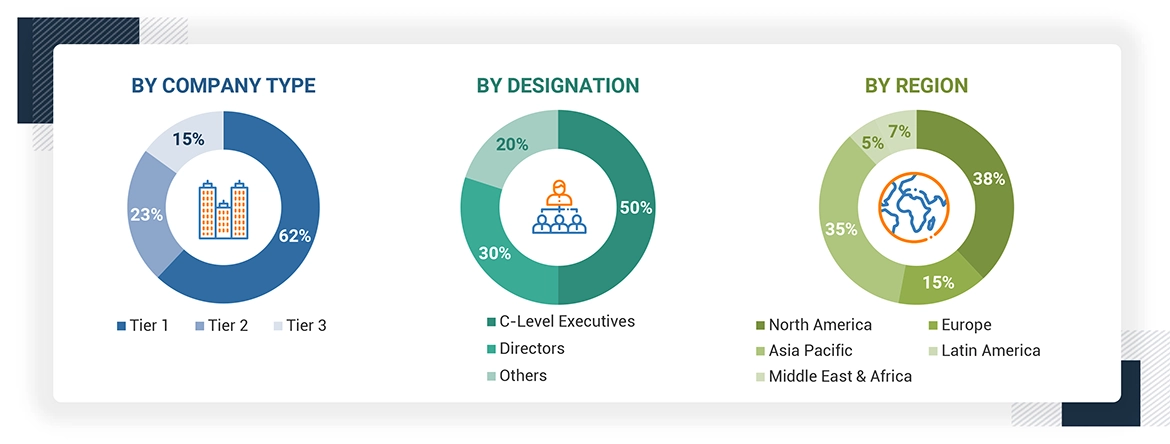
Note 1: Tier 1 companies have revenues over USD 1 billion, Tier 2 companies range between USD 500 million and 1 billion in overall revenues, and Tier 3 companies have revenues less than USD 500 million.
Other designations include sales managers, marketing managers, and product managers.
Source: Industry Experts
To know about the assumptions considered for the study, download the pdf brochure
Market Size Estimation
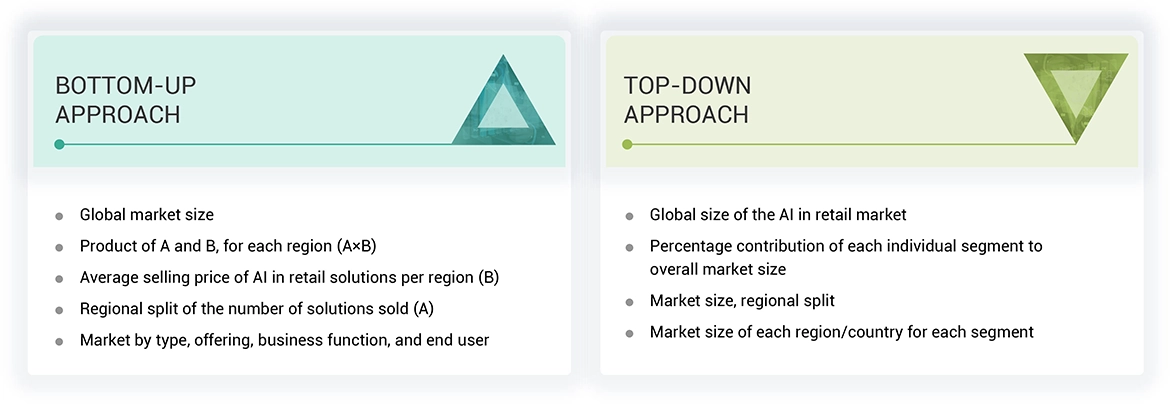
Both top-down and bottom-up approaches were used to estimate and validate the total size of the AI in retail market. These methods were also used extensively to estimate the size of various subsegments in the market. The research methodology used to estimate the market size includes the following:
Artificial Intelligence in Retail Market : Top-Down and Bottom-Up Approach
Data Triangulation
After arriving at the overall market size from the above estimation process, the AI in retail market has been split into several segments and sub-segments. To complete the overall market engineering process and arrive at the exact statistics for all segments and sub-segments, data triangulation and market breakdown procedures have been used, wherever applicable. The data has been triangulated by studying various factors and trends from both the demand and supply sides. The AI in retail market size has been validated using top-down and bottom-up approaches.
Market Definition
AI in retail is the use of artificial intelligence algorithms and technologies, such as computer vision, natural language processing, and machine learning, in various aspects of the retail industry. Using artificial intelligence helps to improve the operations’ efficiency, enhance decision-making processes, drive business growth, and improve overall customer experience. AI helps retailers understand customer behavior, optimize supply chains, and improve overall operational efficiency.
Stakeholders
- Artificial intelligence software developers
- Cloud service providers
- Consulting service providers
- Enterprise end users
- Distributors and Value-added Resellers (VARs)
- Government agencies
- Independent Software Vendors (ISV)
- Managed service providers
- Support & maintenance service providers
- System Integrators (SIs)/Migration service providers
- Technology providers
Report Objectives
- To determine, segment, and forecast the AI in Retail market based on offering, type, business functions, end-user, and region
- To forecast the size of the market segments with respect to five main regions: North America, Europe, Asia Pacific, the Middle East & Africa, and Latin America
- To provide detailed information about the major factors (drivers, restraints, opportunities, and challenges) influencing the growth of the market
- To study the complete value chain and related industry segments and perform a value chain analysis of the market landscape
- To strategically analyze the macro and micromarkets with respect to individual growth trends, prospects, and contributions to the total market
- To analyze the industry trends, pricing data, patents, and innovations related to the market
- To analyze the opportunities for stakeholders by identifying the high-growth segments of the market
- To profile the key players in the market and comprehensively analyze their market share/ranking and core competencies
- To track and analyze competitive developments, such as mergers & acquisitions, product launches & developments, partnerships, and collaborations, in the market
Available Customizations
With the given market data, MarketsandMarkets offers customizations per the company’s specific needs. The following customization options are available for the report:
Geographic Analysis
- Further break-up of the Asia Pacific market into countries contributing 75% to the regional market size
- Further break-up of the North American market into countries contributing 75% to the regional market size
- Further break-up of the Latin American market into countries contributing 75% to the regional market size
- Further break-up of the Middle East African market into countries contributing 75% to the regional market size
- Further break-up of the European market into countries contributing 75% to the regional market size
Company Information
- Detailed analysis and profiling of additional market players (up to 5)
Get the Full Artificial Intelligence in Retail Market Report
Full forecast, segment splits, and company analysis for all Artificial Intelligence in Retail Market.
- UK Artificial Intelligence in Retail Market
- Italy Artificial Intelligence in Retail Market
- China Artificial Intelligence in Retail Market
- India Artificial Intelligence in Retail Market
- Brazil Artificial Intelligence in Retail Market
- US Artificial Intelligence in Retail Market
- Canada Artificial Intelligence in Retail Market
- France Artificial Intelligence in Retail Market
- Germany Artificial Intelligence in Retail Market
- Nordic Countries Artificial Intelligence in Retail Market
- Rest Of Europe Artificial Intelligence in Retail Market
- Spain Artificial Intelligence in Retail Market
- Asean Countries Artificial Intelligence in Retail Market
- Japan Artificial Intelligence in Retail Market
- Rest Of Asia Pacific Artificial Intelligence in Retail Market
- South Korea Artificial Intelligence in Retail Market
- Argentina Artificial Intelligence in Retail Market
- Mexico Artificial Intelligence in Retail Market
- Rest Of Latin America Artificial Intelligence in Retail Market
- Bahrain Artificial Intelligence in Retail Market
- Kuwait Artificial Intelligence in Retail Market
- South Africa Artificial Intelligence in Retail Market
- UAE Artificial Intelligence in Retail Market
Need a Tailored Report?
Customize this report to your needs
Get 10% FREE Customization
Customize This Report
