
China AI Sensor Market (2026-2031)

The China AI Sensor Market was valued at $773.5 Million in 2026 and projected to reach to $10148.9 Million by 2031, representing a compound annual growth rate of CAGR 53.6%. China's AI sensor market is positioned as a global growth engine, driven by government initiatives, technological innovation, and massive capital investments in autonomous systems and smart infrastructure.


| Market Size in | USD 26.32 MN |
| Market Forecast in | |
| CAGR | |
| Forecast Period | |
| Units Considered | Value (USD MN) |
China AI Sensor Market Trends and Insights
- This explosive trajectory reflects China's strategic investments in artificial intelligence infrastructure, autonomous systems, and smart manufacturing.
- China's dominance in semiconductor production and rapid adoption of AI-enabled technologies across consumer electronics, automotive, and industrial sectors are primary catalysts driving this expansion. The 53.6% compound annual growth rate significantly outpaces global benchmarks, positioning China as the fastest-growing AI sensor market globally.
- China's government initiatives, including the Made in China 2025 program and substantial R&D funding, are accelerating sensor innovation and localization.
- By 2031, China is expected to command a substantial share of the global AI sensor ecosystem, driven by demand from autonomous vehicles, robotics, smart cities, and edge computing applications. China's competitive advantages in manufacturing scale, cost efficiency, and vertical integration enable rapid commercialization of advanced sensor technologies.
- The convergence of 5G deployment, IoT proliferation, and AI adoption across China's industrial base creates a robust ecosystem for sustained market growth through 2031..
Key Market Statistics
- CAGR (2026-2031) CAGR 53.6%
- Market Size, 2026 ~USD 773.5 Million
- Forecast, 2031 ~USD 10148.9 Million
- Country China
China AI Sensor Market Overview
Explosive Growth Trajectory :
China's AI sensor market is projected to grow from $773.5 million in 2026 to $10,148.9 million by 2031, representing a remarkable 53.6% CAGR, outpacing the global average of 49.8%.
Government-Backed AI Infrastructure :
China's strategic national initiatives in artificial intelligence and semiconductor self-sufficiency are driving massive investments in AI sensor development and deployment across critical industries.
Autonomous Systems & Smart Manufacturing :
Rapid adoption of autonomous vehicles, robotics, and Industry 4.0 technologies in China is creating unprecedented demand for advanced sensor solutions integrated with AI capabilities.
Semiconductor Production Dominance :
China's established position as a global semiconductor manufacturing hub provides competitive advantages in producing AI sensors at scale, supporting both domestic and export markets.
China AI Sensor Market Dynamics
- The country's vertical integration from chip design to end-product manufacturing creates unique competitive advantages.
- Domestic demand from automotive, industrial automation, and consumer electronics sectors will fuel sustained expansion through 2031. Key growth catalysts include China's push toward technological self-reliance, increasing adoption of edge AI computing, and expansion of 5G networks enabling real-time sensor data processing.
- Strategic partnerships between tech giants and semiconductor manufacturers will accelerate product development cycles.
- The market's 53.6% CAGR reflects both domestic consumption and China's growing role as a global AI sensor supplier..
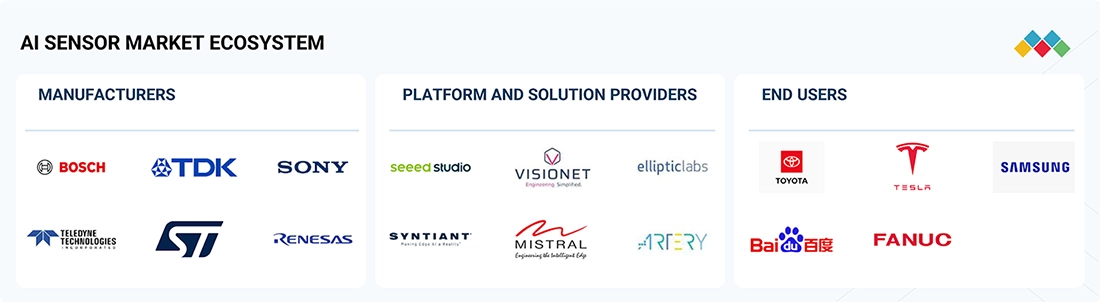
Market Ecosystem
AI SENSOR MARKET SIZE, SHARE & ANALYSIS: COMMERCIAL USE CASES ACROSS INDUSTRIES
| COMPANY | USE CASE DESCRIPTION | BENEFITS |
|---|---|---|
 |
Bosch Sensortec implemented AI-enabled MEMS sensing platforms for wearable health monitoring, predictive industrial maintenance, and smart building applications. Its intelligent motion and environmental sensing modules integrate TinyML algorithms directly on-device to support activity recognition, occupancy detection, vibration analysis, and environmental monitoring with low power consumption. | The solution enhanced low-power edge sensing, improved predictive maintenance capabilities, enabled intelligent contextual analytics, and optimized operational monitoring efficiency across industrial and consumer ecosystems. |
 |
Sony Semiconductor Solutions deployed AI-enabled IMX vision sensors across smart surveillance, retail analytics, and automotive driver monitoring applications requiring real-time edge inference. The sensors process visual data directly within the hardware to support facial recognition, occupancy monitoring, driver behavior analysis, and anomaly detection without heavy cloud dependency. | The solution improved real-time visual intelligence, reduced cloud bandwidth dependency, enabled faster edge-based decision-making, and enhanced driver and occupancy monitoring accuracy across autonomous sensing environments. |
 |
TDK deployed AI-enabled sensing and sensor fusion solutions for edge AI, robotics, wearables, and industrial automation applications. Through its TDK SensEI and InvenSense platforms, the company integrates motion sensors, MEMS microphones, and edge AI software to support contextual awareness, predictive analytics, and real-time machine intelligence. | The solution improved real-time edge intelligence, enabled advanced sensor fusion, enhanced robotic positioning accuracy, reduced AI model deployment time, and supported low-power intelligent sensing across industrial and consumer ecosystems. |
 |
Teledyne Technologies deployed AI-enabled imaging and sensing systems for industrial automation, machine vision, aerospace, healthcare imaging, and defense applications. Through its Teledyne DALSA and FLIR platforms, the company provides smart cameras, thermal imaging sensors, and machine vision systems capable of defect detection, object recognition, inspection automation, and autonomous visual analytics. | The solution improved industrial inspection accuracy, enhanced thermal and machine vision analytics, enabled high-speed defect detection, strengthened autonomous monitoring capabilities, and optimized operational efficiency across industrial and defense environments. |
Logos and trademarks shown above are the property of their respective owners. Their use here is for informational and illustrative purposes only.
Related Ecosystem
Automotive Electronics And Electrical Equipment
- Battery Electric Vehicle (BEV)
- Light Commercial Vehicles (LCVs)
- Fuel Cell Electric Vehicle (FCEV)
- Sensors
- Hybrid Electric Vehicle (HEV)
- BOSCH LIMITED
- Continental ag
- DENSO Corporation
- Texas Instruments Incorporated
- Panasonic Holdings Corporation
Engine Engine System Exhaust
- Light Commercial Vehicles (LCVs)
- Agricultural Tractors
- Battery Electric Vehicle (BEV)
- Hybrid Electric Vehicle (HEV)
- Sensors
- Titan Company Limited
- TENNECO
- GORKOVSKY AVTOMOBILNY ZAVOD
- AISIN CORPORATION
- TI AUTOMOTIVE
Digitalization And Iot
- Sensors
- Remote Monitoring
- Supply Chain Management
- Passenger Information System (PIS)
- Platform as A Service (PaaS)
- International Business Machines Corporation
- Cisco Systems, Inc.
- MICROSOFT CORPORATION
- Oracle Corporation
- HUAWEI TECHNOLOGIES CO LTD
Key Takeaways
- China's AI sensor market will grow from $773.5M (2026) to $10,148.9M (2031), representing a 53.6% CAGR.
- China's government-backed initiatives and semiconductor dominance position it as the global leader in AI sensor innovation.
- Autonomous vehicles, robotics, and smart manufacturing are primary demand drivers accelerating China's market expansion.
- China's vertical integration and manufacturing scale enable faster commercialization and cost-competitive sensor solutions.
AI Sensor Market Report Scope
| Report Metric | Details |
|---|---|
| Base Year | 2026 |
| Fastest Growing Segment | LIDAR SENSORS (Sensor Type) |
| Forecast Period | 2026–2031 |
| Growth Rate | CAGR of 49.8% from 2026 to 2031 |
| Largest Segment | STANDALONE AI SENSING (Architecture Type) |
| Market Size Base Year (Billions) | ~USD 3.87 (2026) |
| Revenue Forecast (Billions) | ~USD 29.23 (2031) |
| Segments Covered | Sensor Type, Application, Technology, Architecture Type |
China AI Sensor Market Report Segmentation
4 segment dimensions are covered across the global market.
By Sensor Type
- Environmental Sensors
- Image Sensors
- Lidar Sensors
- Motion & Position Sensors
- Other AI Sensors
- Pressure Sensors
- Radar Sensors
- Temperature Sensors
- Ultrasonic Sensors
By Application
- Aerospace, Defense, & Public Safety
- Agriculture & Environmental Monitoring
- Automotive & Mobility
- Consumer Electronics & Wearables
- Healthcare & Life Sciences
- Industrial Manufacturing & Robotics
- Other Applications
- Retail, Logistics, & Supply Chain
- Smart Homes, Buildings, & Infrastructure
By Technology
- Computer Vision
- Context-Aware Computing
- Machine Learning
- Natural Language Processing
By Architecture Type
- Sensing Fusion Systems
- Standalone AI Sensing
CHINA: AI SENSOR MARKET, BY APPLICATION, 2026–2032
| Segment | 2026 | 2027 | 2028 | 2029 | 2030 | 2031 | 2032 | CAGR (%) |
|---|---|---|---|---|---|---|---|---|
| AEROSPACE, DEFENSE, & PUBLIC SAFETY | 78.5 | 122.3 | 193.2 | 321.3 | 517.3 | 779.1 | 1116.4 | 55.7 |
| AGRICULTURE & ENVIRONMENTAL MONITORING | 21.8 | 31.3 | 45.3 | 68.6 | 100 | 135.3 | 172.5 | 41.2 |
| AUTOMOTIVE & MOBILITY | 158 | 248.1 | 394.4 | 659.9 | 1069.1 | 1619.6 | 2334.3 | 56.6 |
| CONSUMER ELECTRONICS & WEARABLES | 181.2 | 271.8 | 413 | 659.9 | 1020.8 | 1476.1 | 2029.8 | 49.6 |
| HEALTHCARE & LIFE SCIENCES | 41.3 | 67.6 | 111.7 | 193.6 | 324.2 | 506.4 | 751 | 62.1 |
| INDUSTRIAL MANUFACTURING & ROBOTICS | 138.1 | 210.7 | 325.6 | 529.7 | 834.6 | 1230.1 | 1725.3 | 52.3 |
| OTHER APPLICATIONS | 15.7 | 24.5 | 38.6 | 64.3 | 103.5 | 155.8 | 223.3 | 55.7 |
| RETAIL, LOGISTICS, & SUPPLY CHAIN | 53.3 | 80.5 | 123.4 | 198.8 | 310.4 | 453.1 | 629.2 | 50.9 |
| SMART HOMES, BUILDINGS, & INFRASTRUCTURE | 85.6 | 132.5 | 207.8 | 343 | 548.4 | 820.1 | 1167.1 | 54.6 |
| TOTAL | 773.5 | 1189.3 | 1853.1 | 3039.1 | 4828.3 | 7175.6 | 10148.9 | 53.6 |
Target Audience
- Semiconductor & Sensor Manufacturers : Need detailed market data to guide R&D investments, production capacity planning, and product positioning strategies specific to China's rapidly expanding AI sensor demand.
- Technology Investors & PE Firms : Require comprehensive market analysis and growth forecasts to evaluate investment opportunities in Chinese AI sensor startups, semiconductor companies, and autonomous systems integrators.
- Automotive & Robotics OEMs : Seek insights into China's sensor supply landscape, technology capabilities, and cost structures to optimize component sourcing for autonomous vehicles and industrial robots.
- Strategic Business Planners : Need market intelligence on China's government initiatives, competitive landscape, and emerging applications to develop long-term expansion and partnership strategies.
- Supply Chain & Procurement Teams : Require detailed understanding of Chinese sensor manufacturers, production capabilities, and market trends to identify reliable suppliers and negotiate favorable commercial terms.
Key Companies in the China AI Sensor Market
| Company | HQ | Ownership | Strongest segments |
|---|---|---|---|
| BOSCH SENSORTEC GMBH | India | Subsidiary | |
| KEYENCE CORPORATION | Japan | Public Company | Image / Vision AI Sensors (Computer Vision–centric),Laser / Displacement / 3D Profiling Sensors,Photoelectric, Fiber, and Proximity Motion Sensors, |
| TELEDYNE TECHNOLOGIES INCORPORATED | United States | Public Company | Image Sensors and Digital Cameras (visible spectrum),Infrared/Thermal Sensors and Camera Cores,X-ray and High-Energy Imaging Sensors, |
| SEMICONDUCTOR COMPONENTS INDUSTRIES, LLC | United States | Private Company | Image Sensors for AI Computer Vision,Radar and Motion Sensors for ADAS and Robotics,Ultrasonic and Proximity Sensors, |
| RENESAS ELECTRONICS CORPORATION | Japan | Public Company | Automotive sensors and signal conditioners (motion, image-adjacent, position),Industrial/IoT sensor interfaces and MCUs for AI edge sensing,Power management and drivers for AI sensing modules, |
| STMICROELECTRONICS | Switzerland | Public Company | Motion and environmental MEMS with embedded ML/edge AI,Optical and image/ToF sensing solutions,Automotive radar and ultra-wideband systems, |
| SENSATA TECHNOLOGIES | United States | Public Company | Motion and position sensors with embedded ML,Thermal and pressure sensors in AI-enabled powertrain and HVAC,Electrical protection and power conversion with AI sensing, |
| SYNTIANT CORP. | United States | Private Company | Standalone AI Sensing (NDP-based edge ML for single-sensor endpoints),Sensor Fusion Systems (multimodal perception across motion, audio, and image),Software, tools, and model optimization services, |
| GOERTEK MICROELECTRONICS CO., LTD. | China | Private Company | Acoustic sensors (microphones, bone voiceprint),Pressure and airflow sensors,Other MEMS devices and microsystem modules, |
| AISTORM, INC. | Japan | Public Company | Oracle / JDE / NetSuite consulting and cloud migration tied to sensor data back-ends,Version upgrade and archive solutions for ERP and operational systems,Operational support, troubleshooting, and parameter-tuning services, |
| TAIYO YUDEN CO. | Japan | Public Company | Multilayer Ceramic Capacitors for AI Sensor Boards,Inductors and Power Magnetics for Edge AI Modules,High-Frequency and RF Devices for Radar/LiDAR, |
BOSCH SENSORTEC GMBH
Bosch Sensortec GmbH is a subsidiary of Bosch founded in India in 2005, specializing in sensor technology and microelectromechanical systems (MEMS) solutions.
KEYENCE CORPORATION
Keyence Corporation is a Japanese public company founded in 1972 with 12,784 employees, specializing in automation and inspection equipment, sensors, and measurement systems.
TELEDYNE TECHNOLOGIES INCORPORATED
Teledyne Technologies Incorporated is a U.S.-based public company founded in 1960 with 15,800 employees, providing digital imaging, instrumentation, and aerospace and defense solutions.
SEMICONDUCTOR COMPONENTS INDUSTRIES, LLC
Semiconductor Components Industries, LLC is a private U.S. company founded in 1999 with 9,570 employees, manufacturing semiconductor devices and components.
RENESAS ELECTRONICS CORPORATION
Renesas Electronics Corporation is a Japanese public company founded in 2002 with 21,907 employees, designing and manufacturing microcontrollers, analog semiconductors, and power management solutions.
STMICROELECTRONICS
STMicroelectronics is a Swiss-based public company founded in 1987 with 48,000 employees, producing a broad range of semiconductor products for industrial, consumer, and automotive applications.
SENSATA TECHNOLOGIES
Sensata Technologies is a U.S. public company founded in 1916 with 16,700 employees, manufacturing sensors and controls for automotive, industrial, and aerospace markets.
SYNTIANT CORP.
Syntiant Corp. is a U.S. private company founded in 2017 with 120 employees, developing ultra-low-power artificial intelligence processors for edge computing applications.
GOERTEK MICROELECTRONICS CO., LTD.
Goertek Microelectronics Co., Ltd. is a Chinese private company founded in 2017 with 2,514 employees, engaged in microelectronics design and manufacturing.
AISTORM, INC.
Aistorm, Inc. is a Japanese public company founded in 1960 with 35 employees, operating in the semiconductor or electronics sector.
TAIYO YUDEN CO.
Taiyo Yuden Co. is a Japanese public company founded in 1950 with 20,604 employees, manufacturing passive electronic components including capacitors, inductors, and wireless modules.
Reasons to Buy this Report
- Market Entry Strategy : Comprehensive analysis of China's regulatory landscape, competitive dynamics, and distribution channels to develop effective market entry and localization strategies for AI sensor products.
- Investment Decision Support : Detailed market sizing and growth projections enable informed capital allocation decisions for ventures targeting China's high-growth AI sensor ecosystem and semiconductor supply chain.
- Competitive Intelligence : In-depth insights into Chinese competitors, technology trends, and manufacturing capabilities to benchmark performance and identify differentiation opportunities in this rapidly evolving market.
- Supply Chain Optimization : Strategic understanding of China's sensor production capabilities, supplier networks, and cost structures to optimize sourcing, manufacturing, and distribution operations.
- Technology Roadmap Planning : Forward-looking market intelligence on emerging applications in autonomous vehicles, robotics, and IoT to align product development with China's highest-demand use cases through 2031.
Frequently asked questions
What is the projected size of China's AI sensor market by 2031?
China's AI sensor market is projected to reach $10,148.9 million by 2031, growing from $773.5 million in 2026.
What is the CAGR for China's AI sensor market?
China's AI sensor market is expected to grow at a compound annual growth rate of 53.6% between 2026 and 2031.
What are the primary drivers of growth in China's AI sensor market?
Key drivers include government initiatives like Made in China 2025, autonomous vehicle adoption, robotics expansion, smart city development, and 5G/IoT proliferation across China's industrial sectors.
How does China's AI sensor market compare to global growth rates?
China's 53.6% CAGR significantly exceeds the global AI sensor market CAGR of 49.8%, establishing China as the fastest-growing regional market.
Which industries are driving demand for AI sensors in China?
Primary demand comes from autonomous vehicles, robotics, smart manufacturing, consumer electronics, smart cities, and edge computing applications across China's industrial ecosystem.
RESEARCH METHODOLOGY
The research process for this technical, market-oriented, and commercial study of the AI sensor market included systematic gathering, recording, and analysis of data about companies operating in the market. It involved the extensive use of secondary sources, directories, and databases (Factiva, Oanda) to identify and collect relevant information. In-depth interviews were conducted with various primary respondents, including experts from core and related industries and preferred manufacturers, to obtain and verify critical qualitative and quantitative information as well as to assess the growth prospects of the market. Key players in the AI sensor market were identified through secondary research, and their market rankings were determined through primary and secondary research. This included studying annual reports of top players and interviewing key industry experts, such as CEOs, directors, and marketing executives.
Secondary Research
In the secondary research process, various secondary sources were referred to for identifying and collecting information relevant to this study. Secondary sources included annual reports, press releases, and investor presentations of companies; white papers, certified publications, and articles from recognized authors; directories; and databases. Secondary research was mainly conducted to obtain key information about the supply of the industry; a total pool of key players; segmentation of the market according to industry trends, geographic markets, and key developments from market- and technology-oriented perspectives.
Primary Research
In the primary research process, primary sources from the supply and demand sides were interviewed to obtain qualitative and quantitative information for this report. Primary sources from the supply side include experts, such as CEOs, vice presidents, marketing directors, technology and innovation directors, subject-matter experts, consultants, and related key executives from major companies and organizations operating in the AI sensor market.
After the complete market engineering process (market statistics calculations, market breakdown, market size estimations, market forecasting, and data triangulation), extensive primary research was conducted to gather information and verify and validate the critical market numbers.
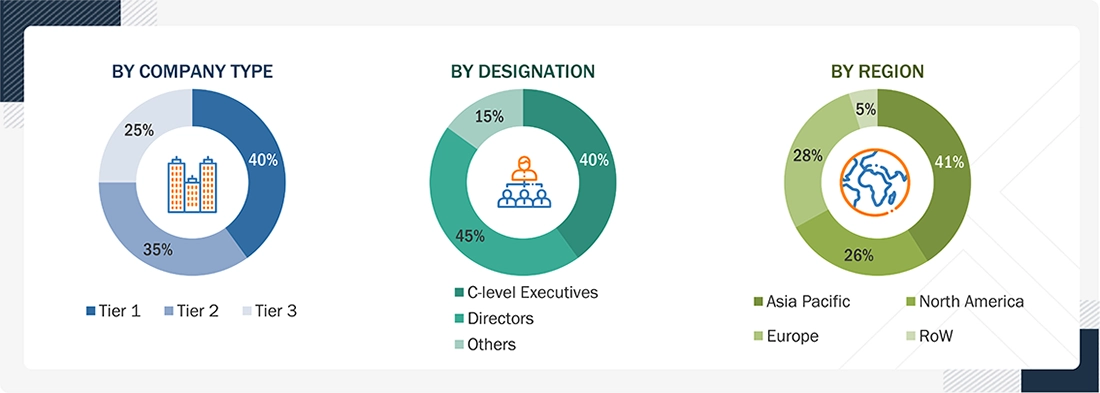
Several primary interviews were conducted with experts from the demand and supply sides across four major regions—North America, Europe, Asia Pacific, and the Rest of the World. Approximately 25% of the primary interviews were conducted with the demand side and 75% with the supply side. This primary data was collected through questionnaires, emails, and telephonic interviews.
BREAKDOWN OF PRIMARY INTERVIEW PARTICIPANTS
Notes:
- Tier 1 companies include market players with revenues above USD 500 million; tier 2 companies earn revenues between USD 100 million and USD 500 million; and tier 3 companies earn revenues up to USD 100 million.
- Others include sales, marketing, and product managers.
To know about the assumptions considered for the study, download the pdf brochure
Market Size Estimation
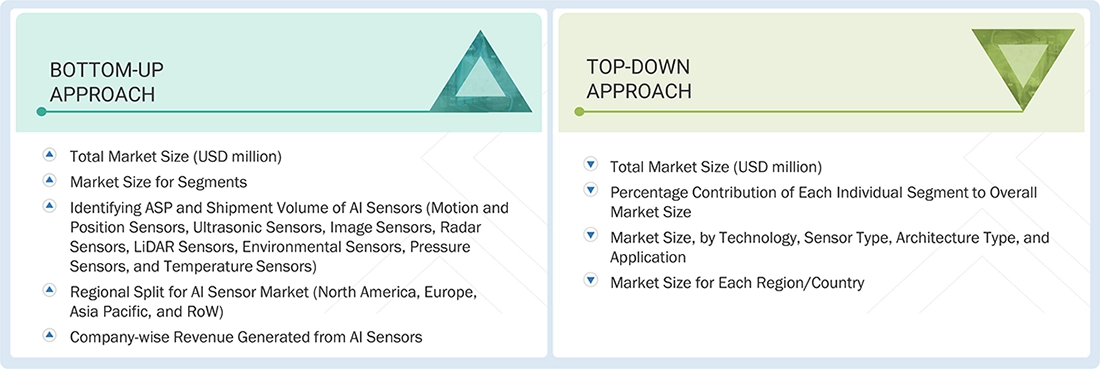
In the complete market estimation process, the top-down and bottom-up approaches were used, along with several data triangulation methods, to estimate and forecast the size of the market and its segments and subsegments listed in the report. Extensive qualitative and quantitative analyses were carried out on the complete market engineering process to list the key information/insights pertaining to the AI sensor market.
Key players in the AI sensor market were identified through secondary research, and their rankings in the respective regions were determined through primary and secondary research. This entire procedure involved the study of the annual and financial reports of top players and interviews with industry experts, such as chief executive officers, vice presidents, directors, and marketing executives, for quantitative and qualitative insights. All percentage shares, splits, and breakdowns were determined using secondary sources and verified through primary sources. All parameters that affect the markets covered in this research study have been accounted for, viewed in extensive detail, verified through primary research, and analyzed to obtain the final quantitative and qualitative data. This data was consolidated and enhanced with detailed inputs and analysis from MarketsandMarkets and presented in this report.
BOTTOM-UP APPROACH
- Identifying entities in the AI sensor market that influence the market, along with providers of related sensors
- Analyzing major manufacturers of AI sensors and original equipment manufacturers (OEMs), as well as studying their portfolios and understanding different sensing technologies used
- Analyzing trends pertaining to the use of different AI sensors across various applications
- Tracking the ongoing and upcoming developments in the AI sensor market that include investments, R&D activities, product launches, collaborations, and partnerships, as well as forecasting the market size based on these developments and other critical parameters
- Carrying out multiple discussion sessions with key opinion leaders to understand different AI sensors, technologies used in them, and applications wherein they are used, as well as recent trends in the market, to analyze the breakup of the scope of work carried out by major companies
- Arriving at the market size by analyzing the revenues of companies and combining these figures to arrive at the market size
- Segmenting each type of sensor based on the application they are to be used in, and deriving the size of the application segment
- Categorizing the overall market into various other market segments
- Verifying and cross-checking the estimates at every level through discussions with key opinion leaders, such as chief executive officers (CXOs), directors, and operations managers, and the domain experts at MarketsandMarkets
- Studying various paid and unpaid sources of information, such as annual reports, press releases, white papers, and databases
TOP-DOWN APPROACH
- Focusing on topline investments and expenditures made in the AI sensor market
- Calculating the market size based on the revenue generated by players through the sales of AI sensors
- Mapping the use of AI sensors in different verticals
- Building and developing the information related to the revenue generated by players through offering key products
- Conducting multiple on-field discussions with key opinion leaders across major companies involved in the development of AI sensors
- Estimating the geographic split using secondary sources based on various factors, such as the number of players in a specific country and region, the role of major players in the development of innovative products in the market, and adoption and penetration rates in a particular country for various industry users
Data Triangulation
After arriving at the overall market size from the market size estimation process explained above, the total market was split into several segments and subsegments. To complete the overall market engineering process and arrive at the exact statistics for all segments and subsegments, the market breakdown and data triangulation procedures were employed, wherever applicable. The data was triangulated by studying various factors and trends from the demand and supply sides. Along with this, the market size was validated using the top-down and bottom-up approaches.
Market Definition
The AI sensor market covers advanced sensing devices integrated with embedded artificial intelligence technologies that can process, analyze, and interpret data directly at the edge. Unlike traditional sensors that only collect and transmit raw data, AI sensors can generate real-time insights and support autonomous decision-making locally using AI-enabled processors such as NPUs, VPUs, or AI-optimized microcontrollers. These sensors are designed to improve response time, reduce latency and bandwidth usage, and enhance operational efficiency across applications such as automotive, industrial automation, smart devices, robotics, and smart infrastructure. The market also includes sensor fusion modules where AI models run within the hardware system itself to deliver contextual and intelligent outputs rather than only combining raw sensor signals.
Key Stakeholders
- AI sensor and module manufacturers
- AI sensor platform and solution providers
- AI processor and edge AI hardware providers
- Sensor fusion and AI software providers
- Cloud, connectivity, and edge infrastructure providers
- Technology consultants and system integrators
- System distributors and suppliers
- Suppliers of raw material components related to AI sensor systems
- Research organizations and consulting companies
- End users/Enterprise customers
- Government bodies, such as regulating authorities and policymakers
- Venture capitalists and private equity firms
- Associations, organizations, and alliances related to the AI sensor ecosystem
- Analysts and strategic business planners
- Technology investors
Report Objectives
- To define, describe, and forecast the AI sensor market size, in terms of value and volume, by sensor type, application, technology, architecture type, and region
- To describe and forecast the market size across four key regions, namely, North America, Europe, Asia Pacific, and the Rest of the World (RoW), along with their respective country-level market size, in terms of value
- To provide detailed information regarding the drivers, restraints, opportunities, and challenges in the AI sensor market
- To strategically analyze the micromarkets concerning the individual growth trends, prospects, and their contribution to the AI sensor market
- To map competitive intelligence based on company profiles, key player strategies, and key developments
- To analyze trends/disruptions impacting customer business, interconnected markets and cross-sector opportunities, strategic moves by tier 1/2/3 players, pricing analysis, patents analysis, trade analysis (export and import scenario), Porter’s five forces analysis, macroeconomics indicators, case studies, investment and funding scenario, decision-making process, buyer stakeholders and buying evaluation criteria, adoption barriers & internal challenges, unmet needs from various industries, technology analysis, technology roadmap, ecosystem analysis, regional regulations and compliance, impact of 2025 US tariff, and key conferences and events related to the AI sensor market
- To benchmark the market players using the proprietary company evaluation matrix framework, which analyzes them on various parameters within the broad categories of market ranking/share and product portfolio
- To analyze competitive developments such as contracts, acquisitions, product launches & developments, collaborations, and partnerships, along with research & development (R&D), in the AI sensor market
Available customizations:
With the given market data, MarketsandMarkets offers customizations according to the company’s specific needs. The following customization options are available for the report:
Company Information
- Detailed analysis and profiling of additional market players (up to 7)
Get the Full AI Sensor Market Report
Full forecast, segment splits, and company analysis for all AI Sensor Market.
- Italy AI Sensor Market
- Japan AI Sensor Market
- India AI Sensor Market
- South Korea AI Sensor Market
- Australia AI Sensor Market
- Nordics AI Sensor Market
- Rest Of Europe AI Sensor Market
- Rest Of Asia Pacific AI Sensor Market
- Rest Of Africa AI Sensor Market
- South Africa AI Sensor Market
- Argentina AI Sensor Market
- Brazil AI Sensor Market
- Rest Of South America AI Sensor Market
- US AI Sensor Market
- Canada AI Sensor Market
- Mexico AI Sensor Market
- Germany AI Sensor Market
- UK AI Sensor Market
- France AI Sensor Market
- Spain AI Sensor Market
Need a Tailored Report?
Customize this report to your needs
Get 10% FREE Customization
Customize This Report
