
South Korea Automotive AI Market (2025-2030)

The South Korea Automotive AI Market was valued at $1445.2 Million in 2025 and projected to reach to $2661.8 Million by 2030, representing a compound annual growth rate of 13.0%. South Korea's automotive AI market is positioned as a critical growth engine within Asia Pacific, leveraging the country's advanced semiconductor ecosystem and leadership in autonomous vehicle technology.


| Market Size in | USD 26.32 MN |
| Market Forecast in | |
| CAGR | |
| Forecast Period | |
| Units Considered | Value (USD MN) |
South Korea Automotive AI Market Trends and Insights
- South Korea's advanced semiconductor ecosystem and leadership in autonomous vehicle technology are driving rapid adoption of AI-powered solutions across the automotive sector.
- The country's major automotive manufacturers and tech conglomerates are investing heavily in AI-enabled features such as autonomous driving, predictive maintenance, and in-vehicle intelligence systems. The 13.0% compound annual growth rate reflects South Korea's strong competitive positioning in next-generation automotive technologies.
- South Korea's regulatory environment and government support for autonomous vehicle development are accelerating market penetration.
- By 2030, South Korea is expected to solidify its role as a regional hub for automotive AI innovation, with increasing integration of machine learning algorithms in vehicle platforms and manufacturing processes..
Key Market Statistics
- CAGR (2025-2030) 13.0% CAGR
- Market Size, 2025 ~USD 1445.2 Million
- Forecast, 2030 ~USD 2661.8 Million
- Country South Korea
South Korea Automotive AI Market Overview
Market Valuation & Growth :
South Korea's automotive AI market is valued at $1,445.2 million in 2025, with a robust 13% CAGR projected through 2030, reaching $2,661.8 million. This growth outpaces many developed markets, driven by aggressive investment in autonomous vehicle technology and AI integration across major OEMs.
Semiconductor Leadership :
South Korea's world-class semiconductor manufacturing capabilities provide a competitive advantage for automotive AI chip production. Companies like Samsung and SK Hynix are increasingly focusing on automotive-grade AI processors, supporting the localization of AI solutions for vehicle manufacturers.
Autonomous Vehicle Innovation :
South Korean automotive giants including Hyundai, Kia, and Genesis are investing heavily in autonomous driving platforms powered by advanced AI algorithms. Government initiatives and R&D funding are accelerating the development of Level 3 and Level 4 autonomous vehicles with domestic AI technology.
Government Support & Policy :
South Korea's government has prioritized autonomous vehicles and AI in transportation through strategic funding, regulatory frameworks, and infrastructure development. The K-Mobility initiative and automotive AI roadmaps are creating favorable conditions for market expansion and technology commercialization.
South Korea Automotive AI Market Dynamics
- The 13% CAGR through 2030 reflects strong demand for AI-powered solutions across autonomous driving, predictive maintenance, and in-vehicle intelligence systems.
- Major automotive manufacturers are accelerating AI adoption to enhance vehicle safety, efficiency, and user experience. The market's expansion is supported by robust government policies, substantial R&D investments, and the integration of domestic semiconductor capabilities into automotive platforms.
- South Korea's focus on developing indigenous AI technologies and autonomous vehicle standards positions it as a regional innovation hub.
- Continued collaboration between automotive OEMs, semiconductor firms, and technology startups will drive sustained growth and competitive differentiation in the global automotive AI landscape..
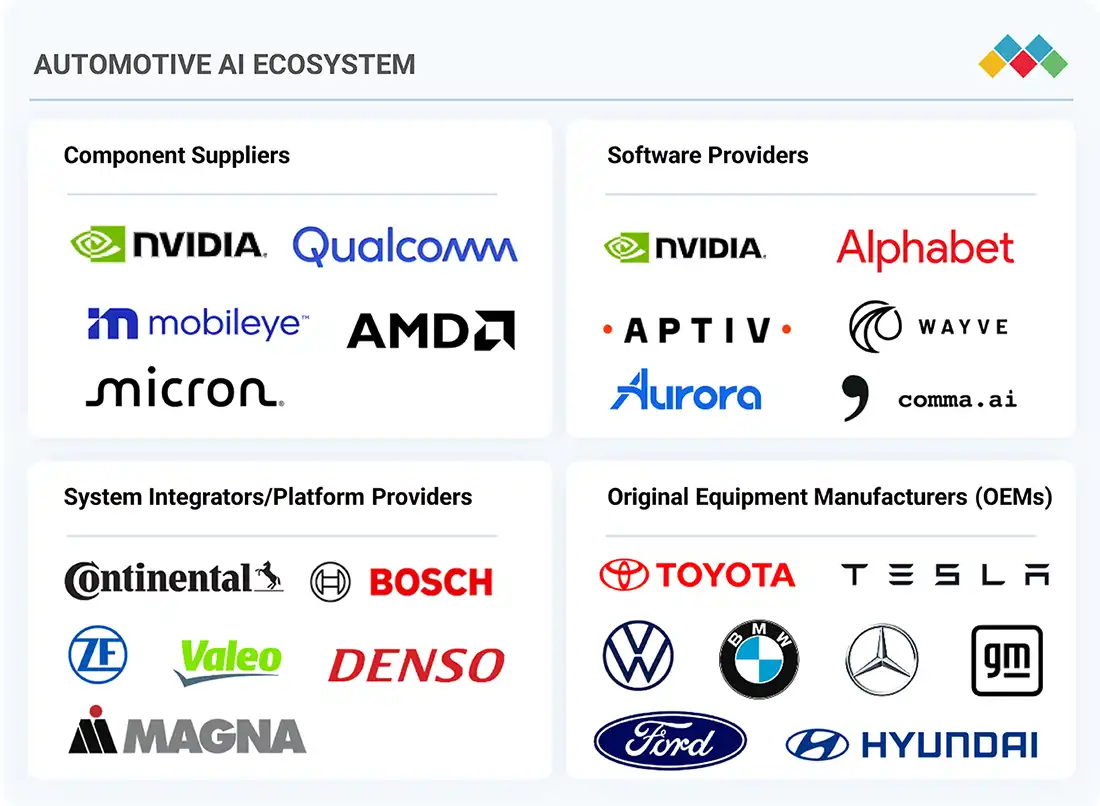
Market Ecosystem
Automotive AI Market: COMMERCIAL USE CASES ACROSS INDUSTRIES
| COMPANY | USE CASE DESCRIPTION | BENEFITS |
|---|---|---|
 |
Implemented generative AI with large multimodal models (LMMs) to extract knowledge from diagram-heavy PowerPoint files and convert them into structured text for reuse in collision-safety vehicle development | 67% reduction in documentation modeling time, 30–50% savings in development and planning work, handbook creation time reduced from three years to one, and improved scalability of knowledge reuse |
 |
Developed the Makalu Computing Platform using AMD processors and GPUs to power immersive in-vehicle digital cockpits supporting 8K/4K displays, 3D HMI, AR/VR, and spatial audio | Delivered 394K DMIPS and 10.1T FLOPS performance, supported 32 GB memory & 8 GB VRAM, enabled AAA gaming and immersive experiences, designed for mass production with integrated safety and power optimization |
|
|
Integrated adaptive SoCs into EyeSight ADAS to deliver advanced AI inference, stereo vision processing, and sensor fusion for real-time safety-critical functions | Up to 3X AI processing power, improved recognition and perception accuracy, support for firmware upgrades, enhanced real-time safety features like braking and steering, positioned Subaru toward 2030 zero-fatality vision |
Logos and trademarks shown above are the property of their respective owners. Their use here is for informational and illustrative purposes only.
Related Ecosystem
Information System And Analytics
- Machine Learning
- Natural Language Processing (NLP)
- Sensors
- Software as A Service (SaaS)
- Data Loss Prevention (DLP)
- International Business Machines Corporation
- MICROSOFT CORPORATION
- Amazon.com, Inc.
- Oracle Corporation
Key Takeaways
- South Korea's automotive AI market will grow from $1,445.2M (2025) to $2,661.8M (2030) at a 13.0% CAGR.
- South Korea's semiconductor leadership and autonomous vehicle expertise position it as a regional innovation leader.
- South Korea's major automakers are integrating AI for autonomous driving, predictive maintenance, and smart cabin technologies.
- South Korea's government support and regulatory frameworks are accelerating automotive AI adoption and market expansion.
Automotive AI Market Report Scope
| Report Metric | Details |
|---|---|
| Base Year | 2025 |
| Fastest Growing Segment | L3 (Level Of Autonomy) |
| Forecast Period | 2025-2030 |
| Growth Rate | CAGR of 15.3% from 2025 to 2030 |
| Largest Segment | L2 (Level Of Autonomy) |
| Market Size Base Year (Billions) | ~USD 18.87 (2025) |
| Revenue Forecast (Billions) | ~USD 38.45 (2030) |
| Segments Covered | Offering, Hardware, Compute, Software, Technology, Level Of Autonomy, Application |
South Korea Automotive AI Market Report Segmentation
7 segment dimensions are covered across the global market.
By Offering
- Hardware
- Software
By Hardware
- Compute
- Memory
By Compute
- Asic-Dominant Soc
- Fpga-Dominant Soc
- Gpu-Dominant Soc
- Npu-Dominant Soc
By Software
- Application Software
- Middleware
- Operating System
By Technology
- Computer Vision
- Context-Aware Computing
- Deep Learning
- Machine Learning
- Natural Language Processing
By Level Of Autonomy
- L1
- L2
- L3
By Application
- Ad/ADAS
- Infotainment Systems
- Other Applications
- Vehicle Telematics
Target Audience
- Automotive OEMs & Tier-1 Suppliers : South Korean and international automotive manufacturers need detailed market intelligence to benchmark AI adoption rates, identify technology gaps, and plan product development roadmaps aligned with local market demands and regulatory requirements.
- Semiconductor & AI Technology Providers : Chip manufacturers and AI software companies require South Korea-specific market data to assess demand for automotive-grade processors, identify key OEM customers, and develop localized solutions for the Korean automotive sector.
- Investment & Private Equity Firms : Investors evaluating opportunities in South Korea's automotive AI ecosystem need comprehensive market sizing, growth projections, and competitive analysis to identify high-potential companies and assess investment returns in this dynamic market.
- Government & Policy Makers : South Korean government agencies and policy bodies require market research to evaluate the effectiveness of automotive AI initiatives, allocate R&D funding, and develop strategic policies supporting domestic technology leadership and industry competitiveness.
- Market Research & Consulting Firms : Research organizations and consultants need granular South Korea automotive AI data to support client advisory services, competitive benchmarking, and strategic planning across the automotive, semiconductor, and technology sectors.
Reasons to Buy this Report
- Market-Specific Sizing & Forecasts : Access precise valuation data for South Korea's automotive AI market with detailed 2025-2030 projections. Understand the 13% CAGR trajectory and competitive positioning relative to global growth rates, enabling accurate business planning and investment decisions.
- Competitive Landscape Intelligence : Gain insights into South Korea's major automotive OEMs and semiconductor players driving AI adoption. Identify key competitors, their AI strategies, and market share dynamics specific to the Korean automotive ecosystem.
- Technology & Innovation Trends : Discover emerging AI applications in South Korean vehicles including autonomous driving, predictive maintenance, and in-vehicle personalization. Stay informed on domestic technology breakthroughs and R&D initiatives shaping the market.
- Government Policy & Regulatory Framework : Understand South Korea's automotive AI policies, K-Mobility initiatives, and regulatory environment. Identify government incentives, funding opportunities, and compliance requirements affecting market entry and expansion strategies.
- Strategic Partnership Opportunities : Identify collaboration potential with South Korean automotive manufacturers, semiconductor firms, and AI startups. Leverage market insights to establish partnerships, joint ventures, or distribution channels in this high-growth regional market.
Frequently asked questions
What is the current size of South Korea's automotive AI market?
South Korea's automotive AI market is valued at $1,445.2 million in 2025 and is expected to reach $2,661.8 million by 2030.
What is the growth rate of South Korea's automotive AI market?
South Korea's automotive AI market is projected to grow at a compound annual growth rate (CAGR) of 13.0% from 2025 to 2030.
Which companies are leading South Korea's automotive AI market?
South Korea's automotive AI market is dominated by major automakers such as Hyundai and Kia, alongside technology conglomerates like Samsung and LG investing in autonomous and AI-enabled vehicle solutions.
What are the key drivers of growth in South Korea's automotive AI market?
South Korea's automotive AI growth is driven by advanced semiconductor capabilities, government support for autonomous vehicles, increasing consumer demand for smart features, and major manufacturer investments in AI-powered platforms.
How does South Korea's automotive AI market compare to other Asia Pacific countries?
South Korea's automotive AI market benefits from its strong technology infrastructure, established automotive industry, and government initiatives, positioning it as a leading market within the Asia Pacific region.
RESEARCH METHODOLOGY
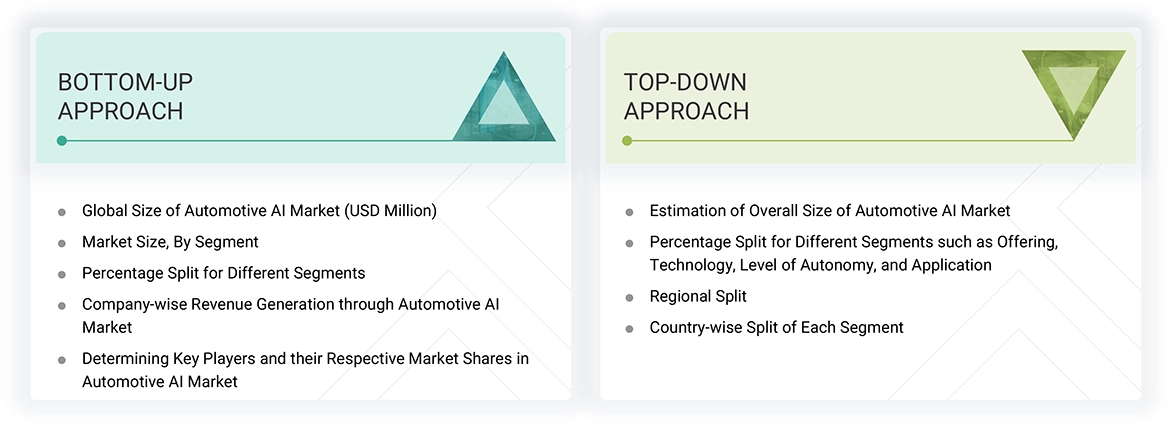
The study involved four major activities in estimating the current size of the automotive AI market. Exhaustive secondary research collected information on the market, peer, and parent markets. The next step was to validate these findings, assumptions, and sizing with industry experts across the value chain through primary research. Both top-down and bottom-up approaches were employed to estimate the complete market size. After that, market breakdown and data triangulation techniques were used to estimate the market size of segments and subsegments.
Secondary Research
The secondary research process has referred to various secondary sources to identify and collect necessary information for this study. The secondary sources include annual reports, press releases, and investor presentations of companies; white papers; journals and certified publications; and articles from recognized authors, websites, directories, and databases. Secondary research was conducted to obtain critical information about the industry’s supply chain, the market’s value chain, the total pool of key players, market segmentation according to the industry trends (to the bottom-most level), regional markets, and key developments from market- and technology-oriented perspectives. Secondary data was collected and analyzed to determine the overall market size, which was further validated through primary research.
Primary Research
Extensive primary research was conducted after gaining knowledge about the current scenario of the automotive AI market through secondary research. Several primary interviews were conducted with experts from the demand and supply sides across four major regions: North America, Europe, Asia Pacific, and RoW. This primary data was collected through questionnaires, emails, and telephone interviews.
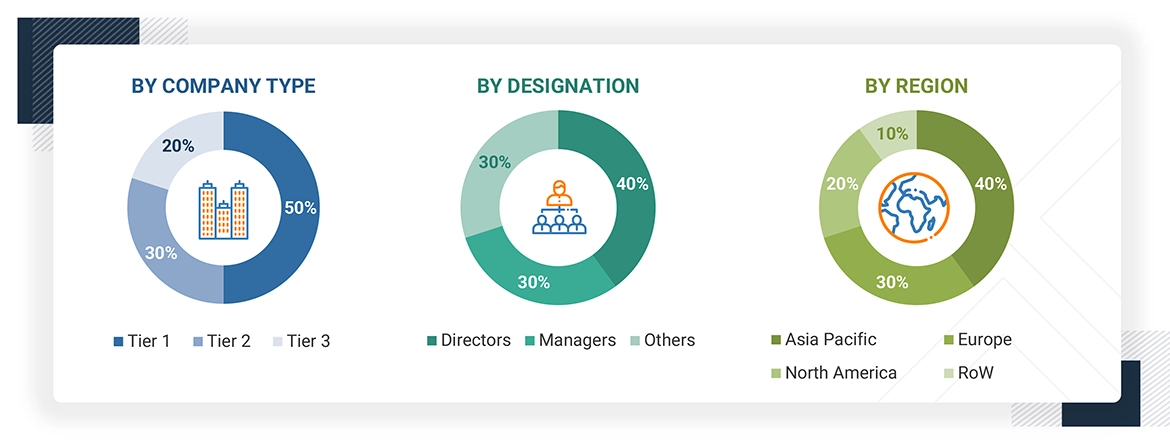
Notes: Other designations include technology heads, media analysts, sales managers, marketing managers, and product managers.
The three tiers of the companies are based on their total revenues as of 2024; Tier 1: >USD 1 billion, Tier 2: USD 500 million–1 billion, and Tier 3: USD 500 million.
To know about the assumptions considered for the study, download the pdf brochure
Market Size Estimation
Both top-down and bottom-up approaches were used to estimate and validate the totalIn the complete market engineering process, top-down and bottom-up approaches and several data triangulation methods were used to estimate and forecast the overall market segments and subsegments listed in this report. Key players in the market were identified through secondary research, and their market shares in the respective regions were determined through primary and secondary research. This entire procedure includes the study of annual and financial reports of the top market players and extensive interviews for key insights (quantitative and qualitative) with industry experts (CEOs, VPs, directors, and marketing executives).
All percentage shares, splits, and breakdowns were determined using secondary sources and verified through primary sources. All the parameters affecting the markets covered in this research study were accounted for, viewed in detail, verified through primary research, and analyzed to obtain the final quantitative and qualitative data. This data was consolidated and supplemented with detailed inputs and analysis from MarketsandMarkets and presented in this report.
Automotive AI Market : Top-Down and Bottom-Up Approach
Data Triangulation
After arriving at the overall market size, the market was split into several segments and subsegments using the market size estimation processes explained above. Data triangulation and market breakdown procedures were employed to complete the entire market engineering process and determine the exact statistics of each market segment and subsegment. The data was triangulated by studying various factors and trends from the demand and supply sides in the automotive AI market.
Market Definition
The automotive AI market refers to the integration and deployment of artificial intelligence technologies across various systems and functions within vehicles to enable intelligent, automated, and data-driven mobility. It encompasses the use of AI in autonomous driving (AD) and advanced driver assistance systems (ADAS), infotainment, vehicle telematics, and other domains such as body control, comfort systems, engine management, and powertrain optimization. These applications leverage technologies such as machine learning, deep learning, computer vision, natural language processing, and context-aware computing to enhance decision-making, improve driver and passenger safety, optimize vehicle performance, and deliver personalized in-vehicle experiences.
Key Stakeholders
- Government bodies and policymakers
- Industry organizations, forums, alliances, and associations
- Market research and consulting firms
- Raw material suppliers and distributors
- Research institutes and organizations
- Traders and suppliers
- Raw material suppliers
- System integrators
- AI solution providers
- AI platform providers
- Original equipment manufacturers (OEMS)
- OEM technology solution providers
- Technology, service, and solution providers
- Intellectual property (IP) core and licensing providers
- Suppliers and distributors
- Forums, alliances, and associations
- Technology investors
- Research institutes and organizations
- Analysts and strategic business planners
- Market research and consulting firms
Report Objectives
- To describe and forecast the automotive AI market, by offering, architecture, technology, level of autonomy, application, and region
- To forecast the automotive AI market by offering in terms of volume
- To provide the market size estimation for North America, Europe, Asia Pacific, and Rest of the World (RoW), along with their respective country-level market sizes, in terms of value
- To provide detailed information regarding the drivers, restraints, opportunities, and challenges influencing the market growth
- To provide value chain analysis, ecosystem analysis, case study analysis, patent analysis, trade analysis, technology analysis, pricing analysis, key conferences and events, key stakeholders and buying criteria, Porter’s Five Forces analysis, regulations, and impact of US tariff pertaining to the market
- To strategically analyze micromarkets1 with regard to individual growth trends, prospects, and contributions to the total market
- To analyze opportunities for stakeholders by identifying high-growth segments of the market
- To strategically profile the key players, comprehensively analyze their market positions in terms of ranking and core competencies2, and provide a competitive market landscape
- To analyze strategic approaches, such as product launches, expansions, and partnerships, in the automotive AI market
- To analyze the impact of the macroeconomic outlook for each region
Available customizations:
With the given market data, MarketsandMarkets offers customizations according to the specific requirements of companies. The following customization options are available for the report:
Country-wise Information:
- Country-wise breakdown for North America, Europe, Asia Pacific, and Rest of the World
Company Information:
- Detailed analysis and profiling of additional market players (up to five)
Get the Full Automotive AI Market Report
Full forecast, segment splits, and company analysis for all Automotive AI Market.
Need a Tailored Report?
Customize this report to your needs
Get 10% FREE Customization
Customize This Report
