
South America Automotive Ceramics Market (2023-2028)

The South America Automotive Ceramics Market was valued at $148.98 Million in 2023 and projected to reach to $186.11 Million by 2028, representing a compound annual growth rate of 4.6%. South America's automotive ceramics market is positioned for steady growth through 2028, supported by expanding vehicle production capacity and rising consumer demand for fuel-efficient vehicles.


| Market Size in | USD 26.32 MN |
| Market Forecast in | |
| CAGR | |
| Forecast Period | |
| Units Considered | Value (USD MN) |
South America Automotive Ceramics Market Trends and Insights
- South America's automotive ceramics sector is driven by increasing demand for lightweight materials, thermal management solutions, and emission control technologies in the region's growing vehicle manufacturing base.
- The market in South America reflects steady expansion as OEMs and suppliers invest in advanced ceramic components for engine efficiency and durability. South America's automotive ceramics adoption is supported by rising vehicle production, stricter environmental regulations, and the shift toward electrification and hybrid powertrains.
- The region's market growth trajectory from 2023 to 2028 demonstrates resilience and opportunity, with South America positioning itself as a key hub for ceramic component innovation in Latin America.
- Key applications in South America include catalytic converters, spark plugs, insulators, and thermal barriers, all critical to modern vehicle performance standards..
Key Market Statistics
- CAGR (2023-2028) 4.6% CAGR
- Market Size, 2023 ~USD 148.98 Million
- Forecast, 2028 ~USD 186.11 Million
- Geography South America
South America Automotive Ceramics Market Overview
Market Valuation & Growth :
South America's automotive ceramics market reached USD 148.98 million in 2023 and is projected to expand to USD 186.11 million by 2028, driven by a steady CAGR of 4.6%, outpacing several regional markets in the automotive materials sector.
Lightweight Material Adoption :
Increasing adoption of ceramic components in South American vehicle manufacturing is reducing overall vehicle weight, improving fuel efficiency, and meeting stringent regional emission standards for both domestic and export markets.
Thermal Management Solutions :
Growing demand for advanced thermal management ceramics in South American automotive production addresses engine efficiency and heat dissipation challenges, particularly in high-performance and commercial vehicle segments.
Emission Control Technologies :
South American automotive manufacturers are increasingly integrating ceramic-based emission control systems to comply with evolving environmental regulations and meet global export requirements for cleaner vehicle technologies.
South America Automotive Ceramics Market Dynamics
- Brazil and Argentina lead regional consumption, with increasing investments in manufacturing infrastructure and technology adoption.
- The region's automotive sector is transitioning toward lightweight and sustainable materials, creating sustained demand for ceramic solutions in engine components, exhaust systems, and thermal barriers.
- Government initiatives promoting cleaner emissions and fuel economy standards will further accelerate ceramic material integration across South American vehicle platforms..
Market Ecosystem
Related Ecosystem
Ceramics And Glass
- Zirconia
- Alumina Ceramics
- Silicon Carbide
- Silicon Nitride
- Titanate Ceramics
- Saint-gobain
- 3M COMPANY
- Kyocera Corporation
- CERAMTEC GMBH
- COORSTEK INCORPORATED
Infrastructure Material
- Alumina Ceramics
- Ceramic Coatings
- Monolithic Ceramics
- Polyphenylene Sulfide (PPS)
- Titanate Ceramics
- Saint-gobain
- Simpson Manufacturing Co., Inc.
- Basf se
- DOW CHEMICAL COMPANY
- Sika ag
Foam And Insulation
- Fiberglass
- Acoustic Insulation
- Elastomeric Foam
- HVAC System
- Flexible Foam
- Basf se
- Saint-gobain
- ARMACELL INTERNATIONAL
- THE WOODBRIDGE GROUP
- Sekisui Chemical Co., Ltd.
Key Takeaways
- South America's automotive ceramics market is valued at USD 148.98 million in 2023 and will reach USD 186.11 million by 2028 at a 4.6% CAGR.
- South America's market growth is fueled by increased vehicle production, emission regulations, and demand for thermal management solutions.
- South America's key applications include catalytic converters, spark plugs, insulators, and thermal barrier coatings for modern engines.
- South America represents a strategic growth region for ceramic component suppliers targeting Latin American automotive OEMs and tier-one suppliers.
Automotive Ceramics Market Report Scope
| Report Metric | Details |
|---|---|
| Base Year | 2023 |
| Fastest Growing Segment | AUTOMOTIVE ELECTRONICS (Application) |
| Forecast Period | 2023-2028 |
| Growth Rate | CAGR of 5.7% from 2023 to 2028 |
| Largest Segment | PASSENGER VEHICLE (Vehicle Type) |
| Market Size Base Year (Billions) | ~USD 2.43 (2023) |
| Revenue Forecast (Billions) | ~USD 3.2 (2028) |
| Segments Covered | Material, Vehicle Type, Application, Material Type |
South America Automotive Ceramics Market Report Segmentation
4 segment dimensions are covered across the global market.
By Material
- Alumina Oxide
- Titanate Oxide
- Zirconia Oxide
By Vehicle Type
- Commercial Vehicle
- Passenger Vehicle
By Application
- Automotive Electronics
- Automotive Engine Part
- Automotive Exhaust System
- Breaking System
By Material Type
- Alumina Oxide
- Titanate Oxide
- Zirconia Oxide
Target Audience
- Automotive OEMs & Suppliers : South American vehicle manufacturers and tier-1 suppliers need market data to optimize ceramic component sourcing, reduce production costs, and meet regional emission and efficiency standards.
- Ceramic Material Manufacturers : Producers of advanced ceramics require South America-specific demand forecasts to guide capacity planning, R&D investments, and market entry strategies in this growing regional segment.
- Investment & Private Equity Firms : Investors evaluating automotive supply chain opportunities in South America need granular market sizing and growth projections to assess portfolio companies and identify acquisition targets.
- Market Research & Consulting Firms : Research organizations serving automotive clients require South America cutout data to support client advisory work, competitive analysis, and strategic planning initiatives across the region.
- Government & Trade Organizations : Regional economic development agencies and trade bodies use market intelligence to support automotive industry policy, trade negotiations, and technology adoption initiatives in South America.
Countries within South America - compare and drill down
| Country | 2025 size (native) |
|---|---|
| Brazil | USD 102.92 Million |
| Argentina | USD 52.3 Million |
| Rest Of South America | USD 30.89 Million |
Country market size visualization
Reasons to Buy this Report
- Country-Level Market Breakdown : Access detailed market sizing for Brazil and Argentina, the two largest automotive ceramics markets in South America, enabling targeted investment and expansion strategies in high-growth segments.
- Regional Growth Trajectory Analysis : Understand South America's 4.6% CAGR performance relative to global 5.7% growth, identifying market maturity levels and untapped opportunities for ceramic material suppliers and automotive manufacturers.
- Application-Specific Demand Insights : Gain clarity on thermal management, emission control, and lightweight material applications driving South American automotive ceramics adoption, supporting product development and market positioning decisions.
- Competitive Landscape Intelligence : Benchmark your South American operations against regional market dynamics, identify key growth drivers, and develop localized strategies for automotive OEMs and ceramic component suppliers.
- Regulatory & Compliance Roadmap : Stay informed on South American emission standards and fuel economy regulations shaping ceramic material demand, ensuring compliance and competitive advantage in the region's evolving automotive sector.
Frequently asked questions
What is the current size of the automotive ceramics market in South America?
The South America automotive ceramics market was valued at USD 148.98 million in 2023 and is expected to grow to USD 186.11 million by 2028.
What is the projected growth rate for South America's automotive ceramics market?
South America's automotive ceramics market is projected to grow at a CAGR of 4.6% from 2023 to 2028.
What are the primary applications of ceramics in South America's automotive industry?
In South America, automotive ceramics are primarily used in catalytic converters, spark plugs, insulators, and thermal barrier coatings for engine components.
What factors are driving growth in South America's automotive ceramics market?
South America's market growth is driven by rising vehicle production, stricter emission regulations, demand for lightweight materials, and the transition to hybrid and electric powertrains.
Why is South America important for the global automotive ceramics industry?
South America is a significant automotive manufacturing hub in Latin America with growing OEM presence, making it a strategic market for ceramic component suppliers and innovation.
RESEARCH METHODOLOGY
The study involved four major activities in estimating the market size of the automotive ceramics market. Exhaustive secondary research was done to collect information on the market, the peer market, and the parent market. The next step was to validate these findings, assumptions, and sizing with industry experts across the value chain through primary research. Both top-down and bottom-up approaches were employed to estimate the complete market size. Thereafter, the market breakdown and data triangulation procedures were used to estimate the market size of the segments and subsegments.
Secondary Research
In the secondary research process, various secondary sources have been referred to for identifying and collecting information for this study. These secondary sources include annual reports, press releases, investor presentations of companies, white papers, certified publications, trade directories, certified publications, articles from recognized authors, gold standard and silver standard websites, and databases.
Secondary research has been used to obtain key information about the value chain of the industry, monetary chain of the market, the total pool of key automotive ceramics, market classification and segmentation according to industry trends to the bottom-most level, and regional markets. It was also used to obtain information about the key developments from a market-oriented perspective.
Primary Research
The automotive ceramics market comprises several stakeholders in the value chain, which include raw material suppliers, manufacturers, and end users. Various primary sources from the supply and demand sides of the automotive ceramics market have been interviewed to obtain qualitative and quantitative information. The primary interviewees from the demand side include key opinion leaders in end-use sectors. The primary sources from the supply side include manufacturers, associations, and institutions involved in the automotive ceramics industry.
Primary interviews were conducted to gather insights such as market statistics, data of revenue collected from the products and services, market breakdowns, market size estimations, market forecasting, and data triangulation. Primary research also helped in understanding the various trends related to material, vehicle type, application, and region. Stakeholders from the demand side, such as CIOs, CTOs, and CSOs were interviewed to understand the buyer’s perspective on the suppliers, products, component providers, and their current usage of automotive ceramics and future outlook of their business which will affect the overall market.
The breakdown of profiles of the primary interviewees is illustrated in the figure below:
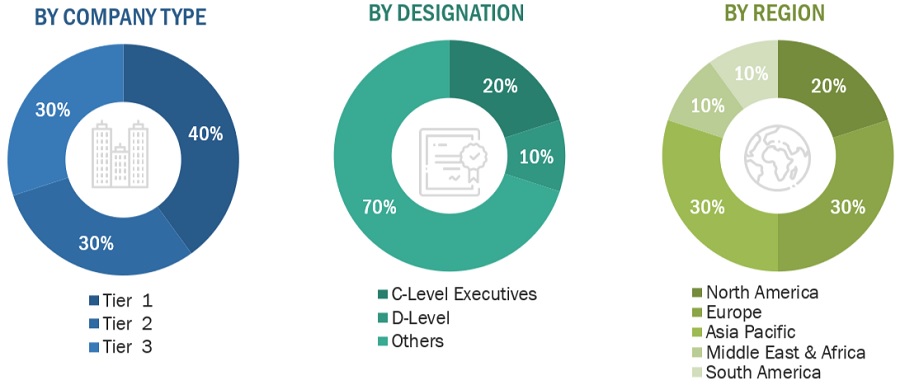
Note: Tier 1, Tier 2, and Tier 3 companies are classified based on their market revenue in 2022 available in the public domain, product portfolios, and geographical presence.
Other designations include sales representatives, production heads, and technicians.
To know about the assumptions considered for the study, download the pdf brochure
Market Size Estimation
The top-down approach was used to estimate and validate the size of various submarkets for automotive ceramics for each region. The research methodology used to estimate the market size included the following steps:
- The key players in the industry have been identified through extensive secondary research.
- The supply chain of the industry has been determined through primary and secondary research.
- The global market was then segmented into five major regions and validated by industry experts.
- All percentage shares, splits, and breakdowns based on material, vehicle type, application, and country were determined using secondary sources and verified through primary sources.
- All possible parameters that affect the markets covered in this research study were accounted for, viewed in extensive detail, verified through primary research, and analyzed to get the final quantitative and qualitative data. This data was consolidated and added with detailed inputs and analysis and presented in this report.
Automotive Ceramics Market: Bottum-Up Approach
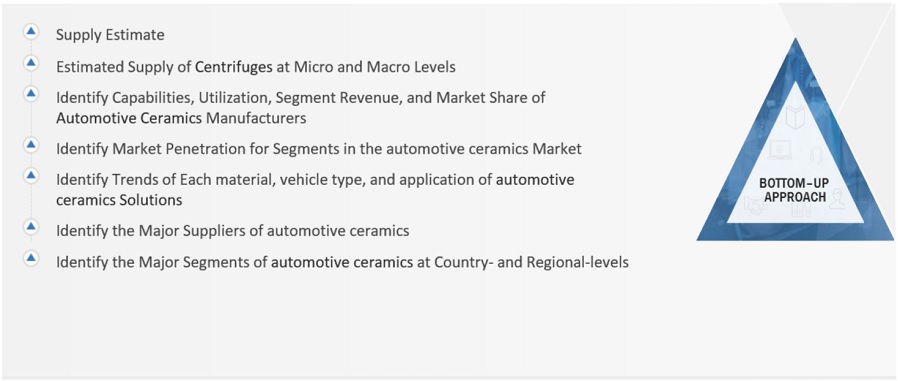
Source: Secondary Research, Interviews with Experts, and MarketsandMarkets Analysis
To know about the assumptions considered for the study, Request for Free Sample Report
Automotive Ceramics Market: Top-Down Approach
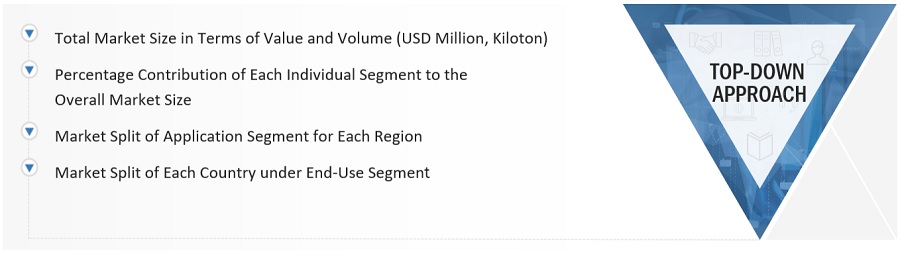
Source: Secondary Research, Interviews with Experts, and MarketsandMarkets Analysis
Data Triangulation
After arriving at the total market size from the estimation process automotive ceramics above, the overall market has been split into several segments and sub-segments. To complete the overall market engineering process and arrive at the exact statistics for all the segments and sub-segments, the data triangulation and market breakdown procedures have been employed, wherever applicable. The data has been triangulated by studying various factors and trends from both the demand and supply sides. Along with this, the market size has been validated by using both the top-down and bottom-up approaches and primary interviews. Hence, for every data segment, there have been three sources—top-down approach, bottom-up approach, and expert interviews. The data was assumed correct when the values arrived from the three sources matched.
Market Definition
Automotive ceramics refer to advanced ceramic materials extensively employed in the manufacturing of various components within the automotive industry. These ceramics, often composed of oxides, nitrides, and carbides, offer exceptional properties such as high strength, thermal resistance, and durability. Their application spans critical areas like engine parts, exhaust systems, braking systems, and automotive electronics. Engine components benefit from ceramics' ability to reduce friction, enhance wear resistance, and optimize thermal stability, thereby improving overall efficiency. In exhaust systems, ceramics play a crucial role in catalytic converters and diesel particulate filters, contributing to emission control. Additionally, the integration of ceramics in automotive electronics ensures enhanced performance and reliability. As the automotive sector evolves towards lightweight, high-performance solutions, automotive ceramics emerge as indispensable materials, addressing the industry's demands for efficiency, sustainability, and regulatory compliance.
Key Stakeholders
- Automotive Ceramics Manufacturers
- Automotive ceramics Traders, Distributors, and Suppliers
- Raw Type Suppliers
- Government and Private Research Organizations
- Associations and Industrial Bodies
- R&D Institutions
- Environmental Support Agencies
Report Objectives
- To define, describe, and forecast the size of the automotive ceramics market, in terms of value and volume.
- To provide detailed information regarding the major factors (drivers, opportunities, restraints, and challenges) influencing the growth of the market.
- To estimate and forecast the market size based on material, vehicle type, application, and region.
- To forecast the size of the market with respect to major regions, namely, Europe, North America, Asia Pacific, Middle East & Africa, and South America, along with their key countries.
- To strategically analyze micromarkets1 with respect to individual growth trends, prospects, and their contribution to the overall market.
- To analyze opportunities in the market for stakeholders and provide a competitive landscape of market leaders.
- To track and analyze recent developments such as expansions, new product launches, partnerships & agreements, and acquisitions in the market.
- To strategically profile key market players and comprehensively analyze their core competencies.
Available Customizations
Along with the given market data, MarketsandMarkets offers customizations according to the company’s specific needs. The following customization options are available for the report:
Regional Analysis
- Further breakdown of a region with respect to a particular country or additional application
Company Information
- Detailed analysis and profiles of additional market players
Tariff & Regulations
- Regulations and impact on automotive ceramics market
Get the Full Automotive Ceramics Market Report
Full forecast, segment splits, and company analysis for all Automotive Ceramics Market.
- China Automotive Ceramics Market
- Japan Automotive Ceramics Market
- South Korea Automotive Ceramics Market
- India Automotive Ceramics Market
- Indonesia Automotive Ceramics Market
- US Automotive Ceramics Market
- Mexico Automotive Ceramics Market
- Canada Automotive Ceramics Market
- Germany Automotive Ceramics Market
- UK Automotive Ceramics Market
- France Automotive Ceramics Market
- Spain Automotive Ceramics Market
- Italy Automotive Ceramics Market
- Brazil Automotive Ceramics Market
- Argentina Automotive Ceramics Market
- South Africa Automotive Ceramics Market
- Rest Of Europe Automotive Ceramics Market
- Rest Of Asia Pacific Automotive Ceramics Market
- GCC Countries Automotive Ceramics Market
- -Rest Of GCC Automotive Ceramics Market
- Rest Of South America Automotive Ceramics Market
Need a Tailored Report?
Customize this report to your needs
Get 10% FREE Customization
Customize This Report
