
France Automotive Fuel Cell Market (2024-2029)

The France Automotive Fuel Cell Market was valued at $89 Million in 2024 and projected to reach to $1357 Million by 2029, representing a compound annual growth rate of 57.4%. France's automotive fuel cell market is poised for transformative growth over the next five years, driven by aggressive government support for hydrogen economy development and stringent EU emissions regulations.


| Market Size in | USD 26.32 MN |
| Market Forecast in | |
| CAGR | |
| Forecast Period | |
| Units Considered | Value (USD MN) |
France Automotive Fuel Cell Market Trends and Insights
- This rapid expansion reflects France's strategic commitment to hydrogen infrastructure development and zero-emission vehicle adoption as part of its broader decarbonization agenda.
- France is positioning itself as a European leader in fuel cell technology, supported by government incentives, investment in hydrogen refueling networks, and partnerships between automotive manufacturers and energy providers. The French automotive fuel cell sector is driven by regulatory pressures to meet EU emissions standards and growing consumer demand for sustainable transportation solutions.
- Between 2024 and 2029, France is expected to see increased commercialization of fuel cell vehicles across passenger and commercial segments.
- Major automotive players are investing in France's hydrogen ecosystem, recognizing the country's potential as a hub for fuel cell innovation and production.
- France's established automotive manufacturing base and commitment to the hydrogen economy position it as a critical market within Europe's transition to clean mobility..
Key Market Statistics
- CAGR (2024-2029) 57.4% CAGR
- Market Size, 2024 ~USD 89 Million
- Forecast, 2029 ~USD 1357 Million
- Country France
France Automotive Fuel Cell Market Overview
Exceptional Growth Trajectory :
France's automotive fuel cell market is projected to grow from $89.0 million in 2024 to $1,357.0 million by 2029, representing a remarkable 57.4% CAGR, significantly outpacing the global average of 48%.
Government Hydrogen Strategy :
France's commitment to hydrogen infrastructure development and zero-emission vehicle adoption is driving market expansion as part of its EU decarbonization targets and national energy transition roadmap.
Strategic Infrastructure Investment :
Substantial investments in hydrogen refueling stations and fuel cell technology development across France are creating favorable conditions for OEM partnerships and supply chain expansion.
Industrial Leadership Position :
France is positioning itself as a European hub for fuel cell innovation, with major automotive manufacturers and tier-1 suppliers establishing R&D centers and production facilities.
France Automotive Fuel Cell Market Dynamics
- The country's strategic focus on building hydrogen infrastructure and incentivizing zero-emission vehicle adoption creates a compelling investment landscape for automotive manufacturers and technology providers.
- With a 57.4% CAGR significantly exceeding global trends, France is emerging as a key European market for fuel cell commercialization. The market expansion will be supported by increasing OEM commitments to fuel cell vehicle launches, growing consumer acceptance of hydrogen technology, and collaborative initiatives between government, industry, and research institutions.
- France's position within the EU regulatory framework and its industrial capabilities position it as a critical market for fuel cell technology deployment and supply chain development through 2029..
Market Ecosystem
Related Ecosystem
Automotive Advance Technologies
- Battery Electric Vehicle (BEV)
- Light Commercial Vehicles (LCVs)
- Fuel Cell Electric Vehicle (FCEV)
- Hybrid Electric Vehicle (HEV)
- Internal Combustion Engine (ICE)
- BOSCH LIMITED
- Continental ag
- Visteon Corporation
- DENSO Corporation
- ZF FRIEDRICHSHAFEN AG
Electric Hybrid Vehicles
- Battery Electric Vehicle (BEV)
- Fuel Cell Electric Vehicle (FCEV)
- Light Commercial Vehicles (LCVs)
- Hybrid Electric Vehicle (HEV)
- Agricultural Tractors
- Visteon Corporation
- Byd company ltd.
- BOSCH LIMITED
- Tesla, Inc.
- FORD MOTOR COMPANY
Key Takeaways
- France's automotive fuel cell market will grow from $89.0M (2024) to $1,357.0M (2029) at a 57.4% CAGR, making it one of Europe's fastest-growing hydrogen vehicle markets.
- France is leveraging government support and hydrogen infrastructure investment to establish itself as a European leader in fuel cell automotive technology and production.
- Regulatory compliance with EU emissions standards and consumer demand for zero-emission vehicles are primary drivers accelerating fuel cell adoption across France's automotive sector.
- France's combination of established automotive manufacturing capabilities and strategic hydrogen economy investments positions it as a critical hub for fuel cell vehicle commercialization through 2029.
Automotive Fuel Cell Market Report Scope
| Report Metric | Details |
|---|---|
| Base Year | 2024 |
| Fastest Growing Segment | ABOVE 500 MILES (Operating Miles) |
| Forecast Period | 2024-2029 |
| Growth Rate | CAGR of 48% from 2024 to 2029 |
| Largest Segment | FUEL STACK (Component) |
| Market Size Base Year (Billions) | ~USD 0.2 (2024) |
| Revenue Forecast (Billions) | ~USD 1.42 (2029) |
| Segments Covered | Component, Operating Miles, Power Output, Propulsion, Vehicle Type |
France Automotive Fuel Cell Market Report Segmentation
5 segment dimensions are covered across the global market.
By Component
- Air Compressor
- Fuel Processor
- Fuel Stack
- Humidifier
- Power Conditioner
By Operating Miles
- 0-250 Miles
- 251-500 Miles
- Above 500 Miles
By Power Output
- 150-250 Kw
- <150 Kw
- >250 Kw
By Propulsion
- Fcev
- Fchev
By Vehicle Type
- Bus
- Lcv
- Passenger Car
- Truck
Target Audience
- Automotive OEMs : Manufacturers need France-specific market data to guide fuel cell vehicle development roadmaps, production capacity planning, and go-to-market strategies in this rapidly expanding European market.
- Fuel Cell Technology Suppliers : Component and system suppliers require detailed French market insights to identify partnership opportunities with OEMs, assess demand forecasts, and plan manufacturing and distribution networks.
- Energy & Infrastructure Companies : Hydrogen producers and refueling infrastructure developers need market projections and policy analysis for France to justify capital investments in hydrogen station networks and supply chain development.
- Investment & Private Equity Firms : Investors evaluating opportunities in the French automotive and hydrogen sectors require comprehensive market data, growth trajectories, and competitive analysis to support funding and M&A decisions.
- Government & Policy Makers : French and EU policymakers need market intelligence to assess hydrogen economy progress, validate policy effectiveness, and inform future regulatory frameworks and incentive programs.
Reasons to Buy this Report
- Market Size & Growth Validation : Obtain precise market valuation data for France ($89M in 2024) with detailed 5-year forecasts to support investment decisions, business planning, and competitive positioning in this high-growth segment.
- France-Specific Strategic Insights : Access localized analysis of government policies, hydrogen infrastructure development, and regulatory drivers unique to France that directly impact market dynamics and opportunity identification.
- Competitive Landscape Intelligence : Understand OEM strategies, supply chain positioning, and technology partnerships specific to the French market to identify collaboration opportunities and competitive threats.
- Investment & Expansion Planning : Leverage detailed market segmentation and growth projections for France to evaluate market entry strategies, facility location decisions, and resource allocation for fuel cell initiatives.
- Regulatory & Policy Alignment : Stay informed on France's hydrogen strategy, EU compliance requirements, and incentive programs that shape market opportunities and influence long-term business viability.
Frequently asked questions
What is the current size of France's automotive fuel cell market in 2024?
France's automotive fuel cell market is valued at $89.0 million in 2024, with strong growth anticipated through the forecast period.
What is the projected market size for France's automotive fuel cell sector by 2029?
France's automotive fuel cell market is projected to reach $1,357.0 million by 2029, representing a 57.4% compound annual growth rate.
What factors are driving growth in France's automotive fuel cell market?
Growth in France is driven by EU emissions regulations, government hydrogen infrastructure investments, increasing consumer demand for zero-emission vehicles, and automotive manufacturer commitments to fuel cell technology.
How does France's fuel cell market growth compare to other European markets?
France's 57.4% CAGR positions it among Europe's fastest-growing automotive fuel cell markets, reflecting its strategic focus on hydrogen economy development and clean mobility.
What role does government policy play in France's fuel cell market expansion?
French government policies supporting hydrogen infrastructure, vehicle purchase incentives, and regulatory compliance with EU standards are critical enablers of the market's rapid expansion between 2024 and 2029.
RESEARCH METHODOLOGY
The study involved four major activities in estimating the current size of the hydrogen fuel cell vehicle market. Exhaustive secondary research was done to collect information on the market, the peer market, and the child markets. The next step was to validate these findings, assumptions, and sizing with the industry experts across value chains through primary research. The top-down and bottom-up approaches were employed to estimate the complete market size. Thereafter, market breakdown and data triangulation processes were used to estimate the market size of segments and subsegments.
Secondary Research
In the secondary research process, various secondary sources such as company annual reports/presentations, press releases, industry association publications [for example, Fuel Cell and Hydrogen Energy Association (FCHEA), International Organization of Motor Vehicle Manufacturers, European Alternative Fuels Observatory (EAFO), International Energy Association (IEA)], articles, directories, technical handbooks, trade websites, technical articles, and databases (for example, Marklines, and Factiva) have been used to identify and collect information useful for an extensive commercial study of the global automotive cell market.
Primary Research
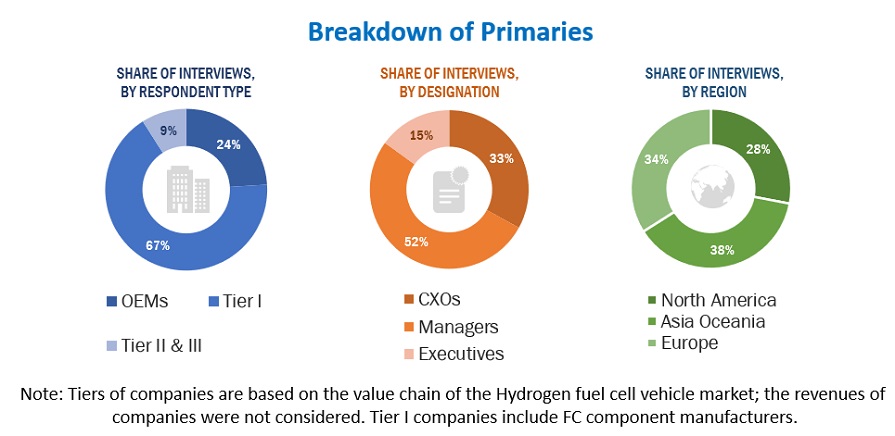
Extensive primary research was conducted after acquiring an understanding of the hydrogen fuel cell vehicle market scenario through secondary research. Several primary interviews were conducted with market experts from both the demand (automotive OEMs) and supply (automotive fuel cell providers) sides across major regions, namely, North America, Europe, and Asia Oceania. Approximately 30% and 70% of primary interviews were conducted from the demand and supply sides, respectively. Primary data was collected through questionnaires, emails, and telephonic interviews.
In the canvassing of primaries, various departments within organizations, such as sales, operations, and marketing, were covered to provide a holistic viewpoint in the report. After interacting with industry experts, brief sessions were also conducted with highly experienced independent consultants to reinforce the findings from primaries. This, along with the in-house subject matter experts’ opinions, led to the findings described in the remainder of this report.
To know about the assumptions considered for the study, download the pdf brochure
Market Size Estimation
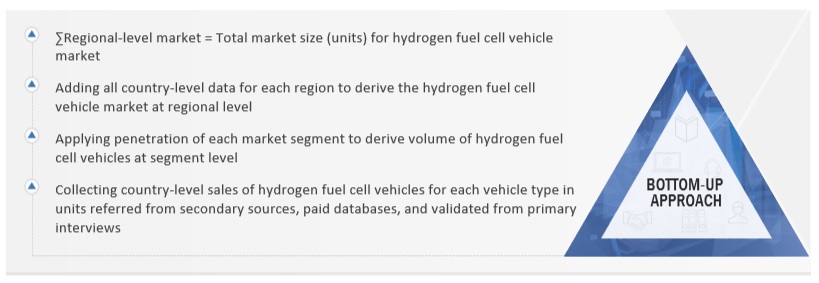
The bottom-up approach has been used to estimate and validate the size of the Hydrogen fuel cell vehicle market by vehicle type. In this approach, the vehicle sales statistics for each vehicle type [Passenger Cars, Light Commercial Vehicles, Buses, and Trucks] have been considered at the country level.
To determine the market size, in terms of volume, a mapping of fuel cell vehicles has been carried out for each country and vehicle type. The number of fuel cell electric models varied from country to country. After this, the types of FCEVs sold were identified, which derived the volume of each segment type. The country-level data was summed up to arrive at the region-level data in terms of volume. The summation of the country-level market size gives the regional market size, and a further summation of the regional market size provides the global Hydrogen fuel cell vehicle market size.
To know about the assumptions considered for the study, Request for Free Sample Report
Market Size Validation
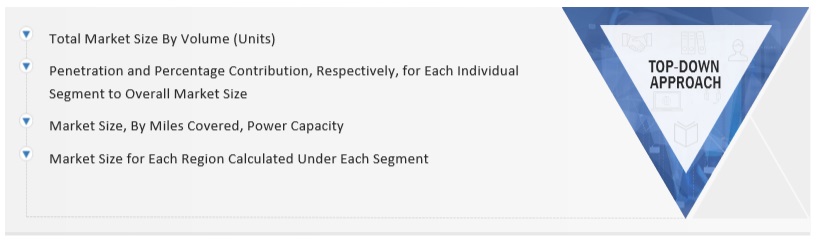
The top-down approach has been used to estimate and validate the size of the hydrogen fuel cell vehicle market at the global level, and by miles covered, power capacity, fuel cell type in terms of volume.
The top-down approach has been used to estimate and validate the size of the market. This approach identifies key fuel cell type, miles covered and power capacity segments of hydrogen fuel cell vehicles at the regional level. The penetration of each identified segment is multiplied by the volume of each vehicle at the regional level to derive the total segment volume.
For instance,
- The Hydrogen fuel cell vehicle market for operating miles was derived using the top-down approach to estimate the subsegments- <250 miles,251-500 miles, above 500 miles.
- The market size, in terms of volume, was derived at the regional level for each segment using this method. The total volume of the market was multiplied by the adoption rate breakup percentage of these segments in regional level (for miles covered, power capacity) and global level (for fuel cell type), respectively.
Data Triangulation
After arriving at the overall hydrogen fuel cell vehicle market size of the global market through the above-mentioned methodology, this market was split into several segments and subsegments. The data triangulation and market breakdown procedure were employed, wherever applicable, to complete the overall market engineering process and arrive at the exact market value data for the key segments and subsegments. The extrapolated market data was triangulated by studying various macro indicators and regional trends from both the demand- and supply-side participants.
Market Definition
A fuel cell electric vehicle (FCEV) is a type of electric vehicle that uses a fuel cell. These vehicles employ hydrogen to create electricity via a chemical process within a fuel cell, resulting in the emission of solely water as a residual product. Stringent emission regulations have led to the increased use of fuel cells in the automotive and transportation industry. A fuel cell can also be used in combination with a battery or supercapacitor to power the onboard electric motor. In an FCEV, hydrogen is pumped into the car and then fed to the fuel cell stack. The fuel cell stack is the center where hydrogen is electrochemically converted into electricity with no combustion and zero emissions. Fuel cells in vehicles generate electricity to power the motor. As long as hydrogen is available, the fuel cell will continue to produce electricity. Most fuel cell vehicles are classified as zero-emission vehicles that emit only water and heat.
List of Key Stakeholders
- Alternative Fuels Data Center (AFDC)
- Automobile OEMs providing Hydrogen Vehicles
- Automotive fuel cell raw material suppliers
- Automotive fuel cell suppliers
- California Fuel Cell Partnership (CaFCP)
- California Hydrogen Business Council (CHBC)
- Canadian Hydrogen Fuel Cell Association (CHFCA)
- Environmental Protection Agency (EPA)
- Fuel Cell and Hydrogen Energy Association (FCHEA)
- Hydrogen gas suppliers
- Hydrogen station service providers
- United States Council for Automotive Research LLC (USCAR)
Report Objectives
- To segment and forecast the hydrogen fuel cell vehicle market size in terms of volume (thousand units) and Value (USD Million)
- To define, describe, and forecast the market based on vehicle type, component, specialized vehicle type, H2 fuel station, power output, operating miles, fuel cell type, fuel type and region.
- To segment the market and forecast its size, by volume and value, based on region (Asia Oceania, Europe, and North America)
- To segment and forecast the market based on vehicle type (passenger car, light commercial vehicle, bus, truck)
- To segment and forecast the market based on component (fuel processor, fuel stack, humidifier, air compressor, and power conditioner)
- To segment and forecast the market based on H2 Fuel Station (Asia Oceania, Europe, and North America)
- To segment and forecast the market based on power capacity (<150 kW, 150-250 kW, >250 kW)
- To segment and forecast the market based on operating miles (0-250 Miles, 250-500 Miles, Above 500 Miles)
- To segment and forecast the market based on fuel type (hydrogen, methanol, ethanol, others)
- To analyze the technological developments impacting the hydrogen fuel cell vehicle market
- To analyze opportunities for stakeholders and the competitive landscape for market leaders
- To provide detailed information regarding the major factors influencing the market growth (drivers, challenges, restraints, and opportunities)
- To strategically analyze markets with respect to individual growth trends, future prospects, and contribution to the total market
-
To study the following with respect to the market
- Value Chain Analysis
- Pricing Analysis
- Technological Roadmap
- Ecosystem
- Technology Analysis
- Case Study Analysis
- Patent Analysis
- Regulatory Landscape
- Buying Criteria
- To strategically profile key players and comprehensively analyze their market shares and core competencies.
- To track and analyze competitive developments such as deals (joint ventures, mergers & acquisitions, partnerships, collaborations), new product developments, and other activities carried out by key industry participants.
AVAILABLE CUSTOMIZATIONS
With the given market data, MarketsandMarkets offers customizations in line with company-specific needs.
- Hydrogen fuel cell vehicle market, By Propulsion at Country Level
- Hydrogen fuel cell vehicle market, Additional Countries (Up to 3)
- Profiling of additional market players (Up to 3)
Get the Full Automotive Fuel Cell Market Report
Full forecast, segment splits, and company analysis for all Automotive Fuel Cell Market.
- China Automotive Fuel Cell Market
- Japan Automotive Fuel Cell Market
- South Korea Automotive Fuel Cell Market
- Australia Automotive Fuel Cell Market
- India Automotive Fuel Cell Market
- Belgium Automotive Fuel Cell Market
- Denmark Automotive Fuel Cell Market
- Germany Automotive Fuel Cell Market
- Italy Automotive Fuel Cell Market
- Netherlands Automotive Fuel Cell Market
- Norway Automotive Fuel Cell Market
- Sweden Automotive Fuel Cell Market
- Spain Automotive Fuel Cell Market
- Switzerland Automotive Fuel Cell Market
- UK Automotive Fuel Cell Market
- Canada Automotive Fuel Cell Market
- Mexico Automotive Fuel Cell Market
- US Automotive Fuel Cell Market
Need a Tailored Report?
Customize this report to your needs
Get 10% FREE Customization
Customize This Report
