
Iran Automotive Lighting Market (2024-2029)

The Iran Automotive Lighting Market was valued at $14.3 Million in 2024 and projected to reach to $17.2 Million by 2029, representing a compound annual growth rate of CAGR 3.2%. Iran's automotive lighting market is positioned for moderate but consistent growth driven by expanding domestic vehicle production and government initiatives to strengthen the local automotive industry.


| Market Size in | USD 26.32 MN |
| Market Forecast in | |
| CAGR | |
| Forecast Period | |
| Units Considered | Value (USD MN) |
Iran Automotive Lighting Market Trends and Insights
- This moderate growth trajectory reflects Iran's developing automotive sector and increasing vehicle production capacity.
- In Iran, the automotive lighting market is driven by rising domestic vehicle manufacturing, regulatory compliance requirements, and gradual modernization of the vehicle fleet. The automotive lighting sector in Iran faces unique challenges including international sanctions, limited access to advanced technologies, and reliance on domestic suppliers.
- Despite these constraints, Iran continues to develop its automotive industry with domestic manufacturers investing in lighting solutions for both conventional and emerging vehicle platforms.
- By 2029, Iran's market is expected to benefit from increased vehicle electrification initiatives and improved manufacturing standards. Iran's automotive lighting market remains a niche segment within the broader Rest of World category, characterized by localized production and domestic consumption patterns.
- The growth in Iran is supported by government policies promoting domestic automotive production and gradual infrastructure improvements in the transportation sector..
Key Market Statistics
- CAGR (2024-2029) CAGR 3.2%
- Market Size, 2024 ~USD 14.3 Million
- Forecast, 2029 ~USD 17.2 Million
- Country Iran
Iran Automotive Lighting Market Overview
Market Size & Growth :
Iran's automotive lighting market is valued at USD 14.3 million in 2024, with projected growth to USD 17.2 million by 2029, representing a steady CAGR of 3.2% over the forecast period.
Domestic Vehicle Manufacturing :
Rising domestic vehicle production capacity in Iran is a primary driver of the lighting market, with local manufacturers increasingly investing in modern lighting technologies for new vehicle models.
Import Substitution Opportunities :
Iran's automotive sector is focusing on reducing import dependency, creating opportunities for local lighting component manufacturers and suppliers to capture market share.
Technology Adoption Challenges :
While LED and advanced lighting technologies are gradually being adopted, cost constraints and supply chain limitations continue to influence the pace of market modernization in Iran.
Iran Automotive Lighting Market Dynamics
- The market's 3.2% CAGR reflects a developing economy gradually modernizing its automotive sector, with increasing emphasis on vehicle quality and safety standards.
- As Iranian manufacturers enhance production capabilities and invest in newer vehicle platforms, demand for advanced lighting solutions is expected to rise incrementally.
- However, geopolitical factors and supply chain constraints may continue to influence market dynamics and technology adoption rates..
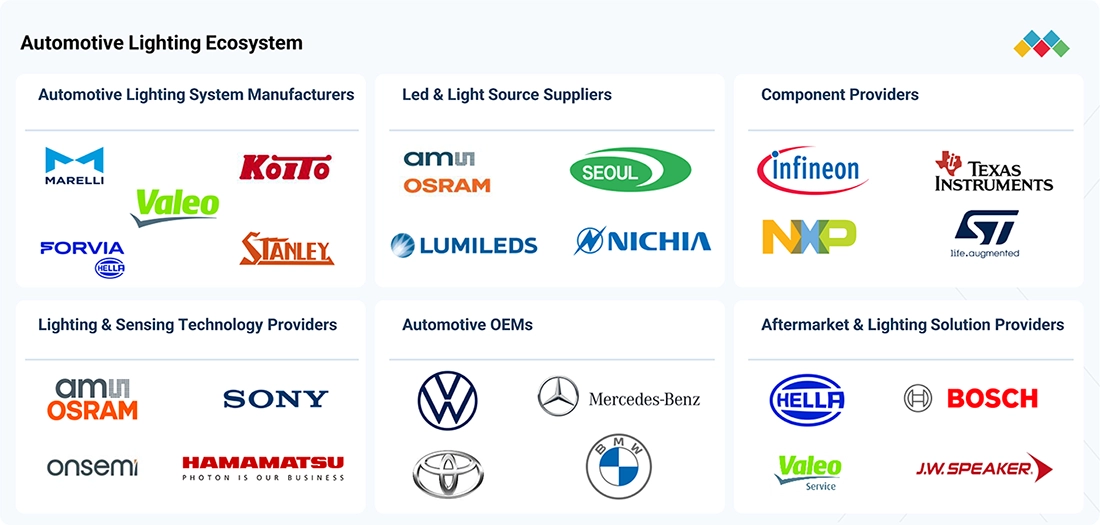
Market Ecosystem
AUTOMOTIVE LIGHTING MARKET: COMMERCIAL USE CASES ACROSS INDUSTRIES
| COMPANY | USE CASE DESCRIPTION | BENEFITS |
|---|---|---|
 |
Provides "Signal Road Projection" headlamps for the Toyota Corolla Cross, projecting a V-shaped light signal onto the road in synchronization with the turn indicator to communicate the vehicle’s intended movement to pedestrians and nearby drivers. The system uses one LED and two lenses in a compact unit. | Improves vehicle visibility and movement recognition at intersections and during turns, helping surrounding road users understand the vehicle’s intention earlier and supporting preventive safety. |
 |
Provides ultra-thin ThinBilite headlamps and RGB front fascia lighting for the Lynk & Co Z10, incorporating 224 RGB LEDs and 256 lighting colors into the front fascia of a production vehicle. | Enables stronger exterior design differentiation and personalization, while the 15 mm ThinBilite headlamp supports more compact front end packaging and greater styling flexibility. |
 |
Provides Digital OLED 2.0 rear lighting for the Audi Q6 e tron, using 60 individually controllable OLED segments connected through a domain architecture. The system supports multiple digital light signatures and communication functions. | Enables personalized rear lighting, dynamic light communication, and improved interaction with surrounding road users, while allowing the rear lamp to function as an exterior display. |
 |
Provides SSL HD high resolution matrix headlamps for the Zeekr 8X, with approximately 25,000 individually controllable LED pixels per headlamp. The system provides adaptive lighting and can project lane guidance and warning information onto the road. | Improves active lighting functionality and driver guidance through precise road projections while reducing installation space by up to 75%, supporting lower packaging requirements and greater vehicle design freedom. |
 |
Provides granular surface emitting rear lamps that use a high lumen LED socket and specially designed light guide to produce uniform, high brightness illumination. The technology has already been adopted in mass produced vehicles. | Improves rear lamp visibility for following vehicles, with Stanley verification tests showing approximately two seconds earlier recognition compared to its previous models, supporting earlier driver response, and improved rear-end collision avoidance potential. |
Logos and trademarks shown above are the property of their respective owners. Their use here is for informational and illustrative purposes only.
Related Ecosystem
Automotive Electronics And Electrical Equipment
- Battery Electric Vehicle (BEV)
- Light Commercial Vehicles (LCVs)
- Fuel Cell Electric Vehicle (FCEV)
- Sensors
- Hybrid Electric Vehicle (HEV)
- BOSCH LIMITED
- DENSO Corporation
- Continental ag
- Panasonic Holdings Corporation
- Texas Instruments Incorporated
Smart Lighting
- Fiber Laser
- Fluorescent Lighting
- Gas Lasers
- Sensors
- 3D Sensors
- Zumtobel group ag
- Nedap n.v.
- Acuity Brands, Inc.
- OSRAM Licht AG
- Philips
Key Takeaways
- Iran's automotive lighting market is valued at USD 14.3 million in 2024 with projected growth to USD 17.2 million by 2029.
- Iran experiences a 3.2% CAGR, reflecting moderate growth driven by domestic vehicle manufacturing and regulatory compliance.
- Iran's market is constrained by international sanctions and limited access to advanced lighting technologies.
- Iran's automotive lighting sector is expected to benefit from vehicle electrification and improved manufacturing standards by 2029.
Automotive Lighting Market Report Scope
| Report Metric | Details |
|---|---|
| Base Year | 2024 |
| Fastest Growing Segment | FOG LIGHTS (Application) |
| Forecast Period | 2024-2029 |
| Growth Rate | CAGR of 4.4% from 2024 to 2029 |
| Largest Segment | PASSENGER CARS (Vehicle Type) |
| Market Size Base Year (Billions) | ~USD 23.48 (2024) |
| Revenue Forecast (Billions) | ~USD 30.4 (2029) |
| Segments Covered | Technology, Vehicle Type, Application, Position |
Iran Automotive Lighting Market Report Segmentation
4 segment dimensions are covered across the global market.
By Technology
- Halogen
- Led
- Xenon
By Vehicle Type
- Bevs
- Buses
- Fcevs
- Light Commercial Vehicles
- Passenger Cars
- Phevs
- Trucks
By Application
- Bus Area Lights
- Cabin & Reading Lights
- Center High-Mount Stop Lights
- Center High-Mount Stop Lights (Chmsl)
- Clearance Lamps
- Dashboard Lamps
- Dashboard Lights
- Daytime Running Lights
- Daytime Running Lights (Drl)
- Dome Lights
- Driver Area Lights
- Engine Compartment Lights
- Fog Lights
- Footwell Lights
- Glove Box
- Glove Box Lights
- Headlamp Units
- Headlights
- Identification Lamps
- Indicator Lamps
- License Plate Lamps
- License Plate Lights
- Marker Lamps
- Reading Lights
- Rear Clearance Lamps
- Rear Identification Lamps
- Rear-View Mirror Interior Lights
- Sidelights
- Stop Lamps
- Tail Lamp Units
- Tail Lights
- Turn Signal Lamps
By Position
- Front
- Rear
- Side
Target Audience
- Automotive Lighting Manufacturers : Manufacturers seeking to expand into Iran's market need detailed insights on local demand, production capacity, and opportunities to supply domestic vehicle assemblers with lighting components.
- Component Suppliers & Distributors : Suppliers and distributors require market-specific data to identify distribution channels, assess demand from Iranian automotive OEMs, and plan inventory and logistics strategies.
- Investment & Private Equity Firms : Investors evaluating opportunities in Iran's automotive sector need accurate market sizing and growth projections to assess the viability and ROI potential of lighting market investments.
- Automotive OEMs & Assemblers : Iranian vehicle manufacturers and assemblers use market data to benchmark lighting technology adoption, identify supplier options, and plan product development roadmaps.
- Market Research & Consulting Firms : Research organizations and consultants require Iran-specific market data to support client advisory services, competitive analysis, and strategic planning in the automotive sector.
Reasons to Buy this Report
- Localized Market Intelligence : Gain detailed insights specific to Iran's automotive lighting market, including domestic production trends, local manufacturer capabilities, and country-specific growth drivers unavailable in global reports.
- Strategic Entry Planning : Develop informed market entry strategies with comprehensive data on Iran's lighting market size, competitive landscape, and import substitution opportunities for suppliers and manufacturers.
- Investment Decision Support : Make confident investment decisions backed by accurate market sizing, CAGR projections, and analysis of Iran's automotive sector development trajectory through 2029.
- Competitive Positioning : Understand Iran-specific market dynamics, local competitor activities, and technology adoption patterns to position products and services effectively within this emerging market.
- Supply Chain Optimization : Identify sourcing opportunities and supply chain partnerships within Iran's growing automotive lighting sector to optimize procurement and manufacturing operations.
Frequently asked questions
What is the current size of Iran's automotive lighting market?
Iran's automotive lighting market is estimated at USD 14.3 million in 2024.
What is the projected market size for Iran by 2029?
Iran's automotive lighting market is projected to reach USD 17.2 million by 2029.
What is the CAGR for Iran's automotive lighting market?
Iran's automotive lighting market is expected to grow at a CAGR of 3.2% from 2024 to 2029.
What are the main drivers of growth in Iran's automotive lighting market?
Growth in Iran is driven by domestic vehicle manufacturing expansion, regulatory compliance requirements, and gradual vehicle fleet modernization.
What challenges does Iran's automotive lighting market face?
Iran's market faces challenges including international sanctions, limited access to advanced technologies, and dependence on domestic suppliers.
RESEARCH METHODOLOGY
This research study involves the extensive use of secondary sources, such as company annual reports/presentations, industry association publications, industry magazine articles, directories, technical handbooks, World Economic Outlook, technical articles, and databases, to identify and collect information on the automotive lighting market. In-depth interviews have been conducted with various primary respondents, including key industry participants, subject-matter experts, C-level executives of key market players (Lighting Manufacturers, Tier 2 Suppliers, and OEMs), and industry consultants, among other experts, to obtain and verify critical qualitative and quantitative information and assess market prospects.
Secondary Research
In the secondary research process, various secondary sources have been used to identify and collect information relevant to an extensive commercial study of the automotive lighting market. These sources include company annual reports and presentations, press releases, and industry association publications such as those from the American Lighting Association (ALA), Canadian Automobile Association (CAA), China Association of Automobile Manufacturers (CAAM), European Automotive Lighting Association (EALA), International Forum on Automotive Lighting (IFAL), Automotive Component Manufacturers Association of India (ACMA), and European Automobile Manufacturers Association (EAAMA), among others. Additionally, secondary research has been conducted to understand the average number of various lights by vehicle type, historical vehicle production, and sales of new vehicles.
Primary Research
Extensive primary research has been conducted after developing an understanding of the global automotive lighting market through secondary research. Several primary interviews have been conducted with market experts from both the demand side, including OEMs, and the supply side, including automotive lighting manufacturers and distributors, across four major regions, namely, North America, Europe, Asia Pacific, and Rest of the World (RoW). Approximately 25% and 75% of the primary interviews have been conducted with demand and supply side participants, respectively. Primary data has been collected through questionnaires, emails, and telephone interviews. Interviews have been conducted with professionals across different organizational functions, including sales, operations, and technical support, to provide a well-rounded perspective for the report.
Primary interviews have been conducted to gather insights such as ICE vehicle production and electric vehicle sales forecast, automotive lighting market forecast and penetration rate, future technology trends, and upcoming technologies in the automotive lighting industry. Data triangulation has been done with the information gathered from secondary research. Stakeholders from the demand and supply side have been interviewed to understand their views on the points mentioned above.
Breakdown of Primaries
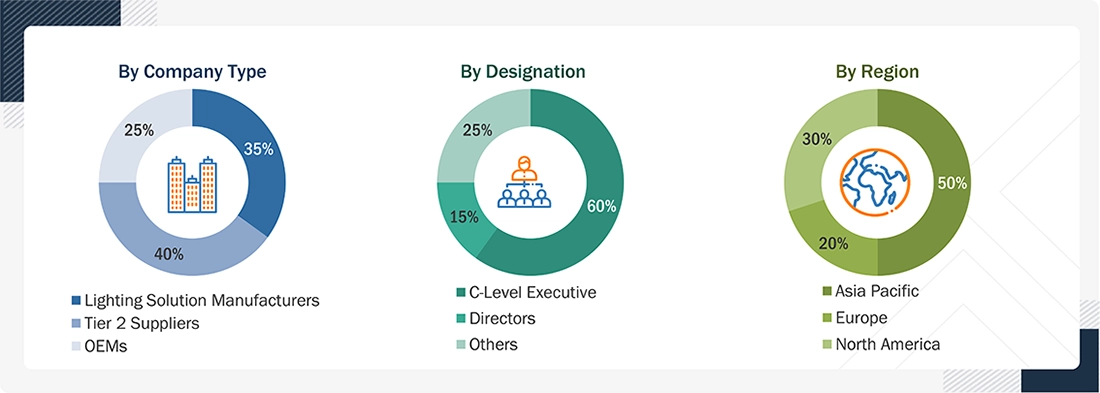
Note: Tiers of companies are based on the supply chain of the automotive lighting market; companies’ revenues have not been considered.
To know about the assumptions considered for the study, download the pdf brochure
Market Size Estimation
A detailed market estimation approach has been followed to estimate and validate the value and volume of the automotive lighting market and other dependent submarkets, as mentioned below:
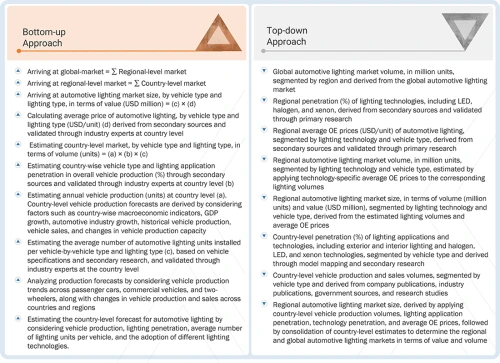
- The bottom-up and top-down approaches have been used to estimate and validate the size of the Automotive Lighting Market. For the bottom up approach, vehicle production data by country and vehicle type is obtained from secondary sources, automotive associations at country level, followed by identification of lighting applications installed across each vehicle type (passenger cars, light commercial vehicles, trucks, and buses), such as front lighting (headlights, fog lights, DRL, indicators), rear light (tail light, CHMSL, brake light, indicators, license plate, reverse lamps), side lights (side lights, ORVM), interior lights (dashboard, glove box, reading light, dome light, rear view mirror interior light). Vehicle production is multiplied by the number of lighting units installed per vehicle and the applicable penetration of each lighting application and technology to estimate lighting volumes. For instance, passenger vehicle production is multiplied by the number of headlights per vehicle and LED headlamp penetration to estimate the LED headlamp volume, which is then multiplied by the corresponding ASP to derive the technology market value. The average selling price is calculated based on company websites, secondary sources, and associations. The calculations are performed at the country level and aggregated across vehicle types, lighting applications, and technologies to estimate the overall automotive lighting market.
- The market size has been derived using parameters such as vehicle production and sales, vehicle type mix, average number of lighting units installed per vehicle, lighting technology penetration, and corresponding application penetration across the countries considered under the scope.
- Key players in the automotive lighting market have been identified through secondary research, and their global market shares and rankings have been determined through primary and secondary research.
- The research methodology included the study of annual and quarterly financial reports, regulatory filings of major market players, company presentations, press releases, and interviews with industry experts to gain detailed market insights.
- All major penetration rates, percentage shares, splits, and breakdowns for the Automotive Lighting Market have been determined through secondary sources and verified through primary sources.
- All key macro indicators affecting the revenue growth of the market segments and subsegments have been accounted for, reviewed in detail, verified through primary research, and analyzed to obtain validated and qualitative data
Automotive Lighting Market : Top-Down and Bottom-Up Approach
Data Triangulation
After arriving at the overall market size, the market has been split into several segments and sub-segments—using the market size estimation processes as explained above. Data triangulation and market breakdown procedures have been employed to complete the overall market engineering process and determine the exact statistics of each market segment and subsegment. The data has been triangulated by studying various factors and trends.
Market Definition
Automotive lighting: An automotive lighting system consists of various lights and signaling devices that are fitted on the front, rear, side, and interior of the vehicle. These lights perform the basic function of providing illumination to the driver to drive safely in the dark. They may be used to enhance the visibility of an automobile, illuminate the interior, and act as a warning system for other vehicles. Automotive lighting is critical for the safety of vehicles and pedestrians on the road. It warns pedestrians of the vehicle’s presence through exterior lighting.
Adaptive lighting: Adaptive lighting is an active safety feature that operates automatically according to changes in external factors. It is designed to make driving at night or in low-light conditions safer by increasing visibility for and of the host vehicle. The adaptive feature is applied to front headlights, rear brake lights, and hazard lights with technological variants.
Key Stakeholders
- Automotive lighting manufacturers and suppliers
- Automobile OEMs
- Automotive component manufacturers and raw material suppliers
- Traders and distributors of automotive lighting systems
- Automobile organizations/associations and government bodies
- Automotive software manufacturers and providers
- Authorized service centers and independent aftermarket service providers)
Report Objectives
- To define, describe, and forecast the size of the automotive lighting market in terms of value (USD million) and volume (million units & units) for the following segments and subsegments:
- Application {exterior (headlights, fog lights, daytime running lights (DRL), taillights, center high mount stop lamp (CHMSL), and sidelights), and interior (dashboard, glove box, reading lights, and dome lights)}
- Technology (halogen, xenon/HID, LED, OLED, Matrix LED, LASER))
- Vehicle type (passenger car, light commercial vehicles, trucks, and buses)
- Electric & Hybrid vehicle lighting market, vehicle type (BEV, PHEV)
- Electric & Hybrid vehicle lighting market, technology (halogen, xenon/HID, and light emitting diode (LED))
- Electric & hybrid vehicle lighting market, application (interior lighting and exterior lighting)
- Two-wheeler automotive lighting market, by position (front, rear, and side)
- Automotive adaptive lighting market, by type (front adaptive lighting (auto on/off, high beam assist, bending/cornering lights, and headlight leveling), rear adaptive lighting, and ambient lighting)
- Region [Asia Pacific, Europe, North America, and Rest of the World]
- To provide detailed information about the major factors influencing the growth of the market (drivers, restraints, opportunities, and challenges)
- To strategically analyze the market and provide the average selling price (ASP) analysis and patent analysis
- To evaluate opportunities in the market for stakeholders and provide details of the competitive landscape for market leaders.
- To evaluate the dynamics of competitors in the automotive lighting market and distinguish them into stars, emerging leaders, pervasive players, and participants.
- To understand the dynamics of startups/SMEs prevalent in the market ecosystem of the ambient lighting market and distinguish them into progressive companies, responsive companies, dynamic companies, and starting blocks.
- To analyze the recent new developments, expansion strategies, collaborations, partnerships, joint ventures, mergers & acquisitions, and other activities carried out by key players in the automotive lighting market.
- To study the following with respect to the market
-
- Impact of EU-FTA trade deal on automotive & transportation industry
- Impact of Israel-Iran war on automotive & transportation industry
- OEM lighting strategy
- Scenario analysis for LED, OLED, and Micro LED adoption
- Technology readiness assessment
- OEM adoption roadmap
- Future profit pools
- Technology analysis
Available customizations:
Along with the given market data, MarketsandMarkets offers customizations in accordance with a company’s specific needs. The following customization options are available:
The following customization options are available for the report:
- ADAPTIVE MODULE MARKET, BY FUNCTION AND COUNTRY
Auto On/Off Function
Bending/Cornering
High Beam Assist
Headlight Levelling
- TWO-WHEELER AUTOMOTIVE LIGHTING MARKET, BY VEHICLE TYPE
Motorcycle
Scooter/Moped
(Note: Countries included in the study: China, India, Japan, South Korea, Thailand, Germany, UK, France, Spain, Italy, US, Canada, Mexico, Brazil, Russia.
- Detailed analysis and profiling of additional market players (Up to 5)
Get the Full Automotive Lighting Market Report
Full forecast, segment splits, and company analysis for all Automotive Lighting Market.
- China Automotive Lighting Market
- Japan Automotive Lighting Market
- South Korea Automotive Lighting Market
- India Automotive Lighting Market
- Germany Automotive Lighting Market
- France Automotive Lighting Market
- Spain Automotive Lighting Market
- UK Automotive Lighting Market
- Canada Automotive Lighting Market
- Mexico Automotive Lighting Market
- US Automotive Lighting Market
- Brazil Automotive Lighting Market
- Rest Of Europe Automotive Lighting Market
- Rest Of Asia Pacific Automotive Lighting Market
Need a Tailored Report?
Customize this report to your needs
Get 10% FREE Customization
Customize This Report
