
Asia Pacific Autonomous Mobile Robots (AMR) Market (2026-2031)

The Asia Pacific Autonomous Mobile Robots (AMR) Market was valued at $935.6 Million in 2026 and projected to reach to $2601.6 Million by 2031, representing a compound annual growth rate of 18.6%. Asia Pacific is positioned as the global growth engine for the Autonomous Mobile Robots market, with transformative adoption across manufacturing, e-commerce, and logistics sectors.


| Market Size in | USD 26.32 MN |
| Market Forecast in | |
| CAGR | |
| Forecast Period | |
| Units Considered | Value (USD MN) |
Asia Pacific Autonomous Mobile Robots (AMR) Market Trends and Insights
- The region's market size was estimated at $935.6 million in 2026 and is projected to expand significantly to $2,601.6 million by 2031, representing an 18.6% compound annual growth rate.
- Asia Pacific's dominance is fueled by increasing labor costs, supply chain optimization demands, and substantial investments in smart factory infrastructure across China, Japan, South Korea, and Southeast Asia. The Asia Pacific AMR market benefits from strong government support for Industry 4.0 initiatives and the region's position as a global manufacturing powerhouse.
- Key verticals driving adoption in Asia Pacific include e-commerce fulfillment, automotive production, semiconductor manufacturing, and food & beverage processing.
- Asia Pacific's competitive landscape features both established robotics leaders and emerging local players capitalizing on region-specific customization needs and cost advantages. Technological advancements in AI, computer vision, and battery efficiency are accelerating AMR deployment across Asia Pacific warehouses and production facilities.
- Asia Pacific's forecast period (2026–2031) will likely see increased integration of collaborative robots and autonomous systems, positioning the region as a strategic market for global and regional AMR manufacturers..
Key Market Statistics
- CAGR (2026-2031) 18.6% CAGR
- Market Size, 2026 ~USD 935.6 Million
- Forecast, 2031 ~USD 2601.6 Million
- Geography Asia Pacific
Asia Pacific Autonomous Mobile Robots (AMR) Market Overview
Explosive Growth Trajectory :
Asia Pacific's AMR market is projected to grow from $935.6 million in 2026 to $2,601.6 million by 2031, representing an 18.6% CAGR—significantly outpacing global growth and establishing the region as the fastest-growing AMR market worldwide.
China's Market Dominance :
China leads Asia Pacific with a market size of $1,164.2 million, driven by aggressive manufacturing automation, e-commerce logistics expansion, and government support for Industry 4.0 initiatives across automotive and electronics sectors.
Manufacturing & Logistics Acceleration :
Rapid industrial automation adoption across Asia Pacific's manufacturing and logistics sectors is fueling AMR deployment. Smart warehouses, supply chain optimization, and labor cost pressures are accelerating technology adoption across the region.
Emerging Market Opportunities :
India ($245 million) and Southeast Asian markets present untapped growth potential as manufacturing bases expand and logistics infrastructure modernizes, offering significant opportunities for AMR vendors and solution providers.
Asia Pacific Autonomous Mobile Robots (AMR) Market Dynamics
- China's technological leadership, coupled with India's emerging manufacturing base and Southeast Asia's logistics expansion, creates a compelling growth narrative.
- The region's 18.6% CAGR reflects structural shifts toward automation-driven supply chains and labor optimization. Key drivers include government industrial policies, rising labor costs, increasing e-commerce volumes, and technological maturity of AMR solutions.
- By 2031, Asia Pacific's market will nearly triple to $2,601.6 million, driven by continued manufacturing relocation, smart warehouse adoption, and integration of AI and IoT technologies.
- Investment in automation infrastructure and skilled workforce development will sustain this momentum through the forecast period..
Market Ecosystem
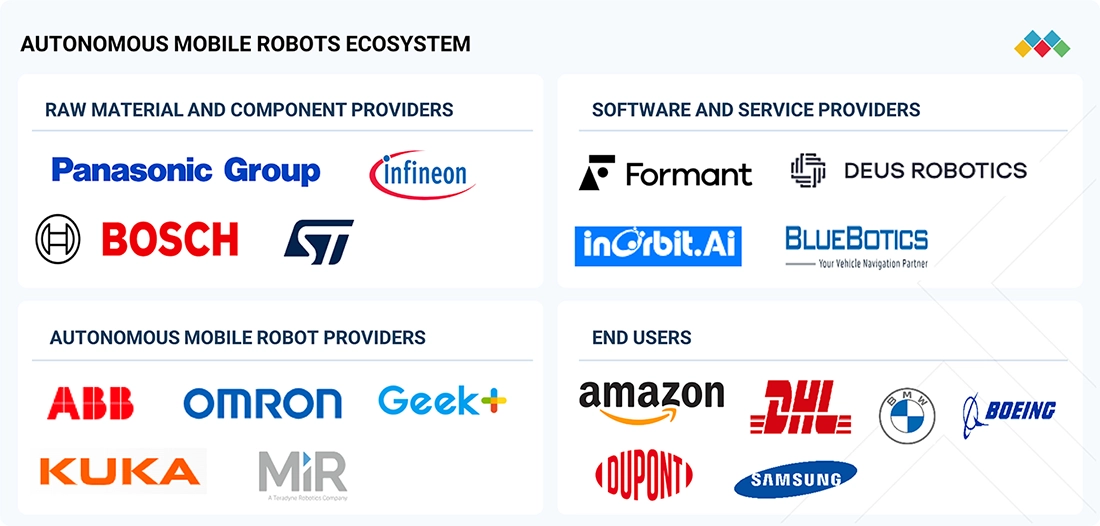
AUTONOMOUS MOBILE ROBOTS (AMR) MARKET: COMMERCIAL USE CASES ACROSS INDUSTRIES
| COMPANY | USE CASE DESCRIPTION | BENEFITS |
|---|---|---|
 |
Deploys autonomous mobile robots for intralogistics automation in manufacturing plants, warehouses, and distribution centers, supporting pallet transport, line feeding, and internal material movement | Improves material flow reliability | Enhances operational safety | Reduces manual handling | Supports scalable automation across high-throughput industrial environments |
 |
Provides AMRs for flexible warehouse automation, distribution centers, and manufacturing logistics, enabling picking, replenishment, and internal transport in dynamic layouts | Increases picking accuracy | Supports layout flexibility |Lowers operating costs | Enables rapid adaptation to changing workflow requirements |
|
|
Implements AMR-based solutions for internal logistics, production supply, and warehouse operations across automotive, food & beverage, and industrial manufacturing facilities | Enhances space utilization | Supports just-in-time material supply |Improves safety | Ensures stable performance in mixed human-robot environments |
|
|
Supplies AMRs for goods-to-person picking, sorting, and inventory movement in e-commerce, retail, manufacturing, and logistics facilities | Increases order fulfillment speed | Improves throughput scalability | Reduces labor dependency | Supports high-volume operations |
|
|
Delivers collaborative AMRs for internal transport of pallets, carts, and components in manufacturing, warehouses, and logistics sites | Enables fast deployment | Operational flexibility | Efficient material movement with minimal infrastructure changes |
Logos and trademarks shown above are the property of their respective owners. Their use here is for informational and illustrative purposes only.
Related Ecosystem
Drones And Robotics
- Sensors
- Articulated Robots
- Cartesian Robots
- Scara Robots
- Actuators
- ABB India Limited
- KUKA AG
- MOMENTIVE PERFORMANCE MATERIALS INC.
- STAUBLI INTERNATIONAL AG
- Fanuc Corporation
Electrical System And Components
- Natural Language Processing (NLP)
- Sensors
- Machine Learning
- Temperature Sensors
- Actuators
- ABB India Limited
- Siemens ag
- SCHNEIDER ELECTRIC SE
- Eaton Corporation plc
- General Electric Company
Key Takeaways
- Asia Pacific AMR market is valued at $935.6 million in 2026 and expected to reach $2,601.6 million by 2031, growing at 18.6% CAGR.
- Asia Pacific's rapid industrialization and e-commerce expansion are primary drivers of AMR adoption across the region.
- Asia Pacific benefits from government Industry 4.0 support and competitive manufacturing ecosystems in China, Japan, and South Korea.
- Asia Pacific's forecast period will see increased AI integration and collaborative robotics deployment in logistics and production facilities.
Autonomous Mobile Robots (AMR) Market Report Scope
| Report Metric | Details |
|---|---|
| Base Year | 2026 |
| Fastest Growing Segment | LOGISTICS/3PL (Industry) |
| Forecast Period | 2026–2031 |
| Largest Segment | HARDWARE (Offering) |
| Segments Covered | Offering, Navigation Technology, Payload Capacity, Industry |
Asia Pacific Autonomous Mobile Robots (AMR) Market Report Segmentation
4 segment dimensions are covered across the global market.
By Offering
- Hardware
- Software & Services
By Navigation Technology
- Laser/Lidar
- Other Navigation Technologies
- Vision Guidance
By Payload Capacity
- 100-500 Kg
- <100 Kg
- >500 Kg
By Industry
- Automotive
- Aviation
- Chemicals
- E-Commerce & Retail
- Food & Beverages
- Healthcare
- Logistics/3Pl
- Metals & Heavy Machinery
- Other Industries
- Pharmaceuticals
- Pulp & Paper
- Semiconductor & Electronics
Target Audience
- AMR Manufacturers & Robotics Companies : Identify high-growth markets within Asia Pacific, understand regional competitive dynamics, and develop localized go-to-market strategies for China, India, and Southeast Asian markets with distinct customer needs.
- Logistics & Warehouse Operators : Evaluate AMR adoption ROI across Asia Pacific regions, benchmark automation maturity against regional peers, and identify best-practice implementations in high-growth markets like China and India.
- Manufacturing & Industrial Companies : Assess automation opportunities within Asia Pacific supply chains, understand regional technology trends, and make informed capital allocation decisions for warehouse and factory automation investments.
- Private Equity & Venture Capital Investors : Identify high-potential AMR companies and automation technology startups in Asia Pacific, understand market growth drivers, and evaluate investment opportunities in the region's rapidly expanding robotics ecosystem.
- Technology Solution Providers & Integrators : Understand Asia Pacific's specific automation requirements, identify partnership opportunities with regional AMR vendors, and develop tailored solutions for manufacturing and logistics customers across the region.
Key Companies in the Asia Pacific Autonomous Mobile Robots (AMR) Market
| Company | HQ | Ownership | Strongest segments |
|---|---|---|---|
| ABB | Switzerland | Public Company | Electrification,Motion,Automation, |
| KUKA SE & CO. KGAA | Germany | Private Company | Industrial robots and controllers,Systems integration and turnkey production cells,Mobile robots, AGVs, and warehouse automation, |
| OMRON CORPORATION | Japan | Public Company | Industrial Automation (sensors, safety, control, motion, robotics, automation systems),Device & Module Solutions (relays, switches, connectors, components),Social Systems & Power (station systems, traffic control, payment, UPS, power storage), |
| GEEKPLUS TECHNOLOGY CO., LTD. | China | Public Company | Shelf-to-person AMR solutions,Tote-to-person and bin-handling solutions,Pallet-to-person and heavy-load AMR, |
| OCEANEERING INTERNATIONAL, INC. | United States | Public Company | Subsea Robotics,Manufactured Products,Offshore Projects Group, |
| ZEBRA TECHNOLOGIES CORP. | United States | Public Company | Printers, supplies, and RFID printers/tags,Rugged mobile computing and accessories,Barcode scanners, imagers, and fixed industrial scanners, |
| JUNGHEINRICH AG | Germany | Public Company | Electric warehouse trucks (pallet trucks, stackers, order pickers, reach trucks, very narrow aisle),Electric counterbalance forklifts,Automation, AGVs, mobile robots, and warehouse systems (including racking and PowerCube), |
| KION GROUP AG | Germany | Public Company | Industrial Trucks (forklifts, warehouse trucks, narrow aisle, heavy trucks),Supply Chain Solutions (Dematic automation, AGVs, AS/RS, conveyors, palletizers),Services, Leasing, and Fleet Management, |
| OCADO GROUP PLC. | United Kingdom | Public Company | UK Online Grocery Retail,Technology Solutions (Ocado Intelligent Automation and platforms),Logistics and Third-Party Fulfillment Services, |
ABB
ABB is a Swiss multinational public company founded in 1883 with 111,900 employees. It is a global leader in robotics, power, and automation technologies serving diverse industrial sectors.
KUKA SE & CO. KGAA
KUKA SE & CO. KGAA is a German private company established in 1898 with 14,985 employees. The company is a leading manufacturer of industrial robots and automation systems.
OMRON CORPORATION
OMRON Corporation is a Japanese public company founded in 1933 with 26,050 employees. It specializes in automation, sensing, and control technologies for industrial and healthcare applications.
GEEKPLUS TECHNOLOGY CO., LTD.
GeekPlus Technology Co., Ltd is a Chinese public company founded in 2015 with 1,054 employees. The company develops intelligent robotic systems for warehouse automation and logistics.
OCEANEERING INTERNATIONAL, INC.
Oceaneering International, Inc is a United States public company founded in 1964 with 11,100 employees. The company provides engineering, robotics, and subsea services to the offshore energy and industrial sectors.
ZEBRA TECHNOLOGIES CORP.
Zebra Technologies Corp is a United States public company founded in 1969 with 10,700 employees. It specializes in data capture, mobile computing, and automation solutions for enterprise environments.
JUNGHEINRICH AG
Jungheinrich AG is a German public company founded in 1953 with 21,438 employees. The company manufactures material handling equipment, warehouse automation systems, and robotic solutions.
KION GROUP AG
KION Group AG is a German public company founded in 2006 with 41,974 employees. It is a global leader in material handling equipment, warehouse automation, and supply chain solutions.
OCADO GROUP PLC.
Ocado Group PLC is a United Kingdom public company founded in 2000 with 21,367 employees. It operates as an online grocery retailer and develops advanced warehouse automation and robotic technologies.
Countries within Asia Pacific - compare and drill down
| Country | 2025 size (native) |
|---|---|
| China | USD 1164.2 Million |
| India | USD 245 Million |
| Japan | USD 565.2 Million |
| South Korea | USD 207.9 Million |
| Rest Of Asia Pacific | USD 419.2 Million |
Country market size visualization
Reasons to Buy this Report
- Regional Market Sizing & Forecasts : Detailed market projections for Asia Pacific from 2026-2031 with country-level breakdowns for China, India, Japan, South Korea, and Rest of Asia Pacific, enabling precise market opportunity assessment and investment planning.
- Competitive Landscape Intelligence : Comprehensive analysis of regional AMR vendors, market share dynamics, and competitive positioning specific to Asia Pacific's unique manufacturing and logistics ecosystems, identifying key players and emerging competitors.
- Growth Driver Analysis : In-depth examination of Asia Pacific-specific growth catalysts including government automation policies, labor cost dynamics, e-commerce expansion, and supply chain modernization driving the 18.6% CAGR.
- Country-Level Market Insights : Granular market data and trend analysis for major Asia Pacific economies, revealing distinct opportunities in China's manufacturing base, India's emerging automation adoption, and Japan's advanced robotics integration.
- Strategic Investment Guidance : Actionable recommendations for market entry, partnership strategies, and investment priorities tailored to Asia Pacific's regional dynamics, regulatory environment, and technology adoption patterns.
Frequently asked questions
What is the current size of the Asia Pacific AMR market?
The Asia Pacific AMR market was valued at $935.6 million in 2026 and is projected to grow to $2,601.6 million by 2031.
What is the expected growth rate for Asia Pacific AMR market?
Asia Pacific's AMR market is expected to grow at a compound annual growth rate (CAGR) of 18.6% from 2026 to 2031.
Which countries are driving AMR adoption in Asia Pacific?
China, Japan, South Korea, and Southeast Asian nations are leading AMR adoption in Asia Pacific due to manufacturing scale and e-commerce growth.
What industries are adopting AMR solutions in Asia Pacific?
Key industries in Asia Pacific adopting AMR include e-commerce fulfillment, automotive production, semiconductor manufacturing, and food & beverage processing.
What factors are accelerating AMR growth in Asia Pacific?
Rising labor costs, supply chain optimization needs, government Industry 4.0 initiatives, and technological advancements in AI and battery efficiency are driving AMR adoption across Asia Pacific.
RESEARCH METHODOLOGY
The study involved four major activities in estimating the current size of the autonomous mobile robots market. Exhaustive secondary research has been done to collect information on the market, peer market, and parent market. To validate these findings, assumptions, and sizing with industry experts across the value chain through primary research has been the next step. Both top-down and bottom-up approaches have been employed to estimate the complete market size. After that, market breakdown and data triangulation methods have been used to estimate the market size of segments and subsegments. Two sources of information—secondary and primary—have been used to identify and collect information for an extensive technical and commercial study of the autonomous mobile robots market.
Secondary Research
Various secondary sources have been referred to in the secondary research process to identify and collect information important for this study. The secondary sources include annual reports, press releases, and investor presentations of companies; white papers; journals and certified publications; and articles from recognized authors, websites, directories, and databases. Secondary research has been conducted to obtain key information about the industry’s supply chain, the market’s value chain, the total pool of key players, market segmentation according to the industry trends (to the bottom-most level), regional markets, and key developments from market- and technology-oriented perspectives. The secondary data has been collected and analyzed to determine the overall market size, further validated by primary research.
Primary Research
Extensive primary research was conducted after gaining knowledge about the current scenario of the autonomous mobile robots market through secondary research. Several primary interviews were conducted with experts from the demand and supply sides across four major regions—North America, Europe, Asia Pacific and RoW. This primary data was collected through questionnaires, emails, and telephonic interviews.
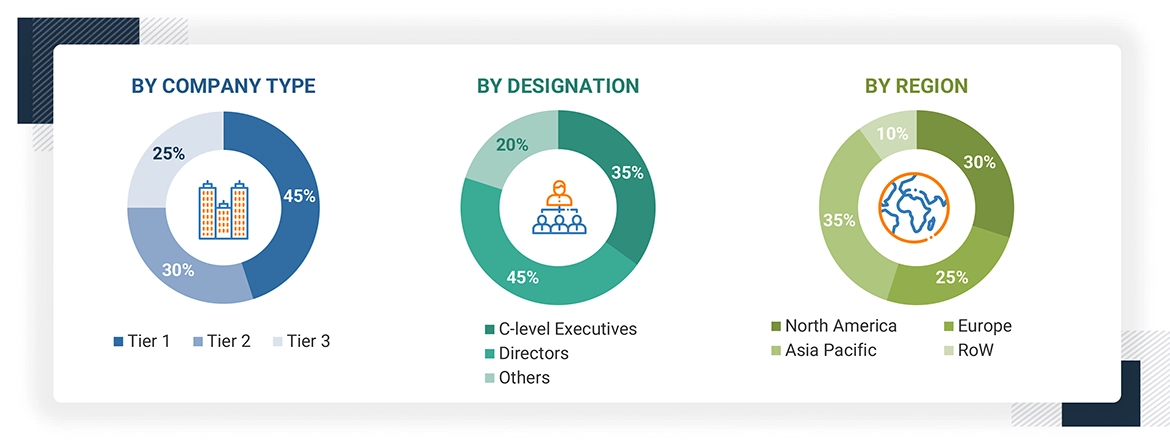
Note: The three tiers of the companies are defined based on their total revenue in 2023: Tier 1 - revenue greater than or equal to USD 1 billion; Tier 2 - revenue between USD 100 million and USD 1 billion; and Tier 3 revenue less than or equal to USD 100 million. Other designations include sales managers, marketing managers, and product managers.
To know about the assumptions considered for the study, download the pdf brochure
Market Size Estimation
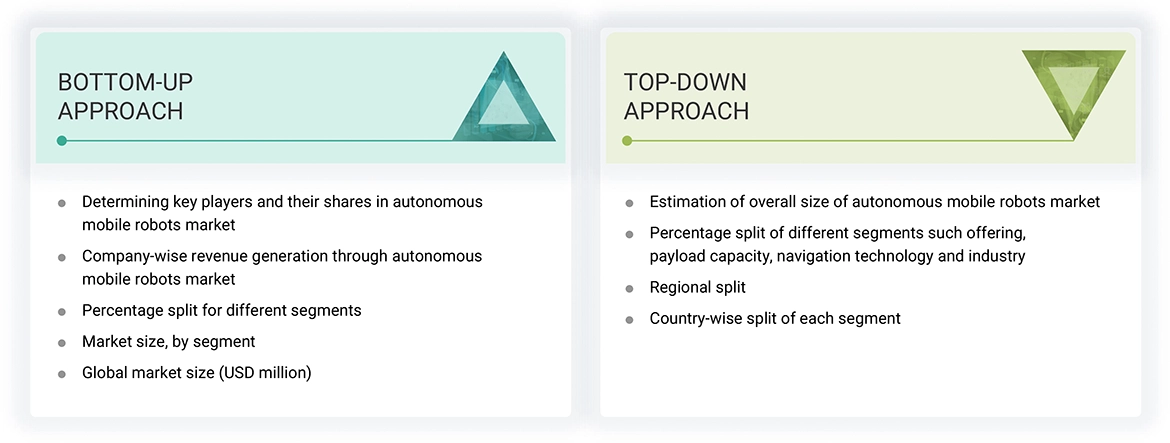
Both top-down and bottom-up approaches have been used to estimate and validate the total size of the autonomous mobile robots market. These methods have also been used extensively to estimate the size of various subsegments in the market. The following research methodology has been used to estimate the market size:
- Major players in the industry and markets have been identified through extensive secondary research.
- The industry’s value chain and market size (in terms of value) have been determined through primary and secondary research processes.
- All percentage shares, splits, and breakdowns have been determined using secondary sources and verified through primary sources.
Autonomous Mobile Robots (AMR) Market : Top-Down and Bottom-Up Approach
Data Triangulation
After arriving at the overall size of the autonomous mobile robots market from the market size estimation process explained above, the total market has been split into several segments and subsegments. Data triangulation and market breakdown procedures have been employed, wherever applicable, to complete the overall market engineering process and arrive at the exact statistics for all segments and subsegments of the market. The data has been triangulated by studying various factors and trends from both the demand and supply sides. Along with this, the market size has been validated using both top-down and bottom-up approaches.
Market Definition
The autonomous mobile robots market designs, manufactures, and deploys intelligent robots that are capable of navigating dynamic environments without human intervention. These are equipped with advanced sensors, artificial intelligence, and navigation systems to perform material handling, inventory management, and quality control. AMRs are available in different configurations and payload capacities, navigation technologies, and battery life. Due to a rising call for automation, labor shortages and increased efficiency requirement, the market of AMRs is looking towards great rise, propelling innovations and disrupting industries all around the globe.
Key Stakeholders
- Autonomous mobile robots manufacturers
- Sensors, actuators, and other hardware component providers
- AMR Software developers
- AMR suppliers and distributors
- E-commerce and retail companies
- Logistic companies
Report Objectives
- To define, describe and forecast the autonomous mobile robots market, in terms of offering, navigation technology, payload capacity, industry and region.
- To describe and forecast the market, in terms of value, with regard to four main regions: North America, Europe, Asia Pacific, and Rest of the World (RoW) along with their respective countries
- To provide detailed information regarding major factors influencing the market growth (drivers, restraints, opportunities, and challenges)
- To provide a detailed overview of the value chain of autonomous mobile robots market.
- To strategically analyze micromarkets with respect to individual growth trends, prospects, and contributions to the autonomous mobile robots market
- To analyze opportunities in the market for stakeholders by identifying high-growth segments of the autonomous mobile robots market.
- To strategically profile key players and comprehensively analyze their market position in terms of ranking and core competencies, along with detailing the competitive landscape for market leaders
- To analyze competitive strategies, such as product launches, expansions, mergers and acquisitions, adopted by key market players in the autonomous mobile robots market.
Available Customizations
With the given market data, MarketsandMarkets offers customizations according to the company’s specific needs. The following customization options are available for the report:
Company Information:
- Detailed analysis and profiling of additional market players (up to 5)
Get the Full Autonomous Mobile Robots (AMR) Market Report
Full forecast, segment splits, and company analysis for all Autonomous Mobile Robots (AMR) Market.
- Canada Autonomous Mobile Robots (AMR) Market
- Mexico Autonomous Mobile Robots (AMR) Market
- US Autonomous Mobile Robots (AMR) Market
- France Autonomous Mobile Robots (AMR) Market
- Germany Autonomous Mobile Robots (AMR) Market
- Italy Autonomous Mobile Robots (AMR) Market
- Spain Autonomous Mobile Robots (AMR) Market
- UK Autonomous Mobile Robots (AMR) Market
- Rest Of Europe Autonomous Mobile Robots (AMR) Market
- China Autonomous Mobile Robots (AMR) Market
- India Autonomous Mobile Robots (AMR) Market
- Japan Autonomous Mobile Robots (AMR) Market
- South Korea Autonomous Mobile Robots (AMR) Market
- Rest Of Asia Pacific Autonomous Mobile Robots (AMR) Market
Need a Tailored Report?
Customize this report to your needs
Get 10% FREE Customization
Customize This Report
