
Argentina Bacteriological Testing Market (2025-2030)

The Argentina Bacteriological Testing Market was valued at $420.3 Million in 2025 and projected to reach to $595.1 Million by 2030, representing a compound annual growth rate of 7.2%. Argentina's bacteriological testing market is positioned for steady expansion driven by strengthened food safety regulations and growing export-oriented production.


| Market Size in | USD 26.32 MN |
| Market Forecast in | |
| CAGR | |
| Forecast Period | |
| Units Considered | Value (USD MN) |
Argentina Bacteriological Testing Market Trends and Insights
- This growth trajectory underscores Argentina's increasing investment in food safety protocols and regulatory compliance within the food and beverage sector.
- Argentina's market expansion is driven by heightened consumer awareness of foodborne pathogens and stricter government food safety standards that mandate rigorous microbial testing across production and distribution chains. The bacteriological testing market in Argentina is benefiting from modernization of laboratory infrastructure and adoption of advanced diagnostic technologies.
- Argentina's food export industry, particularly in beef, dairy, and processed foods, relies heavily on bacteriological testing to maintain international market access and competitive advantage.
- Between 2025 and 2030, Argentina is expected to see sustained demand for testing services as both domestic producers and exporters prioritize quality assurance and contamination prevention..
Key Market Statistics
- CAGR (2025-2030) 7.2% CAGR
- Market Size, 2025 ~USD 420.3 Million
- Forecast, 2030 ~USD 595.1 Million
- Country Argentina
Argentina Bacteriological Testing Market Overview
Market Valuation Growth :
Argentina's bacteriological testing market is valued at USD 420.3 million in 2025 and is projected to reach USD 595.1 million by 2030, representing a robust 7.2% CAGR over the forecast period.
Regulatory Compliance Drivers :
Stringent food safety regulations and export requirements are compelling Argentine food and beverage manufacturers to invest heavily in bacteriological testing infrastructure and quality assurance protocols.
Export Market Pressure :
Argentina's significant agricultural and meat export industry demands advanced bacteriological testing capabilities to meet international food safety standards and maintain competitive advantage in global markets.
Domestic Food Safety Focus :
Increased consumer awareness and government initiatives around food safety are driving demand for comprehensive bacteriological testing services across dairy, meat, produce, and processed food sectors in Argentina.
Argentina Bacteriological Testing Market Dynamics
- The country's significant role in global agricultural trade necessitates advanced testing capabilities to maintain market access and consumer confidence.
- Investment in laboratory infrastructure and testing technologies is accelerating across both public and private sectors. The forecast period through 2030 will see increased adoption of rapid testing methodologies and automation in Argentine testing facilities.
- Rising middle-class consumption, coupled with stricter MERCOSUR and international compliance requirements, will sustain market growth.
- Strategic partnerships between local testing providers and international certification bodies are expected to enhance service quality and market penetration..
Market Ecosystem
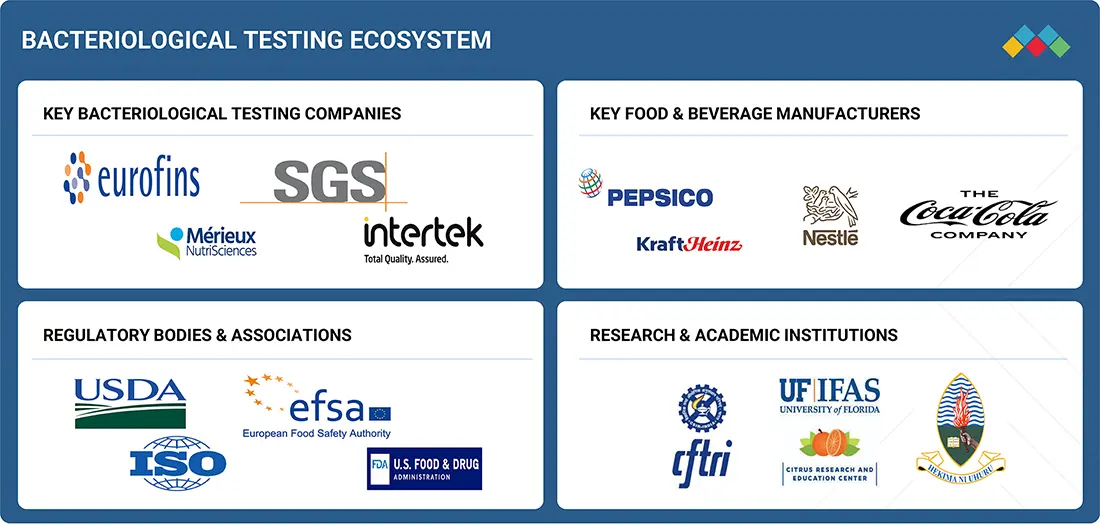
bacteriological testing market: COMMERCIAL USE CASES ACROSS INDUSTRIES
| COMPANY | USE CASE DESCRIPTION | BENEFITS |
|---|---|---|
 |
Automated bacteriological analyzers and PCR-based systems for food, pharma, and clinical labs | High throughput, accurate detection; supports regulatory compliance across multiple industries |
 |
Rapid microbiology test kits and petrifilm plates for food safety testing | Easy-to-use, cost-effective; enables faster quality checks for manufacturers |
 |
Reagents, consumables, and filtration systems for water and pharmaceutical bacteriological testing | Strong reliability; ensures sterility in pharma; trusted partner for water utilities |
|
|
Molecular bacteriological testing platforms (qPCR, sequencing tools) | High precision; supports advanced R&D and clinical diagnostics |
 |
Chromatography and molecular testing solutions for bacteriological applications | Broad application range; innovation-driven testing; supports pharma and biotech labs |
Logos and trademarks shown above are the property of their respective owners. Their use here is for informational and illustrative purposes only.
Related Ecosystem
Food Safety And Tic
- Dairy Products
- Polymerase Chain Reaction (PCR)
- Campylobacter
- Enzyme-Linked Immunosorbent Assay (ELISA)
- Safety Testing
- Sgs s.a.
- Intertek Group plc
- EUROFINS SCIENTIFIC SE
- Als limited
- PROMEGA CORPORATION
Key Takeaways
- Argentina's bacteriological testing market is valued at USD 420.3 million in 2025 and will reach USD 595.1 million by 2030.
- Argentina is experiencing a 7.2% CAGR, driven by stricter food safety regulations and export market requirements.
- Argentina's food export sector, particularly beef and dairy, is a primary driver of bacteriological testing demand.
- Argentina's market growth is supported by laboratory modernization and adoption of advanced diagnostic technologies.
Bacteriological Testing Market Report Scope
| Report Metric | Details |
|---|---|
| Base Year | 2025 |
| Fastest Growing Segment | PCR-BASED TESTING (Rapid Technology) |
| Forecast Period | 2025-2030 |
| Growth Rate | CAGR of 7.6% from 2025 to 2030 |
| Largest Segment | RAPID (Technology) |
| Market Size Base Year (Billions) | ~USD 25.83 (2025) |
| Revenue Forecast (Billions) | ~USD 37.26 (2030) |
| Segments Covered | Bacterium, Type, Technology, Component, End-Use Industry, Mode Of Use, Rapid Technology |
Argentina Bacteriological Testing Market Report Segmentation
7 segment dimensions are covered across the global market.
By Bacterium
- Campylobacter
- Coliform
- Legionella
- Listeria
- Other Bacteria
- Other Bacteria Type
- Salmonella
By Type
- Beverages
- Campylobacter Jejuni
- Cereals & Grains
- Chromatography & Spectrometry
- Convenience-Based Testing
- Dairy
- Drinking Water
- Fish & Seafood
- Fruits & Vegetables
- Generic Coliforms/E. Coli
- Immunoassay-Based Testing
- Industrial Wastewater
- Meat & Poultry
- Other Campylobacter Spp
- Other Food Products
- Other Types
- Pathogenic E. Coli (O157:H7, Stec)
- Pcr-Based Testing
- Processed Food
By Technology
- Rapid
- Traditional
By Component
- Instruments
- Reagents & Consumables
- Test Kits
By End-Use Industry
- Cosmetics & Personal Care
- Food & Beverage
- Other End-Use Industries
- Pharmaceutical
- Pharmaceuticals
- Water
By Mode Of Use
- Laboratory-Based Systems
- Portable/Field-Use Device
- Portable/Field-Use Devices
By Rapid Technology
- Chromatography & Spectrometry
- Convenience-Based Testing
- Immunoassay-Based Testing
- Other Rapid Technologies
- Pcr-Based Testing
Target Audience
- Food & Beverage Manufacturers : Argentine producers need market intelligence to benchmark testing investments, understand compliance requirements, and identify technology upgrades necessary to maintain export competitiveness and domestic market share.
- Testing Laboratory Operators : Local and regional testing service providers require market sizing data to justify capacity expansion, technology investments, and service diversification strategies within Argentina's growing bacteriological testing sector.
- Equipment & Technology Suppliers : Manufacturers of testing equipment and diagnostic solutions need Argentina-specific demand forecasts to prioritize market entry, allocate sales resources, and develop localized product offerings.
- Regulatory & Government Bodies : Argentine food safety agencies and MERCOSUR officials utilize market data to assess testing infrastructure adequacy, identify gaps in laboratory capacity, and inform policy development for food safety standards.
- Investment & Consulting Firms : Private equity, venture capital, and management consultants need Argentina market analysis to evaluate acquisition targets, assess sector growth potential, and guide client expansion strategies in food safety testing.
Reasons to Buy this Report
- Market Size & Growth Validation : Obtain precise market valuation data for Argentina (USD 420.3M in 2025) with verified 7.2% CAGR projections through 2030, enabling accurate business planning and investment decisions specific to this market.
- Competitive Landscape Intelligence : Understand Argentina's unique competitive dynamics, local testing provider capabilities, and market consolidation trends to identify partnership opportunities and competitive positioning strategies.
- Regulatory & Compliance Insights : Access detailed analysis of Argentina-specific food safety regulations, MERCOSUR requirements, and export standards driving bacteriological testing demand across the food and beverage sector.
- Sector-Specific Opportunity Analysis : Identify high-growth segments within Argentina's market including dairy, beef, produce, and processed foods, with tailored growth drivers and investment priorities for each subsector.
- Strategic Market Entry Planning : Leverage Argentina-focused market data to develop go-to-market strategies, assess distribution channels, and evaluate partnership models for testing service providers and equipment manufacturers.
Frequently asked questions
What is the current size of Argentina's bacteriological testing market?
Argentina's bacteriological testing market is valued at USD 420.3 million in 2025.
What is the projected market size for Argentina by 2030?
Argentina's bacteriological testing market is projected to reach USD 595.1 million by 2030.
What is the CAGR for Argentina's bacteriological testing market?
Argentina's bacteriological testing market is growing at a compound annual growth rate of 7.2% from 2025 to 2030.
What are the main drivers of growth in Argentina's bacteriological testing market?
Argentina's market growth is driven by stricter food safety regulations, export market requirements, consumer awareness of foodborne pathogens, and modernization of laboratory infrastructure.
Which sectors in Argentina are driving bacteriological testing demand?
Argentina's food export industry, particularly beef, dairy, and processed foods, is the primary driver of bacteriological testing demand.
RESEARCH METHODOLOGY
The study involved two major approaches in estimating the current size of the bacteriological food safety testing market. Exhaustive secondary research collected information on the market, peer, and parent markets. The next step was to validate these findings, assumptions, and sizing with industry experts across the value chain through primary research. The top-down and bottom-up approaches were employed to estimate the complete market size. After that, market breakdown and data triangulation were used to estimate the market size of segments and subsegments.
Secondary Research
This research study involved extensive secondary sources—directories and databases such as Bloomberg Businessweek and Factiva—to identify and collect information useful for a technical, market-oriented, and commercial market study. In the secondary research process, various sources, such as company annual reports, press releases, investor presentations, white papers, food journals, certified publications, articles from recognized authors, directories, and databases, were used to identify and collect information. Additionally, secondary research was used to obtain key information about the industry’s supply chain, the total pool of key players, and market classification and segmentation per the industry trends to the bottom-most level, regional markets, and key developments from market- and technology-oriented perspectives.
Primary Research
Extensive primary research was conducted after obtaining information regarding the bacteriological food safety testing market scenario through secondary research. Several primary interviews were conducted with market experts from the demand and supply sides across major countries of North America, Europe, Asia Pacific, South America, and the Rest of the World. Primary data was collected through questionnaires, emails, and telephone interviews. Additionally, primary interviews were conducted to gather insights, such as market statistics, data on revenue collected from the products and services, market breakdowns, market size estimations, market forecasting, and data triangulation. Primary sources from the supply side included Chief Experience Officers (CXOs); Vice Presidents (VPs); directors from business development, marketing, research, and development teams; and key opinion leaders.
Primary research helped understand the various trends related to bacteriological food safety testing market segments by bacterium, end-use industry, technology, component, and region. Demand-side stakeholders, such as research institutions, universities, and third-party vendors, were interviewed to understand the buyer’s perspective on the service, their current usage of bacteriological testing services, and their business outlook, which will affect the overall market.
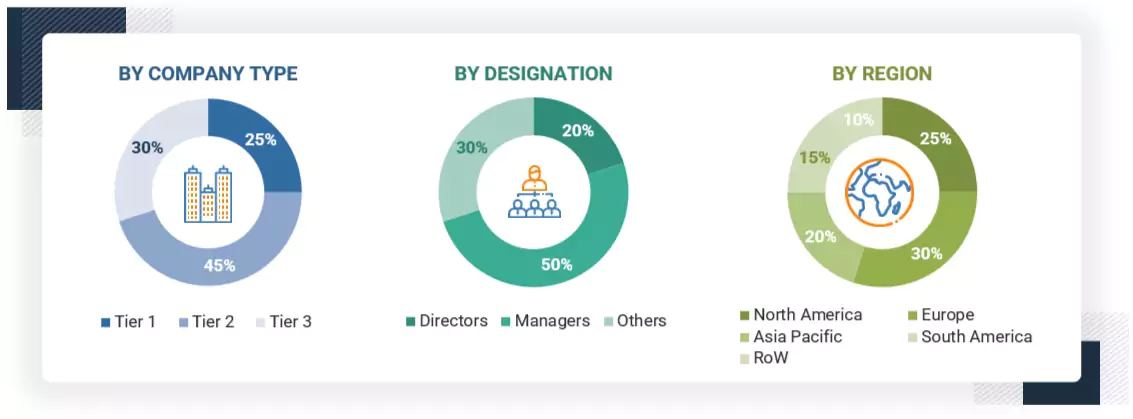
Notes: Others include Executives and Associates.
The three tiers of companies are defined based on their total revenue in 2023 or 2024, as per the availability of financial data. Here’s the bifurcation of tiers:
Tier 1: Revenue > USD 1 billion; tier 2: USD 100 million = Revenue = USD 1 billion; tier 3: Revenue < USD 100 million
To know about the assumptions considered for the study, download the pdf brochure
Market Size Estimation
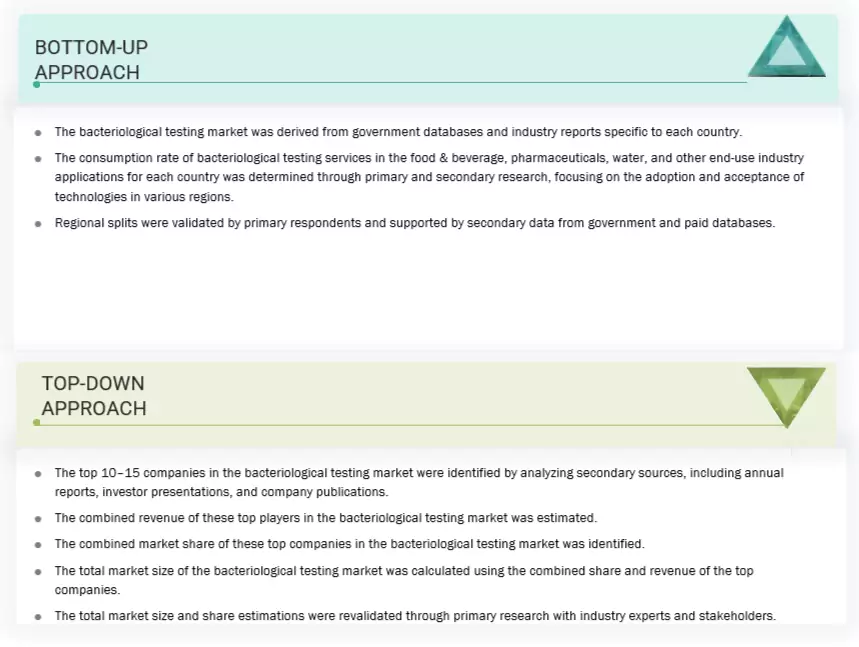
The top-down and bottom-up approaches were used to estimate and validate the total size of the bacteriological testing market. These approaches were used extensively to determine the size of various subsegments in the market.
The research methodology used to estimate the market size included the following details:
- The key players in the industry and the overall markets were identified through extensive secondary research.
- All shares, splits, and breakdowns were determined using secondary sources and verified through primary sources.
- All possible parameters that affect the market covered in this research study were accounted for, viewed in extensive detail, verified through primary research, and analyzed to obtain final quantitative and qualitative data.
- The research included the study of reports, reviews, and newsletters of top market players, along with extensive interviews for opinions from leaders, such as CEOs, directors, and marketing executives.
Bacteriological Testing Market : Top-Down and Bottom-Up Approach
Data Triangulation
After arriving at the overall market size from the estimation process explained above, the total market was split into several segments and subsegments. The data triangulation and market breakdown procedures were employed, wherever applicable, to estimate the overall bacteriological testing market and arrive at the exact statistics for all segments and subsegments. The data was triangulated by studying various factors and trends from the demand and supply sides. The market size was also validated using the top-down and bottom-up approaches.
Market Definition
The bacteriological testing market is focused on detecting, identifying, and quantifying harmful and indicator bacteria across the food & beverage, water, pharmaceutical, cosmetics & personal care industries. It encompasses a range of technologies—including traditional culture-based methods and rapid techniques like PCR, immunoassays, and next-generation sequencing—along with associated consumables, instruments, and test kits. The market is driven by the need to ensure safety, quality, and regulatory compliance in products and processes, while minimizing risks associated with bacterial contamination and outbreaks.
Stakeholders
- Manufacturers of food products and beverages
- Importers and exporters of food & beverages, pharmaceuticals, and cosmetics & personal care products
- Testing laboratories
- Government and research organizations
- Associations and industrial bodies
- Concerned government authorities, commercial R&D institutions, and other regulatory bodies
-
Regulatory bodies:
- US Food and Drug Administration (FDA)
- Health Canada/Canadian Food Inspection Agency (CFIA)
- United States Department of Agriculture (USDA)
- Food Safety and Standards Authority of India (FSSAI)
- European Food Safety Authority (EFSA)
- Food and Agriculture Organization (FAO)
- Food Standards Australia New Zealand (FSANZ)
- World Health Organization (WHO)
Report Objectives
- To determine and project the size of the bacteriological testing market by bacterium (Coliform, Salmonella, Campylobacter, Listeria, Legionella, Other bacteria), end-use industry (Food & Beverage, Water, Pharmaceutical, Cosmetics & Personal Care, Other End-Use Industries), technology (Traditional, Rapid), component (Instruments, Test Kits, Consumables & Reagents), and Region
- To identify the attractive opportunities in the market by determining the largest and fastest-growing segments across regions
- To provide detailed information about the key factors (drivers, restraints, opportunities, and challenges) influencing market growth
- To analyze the opportunities in the market for stakeholders and provide details of the competitive landscape for market leaders
- To analyze the micro-markets with respect to individual growth trends, prospects, and their contribution to the total market
- To identify and profile the key players in the bacteriological testing market
- To understand the competitive landscape and identify the major growth strategies adopted by players across key regions
Available Customizations
With the given market data, MarketsandMarkets offers customizations according to company-specific scientific needs.
The following customization options are available for the report:
Product Analysis
- Service Matrix, which gives a detailed comparison of the service portfolio of each company.
Geographic Analysis as per Feasibility
- Further breakdown of the Rest of European bacteriological testing market into key countries
- Further breakdown of the Rest of Asia Pacific bacteriological testing market into key countries
- Further breakdown of the Rest of South American bacteriological testing market into key countries
Company Information
- Detailed analyses and profiling of additional market players (up to five)
Get the Full Bacteriological Testing Market Report
Full forecast, segment splits, and company analysis for all Bacteriological Testing Market.
- US Bacteriological Testing Market
- Canada Bacteriological Testing Market
- Mexico Bacteriological Testing Market
- Germany Bacteriological Testing Market
- UK Bacteriological Testing Market
- France Bacteriological Testing Market
- Italy Bacteriological Testing Market
- Spain Bacteriological Testing Market
- Poland Bacteriological Testing Market
- China Bacteriological Testing Market
- Japan Bacteriological Testing Market
- India Bacteriological Testing Market
- Brazil Bacteriological Testing Market
- Rest Of Europe Bacteriological Testing Market
- Rest Of Asia Pacific Bacteriological Testing Market
- Southeast Asia Bacteriological Testing Market
- Rest Of South America Bacteriological Testing Market
Need a Tailored Report?
Customize this report to your needs
Get 10% FREE Customization
Customize This Report
