
Germany Battery-free Sensors Market (2026-2031)

The Germany Battery-free Sensors Market was valued at $7.04 Million in 2026 and projected to reach to $24.88 Million by 2031, representing a compound annual growth rate of 12.2%. Germany's battery-free sensors market is positioned for substantial growth, driven by the country's commitment to Industry 4.0, IoT expansion, and energy-efficient technologies.


| Market Size in | USD 26.32 MN |
| Market Forecast in | |
| CAGR | |
| Forecast Period | |
| Units Considered | Value (USD MN) |
Germany Battery-free Sensors Market Trends and Insights
- Valued at $7.04 million in 2026, Germany is experiencing accelerating adoption of energy-harvesting sensor technologies across industrial automation, IoT, and smart building applications.
- The market in Germany is projected to expand to $24.88 million by 2031, representing a compound annual growth rate of 12.2%, driven by stringent EU energy efficiency regulations and Germany's leadership in Industry 4.0 initiatives. The expansion of Germany's battery-free sensors market reflects the country's commitment to sustainable manufacturing and digital transformation.
- Germany's robust engineering base and investment in IoT infrastructure are catalyzing demand for maintenance-free, long-lifecycle sensor solutions.
- Between 2026 and 2031, Germany is expected to capture significant market share as enterprises prioritize wireless sensor networks that eliminate battery replacement costs and environmental waste, aligning with the EU's circular economy objectives..
Key Market Statistics
- CAGR (2026-2031) 12.2% CAGR
- Market Size, 2026 ~USD 7.04 Million
- Forecast, 2031 ~USD 24.88 Million
- Country Germany
Germany Battery-free Sensors Market Overview
Market Valuation Growth :
Germany's battery-free sensors market is valued at $7.04 million in 2026 and is projected to reach $24.88 million by 2031, representing a robust 12.2% CAGR over the forecast period.
Industrial Automation Leadership :
German manufacturing and industrial automation sectors are driving significant adoption of energy-harvesting sensor technologies, leveraging Industry 4.0 initiatives and smart factory implementations across the country.
IoT and Smart Building Integration :
Germany's strong focus on IoT infrastructure and sustainable smart building solutions is accelerating battery-free sensor deployment in commercial and residential applications, supported by government digitalization policies.
European Market Position :
As Europe's largest economy and technology hub, Germany represents a critical market for battery-free sensor innovation, with significant influence on regional adoption trends and technology standardization.
Germany Battery-free Sensors Market Dynamics
- The 12.2% CAGR reflects increasing demand from industrial automation, smart building systems, and connected device ecosystems across manufacturing hubs and urban centers.
- German enterprises are increasingly investing in energy-harvesting solutions to reduce operational costs and environmental impact. The forecast expansion to $24.88 million by 2031 underscores Germany's role as a technology innovator within Europe.
- Government support for digitalization, coupled with stringent energy efficiency regulations, creates favorable conditions for battery-free sensor adoption.
- Key growth will be driven by automotive, manufacturing, and smart infrastructure sectors, positioning Germany as a strategic market for sensor technology providers and IoT solution developers..
Market Ecosystem
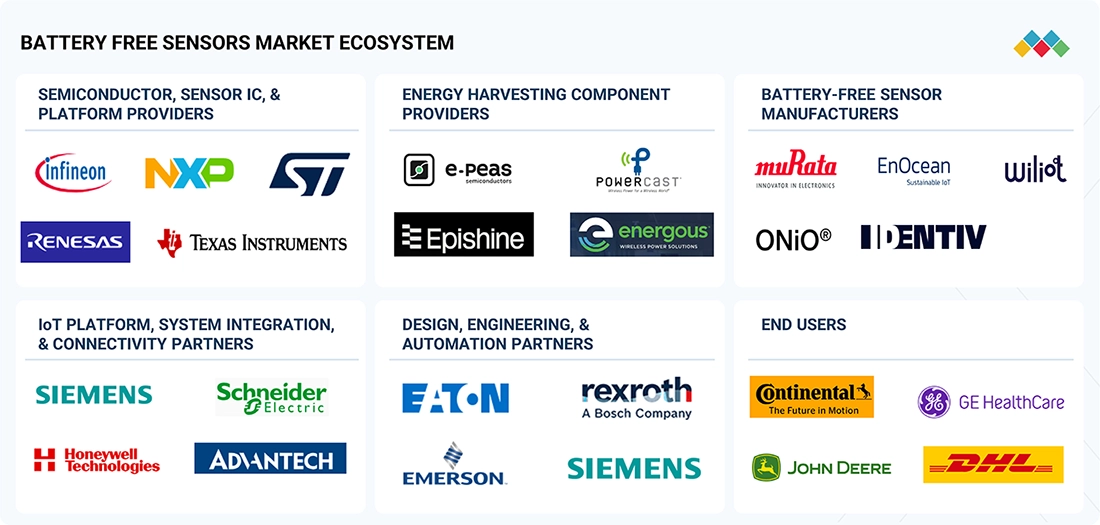
BATTERY-FREE SENSORS MARKET: COMMERCIAL USE CASES ACROSS INDUSTRIES
| COMPANY | USE CASE DESCRIPTION | BENEFITS |
|---|---|---|
 |
Deployment of battery-free IoT Pixels on Royal Mail's rolling cages to enable continuous, real-time asset tracking across postal facilities. The battery-free sensors harvest ambient RF energy and communicate through Bluetooth gateways, eliminating manual barcode/RFID scanning while integrating with Royal Mail's digital logistics platform. | Improved real-time asset visibility | Recovery of over 180,000 previously unaccounted rolling cages | Reduced asset losses and replacement costs | Enhanced logistics efficiency and asset utilization | Increased end-to-end supply chain transparency |
 |
Deployed battery-free wireless sensors at Sumitomo Heavy Industries for real-time environmental monitoring. The sensors harvest ambient energy, eliminating batteries and enabling maintenance-free industrial IoT monitoring. | Maintenance-free monitoring | No battery replacement | Lower operating costs | Easy sensor deployment | Improved predictive maintenance | Reliable real-time monitoring |
 |
Deployed wireless battery-free sensors in an electronics manufacturing facility to monitor equipment power consumption and operating conditions in real time, enabling energy-efficient factory operations. | Real-time energy monitoring | Lower electricity costs | Improved equipment utilization | Reduced carbon emissions | Enhanced predictive maintenance | Increased production efficiency |
 |
Deployed battery-free WAND wireless ultrasonic sensors at Petroineos Refining for continuous pipeline wall thickness monitoring and corrosion detection without wired power or batteries. | Continuous corrosion monitoring | Early defect detection | Reduced inspection costs | Improved asset integrity | Enhanced predictive maintenance | Increased refinery safety |
Logos and trademarks shown above are the property of their respective owners. Their use here is for informational and illustrative purposes only.
Related Ecosystem
Battery And Wireless Charging
- Nickel-Cadmium Battery
- Battery Electric Vehicle (BEV)
- Energy Harvesting
- Hybrid Electric Vehicle (HEV)
- Smart Cards
- Panasonic Holdings Corporation
- MOMENTIVE PERFORMANCE MATERIALS INC.
- Lg corp
- FDK Corporation
- EnerSys
Sensors And Control
- Sensors
- Temperature Sensors
- Image Sensors
- Pressure Sensors
- Flow Sensors
- BAUMER ELECTRIC AG
- HONEYWELL INTERNATIONAL INC.
- Stmicroelectronics
- Lenovo
- Texas Instruments Incorporated
Key Takeaways
- Germany's battery-free sensors market will grow from $7.04M (2026) to $24.88M (2031) at a 12.2% CAGR.
- Germany's Industry 4.0 leadership and EU sustainability mandates are primary growth catalysts for battery-free sensor adoption.
- Germany's manufacturing sector is increasingly deploying energy-harvesting sensors to reduce operational costs and environmental impact.
- Germany's market expansion is supported by strong R&D capabilities and a mature IoT ecosystem across industrial and commercial segments.
Battery-free Sensors Market Report Scope
| Report Metric | Details |
|---|---|
| Base Year | 2026 |
| Fastest Growing Segment | BIOSENSORS (Sensor Type) |
| Forecast Period | 2026-2031 |
| Growth Rate | CAGR of 21.8% from 2026 to 2031 |
| Largest Segment | HIGH (Energy Harvesting Capacity) |
| Market Size Base Year (Billions) | ~USD 0.08 (2026) |
| Revenue Forecast (Billions) | ~USD 0.22 (2031) |
| Segments Covered | Energy Harvesting Capacity, Industry, Energy Source, Sensor Type, Application |
Germany Battery-free Sensors Market Report Segmentation
5 segment dimensions are covered across the global market.
By Energy Harvesting Capacity
- High
- Low
- Medium
By Industry
- Aerospace & Defense
- Energy
- Food & Beverages
- Healthcare
- Logistics & Transportation
- Manufacturing
- Oil & Gas
- Other Industries
- Smart Building
By Energy Source
- Light Energy
- Radio Frequency (Rf) Energy
- Thermal Energy
- Vibration Energy
By Sensor Type
- Biosensor
- Biosensors
- Gas Sensor
- Gas Sensors
- Humidity/Moisture Sensor
- Humidity/Moisture Sensors
- Light Sensor
- Light Sensors
- Motion & Position Sensors
- Other Sensors
- Pressure Sensor
- Pressure Sensors
- Temperature Sensor
- Temperature Sensors
By Application
- Agriculture Monitoring
- Building Automation
- Condition Monitoring
- Environmental Monitoring
- Food Quality Monitoring
- Healthcare Monitoring
- Other Applications
- Supply Chain Management
Target Audience
- Industrial Equipment Manufacturers : German industrial manufacturers need market data to integrate battery-free sensors into automation systems, optimize production efficiency, and meet Industry 4.0 standards while reducing maintenance costs.
- IoT Solution Providers : Technology companies developing IoT platforms require Germany-specific market insights to tailor solutions for smart buildings, connected devices, and enterprise IoT deployments in this key European market.
- Semiconductor and Sensor Companies : Component manufacturers and sensor technology providers need localized market forecasts to guide R&D investments, production capacity planning, and go-to-market strategies in Germany.
- Smart Building and Facility Managers : Building automation and facility management companies require market intelligence to evaluate battery-free sensor adoption for energy monitoring, occupancy detection, and sustainable building operations.
- Investment and Strategy Consultants : Business strategists and investment firms need Germany-specific market data to assess growth opportunities, competitive landscapes, and strategic partnerships in the battery-free sensors sector.
Reasons to Buy this Report
- Localized Market Intelligence : Gain Germany-specific insights into battery-free sensor adoption patterns, competitive dynamics, and regional growth drivers that differ from broader European or global market trends.
- Strategic Investment Planning : Leverage accurate market sizing and 5-year forecasts to inform investment decisions, product development roadmaps, and market entry strategies tailored to Germany's industrial and IoT landscape.
- Competitive Positioning : Understand Germany's unique market structure, key players, and technology adoption rates to identify competitive advantages and differentiation opportunities in this high-growth segment.
- Sector-Specific Opportunities : Identify high-potential applications across German manufacturing, automotive, smart buildings, and industrial automation sectors where battery-free sensors are gaining traction.
- Regulatory and Policy Alignment : Stay informed on Germany's digitalization policies, energy efficiency regulations, and Industry 4.0 initiatives that directly influence battery-free sensor market growth and adoption timelines.
Frequently asked questions
What is the current market size of battery-free sensors in Germany?
Germany's battery-free sensors market was valued at $7.04 million in 2026 and is expected to reach $24.88 million by 2031.
What is the projected growth rate for Germany's battery-free sensors market?
Germany's battery-free sensors market is projected to grow at a compound annual growth rate (CAGR) of 12.2% from 2026 to 2031.
Which industries are driving battery-free sensor adoption in Germany?
Germany's primary adoption drivers include industrial automation, IoT infrastructure, smart building systems, and manufacturing facilities aligned with Industry 4.0 standards.
Why is Germany a key market for battery-free sensors?
Germany's strong engineering base, commitment to sustainability, EU regulatory compliance, and leadership in Industry 4.0 make it a strategic hub for battery-free sensor innovation and deployment.
What regulatory factors support battery-free sensor growth in Germany?
Germany's adherence to EU energy efficiency directives and circular economy policies incentivizes adoption of maintenance-free, sustainable sensor technologies that reduce battery waste.
RESEARCH METHODOLOGY
The research study involved four major activities in estimating the size of the battery-free sensors market. Exhaustive secondary research was conducted to collect relevant information on the market, associated technologies, and adjacent markets. The findings, assumptions, and market estimates were validated through extensive primary research with industry experts across the battery-free sensor ecosystem, including sensor manufacturers, energy harvesting technology providers, semiconductor companies, RFID/NFC solution providers, wireless connectivity providers, system integrators, component suppliers, distributors, and end users. Both top-down and bottom-up approaches were employed to estimate the overall market size and validate the market estimates. Subsequently, market breakdown and data triangulation techniques were applied to estimate the market size of various segments and sub-segments, ensuring accurate and reliable market forecasts.
Secondary Research
In the secondary research process, various secondary sources were referred to for identifying and collecting the information required for this study. These sources included annual reports, investor presentations, press releases, company websites, technical white papers, patents, regulatory publications, industry journals, conference proceedings, and articles published by recognized organizations and technology experts. Secondary research was primarily conducted to obtain key information regarding the battery-free sensors value chain, energy harvesting technologies, sensor manufacturers, semiconductor and RFID/NFC solution providers, wireless communication technology providers, application trends, end-use adoption, regional developments, and the competitive landscape from both market and technology perspectives.
In the battery-free sensors market report, the global market size was estimated using both top-down and bottom-up approaches, along with several dependent submarkets. The major market participants were identified through extensive secondary research, while their product portfolios, business presence, technological capabilities, and strategic developments were validated through primary interviews with industry experts. All percentage shares, market splits, segment breakdowns, and growth estimates were initially derived from secondary sources and subsequently verified through primary research to ensure the accuracy and reliability of the market analysis.
Primary Research
Extensive primary research was conducted after gaining a comprehensive understanding of the battery-free sensors market through secondary research. Several primary interviews were carried out with key opinion leaders from both the demand and supply sides across the four major regions Asia Pacific, North America, Europe, and the Rest of the World (RoW). Approximately 25% of the primary interviews were conducted with demand-side stakeholders, including industrial end users, system integrators, OEMs, and solution providers, while 75% were conducted with supply-side participants, such as battery-free sensor manufacturers, energy harvesting technology providers, semiconductor companies, RFID/NFC solution providers, wireless communication technology providers, and component suppliers. Primary data was collected primarily through telephonic interviews, accounting for nearly 80% of the total interviews, while the remaining input was obtained through questionnaires, e-mail interactions, and virtual meetings.
Following interactions with industry experts, detailed discussions were held with experienced independent consultants and technology specialists to validate the research findings and strengthen the market estimates. These insights, combined with the expertise of in-house analysts and subject-matter experts, helped refine the market assumptions, verify segment-level data, and ensure the accuracy of the competitive landscape, technology trends, and future growth projections presented in the report. The breakdown of primary respondents is as follows:
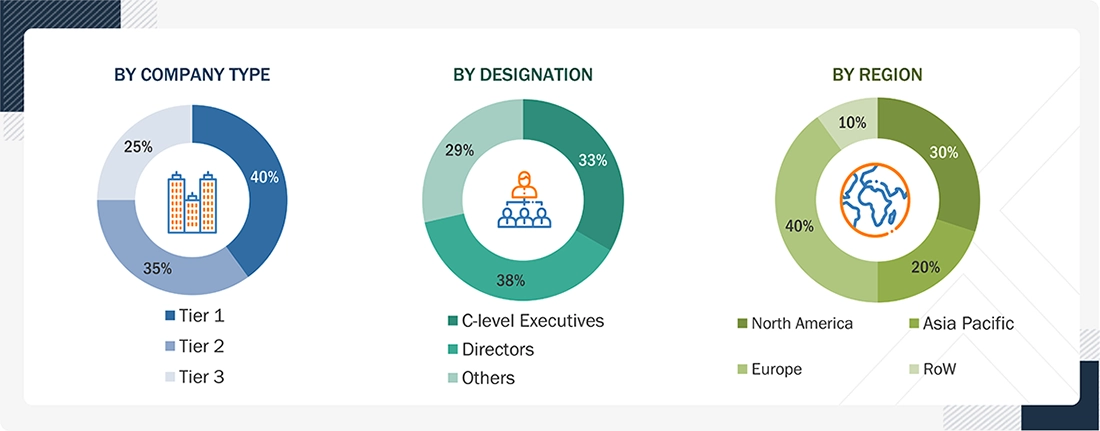
Note: Other designations include product, sales, and marketing managers.
Three tiers of companies have been defined based on their total revenue as of 2025: tier 3: revenue less than USD 50 million; tier 2: revenue between USD 50 million and USD 150 million; and tier 1: revenue more than USD 150 million.
To know about the assumptions considered for the study, download the pdf brochure
Market Size Estimation
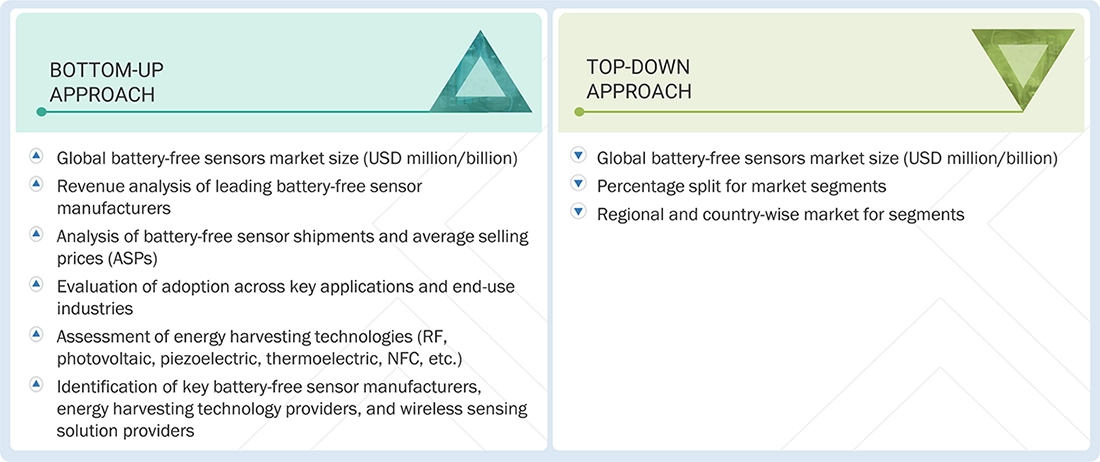
In the market engineering process, both top-down and bottom-up approaches, along with data triangulation methods, were used to estimate and validate the size of the battery-free sensors market and its dependent submarkets. The research methodology used to estimate the market sizes includes the following:
- Identifying investments and spending across industrial automation, smart manufacturing, healthcare, logistics, transportation, smart buildings, agriculture, and other wireless sensing ecosystems while considering segment-level splits and key market developments
- Identifying the major stakeholders influencing the battery-free sensors market, including participants across the energy harvesting, semiconductor, MEMS, RFID/NFC, Bluetooth Low Energy (BLE), wireless communication, and sensor manufacturing value chain
- Analyzing leading companies in the battery-free sensors ecosystem and studying their product portfolios, energy harvesting technologies, manufacturing capabilities, patents, partnerships, and research and development activities
- Assessing the adoption of battery-free sensing technologies across key applications, including condition monitoring, asset tracking, environmental monitoring, structural health monitoring, healthcare monitoring, and cold chain monitoring
- Evaluating the adoption of different energy harvesting technologies, including radio frequency (RF), photovoltaic, piezoelectric, thermoelectric, and NFC-based energy harvesting solutions
- Estimating the market share and value contribution of various sensor types, communication technologies, energy harvesting sources, and application segments
- Aggregating revenues generated by battery-free sensor manufacturers to estimate the global battery-free sensors market size
- Segmenting the overall market into various categories, including sensor type, energy source, energy harvesting capacity, application, end user, and region
- Analyzing regional- and country-level splits and validating demand patterns across major data center markets globally
- Tracking recent and upcoming market developments, including investments, product launches, technology advancements, collaborations, expansions, and partnerships, and forecasting the market size based on these developments and other critical parameters
- Conducting multiple discussions with key opinion leaders to understand technology adoption trends, commercialization strategies, emerging applications, and future developments related to battery-free sensors and energy harvesting technologies
- Validating market estimates at every level through discussions with key opinion leaders, including chief executives (CXOs), vice presidents, business development managers, product managers, R&D heads, technology specialists, procurement managers, system integrators, and independent industry experts
Battery-free Sensors Market : Top-Down and Bottom-Up Approach
Data Triangulation
After arriving at the overall market size using the market estimation processes described above, the battery-free sensors market was segmented into various categories and subcategories. To complete the market engineering process and derive accurate market estimates for each segment and subsegment, data triangulation and market breakdown methodologies were employed wherever applicable. The data was triangulated by analyzing multiple demand- and supply-side factors, including the adoption of battery-free sensing technologies across end users, technological advancements in energy harvesting, product commercialization trends, manufacturing capacities, pricing analysis, company revenues, and regional demand patterns. This comprehensive validation process ensured consistency and reliability in the market estimates, resulting in accurate sizing and forecasting of all market segments and subsegments.
Market Definition
The battery-free sensors market comprises self-powered sensing devices that operate without conventional batteries by harvesting energy from ambient sources such as radio frequency (RF), light, heat, vibration, motion, and near-field communication (NFC). These sensors are designed to enable continuous or on-demand monitoring of physical parameters, including temperature, pressure, humidity, vibration, strain, proximity, and motion while eliminating the need for battery replacement and reducing maintenance requirements.
Key Stakeholders
- Battery-free Sensor Manufacturers
- Energy Harvesting Technology Providers
- Semiconductor and Integrated Circuit (IC) Manufacturers
- MEMS Sensor Manufacturers
- RFID, NFC, and BLE Technology Providers
- Wireless Communication Module Suppliers
- Original Equipment Manufacturers (OEMs)
- System Integrators and IoT Solution Providers
- Industrial Automation and Smart Manufacturing Solution Providers
- Distributors and Channel Partners
- Government and Regulatory Organizations
- Research Institutions and Industry Associations
- End Users
Report Objectives
- To describe, segment, and forecast the size of the battery-free sensors market by sensor type, energy source, energy harvesting capacity, application, end user, and region, in terms of value (USD million)
- To forecast the battery-free sensors market in terms of volume (million units)
- To forecast the size of various segments for four regions: North America, the Asia Pacific, Europe, and RoW, in terms of value
- To offer detailed information on drivers, restraints, opportunities, and challenges influencing the growth of the battery-free sensors market
- To provide a detailed overview of the battery-free sensors value chain
- To strategically analyze the micromarkets concerning individual growth trends, prospects, and contributions to the overall market
- To study industry trends, technological advancements, regulatory landscape, sustainability initiatives, customer landscape & buyer behavior, the impact of AI/Gen AI, along with the macroeconomic outlook
- To analyze opportunities for various stakeholders by identifying the high-growth segments of the market
- To benchmark the key players and analyze their market position in terms of revenue, market share, and core competencies, and to provide a detailed competitive landscape for the market leaders
- To analyze competitive developments such as product launches, deals, and expansions carried out by players in the battery-free sensors market
Available customizations:
With the given market data, MarketsandMarkets offers customizations according to the specific requirements of companies. The following customization options are available for the report:
- Detailed analysis and profiling of additional market players (up to 5)
Get the Full Battery-free Sensors Market Report
Full forecast, segment splits, and company analysis for all Battery-free Sensors Market.
- US Battery-free Sensors Market
- Canada Battery-free Sensors Market
- Mexico Battery-free Sensors Market
- UK Battery-free Sensors Market
- France Battery-free Sensors Market
- Spain Battery-free Sensors Market
- Italy Battery-free Sensors Market
- Rest Of Europe Battery-free Sensors Market
- China Battery-free Sensors Market
- Japan Battery-free Sensors Market
- India Battery-free Sensors Market
- South Korea Battery-free Sensors Market
- Rest Of Asia Pacific Battery-free Sensors Market
- GCC Countries Battery-free Sensors Market
- Rest Of Middle East Battery-free Sensors Market
Need a Tailored Report?
Customize this report to your needs
Get 10% FREE Customization
Customize This Report
