
France Battery Management System Market (2024-2029)

The France Battery Management System Market was valued at $504.5 Million in 2024 and projected to reach to $1156.2 Million by 2029, representing a compound annual growth rate of 18.0%. France's Battery Management System market is poised for significant expansion, driven by the country's ambitious electrification targets and renewable energy transition.


| Market Size in | USD 26.32 MN |
| Market Forecast in | |
| CAGR | |
| Forecast Period | |
| Units Considered | Value (USD MN) |
France Battery Management System Market Trends and Insights
- This expansion in France is driven by the country's aggressive electrification agenda, particularly in automotive and renewable energy storage sectors, where advanced battery technologies are critical.
- France's commitment to carbon neutrality and its position as a European leader in electric vehicle adoption are accelerating demand for sophisticated BMS solutions across industrial and consumer applications. The French market benefits from strong government incentives for EV adoption and substantial investments in battery manufacturing infrastructure.
- France's automotive sector, home to major OEMs and Tier-1 suppliers, is increasingly integrating advanced BMS technologies to enhance vehicle performance and safety.
- Between 2024 and 2029, France is expected to see heightened competition among semiconductor manufacturers and specialized BMS providers seeking to capture market share in this high-growth segment..
Key Market Statistics
- CAGR (2024-2029) 18.0% CAGR
- Market Size, 2024 ~USD 504.5 Million
- Forecast, 2029 ~USD 1156.2 Million
- Country France
France Battery Management System Market Overview
Market Valuation Growth :
France's Battery Management System market is valued at USD 504.5 million in 2024, with projections reaching USD 1,156.2 million by 2029, demonstrating strong investor confidence in the sector.
Automotive Electrification Drive :
France's commitment to EV adoption and stringent EU emissions regulations are accelerating demand for advanced battery management solutions in the automotive sector, positioning the country as a key European hub.
Renewable Energy Integration :
Expanding renewable energy capacity and grid storage initiatives across France are creating substantial opportunities for battery management systems in stationary energy storage applications.
Competitive CAGR Performance :
At 18% CAGR through 2029, France's market growth slightly trails the global rate of 19.3%, reflecting mature market dynamics while maintaining strong expansion momentum.
France Battery Management System Market Dynamics
- Government incentives for EV adoption, combined with investments in battery manufacturing and energy storage infrastructure, are creating a favorable ecosystem for BMS technology providers.
- The automotive sector remains the primary growth engine, supported by major OEM presence and supply chain development across the region. Looking ahead, France's strategic position within the EU battery regulation framework and its focus on domestic battery production capacity will further strengthen market opportunities.
- Emerging applications in grid-scale energy storage and industrial battery systems present additional growth vectors.
- Market consolidation and technological innovation in thermal management and safety features will define competitive dynamics through 2029..
Market Ecosystem
Related Ecosystem
Automotive Systems
- Light Commercial Vehicles (LCVs)
- Battery Electric Vehicle (BEV)
- Hybrid Electric Vehicle (HEV)
- Agricultural Tractors
- Fuel Cell Electric Vehicle (FCEV)
- BOSCH LIMITED
- DENSO Corporation
- Continental ag
- ZF FRIEDRICHSHAFEN AG
- TENNECO
Battery And Wireless Charging
- Nickel-Cadmium Battery
- Battery Electric Vehicle (BEV)
- Energy Harvesting
- Hybrid Electric Vehicle (HEV)
- Smart Cards
- Panasonic Holdings Corporation
- MOMENTIVE PERFORMANCE MATERIALS INC.
- Lg corp
- FDK Corporation
- Samsung
Electrical System And Components
- Natural Language Processing (NLP)
- Sensors
- Machine Learning
- Temperature Sensors
- Actuators
- ABB India Limited
- Siemens ag
- SCHNEIDER ELECTRIC SE
- Eaton Corporation plc
- Lenovo
Key Takeaways
- France's BMS market will more than double from USD 504.5M (2024) to USD 1,156.2M (2029) at an 18.0% CAGR.
- France's EV adoption leadership and renewable energy transition are primary catalysts for BMS demand growth.
- France's automotive OEMs and battery manufacturers are investing heavily in advanced BMS integration and localization.
- France's regulatory environment and carbon neutrality targets create sustained long-term growth opportunities for BMS providers.
Battery Management System Market Report Scope
| Report Metric | Details |
|---|---|
| Base Year | 2024 |
| Fastest Growing Segment | AUTOMOTIVE (Application) |
| Forecast Period | 2024-2029 |
| Growth Rate | CAGR of 19.3% from 2024 to 2029 |
| Largest Segment | LITHIUM-ION (Battery Type) |
| Market Size Base Year (Billions) | ~USD 9.1 (2024) |
| Revenue Forecast (Billions) | ~USD 22 (2029) |
| Segments Covered | Type, Battery Type, Topology, Application |
France Battery Management System Market Report Segmentation
4 segment dimensions are covered across the global market.
By Type
- 9 V Batteries
- A Batteries
- Aa Batteries
- Aaa Batteries
- C Batteries
- D Batteries
- Motive Batteries
- Stationary Batteries
By Battery Type
- Lead-Acid
- Lithium-Ion
- Nickel-Based
- Other Battery Types
By Topology
- Centralized
- Distributed
- Modular
By Application
- Automotive
- Industrial
- Other Applications
- Renewable Energy
- Telecommunications
Target Audience
- Automotive OEMs & Suppliers : French and international automotive manufacturers need market data to optimize EV battery management strategies, supply chain planning, and technology partnerships in France's growing electrification market.
- Energy Storage & Renewable Companies : Renewable energy developers and grid operators require insights into stationary battery management opportunities and regulatory frameworks to capitalize on France's energy transition investments.
- Battery & Electronics Manufacturers : BMS component and system manufacturers need France-specific demand forecasts, competitive analysis, and technology trends to guide R&D investments and market expansion strategies.
- Investment & Private Equity Firms : Investors evaluating opportunities in French battery technology, EV infrastructure, and energy storage sectors require detailed market sizing and growth projections for due diligence and portfolio decisions.
- Government & Policy Makers : French regulatory bodies and industrial development agencies need comprehensive market analysis to inform policy decisions, incentive programs, and strategic initiatives supporting the battery ecosystem.
Reasons to Buy this Report
- Localized Market Intelligence : Gain France-specific insights on market dynamics, regulatory environment, and competitive landscape essential for strategic planning and market entry decisions in this high-growth European market.
- Investment Decision Support : Access detailed valuation data and growth projections (18% CAGR) to support investment thesis development, funding decisions, and capital allocation strategies in the French BMS sector.
- Competitive Positioning : Understand France's market structure, key players, and technology trends to benchmark your offerings and identify competitive advantages in automotive and energy storage segments.
- Regulatory & Policy Alignment : Navigate France's electrification agenda, EU compliance requirements, and government incentives with comprehensive analysis of policy drivers shaping market opportunities through 2029.
- Sector-Specific Growth Opportunities : Identify high-potential applications across automotive, renewable energy storage, and industrial sectors with detailed segment analysis and demand forecasting for France.
Frequently asked questions
What is the current size of France's Battery Management System market?
France's BMS market was valued at USD 504.5 million in 2024 and is expected to grow significantly through 2029.
What is the projected growth rate for France's BMS market?
France's BMS market is projected to grow at an 18.0% CAGR from 2024 to 2029, reaching USD 1,156.2 million.
What are the main drivers of BMS market growth in France?
Key drivers include France's EV adoption targets, renewable energy storage expansion, government incentives, and automotive sector investments in battery technology.
Which industries are driving BMS demand in France?
The automotive sector, renewable energy storage, industrial applications, and consumer electronics are the primary demand drivers in France.
What is the forecast market size for France's BMS market by 2029?
France's BMS market is forecasted to reach USD 1,156.2 million by 2029, more than doubling from 2024 levels.
RESEARCH METHODOLOGY
The study involved four major activities in estimating the current size of the battery management system market. Exhaustive secondary research has been done to collect information on the market, peer market, and parent market. The next step has been to validate these findings, assumptions, and sizing with industry experts across the value chain through primary research. Both top-down and bottom-up approaches have been employed to estimate the complete market size. After that, market breakdown and data triangulation methods have been used to estimate the market size of segments and subsegments. Two sources of information—secondary and primary—have been used to identify and collect information for an extensive technical and commercial study of the battery management system (BMS) market.
Secondary Research
Secondary sources include annual reports, press releases, investor presentations of companies, white papers, certified publications, articles by recognized authors, regulatory bodies, trade directories, databases, and corporate filings such as annual reports, investor presentations, financial statements, trade, business and professional associations, white papers, manufacturing associations.
Primary Research
Primary sources are experts from the core and related industries and preferred battery management system providers, distributors, alliances, standards, and certification organizations related to various segments of this industry’s value chain.
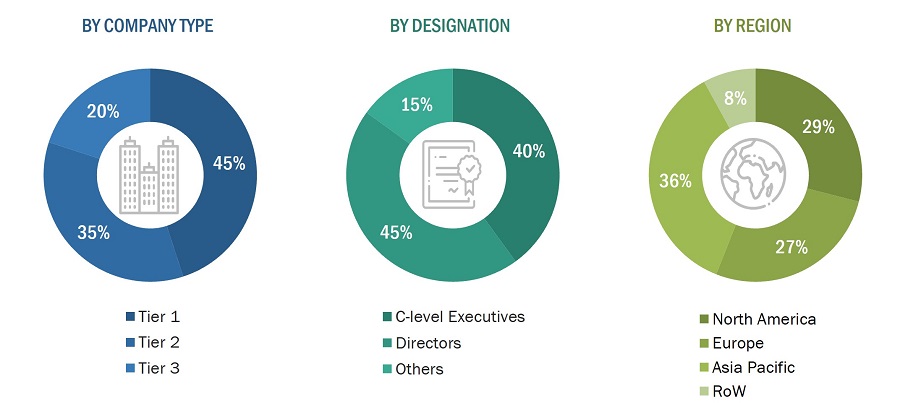
In the primary research process, various primary sources from both supply and demand sides have been interviewed to obtain qualitative and quantitative information on the market. The primary sources from the supply side included various industry experts, such as chief experience officers (CXOs), vice presidents (VPs), and directors from business development, marketing, product development/innovation teams, and related key executives from battery management system providers, such as Renesas Electronics Corporation. (Germany), Sensata Technologies, Inc. (Japan), Eberspächer (Germany), Panasonic Holdings Corporation (Japan), and Texas Instruments Incorporated. (US); industry associations; independent consultants and importers; distributors; and key opinion leaders.
The breakdown of primary respondents has been provided in the figure below.
To know about the assumptions considered for the study, download the pdf brochure
Market Size Estimation
Both top-down and bottom-up approaches have been used to estimate and validate the total size of the battery management system market. These methods have also been used extensively to estimate the size of various subsegments in the market. The following research methodology has been used to estimate the market size:
- Major players in the industry and markets have been identified through extensive secondary research.
- The industry’s value chain and market size (in terms of value) have been determined through primary and secondary research processes.
- All percentage shares, splits, and breakdowns have been determined using secondary sources and verified through primary sources.
Bottom-up Approach
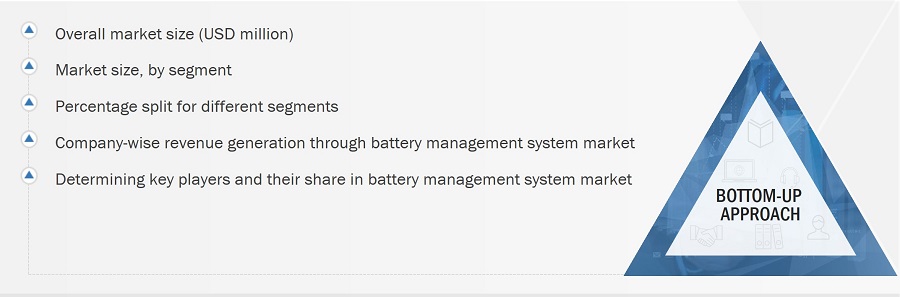
The bottom-up approach has been used to arrive at the overall size of the battery management system market from the revenues of the key players and their market shares. Calculations based on revenues of key companies identified in the market led to the estimation of their overall market size.
Approaches to determining market size by bottom-up analysis
- Identifying industries that either use or will use battery management systems.
- Tracking leading companies and system integrators operating across various industries.
- Deriving the size of the BMS market through the data sanity method; analyzing revenues of more than 25 key providers through their annual reports and press releases and summing them up to estimate the overall market size.
- Conducting multiple discussions with key opinion leaders to understand the demand for battery management systems and analyzing the breakup of the scope of work carried out by each major company.
- Carrying out the market trend analysis to obtain the CAGR of the battery management system market by understanding the product penetration rate in each industry and analyzing the demand and supply of battery management systems in different industries.
- Assigning a percentage to the overall revenue or, in a few cases, to segmental revenues of each company to derive their revenues from the sales of battery management systems. This percentage for each company has been assigned based on their product portfolios.
- Verifying and crosschecking estimates at every level through discussions with key opinion leaders, including CXOs, directors, operation managers, and domain experts at MarketsandMarkets.
- Studying various paid and unpaid information sources such as annual reports, press releases, white papers, and databases.
- Tracking ongoing and identifying upcoming battery management system projects by companies and forecasting the market size based on these developments and other critical parameters.
Top-Down Approach
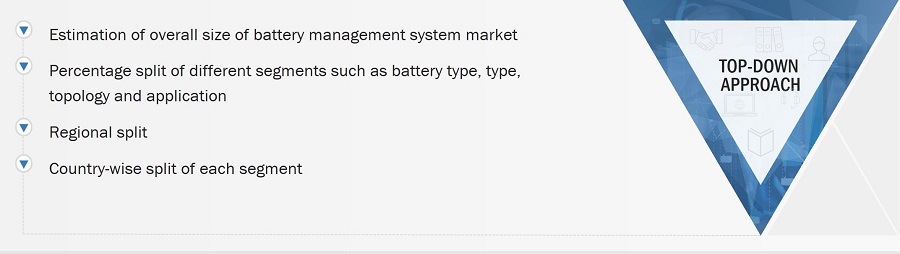
In the top-down approach, the overall market size has been used to estimate the size of the individual market (mentioned in market segmentation) through percentage splits from secondary and primary research. For specific market segments, the size of the most appropriate immediate parent market has been used to implement the top-down approach. The bottom-up approach has also been implemented for data obtained from secondary research to validate the market size of various segments.
The market share for each company has been estimated to verify revenues used earlier in the bottom-up approach. With the data triangulation procedure and validation of the data through primaries, the size of the parent market and each market segment has been determined and confirmed. The data triangulation procedure used for this study has been explained in the next section.
Approach to determining market size by top-down analysis
- MarketsandMarkets focuses on the top-line expenditures and investments made throughout the battery management system ecosystem to manufacture new batteries and retrofit the existing ones.
- The information related to revenues generated by key manufacturers of battery management systems has been studied and analyzed.
- Multiple on-field discussions have been carried out with key opinion leaders of leading companies involved in manufacturing battery management systems.
- The geographical split has been estimated using secondary sources based on various factors, such as the number of players in a specific country or region and battery management systems provided by these players.
Data Triangulation
After arriving at the overall market size from the estimation process explained above, the overall market has been split into several segments and subsegments. Where applicable, the market breakdown and data triangulation procedures have been employed to complete the overall market engineering process and arrive at the exact statistics for all segments and subsegments. The data has been triangulated by studying numerous factors and trends from both the demand and supply sides. The market has also been validated using both top-down and bottom-up approaches.
Market Definition
A battery management system (BMS) is an electronic device that monitors and controls the operation and functioning of a rechargeable battery. It is called the brain of the battery, as it enhances safety, performance, charging rates, and longevity by managing current, voltage, temperature, and battery capacity. Its primary functions include protection from overcharging, ensuring safe operation, cell balancing, voltage and temperature control, and determining the state of charge (SoC) and state of health (SoH) of the battery. A battery management system typically comprises hardware and software customized per applications and battery specifications.
Key Stakeholders
- Government Bodies and Policymakers
- Industry-standard Organizations, Forums, Alliances, and Associations
- Market Research and Consulting Firms
- Raw Material Suppliers and Distributors
- Research Institutes and Organizations
- Battery Cell and Battery Pack Manufacturers
- Testing, Inspection, and Certification Providers
- Distributors and Resellers
- End Users
Report Objectives
- To define, describe, and forecast the battery management system market based on type, battery type, topology, and application
- To describe and forecast the size of the BMS market based on four regions: North America, Europe, Asia Pacific, and the Rest of the World (RoW), along with their respective countries
- To provide detailed information regarding drivers, restraints, opportunities, and challenges influencing the market growth
- To provide a detailed overview of the process flow of the BMS market
- To provide ecosystem analysis, case study analysis, patent analysis, technology analysis, pricing analysis, Porter’s five forces analysis, key stakeholders & buying criteria, key conferences & events, regulatory bodies, government agencies, and regulations pertaining to the market under study
- To strategically analyze micromarkets with respect to individual growth trends, prospects, and contributions to the overall market size
- To study the complete value chain of the battery management system market
- To analyze opportunities for stakeholders by identifying high-growth segments of the BMS market
- To strategically profile the key players and comprehensively analyze their market positions in terms of their ranking and core competencies
- To analyze competitive developments, such as product launches, acquisitions, agreements, and partnerships, in the battery management system market
Available Customizations
Based on the given market data, MarketsandMarkets offers customizations in the reports according to the client’s specific requirements. The available customization options are as follows:
Company Information
- Detailed analysis and profiling of additional market players (up to 5)
Get the Full Battery Management System Market Report
Full forecast, segment splits, and company analysis for all Battery Management System Market.
- Canada Battery Management System Market
- Mexico Battery Management System Market
- US Battery Management System Market
- Germany Battery Management System Market
- UK Battery Management System Market
- Rest Of Europe Battery Management System Market
- China Battery Management System Market
- India Battery Management System Market
- Japan Battery Management System Market
- South Korea Battery Management System Market
- Rest Of Asia Pacific Battery Management System Market
- Africa Battery Management System Market
- Middle East Battery Management System Market
- South America Battery Management System Market
Need a Tailored Report?
Customize this report to your needs
Get 10% FREE Customization
Customize This Report
