
Asia Pacific Battery Simulation Software Market (2025-2030)

The Asia Pacific Battery Simulation Software Market was valued at $695.2 Million in 2025 and projected to reach to $1466.7 Million by 2030, representing a compound annual growth rate of 16.1%. Asia Pacific's battery simulation software market is positioned for exceptional growth, driven by the region's leadership in electric vehicle production and battery manufacturing.


| Market Size in | USD 26.32 MN |
| Market Forecast in | |
| CAGR | |
| Forecast Period | |
| Units Considered | Value (USD MN) |
Asia Pacific Battery Simulation Software Market Trends and Insights
- Asia Pacific's rapid industrialization, coupled with aggressive electric vehicle adoption across China, India, and Southeast Asia, is driving demand for advanced battery modeling and simulation tools.
- The region's dominance in battery manufacturing and EV production makes Asia Pacific a critical hub for battery simulation software innovation and deployment. Asia Pacific's 16.1% compound annual growth rate significantly outpaces global trends, reflecting the region's strategic focus on energy storage solutions and automotive electrification.
- Major investments in battery R&D facilities and manufacturing capacity across Asia Pacific are accelerating the adoption of simulation software to optimize battery performance, safety, and cost efficiency.
- By 2030, Asia Pacific is expected to command a substantial share of the global battery simulation software market, driven by regulatory mandates, competitive pressures, and technological advancement in the region..
Key Market Statistics
- CAGR (2025-2030) 16.1% CAGR
- Market Size, 2025 ~USD 695.2 Million
- Forecast, 2030 ~USD 1466.7 Million
- Geography Asia Pacific
Asia Pacific Battery Simulation Software Market Overview
EV-Driven Growth :
China, India, and Southeast Asia's aggressive electric vehicle adoption is accelerating demand for advanced battery simulation software to optimize performance and safety.
Regional Market Leadership :
Asia Pacific commands USD 695.2 million in 2025, with a 16.1% CAGR outpacing the global growth rate of 13.5%, establishing the region as a critical innovation hub.
Industrial Expansion :
Rapid industrialization across Asia Pacific is driving investments in battery manufacturing, energy storage systems, and automotive electrification infrastructure.
Forecast Trajectory :
Market is projected to reach USD 1,466.7 million by 2030, more than doubling in value as battery technology becomes central to regional energy and mobility strategies.
Asia Pacific Battery Simulation Software Market Dynamics
- China's dominance in EV adoption, combined with India's emerging automotive sector and Southeast Asia's renewable energy initiatives, creates substantial demand for sophisticated modeling and simulation tools.
- Government incentives and manufacturing investments further accelerate market expansion. The forecast period through 2030 will witness intensified competition among software vendors, increased R&D spending by battery manufacturers, and growing integration of AI and machine learning in simulation platforms.
- Regional players are expected to emerge alongside global leaders, offering localized solutions tailored to Asia Pacific's unique regulatory and manufacturing requirements, ensuring sustained market momentum..
Market Ecosystem
Related Ecosystem
Software And Services
- Natural Language Processing (NLP)
- Machine Learning
- Supply Chain Management
- Predictive Analytics
- Image Sensors
- International Business Machines Corporation
- MICROSOFT CORPORATION
- Oracle Corporation
- SAP SE
- Amazon.com, Inc.
Key Takeaways
- Asia Pacific battery simulation software market will nearly double from USD 695.2M (2025) to USD 1,466.7M (2030), driven by EV electrification and battery manufacturing expansion.
- Asia Pacific's 16.1% CAGR outpaces the global average, positioning the region as the fastest-growing market for battery simulation solutions.
- China, India, and Southeast Asia lead Asia Pacific adoption, leveraging simulation software to enhance battery performance, safety, and cost competitiveness.
- Regulatory pressures and competitive dynamics in Asia Pacific are accelerating investment in advanced battery modeling and simulation technologies through 2030.
Battery Simulation Software Market Report Scope
| Report Metric | Details |
|---|---|
| Base Year | 2025 |
| Fastest Growing Segment | SOLID-STATE BATTERIES (Battery Type) |
| Forecast Period | 2025–2030 |
| Growth Rate | CAGR of 13.5% from 2025 to 2030 |
| Largest Segment | FEA (Software Type) |
| Market Size Base Year (Billions) | ~USD 2.22 (2025) |
| Revenue Forecast (Billions) | ~USD 4.19 (2030) |
| Segments Covered | Simulation Type, Battery Type, End-Use Industry, Offering, Application, Capability, Deployment Mode, Organization Size, Vertical, Software Type |
Asia Pacific Battery Simulation Software Market Report Segmentation
10 segment dimensions are covered across the global market.
By Simulation Type
- Electrical & Circuit Simulation
- Electrochemical Simulation
- Other Simulation Types
- Structural & Mechanical Simulation
- Thermal Simulation
By Battery Type
- Lead-Acid Batteries
- Lithium-Ion (Li-Ion) Batteries
- Other Battery Types
- Solid-State Batteries
By End-Use Industry
- Aerospace
- Automotive Oems
- Battery Manufacturers
- Consumer Electronics
- Energy Storage Systems (Ess)
- EV Manufacturers
- Other End Users
By Offering
- Professional Services
- Services
- Software
By Application
- Automotive & Vehicle Simulation
- Engineering, Research, Modeling, And Simulated Testing
- Gamification, Vr, Ar, And Immersive Experience
- Healthcare & Medical Device Simulation
- Machining & Production
- Manufacturing & Process Optimization
- Other Applications
- Product Design & Prototyping
- Quality Control & Inspection
- Supply Chain, Logistics Management, And Transportation
- Urban Planning
By Capability
- 2D
- 3D
- Multi-Axis
By Deployment Mode
- Cloud
- On-Premises
By Organization Size
- Large Enterprises
- Smes
By Vertical
- Aerospace
- Aerospace & Defense
- Automotive
- Chemical
- Chemicals
- Construction
- Electrical & Electronics
- Electronics & Semiconductors
- Energy & Power
- Food & Beverages
- Gaming
- Healthcare & Pharmaceuticals
- Heavy Machinery
- Medical Devices & Pharmaceuticals
- Metal & Mining
- Oil & Gas
- Oil, Gas, And Mining
- Other Verticals
- Pulp & Paper
- Shipbuilding & Marine Engineering
By Software Type
- Cad Simulation Software
- Cfd
- Electromagnetic Simulation Software
- Electronic Simulation Software
- Fea
- Gaming, Ar, Vr, And Training Simulation Software
- Healthcare & Epidemiological Simulation Software
- Manufacturing Simulation Software
- Other Software Types
- Physics & Multiphysics Simulation Software
- Process Simulation Software
Target Audience
- Battery Manufacturers : Need advanced simulation software to optimize battery design, performance, and safety across Asia Pacific's rapidly expanding production facilities.
- EV Automakers : Require sophisticated modeling tools to accelerate vehicle development cycles and meet regional electrification targets in competitive Asian markets.
- Software Vendors : Seeking market entry or expansion opportunities in Asia Pacific's high-growth segment with detailed competitive and customer landscape analysis.
- Energy Storage Companies : Need simulation capabilities to develop grid-scale and distributed energy storage solutions supporting Asia Pacific's renewable energy transition.
- Investment & Strategy Teams : Require market sizing, growth forecasts, and opportunity assessment for M&A, partnerships, and capital allocation decisions in Asia Pacific.
Key Companies in the Asia Pacific Battery Simulation Software Market
| Company | HQ | Ownership | Strongest segments |
|---|---|---|---|
| ANSYS | United States | Private Company | Electrochemical Simulation,Thermal Simulation,Structural & Mechanical Simulation, |
| SIEMENS | Germany | Public Company | Electrochemical simulation,Thermal simulation,Structural & Mechanical simulation, |
| ALTAIR ENGINEERING | United States | ||
| DASSAULT SYSTEMES | France | ||
| ESI GROUP | United States | Private Company | Thermal Simulation for Battery Packs,Structural & Mechanical Battery Simulation,Electrochemical Simulation, |
| RICARDO | United Kingdom | ||
| INTERTEK | United Kingdom | ||
| HEXAGON | Sweden | ||
| SYNOPSYS | United States |
ANSYS
ANSYS is a private American software company founded in 1970 with 6,600 employees, specializing in engineering simulation and analysis solutions.
SIEMENS
Siemens is a German multinational public company founded in 1847 with 310,312 employees, operating across diverse industrial and technology sectors.
ALTAIR ENGINEERING
Insufficient data provided for Altair Engineering.
DASSAULT SYSTEMES
Insufficient data provided for Dassault Systèmes.
ESI GROUP
ESI Group is a private American company founded in 1973 with 900 employees, providing engineering simulation and virtual prototyping software solutions.
RICARDO
Insufficient data provided for Ricardo.
INTERTEK
Insufficient data provided for Intertek.
HEXAGON
Insufficient data provided for Hexagon.
SYNOPSYS
Insufficient data provided for Synopsys.
Countries within Asia Pacific - compare and drill down
| Country | 2025 size (native) |
|---|---|
| China | USD 698.3 Million |
| Japan | USD 245.1 Million |
| India | USD 109 Million |
| Rest Of Asia Pacific | USD 414.3 Million |
Country market size visualization
Reasons to Buy this Report
- Regional Market Intelligence : Gain comprehensive insights into Asia Pacific's fastest-growing battery simulation segment with country-level data, competitive dynamics, and localized market trends.
- Strategic Investment Guidance : Identify high-growth opportunities across China, Japan, India, and emerging Southeast Asian markets with detailed forecasts through 2030.
- Competitive Benchmarking : Understand regional competitive positioning, vendor strategies, and market consolidation patterns specific to Asia Pacific's unique regulatory landscape.
- Technology Adoption Trends : Access insights on AI integration, cloud-based solutions, and emerging simulation technologies driving adoption across Asia Pacific manufacturers.
- Expansion Planning : Leverage detailed market segmentation and growth projections to develop targeted go-to-market strategies for Asia Pacific's battery and EV sectors.
Frequently asked questions
What is the current size of the Asia Pacific battery simulation software market?
The Asia Pacific battery simulation software market is valued at USD 695.2 million in 2025 and is projected to reach USD 1,466.7 million by 2030.
What is the growth rate for battery simulation software in Asia Pacific?
Asia Pacific's battery simulation software market is growing at a compound annual growth rate (CAGR) of 16.1% from 2025 to 2030.
Which countries are driving growth in Asia Pacific's battery simulation software market?
China, India, and Southeast Asian nations are the primary growth drivers in Asia Pacific, fueled by EV production, battery manufacturing, and regulatory mandates.
Why is Asia Pacific's growth rate higher than the global average?
Asia Pacific's 16.1% CAGR exceeds the global 13.5% rate due to the region's dominance in battery manufacturing, aggressive EV adoption, and substantial R&D investments.
What factors are accelerating battery simulation software adoption in Asia Pacific?
Key drivers include rapid EV electrification, battery manufacturing expansion, regulatory compliance requirements, competitive pressures, and investments in battery R&D facilities across the region.
RESEARCH METHODOLOGY
Exhaustive secondary research was done to collect information on the battery simulation software industry. The next step was to validate these findings, assumptions, and sizing with industry experts across the value chain using primary research. Different approaches, such as top-down and bottom-up, were employed to estimate the total market size. After that, the market breakdown and data triangulation procedures were used to estimate the market size of the segments and subsegments of the battery simulation software market.
Secondary Research
The market for companies offering battery simulation software solutions and services is arrived at by secondary data available through paid and unpaid sources, analyzing the product portfolios of the major companies in the ecosystem, and rating the companies by their performance and quality. Various sources were referred to in the secondary research process to identify and collect information for this study. The secondary sources include annual reports, press releases, investor presentations of companies, white papers, journals, certified publications, and articles from recognized authors, directories, and databases.
In the secondary research process, various secondary sources were referred to identify and collect information related to the study. Secondary sources included annual reports, press releases, and investor presentations of battery simulation software vendors, forums, certified publications, and whitepapers. The secondary research was used to obtain essential information on the industry’s value chain, the total pool of key players, market classification, and segmentation from the market and technology-oriented perspectives.
Primary Research
In the primary research process, various supply and demand sources were interviewed to obtain qualitative and quantitative information for this report. The primary sources from the supply side included industry experts, such as Chief Executive Officers (CEOs), Vice Presidents (VPs), marketing directors, technology and innovation directors, and related key executives from various key companies and organizations operating in the market.
After the complete market engineering (calculations for market statistics, market breakdown, market size estimations, market forecasting, and data triangulation), extensive primary research was conducted to gather information and verify and validate the critical numbers arrived at. Primary research was also undertaken to identify the segmentation types, industry trends, competitive landscape of battery simulation software solutions offered by various market players, and fundamental market dynamics, such as drivers, restraints, opportunities, challenges, industry trends, and key player strategies.
In the complete market engineering process, the top-down and bottom-up approaches and several data triangulation methods were extensively used to perform the market estimation and market forecasting for the overall market segments and subsegments listed in this report. Extensive qualitative and quantitative analysis was performed on the complete market engineering process to list the key information/insights throughout the report.
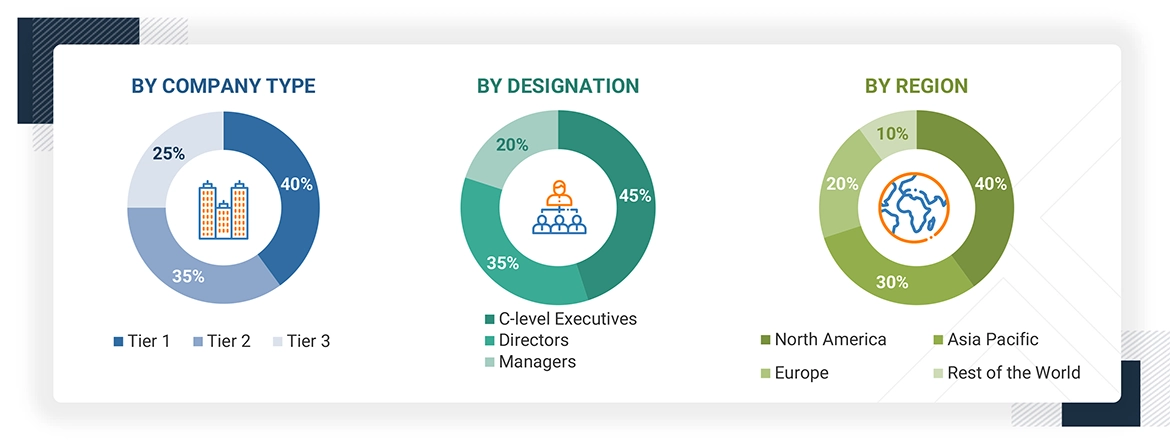
Note 1: Others include sales managers, marketing managers, and product managers.
Note 2: Tier 1 companies’ revenues are more than USD 10 billion; tier 2 companies’ revenues range between USD 1 and 10 billion; and tier 3 companies’ revenues range between USD 500 million and USD 1 billion.
Source: Industry Experts
To know about the assumptions considered for the study, download the pdf brochure
Market Size Estimation
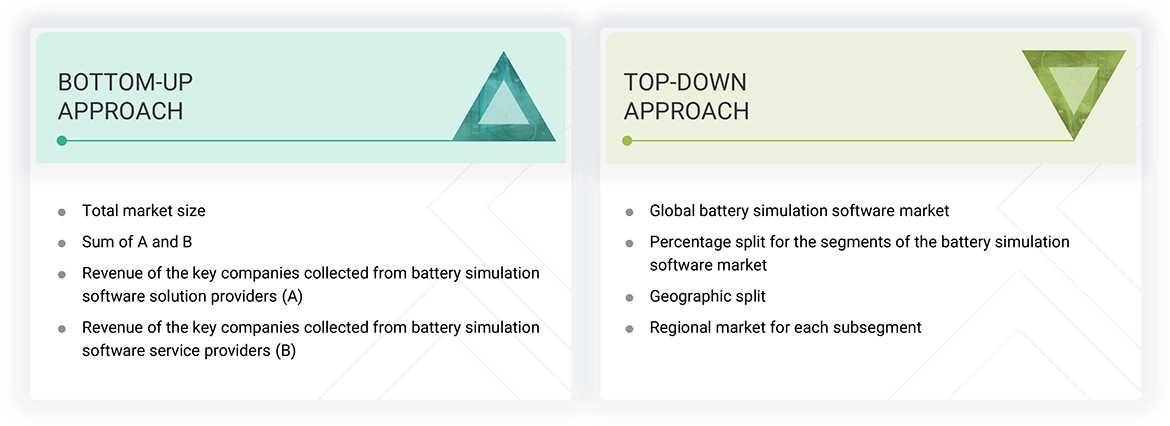
Top-down and bottom-up approaches were used to estimate and validate the size of the global battery simulation software market and the size of various other dependent subsegments. The research methodology used to estimate the market size includes the following details: key players in the market were identified through secondary research, and their market shares in the respective regions were determined through primary and secondary research. This entire procedure included the study of the annual and financial reports of the top market players, and extensive interviews were conducted for key insights from the industry leaders, such as CEOs, VPs, directors, and marketing executives.
All percentage splits and breakdowns were determined using secondary sources and verified through primary sources. All possible parameters that affect the market covered in this research study have been accounted for, viewed in extensive detail, verified through primary research, and analyzed to get the final quantitative and qualitative data. This data is consolidated and added to detailed input and analysis from MarketsandMarkets.
Battery Simulation Software Market : Top-Down and Bottom-Up Approach
Data Triangulation
After arriving at the overall market size using the market size estimation processes explained above, the market was split into several segments and subsegments. The data triangulation and market breakdown procedures were employed, wherever applicable, to complete the overall market engineering process and arrive at the exact statistics of each market segment and subsegment. The data was triangulated by studying various factors and trends from both the demand and supply sides.
Market Definition
Battery simulation software is a specialized tool that models and analyzes battery performance, behavior, and efficiency under various conditions. It enables engineers to simulate thermal management, electrochemical reactions, and mechanical stresses, ensuring optimal design and reliability. By integrating computational techniques, it reduces reliance on physical testing, accelerates development cycles, and enhances safety. The software supports applications across industries, including electric vehicles, renewable energy, and consumer electronics, providing accurate insights for optimizing battery life, energy efficiency, and overall system performance.
Stakeholders
- Software Developers
- Battery Manufacturers
- Automotive OEMs
- Research Institutions
- Material Suppliers
- Government Agencies
- Simulation Software Providers
- Third-party Providers
- Consultants/Consultancies/Advisory Firms
- System Integrators
- Value-added Resellers (VARs)
- Investors and Venture Capitalists
Report Objectives
- To describe and forecast the global battery simulation software market by simulation type, battery type, end-use industry, and region
- To forecast the market size of four main regions: North America, Europe, Asia Pacific, Rest of the World
- To provide detailed information related to significant factors (drivers, restraints, opportunities, and challenges) influencing the growth of the market
- To analyze the subsegments of the market concerning individual growth trends, prospects, and contributions to the overall market
- To profile the key players of the market and comprehensively analyze their market shares and core competencies
- To analyze the opportunities in the market for stakeholders and provide the competitive landscape details of major players
- To map the companies to get competitive intelligence based on company profiles, key player strategies, and game-changing developments such as product developments, collaborations, and acquisitions
- To track and analyze the competitive developments, such as product enhancements and new product launches; acquisitions; and partnerships and collaborations, in the battery simulation software market globally.
Available Customizations
With the given market data, MarketsandMarkets offers customizations based on company-specific needs. The following customization options are available for the report:
Geographic Analysis as per Feasibility
- Further breakdown of the Asia Pacific market into countries contributing 75% to the regional market size
- Further breakdown of the North American market into countries contributing 75% to the regional market size
- Further breakdown of the European market into countries contributing 75% to the regional market size
- Further breakdown of the Rest of the World market into regions or countries contributing 75% to the regional market size
Company Information
- Detailed analysis and profiling of additional market players (up to 5)
Get the Full Battery Simulation Software Market Report
Full forecast, segment splits, and company analysis for all Battery Simulation Software Market.
- Canada Battery Simulation Software Market
- US Battery Simulation Software Market
- UK Battery Simulation Software Market
- Germany Battery Simulation Software Market
- France Battery Simulation Software Market
- Italy Battery Simulation Software Market
- China Battery Simulation Software Market
- Japan Battery Simulation Software Market
- India Battery Simulation Software Market
- Rest Of Europe Battery Simulation Software Market
- Rest Of Asia Pacific Battery Simulation Software Market
Need a Tailored Report?
Customize this report to your needs
Get 10% FREE Customization
Customize This Report
