
Europe Bidirectional Charging Market (2025-2030)

The Europe Bidirectional Charging Market was valued at $8.8 Million in 2025 and projected to reach to $116.2 Million by 2030, representing a compound annual growth rate of 29.5%. Europe's bidirectional charging market is poised for transformative growth through 2030, driven by EU regulatory mandates requiring V2G-capable infrastructure and renewable energy integration targets.


| Market Size in | USD 26.32 MN |
| Market Forecast in | |
| CAGR | |
| Forecast Period | |
| Units Considered | Value (USD MN) |
Europe Bidirectional Charging Market Trends and Insights
- This represents a compound annual growth rate of 29.5%, significantly outpacing global trends.
- Europe is leading the adoption of vehicle-to-grid (V2G) and vehicle-to-load (V2L) technologies, driven by stringent emissions regulations, renewable energy integration goals, and substantial government incentives across member states. The European market benefits from advanced charging infrastructure, strong OEM commitment, and favorable regulatory frameworks that encourage bidirectional capability deployment.
- Europe's transition toward electrification and grid decentralization is positioning bidirectional charging as a critical enabler of energy resilience and sustainability.
- By 2030, Europe is expected to account for a substantial share of global bidirectional charging adoption, with widespread implementation across commercial fleets, residential installations, and public charging networks. Key European markets including Germany, France, and the United Kingdom are spearheading innovation and standardization efforts.
- Europe's commitment to carbon neutrality and circular economy principles continues to accelerate bidirectional charging technology maturation and market penetration through 2030..
Key Market Statistics
- CAGR (2025-2030) 29.5% CAGR
- Market Size, 2025 ~USD 8.8 Million
- Forecast, 2030 ~USD 116.2 Million
- Geography Europe
Europe Bidirectional Charging Market Overview
Market Leadership in V2G Technology :
Europe dominates global vehicle-to-grid (V2G) adoption, with Germany, France, and the UK spearheading infrastructure development. Regulatory frameworks and grid modernization initiatives position Europe as the innovation hub for bidirectional charging solutions.
Exceptional Growth Trajectory :
Europe's bidirectional charging market is expanding at 29.5% CAGR from 2025 to 2030, outpacing the global rate of 28.3%. This acceleration reflects strong policy support, renewable energy integration mandates, and accelerating EV fleet electrification across member states.
Renewable Energy Integration Driver :
Stringent EU emissions regulations and the Green Deal push bidirectional charging as a critical enabler for grid stability and renewable energy storage. Vehicle-to-load (V2L) capabilities are increasingly valued for distributed energy management and peak demand reduction.
Germany's Market Dominance :
Germany leads European adoption with $170 million in market value, driven by robust automotive manufacturing, advanced grid infrastructure, and government incentives. France ($47M) and the UK ($38M) follow as secondary growth engines with expanding charging networks.
Europe Bidirectional Charging Market Dynamics
- The continent's mature EV ecosystem, combined with advanced grid modernization projects, creates ideal conditions for rapid technology adoption.
- Germany's industrial leadership and France's renewable energy focus will anchor market expansion, while emerging markets like Spain and Italy present significant growth opportunities. Investment in charging infrastructure standardization and grid interoperability will accelerate deployment across member states.
- The convergence of vehicle electrification, energy storage demands, and climate commitments positions Europe as the global benchmark for bidirectional charging innovation.
- By 2030, V2G and V2L technologies are expected to become standard features in European EV offerings, fundamentally reshaping vehicle-grid relationships and energy consumption patterns..
Market Ecosystem
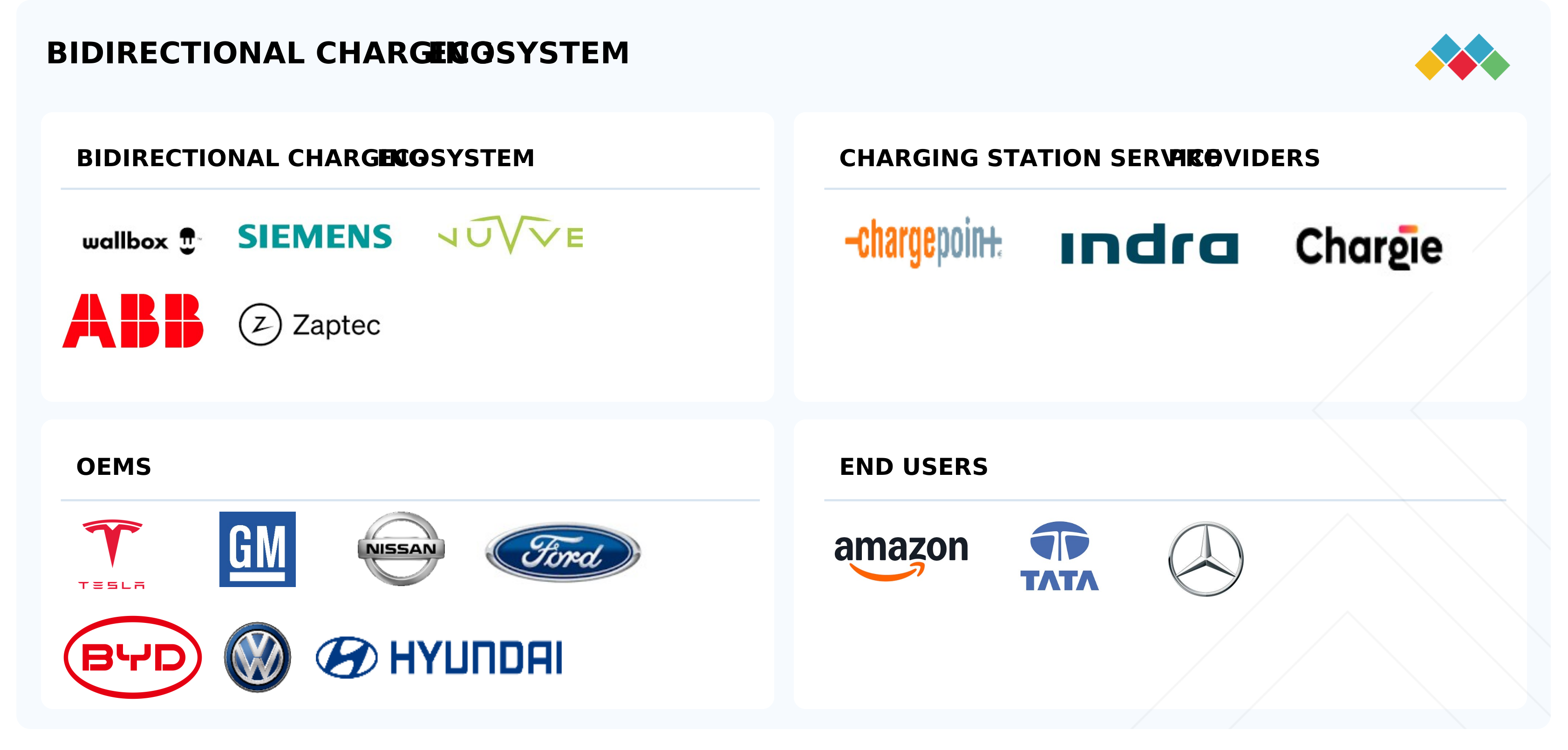
bidirectional charging market: COMMERCIAL USE CASES ACROSS INDUSTRIES
| COMPANY | USE CASE DESCRIPTION | BENEFITS |
|---|---|---|
 |
Deploying bidirectional chargers for residential and fleet applications, enabling vehicle-to-home (V2H) and vehicle-to-grid (V2G) integration | Supports grid balancing, provides backup power to households, and reduces energy costs by enabling energy trading |
 |
Partnering with utilities, schools, and fleet operators to enable V2G solutions for electric buses and commercial fleets | Enhances grid stability, generates additional revenue streams for fleet operators, and promotes renewable energy integration |
 |
Developing smart charging infrastructure that integrates V2G technology for commercial fleets and energy companies | Facilitates large-scale energy management, supports renewable integration, and provides cost savings for fleet operators |
 |
Offering scalable charging solutions with potential V2X functionalities for commercial and residential sectors | Optimizes charging infrastructure, supports efficient energy distribution, and enables future readiness for V2G |
 |
Supplying bidirectional chargers for pilot projects with utilities and fleets, focusing on V2G integration at scale | Enables energy storage through EVs, improves grid resilience, and lowers operational costs for commercial users |
Logos and trademarks shown above are the property of their respective owners. Their use here is for informational and illustrative purposes only.
Related Ecosystem
Agrochemicals
- Phosphatic Fertilizers
- Potassic Fertilizers
- Fungicides
- Ammonium Nitrate
- Anticoagulant Rodenticides
- AZELIS HOLDINGS SA
- Basf se
- Origin Enterprises plc
- MITSUI AGRO BUSINESS SACO
- Mitsui & Co., Ltd.
Automotive Advance Technologies
- Battery Electric Vehicle (BEV)
- Light Commercial Vehicles (LCVs)
- Fuel Cell Electric Vehicle (FCEV)
- Hybrid Electric Vehicle (HEV)
- Internal Combustion Engine (ICE)
- BOSCH LIMITED
- Continental ag
- Visteon Corporation
- DENSO Corporation
- ZF FRIEDRICHSHAFEN AG
Automotive Electronics And Electrical Equipment
- Battery Electric Vehicle (BEV)
- Light Commercial Vehicles (LCVs)
- Fuel Cell Electric Vehicle (FCEV)
- Sensors
- Hybrid Electric Vehicle (HEV)
- BOSCH LIMITED
- DENSO Corporation
- Continental ag
- Panasonic Holdings Corporation
- Texas Instruments Incorporated
Key Takeaways
- Europe's bidirectional charging market will grow from $8.8M (2025) to $116.2M (2030) at a 29.5% CAGR, driven by V2G/V2L adoption and grid modernization.
- Europe leads global bidirectional charging deployment through regulatory mandates, renewable energy targets, and government subsidies supporting electrification.
- Advanced charging infrastructure and strong OEM partnerships position Europe as the primary innovation hub for bidirectional charging standardization and technology development.
- By 2030, Europe's bidirectional charging ecosystem will enable vehicle-to-grid services, demand response programs, and distributed energy resource management across residential and commercial sectors.
Bidirectional Charging Market Report Scope
| Report Metric | Details |
|---|---|
| Base Year | 2025 |
| Fastest Growing Segment | DC CHARGING (Charging Type) |
| Forecast Period | 2025–2030 |
| Growth Rate | CAGR of 28.3% from 2025 to 2030 |
| Largest Segment | BEV (Propulsion Type) |
| Market Size Base Year (Billions) | ~USD 0.07 (2025) |
| Revenue Forecast (Billions) | ~USD 0.24 (2030) |
| Segments Covered | Charging Type, Propulsion Type, Vehicle Type, Application |
Europe Bidirectional Charging Market Report Segmentation
4 segment dimensions are covered across the global market.
By Charging Type
- Ac Charging
- Dc Charging
By Propulsion Type
- Bev
By Vehicle Type
- Light Commercial Vehicle
- Passenger Car
By Application
- V2G + V2H + V2L
- V2H + V2L
- V2L
Target Audience
- Automotive OEMs & Suppliers : European and global automakers need regional market intelligence to align V2G/V2L product development with regulatory requirements and customer demand. Understand competitive positioning and technology integration strategies across key markets.
- Energy & Utility Companies : Grid operators and energy providers require detailed market forecasts to plan infrastructure investments, grid modernization projects, and demand-response programs leveraging bidirectional charging capabilities.
- Charging Infrastructure Developers : EV charging network operators and infrastructure investors need market sizing, growth projections, and regional deployment strategies to optimize capital allocation and network expansion across Europe.
- Policy & Government Agencies : EU and national policymakers require evidence-based market data to design effective incentive programs, regulatory frameworks, and infrastructure standards supporting bidirectional charging adoption.
- Technology & Software Providers : Smart grid, IoT, and energy management software companies need market insights to develop solutions addressing Europe's V2G/V2L integration challenges and capitalize on growing demand for grid-vehicle connectivity.
Key Companies in the Europe Bidirectional Charging Market
| Company | HQ | Ownership | Strongest segments |
|---|---|---|---|
| TESLA | United States | Public Company | V2H (vehicle-to-home),V2G (vehicle-to-grid),V2L (vehicle-to-load), |
| GENERAL MOTORS | United States | Public Company | V2H (Vehicle-to-Home),V2L (Vehicle-to-Load),V2G (Vehicle-to-Grid), |
| HYUNDAI MOTOR COMPANY | South Korea | Public Company | V2L-enabled BEV passenger cars,V2H/V2G-capable BEV passenger cars,PHEV with bidirectional capability, |
| NISSAN MOTOR CO., LTD. | Japan | Public Company | V2H (Vehicle-to-Home),V2G (Vehicle-to-Grid),V2L (Vehicle-to-Load), |
| BYD COMPANY LTD | United States | Public Company | V2L-enabled vehicles and embedded bidirectional hardware,V2H solutions (vehicle plus home interface hardware),V2G fleet and utility pilots, |
| FORD MOTOR COMPANY | United States | Public Company | V2H / V2L applications,V2G applications,BEV platforms (bidirectional-capable), |
| INDRA SISTEMAS S.A. | United States | Public Company | V2G platforms and integration,V2H and residential energy solutions,V2L and commercial off-grid applications, |
TESLA
Tesla is a publicly traded American electric vehicle and clean energy company founded in 2003, employing 134,785 people. The company designs, manufactures, and sells electric vehicles, energy storage systems, and solar products globally.
GENERAL MOTORS
General Motors is a publicly traded American automotive manufacturer founded in 1908 with 156,000 employees. The company designs, manufactures, and sells vehicles under multiple brands and is transitioning toward electric vehicle production.
HYUNDAI MOTOR COMPANY
Hyundai Motor Company is a publicly traded South Korean automotive manufacturer founded in 1967. The company produces a wide range of vehicles including sedans, SUVs, and commercial vehicles for global markets.
NISSAN MOTOR CO., LTD.
Nissan Motor Co., Ltd. is a publicly traded Japanese automotive manufacturer founded in 1933 with 120,079 employees. The company designs and manufactures vehicles including sedans, SUVs, and electric vehicles for worldwide distribution.
BYD COMPANY LTD
BYD Company Ltd is a publicly traded American company founded in 1994 with 869,600 employees. The company specializes in electric vehicles, batteries, and renewable energy solutions.
FORD MOTOR COMPANY
Ford Motor Company is a publicly traded American automotive manufacturer founded in 1903 with 169,000 employees. The company designs, manufactures, and sells vehicles across multiple segments and is investing in electric vehicle development.
INDRA SISTEMAS S.A.
Indra Sistemas S.A. is a publicly traded American company founded in 1921 with 62,689 employees operating in the technology and defense sectors.
Countries within Europe - compare and drill down
| Country | 2025 size (native) |
|---|---|
| Germany | USD 170 Million |
| France | USD 47 Million |
| UK | USD 38 Million |
| Spain | USD 18 Million |
| Italy | USD 14 Million |
Country market size visualization
Reasons to Buy this Report
- Regional Market Segmentation : Gain detailed insights into country-level performance across Germany, France, UK, Italy, and Spain. Understand market dynamics, regulatory environments, and growth drivers specific to each European nation for targeted business strategy.
- Competitive Landscape Analysis : Identify leading OEMs, charging infrastructure providers, and technology innovators dominating Europe's bidirectional charging ecosystem. Benchmark competitive positioning and market share distribution across the region.
- Regulatory & Policy Intelligence : Access comprehensive analysis of EU directives, national incentive programs, and grid modernization policies driving market adoption. Stay informed on compliance requirements and emerging regulatory trends shaping investment opportunities.
- Technology Adoption Roadmap : Understand V2G and V2L deployment timelines, infrastructure readiness levels, and standardization progress across European markets. Identify early-mover advantages and technology integration pathways for strategic planning.
- Investment & Growth Opportunities : Discover high-potential market segments, emerging geographies, and partnership opportunities within Europe's rapidly expanding bidirectional charging ecosystem. Quantify revenue streams and ROI projections through 2030.
Frequently asked questions
What is the projected market size for bidirectional charging in Europe by 2030?
Europe's bidirectional charging market is projected to reach $116.2 million by 2030, growing from $8.8 million in 2025, representing a 29.5% compound annual growth rate.
What are the primary drivers of bidirectional charging adoption in Europe?
Europe's bidirectional charging growth is driven by stringent EU emissions regulations, renewable energy integration mandates, government incentives, advanced grid infrastructure, and strong OEM commitment to electrification.
Which European countries are leading bidirectional charging market development?
Germany, France, and the United Kingdom are spearheading Europe's bidirectional charging innovation, standardization, and deployment through regulatory frameworks and infrastructure investment.
How does Europe's bidirectional charging CAGR compare to global growth rates?
Europe's 29.5% CAGR for bidirectional charging exceeds the global average of 28.3%, reflecting Europe's accelerated adoption of V2G and V2L technologies and grid modernization initiatives.
What applications will drive Europe's bidirectional charging market through 2030?
Vehicle-to-grid services, demand response programs, distributed energy resource management, commercial fleet electrification, and residential energy storage integration will be primary growth drivers in Europe by 2030.
RESEARCH METHODOLOGY
The research study involved extensive use of secondary sources such as company annual reports/presentations, industry association publications, magazines, directories, technical handbooks, World Economic Outlook, trade websites, technical articles, and databases to identify and collect information on the bidirectional charging market. In-depth interviews were conducted with various primary sources experts from related industries, bidirectional charging providers, EV manufacturers, and component suppliers to obtain and verify critical information and assess the growth prospects and market estimations.
Secondary Research
In the secondary research process, various secondary sources were used to identify and collect information on the bidirectional charging market for this study. Secondary sources included annual reports, press releases, and investor presentations of companies; whitepapers, certified publications, and articles from recognized authors; directories; databases; and articles from recognized associations and government publishing sources.
Primary Research
Extensive primary research was conducted after understanding the bidirectional charging market scenario through secondary research. Several primary interviews were conducted with market experts from both the demand and supply sides across North America, Europe, and Asia Pacific. Approximately 45% and 55% of primary interviews were conducted from the demand and supply sides. Primary data was collected through questionnaires, emails, and telephonic interviews.
In the canvassing of primaries, various departments within organizations, such as sales, operations, and marketing, were covered to provide a holistic viewpoint in the report. After interacting with industry experts, brief sessions were conducted with experienced independent consultants to reinforce the findings from the primaries. This, along with the opinions of in-house subject matter experts, led to the conclusions described in the remainder of this report.
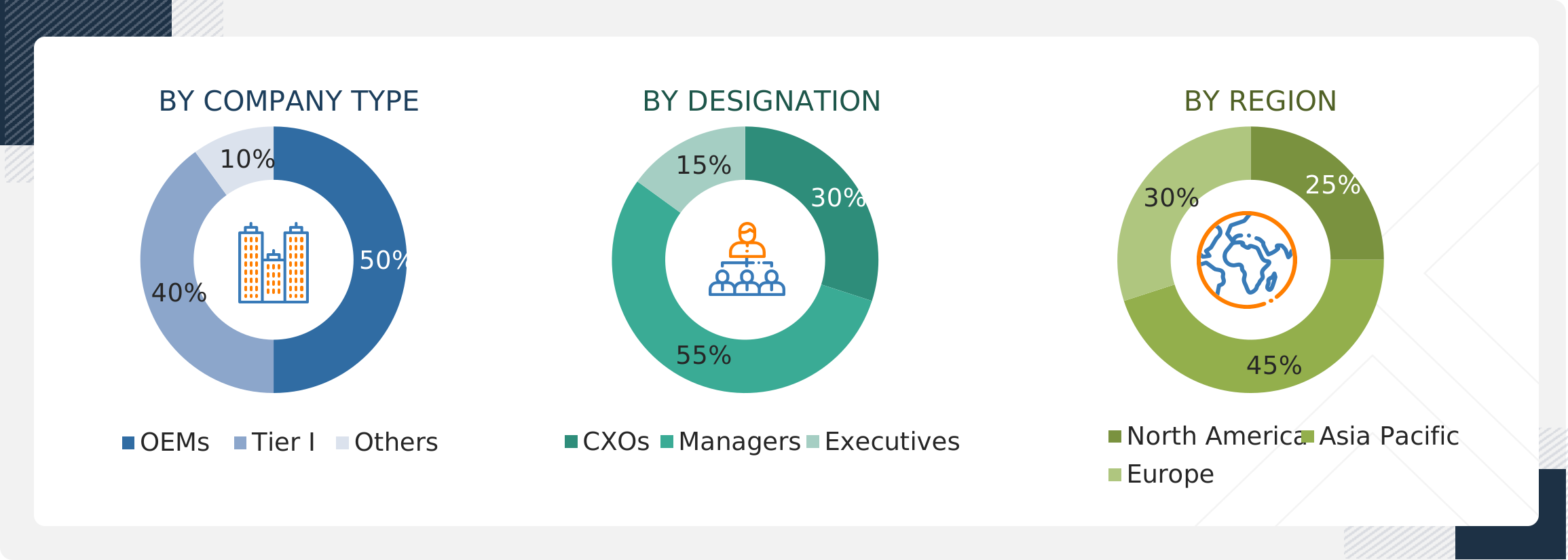
Note: Tiers are based on the value chain of the bidirectional charging market; companies’ revenues were not considered. Tier I companies include
bidirectional charger providers, while others include the remaining companies in the bidirectional charging ecosystem.
To know about the assumptions considered for the study, download the pdf brochure
Market Size Estimation
A detailed market estimation approach was followed to estimate and validate the value and volume of the bidirectional charging market and other dependent submarkets, as mentioned below:
- The market size was derived using parameters such as sales of bidirectional charger-enabled vehicle models and corresponding penetration of the trims.
- Key players in the bidirectional charging market were identified through secondary research, and their global market rankings were determined through primary and secondary research.
- The research methodology included the study of annual and quarterly financial reports, regulatory filings of major market players, and interviews with industry experts to gain detailed market insights.
- All major penetration rates, percentage shares, splits, and breakdowns for the bidirectional charging market were determined through secondary sources and verified through primary sources.
- All key macro indicators affecting the revenue growth of the market segments and subsegments have been accounted for, viewed in extensive detail, verified through primary research, and analyzed to get the validated and verified quantitative & qualitative data.
The market data gathered was consolidated and added with detailed inputs, analyzed, and presented in this report.
Bidirectional Charging Market : Top-Down and Bottom-Up Approach

Data Triangulation
After arriving at the overall market size of the global market through the above-mentioned methodology, this market was split into several segments and subsegments. The data triangulation and market breakdown procedures were employed, wherever applicable, to complete the overall market engineering process and arrive at the exact data for the market by value for the key segments and subsegments. The extrapolated market data was triangulated by studying various macro indicators and regional trends from both the demand and supply-side participants.
Market Definition
Bidirectional charging allows energy to flow from and to an electric vehicle through a compatible charging system, unlike traditional charging, which only sends power to the EV. This capability enables various applications, such as Vehicle-to-Grid (V2G) for returning power to the electrical grid, Vehicle-to-Home (V2H) to power a household during an outage, and Vehicle-to-Load (V2L) to operate external devices directly from the EV.
Stakeholders
- Association of European Automotive and Industrial Battery Manufacturers (EUROBAT)
- Alternative Fuels Data Center (AFDC)
- Departments of Transportation across governments
- Electric Vehicle Association of Asia Pacific (EVAAP)
- Environmental Protection Agency (EPA)
- European Alternative Fuels Observatory (EAFO)
- European Automobile Manufacturers’ Association (ACEA)
- EV Charging station service providers
- International Council on Clean Transportation (ICCT)
- International Organization of Motor Vehicle Manufacturers (OICA)
- International Energy Agency (IEA)
- Investor presentations and annual reports of key market players
- Regional EV charging associations
- Regional electric vehicle regulatory authorities
- Society of Manufacturers of Electric Vehicles (SMEV)
- World Electric Vehicle Association (WEVA)
Report Objectives
- To define, segment, and forecast the bidirectional charging market, in terms of volume (thousand units) and value (USD million)
-
To segment the market and forecast its size by charging type, vehicle type, propulsion, application, end use, and region
- To segment the market and forecast its size, by volume and value, based on charging type - AC charging and DC charging
- To segment the market and forecast its size, by volume and value, based on propulsion - battery electric vehicle (BEV) and plug-in hybrid electric vehicle (PHEV)
- To segment the market and forecast its size, by volume and value, based on Vehicle type – passenger car, light commercial vehicle
- To segment the market and forecast its size, by volume and value, based on application - V2G, V2H, V2L
- To segment the market and forecast its size, by volume and value, based on end use - residential, commercial fleets, public/semi-public utility charging
- To forecast the market size with respect to key regions, namely North America, Europe, and Asia Pacific
- To provide detailed information regarding the major factors influencing market growth (drivers, challenges, restraints, and opportunities)
-
To study the following concerning the market
- Supply chain analysis
- Ecosystem analysis
- Technology analysis
- Trade analysis
- Case study analysis
- Patent analysis
- Regulatory landscape
- Pricing analysis
- Trends and disruptions impacting customer business
- Impact of AI/Gen AI
- Key stakeholders and buying criteria
- Key conferences and events
- To strategically analyze the market with respect to individual growth trends, prospects, and contribution to the total market
- To strategically profile key players and comprehensively analyze their market shares and core competencies
- To analyze the opportunities for stakeholders and the competitive landscape for market leaders
- To track and analyze competitive developments such as joint ventures, mergers & acquisitions, new product launches, expansions, and other activities carried out by key industry participants.
Available Customizations
With the given market data, MarketsandMarkets offers customizations in accordance with a company’s specific needs. The following are examples of those available:
- Bidirectional charging market, by plug type, at the regional level
- Bidirectional charging market, by vehicle body type, at the regional level
Company Information
- Profiling of additional market players (up to five)
Get the Full Bidirectional Charging Market Report
Full forecast, segment splits, and company analysis for all Bidirectional Charging Market.
- China Bidirectional Charging Market
- India Bidirectional Charging Market
- Japan Bidirectional Charging Market
- South Korea Bidirectional Charging Market
- France Bidirectional Charging Market
- Italy Bidirectional Charging Market
- Germany Bidirectional Charging Market
- Spain Bidirectional Charging Market
- UK Bidirectional Charging Market
- Canada Bidirectional Charging Market
- US Bidirectional Charging Market
Need a Tailored Report?
Customize this report to your needs
Get 10% FREE Customization
Customize This Report
