
Europe Biometrics As a Service in Healthcare Market (2023-2028)

The Europe Biometrics As a Service in Healthcare Market was valued at $128.6 Million in 2023 and projected to reach to $348.5 Million by 2028, representing a compound annual growth rate of 22.1%. Europe's Biometrics As a Service in Healthcare market is positioned for substantial growth, expanding from USD 128.6 million in 2023 to USD 348.5 million by 2028.


| Market Size in | USD 26.32 MN |
| Market Forecast in | |
| CAGR | |
| Forecast Period | |
| Units Considered | Value (USD MN) |
Europe Biometrics As a Service in Healthcare Market Trends and Insights
- This represents a compound annual growth rate (CAGR) of 22.1%, driven by Europe's stringent regulatory frameworks, advanced healthcare infrastructure, and increasing adoption of digital identity solutions across member states.
- Europe's emphasis on data security and GDPR compliance has accelerated investment in secure biometric authentication systems within healthcare facilities. The European market benefits from strong government initiatives promoting digital health transformation and interoperability standards across the continent.
- Europe's aging population and rising healthcare costs are compelling providers to adopt biometric-as-a-service solutions for patient identification, access control, and fraud prevention.
- Between 2023 and 2028, Europe is expected to lead regional adoption of cloud-based biometric platforms, supported by substantial funding from the European Union's digital health programs and private sector innovation..
Key Market Statistics
- CAGR (2023-2028) 22.1% CAGR
- Market Size, 2023 ~USD 128.6 Million
- Forecast, 2028 ~USD 348.5 Million
- Geography Europe
Europe Biometrics As a Service in Healthcare Market Overview
Regulatory Compliance Driving Adoption :
Europe's stringent GDPR and eIDAS regulations are accelerating biometric authentication adoption in healthcare, creating a competitive advantage for providers meeting compliance standards across EU member states.
Advanced Healthcare Infrastructure :
Developed healthcare systems across Western Europe are investing heavily in digital identity and biometric solutions, with Germany, UK, and France leading market expansion at USD 67.2M, USD 55.1M, and USD 65.6M respectively in 2023.
Rapid Market Expansion :
Europe's Biometrics As a Service market is growing at 22.1% CAGR, outpacing the global rate of 20.7%, reflecting strong regional demand for secure patient identification and data protection solutions.
Digital Identity Integration :
Increasing adoption of digital identity solutions across EU member states is enabling seamless biometric authentication in healthcare systems, improving patient experience and operational efficiency across the continent.
Europe Biometrics As a Service in Healthcare Market Dynamics
- This 22.1% CAGR reflects strong regional momentum driven by regulatory mandates, healthcare digitalization initiatives, and heightened security requirements across member states. Key European markets including Germany, France, and the UK are spearheading innovation in biometric authentication for patient identification, access control, and data security.
- Continued investment in healthcare IT infrastructure, combined with Europe's commitment to digital sovereignty and data protection, will sustain market growth through 2028 and beyond..
Market Ecosystem
Related Ecosystem
Healthcare It
- Computed Tomography (CT)
- Machine Learning
- Magnetic Resonance Imaging (MRI)
- Natural Language Processing (NLP)
- Predictive Analytics
- CERNER CORPORATION
- PHILIPS HEALTHCARE
- Oracle Corporation
- GE HealthCare Technologies Inc.
- Siemens healthineers
Healthcare Analytics
- Machine Learning
- Natural Language Processing (NLP)
- Blood Pressure Monitors
- Computed Tomography (CT)
- Magnetic Resonance Imaging (MRI)
- Oracle Corporation
- PHILIPS HEALTHCARE
- Siemens healthineers
- Zensar Technologies Limited
- EPIC SYSTEMS CORPORATION
Key Takeaways
- Europe's Biometrics As a Service in Healthcare market is valued at USD 128.6 million in 2023 and will grow to USD 348.5 million by 2028, representing a 22.1% CAGR.
- Europe's GDPR compliance requirements and data protection regulations are primary drivers accelerating adoption of secure biometric authentication in healthcare settings.
- Europe's aging demographic and healthcare cost pressures are motivating providers to implement biometric solutions for patient identification and fraud prevention.
- Europe is positioned to lead regional adoption of cloud-based biometric-as-a-service platforms through EU digital health initiatives and substantial private investment.
Biometrics As a Service in Healthcare Market Report Scope
| Report Metric | Details |
|---|---|
| Base Year | 2023 |
| Fastest Growing Segment | VOICE RECOGNITION (Solution Type) |
| Forecast Period | 2023-2028 |
| Growth Rate | CAGR of 20.7% from 2023 to 2028 |
| Largest Segment | SOFTWARE (Component) |
| Market Size Base Year (Billions) | ~USD 0.43 (2023) |
| Revenue Forecast (Billions) | ~USD 1.1 (2028) |
| Segments Covered | Component, Modality, Solution Type, Application, End User |
Europe Biometrics As a Service in Healthcare Market Report Segmentation
5 segment dimensions are covered across the global market.
By Component
- Services
- Software
By Modality
- Multimodal
- Unimodal
By Solution Type
- Facial Recognition
- Fingerprint Scanning
- Iris Recognition
- Other Solutions
- Palm & Vein Recognition
- Voice Recognition
By Application
- Care Provider Authentication
- Medical Record & Data Center Security
- Other Applications
- Patient Identification & Tracking
- Pharmacy Dispensing
- Rpm
By End User
- Ambulatory Surgical Centers
- Hospitals & Clinics
- Long-Term Care Centers & Home Care Settings
- Other End Users
EUROPE: BIOMETRICS AS A SERVICE IN HEALTHCARE MARKET, BY END USER, 2021–2028
| Segment | 2021 | 2022 | 2023 | 2024 | 2025 | 2026 | 2027 | 2028 | CAGR (%) |
|---|---|---|---|---|---|---|---|---|---|
| AMBULATORY SURGICAL CENTERS | 11.9 | 15.8 | 19.3 | 23.8 | 29.4 | 36.5 | 45.6 | 57.2 | 24.3 |
| HOSPITALS & CLINICS | 35.7 | 42.1 | 50.4 | 60.9 | 73.9 | 90 | 110.1 | 135.2 | 21.8 |
| LONG-TERM CARE CENTERS & HOME CARE SETTINGS | 21.1 | 25.9 | 31.2 | 37.9 | 46.3 | 56.8 | 70 | 86.6 | 22.7 |
| OTHER END USERS | 20.8 | 23.5 | 27.7 | 33 | 39.5 | 47.4 | 57.3 | 69.5 | 20.2 |
| TOTAL | 89.6 | 107.2 | 128.6 | 155.6 | 189.1 | 230.8 | 282.9 | 348.5 | 22.1 |
REST OF EUROPE: BIOMETRICS AS A SERVICE IN HEALTHCARE MARKET, BY END USER, 2021–2028
| Segment | 2021 | 2022 | 2023 | 2024 | 2025 | 2026 | 2027 | 2028 | CAGR (%) |
|---|---|---|---|---|---|---|---|---|---|
| AMBULATORY SURGICAL CENTERS | 4 | 5.3 | 6.6 | 8.3 | 10.4 | 13.1 | 16.6 | 21.1 | 26 |
| HOSPITALS & CLINICS | 12 | 14.3 | 17.4 | 21.3 | 26.2 | 32.4 | 40.1 | 50 | 23.5 |
| LONG-TERM CARE CENTERS & HOME CARE SETTINGS | 6.7 | 8.3 | 10.2 | 12.6 | 15.6 | 19.4 | 24.2 | 30.4 | 24.4 |
| OTHER END USERS | 6.7 | 7.7 | 9.2 | 11.1 | 13.4 | 16.4 | 20 | 24.6 | 21.9 |
| TOTAL | 29.4 | 35.7 | 43.4 | 53.2 | 65.6 | 81.2 | 100.9 | 126 | 23.8 |
Target Audience
- Healthcare IT Providers : Need market intelligence on biometric solution demand, regulatory requirements, and adoption rates across European healthcare systems to develop compliant offerings and expand market share.
- Biometric Technology Vendors : Require regional market sizing, growth forecasts, and competitive analysis to prioritize European expansion, allocate R&D resources, and identify partnership opportunities with healthcare providers.
- Healthcare System Administrators : Seek data on biometric authentication benefits, implementation costs, and peer adoption rates across Europe to justify investments in patient identification and security infrastructure.
- Investment & Private Equity Firms : Need market growth projections, regional trends, and competitive landscapes to evaluate investment opportunities in European healthcare biometric companies and digital health platforms.
- Healthcare Consultants & Integrators : Require comprehensive market analysis and regulatory insights to advise clients on biometric solution selection, implementation strategies, and ROI expectations in European healthcare settings.
Countries within Europe - compare and drill down
| Country | 2025 size (native) |
|---|---|
| Germany | USD 67.2 Million |
| UK | USD 55.1 Million |
| France | USD 65.6 Million |
| Rest Of Europe | USD 126 Million |
Country market size visualization
Reasons to Buy this Report
- Regional Market Segmentation : Gain detailed insights into Europe's largest markets—Germany (USD 67.2M), France (USD 65.6M), and UK (USD 55.1M)—with country-specific growth trajectories and competitive landscapes.
- Regulatory Intelligence : Understand how GDPR, eIDAS, and other European regulations shape biometric adoption, enabling compliant product development and market entry strategies across member states.
- Growth Opportunity Assessment : Identify high-growth segments within Europe's 22.1% CAGR market, including patient identification, access control, and secure data authentication in healthcare institutions.
- Competitive Positioning : Benchmark against regional competitors and understand market dynamics in advanced healthcare systems, enabling strategic partnerships and market penetration planning.
- Investment Decision Support : Make informed investment and expansion decisions with comprehensive market forecasts through 2028, supporting business case development for European healthcare biometric initiatives.
Frequently asked questions
What is the current market size of Biometrics As a Service in Healthcare in Europe?
Europe's Biometrics As a Service in Healthcare market was valued at USD 128.6 million in 2023 and is projected to reach USD 348.5 million by 2028.
What is the expected growth rate for Europe's Biometrics As a Service in Healthcare market?
Europe's market is expected to grow at a compound annual growth rate (CAGR) of 22.1% from 2023 to 2028.
What regulatory factors are driving adoption in Europe?
Europe's GDPR compliance requirements, stringent data protection regulations, and emphasis on healthcare data security are primary drivers accelerating biometric-as-a-service adoption across the region.
How is Europe's aging population influencing the market?
Europe's aging demographic and associated healthcare cost pressures are motivating healthcare providers to adopt biometric solutions for efficient patient identification, access control, and fraud prevention.
Which deployment models are gaining traction in Europe?
Cloud-based biometric-as-a-service platforms are gaining significant traction in Europe, supported by EU digital health initiatives and substantial investment from both public and private sectors.
RESEARCH METHODOLOGY
This study involved four major activities in estimating the size of biometrics as a service in the healthcare market. Exhaustive secondary research was done to collect information on the market, peer market, and parent market. The next step was to validate these findings, assumptions, and sizing with industry experts across value chains through primary research. The bottom-up approach was employed to estimate the overall market size. After that, market breakdown and data triangulation were used to estimate the market size of segments and sub-segments.
Secondary Research
The secondary research process involved the widespread use of secondary sources, directories, databases (such as Bloomberg Businessweek, Factiva, and D&B Hoovers), white papers, annual reports, company house documents, investor presentations, and SEC filings of companies. Some non-exclusive secondary sources include the Accreditation Council for Continuing Medical Education (ACCME), Royal College of Physicians and Surgeons of Canada (RCPSC), World Health Organization (WHO), European Accreditation Council for CME (EACCME), Agency for Healthcare Research and Quality (AHRQ), European Union of Medical Specialists (UEMS), Eurostat, The American College of Cardiology (ACC), The American Registry of Radiologic Technologists (ARRT), Expert Interviews, and MarketsandMarkets Analysis.
Secondary research was used to identify and collect information useful for the extensive, technical, market-oriented, and commercial study of the clinical decision support system market. It was also used to obtain important information about the key players and market classification and segmentation according to industry trends to the bottom-most level and key developments related to market and technology perspectives. A database of the key industry leaders was also prepared using secondary research.
Primary Research
In the primary research process, various sources from both the supply and demand sides were interviewed to obtain qualitative and quantitative information for this report. The primary sources from the supply side include industry experts such as CEOs, vice presidents, marketing and sales directors, technology & innovation directors, and related key executives from various key companies and organizations operating in the clinical decision support system market. The primary sources from the demand side included industry experts, consultants, healthcare providers, hospital administration, and government bodies. Primary research was conducted to validate the market segmentation, identify key players in the market, and gather insights on key industry trends and key market dynamics.
Breakdown of Primary Interviews
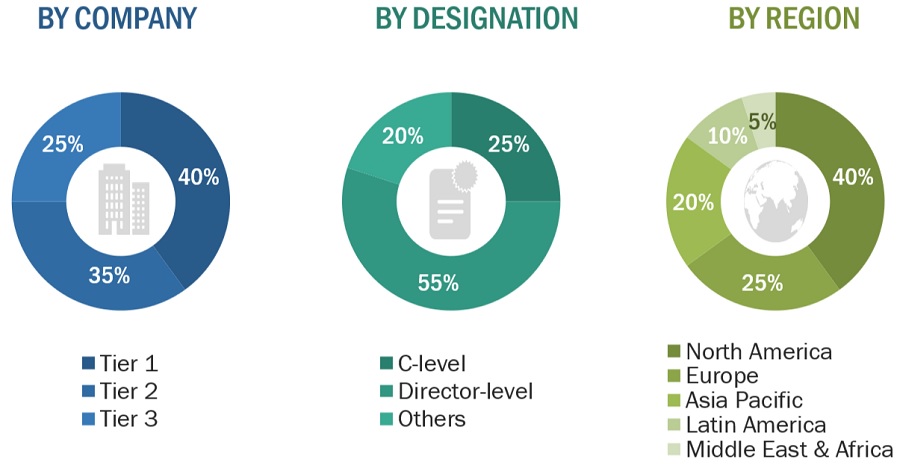
Tiers are defined based on a company’s total revenue. As of 2022: Tier 1= >USD 2 billion, Tier 2 = USD 50 million to USD 2 billion, and Tier 3= <USD 50 million.
To know about the assumptions considered for the study, download the pdf brochure
Market Size Estimation
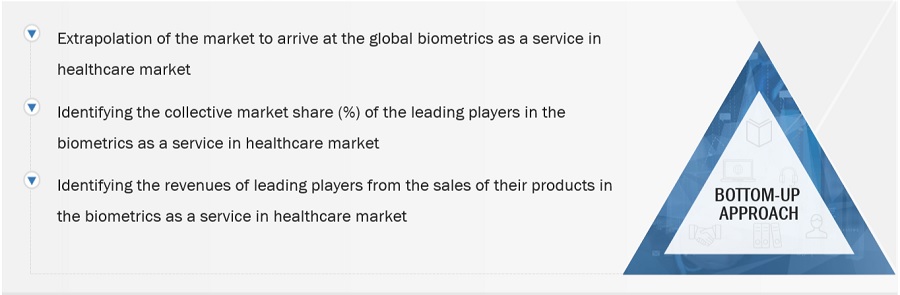
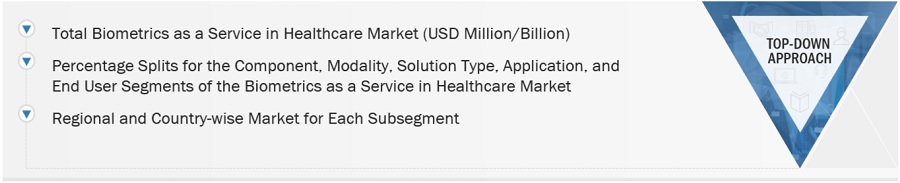
Both top-down and bottom-up approaches were used to estimate and validate the total size of the biometrics as a service in the healthcare market. These methods were also used extensively to estimate the size of various subsegments in the market. The research methodology used to estimate the market size includes the following:
- The key players in the industry and markets have been identified through extensive secondary research
- The industry’s supply chain and market size, in terms of value, have been determined through primary and secondary research processes.
- All percentage shares, splits, and breakdowns have been determined using secondary sources and verified through primary sources.
Global biometrics as a service in the healthcare market: Bottom-Up Approach
To know about the assumptions considered for the study, Request for Free Sample Report
Global biometrics as a service in the healthcare market: Top-Down Approach
Data Triangulation
After arriving at the overall market size—using the market size estimation processes as explained above—the market was split into several segments and sub-segments. To complete the overall market engineering process and arrive at the exact statistics of each market segment and subsegment, data triangulation and market breakdown procedures were employed, wherever applicable. The data was triangulated by studying various factors and trends from both the demand and supply sides in the provider, payer, and other industries.
Market Definition:
Healthcare biometrics refers to the application of biometric technology, such as fingerprint or facial recognition, in the healthcare sector for patient identification, access control, and data security purposes. Biometrics as a service (BaaS) in healthcare involves the delivery of biometric solutions through cloud-based platforms, allowing healthcare organizations to utilize biometric authentication and identification services on a scalable and subscription-based model without the need for extensive in-house infrastructure.
Key Stakeholders:
- Manufacturers of biometric services and software
- Manufacturers of biometric technologies
- Healthcare institutions (medical data centers)
- Research and clinical laboratories
- Distributors and suppliers of healthcare biometrics
- Health insurance payers
- Academic institutes and universities
- Educational platform providers
- Academic medical institutes
- Venture capitalists
- Government agencies
- Hospitals (public and private)
- Ambulatory surgery centers (ASCs)
- Rehabilitation centers
- Market research and consulting firms
Report Objectives
- To define, describe, and forecast the biometrics as a service in healthcare market on the basis of component, modality, solution type, application, end-user, and region
- To provide detailed information regarding the major factors influencing the market growth (such as drivers, restraints, opportunities, and challenges)
- To strategically analyze micromarkets1 with respect to individual growth trends, prospects, and contributions to the overall market
- To analyze the opportunities in the market for stakeholders and provide details of the competitive landscape for market leaders
- To forecast the size of the market segments with respect to four main regions—North America, Europe, Asia Pacific, Latin America and Middle East and Africa.
- To profile the key players and comprehensively analyze their market shares and core competencies
- To track and analyze competitive developments such as acquisitions, product launches, expansions, agreements, collaborations, and approvals in the global biometrics as a service in healthcare market.
Available Customizations
With the given market data, MarketsandMarkets offers customizations as per the company’s specific needs. The following customization options are available for the report:
Geographic Analysis
- Further breakdown of the Rest of the Asia Pacific market into South Korea, Australia, New Zealand, and others
- Further breakdown of the Rest of Europe market into Belgium, Russia, Switzerland, and others
Get the Full Biometrics As a Service in Healthcare Market Report
Full forecast, segment splits, and company analysis for all Biometrics As a Service in Healthcare Market.
- Canada Biometrics As a Service in Healthcare Market
- US Biometrics As a Service in Healthcare Market
- Germany Biometrics As a Service in Healthcare Market
- UK Biometrics As a Service in Healthcare Market
- France Biometrics As a Service in Healthcare Market
- China Biometrics As a Service in Healthcare Market
- Japan Biometrics As a Service in Healthcare Market
- India Biometrics As a Service in Healthcare Market
- Rest Of Europe Biometrics As a Service in Healthcare Market
- Rest Of Asia Pacific Biometrics As a Service in Healthcare Market
Need a Tailored Report?
Customize this report to your needs
Get 10% FREE Customization
Customize This Report
