
Mexico Biosensors Market (2025-2030)

The Mexico Biosensors Market was valued at $307.8 Million in 2025 and projected to reach to $386.6 Million by 2030, representing a compound annual growth rate of 4.7%. Mexico's biosensors market is positioned for steady growth as healthcare providers increasingly invest in diagnostic technologies to improve patient outcomes and operational efficiency.


| Market Size in | USD 26.32 MN |
| Market Forecast in | |
| CAGR | |
| Forecast Period | |
| Units Considered | Value (USD MN) |
Mexico Biosensors Market Trends and Insights
- This moderate growth trajectory reflects Mexico's expanding healthcare infrastructure and increasing adoption of diagnostic technologies across medical and industrial applications.
- Mexico's biosensors sector is driven by rising demand for point-of-care testing, chronic disease management, and food safety monitoring, supported by growing investments in healthcare modernization and biotechnology research. The Mexican biosensors market benefits from the country's strategic position within North America and its integration into regional supply chains.
- Mexico's pharmaceutical and medical device sectors are increasingly incorporating biosensor technologies to enhance diagnostic accuracy and patient outcomes.
- Between 2025 and 2030, Mexico is expected to see accelerated adoption in environmental monitoring and agricultural applications, complementing traditional healthcare uses.
- Government initiatives promoting healthcare accessibility and industrial automation are anticipated to further support market expansion throughout the forecast period..
Key Market Statistics
- CAGR (2025-2030) 4.7% CAGR
- Market Size, 2025 ~USD 307.8 Million
- Forecast, 2030 ~USD 386.6 Million
- Country Mexico
Mexico Biosensors Market Overview
Market Size & Growth :
Mexico's biosensors market is valued at USD 307.8 million in 2025, with projected growth to USD 386.6 million by 2030, representing a steady CAGR of 4.7% over the forecast period.
Healthcare Infrastructure Expansion :
Mexico's growing healthcare infrastructure and modernization of diagnostic facilities are driving increased adoption of biosensor technologies across hospitals, clinics, and diagnostic laboratories nationwide.
Moderate Growth Trajectory :
While Mexico's 4.7% CAGR is below the global average of 9.5%, it reflects a stable and sustainable market development driven by local healthcare needs and industrial applications.
Diagnostic Technology Adoption :
Increasing demand for point-of-care testing, glucose monitoring, and infectious disease diagnostics is accelerating biosensor adoption across Mexico's medical and industrial sectors.
Mexico Biosensors Market Dynamics
- The country's expanding middle class and rising healthcare expenditure are creating favorable conditions for biosensor adoption in both urban and emerging markets.
- Government initiatives to strengthen healthcare infrastructure and disease surveillance systems are expected to support market expansion through 2030. The Mexican biosensors market will benefit from growing demand for chronic disease management, infectious disease detection, and industrial quality control applications.
- Strategic partnerships between local healthcare providers and international biosensor manufacturers, combined with improving regulatory frameworks, will facilitate market penetration.
- However, price sensitivity and competition from established diagnostic methods may moderate growth rates compared to more developed markets..
Market Ecosystem
Biosensor Market Share: COMMERCIAL USE CASES ACROSS INDUSTRIES
| COMPANY | USE CASE DESCRIPTION | BENEFITS |
|---|---|---|
 |
Offer biosensors that are used for glucose monitoring, cardiac markers, and infectious diseases | Provides convenient testing by delivering quick and accurate results and helps people see the connections between their food choices and glucose data, and create healthier habits over time. |
 |
Offer biosensors that are used for clinical diagnostics, oncology, and metabolic monitoring | Provides diagnostic solutions for screening, early detection, evaluation, and monitoring of diseases. |
 |
Offer biosensors that are used for chronic disease monitoring, implantable biosensors | Offers continuous glucose monitoring solutions with daily glucose patterns. |
 |
Offer biosensors that are used for life science research, clinical diagnostics | Provides label-free, high-throughput, real-time affinity, specificity, and kinetic data for protein interaction analysis using multiplexed surface plasmon resonance (SPR) technology. |
 |
Offer biosensors that are used for food safety, environmental, and industrial monitoring | Serves a wide range of medical device applications requiring high-quality and easy-to-process medical-grade elastomers, adhesives, and parts. |
Logos and trademarks shown above are the property of their respective owners. Their use here is for informational and illustrative purposes only.
Related Ecosystem
Sensors And Control
Smart Home
Key Takeaways
- Mexico's biosensors market is valued at USD 307.8 million in 2025 and will reach USD 386.6 million by 2030 at a 4.7% CAGR.
- Mexico's healthcare modernization and chronic disease prevalence are primary drivers of biosensor adoption in diagnostic applications.
- Mexico's position within North America's supply chain creates opportunities for integration with regional medical device and pharmaceutical sectors.
- Mexico's emerging applications in food safety, environmental monitoring, and agricultural biosensing represent untapped growth segments through 2030.
Biosensors Market Report Scope
| Report Metric | Details |
|---|---|
| Base Year | 2025 |
| Fastest Growing Segment | HOME DIAGNOSTICS (Application) |
| Forecast Period | 2025–2030 |
| Growth Rate | CAGR of 9.5% from 2025 to 2030 |
| Largest Segment | NON-WEARABLE BIOSENSORS (Product) |
| Market Size Base Year (Billions) | ~USD 34.54 (2025) |
| Revenue Forecast (Billions) | ~USD 54.37 (2030) |
| Segments Covered | Type, Product, Application, Technology |
Mexico Biosensors Market Report Segmentation
4 segment dimensions are covered across the global market.
By Type
- Blood Gas & Electrolyte Detection
- Bodywear
- Cardiac Marker Detection
- Cholesterol Testing
- Coagulation Monitoring
- Embedded Devices
- Eyewear
- Footwear
- Glucose Monitoring
- Infectious Disease Detection
- Neckwear
- Other Wearable Biosensors
- Pregnancy Testing
- Sensor Patches
- Tumor/Cancer Marker Detection
- Urinalysis Testing
- Wristwear
By Product
- Non-Wearable Biosensors
- Wearable Biosensors
By Application
- Biodefense
- Environmental Monitoring
- Food & Beverage
- Food & Beverages
- Home Diagnostic
- Home Diagnostics
- Poc
- Research Lab
- Research Labs
By Technology
- Electrochemical
- Nanomechanical
- Optical
- Piezoelectric
- Thermal
Target Audience
- Medical Device Manufacturers : Biosensor and diagnostic device companies seeking to expand operations in Mexico need market sizing, competitive analysis, and growth forecasts to guide product development and market entry strategies.
- Healthcare Providers & Hospitals : Mexican hospitals and diagnostic centers require market trend data to make informed procurement decisions, evaluate technology investments, and plan diagnostic service expansion initiatives.
- Investment & Private Equity Firms : Investors evaluating opportunities in Mexico's healthcare technology sector need comprehensive market data, growth projections, and competitive intelligence to assess investment viability and returns.
- Pharmaceutical & Biotech Companies : Pharma firms developing companion diagnostics and point-of-care solutions need Mexico-specific market insights to identify partnership opportunities and commercialization pathways.
- Government & Healthcare Policy Makers : Mexican health authorities and policy organizations require market intelligence to inform healthcare infrastructure planning, regulatory frameworks, and technology adoption initiatives.
Key Companies in the Mexico Biosensors Market
| Company | HQ | Ownership | Strongest segments |
|---|---|---|---|
| TSI INC | China | Public Company | Tsingtao Beer (core and premium variants),Laoshan Beer,Hans Beer and other regional beers, |
| X-FAB | Germany | Public Company | Analog/Mixed-Signal Foundry (incl. automotive, industrial, consumer),MEMS and Sensor Platforms,Power (SiC, GaN, and related) and Silicon Photonics, |
| LENOVO | China | Public Company | Small form factor / desktop PCs as signage players,Embedded / dedicated media players and thin clients,Tablets and smart devices as kiosks / POS displays, |
| DANAHER CORPORATION | United States | Public Company | Biotechnology (bioprocessing and bioproduction solutions),Life Sciences (genomics, analytical instruments, and research tools),Diagnostics (clinical instruments, consumables, and software), |
| ABBOTT LABORATORIES | United States | Public Company | Diagnostic Products,Medical Devices,Nutritional Products, |
| MEDTRONIC | Ireland | Public Company | Cardiovascular Portfolio,Neuroscience Portfolio,Medical Surgical Portfolio, |
| BIO-RAD LABORATORIES, INC. | United States | Public Company | Clinical Diagnostics,Life Science Instruments and Systems,Life Science Reagents and Consumables, |
| DUPONT | United States | Public Company | Healthcare & Water Technologies,Protective Materials and Medical Packaging (TYVEK),Construction Solutions (TYVEK house wrap, STYROFOAM, CORIAN), |
| BIOSENSORS INTERNATIONAL GROUP, LTD. | Singapore | Private Company | Interventional Cardiology (DES, BMS, balloons, catheters),Critical Care (pressure transducers, CVCs, PA catheters, pacing, embolectomy),Cardiac Diagnostic (imaging and clinical applications), |
| DEXCOM, INC. | United States | Public Company | Dexcom G7 and G7 15 Day,Dexcom G6,Dexcom ONE+ and value-focused CGM, |
| MASIMO | United States | Private Company | SET and Rainbow SET pulse oximetry (including sensors and OEM),Brain function and hemodynamic monitoring,Hospital automation and connectivity (Patient SafetyNet, Iris, iSirona, Replica, UniView), |
| UNIVERSAL BIOSENSORS | Australia | Public Company | PT/INR coagulation strips and Xprecia devices,Sentia wine testing products,Laboratory and coagulation testing services, |
TSI INC
TSI Inc is a publicly traded company founded in 1903 and headquartered in China, employing 29,257 people. The company operates as a significant industrial enterprise with a long-established presence in its market.
X-FAB
X-FAB is a publicly traded semiconductor manufacturer founded in 1992 and headquartered in Germany, employing 4,300 people. The company specializes in analog and mixed-signal semiconductor fabrication services.
LENOVO
Lenovo is a publicly traded technology company founded in 1984 and based in China, operating as a major global manufacturer of computing devices and IT solutions.
DANAHER CORPORATION
Danaher Corporation is a publicly traded American conglomerate founded in 1969, employing 59,000 people across diversified business segments including life sciences, diagnostics, and environmental solutions.
ABBOTT LABORATORIES
Abbott Laboratories is a publicly traded pharmaceutical and healthcare company founded in 1888 and headquartered in the United States, employing 115,000 people globally. The company develops and manufactures pharmaceuticals, diagnostics, nutritional products, and medical devices.
MEDTRONIC
Medtronic is a publicly traded medical technology company founded in 1949 and headquartered in Ireland, employing 95,000 people. The company develops and manufactures medical devices and therapies across multiple healthcare specialties.
BIO-RAD LABORATORIES, INC.
Bio-Rad Laboratories, Inc. is a publicly traded company founded in 1952 and based in the United States, employing 7,450 people. The company manufactures and distributes life science research products and clinical diagnostics solutions.
DUPONT
DuPont is a publicly traded chemical and materials company founded in 2015 and headquartered in the United States, employing 15,000 people. The company produces specialty chemicals, advanced materials, and industrial solutions.
BIOSENSORS INTERNATIONAL GROUP, LTD.
Biosensors International Group, Ltd. is a private medical device company founded in 1990 and based in Singapore, employing 312 people. The company specializes in the development and manufacture of interventional cardiology devices.
DEXCOM, INC.
Dexcom, Inc. is a publicly traded medical technology company founded in 1999 and based in the United States, employing 11,050 people. The company specializes in continuous glucose monitoring systems for diabetes management.
MASIMO
Masimo is a privately held medical technology company founded in 1989 and based in the United States, employing 2,200 people. The company develops and manufactures noninvasive monitoring technologies and sensors.
UNIVERSAL BIOSENSORS
Universal Biosensors is a publicly traded diagnostics company founded in 2001 and based in Australia, employing 76 people. The company develops and manufactures rapid diagnostic test devices.
Reasons to Buy this Report
- Market-Specific Sizing & Forecasts : Access precise market valuation data for Mexico (USD 307.8M in 2025) with detailed 5-year forecasts, enabling accurate budget allocation and investment planning specific to the Mexican market.
- Competitive Landscape Intelligence : Understand Mexico-specific competitive dynamics, local player strategies, and market entry barriers to identify partnership opportunities and competitive positioning within the Mexican biosensors sector.
- Growth Driver Analysis : Identify key growth catalysts unique to Mexico including healthcare infrastructure expansion, regulatory changes, and adoption trends in diagnostic technologies to capitalize on emerging opportunities.
- Segment & Application Insights : Gain detailed breakdown of Mexico's biosensors market by application type, end-user segments, and technology categories to target high-potential customer segments and product categories.
- Strategic Market Entry Planning : Leverage Mexico-focused market intelligence to develop localized go-to-market strategies, distribution channel recommendations, and pricing models aligned with local market conditions and customer preferences.
Frequently asked questions
What is the current size of Mexico's biosensors market?
Mexico's biosensors market is estimated at USD 307.8 million in 2025, with expectations to grow to USD 386.6 million by 2030.
What is the projected growth rate for biosensors in Mexico?
Mexico's biosensors market is projected to grow at a compound annual growth rate (CAGR) of 4.7% from 2025 to 2030.
What are the main drivers of biosensor adoption in Mexico?
Key drivers include Mexico's expanding healthcare infrastructure, rising chronic disease prevalence, demand for point-of-care diagnostics, food safety requirements, and government healthcare modernization initiatives.
Which applications are growing fastest in Mexico's biosensors market?
Mexico is experiencing accelerated growth in point-of-care testing, chronic disease management, food safety monitoring, environmental sensing, and agricultural biosensor applications.
How does Mexico's biosensors market compare to North America?
Mexico's 4.7% CAGR is more moderate than the global 9.5% CAGR, reflecting Mexico's developing market status, though its North American integration provides competitive advantages for regional supply chain participation.
RESEARCH METHODOLOGY
The study involved major activities in estimating the current size of the biosensors market. Exhaustive secondary research was done to collect information on biosensors. The next step was to validate these findings, assumptions, and sizing with industry experts across the value chain using primary research. Different approaches, such as top-down and bottom-up, were employed to estimate the total market size. After that, the market breakup and data triangulation procedures were used to estimate the market size of the segments and subsegments of the biosensor.
Secondary Research
Various secondary sources were referred to in the secondary research process to identify and collect information relevant to this study. Secondary sources included annual reports, press releases, and investor presentations of companies; white papers, certified publications, and articles from recognized authors; directories; and databases. Secondary research was mainly carried out to obtain critical information about the industry’s supply chain, value chain, the pool of key players, and market classification and segmentation according to industry trends, geographic markets, and key developments from both market- and technology-oriented perspectives. Secondary sources included corporate filings (such as annual reports, investor presentations, and financial statements); trade, business, and professional associations; white papers; IoT technologies journals and certified publications; articles by recognized authors; gold- and silver-standard websites; directories; and databases. Data was also collected from secondary sources, such as the Semiconductor Industry Association, Global Semiconductor Alliance, and Taiwan Semiconductor Industry Association.
Secondary research was mainly used to obtain critical information about the industry's supply chain and value chain, the total pool of key players, market classification and segmentation according to industry trends to the bottom-most level, geographic markets, and key developments from both the market and technology-oriented perspectives. Secondary data has been gathered and analyzed to determine the overall market size, which has also been validated by primary research.
Primary Research
Extensive primary research was conducted after understanding and analyzing the current scenario of the biosensors market through secondary research. Primary interviews were held with key opinion leaders from the demand and supply sides in four key regions: North America, Europe, Asia Pacific, and the rest of the world. Nearly 25% of the primary interviews were held with the demand side and 75% with the supply side. The primary data was gathered primarily through telephonic interviews, which were 80% of the total primary interviews. Surveys and e-mails were also utilized to gather data.
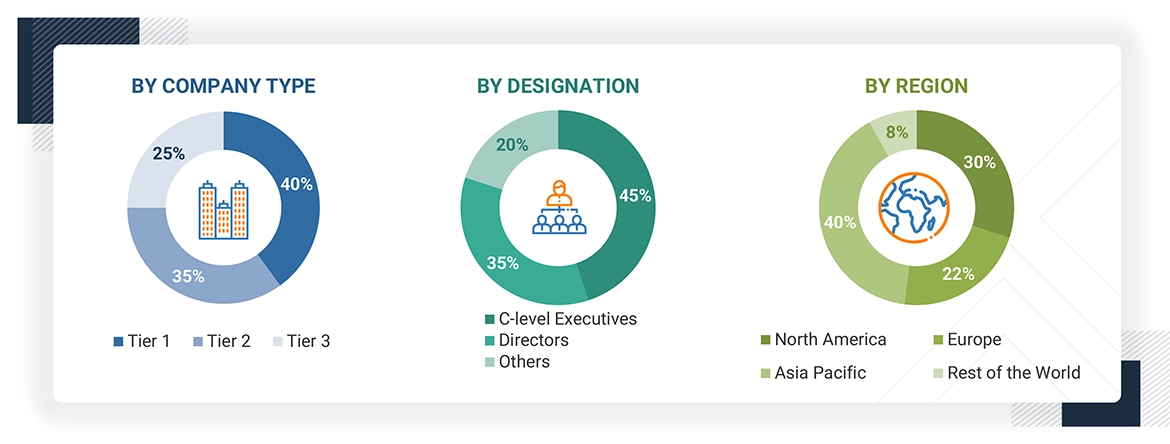
Note: Three tiers of companies are defined based on their total revenue as of 2024; tier 1: revenue more than or equal to USD 500 million, tier 2: revenue between USD 100 million and USD 500 million, and tier 3: revenue less than or equal to USD 100 million. Other designations include sales and marketing executives, researchers, and members of various biosensor organizations.
To know about the assumptions considered for the study, download the pdf brochure
Market Size Estimation
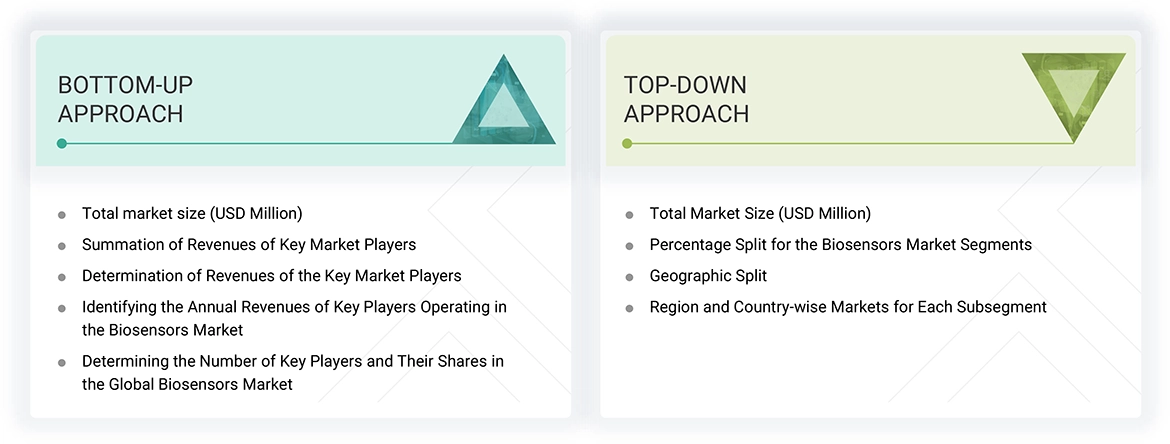
In this report, both the top-down and bottom-up approaches were implemented to estimate and validate the size of the biosensors market and various other dependent submarkets. Secondary research identified key players in this market, and their market shares in the respective regions were determined through primary and secondary research.
This entire research methodology included the study of annual and financial reports of top companies, as well as interviews with experts (such as CEOs, VPs, directors, and marketing executives) for key insights (both quantitative and qualitative). All percentage shares, splits, and breakdowns were determined using secondary sources and verified through primary sources. All the possible parameters that affect the market covered in this research study were accounted for, viewed in detail, verified through primary research, and analyzed to obtain the final quantitative and qualitative data. This data was consolidated and supplemented with detailed inputs and analysis from MarketsandMarkets and presented in this report. The figures below show the overall market size estimation process employed for this study.
Bottom-Up Approach
- Key players in the biosensors market were identified through secondary research, and their global market share was determined through primary and secondary research.
- The research methodology included a study of annual and quarterly financial reports, regulatory filings of major market players (public), and interviews with industry experts for detailed market insights.
- All biosensor penetration rates, percentage shares, splits, and breakdowns for the biosensors market were determined using secondary sources and verified through primary sources.
- All key macroindicators influencing the revenue growth of market segments and subsegments were considered, examined in detail, validated through primary research, and analyzed to produce accurate quantitative and qualitative data.
- The market data gathered was consolidated, enhanced with detailed inputs, analyzed, and presented in this report.
Top-Down Approach
- Focusing initially on the top-line investments and expenditures made in the biosensor ecosystem, splitting the key market areas into component, type, product, technology, and region, and listing key developments
- Identifying all leading players and end users in the biosensors market based on product, type, technology, and application through secondary research and fully verifying them through a brief discussion with industry experts
- Analyzing revenues, product mix, geographic presence, and key applications served by all identified players to estimate and arrive at percentage splits for all key segments
- Discussing splits with industry experts to validate the information and identify key growth pockets across all key segments
- Breaking down the total market based on verified splits and key growth pockets across all segments
Biosensors Market : Top-Down and Bottom-Up Approach
Data Triangulation
After arriving at the overall size of the biosensors market from the estimation process explained above, the market was split into several segments and subsegments. The data triangulation and market breakdown procedures were employed (wherever applicable) to complete the overall market engineering process and arrive at the exact statistics for all segments and subsegments. The data was triangulated by studying various factors and trends from both the demand and supply sides. The biosensors market size was validated using both top-down and bottom-up approaches.
Market Definition
Biosensors are semiconductor devices designed to detect biological responses using transducers that convert these responses into electrical signals. They achieve this by combining a biological recognition element (bioreceptor) with a physicochemical transducer. The bioreceptor specifically interacts with a particular biological analyte. The transducer then converts this interaction into a measurable signal, such as an electrical current, optical change, mass change, or thermal signal, which relates to the analyte’s concentration. Common bioreceptors include enzymes, antibodies, nucleic acids, cells, or microorganisms. They are used as analytical tools to deliver qualitative or quantitative results in detecting protein or nucleic acid targets.
Key Stakeholders
- Semiconductor Industry Association
- Global Semiconductor Alliance
- European Semiconductor Industry Association
- Taiwan Semiconductor Industry Association
- International Diabetes Federation (IDF)
- American Diabetes Association (ADA)
- National Biodefense Analysis and Countermeasures Center (NBACC).
- IEEE
- Educational Institutions Research/White Papers (Published by Communication Organizations)
- Investor Presentations and Annual Reports of Key Market Players
Report Objectives
- To define, describe, and forecast the biosensors market, by type, product, technology, application, and region, in terms of value
- To define, describe, and forecast the global biosensors market by product, in terms of volume
- To forecast the sizes of various segments with respect to the four major regions: North America, Europe, Asia Pacific, and Rest of the World (RoW)
- To provide a detailed analysis of the biosensors supply chain
- To strategically analyze the micromarkets with respect to individual growth trends and prospects, and their contributions to the total market
- To analyze competitive developments, such as expansions, agreements, partnerships, acquisitions, product developments, and research & development (R&D), in the biosensors market
- To analyze the opportunities for market players and provide details of the market's competitive landscape
- To benchmark the market players using the proprietary company evaluation matrix framework, which analyzes the market players on various parameters within the broad categories of business strategy excellence and strength of product portfolios
- To strategically profile the key players and comprehensively analyze their market positions in terms of ranking and core competencies, along with a detailed competitive landscape of the market
- To analyze the supply chain, ecosystem, trend/disruptions impacting customer business, technologies, trade & patent scenario, key conferences & events, regulations, and conduct Porter’s five force analysis
Available customizations:
With the market data given, MarketsandMarkets offers customizations according to the company’s specific needs. The following customization options are available for the report:
Company Information
- Detailed analysis and profiling of additional market players (up to 7)
Get the Full Biosensors Market Report
Full forecast, segment splits, and company analysis for all Biosensors Market.
- Rest Of Europe Biosensors Market
- China Biosensors Market
- Japan Biosensors Market
- India Biosensors Market
- Rest Of Asia Pacific Biosensors Market
- Saudi Arabia Biosensors Market
- UAE Biosensors Market
- Rest Of GCC Countries Biosensors Market
- US Biosensors Market
- Canada Biosensors Market
- Germany Biosensors Market
- UK Biosensors Market
- France Biosensors Market
- Italy Biosensors Market
- Itay Biosensors Market
Need a Tailored Report?
Customize this report to your needs
Get 10% FREE Customization
Customize This Report
