
US Biosimulation Market (2026-2031)

The US Biosimulation Market was valued at $1894.7 Million in 2026 and projected to reach to $3993.1 Million by 2031, representing a compound annual growth rate of 16.1%. The US biosimulation market is poised for sustained expansion driven by the pharmaceutical industry's need to reduce development costs and accelerate time-to-market for new therapeutics.


| Market Size in | USD 26.32 MN |
| Market Forecast in | |
| CAGR | |
| Forecast Period | |
| Units Considered | Value (USD MN) |
US Biosimulation Market Trends and Insights
- This expansion reflects the US healthcare sector's increasing adoption of computational modeling and simulation technologies to accelerate drug development and reduce time-to-market.
- The US market benefits from strong pharmaceutical R&D investment, advanced regulatory frameworks, and widespread integration of biosimulation tools across major biopharma companies. Driving this growth, the US market is witnessing heightened demand for predictive analytics in clinical trial design, personalized medicine applications, and regulatory compliance optimization.
- US-based pharmaceutical and biotechnology firms are leveraging biosimulation to enhance decision-making in preclinical and clinical phases, thereby reducing development costs and improving success rates.
- The US regulatory environment, particularly FDA guidance on model-informed drug development, continues to incentivize adoption among US healthcare innovators. By 2031, the US biosimulation market is expected to nearly double in value, reflecting sustained investment in digital health infrastructure and computational biology capabilities across the US healthcare ecosystem..
Key Market Statistics
- CAGR (2026-2031) 16.1% CAGR
- Market Size, 2026 ~USD 1894.7 Million
- Forecast, 2031 ~USD 3993.1 Million
- Country US
US Biosimulation Market Overview
Market Valuation Growth :
The US biosimulation market is valued at $1,894.7 million in 2026 and is projected to reach $3,993.1 million by 2031, representing a robust 16.1% CAGR over the forecast period.
Strong R&D Investment :
US pharmaceutical and biotechnology companies are significantly increasing computational modeling investments to accelerate drug development timelines, reduce clinical trial costs, and improve regulatory approval rates.
Regulatory Advancement :
The FDA's growing acceptance of in silico modeling and simulation data in drug submissions is driving adoption across US-based pharmaceutical companies and contract research organizations.
Technology Integration :
Advanced AI, machine learning, and cloud-based platforms are enabling US healthcare organizations to enhance biosimulation capabilities and streamline drug discovery and development processes.
US Biosimulation Market Dynamics
- Increasing regulatory acceptance of computational modeling, combined with substantial R&D budgets from major US pharmaceutical companies, creates a favorable environment for market growth.
- The integration of artificial intelligence and machine learning technologies is enhancing simulation accuracy and predictive capabilities. Looking ahead, the US market will benefit from growing adoption among mid-sized biotech firms and contract research organizations seeking competitive advantages.
- Investment in digital health infrastructure and personalized medicine approaches will further propel biosimulation adoption.
- Strategic partnerships between software developers and pharmaceutical companies will continue to drive innovation and market penetration through 2031..
Market Ecosystem
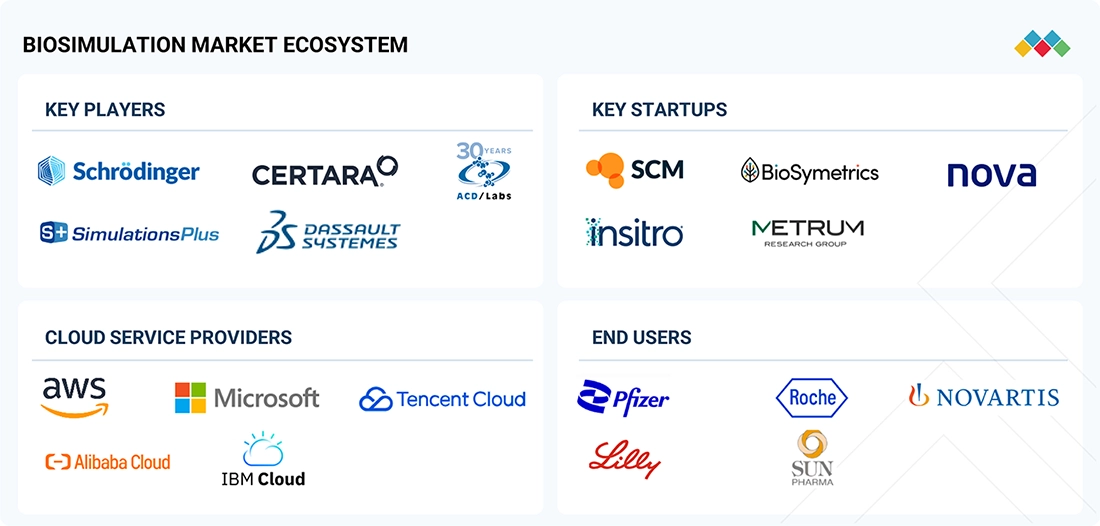
BIOSIMULATION MARKET: COMMERCIAL USE CASES ACROSS INDUSTRIES
| COMPANY | USE CASE DESCRIPTION | BENEFITS |
|---|---|---|
 |
PBPK, QSP, pharmacometrics, and MIDD platforms for drug development and regulatory decision-making. | Faster dose optimization, lower development risk, accelerated approvals. |
 |
Virtual twin technology and biological system modeling for in silico research. | Reduced experimental costs, improved collaboration, faster innovation. |
 |
AI-driven molecular modeling and computational drug discovery. | Faster lead optimization, improved candidate quality, higher R&D productivity. |
 |
PBPK, PK/PD, toxicology, and clinical trial simulation solutions. | Better outcome prediction, optimized trial design, reduced late-stage failures. |
 |
Computational chemistry and molecular property prediction tools. | Improved compound selection, reduced laboratory testing, enhanced research efficiency. |
Logos and trademarks shown above are the property of their respective owners. Their use here is for informational and illustrative purposes only.
Related Ecosystem
Healthcare It
Key Takeaways
- The US biosimulation market will grow from $1,894.7M (2026) to $3,993.1M (2031), representing a 16.1% CAGR.
- US pharmaceutical companies are increasingly adopting biosimulation for clinical trial optimization and regulatory strategy.
- FDA guidance on model-informed drug development is a key driver of biosimulation adoption across the US market.
- The US market's growth is supported by substantial R&D investment and advanced computational infrastructure in the healthcare sector.
Biosimulation Market Report Scope
| Report Metric | Details |
|---|---|
| Base Year | 2026 |
| Fastest Growing Segment | DATA ANALYSIS & INTERPRETATION (Type) |
| Forecast Period | 2026–2031 |
| Growth Rate | CAGR of 16.7% from 2026 to 2031 |
| Largest Segment | SOFTWARE (Offering) |
| Market Size Base Year (Billions) | ~USD 4.27 (2026) |
| Revenue Forecast (Billions) | ~USD 9.24 (2031) |
| Segments Covered | Offering, Type, Phase Of Development |
US Biosimulation Market Report Segmentation
3 segment dimensions are covered across the global market.
By Offering
- Services
- Software
By Type
- Consulting & Advisory
- Data Analysis & Interpretation
- Implementation, Training, And Support
By Phase Of Development
- Commercial & Market Access
- Drug Discovery
- Early Clinical Development
- Late Clinical Development
- Preclinical Development
- Regulatory
US: BIOSIMULATION MARKET, BY END USER, 2024–2031
| Segment | 2024 | 2025 | 2026 | 2027 | 2028 | 2029 | 2030 | 2031 | CAGR (%) |
|---|---|---|---|---|---|---|---|---|---|
| ACADEMIC & RESEARCH INSTITUTES | 145.3 | 164.9 | 187.5 | 213.5 | 243.6 | 278.6 | 319.2 | 366.4 | 14.3 |
| CONTRACT RESEARCH ORGANIZATIONS | 283.5 | 327.6 | 379.3 | 439.9 | 511 | 595.1 | 694.3 | 811.5 | 16.4 |
| OTHER END USERS | 86.9 | 97.5 | 109.4 | 122.8 | 137.9 | 154.9 | 173.9 | 195.3 | 12.3 |
| PHARMACEUTICAL & BIOTECHNOLOGY COMPANIES | 842 | 975 | 1131 | 1314.1 | 1529.6 | 1785 | 2086.6 | 2443.8 | 16.7 |
| REGULATORY BODIES | 67 | 76.5 | 87.5 | 100.2 | 115 | 132.3 | 152.5 | 176.2 | 15 |
| TOTAL | 1424.7 | 1641.5 | 1894.7 | 2190.6 | 2537.1 | 2945.9 | 3426.6 | 3993.1 | 16.1 |
Target Audience
- Pharmaceutical Companies : US-based pharma executives need market intelligence to benchmark R&D investments, evaluate biosimulation adoption strategies, and optimize drug development timelines against competitive standards.
- Biotech & CRO Leaders : Biotechnology firms and contract research organizations require US market data to assess service offerings, identify partnership opportunities, and justify investments in simulation capabilities.
- Software & Technology Vendors : Biosimulation software developers and IT solution providers need US market insights to refine product positioning, identify customer segments, and forecast revenue opportunities in the American market.
- Healthcare Investors : Venture capitalists, private equity firms, and institutional investors need detailed US market analysis to evaluate investment opportunities, assess portfolio company performance, and identify acquisition targets.
- Regulatory & Policy Advisors : Regulatory consultants and healthcare policy professionals require US-specific market data to advise clients on FDA trends, competitive positioning, and strategic implications of biosimulation adoption.
Key Companies in the US Biosimulation Market
| Company | HQ | Ownership | Strongest segments |
|---|---|---|---|
| SANOFI | France | Public Company | Pediatric and combination vaccines (polio, pertussis, Hib, hexavalent),Other vaccines (RSV, hepatitis A, typhoid, yellow fever, rabies),Immunology and inflammation therapies, |
| CERTARA | United States | Public Company | Biosimulation platforms (Simcyp, Phoenix, NLME, Pirana),Regulatory data and submission software (Pinnacle 21, GlobalSubmit, CoAuthor, Metadata Repository),Discovery and informatics solutions (Chemaxon suite, D360, design tools), |
| DASSAULT SYSTÈMES | France | Public Company | 3D Modeling (CATIA, SOLIDWORKS, GEOVIA, BIOVIA),PLM & Collaboration (ENOVIA, CENTRIC PLM, 3DEXCITE, 3DEXPERIENCE collaboration),Simulation & Manufacturing (SIMULIA, DELMIA, 3DVIA), |
| SCHRöDINGER, INC. | United States | Public Company | Software,Drug Discovery – Collaborations (e.g., Novartis),Drug Discovery – Internal Pipeline, |
| SIMULATIONS PLUS | United States | Public Company | PBPK/PKPD and biopharmaceutics software (GastroPlus, DDDPlus, MembranePlus),QSP and disease-systems platforms (DILIsym, NAFLDsym, ILDsym, IPFsym, RENAsym, MITOsym, OBESITYsym, Thales),ADMET Predictor, MedChem Designer and discovery-oriented AI/ML tools, |
| PHYSIOMICS PLC | United Kingdom | Public Company | Oncology modeling & simulation (Virtual Tumour–centric consulting),Broader quantitative pharmacology & computational biology services,Personalized medicine technology and related analytics, |
| INSTEM PLC | United Kingdom | Private Company | Research study management software (discovery, preclinical, early clinical),Regulatory submission and SEND-compliant dataset solutions,In silico and data insights / predictive analytics, |
SANOFI
Sanofi is a French multinational pharmaceutical company founded in 1994 with 74,846 employees. As a public company, it operates globally in the development, manufacturing, and distribution of medicines and vaccines.
CERTARA
Certara is a United States-based public company founded in 2008 with 1,546 employees. It provides software and services for drug development, including modeling, simulation, and regulatory consulting.
DASSAULT SYSTÈMES
Dassault Systèmes is a French software company founded in 1981 with 25,724 employees. As a public company, it develops 3D design, simulation, and digital lifecycle management solutions for various industries.
SCHRöDINGER, INC.
Schrödinger, Inc. is a United States-based public company founded in 1990 with 850 employees. It provides computational chemistry and molecular simulation software platforms for drug discovery and materials science.
SIMULATIONS PLUS
Simulations Plus is a United States-based public company founded in 1996 with 213 employees. It develops software for drug development, including pharmacokinetic and pharmacodynamic modeling and simulation.
PHYSIOMICS PLC
Physiomics PLC is a United Kingdom-based public company founded in 2001 with 10 employees. It specializes in computational biology and systems pharmacology for drug development.
INSTEM PLC
Instem PLC is a United Kingdom-based private company founded in 1969 with 510 employees. It provides software and services for data management and analysis in preclinical and clinical research.
Reasons to Buy this Report
- Market Size & Growth Validation : Obtain precise US market valuation data ($1,894.7M in 2026) and verified growth projections through 2031, enabling accurate financial forecasting and investment decision-making for US-focused strategies.
- Competitive Landscape Intelligence : Understand the competitive positioning of US pharmaceutical and biotech companies leveraging biosimulation technologies, identifying market leaders and emerging players in the American market.
- Regulatory & Adoption Insights : Gain detailed analysis of FDA regulatory trends, approval pathways for in silico data, and adoption rates among US pharmaceutical companies to inform compliance and market entry strategies.
- Investment & Partnership Opportunities : Identify high-growth segments, emerging technologies, and strategic partnership opportunities within the US biosimulation ecosystem for venture capital, M&A, and business development initiatives.
- Technology & Innovation Trends : Access comprehensive insights on AI/ML integration, cloud-based platforms, and digital health convergence specific to the US market, enabling technology roadmap alignment and innovation planning.
Frequently asked questions
What is the current size of the US biosimulation market?
The US biosimulation market is valued at $1,894.7 million in 2026 and is projected to reach $3,993.1 million by 2031.
What is the growth rate of the US biosimulation market?
The US biosimulation market is expected to grow at a compound annual growth rate (CAGR) of 16.1% from 2026 to 2031.
What are the primary drivers of biosimulation adoption in the US?
Key drivers include FDA guidance on model-informed drug development, the need to reduce clinical trial costs, accelerate drug development timelines, and support personalized medicine initiatives across US healthcare organizations.
How is the US biosimulation market expected to evolve by 2031?
By 2031, the US market is anticipated to more than double in value, driven by increased integration of computational modeling in drug development workflows and regulatory acceptance of biosimulation data.
Which sectors are driving growth in the US biosimulation market?
Pharmaceutical and biotechnology companies in the US are the primary drivers, leveraging biosimulation for preclinical research, clinical trial design, and regulatory submissions to enhance efficiency and reduce development risk.
RESEARCH METHODOLOGY
This research study involved the extensive use of both primary and secondary sources. It involved the analysis of various factors affecting the industry to identify the segmentation types, industry trends, key players, the competitive landscape of market players, and key market dynamics such as drivers, opportunities, challenges, restraints, and key player strategies.
Secondary Research
This research study extensively utilized secondary sources, including directories, databases such as Dun & Bradstreet, Bloomberg Businessweek, and Factiva, as well as white papers, annual reports, and companies' house documents. The secondary research aimed to gather and analyze information for a comprehensive and commercially focused study of the biosimulation market, encompassing technical aspects and market dynamics. It also facilitated the identification of key players, market classification, industry trends, geographical markets, and significant market-related developments. Additionally, a database of prominent industry leaders was compiled through secondary research.
Primary Research
In the primary research process, various supply-side and demand-side sources were interviewed to obtain qualitative and quantitative information for this report. Primary sources from the supply side included industry experts such as CEOs, vice presidents, marketing and sales directors, technology & innovation directors, engineers, and related key executives from various companies and organizations operating in the biosimulation market. Primary sources from the demand side included personnel from pharmaceutical & biotechnology companies, contract research organizations, academic & research institutes, and regulatory bodies.
A breakdown of the primary respondents is provided below:
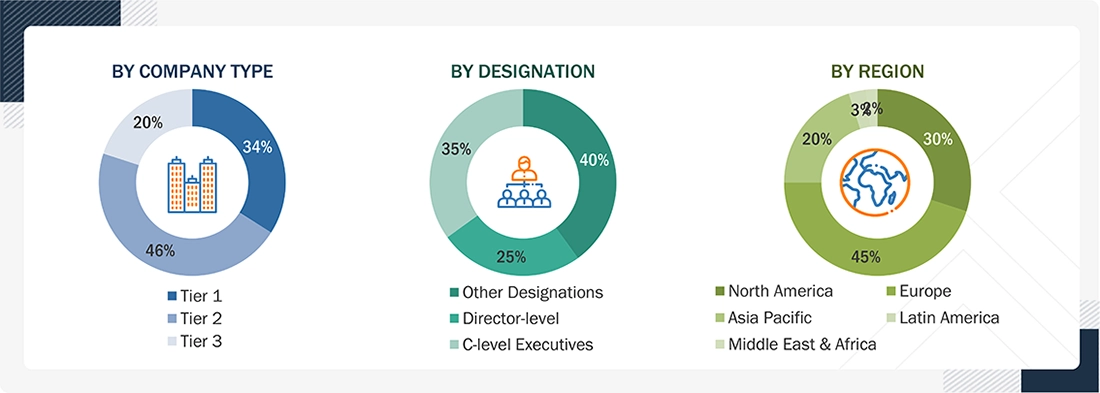
Note: Tiers are defined based on a company’s total revenue, as of 2025: Tier 1 = >USD 1 billion, Tier 2 = USD 500 million to USD 1 billion, and Tier 3 = <USD 500 million. Other designations include sales managers, marketing managers, and product managers.
To know about the assumptions considered for the study, download the pdf brochure
Market Size Estimation
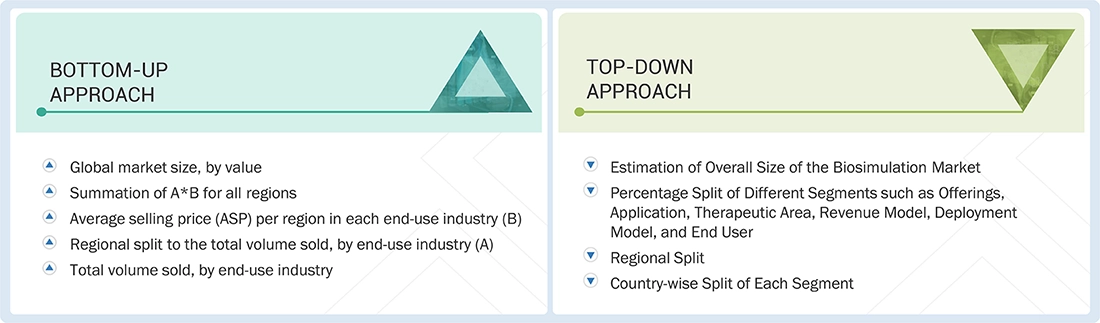
The total size of the biosimulation market was determined after data triangulation through the two approaches mentioned below. After the completion of each approach, the weighted average of these approaches was taken based on the level of assumptions used in each approach.
Biosimulation Market : Top-Down and Bottom-Up Approach
Data Triangulation
The size of the biosimulation market was estimated through segmental extrapolation using the bottom-up approach. The methodology used is as follows: -
- Revenues for individual companies were gathered from public sources and databases.
- Shares of leading players in the biosimulation market were gathered from secondary sources to the extent available. In certain cases, shares of biosimulation businesses were ascertained after a detailed analysis of various parameters, including product portfolios, market positioning, selling price, and geographic reach & strength.
- Individual shares or revenue estimates were validated through interviews with experts.
- The total revenue in the biosimulation market was determined by extrapolating the market share data of major companies.
Market Definition
Biosimulation is a technology that employs computer-aided simulations to replicate and predict the dynamics of biological processes and systems. It uses modern computational power to analyze and model biological behavior through mathematical expressions. Biosimulation, often referred to as Computer-aided Drug Design (CADD), plays a critical role in various stages of drug discovery and development. Leveraging AI and machine learning, biosimulation enhances the evaluation of drug safety, efficacy, and interactions, ultimately streamlining clinical trial design and accelerating time-to-market for new therapeutics.
Key Stakeholders
- Clinical/Physician centers
- Biosimulation vendors
- Clinical research organizations
- Pharmaceutical/Biopharmaceutical companies
- Research & development (R&D) companies
- Business research and consulting service providers
- Medical research laboratories
- Academic medical centers/Universities/Hospitals
- Regulatory agencies
- Clinical researchers
- Accountable care organizations
- Investors and venture capitalists
Report Objectives
- To define, describe, and forecast the biosimulation market based on offering, phase of development, modality, application, therapeutic area, deployment mode, end user, and region
- To provide detailed information regarding the major factors influencing the market growth (such as drivers, restraints, opportunities, and challenges)
- To analyze the micromarkets with respect to individual growth trends, prospects, and contributions to the overall biosimulation market
- To analyze the opportunities for stakeholders and provide details of the competitive landscape for market leaders
- To forecast the size of the market segments with respect to five main regions: North America, Europe, Asia Pacific, Latin America, and the Middle East & Africa
- To profile the key players and analyze their market shares and core competencies
- To track and analyze competitive developments such as product launches & approvals, partnerships, agreements, and collaborations in the overall biosimulation market
- To benchmark players within the market using the proprietary "Competitive Leadership Mapping" framework, which analyzes market players on various parameters within the broad categories of business and product strategy
Available customizations:
With the given market data, MarketsandMarkets offers customizations as per your company’s specific needs. The following customization options are available for the report:
- Company information
- Detailed analysis and profiling of additional market players (up to 5)
Regional Analysis
- Further breakdown of the Rest of Asia Pacific biosimulation market into Taiwan, New Zealand, Thailand, Singapore, Malaysia, and other countries
- Further breakdown of the Rest of Europe biosimulation market into Russia, Austria, Finland, Sweden, Turkey, Norway, Poland, Portugal, Romania, Denmark, and other countries
Get the Full Biosimulation Market Report
Full forecast, segment splits, and company analysis for all Biosimulation Market.
- Canada Biosimulation Market
- Germany Biosimulation Market
- France Biosimulation Market
- UK Biosimulation Market
- Italy Biosimulation Market
- Spain Biosimulation Market
- China Biosimulation Market
- Japan Biosimulation Market
- India Biosimulation Market
- Australia Biosimulation Market
- South Korea Biosimulation Market
- Brazil Biosimulation Market
- Mexico Biosimulation Market
- Saudi Arabia Biosimulation Market
- UAE Biosimulation Market
- South Africa Biosimulation Market
Need a Tailored Report?
Customize this report to your needs
Get 10% FREE Customization
Customize This Report
