
GCC Countries Blockchain Market (2025-2030)

The GCC Countries Blockchain Market was valued at $1591.7 Million in 2025 and projected to reach to $20315 Million by 2030, representing a compound annual growth rate of 66.4%.
GCC Countries Blockchain Market Trends and Insights
- This represents a compound annual growth rate (CAGR) of 66.4%, significantly outpacing global trends and reflecting the region's strategic commitment to digital transformation and Web3 adoption.
- GCC Countries are positioning themselves as leading blockchain hubs in the Middle East, driven by substantial government investments, regulatory clarity, and enterprise adoption across financial services, supply chain, and digital asset sectors. GCC Countries' blockchain ecosystem is characterized by strong institutional support and cross-border collaboration among member states.
- The region's oil-rich economies are leveraging blockchain technology to diversify revenue streams, enhance operational efficiency, and establish competitive advantages in emerging digital markets.
- By 2030, GCC Countries is expected to capture a significant share of regional blockchain infrastructure, with applications spanning cryptocurrency exchanges, smart contracts, tokenization of assets, and decentralized finance (DeFi) platforms. The accelerated growth trajectory in GCC Countries reflects increasing venture capital inflows, talent migration, and technology partnerships with global blockchain leaders.
- Enterprise adoption in GCC Countries is particularly strong among financial institutions and government agencies seeking to modernize legacy systems and improve transparency in cross-border transactions..
Key Market Statistics
- CAGR (2025-2030) : 66.4% CAGR
- Market Size, 2025 : ~USD 1591.7
- Forecast, 2030 : ~USD 20315
- Country : GCC Countries
GCC Countries Blockchain Market Overview
Exceptional Regional Growth :
GCC Countries' blockchain market is expanding at 66.4% CAGR, outpacing the global rate of 64.2%, demonstrating the region's accelerated digital transformation momentum and strategic Web3 investments.
Rapid Market Expansion :
Market valuation is projected to surge from USD 1,591.7 million in 2025 to USD 20,315.0 million by 2030, representing a 12.8x increase over five years, driven by government initiatives and enterprise adoption.
Strategic Digital Leadership :
GCC nations are positioning themselves as global blockchain hubs through regulatory frameworks, fintech innovation, and cryptocurrency integration, attracting international blockchain enterprises and talent.
Diversified Sector Applications :
Blockchain adoption spans financial services, supply chain management, government services, and real estate sectors, with significant investments from sovereign wealth funds and private enterprises across the region.
GCC Countries Blockchain Market Dynamics
The GCC blockchain market is poised for transformative growth through 2030, driven by government-backed digital economy initiatives, substantial capital investments, and regulatory clarity that positions the region as a competitive blockchain destination. Countries like UAE and Saudi Arabia are establishing blockchain innovation zones and implementing Web3-friendly policies that attract global enterprises and startups. Enterprise adoption is accelerating across banking, logistics, and public administration sectors, with major financial institutions integrating blockchain for cross-border payments and settlement efficiency. The region's strategic focus on reducing oil dependency through digital transformation creates sustained momentum for blockchain infrastructure development. Sovereign wealth funds are actively investing in blockchain ventures, while government procurement increasingly favors blockchain-based solutions. The convergence of regulatory support, technological infrastructure investment, and regional collaboration through GCC frameworks will solidify the market's position as a critical global blockchain ecosystem by 2030.
Related Ecosystem
Software And Services
- Natural Language Processing (NLP)
- Machine Learning
- Supply Chain Management
- Predictive Analytics
- Image Sensors
- International Business Machines Corporation
- MICROSOFT CORPORATION
- Oracle Corporation
- SAP SE
-
Amazon.com, Inc.
Key Takeaways
- GCC Countries blockchain market will grow from $1,591.7M (2025) to $20,315.0M (2030) at a 66.4% CAGR, driven by government initiatives and enterprise adoption.
- GCC Countries is emerging as a regional blockchain leader with strong regulatory frameworks and institutional support from member state governments.
- Financial services, supply chain management, and digital asset tokenization are primary growth drivers in GCC Countries blockchain adoption.
- GCC Countries attracts significant venture capital and global technology partnerships, positioning the region as a competitive blockchain hub by 2030.
GCC Countries Blockchain Market Report Scope
| Report Metric | Details |
|---|---|
| Base Year | 2025 |
| Forecast Period | 2025–2039 |
| Growth Rate | CAGR of 64.2% from 2025 to 2039 |
| Market Size Base Year | 32.96 (2025) |
| Revenue Forecast | 393.45 (2039) |
| Segments Covered | Offering, Service, Professional Service, Provider, Type, Deployment Mode, Organization Size, Vertical, Application |
GCC Countries Blockchain Market Report Segmentation
9 segment dimensions are covered across the global market.
By Offering
- Platforms
- Services
By Service
- Managed Services
- Professional Services
By Professional Service
- Development & Integration
- Support & Maintenance
- Technology Advisory & Consulting
By Provider
- Application Providers
- Infrastructure Providers
- Middleware Providers
By Type
- Consortium
- Hybrid
- Private
- Public
By Deployment Mode
- Cloud
- Hybrid
- On-Premises
By Organization Size
- Large Enterprises
- Smes
By Vertical
- Agriculture & Food
- Banking & Financial Services
- Energy & Utilities
- Government
- Healthcare & Life Science
- Healthcare & Life Sciences
- Insurance
- It & Telecom
- Manufacturing
- Media, Advertising, And Entertainment
- Other Verticals
- Real Estate & Construction
- Retail & Ecommerce
- Transportation & Logistics
- Transportation And Logistics
By Application
- Asset Registry
- Asset Tracking & Management
- Business Process Optimization
- Claims Adjudication & Billing Management
- Clinical Data Exchange & Interoperability
- Compliance Management
- Compliance Management/Kyc
- Connectivity Provisioning
- Content Security
- Death & Claims Management
- Digital Advertising
- Energy Trading
- Exchanges & Remittance
- Financing
- Government Risk & Compliance Management
- Grc Management
- Grid Management
- Identity Management
- Identity Management & Fraud Detection
- Improved Quality Control & Food Safety
- Licensing & Rights Management
- Logistics & Supply Chain Management
- Loyalty & Rewards Management
- Mobility Solutions
- Online Gaming
- Oss/Bss Processes
- Other Banking & Financial Service Applications
- Other Healthcare & Life Science Applications
- Other Insurance Applications
- Other It & Telecom Applications
- Other Manufacturing Applications
- Other Media, Advertising, And Entertainment Applications
- Other Retail & Ecommerce Applications
- Other Transportation & Logistics Applications
- Payment
- Payment & Settlement
- Payment Schemes
- Payments
- Payments, Clearing, And Settlement
- Predictive Maintenance
- Product Traceability, Tracking, And Visibility
- Quality Control & Compliance
- Smart Contracts
- Supply Chain Management
- Voting
Target Audience
- Blockchain & Crypto Enterprises : Companies seeking to establish or expand operations in GCC Countries need detailed market sizing, regulatory insights, and competitive analysis to identify growth opportunities and optimize market entry strategies.
- Financial Services & Banking Institutions : Banks and fintech firms require GCC-specific blockchain adoption data, payment infrastructure trends, and regulatory frameworks to develop cross-border solutions and digital asset strategies aligned with regional demand.
- Government & Policy Makers : GCC government agencies and regulatory bodies need market intelligence to inform blockchain policy development, infrastructure investment decisions, and competitive positioning within the global Web3 ecosystem.
- Investment & Venture Capital Firms : Investors targeting GCC blockchain opportunities require comprehensive market forecasts, sector analysis, and deal landscape insights to identify high-potential ventures and optimize portfolio allocation in the region.
- Enterprise & Supply Chain Organizations : Large corporations operating in GCC Countries need blockchain adoption benchmarks, use case analysis, and implementation roadmaps to evaluate digital transformation opportunities and competitive advantages in their sectors.
Key Companies in the GCC Countries Blockchain Market
| Company | HQ | rev. share | Strongest segments |
|---|---|---|---|
| ZENSAR TECHNOLOGIES LTDPublic Company | India | 56874 |
ZENSAR TECHNOLOGIES LTD
Zensar Technologies Ltd is an Indian IT services and solutions company founded in 1963, employing approximately 9,975 people and operating as a publicly traded enterprise.
Reasons to Buy this Report
- Regional Market Sizing & Forecasts : Obtain precise valuation data specific to GCC Countries with detailed 2025-2030 projections, enabling accurate budget allocation and investment planning for market entry or expansion strategies.
- Competitive Landscape Intelligence : Understand key blockchain players, government initiatives, and regulatory frameworks unique to GCC nations, identifying partnership opportunities and competitive positioning within the region's rapidly evolving ecosystem.
- Sector-Specific Growth Drivers : Access detailed analysis of blockchain adoption across GCC financial services, supply chain, government, and real estate sectors, revealing high-potential verticals and investment opportunities tailored to regional demand.
- Strategic Investment Guidance : Leverage comprehensive market intelligence to identify optimal entry points, sovereign wealth fund investment trends, and government procurement priorities specific to GCC Countries' blockchain initiatives.
- Risk & Opportunity Assessment : Evaluate regulatory developments, geopolitical factors, and market maturity indicators specific to GCC nations, enabling informed decision-making and risk mitigation for blockchain ventures in the region.
Frequently asked questions
What is the projected market size of blockchain in GCC Countries by 2030?
The blockchain market in GCC Countries is projected to reach USD 20,315.0 million by 2030, growing from USD 1,591.7 million in 2025 at a CAGR of 66.4%.
What is driving blockchain adoption in GCC Countries?
GCC Countries blockchain growth is driven by government digital transformation initiatives, regulatory clarity, enterprise adoption in financial services, supply chain modernization, and strategic positioning as a regional Web3 hub.
Which sectors are leading blockchain implementation in GCC Countries?
Financial services, digital asset tokenization, supply chain management, and decentralized finance (DeFi) are the primary sectors driving blockchain adoption in GCC Countries.
How does GCC Countries blockchain growth compare to global trends?
GCC Countries blockchain market is growing at 66.4% CAGR, exceeding the global CAGR of 64.2%, reflecting the region's accelerated digital transformation and strategic blockchain investments.
What role do governments play in GCC Countries blockchain development?
GCC Countries governments provide substantial funding, regulatory frameworks, and institutional support for blockchain infrastructure, positioning member states as competitive digital economy leaders.
RESEARCH METHODOLOGY
Secondary research was conducted to collect information useful for this technical, market-oriented, and commercial study of the blockchain market. The next step involved validating these findings, assumptions, and sizing with industry experts across the value chain using primary research. Different approaches, including top-down and bottom-up methods, were employed to estimate the total market size. After that, the market breakup and data triangulation procedures were used to estimate the market size of the segments and sub-segments of the blockchain market.
Secondary Research
During the secondary research process, various secondary sources were consulted to identify and collect information relevant to the study. The secondary sources included annual reports, press releases, investor presentations of blockchain vendors, forums, certified publications, and whitepapers. The secondary research was mainly used to obtain key information about the industry’s supply chain, the total pool of key players, market classification and segmentation according to industry trends to the bottom-most level, regional markets, and key developments from the market- and technology-oriented perspectives, all of which were further validated by primary sources.
Primary Research
In the primary research process, various primary sources from the supply and demand sides were interviewed to obtain qualitative and quantitative information for this report. The primary sources from the supply side included various industry experts, including chief executive officers (CEOs), vice presidents (VPs), marketing directors, technology and innovation directors, and related key executives from various key companies and organizations operating in the blockchain market.
In the market engineering process, top-down and bottom-up approaches were extensively used, along with several data triangulation methods, to perform market estimation and forecasting for the overall market segments and sub-segments listed in this report. Extensive qualitative and quantitative analysis was performed on the complete market engineering process to list key information/insights throughout the report.
After the complete market engineering process (calculations for market statistics, market breakups, market size estimations, market forecasts, and data triangulation), extensive primary research was conducted to gather information and verify and validate the critical numbers arrived at. The primary research was also conducted to identify the segmentation types, industry trends, competitive landscape of blockchain market players, and key market dynamics, such as drivers, restraints, opportunities, challenges, trends, and strategies.
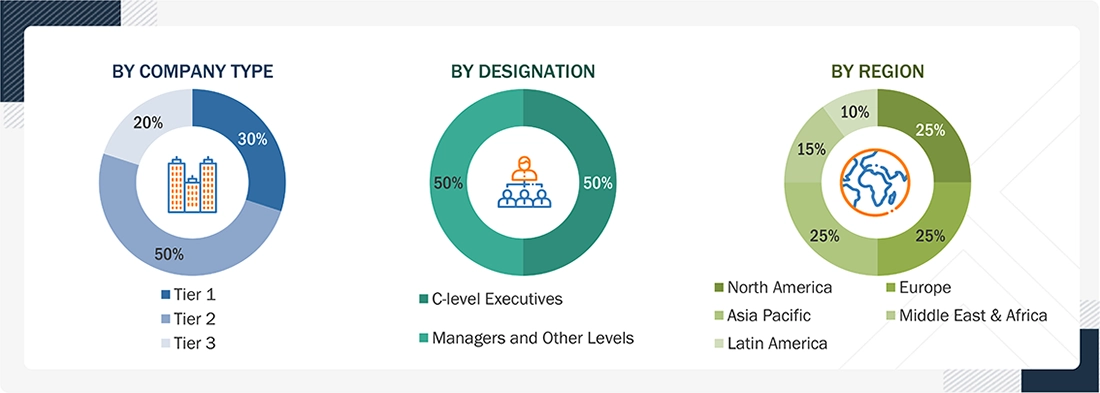
Note: Tier 1 companies receive revenues higher than USD 10 billion; Tier 2 companies’ revenues range between USD 1 and 10 billion; and Tier 3 companies’ revenues range between USD 500 million and USD 1 billion. Other designations include sales, marketing, and product managers.
To know about the assumptions considered for the study, download the pdf brochure
Market Size Estimation
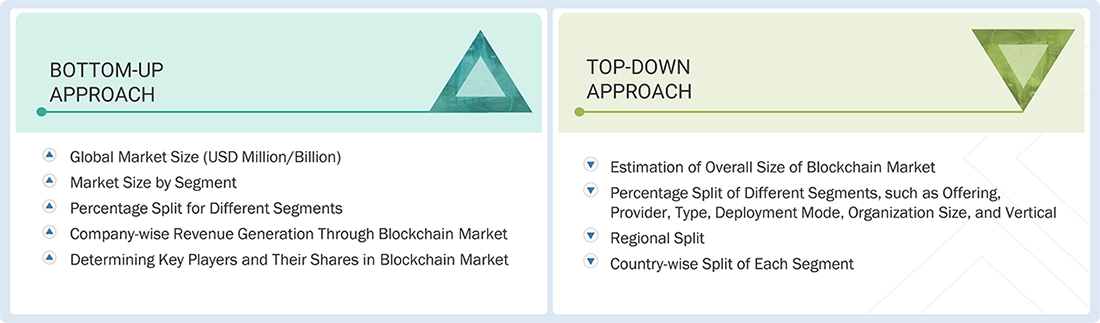
Top-down and bottom-up approaches were employed to estimate and validate the size of the blockchain market, as well as the size of various dependent sub-segments within the overall market. The research methodology used to estimate the market size includes the following details: critical players in the market were identified through secondary research, and their market shares in the respective regions were determined through primary and secondary research. This entire procedure involved studying the annual and financial reports of the top market players, and extensive interviews were conducted with key industry leaders, including CEOs, VPs, directors, and marketing executives, to gather valuable insights.
All percentage splits and breakdowns were determined using secondary sources and verified through primary sources. All possible parameters that affect the market covered in this research study were accounted for, viewed in extensive detail, verified through primary research, and analyzed to get the final quantitative and qualitative data. This data was consolidated and added to detailed inputs and analysis from MarketsandMarkets.
INFOGRAPHIC DEPICTING BOTTOM-UP AND TOP-DOWN APPROACHES
Data Triangulation
The market was split into several segments and sub-segments after arriving at the overall market size using the market size estimation processes explained above. The data triangulation and market breakup procedures were employed, wherever applicable, to complete the overall market engineering process and arrive at the exact statistics of each market segment and sub-segment. The data was triangulated by studying various factors and trends from the demand and supply sides.
Market Definition
The blockchain market comprises infrastructure, platforms, middleware, & professional and managed services that enable organizations to develop, deploy, operate, and scale distributed ledger technology (DLT)-based applications and networks. The market includes blockchain infrastructure hosting, node & validator infrastructure, blockchain platforms, blockchain-as-a-service (BaaS), node services, APIs & integration layers, developer tools, consulting, integration & deployment, support & maintenance, and managed services. These solutions support public, private, hybrid, and consortium blockchain networks. They are adopted across industries such as banking & financial services, insurance, government, healthcare & life sciences, manufacturing, retail & eCommerce, energy & utilities, transportation & logistics, media & entertainment, agriculture & food, and real estate.
Key Stakeholders
- Information technology (IT) professionals
- Government agencies
- Investors and venture capitalists
- Small- and medium-sized enterprises (SMEs) and large enterprises
- Managed and professional service providers
- Blockchain platform vendors
- Infrastructure providers
- Consultants/consultancies/advisory firms
- System integrators
- Third-party providers
- Value-added resellers (VARs)
- Business analysts
- Financial services firms
Report Objectives
- To define and forecast the blockchain market based on offering, provider, type, deployment mode, organization size, vertical, and region
- To provide detailed information about the major factors, such as drivers, opportunities, restraints, and challenges, influencing the market growth
- To forecast the size of the market segments with respect to five main regions: North America, Europe, Asia Pacific, the Middle East & Africa, and Latin America
- To analyze sub-segments of the market with respect to individual growth trends, prospects, and contributions to the overall market
- To profile the key players of the market and comprehensively analyze their market shares and core competencies
- To map the competitive intelligence based on company profiles, key player strategies, and game-changing developments, such as product enhancements/launches, collaborations, and acquisitions
- To track and analyze the competitive developments, such as product enhancements/launches, acquisitions, partnerships, and collaborations, in the blockchain market globally
Available customizations:
With the given market data, MarketsandMarkets offers customizations based on company-specific needs. The following customization options are available for the report:
GEOGRAPHIC ANALYSIS
- Further breakup of the Asia Pacific market into countries contributing to the rest of the regional market size.
- Further breakup of the North American market into countries, contributing to the rest of the regional market size.
- Further breakup of the Latin American market into countries contributing to the rest of the regional market size.
- Further breakup of the Middle East & African market into countries contributing to the rest of the regional market size.
- Further breakup of the European market into countries contributes to the rest of the regional market size.
Company information
- Detailed analysis and profiling of additional market players (up to 5)
Get the Full Blockchain Market Report
Full forecast, segment splits, and company analysis for all Blockchain Market.
- US Blockchain Market
- China Blockchain Market
- Canada Blockchain Market
- UK Blockchain Market
- Germany Blockchain Market
- France Blockchain Market
- Italy Blockchain Market
- Singapore Blockchain Market
- Japan Blockchain Market
- India Blockchain Market
- UAE Blockchain Market
- South Africa Blockchain Market
- Brazil Blockchain Market
- Mexico Blockchain Market
- Anz Blockchain Market
- Rest Of Asia Pacific Blockchain Market
- Ksa Blockchain Market
- Rest Of GCC Countries Blockchain Market
- Spain Blockchain Market
- Switzerland Blockchain Market
- Netherlands Blockchain Market
Need a Tailored Report?
Customize this report to your needs
Get 10% FREE Customization
Customize This Report