
Italy Brain Monitoring Market (2023-2028)

The Italy Brain Monitoring Market was valued at $85.4 Million in 2023 and projected to reach to $103.5 Million by 2028, representing a compound annual growth rate of CAGR 3.9%. Italy's brain monitoring market is positioned for steady growth driven by demographic shifts and healthcare modernization efforts.


| Market Size in | USD 26.32 MN |
| Market Forecast in | |
| CAGR | |
| Forecast Period | |
| Units Considered | Value (USD MN) |
Italy Brain Monitoring Market Trends and Insights
- Italy's healthcare sector is increasingly adopting advanced neurological monitoring technologies driven by an aging population and rising prevalence of neurological disorders.
- The Italian market reflects steady demand for non-invasive and portable brain monitoring solutions across hospitals, diagnostic centers, and research institutions. In Italy, the brain monitoring market growth is supported by investments in healthcare infrastructure and growing clinical awareness of early neurological disease detection.
- Italy's regulatory environment and healthcare reimbursement policies continue to shape market adoption patterns through 2028.
- The country's emphasis on precision medicine and patient-centric care is expected to drive incremental demand for innovative brain monitoring devices and software platforms..
Key Market Statistics
- CAGR (2023-2028) CAGR 3.9%
- Market Size, 2023 ~USD 85.4 Million
- Forecast, 2028 ~USD 103.5 Million
- Country Italy
Italy Brain Monitoring Market Overview
Market Size & Growth :
Italy's brain monitoring market reached USD 85.4 million in 2023 and is expected to expand to USD 103.5 million by 2028, with a steady CAGR of 3.9%, reflecting consistent healthcare investment in neurological technologies.
Aging Population Driver :
Italy has one of Europe's oldest populations, with increasing prevalence of age-related neurological disorders such as Alzheimer's and Parkinson's disease, creating sustained demand for advanced brain monitoring solutions.
Healthcare System Modernization :
Italian healthcare providers are progressively adopting cutting-edge neurological monitoring technologies to improve diagnostic accuracy and patient outcomes, supported by regional healthcare initiatives and EU funding.
Lagging Global Growth :
Italy's CAGR of 3.9% trails the global market growth of 6.3%, indicating opportunities for market acceleration through increased adoption of innovative monitoring devices and digital health integration.
Italy Brain Monitoring Market Dynamics
- The aging population continues to fuel demand for neurological monitoring technologies, particularly for chronic disease management and early diagnosis of neurodegenerative conditions.
- Healthcare institutions across Italy are increasingly investing in advanced monitoring systems to enhance clinical capabilities and patient care quality. Looking ahead to 2028, the Italian market will benefit from growing awareness of neurological health, improved reimbursement policies, and integration of digital health solutions.
- However, market growth remains moderate compared to global trends, presenting opportunities for market players to accelerate adoption through strategic partnerships with Italian healthcare providers and targeted awareness campaigns addressing the specific needs of Italy's aging demographic..
Market Ecosystem
Related Ecosystem
Diagnostic Imaging
- Magnetic Resonance Imaging (MRI)
- Computed Tomography (CT)
- CT Scanners
- Nuclear Imaging
- Positron Emission Tomography
- Siemens healthineers
- PHILIPS HEALTHCARE
- CANON INC.
- FUJIFILM Holdings Corporation
- UNITED IMAGING HEALTHCARE CO., LTD.
Medical Devices
- Polymerase Chain Reaction (PCR)
- Magnetic Resonance Imaging (MRI)
- Disposable Autoinjectors
- Pulse Oximeters
- Blood Pressure Monitors
- Medtronic plc
- Abbott Laboratories
- Stryker Corporation
- Becton, Dickinson and Company
- JOHNSON & JOHNSON
Key Takeaways
- Italy's brain monitoring market is valued at USD 85.4 million in 2023 and will reach USD 103.5 million by 2028.
- Italy experiences a 3.9% CAGR, reflecting moderate but consistent market expansion driven by aging demographics and neurological disease prevalence.
- Italy's healthcare infrastructure investments and regulatory framework support steady adoption of non-invasive brain monitoring technologies.
- Italy's market growth is underpinned by increasing clinical awareness and demand for early neurological disease detection solutions.
Brain Monitoring Market Report Scope
| Report Metric | Details |
|---|---|
| Base Year | 2023 |
| Fastest Growing Segment | CEREBRAL OXIMETERS (Type) |
| Forecast Period | 2023–2028 |
| Growth Rate | CAGR of 6.3% from 2023 to 2028 |
| Largest Segment | NON-INVASIVE PROCEDURES (Procedure) |
| Market Size Base Year (Billions) | ~USD 3.54 (2023) |
| Revenue Forecast (Billions) | ~USD 4.8 (2028) |
| Segments Covered | Product, Type, Usability, Procedure, Modality, Medical Condition, End User |
Italy Brain Monitoring Market Report Segmentation
7 segment dimensions are covered across the global market.
By Product
- Accessories
- Devices
By Type
- Batteries
- Cables
- Caps
- Cerebral Oximeters
- Ct Scanners
- Dry Electrodes
- Eeg Devices
- Electrodes
- Emg Devices
- Icp Monitors
- Meg Devices
- Mri Scanners
- Needle Electrodes
- Other Accessories
- Pastes & Gels
- Pet Scanners
- Sensors
- Sleep Monitoring Devices
- Tcd Devices
- Wet Electrodes
By Usability
- Disposable Accessories
- Non- Disposable Accessories
- Non-Disposable Accessories
By Procedure
- Invasive Procedures
- Non-Invasive Procedures
By Modality
- Fixed Devices
- Portable Devices
- Wearable Devices
By Medical Condition
- Dementia
- Epilepsy
- Headache Disorders
- Huntington'S Disease
- Other Medical Conditions
- Parkinson'S Disease
- Sleep Disorders
- Stroke
- Traumatic Brain Injury
By End User
- Ambulatory Surgery Centers & Clinics
- Diagnostic Centers
- Diagnostic Centres
- Hospitals
- Neurological Centers
- Neurological Centres
- Other End Users
ITALY: BRAIN MONITORING MARKET, BY END USER, 2021–2028
| Segment | 2021 | 2022 | 2023 | 2024 | 2025 | 2026 | 2027 | 2028 | CAGR (%) |
|---|---|---|---|---|---|---|---|---|---|
| AMBULATORY SURGERY CENTERS & CLINICS | 10.16 | 10.65 | 11.43 | 12.06 | 12.75 | 13.42 | 14.12 | 14.83 | 5.3 |
| DIAGNOSTIC CENTRES | 3.93 | 4.09 | 4.36 | 4.57 | 4.8 | 5.01 | 5.24 | 5.47 | 4.6 |
| HOSPITALS | 61.11 | 63.19 | 66.89 | 69.59 | 72.6 | 75.36 | 78.25 | 81.07 | 3.9 |
| NEUROLOGICAL CENTRES | 18.11 | 19.07 | 20.56 | 21.78 | 23.14 | 24.46 | 25.86 | 27.29 | 5.8 |
| OTHER END USERS | 9.51 | 9.68 | 10.09 | 10.33 | 10.61 | 10.84 | 11.09 | 11.31 | 2.3 |
| TOTAL | 102.8 | 106.7 | 113.3 | 118.3 | 123.9 | 129.1 | 134.6 | 140 | 4.3 |
Target Audience
- Medical Device Manufacturers : Need Italy-specific market data to assess market entry feasibility, competitive landscape, and growth potential for brain monitoring devices in one of Europe's key healthcare markets with significant aging demographics.
- Healthcare Providers & Hospital Networks : Require market insights to justify capital investments in neurological monitoring infrastructure, understand adoption trends among Italian peers, and optimize procurement strategies for advanced brain monitoring technologies.
- Investment & Private Equity Firms : Seek detailed Italy market analysis to evaluate investment opportunities in healthcare technology companies, assess market growth potential, and identify acquisition targets within the Italian brain monitoring sector.
- Healthcare Consultants & Strategy Firms : Need comprehensive Italy market data to advise clients on market positioning, competitive strategies, and expansion opportunities within Italy's neurological monitoring and healthcare technology landscape.
- Regulatory & Market Access Professionals : Require Italy-specific market intelligence to navigate regulatory pathways, understand reimbursement dynamics, and develop market access strategies for brain monitoring solutions in the Italian healthcare system.
Key Companies in the Italy Brain Monitoring Market
| Company | HQ | Ownership | Strongest segments |
|---|---|---|---|
| CONMED CORPORATION | United States | Public Company | Orthopedic and Sports Medicine (BioBrace, Y-Knot, Hall power tools, arthroscopy ecosystem),General Surgery (AirSeal, Buffalo Filter, endomechanical, electrosurgery),Endoscopic Technologies and Patient Monitoring, |
| NATUS MEDICAL INCORPORATED | United States | Private Company | Neurodiagnostic systems (EEG, EMG, ICU monitoring, polysomnography, intra-operative monitoring),Newborn care (hearing screening, jaundice management, brain injury, NICU essentials, NICVIEW),Audiology, otoneurologic, and vestibular systems, |
| NIHON KOHDEN CORPORATION | Japan | Public Company | Patient monitors & clinical information systems,Physiological measuring equipment (EEG/ECG/EMG and related),Defibrillators, AEDs, ventilators, anesthesia and related devices, |
| GE HEALTHCARE | United States | Public Company | Imaging,Advanced Visualization Solutions (AVS),Patient Care Solutions (PCS), |
| SIEMENS HEALTHINEERS AG | Germany | Public Company | Imaging,Diagnostics,Varian (Oncology), |
| COMPUMEDICS LIMITED | Australia | Public Company | Sleep diagnostics (PSG, HST, Somfit),Neurology diagnostics (EEG, LTM, ambulatory),Brain research & MEG systems, |
| MEDTRONIC | Ireland | Public Company | Cardiovascular Portfolio,Neuroscience Portfolio,Medical Surgical Portfolio (incl. Surgical, Monitoring, Diabetes), |
| EDWARDS LIFESCIENCES CORPORATION | United States | Public Company | Transcatheter aortic valve replacement (SAPIEN family),Transcatheter mitral and tricuspid (PASCAL, EVOQUE),Surgical structural heart (INSPIRIS, RESILIA, KONECT, MITRIS), |
| CGX | Canada | Public Company | Film Entertainment and Content (theatrical, Event Cinema, food service),Media (on-screen, digital signage, advertising solutions),Location-Based Entertainment (Rec Room, Playdium, Junxion, in-theatre gaming), |
CONMED CORPORATION
CONMED Corporation is a publicly traded U.S. medical device company founded in 1970 with approximately 3,900 employees.
NATUS MEDICAL INCORPORATED
Natus Medical Incorporated is a U.S.-based private company founded in 1987 with 1,400 employees specializing in medical devices and monitoring solutions.
NIHON KOHDEN CORPORATION
Nihon Kohden Corporation is a Japanese public company founded in 1951 with 6,116 employees, operating in the medical device and healthcare technology industry.
GE HEALTHCARE
GE Healthcare is a publicly traded U.S. company established in 2022 with 54,000 employees, providing healthcare technology and solutions.
SIEMENS HEALTHINEERS AG
Siemens Healthineers AG is a German public company with roots dating to 1896 and 72,369 employees, operating as a global leader in medical technology and diagnostics.
COMPUMEDICS LIMITED
Compumedics Limited is an Australian publicly traded company founded in 1987 with 175 employees, specializing in medical device manufacturing.
MEDTRONIC
Medtronic is a publicly traded company founded in Ireland in 1949 with 95,000 employees, serving as a global leader in medical technology and healthcare solutions.
EDWARDS LIFESCIENCES CORPORATION
Edwards Lifesciences Corporation is a U.S. public company founded in 1958 with 16,000 employees, specializing in cardiovascular and critical care medical devices.
CGX
CGX is a Canadian public company founded in 1912 with 10,000 employees operating across multiple business sectors.
Reasons to Buy this Report
- Italy-Specific Market Sizing : Obtain precise market valuation data for Italy (USD 85.4M in 2023) with detailed forecasts through 2028, enabling accurate business planning and investment decisions tailored to the Italian market landscape.
- Demographic Insights & Opportunity Assessment : Understand Italy's aging population dynamics and rising neurological disorder prevalence, identifying high-potential customer segments and geographic regions within Italy for targeted market entry strategies.
- Competitive Positioning Analysis : Benchmark your organization against Italy-specific market trends and growth rates (3.9% CAGR vs. 6.3% global), revealing competitive gaps and opportunities for market share expansion in this mature healthcare market.
- Healthcare System Integration Strategy : Gain actionable intelligence on Italian healthcare provider adoption patterns, reimbursement frameworks, and regulatory requirements essential for successful product launches and partnership development in Italy.
- Long-Term Growth Planning : Leverage Italy market forecasts and trend analysis to develop sustainable growth strategies, identify emerging technologies gaining traction, and plan resource allocation for the Italian market through 2028.
Frequently asked questions
What is the current size of Italy's brain monitoring market?
Italy's brain monitoring market was valued at USD 85.4 million in 2023.
What is the projected market size for Italy by 2028?
Italy's brain monitoring market is projected to reach USD 103.5 million by 2028.
What is the CAGR for Italy's brain monitoring market?
Italy's brain monitoring market is expected to grow at a CAGR of 3.9% from 2023 to 2028.
What factors are driving growth in Italy's brain monitoring market?
Growth in Italy is driven by an aging population, rising neurological disease prevalence, healthcare infrastructure investments, and increased clinical awareness of early detection.
Which applications dominate Italy's brain monitoring market?
Italy's market includes non-invasive and portable brain monitoring solutions used across hospitals, diagnostic centers, and research institutions for neurological assessment and monitoring.
RESEARCH METHODOLOGY
The study involved four major activities in estimating the current size of the Brain Monitoring market. Exhaustive secondary research was done to collect information on the market and its different sub-segments. The next step was to validate these findings, assumptions, and market sizing with industry experts across the value chain through primary research. Both top-down and bottom-up approaches were employed to estimate the complete market size. After that, market breakdown and data triangulation procedures were used to estimate the market size of the segments and sub-segments.
Secondary Research
This research study involved the extensive usage of secondary sources; directories; databases such as Bloomberg Business, Factiva, and Wall Street Journal; white papers and annual reports; company house documents; investor presentations; and SEC filings of companies. Secondary research was used to identify and collect information useful for the extensive, technical, market-oriented, and commercial study of the brain monitoring market. It was also used to obtain important information about the key market players, market classification & segmentation according to industry trends to the bottom-most level, and key developments related to market and technology perspectives. A database of the key industry leaders was also prepared using secondary research.
Primary Research
In the primary research process, various primary sources from both the supply and demand sides were interviewed to obtain qualitative and quantitative information important for this report. Primary sources from the supply side include industry experts such as CEOs, vice presidents, marketing directors, technology and innovation directors, and related executives from various key companies and organizations operating in the brain monitoring market. After the complete market engineering process (which includes calculations for market statistics, market breakdown, market size estimations, market forecasting, and data triangulation), extensive primary research was conducted to gather information and verify and validate the critical numbers arrived at.
Some of the major objectives of primary research are:
- To validate market segmentation defined through an assessment of the product portfolios of leading players
- To understand the key industry trends and technologies defining the strategic growth objectives of market players
- To gather both demand- and supply-side validation of the key factors affecting the market growth
- To validate assumptions for the market sizing and forecasting model used for this study
- To understand the market position of leading players in the brain monitoring market and their market share/ranking
Breakdown Of Primary Participants
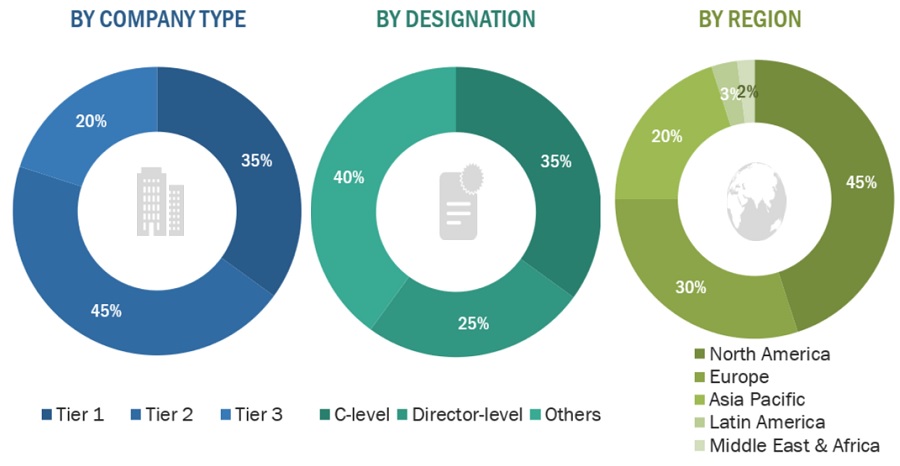
*Others include sales managers, marketing managers, and product managers.
Note: Tiers are defined based on a company’s total revenue. As of 2019, Tier 1 = >USD 1 billion, Tier 2 = USD 500 million to USD 1 billion, and Tier 3 = <USD 500 million.
To know about the assumptions considered for the study, download the pdf brochure
Market Size Estimation
Both top-down and bottom-up approaches were used to estimate and validate the total size of the Brain Monitoring market. These methods were also used extensively to estimate the size of various subsegments in the market.
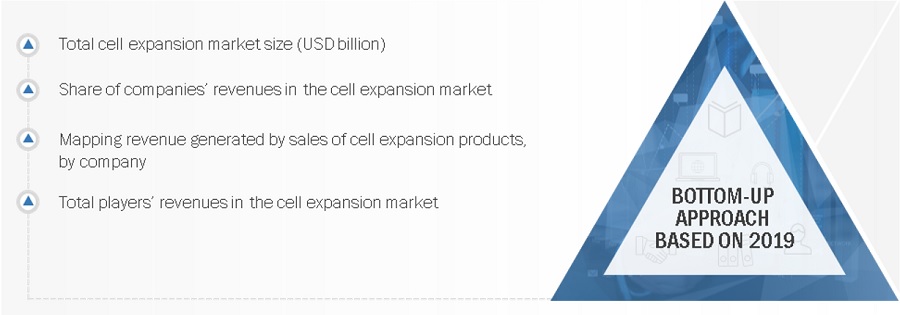
Bottom-up approach
The bottom-up procedure was adopted to arrive at the overall size of the Brain Monitoring market from the revenue of key players (companies), their shares in the market, and their annual sales of Brain Monitoring products.
To know about the assumptions considered for the study, Request for Free Sample Report
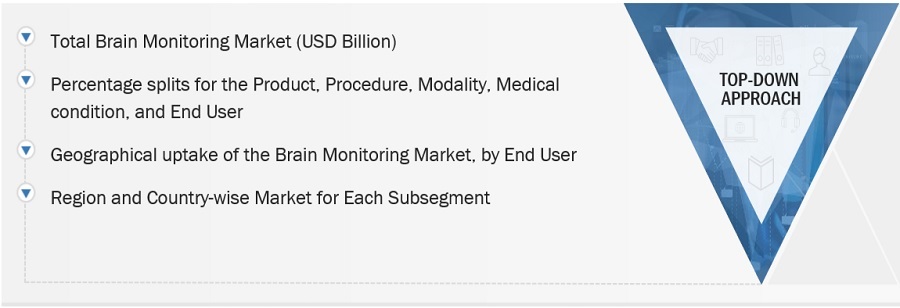
Top-down approach
The overall Brain Monitoring market size was used in the top-down approach to estimate the sizes of other individual markets (mentioned in the market segmentation by product, medical condition, end user, and region) through percentage splits from secondary and primary research.
For the calculation of each type of specific market segment, the most appropriate immediate-parent market size was used for implementing the top-down approach. The bottom-up approach was also implemented (wherever applicable) for data extracted from secondary research to validate the market segment revenues obtained. Market shares were then estimated for top companies to verify the total market revenue arrived earlier in the bottom-up approach.
Data Triangulation
After arriving at the overall market size, from the market size estimation process explained above, the Brain Monitoring market was split into segments and subsegments. To complete the overall market engineering process and to arrive at the exact statistics for all segments and subsegments, the data triangulation and market breakdown procedures were employed, wherever applicable. The data was triangulated by studying various factors and trends from both the demand and supply sides in the Brain Monitoring industry.
Market Definition
Brain Monitoring is a procedure that monitors the activity of various parameters associated with the functioning of brain, which includes electrical activity, blood flow, magnetic activity, the pressure surrounding the brain, and cerebral oxygen saturation.
Key Stakeholders
- World Health Organization (WHO)
- National Center for Biotechnology Information (NCBI)
- World Federation of Neurology (WFN)
- Centers for Disease Control and Prevention (CDC)
- Epilepsy Foundation
- American Brain Foundation (ABF)
- Brain Injury Association of America (BIAA)
- Neurology Asia Journal
- Alzheimer's Association
- American Neurological Association (ANA)
- European Journal of Neurology
Report Objectives
- To define, describe, and forecast the brain monitoring market based on the product, procedure, modality, medical condition, end user, and region.
- To provide detailed information regarding the major factors influencing the growth of the market (such as drivers, restraints, opportunities, and challenges).
- To strategically analyze micromarkets with respect to individual growth trends, prospects, and contributions to the overall brain monitoring market.
- To analyze the opportunities in the market for stakeholders and provide details of the competitive landscape for market leaders.
- To profile the key players in the market and comprehensively analyze their market shares and core competencies.
- To forecast the size of the market segments with respect to four main regions, namely, North America, Asia Pacific, Europe, Latin America, and Middle East & Africa.
- To track and analyze competitive developments such as new product launches, agreements, collaborations, and expansions.
Available Customizations:
MarketsandMarkets offers the following customizations for this market report:
Company Information
- Profiling of additional market players (up to 3)
- Additional country-level analysis of sub-segments such as media, reagents, flow cytometers, and centrifuges.
Get the Full Brain Monitoring Market Report
Full forecast, segment splits, and company analysis for all Brain Monitoring Market.
- Canada Brain Monitoring Market
- US Brain Monitoring Market
- Germany Brain Monitoring Market
- France Brain Monitoring Market
- UK Brain Monitoring Market
- Spain Brain Monitoring Market
- Japan Brain Monitoring Market
- China Brain Monitoring Market
- India Brain Monitoring Market
- Brazil Brain Monitoring Market
- Mexico Brain Monitoring Market
Need a Tailored Report?
Customize this report to your needs
Get 10% FREE Customization
Customize This Report
