



Neurovascular Devices Market
Report Code
MD 1310
Published in
Nov, 2025, By MarketsandMarkets™
Neurovascular Devices Market Size by Disease Pathology (Cerebral Aneurysm (Embolic coils, Flow Diverters), Ischemic Stroke (Clot Retriever, Aspiration, Snare), Carotid Stenosis (Stent, Embolic Protection), Others), End User (Hospitals) - Global Forecast to 2030

USD 7.22 BN
MARKET SIZE, 2030

CAGR 9.3%
(2025-2030)

300
REPORT PAGES

310
MARKET TABLES
Neurovascular Devices Market Size, Share & Growth Snapshot
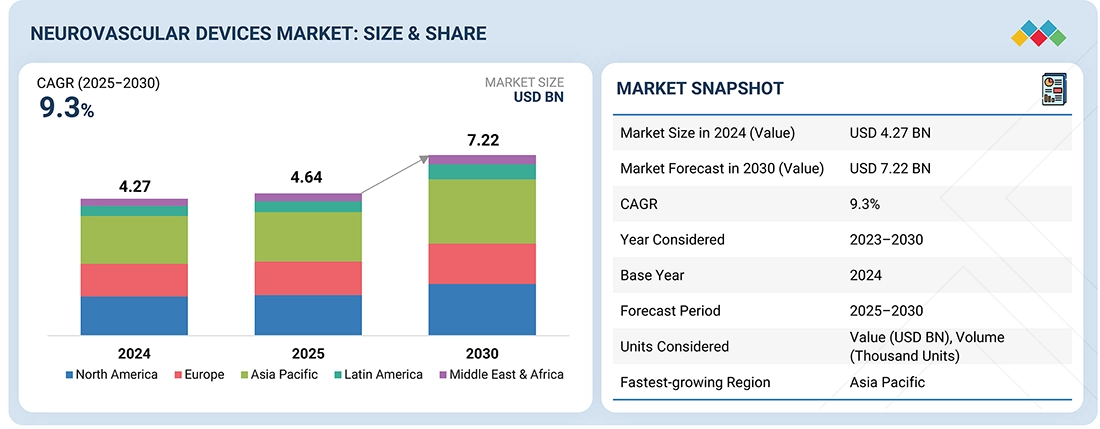
Source: Secondary Research, Interviews with Experts, MarketsandMarkets Analysis
The global neurovascular devices market size is projected to reach USD 7.22 billion in 2030 from USD 4.64 billion in 2025, at a CAGR of 9.3% during the forecast period. The market growth is primarily driven by the prevalence of neurovascular diseases, influenced by factors such as aging populations, hypertension, smoking, and sedentary lifestyles. This significantly boosts the demand for advanced tools for effective monitoring and treatment. As the incidence of conditions like stroke, brain aneurysms, and arteriovenous malformations rises, so does the need for timely diagnosis and minimally invasive procedures.
KEY TAKEAWAYS
-
BY DISEASE PATHOLOGYBased on disease pathology, the global neurovascular devices market is divided into five main segments: cerebral aneurysms, ischemic strokes, carotid artery stenosis, arteriovenous malformation & fistulas, and other disease pathologies. The cerebral aneurysm segment held the largest market share. The high incidence of cerebral aneurysms results from lifestyle, physiological, and genetic factors. Chronic hypertension, smoking, and atherosclerosis significantly contribute to weakening blood vessel walls, while lifestyle habits such as alcohol use and a sedentary lifestyle increase vascular stress. Age and gender are also important; middle-aged individuals and women face a higher risk. Additionally, those with a family history of aneurysms or certain genetic disorders are more likely to develop these conditions, highlighting genetics as a key underlying factor.
-
BY END USERBased on end user, the global neurovascular devices market is segmented by end user into the following categories: hospitals & surgical centers, ambulatory care centers, research laboratories, and academic institutes. Among these, the hospitals & surgical centers segment is expected to capture the largest market share. They have the latest diagnostic tools and a highly trained medical team to handle critical conditions like strokes, aneurysms, and vascular malformations. Hospitals & Surgical Centers provide quick, specialized care, which is often crucial in time-sensitive situations. Their ability to offer continuous monitoring, rehabilitation services, and manage complications ensures the best patient outcomes, making them the market leaders..
-
BY REGIONThe global neurovascular devices market is segmented into five key regions: North America, Europe, the Asia Pacific, Latin America, and the Middle East & Africa. Among these, in 2024, North America held the largest market share in the neurovascular devices industry. North America remains the biggest market for neurovascular devices, driven by several region-specific factors. The region benefits from a well-developed healthcare infrastructure with widespread access to advanced medical technologies, enabling early diagnosis and effective treatment of neurovascular conditions like stroke, aneurysms, and arteriovenous malformations. The high prevalence of lifestyle-related risk factors—such as hypertension, obesity, and smoking—has increased the incidence of neurovascular diseases, boosting demand for treatment options. Additionally, North America hosts leading medical device manufacturers and research institutions, fostering ongoing innovation and quick adoption of new technologies. The availability of skilled healthcare professionals, including neurosurgeons and interventional radiologists, further supports the use of cutting-edge neurovascular procedures. Favorable reimbursement policies and strong awareness among patients and physicians regarding early intervention and minimally invasive treatments also drive higher procedure volumes.
-
COMPETITIVE LANDSCAPEThe major market players have adopted organic and inorganic strategies, including product launches, partnerships, and acquisitions. Leading companies such as Stryker (US), Medtronic (Ireland), Johnson & Johnson (US), Terumo Corporation (Japan), Penumbra (US), and others have strengthened their product portfolios and expanded their global presence to meet the rising demand for neurovascular devices. Continuous innovation in neurovascular devices and advancements in technology have helped these players maintain a competitive advantage in a rapidly evolving market.
The global neurovascular devices market is anticipated to grow during the forecast timeframe owing to the rising incidence of neurovascular diseases, such as stroke, brain aneurysms, and arteriovenous malformations, is significantly driving demand for advanced diagnostic and treatment solutions. At the same time, the expansion of healthcare infrastructure across emerging economies is enabling broader adoption of neurointerventional technologies, bridging gaps in specialized care.
TRENDS & DISRUPTIONS IMPACTING CUSTOMERS' CUSTOMERS
The neurovascular devices market operates within a dynamic environment shaped by fierce competition, changing consumer needs, and regulatory challenges. Well-established companies and new entrants continually innovate to gain market share, which drives pricing pressures across different segments. At the same time, increasing costs for raw materials, sustainable packaging, and marketing push manufacturers to find a balance between affordability and profitability. Moreover, evolving health regulations, ingredient restrictions, and labeling standards across various regions influence product development and market entry strategies, prompting companies to reevaluate their pricing, positioning, and investment plans.
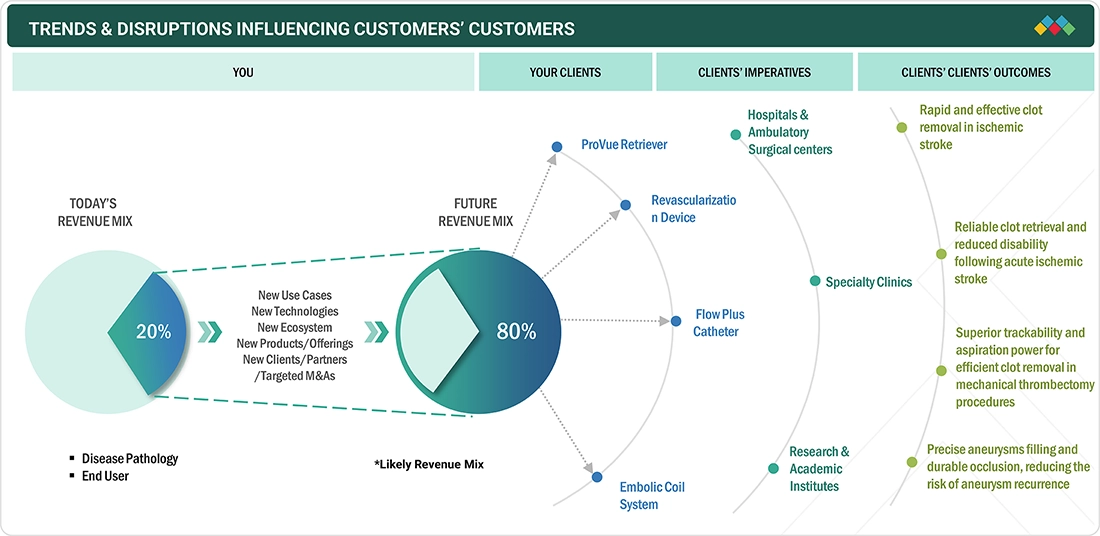
Source: Secondary Research, Interviews with Experts, MarketsandMarkets Analysis
MARKET DYNAMICS

Drivers
Impact
Level
Level
-
Rising incidence of neurovascular diseases

-
Availability of medical reimbursements for neurovascular procedures


RESTRAINTS
Impact
Level
Level
-
Dearth of skilled neurosurgeons

-
High procedural cost of neurovascular surgeries and associated products


OPPORTUNITIES
Impact
Level
Level
-
Advancement of AI- and robot-assisted systems for next-generation neurointerventions

-
§Growing preference for minimally neurosurgical procedures


CHALLENGES
Impact
Level
Level
-
Stringent regulatory approval process for medical devices

Source: Secondary Research, Interviews with Experts, MarketsandMarkets Analysis
Driver: Rising Incidence of Neurovascular Diseases
The high prevalence of neurovascular conditions continues to drive the growth of the neurovascular devices market worldwide. According to the Brain Aneurysm Foundation (2024), an estimated 6.8 million people in the United States—about 1 in 50—live with an unruptured brain aneurysm. Each year, around 30,000 people in the U.S. experience a rupture, happening roughly every 18 minutes, with an annual rupture rate of 8 to 10 per 100,000 people. Globally, brain aneurysms cause nearly 500,000 deaths annually, with half of the victims being under 50 years old. Brain aneurysms are most common in individuals aged 35 to 60 but can also occur in children. Most develop after age 40. Women are more likely than men to have a brain aneurysm, with a ratio of about 3 to 2. Additionally, women over 55 face a higher risk of rupture—about 1.5 times greater than men. Based on this data, the growing prevalence and significant impact of brain aneurysms highlight the urgent need for advanced neurovascular devices that enable early detection, effective treatment, and better patient outcomes. Continued innovation and increased accessibility in this field are essential to reducing mortality and improving quality of life for affected individuals worldwide. The rising prevalence of neurovascular conditions, particularly brain aneurysms, affects millions across various age groups. The increasing incidence is driven by factors such as age, gender, and underlying health issues. As more people are impacted, demand for advanced neurovascular devices that enable early diagnosis, efficient treatment, and improved patient outcomes continues to grow..
Restraint: Dearth of skilled neurosurgeons
The limited number of neurosurgeons worldwide significantly restricts the neurovascular devices market, as the availability of skilled professionals directly influences the adoption and effective use of these advanced technologies. According to the Journal of Neurosurgery, 2022, in India, the neurosurgical workforce is notably inadequate. With a population exceeding 1.3 billion, the country has approximately 3,500 neurosurgeons, which translates to about one neurosurgeon per 370,000 people. This ratio is well below the recommended benchmark of one neurosurgeon per 100,000 individuals, needed to ensure adequate access to care. The shortage of neurosurgeons creates a major challenge for the neurovascular devices market. With too few specialists to meet the rising demand for complex neurovascular procedures, access to advanced treatments is limited. This scarcity decelerates the adoption of innovative neurovascular devices, restricting their use and overall market growth
Opportunity: Advancement of AI- and robot-assisted systems for next-generation neurointerventions.
The rapid progress of AI and robot-assisted systems presents a transformative opportunity for the neurovascular devices market. These next-generation technologies are changing how complex neurointerventions are done by improving precision, accuracy, and safety during procedures. AI algorithms help with preoperative planning, risk assessment, and real-time decision-making, while robotic systems offer highly controlled, minimally invasive navigation, reducing the chance of human error. Such innovations not only enhance patient outcomes by making treatments more effective and targeted but also boost procedural efficiency and shorten recovery times. Additionally, AI and robotic integration can help address limitations caused by the shortage of highly skilled neurosurgeons by providing decision support and enhancing surgical capabilities. The adoption of these advanced systems also creates opportunities for remote and tele-guided procedures, expanding access to specialized neurovascular care in underserved areas. Overall, these advancements are expected to speed up market growth, increase demand for sophisticated devices, and promote ongoing investment in research and development within the neurovascular sector..
Challenge: Stringent regulatory approval process for medical devices
The strict regulatory approval process for medical devices remains a major challenge for the neurovascular devices market. Neurovascular devices, being highly specialized and used in critical procedures, are subject to extensive safety and efficacy assessments, including lengthy clinical trials and comprehensive documentation. This rigorous approval process can greatly extend development timelines and costs, delaying the introduction of innovative solutions to the market. Additionally, navigating complex regulatory requirements across different regions presents further obstacles for manufacturers, limiting how quickly new technologies reach patients and restricting overall market growth.
Neurovascular Devices Market: COMMERCIAL USE CASES ACROSS INDUSTRIES
| COMPANY | USE CASE DESCRIPTION | BENEFITS |
|---|---|---|
 |
Neurovascular devices for ischemic and hemorrhagic stroke treatment, including stent retrievers, aspiration systems, and flow diverters. | Enables rapid clot removal, restores blood flow, minimizes brain damage, and improves recovery outcomes in stroke patients |
 |
Neurovascular technologies including Solitaire™ stent retrievers, flow diverters, and embolization coils for stroke and aneurysm management. | Provides effective clot retrieval and aneurysm repair, reduces procedural time, and improves patient survival rates. |
 |
Comprehensive portfolio for stroke care — embolic coils, stent retrievers, and access systems for both ischemic and hemorrhagic stroke management | Delivers reliable stroke intervention solutions, supports minimally invasive procedures, and enhances long-term neurological outcomes. |
 |
Catheters, guidewires, and embolization devices for neurovascular access and aneurysm treatment. | Offers superior device flexibility and control, ensures precise navigation in complex brain vasculature, and supports safer neurointerventions. |
 |
Aspiration-based thrombectomy systems and embolization devices for ischemic and hemorrhagic stroke. | Facilitates rapid clot removal with continuous aspiration, reduces the risk of re-occlusion, and enables faster neurological recovery |
Logos and trademarks shown above are the property of their respective owners. Their use here is for informational and illustrative purposes only.
MARKET ECOSYSTEM
The neurovascular devices market ecosystem includes device manufacturers, component suppliers, healthcare providers, regulatory authorities, and research institutions that collectively drive innovation and market growth. Manufacturers work with technology partners to develop advanced products such as stent retrievers, embolic coils, flow diverters, aspiration systems, and microcatheters, enhancing procedural accuracy and patient outcomes in stroke and aneurysm treatment. Hospitals, surgical centers, and specialty neurology clinics are the main end-users, increasing demand through the growing use of minimally invasive neurointerventional procedures. Regulatory agencies, including the FDA, oversee product safety and clinical effectiveness, affecting approval processes and marketing strategies. Strategic partnerships, government healthcare initiatives, and ongoing R&D investments further boost technological progress, while medical training centers and professional societies improve physician skills, encouraging broader clinical use and strengthening the overall neurovascular devices ecosystem.
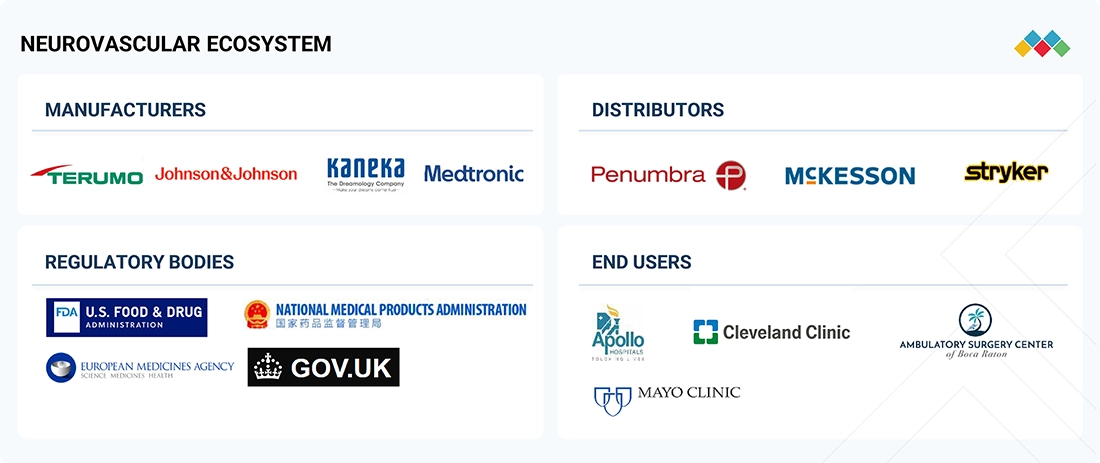
Logos and trademarks shown above are the property of their respective owners. Their use here is for informational and illustrative purposes only.
MARKET SEGMENTS
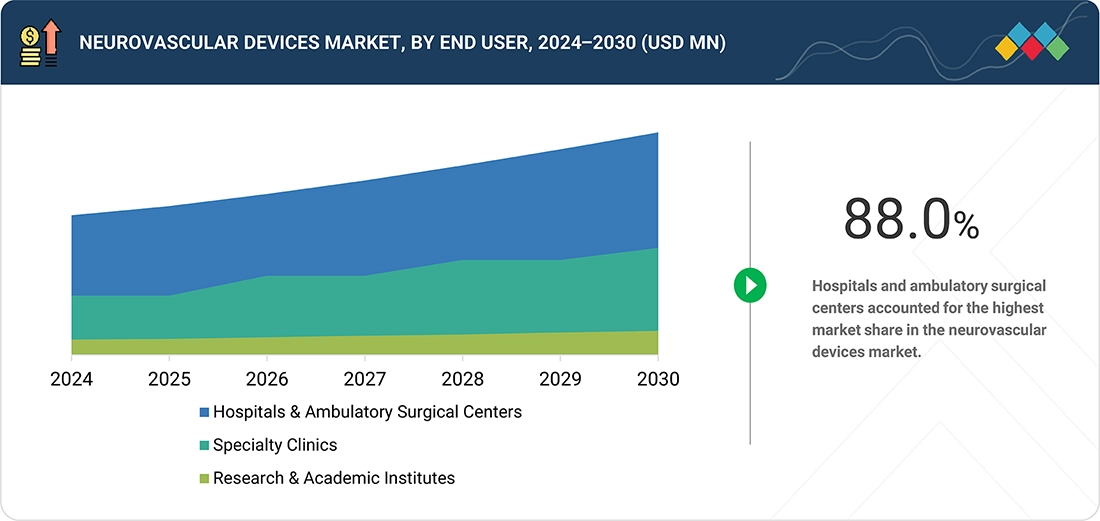
Source: Secondary Research, Interviews with Experts, MarketsandMarkets Analysis
Neurovascular Devices Market, By Disease Pathology
By disease pathology, the global neurovascular devices market is divided into five main segments: cerebral aneurysms, ischemic strokes, carotid artery stenosis, arteriovenous malformation & fistulas, and other disease pathologies. The cerebral aneurysms segment held the largest market share. The high rate of cerebral aneurysms results from lifestyle, physiological, and genetic factors. Chronic hypertension, smoking, and atherosclerosis significantly weaken blood vessel walls, while lifestyle choices such as alcohol consumption and a sedentary lifestyle increase vascular stress. Age and gender are also important, with middle-aged individuals and women at higher risk. Additionally, those with a family history of aneurysms or specific genetic disorders are more likely to develop these conditions, making genetics a key underlying factor.
Neurovascular Devices Market, By End User
By end user, the global neurovascular devices market is segmented by end user into the following categories: hospitals & ambulatory surgical centers, specialty clinics, research & academic institutes. Among these, the hospitals & ambulatory surgical centers segment is expected to garner the highest share in the market. They have the latest diagnostic tools and experienced, well-trained medical teams to manage critical conditions like strokes, aneurysms, and vascular malformations. Hospitals and ambulatory surgical centers provide quick, specialized care, often essential in time-sensitive situations. Their ability to offer continuous monitoring, rehabilitation services, and handle complications ensures optimal patient outcomes and remains a major reason for their leading position within the market landscape.
REGION
Asia Pacific to be fastest-growing region in global neurovascular devices market during forecast period
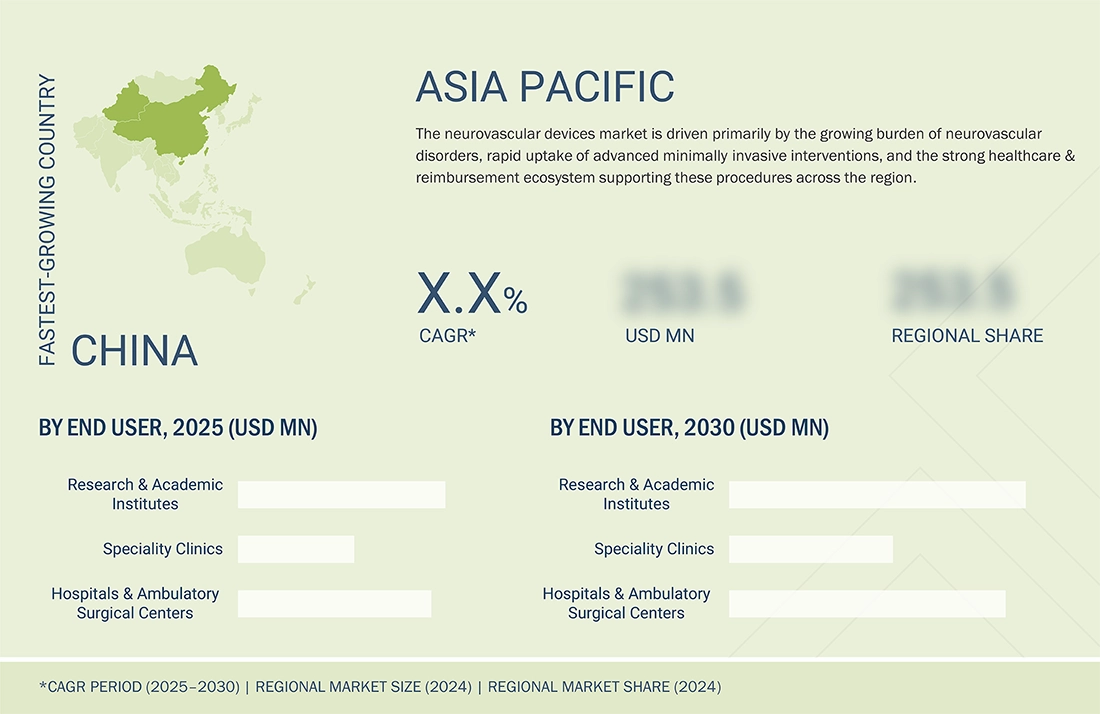
The global neurovascular devices market is divided into five main regions: North America, Europe, Asia Pacific, Latin America, and the Middle East & Africa. Among these, the Asia Pacific region is expected to experience the fastest growth during the forecast period. Asia-Pacific is emerging as the quickest-growing area in the neurovascular devices market during this time, driven by rapid healthcare improvements and increasing awareness of neurological conditions. Rising rates of stroke and cerebral aneurysm, along with a growing aging population and lifestyle-related risk factors such as hypertension and diabetes, are boosting demand for advanced neurointerventional treatments. Governments in countries such as China, India, and Japan are heavily investing in upgrading hospital infrastructure and increasing access to minimally invasive neurosurgical care. Moreover, the availability of skilled medical professionals, expanding medical tourism, and collaborations between global device makers and local healthcare providers are speeding up the adoption of innovative neurovascular technologies, making Asia-Pacific a key growth center for the industry.
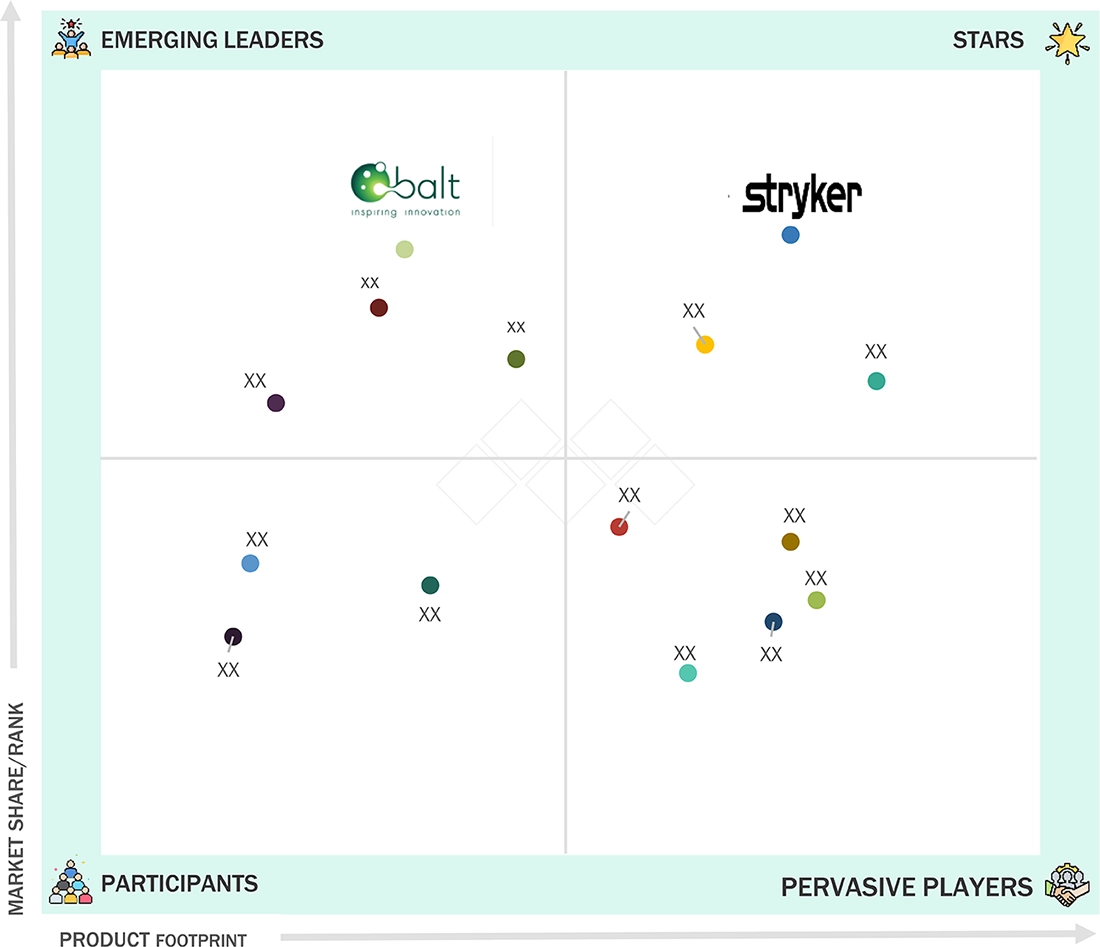
Neurovascular Devices Market: COMPANY EVALUATION MATRIX
The neurovascular devices market is dominated by Stryker (US), Medtronic (Ireland), Johnson & Johnson (US), Terumo Corporation (Japan), and Penumbra (US) due to their strong brand reputations, extensive product portfolios, and continuous innovation in the products. Stryker (US) and Medtronic (Ireland) lead the industry with high-quality neurovascular devices. Their dominance is reinforced by robust R&D, regulatory compliance, and comprehensive after-sales support, ensuring customer trust and market leadership.
Source: Secondary Research, Interviews with Experts, MarketsandMarkets Analysis
KEY MARKET PLAYERS
MARKET SCOPE
| REPORT METRIC | DETAILS |
|---|---|
| Market Size in 2024 (Value) | USD 4.27 Billion |
| Market Forecast in 2030 (Value) | USD 7.22 Billion |
| Growth Rate | CAGR of 9.3% from 2025 to 2030 |
| Years Considered | 2023-2030 |
| Base Year | 2024 |
| Forecast Period | 2025-2030 |
| Units Considered | Value (USD Billion), Volume (Thousand Units) |
| Report Coverage | Revenue Forecast, Company Ranking, Competitive Landscape, Growth Factors, and Trends |
| Segments Covered | By Type: Cerebral Aneurysms, Ischemic Strokes, Carotid Artery Stenosis, Arteriovenous Malformation & Fistulas, and Other Disease Pathologies By End User: Hospitals & Ambulatory Surgical Centers, Specialty Clinics, Research & Academic Institutes |
| Regions Covered | North America, Europe, Asia Pacific, Latin America, Middle East & Africa, and GCC countries |
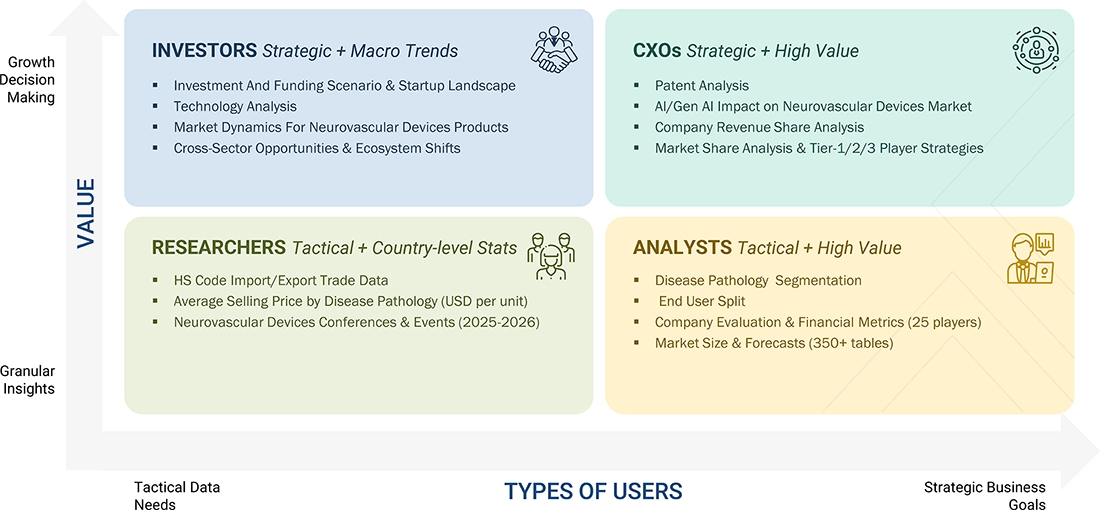
WHAT IS IN IT FOR YOU: Neurovascular Devices Market REPORT CONTENT GUIDE
RECENT DEVELOPMENTS
- September 2025 : Siemens Healthineers and Stryker entered a strategic partnership to develop a first-of-its-kind robotic system for neurovascular interventions. The collaboration combines Siemens’ expertise in imaging and robotics with Stryker’s leadership in neurovascular technologies, with the goal of enhancing precision in aneurysm treatment and improving timely access to stroke care.
- February 2025 : Stryker (US) acquired Inari Medical (US), a company specializing in innovative VTE clot removal solutions without thrombolytic drugs, to expand Stryker’s interventional endovascular portfolio, strengthening its peripheral vascular capabilities and positioning it strongly in the rapidly growing VTE treatment market.
- October 2024 : Terumo Corporation and NAMSA announced a strategic outsourcing partnership to expand the global regulatory approval and commercialization of Terumo's medical devices. This collaboration leverages NAMSA's clinical research, testing, and consulting services to streamline product development and bring innovative healthcare solutions to patients more efficiently.
- February 2024 : Medtronic inaugurated its newly expanded, state-of-the-art Engineering and Innovation Center (MEIC) in Hyderabad, India. This expansion is strategically aligned with Medtronic's goal of broadening its global R&D footprint.
Table of Contents
 Exclusive indicates content/data unique to MarketsandMarkets and not available with any competitors.
TITLE
PAGE NO
1
INTRODUCTION
30
2
EXECUTIVE SUMMARY
35
3
PREMIUM INSIGHTS
40
4
MARKET OVERVIEW
Emerging markets drive neurovascular growth amid skilled surgeon shortage and high surgery costs.
44
4.1
INTRODUCTION
4.2
MARKET DYNAMICS
4.2.1
DRIVERS
4.2.1.1
INCREASE IN INCIDENCE OF NEUROVASCULAR DISEASES
4.2.1.2
AVAILABILITY OF MEDICAL REIMBURSEMENTS FOR NEUROVASCULAR PROCEDURES
4.2.1.3
EXPANSION OF HEALTHCARE INFRASTRUCTURE ACROSS EMERGING ECONOMIES
4.2.1.4
RISE IN DEMAND FOR EFFECTIVE NEUROVASCULAR TECHNOLOGIES
4.2.2
RESTRAINTS
4.2.2.1
DEARTH OF SKILLED NEUROSURGEONS
4.2.2.2
HIGH PROCEDURAL COST OF NEUROVASCULAR SURGERIES AND ASSOCIATED PRODUCTS
4.2.3
OPPORTUNITIES
4.2.3.1
ADVANCEMENT OF AI- AND ROBOT-ASSISTED SYSTEMS FOR NEXT-GENERATION NEUROINTERVENTIONS
4.2.4
CHALLENGES
4.2.4.1
STRINGENT REGULATORY APPROVAL PROCESS FOR MEDICAL DEVICES
4.3
UNMET NEEDS AND WHITE SPACES
4.3.1
UNMET NEEDS
4.3.2
WHITE SPACE OPPORTUNITIES
4.4
INTERCONNECTED MARKETS AND CROSS-SECTOR OPPORTUNITIES
4.4.1
INTERCONNECTED MARKETS
4.4.2
CROSS-SECTOR OPPORTUNITIES
4.5
STRATEGIC MOVES BY TIER 1/2/3 PLAYERS
5
INDUSTRY TRENDS
Navigate competitive dynamics and pricing shifts in the evolving neurovascular devices market landscape.
51
5.1
PORTER’S FIVE FORCES ANALYSIS
5.1.1
INTENSITY OF COMPETITIVE RIVALRY
5.1.2
BARGAINING POWER OF SUPPLIERS
5.1.3
BARGAINING POWER OF BUYERS
5.1.4
THREAT OF SUBSTITUTES
5.1.5
THREAT OF NEW ENTRANTS
5.2
MACROECONOMIC OUTLOOK
5.2.1
INTRODUCTION
5.2.2
GDP TRENDS AND FORECAST
5.2.3
TRENDS IN NEUROVASCULAR DEVICES MARKET
5.3
SUPPLY CHAIN ANALYSIS
5.4
VALUE CHAIN ANALYSIS
5.5
ECOSYSTEM ANALYSIS
5.6
PRICING ANALYSIS
5.6.1
AVERAGE SELLING PRICE TREND OF KEY PLAYERS, BY DISEASE PATHOLOGY
5.6.2
AVERAGE SELLING PRICE TREND OF NEUROVASCULAR DEVICES, BY REGION
5.7
TRADE ANALYSIS
5.7.1
IMPORT DATA FOR HS CODE 901890, 2020–2024
5.7.2
EXPORT DATA FOR HS CODE 901890, 2020–2024
5.8
KEY CONFERENCES & EVENTS, 2025–2026
5.9
TRENDS/DISRUPTIONS IMPACTING CONSUMERS’ BUSINESSES
5.10
INVESTMENT & FUNDING SCENARIO
5.11
CASE STUDY ANALYSIS
5.11.1
FLOW DIVERTER FOR COMPLEX INTRACRANIAL ANEURYSMS
5.11.2
ADVANCED FLOW DIVERTER WITH ENHANCED DELIVERABILITY
5.11.3
STENT RETRIEVER THROMBECTOMY FOR ACUTE IN-STENT THROMBOSIS
5.12
IMPACT OF 2025 US TARIFFS ON NEUROVASCULAR DEVICES MARKET
5.12.1
INTRODUCTION
5.12.2
KEY TARIFF RATES
5.12.3
PRICE IMPACT ANALYSIS
5.12.4
IMPACT ON COUNTRIES AND REGIONS
5.12.4.1
US
5.12.4.2
EUROPE
5.12.4.3
ASIA PACIFIC
5.12.5
IMPACT ON END-USER INDUSTRIES
6
TECHNOLOGICAL ADVANCEMENTS, AI-DRIVEN IMPACT, PATENTS, AND INNOVATIONS
AI-driven innovations are revolutionizing neurovascular devices, with patents and real-world applications leading market disruption.
71
6.1
KEY EMERGING TECHNOLOGIES
6.1.1
NEGATIVE PRESSURE CLOT REMOVAL TECHNOLOGY
6.2
COMPLEMENTARY TECHNOLOGIES
6.2.1
DIGITAL HEALTH AND REMOTE MONITORING PLATFORMS
6.3
TECHNOLOGY/PRODUCT ROADMAP
6.3.1
SHORT-TERM (2025–2027) | FOUNDATION & EARLY COMMERCIALIZATION
6.3.2
MID-TERM (2027–2030) | EXPANSION & STANDARDIZATION
6.3.3
LONG-TERM (2030–2035+) | MASS COMMERCIALIZATION & DISRUPTION
6.4
PATENT ANALYSIS
6.4.1
PATENT PUBLICATION TRENDS FOR NEUROVASCULAR DEVICES MARKET
6.4.2
JURISDICTION ANALYSIS: TOP APPLICANTS FOR PATENTS IN NEUROVASCULAR DEVICES MARKET
6.4.3
LIST OF MAJOR PATENTS
6.5
IMPACT OF AI/GEN AI ON NEUROVASCULAR DEVICES MARKET
6.5.1
TOP USE CASES AND MARKET POTENTIAL
6.5.2
TOP CASE STUDIES OF AI IMPLEMENTATION IN NEUROVASCULAR DEVICES MARKET
6.5.3
INTERCONNECTED ADJACENT ECOSYSTEM AND IMPACT ON MARKET PLAYERS
6.5.4
CLIENTS’ READINESS TO ADOPT GENERATIVE AI IN NEUROVASCULAR DEVICES MARKET
6.6
SUCCESS STORIES AND REAL-WORLD APPLICATIONS
6.6.1
RAPID MEDICAL – AI-POWERED ROBOTIC THROMBECTOMY
6.6.2
AIDOC – AI IMAGING & STROKE WORKFLOW ACCELERATION
6.6.3
RAPIDAI – AI-DRIVEN NEUROVASCULAR IMAGING
7
REGULATORY LANDSCAPE
Navigate complex global regulations with regional insights and compliance strategies across key markets.
79
7.1
REGIONAL REGULATIONS AND COMPLIANCE
7.1.1
REGULATORY BODIES, GOVERNMENT AGENCIES, AND OTHER ORGANIZATIONS
7.1.2
INDUSTRY STANDARDS
7.1.2.1
NORTH AMERICA
7.1.2.1.1
US
7.1.2.1.2
CANADA
7.1.2.2
EUROPE
7.1.2.3
ASIA PACIFIC
7.1.2.3.1
CHINA
7.1.2.3.2
JAPAN
7.1.2.3.3
INDIA
7.1.2.4
LATIN AMERICA
7.1.2.4.1
BRAZIL
7.1.2.4.2
MEXICO
7.1.2.5
MIDDLE EAST
7.1.2.6
AFRICA
7.2
CERTIFICATIONS, LABELING, AND ECO-STANDARDS
7.2.1
CERTIFICATIONS, LABELING, AND ECO-STANDARDS IN NEUROVASCULAR DEVICES MARKET
8
CUSTOMER LANDSCAPE & BUYER BEHAVIOR
Unlock hidden profitability by navigating stakeholder influence and unmet needs in buyer behavior.
85
8.1
DECISION-MAKING PROCESS
8.2
BUYER STAKEHOLDERS AND BUYING EVALUATION CRITERIA
8.2.1
KEY STAKEHOLDERS IN BUYING PROCESS
8.2.2
KEY BUYING CRITERIA
8.3
ADOPTION BARRIERS & INTERNAL CHALLENGES
8.4
UNMET NEEDS IN END USERS
8.5
MARKET PROFITABILITY
8.5.1
REVENUE POTENTIAL
8.5.2
COST DYNAMICS
8.5.3
MARGIN OPPORTUNITIES IN KEY APPLICATIONS
9
NEUROVASCULAR DEVICES MARKET, BY DISEASE PATHOLOGY
Market Size & Growth Rate Forecast Analysis to 2030 in USD Million and Units | 32 Data Tables
91
9.1
INTRODUCTION
9.2
CEREBRAL ANEURYSMS
9.2.1
EMBOLIC COILS
9.2.2
BARE DETACHABLE COILS
9.2.2.1
SIGNIFICANT ADOPTION OF BARE DETACHABLE COILS BY NEUROSURGEONS FOR BRAIN ANEURYSM TREATMENT TO PROMOTE GROWTH
9.2.3
COATED DETACHABLE COILS
9.2.3.1
HIGH COST OF COATED DETACHABLE COILS TO LIMIT ADOPTION
9.2.4
FLOW DIVERSION DEVICES
9.2.4.1
RISING R&D ACTIVITIES TO DEVELOP NOVEL FLOW DIVERSION DEVICES TO PROMOTE GROWTH
9.2.5
INTRACRANIAL STENTS
9.2.5.1
INCREASED EFFICACY OF STENT-ASSISTED COILING FOR TREATMENT OF WIDE-NECKED INTRACRANIAL ANEURYSMS TO BOOST ADOPTION
9.2.6
OTHER DEVICES
9.3
ISCHEMIC STROKES
9.3.1
CLOT RETRIEVER DEVICES
9.3.1.1
PROVEN CLINICAL EFFECTIVENESS IN TREATING LARGE CLOTS AND INCREASE IN NUMBER OF CLINICAL TRIALS AIMED AT VALIDATING THEIR USE IN ISCHEMIC STROKE TREATMENT TO DRIVE MARKET
9.3.2
SUCTION & ASPIRATION DEVICES
9.3.2.1
RAPID COMMERCIALIZATION OF TECHNOLOGICALLY ADVANCED ASPIRATION DEVICES FOR ISCHEMIC STROKE TREATMENT TO SUPPORT MARKET
9.3.3
VASCULAR SNARES
9.3.3.1
LIMITED PROCEDURAL BENEFITS IN STROKE TREATMENT TO LIMIT ADOPTION OF VASCULAR SNARES
9.3.4
BALLOON CATHETERS
9.3.4.1
GROWING RECOGNITION OF BENEFITS ASSOCIATED WITH BALLOON CATHETERS TO BOLSTER DEMAND
9.3.5
OTHER DEVICES
9.4
CAROTID ARTERY STENOSIS
9.4.1
CAROTID ARTERY STENTS
9.4.1.1
GROWING ADOPTION OF CAROTID ARTERY STENTS FOR CAROTID INTERVENTION PROCEDURES TO SUPPORT GROWTH
9.4.2
EMBOLIC PROTECTION DEVICES
9.4.2.1
GROWING UTILIZATION OF DISTAL FILTERS DURING CAROTID INTERVENTION PROCEDURES TO PROMOTE GROWTH
9.4.3
BALLOON CATHETERS
9.4.3.1
GROWING PREFERENCE FOR BALLOON CATHETERS TO IMPROVE EFFICACY OF CAROTID INTERVENTION PROCEDURES TO AUGMENT GROWTH
9.5
ARTERIOVENOUS MALFORMATION & FISTULAS
9.5.1
LIQUID EMBOLIC AGENTS
9.5.1.1
DEVELOPMENT OF NOVEL LIQUID EMBOLIC AGENTS OFFERING HIGH EMBOLIZATION OF ARTERIOVENOUS FISTULAS TO SUPPORT GROWTH
9.5.2
OCCLUSION BALLOON CATHETERS
9.5.2.1
GROWING UTILIZATION OF BALLOON CATHETERS FOR AVM TREATMENT TO SUPPORT GROWTH
9.5.3
MICROCATHETERS
9.5.3.1
IMPROVED COMPATIBILITY OF MICROCATHETERS WITH EMBOLIC AGENTS TO BOOST DEMAND
9.6
OTHER DISEASE PATHOLOGIES
10
NEUROVASCULAR DEVICES MARKET, BY END USER
Market Size & Growth Rate Forecast Analysis to 2030 in USD Million | 4 Data Tables
113
10.1
INTRODUCTION
10.2
HOSPITALS AND AMBULATORY SURGICAL CENTERS
10.2.1
INCREASING VOLUME OF NEUROVASCULAR PROCEDURES DUE TO AVAILABILITY OF ADVANCED EQUIPMENT TO DRIVE MARKET
10.3
SPECIALTY CLINICS
10.3.1
INCREASE IN NEUROVASCULAR DISEASES TO DRIVE MARKET
10.4
RESEARCH AND ACADEMIC INSTITUTES
10.4.1
INCREASING COLLABORATIONS FOR DEVELOPMENT OF TECHNOLOGICALLY ADVANCED NEUROVASCULAR DEVICES TO SUPPORT MARKET GROWTH
11
NEUROVASCULAR DEVICES MARKET, BY REGION
Comprehensive coverage of 8 Regions with country-level deep-dive of 14 Countries | 174 Data Tables.
117
11.1
INTRODUCTION
11.2
NORTH AMERICA
11.2.1
MACROECONOMIC OUTLOOK FOR NORTH AMERICA
11.2.2
US
11.2.2.1
PRESENCE OF ESTABLISHED NEUROVASCULAR DEVICE MANUFACTURERS TO DRIVE MARKET
11.2.3
CANADA
11.2.3.1
LARGE TARGET POOL FOR ISCHEMIC STROKE PATIENTS TO DRIVE MARKET
11.3
EUROPE
11.3.1
MACROECONOMIC OUTLOOK FOR EUROPE
11.3.2
GERMANY
11.3.2.1
RISING GERIATRIC POPULATION TO DRIVE MARKET
11.3.3
FRANCE
11.3.3.1
GROWING PREFERENCE FOR MINIMALLY INVASIVE NEUROVASCULAR PROCEDURES TO DRIVE MARKET
11.3.4
UK
11.3.4.1
RISING PREVALENCE OF STROKE TO DRIVE MARKET
11.3.5
ITALY
11.3.5.1
INCREASING GERIATRIC POPULATION TO DRIVE DEMAND FOR NEUROVASCULAR DEVICES
11.3.6
SPAIN
11.3.6.1
RISING STROKE BURDEN AND STRONG HEALTHCARE INVESTMENT TO DRIVE DEMAND FOR NEUROVASCULAR DEVICES MARKET
11.3.7
REST OF EUROPE
11.4
ASIA PACIFIC
11.4.1
MACROECONOMIC OUTLOOK FOR ASIA PACIFIC
11.4.2
JAPAN
11.4.2.1
INCREASE IN HEALTHCARE SPENDING TO DRIVE MARKET
11.4.3
CHINA
11.4.3.1
ROBUST PRESENCE OF NEUROVASCULAR DEVICE MANUFACTURERS TO DRIVE MARKET
11.4.4
INDIA
11.4.4.1
INCREASE IN PREVALENCE OF NEUROVASCULAR DISEASES TO DRIVE UPTAKE FOR NEUROVASCULAR DEVICES
11.4.5
AUSTRALIA
11.4.5.1
RISE IN INCIDENCE OF CEREBROVASCULAR DISEASE TO DRIVE MARKET
11.4.6
SOUTH KOREA
11.4.6.1
HEALTH INSURANCE COVERAGE FOR NEUROVASCULAR PROCEDURES TO SUPPORT MARKET GROWTH
11.4.7
REST OF ASIA PACIFIC
11.5
LATIN AMERICA
11.5.1
MACROECONOMIC OUTLOOK FOR LATIN AMERICA
11.5.2
BRAZIL
11.5.2.1
INCREASING AWARENESS INITIATIVES ON STROKE SYMPTOMS TO DRIVE MARKET
11.5.3
MEXICO
11.5.3.1
INCREASING NEUROVASCULAR DISEASES TO SUPPORT MARKET GROWTH
11.5.4
REST OF LATIN AMERICA
11.6
MIDDLE EAST & AFRICA
11.6.1
MACROECONOMIC OUTLOOK FOR THE MIDDLE EAST & AFRICA
11.6.2
SHORTAGE OF NEUROSURGEONS AND POOR HEALTHCARE COVERAGE TO RESTRAIN MARKET GROWTH
11.6.3
GCC COUNTRIES
11.6.3.1
RISING STROKE PREVALENCE TO DRIVE NEUROVASCULAR DEVICES MARKET IN GCC COUNTRIES
11.6.4
REST OF MIDDLE EAST & AFRICA
12
COMPETITIVE LANDSCAPE
Discover strategic moves and market dominance of neurovascular device leaders and emerging innovators.
196
12.1
INTRODUCTION
12.2
KEY PLAYER STRATEGIES/RIGHT TO WIN
12.2.1
OVERVIEW OF MAJOR STRATEGIES ADOPTED BY KEY PLAYERS IN NEUROVASCULAR DEVICES MARKET
12.3
REVENUE ANALYSIS
12.4
MARKET SHARE ANALYSIS, 2024
12.5
COMPANY EVALUATION MATRIX: KEY PLAYERS, 2024
12.5.1
STARS
12.5.2
EMERGING LEADERS
12.5.3
PERVASIVE PLAYERS
12.5.4
PARTICIPANTS
12.5.5
COMPANY FOOTPRINT: KEY PLAYERS, 2024
12.5.5.1
COMPANY FOOTPRINT
12.5.5.2
REGIONAL FOOTPRINT
12.5.5.3
DISEASE PATHOLOGY FOOTPRINT
12.5.5.4
BY END USER FOOTPRINT
12.6
COMPANY EVALUATION MATRIX: STARTUPS/SMES, 2024
12.6.1
PROGRESSIVE COMPANIES
12.6.2
RESPONSIVE COMPANIES
12.6.3
DYNAMIC COMPANIES
12.6.4
STARTING BLOCKS
12.6.5
COMPETITIVE BENCHMARKING: STARTUPS/SMES, 2024
12.6.5.1
DETAILED LIST OF KEY STARTUPS/SMES
12.6.5.2
COMPETITIVE BENCHMARKING OF KEY STARTUPS/SMES
12.7
COMPANY VALUATION & FINANCIAL METRICS
12.7.1
FINANCIAL METRICS
12.7.2
COMPANY VALUATION
12.8
BRAND/PRODUCT COMPARISON
12.9
R&D EXPENDITURE OF KEY PLAYERS
12.10
COMPETITIVE SCENARIO
12.10.1
PRODUCT LAUNCHES AND APPROVALS
12.10.2
DEALS
12.10.3
EXPANSIONS
12.10.4
OTHER DEVELOPMENTS
13
COMPANY PROFILES
In-depth Company Profiles of Leading Market Players with detailed Business Overview, Product and Service Portfolio, Recent Developments, and Unique Analyst Perspective (MnM View)
218
13.1
KEY PLAYERS
13.1.1
STRYKER
13.1.1.1
BUSINESS OVERVIEW
13.1.1.2
PRODUCTS OFFERED
13.1.1.3
RECENT DEVELOPMENTS
13.1.1.3.1
PRODUCT LAUNCHES & APPROVALS
13.1.1.3.2
DEALS
13.1.1.3.3
EXPANSIONS
13.1.1.4
MNM VIEW
13.1.1.4.1
KEY STRENGTHS
13.1.1.4.2
STRATEGIC CHOICES
13.1.1.4.3
WEAKNESSES AND COMPETITIVE THREATS
13.1.2
MEDTRONIC
13.1.3
JOHNSON & JOHNSON
13.1.4
TERUMO CORPORATION
13.1.5
PENUMBRA, INC.
13.1.6
MICROPORT SCIENTIFIC CORPORATION
13.1.7
BALT GROUP
13.1.8
KANEKA CORPORATION
13.1.9
PHENOX GMBH (WALLABY MEDICAL)
13.1.10
ASAHI INTECC CO., LTD
13.1.11
ACHIEVA MEDICAL (PEIJIA MEDICAL)
13.1.12
RAPID MEDICAL
13.1.13
JAPAN LIFELINE CO., LTD
13.1.14
ACANDIS GMBH
13.1.15
EVASC MEDICAL SYSTEM CORP
13.2
OTHER KEY PLAYERS
13.2.1
SENSOME
13.2.2
LEPU MEDICAL TECHNOLOGY (BEIJING) CO., LTD.
13.2.3
IMPERATIVE CARE, INC.
13.2.4
MEDIKIT CO., LTD.
13.2.5
ZYLOX-TONBRIDGE MEDICAL CO., LTD.
13.3
SMES/STARTUPS
13.3.1
NEUROSAFE MEDICAL CO., LTD
13.3.2
LUSEED VASCULAR
13.3.3
NEUROVASC TECHNOLOGIES, INC.
13.3.4
OXFORDENDOVASCULAR
13.3.5
GALAXY THERAPEUTICS
14
RESEARCH METHODOLOGY
286
14.1
RESEARCH DATA
14.1.1
SECONDARY DATA
14.1.1.1
KEY SOURCES OF SECONDARY DATA
14.1.1.2
KEY DATA FROM SECONDARY SOURCES
14.1.2
PRIMARY DATA
14.1.2.1
KEY PRIMARY SOURCES
14.1.2.2
OBJECTIVES OF PRIMARY RESEARCH
14.1.2.3
KEY DATA FROM PRIMARY SOURCES
14.1.2.4
KEY INDUSTRY INSIGHTS
14.1.2.5
BREAKDOWN OF PRIMARIES
14.2
MARKET SIZE ESTIMATION
14.3
DATA TRIANGULATION
14.4
MARKET SHARE ESTIMATION
14.5
RESEARCH ASSUMPTIONS
14.6
FACTOR ANALYSIS
14.7
RESEARCH LIMITATIONS
14.7.1
SCOPE-RELATED LIMITATIONS
14.7.2
METHODOLOGY-RELATED LIMITATIONS
14.8
RISK ASSESSMENT
14.9
METHODOLOGY-RELATED LIMITATIONS
15
APPENDIX
300
15.1
DISCUSSION GUIDE
15.2
KNOWLEDGESTORE: MARKETSANDMARKETS’ SUBSCRIPTION PORTAL
15.3
CUSTOMIZATION OPTIONS
15.4
RELATED REPORTS
15.5
AUTHOR DETAILS
LIST OF TABLES
TABLE 1
STANDARD CURRENCY CONVERSION RATES
TABLE 2
NEUROVASCULAR DEVICES MARKET: UNMET NEEDS
TABLE 3
STRATEGIC MOVES BY TIER 1/2/3 PLAYERS
TABLE 4
NEUROVASCULAR DEVICES MARKET: PORTER’S FIVE FORCES
TABLE 5
GDP PERCENTAGE CHANGE, BY KEY COUNTRY, 2021–2030
TABLE 6
ROLE IN ECOSYSTEM: NEUROVASCULAR DEVICES MARKET
TABLE 7
AVERAGE SELLING PRICE TREND OF STENT RETRIEVERS, BY COMPANY, 2023–2025 (USD)
TABLE 8
AVERAGE SELLING PRICE TREND OF CAROTID ARTERY STENTS, BY COMPANY, 2023–2025 (USD)
TABLE 9
AVERAGE SELLING PRICE TREND OF ASPIRATION DEVICES, BY COMPANY, 2023–2025 (USD)
TABLE 10
AVERAGE SELLING PRICE TREND OF MICROCATHETERS, BY COMPANY, 2023–2025 (USD)
TABLE 11
AVERAGE SELLING PRICE TREND OF BALLOON CATHETERS, BY COMPANY, 2023–2025 (USD)
TABLE 12
AVERAGE SELLING PRICE TREND OF NEUROVASCULAR DEVICES, BY REGION, 2022–2024 (USD)
TABLE 13
IMPORT DATA FOR HS CODE 901890, BY COUNTRY, 2020–2024 (USD THOUSAND)
TABLE 14
EXPORT DATA FOR HS CODE 901890, BY COUNTRY, 2020–2024 (USD THOUSAND)
TABLE 15
NEUROVASCULAR DEVICES MARKET: DETAILED LIST OF KEY CONFERENCES & EVENTS, JANUARY 2025–DECEMBER 2026
TABLE 16
MEDTRONIC: FLOW DIVERTER FOR COMPLEX INTRACRANIAL ANEURYSMS
TABLE 17
PHENOX: ADVANCED FLOW DIVERTER WITH ENHANCED DELIVERABILITY
TABLE 18
STRYKER: STENT RETRIEVER THROMBECTOMY FOR ACUTE IN-STENT THROMBOSIS
TABLE 19
US-ADJUSTED RECIPROCAL TARIFF RATES
TABLE 20
NEUROVASCULAR DEVICES MARKET: LIST OF MAJOR PATENTS, 2022–2025
TABLE 21
TOP USE CASES AND MARKET POTENTIAL
TABLE 22
NEUROVASCULAR DEVICES MARKET: CASE STUDIES RELATED TO GEN AI IMPLEMENTATION
TABLE 23
INTERCONNECTED ADJACENT ECOSYSTEM AND IMPACT ON MARKET PLAYERS
TABLE 24
NORTH AMERICA: REGULATORY BODIES, GOVERNMENT AGENCIES, AND OTHER ORGANIZATIONS
TABLE 25
EUROPE: REGULATORY BODIES, GOVERNMENT AGENCIES, AND OTHER ORGANIZATIONS
TABLE 26
ASIA PACIFIC: REGULATORY BODIES, GOVERNMENT AGENCIES, AND OTHER ORGANIZATIONS
TABLE 27
LATIN AMERICA: REGULATORY BODIES, GOVERNMENT AGENCIES, AND OTHER ORGANIZATIONS
TABLE 28
REST OF THE WORLD: REGULATORY BODIES, GOVERNMENT AGENCIES, AND OTHER ORGANIZATIONS
TABLE 29
INFLUENCE OF STAKEHOLDERS ON BUYING PROCESS BY DISEASE PATHOLOGY
TABLE 30
KEY BUYING CRITERIA FOR TOP APPLICATIONS
TABLE 31
ADOPTION BARRIERS & INTERNAL CHALLENGES
TABLE 32
NEUROVASCULAR DEVICES MARKET, BY DISEASE PATHOLOGY, 2023–2030 (USD MILLION)
TABLE 33
NEUROVASCULAR DEVICES MARKET FOR CEREBRAL ANEURYSMS, BY TYPE, 2023–2030 (USD MILLION)
TABLE 34
NEUROVASCULAR DEVICES MARKET FOR CEREBRAL ANEURYSMS, BY REGION, 2023–2030 (USD MILLION)
TABLE 35
EMBOLIC COILS MARKET FOR CEREBRAL ANEURYSMS, BY REGION, 2023–2030 (USD MILLION)
TABLE 36
EMBOLIC COILS MARKET FOR CEREBRAL ANEURYSMS, BY TYPE, 2023–2030 (USD MILLION)
TABLE 37
EMBOLIC COILS MARKET FOR CEREBRAL ANEURYSMS, BY REGION, 2023–2030 (THOUSAND UNITS)
TABLE 38
BARE DETACHABLE COILS MARKET FOR CEREBRAL ANEURYSMS, BY REGION, 2023–2030 (USD MILLION)
TABLE 39
COATED DETACHABLE COILS MARKET FOR CEREBRAL ANEURYSMS, BY REGION, 2023–2030 (USD MILLION)
TABLE 40
FLOW DIVERSION DEVICES MARKET FOR CEREBRAL ANEURYSMS, BY REGION, 2023–2030 (USD MILLION)
TABLE 41
INTRACRANIAL STENTS MARKET FOR CEREBRAL ANEURYSMS, BY REGION, 2023–2030 (USD MILLION)
TABLE 42
INTRACRANIAL STENTS MARKET FOR CEREBRAL ANEURYSMS, BY REGION, 2023–2030 (THOUSAND UNITS)
TABLE 43
OTHER DEVICES MARKET FOR CEREBRAL ANEURYSMS, BY REGION, 2023–2030 (USD MILLION)
TABLE 44
NEUROVASCULAR DEVICES MARKET FOR ISCHEMIC STROKES, BY REGION, 2023–2030 (USD MILLION)
TABLE 45
NEUROVASCULAR DEVICES MARKET FOR ISCHEMIC STROKES, BY TYPE 2023–2030 (USD MILLION)
TABLE 46
CLOT RETRIEVER DEVICES MARKET FOR ISCHEMIC STROKES, BY REGION, 2023–2030 (USD MILLION)
TABLE 47
CLOT RETRIEVER DEVICES MARKET FOR ISCHEMIC STROKES, BY REGION, 2023–2030 (THOUSAND UNITS)
TABLE 48
SUCTION & ASPIRATION DEVICES MARKET FOR ISCHEMIC STROKES, BY REGION, 2023–2030 (USD MILLION)
TABLE 49
VASCULAR SNARES MARKET FOR ISCHEMIC STROKES, BY REGION, 2023–2030 (USD MILLION)
TABLE 50
BALLOON CATHETERS MARKET FOR ISCHEMIC STROKES, BY REGION, 2023–2030 (USD MILLION)
TABLE 51
OTHER DEVICES MARKET FOR ISCHEMIC STROKES, BY REGION, 2023–2030 (USD MILLION)
TABLE 52
NEUROVASCULAR DEVICES MARKET FOR CAROTID ARTERY STENOSIS, BY REGION, 2023–2030 (USD MILLION)
TABLE 53
NEUROVASCULAR DEVICES MARKET FOR CAROTID ARTERY STENOSIS, BY TYPE, 2023–2030 (USD MILLION)
TABLE 54
CAROTID ARTERY STENTS MARKET FOR CAROTID ARTERY STENOSIS, BY REGION, 2023–2030 (USD MILLION)
TABLE 55
CAROTID ARTERY STENTS MARKET FOR CAROTID ARTERY STENOSIS, BY REGION, 2023–2030 (THOUSAND UNITS)
TABLE 56
EMBOLIC PROTECTION DEVICES MARKET FOR CAROTID ARTERY STENOSIS, BY REGION, 2023–2030 (USD MILLION)
TABLE 57
BALLOON CATHETERS MARKET FOR CAROTID ARTERY STENOSIS, BY REGION, 2023–2030 (USD MILLION)
TABLE 58
NEUROVASCULAR DEVICES MARKET FOR ARTERIOVENOUS MALFORMATION & FISTULAS, BY REGION, 2023–2030 (USD MILLION)
TABLE 59
NEUROVASCULAR DEVICES MARKET FOR ARTERIOVENOUS MALFORMATION & FISTULAS, BY TYPE, 2023–2030 (USD MILLION)
TABLE 60
LIQUID EMBOLIC AGENTS MARKET FOR ARTERIOVENOUS MALFORMATION & FISTULAS, BY REGION, 2023–2030 (USD MILLION)
TABLE 61
OCCLUSION BALLOON CATHETERS MARKET FOR ARTERIOVENOUS MALFORMATION & FISTULAS, BY REGION, 2023–2030 (USD MILLION)
TABLE 62
MICROCATHETERS MARKET FOR ARTERIOVENOUS MALFORMATION & FISTULAS, BY REGION, 2023–2030 (USD MILLION)
TABLE 63
NEUROVASCULAR DEVICES MARKET FOR OTHER DISEASE PATHOLOGIES, BY REGION, 2023–2030 (USD MILLION)
TABLE 64
NEUROVASCULAR DEVICES MARKET, BY END USER, 2023–2030 (USD MILLION)
TABLE 65
NEUROVASCULAR DEVICES MARKET FOR HOSPITALS AND AMBULATORY SURGICAL CENTERS, BY REGION, 2023–2030 (USD MILLION)
TABLE 66
NEUROVASCULAR DEVICES MARKET FOR SPECIALTY CLINICS, BY REGION, 2023–2030 (USD MILLION)
TABLE 67
NEUROVASCULAR DEVICES MARKET FOR RESEARCH LABORATORIES AND ACADEMIC INSTITUTES, BY REGION, 2023–2030 (USD MILLION)
TABLE 68
NEUROVASCULAR DEVICES MARKET, BY REGION, 2023–2030 (USD MILLION)
TABLE 69
NORTH AMERICA: NEUROVASCULAR DEVICES MARKET, BY COUNTRY, 2023–2030 (USD MILLION)
TABLE 70
NORTH AMERICA: NEUROVASCULAR DEVICES MARKET, BY DISEASE PATHOLOGY, 2023–2030 (USD MILLION)
TABLE 71
NORTH AMERICA: NEUROVASCULAR DEVICES MARKET FOR CEREBRAL ANEURYSMS, 2023–2030 (USD MILLION)
TABLE 72
NORTH AMERICA: EMBOLIC COILS MARKET FOR CEREBRAL ANEURYSMS, BY TYPE, 2023–2030 (USD MILLION)
TABLE 73
NORTH AMERICA: NEUROVASCULAR DEVICES MARKET FOR ISCHEMIC STROKES, BY TYPE, 2023–2030 (USD MILLION)
TABLE 74
NORTH AMERICA: NEUROVASCULAR DEVICES MARKET FOR CAROTID ARTERY STENOSIS, BY TYPE, 2023–2030 (USD MILLION)
TABLE 75
NORTH AMERICA: NEUROVASCULAR DEVICES MARKET FOR ARTERIOVENOUS MALFORMATIONS AND FISTULAS, BY TYPE, 2023–2030 (USD MILLION)
TABLE 76
NORTH AMERICA: NEUROVASCULAR DEVICES MARKET, BY END USER, 2023–2030 (USD MILLION)
TABLE 77
US: NEUROVASCULAR DEVICES MARKET, BY DISEASE PATHOLOGY, 2023–2030 (USD MILLION)
TABLE 78
US: NEUROVASCULAR DEVICES MARKET FOR CEREBRAL ANEURYSMS, 2023–2030 (USD MILLION)
TABLE 79
US: EMBOLIC COILS MARKET FOR CEREBRAL ANEURYSMS, BY TYPE, 2023–2030 (USD MILLION)
TABLE 80
US: NEUROVASCULAR DEVICES MARKET FOR ISCHEMIC STROKES, BY TYPE, 2023–2030 (USD MILLION)
TABLE 81
US: NEUROVASCULAR DEVICES MARKET FOR CAROTID ARTERY STENOSIS, BY TYPE, 2023–2030 (USD MILLION)
TABLE 82
US: NEUROVASCULAR DEVICES MARKET FOR ARTERIOVENOUS MALFORMATIONS AND FISTULAS, BY TYPE, 2023–2030 (USD MILLION)
TABLE 83
US: NEUROVASCULAR DEVICES MARKET, BY END USER, 2023–2030 (USD MILLION)
TABLE 84
CANADA: NEUROVASCULAR DEVICES MARKET, BY DISEASE PATHOLOGY, 2023–2030 (USD MILLION)
TABLE 85
CANADA: NEUROVASCULAR DEVICES MARKET FOR CEREBRAL ANEURYSMS, BY TYPE, 2023–2030 (USD MILLION)
TABLE 86
CANADA: EMBOLIC COILS MARKET FOR CEREBRAL ANEURYSMS, BY TYPE, 2023–2030 (USD MILLION)
TABLE 87
CANADA: NEUROVASCULAR DEVICES MARKET FOR ISCHEMIC STROKES, BY TYPE, 2023–2030 (USD MILLION)
TABLE 88
CANADA: NEUROVASCULAR DEVICES MARKET FOR CAROTID ARTERY STENOSIS, BY TYPE, 2023–2030 (USD MILLION)
TABLE 89
CANADA: NEUROVASCULAR DEVICES MARKET FOR ARTERIOVENOUS MALFORMATIONS AND FISTULAS, BY TYPE, 2023–2030 (USD MILLION)
TABLE 90
CANADA: NEUROVASCULAR DEVICES MARKET, BY END USER, 2023–2030 (USD MILLION)
TABLE 91
EUROPE: NEUROVASCULAR DEVICES MARKET, BY COUNTRY, 2023–2030 (USD MILLION)
TABLE 92
EUROPE: NEUROVASCULAR DEVICES MARKET, BY DISEASE PATHOLOGY, 2023–2030 (USD MILLION)
TABLE 93
EUROPE: NEUROVASCULAR DEVICES MARKET FOR CEREBRAL ANEURYSMS, BY TYPE, 2023–2030 (USD MILLION)
TABLE 94
EUROPE: EMBOLIC COILS MARKET FOR CEREBRAL ANEURYSMS, BY TYPE, 2023–2030 (USD MILLION)
TABLE 95
EUROPE: NEUROVASCULAR DEVICES MARKET FOR ISCHEMIC STROKES, BY TYPE, 2023–2030 (USD MILLION)
TABLE 96
EUROPE: NEUROVASCULAR DEVICES MARKET FOR CAROTID ARTERY STENOSIS, BY TYPE, 2023–2030 (USD MILLION)
TABLE 97
EUROPE: NEUROVASCULAR DEVICES MARKET FOR ARTERIOVENOUS MALFORMATIONS AND FISTULAS, BY TYPE, 2023–2030 (USD MILLION)
TABLE 98
EUROPE: NEUROVASCULAR DEVICES MARKET, BY END USER, 2023–2030 (USD MILLION)
TABLE 99
GERMANY: NEUROVASCULAR DEVICES MARKET, BY DISEASE PATHOLOGY, 2023–2030 (USD MILLION)
TABLE 100
GERMANY: NEUROVASCULAR DEVICES MARKET FOR CEREBRAL ANEURYSMS, BY TYPE, 2023–2030 (USD MILLION)
TABLE 101
GERMANY: EMBOLIC COILS MARKET FOR CEREBRAL ANEURYSMS, BY TYPE, 2023–2030 (USD MILLION)
TABLE 102
GERMANY: NEUROVASCULAR DEVICES MARKET FOR ISCHEMIC STROKES, BY TYPE, 2023–2030 (USD MILLION)
TABLE 103
GERMANY: NEUROVASCULAR DEVICES MARKET FOR CAROTID ARTERY STENOSIS, BY TYPE, 2023–2030 (USD MILLION)
TABLE 104
GERMANY: NEUROVASCULAR DEVICES MARKET FOR ARTERIOVENOUS MALFORMATIONS AND FISTULAS, BY TYPE, 2023–2030 (USD MILLION)
TABLE 105
GERMANY: NEUROVASCULAR DEVICES MARKET, BY END USER, 2023–2030 (USD MILLION)
TABLE 106
FRANCE: NEUROVASCULAR DEVICES MARKET, BY DISEASE PATHOLOGY, 2023–2030 (USD MILLION)
TABLE 107
FRANCE: NEUROVASCULAR DEVICES MARKET FOR CEREBRAL ANEURYSMS, BY TYPE, 2023–2030 (USD MILLION)
TABLE 108
FRANCE: EMBOLIC COILS MARKET FOR CEREBRAL ANEURYSMS, BY TYPE, 2023–2030 (USD MILLION)
TABLE 109
FRANCE: NEUROVASCULAR DEVICES MARKET FOR ISCHEMIC STROKES, BY TYPE, 2023–2030 (USD MILLION)
TABLE 110
FRANCE: NEUROVASCULAR DEVICES MARKET FOR CAROTID ARTERY STENOSIS, BY TYPE, 2023–2030 (USD MILLION)
TABLE 111
FRANCE: NEUROVASCULAR DEVICES MARKET FOR ARTERIOVENOUS MALFORMATIONS AND FISTULAS, BY TYPE, 2023–2030 (USD MILLION)
TABLE 112
FRANCE: NEUROVASCULAR DEVICES MARKET, BY END USER, 2023–2030 (USD MILLION)
TABLE 113
UK: NEUROVASCULAR DEVICES MARKET, BY DISEASE PATHOLOGY, 2023–2030 (USD MILLION)
TABLE 114
UK: NEUROVASCULAR DEVICES MARKET FOR CEREBRAL ANEURYSMS, BY TYPE, 2023–2030 (USD MILLION)
TABLE 115
UK: EMBOLIC COILS MARKET FOR CEREBRAL ANEURYSMS, BY TYPE, 2023–2030 (USD MILLION)
TABLE 116
UK: NEUROVASCULAR DEVICES MARKET FOR ISCHEMIC STROKES, BY TYPE, 2023–2030 (USD MILLION)
TABLE 117
UK: NEUROVASCULAR DEVICES MARKET FOR CAROTID ARTERY STENOSIS, BY TYPE, 2023–2030 (USD MILLION)
TABLE 118
UK: NEUROVASCULAR DEVICES MARKET FOR ARTERIOVENOUS MALFORMATIONS AND FISTULAS, BY TYPE, 2023–2030 (USD MILLION)
TABLE 119
UK: NEUROVASCULAR DEVICES MARKET, BY END USER, 2023–2030 (USD MILLION)
TABLE 120
ITALY: NEUROVASCULAR DEVICES MARKET, BY DISEASE PATHOLOGY, 2023–2030 (USD MILLION)
TABLE 121
ITALY: NEUROVASCULAR DEVICES MARKET FOR CEREBRAL ANEURYSMS, BY TYPE, 2023–2030 (USD MILLION)
TABLE 122
ITALY: EMBOLIC COILS MARKET FOR CEREBRAL ANEURYSMS, BY TYPE, 2023–2030 (USD MILLION)
TABLE 123
ITALY: NEUROVASCULAR DEVICES MARKET FOR ISCHEMIC STROKES, BY TYPE, 2023–2030 (USD MILLION)
TABLE 124
ITALY: NEUROVASCULAR DEVICES MARKET FOR CAROTID ARTERY STENOSIS, BY TYPE, 2023–2030 (USD MILLION)
TABLE 125
ITALY: NEUROVASCULAR DEVICES MARKET FOR ARTERIOVENOUS MALFORMATIONS AND FISTULAS, BY TYPE, 2023–2030 (USD MILLION)
TABLE 126
ITALY: NEUROVASCULAR DEVICES MARKET, BY END USER, 2023–2030 (USD MILLION)
TABLE 127
SPAIN: NEUROVASCULAR DEVICES MARKET, BY DISEASE PATHOLOGY, 2023–2030 (USD MILLION)
TABLE 128
SPAIN: NEUROVASCULAR DEVICES MARKET FOR CEREBRAL ANEURYSMS, BY TYPE, 2023–2030 (USD MILLION)
TABLE 129
SPAIN: EMBOLIC COILS MARKET FOR CEREBRAL ANEURYSMS, BY TYPE, 2023–2030 (USD MILLION)
TABLE 130
SPAIN: NEUROVASCULAR DEVICES MARKET FOR ISCHEMIC STROKES, BY TYPE, 2023–2030 (USD MILLION)
TABLE 131
SPAIN: NEUROVASCULAR DEVICES MARKET FOR CAROTID ARTERY STENOSIS, BY TYPE, 2023–2030 (USD MILLION)
TABLE 132
SPAIN: NEUROVASCULAR DEVICES MARKET FOR ARTERIOVENOUS MALFORMATIONS AND FISTULAS, BY TYPE, 2023–2030 (USD MILLION)
TABLE 133
SPAIN: NEUROVASCULAR DEVICES MARKET, BY END USER, 2023–2030 (USD MILLION)
TABLE 134
REST OF EUROPE: NEUROVASCULAR DEVICES MARKET, BY DISEASE PATHOLOGY, 2023–2030 (USD MILLION)
TABLE 135
REST OF EUROPE: NEUROVASCULAR DEVICES MARKET FOR CEREBRAL ANEURYSMS, BY TYPE, 2023–2030 (USD MILLION)
TABLE 136
REST OF EUROPE: EMBOLIC COILS MARKET FOR CEREBRAL ANEURYSMS, BY TYPE, 2023–2030 (USD MILLION)
TABLE 137
REST OF EUROPE: NEUROVASCULAR DEVICES MARKET FOR ISCHEMIC STROKES, BY TYPE, 2023–2030 (USD MILLION)
TABLE 138
REST OF EUROPE: NEUROVASCULAR DEVICES MARKET FOR CAROTID ARTERY STENOSIS, BY TYPE, 2023–2030 (USD MILLION)
TABLE 139
REST OF EUROPE: NEUROVASCULAR DEVICES MARKET FOR ARTERIOVENOUS MALFORMATIONS AND FISTULAS, BY TYPE, 2023–2030 (USD MILLION)
TABLE 140
REST OF EUROPE: NEUROVASCULAR DEVICES MARKET, BY END USER, 2023–2030 (USD MILLION)
TABLE 141
ASIA PACIFIC: NEUROVASCULAR DEVICES MARKET, BY COUNTRY, 2023–2030 (USD MILLION)
TABLE 142
ASIA PACIFIC: NEUROVASCULAR DEVICES MARKET, BY DISEASE PATHOLOGY, 2023–2030 (USD MILLION)
TABLE 143
ASIA PACIFIC: NEUROVASCULAR DEVICES MARKET FOR CEREBRAL ANEURYSMS, BY TYPE, 2023–2030 (USD MILLION)
TABLE 144
ASIA PACIFIC: EMBOLIC COILS MARKET FOR CEREBRAL ANEURYSMS, BY TYPE, 2023–2030 (USD MILLION)
TABLE 145
ASIA PACIFIC: NEUROVASCULAR DEVICES MARKET FOR ISCHEMIC STROKES, BY TYPE, 2023–2030 (USD MILLION)
TABLE 146
ASIA PACIFIC: NEUROVASCULAR DEVICES MARKET FOR CAROTID ARTERY STENOSIS, BY TYPE, 2023–2030 (USD MILLION)
TABLE 147
ASIA PACIFIC: NEUROVASCULAR DEVICES MARKET FOR ARTERIOVENOUS MALFORMATIONS AND FISTULAS, BY TYPE, 2023–2030 (USD MILLION)
TABLE 148
ASIA PACIFIC: NEUROVASCULAR DEVICES MARKET, BY END USER, 2023–2030 (USD MILLION)
TABLE 149
JAPAN: NEUROVASCULAR DEVICES MARKET, BY DISEASE PATHOLOGY, 2023–2030 (USD MILLION)
TABLE 150
JAPAN: NEUROVASCULAR DEVICES MARKET FOR CEREBRAL ANEURYSMS, BY TYPE, 2023–2030 (USD MILLION)
TABLE 151
JAPAN: EMBOLIC COILS MARKET FOR CEREBRAL ANEURYSMS, BY TYPE, 2023–2030 (USD MILLION)
TABLE 152
JAPAN: NEUROVASCULAR DEVICES MARKET FOR ISCHEMIC STROKES, BY TYPE, 2023–2030 (USD MILLION)
TABLE 153
JAPAN: NEUROVASCULAR DEVICES MARKET FOR CAROTID ARTERY STENOSIS, BY TYPE, 2023–2030 (USD MILLION)
TABLE 154
JAPAN: NEUROVASCULAR DEVICES MARKET FOR ARTERIOVENOUS MALFORMATIONS AND FISTULAS, BY TYPE, 2023–2030 (USD MILLION)
TABLE 155
JAPAN: NEUROVASCULAR DEVICES MARKET, BY END USER, 2023–2030 (USD MILLION)
TABLE 156
CHINA: NEUROVASCULAR DEVICES MARKET, BY DISEASE PATHOLOGY, 2023–2030 (USD MILLION)
TABLE 157
CHINA: NEUROVASCULAR DEVICES MARKET FOR CEREBRAL ANEURYSMS, BY TYPE, 2023–2030 (USD MILLION)
TABLE 158
CHINA: EMBOLIC COILS MARKET FOR CEREBRAL ANEURYSMS, BY TYPE, 2023–2030 (USD MILLION)
TABLE 159
CHINA: NEUROVASCULAR DEVICES MARKET FOR ISCHEMIC STROKES, BY TYPE, 2023–2030 (USD MILLION)
TABLE 160
CHINA: NEUROVASCULAR DEVICES MARKET FOR CAROTID ARTERY STENOSIS, BY TYPE, 2023–2030 (USD MILLION)
TABLE 161
CHINA: NEUROVASCULAR DEVICES MARKET FOR ARTERIOVENOUS MALFORMATIONS AND FISTULAS, BY TYPE, 2023–2030 (USD MILLION)
TABLE 162
CHINA: NEUROVASCULAR DEVICES MARKET, BY END USER, 2023–2030 (USD MILLION)
TABLE 163
INDIA: NEUROVASCULAR DEVICES MARKET, BY DISEASE PATHOLOGY, 2023–2030 (USD MILLION)
TABLE 164
INDIA: NEUROVASCULAR DEVICES MARKET FOR CEREBRAL ANEURYSMS, BY TYPE, 2023–2030 (USD MILLION)
TABLE 165
INDIA: EMBOLIC COILS MARKET FOR CEREBRAL ANEURYSMS, BY TYPE, 2023–2030 (USD MILLION)
TABLE 166
INDIA: NEUROVASCULAR DEVICES MARKET FOR ISCHEMIC STROKES, BY TYPE, 2023–2030 (USD MILLION)
TABLE 167
INDIA: NEUROVASCULAR DEVICES MARKET FOR CAROTID ARTERY STENOSIS, BY TYPE, 2023–2030 (USD MILLION)
TABLE 168
INDIA: NEUROVASCULAR DEVICES MARKET FOR ARTERIOVENOUS MALFORMATIONS AND FISTULAS, BY TYPE, 2023–2030 (USD MILLION)
TABLE 169
INDIA: NEUROVASCULAR DEVICES MARKET, BY END USER, 2023–2030 (USD MILLION)
TABLE 170
AUSTRALIA: NEUROVASCULAR DEVICES MARKET, BY DISEASE PATHOLOGY, 2023–2030 (USD MILLION)
TABLE 171
AUSTRALIA: NEUROVASCULAR DEVICES MARKET FOR CEREBRAL ANEURYSMS, BY TYPE, 2023–2030 (USD MILLION)
TABLE 172
AUSTRALIA: EMBOLIC COILS MARKET FOR CEREBRAL ANEURYSMS, BY TYPE, 2023–2030 (USD MILLION)
TABLE 173
AUSTRALIA: NEUROVASCULAR DEVICES MARKET FOR ISCHEMIC STROKES, BY TYPE, 2023–2030 (USD MILLION)
TABLE 174
AUSTRALIA: NEUROVASCULAR DEVICES MARKET FOR CAROTID ARTERY STENOSIS, BY TYPE, 2023–2030 (USD MILLION)
TABLE 175
AUSTRALIA: NEUROVASCULAR DEVICES MARKET FOR ARTERIOVENOUS MALFORMATIONS AND FISTULAS, BY TYPE, 2023–2030 (USD MILLION)
TABLE 176
AUSTRALIA: NEUROVASCULAR DEVICES MARKET, BY END USER, 2023–2030 (USD MILLION)
TABLE 177
SOUTH KOREA: NEUROVASCULAR DEVICES MARKET, BY DISEASE PATHOLOGY, 2023–2030 (USD MILLION)
TABLE 178
SOUTH KOREA: NEUROVASCULAR DEVICES MARKET FOR CEREBRAL ANEURYSMS, BY TYPE, 2023–2030 (USD MILLION)
TABLE 179
SOUTH KOREA: EMBOLIC COILS MARKET FOR CEREBRAL ANEURYSMS, BY TYPE, 2023–2030 (USD MILLION)
TABLE 180
SOUTH KOREA: NEUROVASCULAR DEVICES MARKET FOR ISCHEMIC STROKES, BY TYPE, 2023–2030 (USD MILLION)
TABLE 181
SOUTH KOREA: NEUROVASCULAR DEVICES MARKET FOR CAROTID ARTERY STENOSIS, BY TYPE, 2023–2030 (USD MILLION)
TABLE 182
SOUTH KOREA: NEUROVASCULAR DEVICES MARKET FOR ARTERIOVENOUS MALFORMATIONS AND FISTULAS, BY TYPE, 2023–2030 (USD MILLION)
TABLE 183
SOUTH KOREA: NEUROVASCULAR DEVICES MARKET, BY END USER, 2023–2030 (USD MILLION)
TABLE 184
REST OF ASIA PACIFIC: NEUROVASCULAR DEVICES MARKET, BY DISEASE PATHOLOGY, 2023–2030 (USD MILLION)
TABLE 185
REST OF ASIA PACIFIC: NEUROVASCULAR DEVICES MARKET FOR CEREBRAL ANEURYSMS, BY TYPE, 2023–2030 (USD MILLION)
TABLE 186
REST OF ASIA PACIFIC: EMBOLIC COILS MARKET FOR CEREBRAL ANEURYSMS, BY TYPE, 2023–2030 (USD MILLION)
TABLE 187
REST OF ASIA PACIFIC: NEUROVASCULAR DEVICES MARKET FOR ISCHEMIC STROKES, BY TYPE, 2023–2030 (USD MILLION)
TABLE 188
REST OF ASIA PACIFIC: NEUROVASCULAR DEVICES MARKET FOR CAROTID ARTERY STENOSIS, BY TYPE, 2023–2030 (USD MILLION)
TABLE 189
REST OF ASIA PACIFIC: NEUROVASCULAR DEVICES MARKET FOR ARTERIOVENOUS MALFORMATIONS AND FISTULAS, BY TYPE, 2023–2030 (USD MILLION)
TABLE 190
REST OF ASIA PACIFIC: NEUROVASCULAR DEVICES MARKET, BY END USER, 2023–2030 (USD MILLION)
TABLE 191
LATIN AMERICA: NEUROVASCULAR DEVICES MARKET, BY COUNTRY, 2023–2030 (USD MILLION)
TABLE 192
LATIN AMERICA: NEUROVASCULAR DEVICES MARKET, BY DISEASE PATHOLOGY, 2023–2030 (USD MILLION)
TABLE 193
LATIN AMERICA: NEUROVASCULAR DEVICES MARKET FOR CEREBRAL ANEURYSMS, BY TYPE, 2023–2030 (USD MILLION)
TABLE 194
LATIN AMERICA: EMBOLIC COILS MARKET FOR CEREBRAL ANEURYSMS, BY TYPE, 2023–2030 (USD MILLION)
TABLE 195
LATIN AMERICA: NEUROVASCULAR DEVICES MARKET FOR ISCHEMIC STROKES, BY TYPE, 2023–2030 (USD MILLION)
TABLE 196
LATIN AMERICA: NEUROVASCULAR DEVICES MARKET FOR CAROTID ARTERY STENOSIS, BY TYPE, 2023–2030 (USD MILLION)
TABLE 197
LATIN AMERICA: NEUROVASCULAR DEVICES MARKET FOR ARTERIOVENOUS MALFORMATIONS AND FISTULAS, BY TYPE, 2023–2030 (USD MILLION)
TABLE 198
LATIN AMERICA: NEUROVASCULAR DEVICES MARKET, BY END USER, 2023–2030 (USD MILLION)
TABLE 199
BRAZIL: NEUROVASCULAR DEVICES MARKET, BY DISEASE PATHOLOGY, 2023–2030 (USD MILLION)
TABLE 200
BRAZIL: NEUROVASCULAR DEVICES MARKET FOR CEREBRAL ANEURYSMS, BY TYPE, 2023–2030 (USD MILLION)
TABLE 201
BRAZIL: EMBOLIC COILS MARKET FOR CEREBRAL ANEURYSMS, BY TYPE, 2023–2030 (USD MILLION)
TABLE 202
BRAZIL: NEUROVASCULAR DEVICES MARKET FOR ISCHEMIC STROKES, BY TYPE, 2023–2030 (USD MILLION)
TABLE 203
BRAZIL: NEUROVASCULAR DEVICES MARKET FOR CAROTID ARTERY STENOSIS, BY TYPE, 2023–2030 (USD MILLION)
TABLE 204
BRAZIL: NEUROVASCULAR DEVICES MARKET FOR ARTERIOVENOUS MALFORMATIONS AND FISTULAS, BY TYPE, 2023–2030 (USD MILLION)
TABLE 205
BRAZIL: NEUROVASCULAR DEVICES MARKET, BY END USER 2023–2030 (USD MILLION)
TABLE 206
MEXICO: NEUROVASCULAR DEVICES MARKET, BY DISEASE PATHOLOGY, 2023–2030 (USD MILLION)
TABLE 207
MEXICO: NEUROVASCULAR DEVICES MARKET FOR CEREBRAL ANEURYSMS, BY TYPE, 2023–2030 (USD MILLION)
TABLE 208
MEXICO: EMBOLIC COILS MARKET FOR CEREBRAL ANEURYSMS, BY TYPE, 2023–2030 (USD MILLION)
TABLE 209
MEXICO: NEUROVASCULAR DEVICES MARKET FOR ISCHEMIC STROKES, BY TYPE, 2023–2030 (USD MILLION)
TABLE 210
MEXICO: NEUROVASCULAR DEVICES MARKET FOR CAROTID ARTERY STENOSIS, BY TYPE, 2023–2030 (USD MILLION)
TABLE 211
MEXICO: NEUROVASCULAR DEVICES MARKET FOR ARTERIOVENOUS MALFORMATIONS AND FISTULAS, BY TYPE, 2023–2030 (USD MILLION)
TABLE 212
MEXICO: NEUROVASCULAR DEVICES MARKET, BY END USER, 2023–2030 (USD MILLION)
TABLE 213
REST OF LATIN AMERICA: NEUROVASCULAR DEVICES MARKET, BY DISEASE PATHOLOGY, 2023–2030 (USD MILLION)
TABLE 214
REST OF LATIN AMERICA: NEUROVASCULAR DEVICES MARKET FOR CEREBRAL ANEURYSMS, BY TYPE, 2023–2030 (USD MILLION)
TABLE 215
REST OF LATIN AMERICA: EMBOLIC COILS MARKET FOR CEREBRAL ANEURYSMS, BY TYPE, 2023–2030 (USD MILLION)
TABLE 216
REST OF LATIN AMERICA: NEUROVASCULAR DEVICES MARKET FOR ISCHEMIC STROKES, BY TYPE, 2023–2030 (USD MILLION)
TABLE 217
REST OF LATIN AMERICA: NEUROVASCULAR DEVICES MARKET FOR CAROTID ARTERY STENOSIS, BY TYPE, 2023–2030 (USD MILLION)
TABLE 218
REST OF LATIN AMERICA: NEUROVASCULAR DEVICES MARKET FOR ARTERIOVENOUS MALFORMATIONS AND FISTULAS, BY TYPE, 2023–2030 (USD MILLION)
TABLE 219
REST OF LATIN AMERICA: NEUROVASCULAR DEVICES MARKET, BY END USER, 2023–2030 (USD MILLION)
TABLE 220
MIDDLE EAST & AFRICA: NEUROVASCULAR DEVICES MARKET, BY SUBREGION, 2023–2030 (USD MILLION)
TABLE 221
MIDDLE EAST & AFRICA: NEUROVASCULAR DEVICES MARKET, BY DISEASE PATHOLOGY, 2023–2030 (USD MILLION)
TABLE 222
MIDDLE EAST & AFRICA: NEUROVASCULAR DEVICES MARKET FOR CEREBRAL ANEURYSMS, BY TYPE, 2023–2030 (USD MILLION)
TABLE 223
MIDDLE EAST & AFRICA: EMBOLIC COILS MARKET FOR CEREBRAL ANEURYSMS, BY TYPE, 2023–2030 (USD MILLION)
TABLE 224
MIDDLE EAST & AFRICA: NEUROVASCULAR DEVICES MARKET FOR ISCHEMIC STROKES, BY TYPE, 2023–2030 (USD MILLION)
TABLE 225
MIDDLE EAST & AFRICA: NEUROVASCULAR DEVICES MARKET FOR CAROTID ARTERY STENOSIS, BY TYPE, 2023–2030 (USD MILLION)
TABLE 226
MIDDLE EAST & AFRICA: NEUROVASCULAR DEVICES MARKET FOR ARTERIOVENOUS MALFORMATIONS AND FISTULAS, BY TYPE, 2023–2030 (USD MILLION)
TABLE 227
MIDDLE EAST & AFRICA: NEUROVASCULAR DEVICES MARKET, BY END USER, 2023–2030 (USD MILLION)
TABLE 228
GCC COUNTRIES: NEUROVASCULAR DEVICES MARKET, BY DISEASE PATHOLOGY, 2023–2030 (USD MILLION)
TABLE 229
GCC COUNTRIES: NEUROVASCULAR DEVICES MARKET FOR CEREBRAL ANEURYSMS, BY TYPE, 2023–2030 (USD MILLION)
TABLE 230
GCC COUNTRIES: EMBOLIC COILS MARKET FOR CEREBRAL ANEURYSMS, BY TYPE, 2023–2030 (USD MILLION)
TABLE 231
GCC COUNTRIES: NEUROVASCULAR DEVICES MARKET FOR ISCHEMIC STROKES, BY TYPE, 2023–2030 (USD MILLION)
TABLE 232
GCC COUNTRIES: NEUROVASCULAR DEVICES MARKET FOR CAROTID ARTERY STENOSIS, BY TYPE, 2023–2030 (USD MILLION)
TABLE 233
GCC COUNTRIES: NEUROVASCULAR DEVICES MARKET FOR ARTERIOVENOUS MALFORMATIONS AND FISTULAS, BY TYPE, 2023–2030 (USD MILLION)
TABLE 234
GCC COUNTRIES: NEUROVASCULAR DEVICES MARKET, BY END USER, 2023–2030 (USD MILLION)
TABLE 235
REST OF MIDDLE EAST & AFRICA: NEUROVASCULAR DEVICES MARKET, BY DISEASE PATHOLOGY, 2023–2030 (USD MILLION)
TABLE 236
REST OF MIDDLE EAST & AFRICA: NEUROVASCULAR DEVICES MARKET FOR CEREBRAL ANEURYSMS, BY TYPE, 2023–2030 (USD MILLION)
TABLE 237
REST OF MIDDLE EAST & AFRICA: EMBOLIC COILS MARKET FOR CEREBRAL ANEURYSMS, BY TYPE, 2023–2030 (USD MILLION)
TABLE 238
REST OF MIDDLE EAST & AFRICA: NEUROVASCULAR DEVICES MARKET FOR ISCHEMIC STROKES, BY TYPE, 2023–2030 (USD MILLION)
TABLE 239
REST OF MIDDLE EAST & AFRICA: NEUROVASCULAR DEVICES MARKET FOR CAROTID ARTERY STENOSIS, BY TYPE, 2023–2030 (USD MILLION)
TABLE 240
REST OF MIDDLE EAST & AFRICA: NEUROVASCULAR DEVICES MARKET FOR ARTERIOVENOUS MALFORMATIONS AND FISTULAS, BY TYPE, 2023–2030 (USD MILLION)
TABLE 241
REST OF MIDDLE EAST & AFRICA: NEUROVASCULAR DEVICES MARKET, BY END USER, 2023–2030 (USD MILLION)
TABLE 242
MAJOR STRATEGIES ADOPTED BY KEY PLAYERS IN NEUROVASCULAR DEVICES MARKET, JANUARY 2022–JUNE 2025
TABLE 243
NEUROVASCULAR DEVICE MARKET: DEGREE OF COMPETITION
TABLE 244
NEUROVASCULAR DEVICES MARKET: REGIONAL FOOTPRINT, 2024
TABLE 245
NEUROVASCULAR DEVICES MARKET: DISEASE PATHOLOGY FOOTPRINT, 2024
TABLE 246
NEUROVASCULAR DEVICES MARKET: BY END USER FOOTPRINT
TABLE 247
NEUROVASCULAR DEVICES MARKET: DETAILED LIST OF KEY STARTUPS/SME PLAYERS, 2024
TABLE 248
NEUROVASCULAR DEVICES MARKET: COMPETITIVE BENCHMARKING OF KEY STARTUPS/SME PLAYERS, BY PRODUCT TYPE AND REGION, 2024
TABLE 249
NEUROVASCULAR DEVICES MARKET: PRODUCT LAUNCHES AND APPROVALS, JANUARY 2022–NOVEMBER 2025
TABLE 250
NEUROVASCULAR DEVICES MARKET: DEALS, JANUARY 2022–NOVEMBER 2025
TABLE 251
NEUROVASCULAR DEVICES MARKET: EXPANSIONS, JANUARY 2022–NOVEMBER 2025
TABLE 252
NEUROVASCULAR DEVICES MARKET: OTHER DEVELOPMENTS, JANUARY 2022–NOVEMBER 2025
TABLE 253
STRYKER: COMPANY OVERVIEW
TABLE 254
STRYKER: PRODUCTS OFFERED
TABLE 255
STRYKER: PRODUCT LAUNCHES & APPROVALS
TABLE 256
STRYKER: DEALS
TABLE 257
STRYKER: EXPANSIONS
TABLE 258
MEDTRONIC: COMPANY OVERVIEW
TABLE 259
MEDTRONIC: PRODUCTS OFFERED
TABLE 260
MEDTRONIC: PRODUCT LAUNCHES & APPROVALS
TABLE 261
MEDTRONIC: EXPANSIONS
TABLE 262
JOHNSON & JOHNSON: BUSINESS OVERVIEW
TABLE 263
JOHNSON & JOHNSON: PRODUCTS OFFERED
TABLE 264
JOHNSON & JOHNSON: PRODUCT LAUNCHES & APPROVALS
TABLE 265
JOHNSON & JOHNSON SERVICES, INC.: OTHER DEVELOPMENTS
TABLE 266
TERUMO CORPORATION: COMPANY OVERVIEW
TABLE 267
TERUMO CORPORATION: PRODUCTS OFFERED
TABLE 268
TERUMO CORPORATION: PRODUCT LAUNCHES & APPROVALS
TABLE 269
TERUMO CORPORATION: DEALS
TABLE 270
TERUMO CORPORATION: EXPANSIONS
TABLE 271
TERUMO CORPORATION: OTHER DEVELOPMENTS, JANUARY 2022–AUGUST 2025
TABLE 272
PENUMBRA, INC.: COMPANY OVERVIEW
TABLE 273
PENUMBRA, INC.: PRODUCTS OFFERED
TABLE 274
PENUMBRA, INC.: PRODUCT LAUNCHES & APPROVALS
TABLE 275
MICROPORT SCIENTIFIC CORPORATION: COMPANY OVERVIEW
TABLE 276
MICROPORT SCIENTIFIC CORPORATION: PRODUCTS OFFERED
TABLE 277
MICROPORT SCIENTIFIC CORPORATION: PRODUCT LAUNCHES & APPROVALS
TABLE 278
BALT GROUP: COMPANY OVERVIEW
TABLE 279
BALT GROUP: PRODUCTS OFFERED
TABLE 280
BALT GROUP: DEALS
TABLE 281
BALT GROUP: EXPANSIONS
TABLE 282
KANEKA CORPORATION: COMPANY OVERVIEW
TABLE 283
KANEKA CORPORATION: PRODUCTS OFFERED
TABLE 284
KANEKA CORPORATION: PRODUCT LAUNCHES & APPROVALS
TABLE 285
KANEKA CORPORATION: DEALS
TABLE 286
PHENOX GMBH (WALLABY MEDICAL): COMPANY OVERVIEW
TABLE 287
PHENOX GMBH (WALLABY MEDICAL): PRODUCTS OFFERED
TABLE 288
PHENOX GMBH (WALLABY MEDICAL): PRODUCT LAUNCHES & APPROVALS
TABLE 289
ASAHI INTECC CO., LTD.: COMPANY OVERVIEW
TABLE 290
ASAHI INTECC CO., LTD.: PRODUCTS OFFERED
TABLE 291
ASAHI INTECC CO., LTD: DEALS
TABLE 292
ASAHI INTECC CO., LTD: EXPANSIONS
TABLE 293
ACHIEVA MEDICAL (PEIJIA MEDICAL): COMPANY OVERVIEW
TABLE 294
ACHIEVA MEDICAL (PEIJIA MEDICAL): PRODUCTS OFFERED
TABLE 295
ACHIEVA MEDICAL (PEIJIA MEDICAL): DEALS
TABLE 296
RAPID MEDICAL: COMPANY OVERVIEW
TABLE 297
RAPID MEDICAL: PRODUCTS OFFERED
TABLE 298
RAPID MEDICAL: PRODUCT LAUNCHES & APPROVALS
TABLE 299
RAPID MEDICAL: DEALS
TABLE 300
JAPAN LIFELINE CO., LTD: COMPANY OVERVIEW
TABLE 301
JAPAN LIFELINE CO., LTD: PRODUCTS OFFERED
TABLE 302
ACANDIS GMBH: COMPANY OVERVIEW
TABLE 303
ACANDIS GMBH: PRODUCTS OFFERED
TABLE 304
ACANDIS GMBH: EXPANSIONS
TABLE 305
EVASC MEDICAL SYSTEM CORP: COMPANY OVERVIEW
TABLE 306
EVASC MEDICAL SYSTEM CORP: PRODUCTS OFFERED
TABLE 307
EVASC MEDICAL SYSTEM CORP: PRODUCT LAUNCHES & APPROVALS
TABLE 308
EVASC MEDICAL SYSTEM CORP: EXPANSIONS
TABLE 309
RESEARCH ASSUMPTIONS
TABLE 310
RISK ASSESSMENT
LIST OF FIGURES
FIGURE 1
MARKETS COVERED & REGIONAL SCOPE
FIGURE 2
YEARS CONSIDERED
FIGURE 3
MARKET SCENARIO
FIGURE 4
NEUROVASCULAR DEVICES MARKET, BY DISEASE PATHOLOGY, 2025 VS. 2030 (USD MILLION)
FIGURE 5
MAJOR STRATEGIES ADOPTED BY KEY PLAYERS IN NEUROVASCULAR DEVICES MARKET
FIGURE 6
DISRUPTIVE TRENDS IMPACTING GROWTH OF NEUROVASCULAR DEVICES MARKET
FIGURE 7
HIGH-GROWTH SEGMENTS & EMERGING FRONTIERS IN NEUROVASCULAR DEVICES MARKET, 2024
FIGURE 8
ASIA PACIFIC TO REGISTER HIGHEST GROWTH DURING FORECAST PERIOD
FIGURE 9
INCREASE IN NUMBER OF DISEASES RELATED TO NEUROLOGICAL DISORDERS SUCH AS CEREBRAL ANEURYSMS AND STROKES TO DRIVE MARKET GROWTH
FIGURE 10
CEREBRAL ANEURYSMS SEGMENT ACCOUNTED FOR HIGHEST MARKET SHARE IN ASIA PACIFIC
FIGURE 11
CHINA TO GROW AT HIGHEST CAGR DURING FORECAST PERIOD
FIGURE 12
ASIA PACIFIC TO REGISTER HIGHEST GROWTH RATE DURING FORECAST PERIOD, 2025–2030
FIGURE 13
EMERGING MARKETS TO REGISTER HIGHER GROWTH RATES DURING FORECAST PERIOD
FIGURE 14
DIABETES CARE DEVICES MARKET: DRIVERS, RESTRAINTS, OPPORTUNITIES, AND CHALLENGES
FIGURE 15
NEUROVASCULAR DEVICES MARKET: PORTER’S FIVE FORCES ANALYSIS
FIGURE 16
NEUROVASCULAR DEVICES MARKET: SUPPLY CHAIN ANALYSIS
FIGURE 17
NEUROVASCULAR DEVICES MARKET: VALUE CHAIN ANALYSIS
FIGURE 18
NEUROVASCULAR DEVICES MARKET: ROLE IN ECOSYSTEM
FIGURE 19
NEUROVASCULAR DEVICES MARKET: TRENDS/DISRUPTIONS IMPACTING CUSTOMERS’ BUSINESSES
FIGURE 20
NEUROVASCULAR DEVICES MARKET: FUNDING (USD MILLION) AND NUMBER OF DEALS, 2019–2023
FIGURE 21
TOP PATENT APPLICANTS AND OWNERS (COMPANIES/INSTITUTES) FOR NEUROVASCULAR DEVICES MARKET, JANUARY 2014–DECEMBER 2024
FIGURE 22
TOP PATENT APPLICANT COUNTRIES FOR NEUROVASCULAR DEVICES MARKET, JANUARY 2014–DECEMBER 2024
FIGURE 23
INFLUENCE OF KEY STAKEHOLDERS ON BUYING PROCESS BY DISEASE PATHOLOGY
FIGURE 24
KEY BUYING CRITERIA, BY DISEASE PATHOLOGY
FIGURE 25
NEUROVASCULAR DEVICES MARKET: GEOGRAPHIC GROWTH OPPORTUNITIES
FIGURE 26
NEUROVASCULAR DEVICES MARKET: NORTH AMERICA SNAPSHOT
FIGURE 27
NEUROVASCULAR DEVICES MARKET: ASIA PACIFIC SNAPSHOT
FIGURE 28
REVENUE SHARE ANALYSIS OF KEY PLAYERS IN NEUROVASCULAR DEVICES MARKET, 2022–2024 (USD MILLION)
FIGURE 29
MARKET SHARE ANALYSIS OF KEY PLAYERS IN NEUROVASCULAR DEVICES MARKET, 2024
FIGURE 30
NEUROVASCULAR DEVICES MARKET: COMPANY EVALUATION MATRIX (KEY PLAYERS), 2024
FIGURE 31
NEUROVASCULAR DEVICES MARKET: COMPANY FOOTPRINT, 2024
FIGURE 32
NEUROVASCULAR DEVICES MARKET: COMPANY EVALUATION MATRIX (STARTUPS/SMES), 2024
FIGURE 33
EV/EBITDA OF KEY VENDORS, 2024
FIGURE 34
YEAR-TO-DATE (YTD) PRICE TOTAL RETURN AND 5-YEAR STOCK BETA OF KEY VENDORS, 2024
FIGURE 35
NEUROVASCULAR DEVICES MARKET: BRAND/PRODUCT COMPARATIVE ANALYSIS
FIGURE 36
NEUROVASCULAR DEVICES MARKET: R&D EXPENDITURE OF KEY PLAYERS, 2022–2024
FIGURE 37
STRYKER: COMPANY SNAPSHOT, 2024
FIGURE 38
MEDTRONIC: COMPANY SNAPSHOT, 2024
FIGURE 39
JOHNSON & JOHNSON: COMPANY SNAPSHOT, 2024
FIGURE 40
TERUMO CORPORATION: COMPANY SNAPSHOT, 2024
FIGURE 41
PENUMBRA, INC.: COMPANY SNAPSHOT, 2024
FIGURE 42
MICROPORT SCIENTIFIC CORPORATION: COMPANY SNAPSHOT, 2024
FIGURE 43
KANEKA CORPORATION: COMPANY SNAPSHOT, 2024
FIGURE 44
ASAHI INTECC CO., LTD: COMPANY SNAPSHOT, 2024
FIGURE 45
JAPAN LIFELINE CO., LTD: COMPANY SNAPSHOT, 2024
FIGURE 46
RESEARCH DESIGN
FIGURE 47
NEUROVASCULAR DEVICES MARKET: KEY DATA FROM SECONDARY SOURCES
FIGURE 48
NEUROVASCULAR DEVICES MARKET: KEY PRIMARY SOURCES (DEMAND AND SUPPLY SIDE)
FIGURE 49
KEY DATA FROM PRIMARY SOURCES
FIGURE 50
KEY INSIGHTS FROM INDUSTRY EXPERTS
FIGURE 51
BREAKDOWN OF PRIMARY INTERVIEWS: SUPPLY-SIDE AND DEMAND-SIDE PARTICIPANTS
FIGURE 52
BREAKDOWN OF PRIMARY INTERVIEWS, BY END USER, DESIGNATION, AND REGION
FIGURE 53
MARKET SIZE ESTIMATION PROCESS THROUGH REVENUE DATA
FIGURE 54
US: REVENUE SHARE ANALYSIS FOR STRYKER, 2024
FIGURE 55
SUPPLY SIDE ANALYSIS, 2024
FIGURE 56
CAGR PROJECTIONS: SUPPLY-SIDE ANALYSIS
FIGURE 57
BOTTOM-UP APPROACH
FIGURE 58
CAGR PROJECTIONS FROM DRIVERS, RESTRAINTS, OPPORTUNITIES, AND CHALLENGES ANALYSIS, 2025–2030
FIGURE 59
TOP-DOWN APPROACH
FIGURE 60
DATA TRIANGULATION METHODOLOGY
FIGURE 61
FACTOR ANALYSIS
Methodology
The study included four main activities to estimate the current size of the neurovascular devices market. First, extensive secondary research was performed to collect information on the market, including related and parent markets. The next step was to validate these findings, assumptions, and market size estimates through primary research with industry experts across the value chain. We used both top-down and bottom-up approaches to develop a comprehensive estimate of the overall market size. Finally, we applied market segmentation and data triangulation techniques to assess the sizes of segments and subsegments within the market.
Secondary Research
The secondary research process involved extensively using various sources, including directories, databases like Bloomberg Business, Factiva, and D&B Hoovers, as well as white papers, annual reports, company house documents, investor presentations, and SEC filings. This research aimed to gather information valuable for a thorough, technical, market-focused, and commercial study of the neurovascular devices market. It also helped obtain key insights about industry leaders, market classification, and segmentation based on current industry trends, down to the smallest details. Additionally, a database of leading industry players was compiled through this secondary research.
Primary Research
In the primary research process, we conducted interviews with various sources from both the supply and demand sides to collect qualitative and quantitative information for this report. On the supply side, we spoke with industry experts, including CEOs, vice presidents, marketing and sales directors, technology and innovation directors, and other key executives from prominent companies and organizations involved in the neurovascular devices market. For the demand side, we engaged with industry experts, purchasing and sales managers, doctors, and personnel from research organizations. This primary research was crucial to validate market segmentation, identify key players in the industry, and gather insights on important industry trends and market dynamics.
A breakdown of the primary respondents for the neurovascular devices market is provided below:
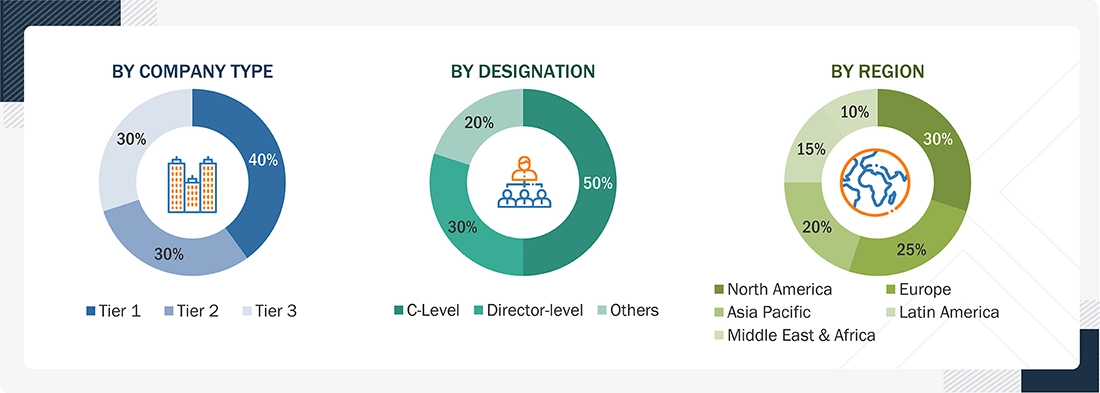
Note 1: C-level executives include CEOs, COOs, CTOs, and VPs.
Note 2: Others include sales, marketing, and product managers.
Note 3: Companies are classified into tiers based on their total revenue. As of 2024: Tier 1=>USD 1 billion, Tier 2 = USD 500 million to USD 1 billion, and Tier 3 = < USD 500 million.
To know about the assumptions considered for the study, download the pdf brochure
Market Size Estimation
The research methodology used to estimate the size of the neurovascular devices market includes the following details.
The market sizing was undertaken from the global side.
Country-level Analysis: The size of the neurovascular devices market was determined from annual presentations by leading players and secondary data available in the public domain. The share of products and services within the overall neurovascular devices market was derived from secondary data and validated by primary participants to estimate the total market. Primary participants further confirmed the validity of these data numbers.
Geographic Market Assessment (By Region & Country): The geographic assessment was done using the following approaches:
Approach 1: Geographic revenue contributions/splits of leading players in the market (wherever available) and respective growth trends
Approach 2: Geographic adoption trends for individual product segments by end users and growth prospects for each of the segments (assumptions and indicative estimates validated from primary interviews)
At each stage, the assumptions and approaches were verified through industry experts contacted during primary research. Given the limitations of data available from secondary research, revenue estimates for individual companies—covering the overall neurovascular devices market and regional market assessments—were determined based on a detailed analysis of their product offerings, geographic reach or strength (whether direct or through distributors or suppliers), and the market shares of leading players in specific regions and countries.
Global Neurovascular Devices Market Size: Bottom-Up and Top-Down Approach

Data Triangulation
After determining the overall size from the market size estimation process described above, the total market was divided into multiple segments and subsegments. The data triangulation and market breakdown procedures explained below were applied, where applicable, to complete the overall market analysis and derive precise statistics for various market segments and subsegments. The data was triangulated by examining diverse factors and trends from both the demand and supply sides. Additionally, the market size was validated using both top-down and bottom-up methods.
Market Definition
The neurovascular devices market includes medical technologies and tools designed for monitoring, managing, and treating neurovascular diseases. It encompasses devices used to treat brain aneurysms (such as embolic coils, flow diversion devices, intracranial stents, and others), ischemic strokes (like clot retriever devices, suction and aspiration tools, vascular snares, balloon catheters, and more), carotid artery stenosis (including carotid artery stents, embolic protection devices, and balloon catheters), arteriovenous malformations and fistulas (such as liquid embolic agents, occlusion balloon catheters, microcatheters), and other related conditions. Neurovascular devices are essential for accurate diagnosis, effective treatment, and comprehensive management of neurovascular disorders. By enabling timely interventions and enhancing procedural success, these technologies help reduce complications and promote better patient recovery. The market serves patients, healthcare professionals, and medical institutions, driven by continuous advancements in device technology, the rising prevalence of neurovascular disorders, and increasing demand for innovative, minimally invasive, and user-friendly treatment options.
Stakeholders
- Neurovascular devices’ manufacturing companies
- Contract manufacturers
- Distributors, suppliers, and channel partners of neurovascular devices
- Senior Management
- Finance Department
- Procurement Department
- Hospitals & Clinics
- E-commerce and Digital Platforms
- Academic & Research Institutes
- Trade Associations and Industry Bodies
- Regulatory Bodies and Government Agencies
- Business Research and Consulting Service Providers
- Market Research and Consulting Firms
- Venture Capitalists and Investors
Report Objectives
- To define, describe, segment, analyse, and forecast the global neurovascular devices market by disease pathology, end user, and region
- To provide detailed information about the factors influencing market growth (drivers, restraints, opportunities, and challenges)
- To analyze micro markets concerning individual growth trends, prospects, and contributions to the overall market
- To analyze market opportunities for stakeholders and provide details of the competitive landscape for key players
- To forecast the size of the neurovascular devices market in North America, Europe, the Asia Pacific, Latin America, the Middle East & Africa, and GCC countries
- To profile the key players in the neurovascular devices market and comprehensively analyze their core competencies
- To track and analyze competitive developments such as agreements, collaborations, and partnerships; expansions; acquisitions; and product launches & approvals in the neurovascular devices market
Fact checked
Personalize This Research
- Triangulate with your Own Data
- Get Data as per your Format and Definition
- Gain a Deeper Dive on a Specific Application, Geography, Customer or Competitor
- Any level of Personalization
Let Us Help You
- What are the Known and Unknown Adjacencies Impacting the Neurovascular Devices Market
- What will your New Revenue Sources be?
- Who will be your Top Customer; what will make them switch?
- Defend your Market Share or Win Competitors
- Get a Scorecard for Target Partners

Custom Market Research Services
We Will Customise The Research For You, In Case The Report Listed Above Does Not Meet With Your Requirements
Get 10% Free CustomisationTESTIMONIALS

JAYANT RAJPUROHIT
Director of Market Insights, Data and Analytics
SFI Health,
Leading Pharmaceutical Companywww.sfihealth.com/

We at SFI Health approached MarketsandMarkets for an Opportunity Assessment on "Incidence and Prevalence of Focus Indications" as we wanted to know the most attractive HCPs like Physician, Functional MD, Naturopath and Pharmacist. The project was critical for us to ensure our focus on the right target which would enable sustainable growth and profitability for SFI Health. The business insights provided exceeded our expectations and we were extremely impressed. The team at MarketsandMarkets is highly professional and detail oriented and very well understood our business needs. MarketsandMarkets offers a unique combination of expertise and dedicated engagement model. We identified 2 new products to be launched in coming months, based on the research findings provided by MarketsandMarkets. We are happy with the services and would strongly recommend MarketsandMarkets to my peers in the industry.

BEATRIZ DE LA CALLE
Head of Commercial Analytics
Qualicaps,
Leading Pharmaceutical Companywww.qualicaps.com/

We partnered with MarketsandMarkets for an assessment study on hard empty capsules. The team was extremely professional in understanding our business requirements and we received timely responses to all our queries. The market intelligence and the recommendations has met our business requirements. We were extremely impressed to see the final study results; it really exceeded our expectations. The market intelligence offered by MarketsandMarkets, and clarity on next steps will help us achieve our business objective for the Year 2021. We are happy with the services and would strongly recommend MarketsandMarkets to my peers in the industry.

Bob Williams,
Senior Director Business Development & Innovation
Bracco Diagnostics Inc.,
Italian Multinational in life sciences sector and a World Leader in imaging diagnosticsimaging.bracco.com/us-en
We were pleased with targeted insights that MarketsandMarkets identified from a custom study on the 'Radiation Dose Management Solutions Market'. Your team identified and characterized the market participants as well as underlying trends accurately. This study was useful to Bracco in formulating business strategies for our dose monitoring product lines and we thank MarketsandMarkets for the job well done.
Cody Coonradt,
Market Development and Strategy Manager
3M Health Information Systems,
Leader in Health care Coding, Payment & Analytics Solutions.www.3m.com/3M/en_US/health-information-systems-us
The value for our organization comes from three things: depth of research, specificity of segments and being easy to work with. As important as the first two are, the third can't be underestimated. MarketsandMarkets, maybe more than any other research vendor, wants to know what is top of mind for our team and what big questions we are grappling to answer.
Their customer first approach and high value engagement model, have given us great analysis and excellent value for money
- Canada Neurovascular Devices Market
- US Neurovascular Devices Market
- Germany Neurovascular Devices Market
- France Neurovascular Devices Market
- UK Neurovascular Devices Market
- Italy Neurovascular Devices Market
- Spain Neurovascular Devices Market
- Japan Neurovascular Devices Market
- China Neurovascular Devices Market
- India Neurovascular Devices Market
- Australia Neurovascular Devices Market
- South Korea Neurovascular Devices Market
- Brazil Neurovascular Devices Market
- Mexico Neurovascular Devices Market
Growth opportunities and latent adjacency in Neurovascular Devices Market






Lester
May, 2022
need data on advancements in the Neurovascular Devices market. outlook, size, share everything..
Jamie
May, 2022
Detailed US geo information of Neurovascular Devices Market with a vision to 2022 - 2026.
Joseph
Jun, 2026
After reviewing the Neurovascular Devices Market report, I noticed how the increasing shift toward minimally invasive neurointerventional procedures is reshaping hospital procurement priorities and physician training requirements..
Scarlett
Jun, 2026
From a technical lens, the Neurovascular Devices Market highlights continuous improvements in catheter design and imaging compatibility, which are critical for navigating complex vascular structures with higher precision..
Matthew
Jun, 2026
Looking at market dynamics, my takeaway from the Neurovascular Devices Market is that growth will be strongly influenced by stroke management protocols and the expansion of specialized neurointervention centers globally..
Douglas
Mar, 2022
In what way COVID19 is Impacting the global growth of the Neurovascular Devices Market?.