
Middle East Business Jet Market (2024-2029)

The Middle East Business Jet Market was valued at $8130 Million in 2024 and projected to reach to $12790 Million by 2029, representing a compound annual growth rate of 5.8%. The Middle East business jet market is poised for sustained expansion through 2029, driven by rising corporate travel demands and wealth accumulation among regional entrepreneurs and business leaders.


| Market Size in | USD 26.32 MN |
| Market Forecast in | |
| CAGR | |
| Forecast Period | |
| Units Considered | Value (USD MN) |
Middle East Business Jet Market Trends and Insights
- This 5.8% compound annual growth rate reflects the region's strong demand for premium aviation services, driven by high-net-worth individuals, corporate expansion, and regional economic diversification initiatives.
- The Middle East's strategic geographic position and robust oil and gas sector continue to support sustained investment in business aviation infrastructure and fleet modernization. Key factors propelling the Middle East market include increasing business travel among Gulf Cooperation Council (GCC) nations, rising demand for ultra-long-range aircraft, and enhanced airport facilities across major hubs.
- The Middle East's affluent demographic and growing corporate sector are accelerating adoption of business jets for executive mobility and time-sensitive operations.
- Between 2024 and 2029, the Middle East is expected to capture significant market share within the global business jet sector, supported by favorable regulatory environments and competitive pricing strategies from leading manufacturers targeting the region's expanding clientele..
Key Market Statistics
- CAGR (2024-2029) 5.8% CAGR
- Market Size, 2024 ~USD 8130 Million
- Forecast, 2029 ~USD 12790 Million
- Geography Middle East
Middle East Business Jet Market Overview
Strong Regional Growth Trajectory :
The Middle East business jet market is projected to grow from $8,130 million in 2024 to $12,790 million by 2029, representing a robust 5.8% CAGR that reflects sustained demand for premium aviation across the region.
High-Net-Worth Individual Concentration :
The region's significant population of ultra-high-net-worth individuals drives consistent demand for luxury business aviation, with private jet ownership serving as a status symbol and essential business tool for regional executives.
Economic Diversification Initiatives :
Government-led diversification programs across Gulf states are spurring corporate expansion and international business activities, increasing the need for efficient business jet travel among multinational corporations and regional enterprises.
Strategic Geographic Positioning :
The Middle East's location as a bridge between Europe, Asia, and Africa positions it as a critical hub for business aviation, with major airports serving as connectivity points for regional and international business travel.
Middle East Business Jet Market Dynamics
- The region's strategic geographic position and ongoing economic diversification initiatives create favorable conditions for business aviation growth, with increasing adoption among both established corporations and emerging enterprises seeking premium travel solutions. Key growth catalysts include expanding international business partnerships, rising tourism and hospitality sectors, and government support for aviation infrastructure development.
- As regional economies continue to modernize and diversify beyond traditional sectors, business jet utilization is expected to increase significantly, supporting the projected market expansion to $12,790 million by 2029..
Market Ecosystem
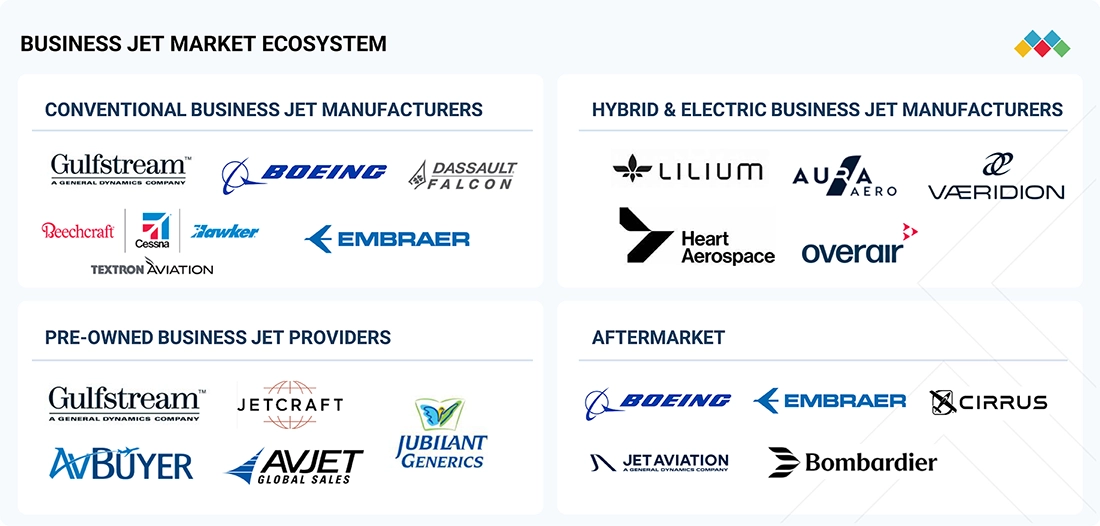
BUSINESS JET MARKET SIZE, SHARE, TRENDS, COMPANIES & INDUSTRY: COMMERCIAL USE CASES ACROSS INDUSTRIES
| COMPANY | USE CASE DESCRIPTION | BENEFITS |
|---|---|---|
 |
Managing diverse cabin configurations and complex cabin data systems. | Reduced manual testing, streamlined integration, faster validation. |
 |
Fractional ownership and management of business jet fleets. | Lower ownership costs, efficient asset utilization, reduced overhead. |
 |
Development of a fully electric propulsion demonstrator module for eVTOL and small aircraft. | Lightweight design, modular scalability, fast-charging capability, zero-emission operation. |
Logos and trademarks shown above are the property of their respective owners. Their use here is for informational and illustrative purposes only.
Related Ecosystem
Aviation
- Narrow Body Aircraft
- Wide Body Aircraft
- Military Helicopters
- Special Mission Aircraft
- Fighter Aircraft
- HONEYWELL INTERNATIONAL INC.
- COLLINS AEROSPACE
- Thales group
- Safran group
- HEICO Corporation
Key Takeaways
- The Middle East business jet market will grow from $8.13B (2024) to $12.79B (2029) at a 5.8% CAGR.
- The Middle East's high-net-worth population and GCC business expansion drive sustained demand for premium aircraft.
- Ultra-long-range jets and advanced cabin technologies are increasingly preferred by Middle East operators.
- The Middle East benefits from strategic geographic positioning and robust aviation infrastructure development through 2029.
Business Jet Market Report Scope
| Report Metric | Details |
|---|---|
| Base Year | 2024 |
| Fastest Growing Segment | 11-25 YEARS (Aircraft Age) |
| Forecast Period | 2024-2029 |
| Growth Rate | CAGR of 6.4% from 2024 to 2029 |
| Largest Segment | PRE-OWNED (Point Of Sale) |
| Market Size Base Year (Billions) | ~USD 95.57 (2024) |
| Revenue Forecast (Billions) | ~USD 130.33 (2029) |
| Segments Covered | Aircraft Type, End Use, Point Of Sale, Aircraft Age, Type, Operation, Range, System, Subsystem |
Middle East Business Jet Market Report Segmentation
9 segment dimensions are covered across the global market.
By Aircraft Type
- Airliner
- Large
- Light
- Mid-Sized
By End Use
- Operators
- Private Users
By Point Of Sale
- Aftermarket
- OEM
- Pre-Owned
By Aircraft Age
- 11-25 Years
- <10 Years
- >25 Years
By Type
- Conventional
- Hybrid-Electric
By Operation
- Mro
- Parts Replacement
By Range
- 3,000-5,000 Nm
- <3, 000 Nm
- >5,000 Nm
By System
- Aerostructures
- Aftermarket Systems
- Aircraft Systems
- Avionics
- Cabin Interiors
- Doors, Windows, & Windshields
- OEM Systems
By Subsystem
- Communications Systems
- Electrical Systems
- Emergency Systems
- Empennages
- Environmental Control Systems
- Flight Control Surfaces
- Flight Management Systems
- Fuselages
- Galleys
- Hydraulic Systems
- In-Flight Entertainment & Connectivity Systems
- Landing Systems
- Lavatories
- Nacelles & Pylons
- Navigation Systems
- Noses
- Panels
- Pneumatic Systems
- Propulsion Systems
- Seats
- Software
- Stowage Bins
- Wings
Target Audience
- Business Jet Manufacturers & OEMs : Manufacturers need detailed Middle East market data to identify growth opportunities, forecast demand by aircraft category, and develop region-specific sales and support strategies for premium business aviation products.
- Charter & Management Companies : Aviation service providers require market insights to expand charter operations, optimize fleet deployment, and understand HNW client concentration in key Middle Eastern markets for targeted service development.
- Airport & FBO Operators : Fixed-base operators and airport authorities need market forecasts to plan infrastructure investments, terminal expansions, and service enhancements aligned with projected business jet traffic growth in the region.
- Investment & Private Equity Firms : Investors evaluating aviation sector opportunities require comprehensive market analysis to assess growth potential, identify acquisition targets, and make informed capital allocation decisions in the Middle East business aviation space.
- Corporate Travel & Procurement Teams : Enterprise procurement departments need market data to evaluate business jet charter options, negotiate service agreements, and understand regional aviation capacity and pricing trends for executive travel programs.
Countries within Middle East - compare and drill down
| Country | 2025 size (native) |
|---|---|
| UAE | USD 780 Million |
| Saudi Arabia | USD 750 Million |
| Qatar | USD 290 Million |
| Israel | USD 380 Million |
| Rest Of Middle East | USD 300 Million |
Country market size visualization
Reasons to Buy this Report
- Market Size & Growth Validation : Obtain precise market valuation data for the Middle East ($8.13B in 2024) with detailed 5-year forecasts, enabling accurate investment decisions and strategic planning for aviation service providers and manufacturers targeting the region.
- Regional Demand Driver Analysis : Understand the specific factors driving Middle East business jet adoption—HNW concentration, corporate expansion, and economic diversification—to tailor product offerings and marketing strategies for maximum market penetration.
- Country-Level Market Breakdown : Access granular market data for key Middle Eastern markets including UAE ($780M), Saudi Arabia ($750M), and Qatar ($290M), allowing targeted expansion strategies and resource allocation across high-opportunity markets.
- Competitive Positioning Intelligence : Benchmark your business jet operations against regional market trends and growth rates (5.8% CAGR vs. 6.4% global), identifying competitive advantages and market gaps in the Middle East aviation sector.
- Strategic Investment Roadmap : Develop informed expansion plans with comprehensive market outlook data, supporting decisions on facility investments, fleet acquisitions, and service offerings aligned with projected $4.66B market growth through 2029.
Frequently asked questions
What is the current size of the Middle East business jet market?
The Middle East business jet market was valued at $8,130 million in 2024 and is projected to reach $12,790 million by 2029.
What is the expected growth rate for the Middle East business jet market?
The Middle East business jet market is expected to grow at a compound annual growth rate (CAGR) of 5.8% from 2024 to 2029.
Which factors are driving growth in the Middle East business jet market?
Key growth drivers in the Middle East include increasing high-net-worth individuals, GCC corporate expansion, demand for ultra-long-range aircraft, and enhanced airport infrastructure.
What aircraft types are most popular in the Middle East market?
Ultra-long-range business jets with advanced cabin technologies and premium amenities are increasingly preferred by Middle East operators for executive mobility and international travel.
How does the Middle East market compare to global business jet trends?
The Middle East's 5.8% CAGR is slightly below the global 6.4% CAGR, but the region maintains strong market fundamentals supported by regional wealth concentration and economic diversification.
RESEARCH METHODOLOGY
The research study conducted on the business jet market involved extensive use of secondary sources, directories, and databases such as Hoovers, Bloomberg Businessweek, and Factiva to identify and collect information relevant to the business jet market. The primary sources considered included industry experts from the business jet market as well as suppliers, manufacturers, solution providers, technology developers, alliances, and organizations related to all segments of the value chain of this industry. In-depth interviews with various primary respondents, including key industry participants, Subject Matter Experts (SMEs), industry consultants, and C-level executives have been conducted to obtain and verify critical qualitative and quantitative information pertaining to the business jet market as well as to assess the growth prospects of the market.
Secondary Research
The secondary sources referred for this research study included government sources, such as the Federal Aviation Industry (FAA), the European Aviation Safety Agency (EASA), the General Civil Aviation Authority (GCAA), the International Air Transport Association (IATA), and corporate filings, such as annual reports, investor presentations, and financial statements of trade, business, and professional associations, among others. The secondary data was collected and analyzed to arrive at the overall market size, which primary respondents further validated. Other secondary sources referred for this research study included Airfleets, Bombardier, Honeywell’s Global Business Aviation Outlook and Embraer Market Outlook 2023, General Aviation Manufacturers Association (GAMA); corporate filings (such as annual reports, investor presentations, and financial statements); and trade, business, and professional associations. Secondary data was collected and analyzed to arrive at the overall market size, which was further validated by primary respondents.
Primary Research
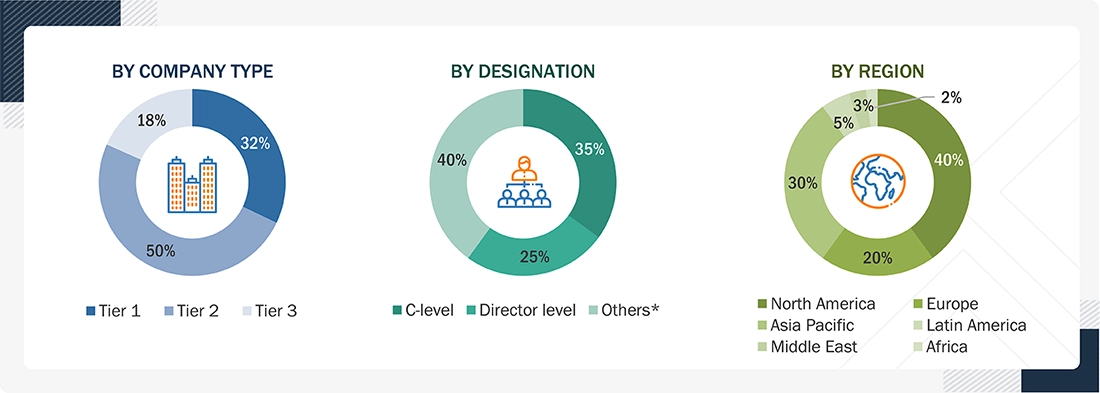
Extensive primary research was conducted to obtain qualitative and quantitative information such as market statistics, market breakdowns, market size estimations, market forecasting, and data triangulation. Primary research also helped understand industry trends, type, range, aftermarket systems, services, and region. Stakeholders from the demand side included government telecommunication organizations, system integrators, technology providers, and solution providers.
After obtaining information regarding the business jet market scenario, extensive primary research was conducted with market experts from the demand and supply sides across six regions, namely, North America, Europe, Asia Pacific, Middle East, Africa, and Latin America. This primary data is obtained through questionnaires, emails, and telephonic interviews.
To know about the assumptions considered for the study, download the pdf brochure
Market Size Estimation
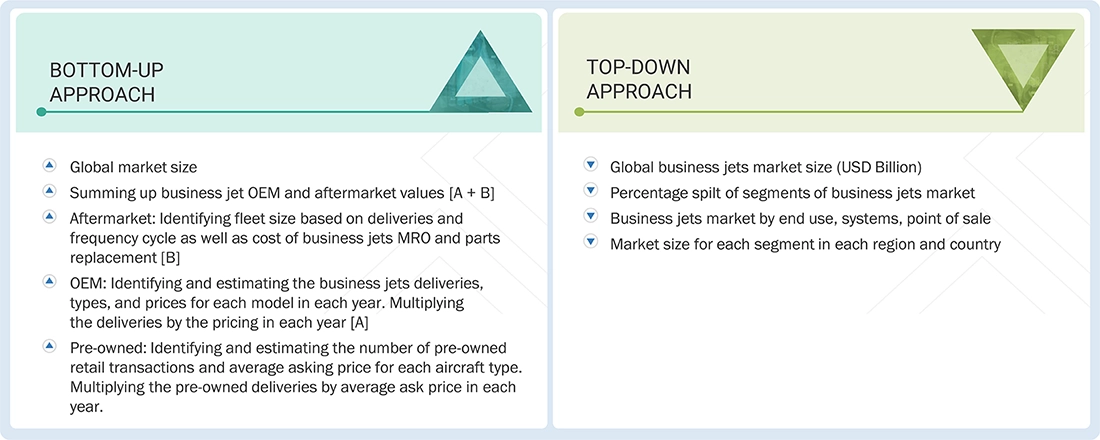
Both top-down and bottom-up approaches were used to estimate and validate the size of the business jet market. The following figure offers a representation of the overall market size estimation process employed for the purpose of this study on the business jet market.
The research methodology used to estimate the market size includes the following details:
- Key players in this market were identified through secondary research, and their market share was determined through primary and secondary research. This included a study of the annual and financial reports of top market players and extensive interviews of leaders such as Chief Executive Officers (CEOs), directors, and marketing executives of leading companies operating in the business jet market.
- All percentage shares, splits, and breakdowns were determined using secondary sources and verified through primary sources.
- All possible parameters that affect the markets covered in this research study were accounted for, viewed in extensive detail, verified through primary research, and analyzed to obtain the final quantitative and qualitative data.
Market size estimation methodology: Bottom-up Approach & Top-down Approach
Data triangulation
After arriving at the overall size of the business jet market from the market size estimation process explained above, the total market was split into several segments and subsegments. The data triangulation and market breakdown procedures explained below were implemented, wherever applicable, to complete the overall market engineering process and arrive at the estimated sizes of different market segments and subsegments. The data was triangulated by studying various factors and trends from both the demand and supply sides. Along with this, the market size was validated using both the top-down and bottom-up approaches.
Market Definition
A business jet is an aircraft used by business people, politicians and other government officials, and high-net-worth individuals. Business jet provide an efficient and productive means of air travel to cater to schedules of various individuals or groups and to reach destinations that are not covered by commercial airlines. These aircraft are also used during emergencies such as floods, evacuations, etc. Business jet are generally owned by high-net-worth individuals, governments, businesses, and operators such as charter companies.
Pre-owned business jet refers to used business jet, and resale of business jet refer to the sale of pre-owned business jet.
Stakeholders
Various stakeholders of the market are listed below:
- Business Jet Manufacturers
- Business Jet Systems and Component Manufacturers
- Aircraft System Integrators
- Pre-owned aircraft providers
- Charter Operators
- Maintenance, Repair, and Overhaul (MRO) Companies
- Research Bodies
- Government Bodies and Agencies
- Regulators
- Investors
Report Objectives
- To define, describe, segment, and forecast the size of the business jet market based on aircraft type, end-use, point of sale, system, range, and region
- To forecast the market size of various segments of the business jet market with respect to 6 major regions: North America, Europe, Asia Pacific, Latin America, Middle East, and Africa, along with major countries in each region
- To identify and analyze key drivers, restraints, opportunities, and challenges influencing the growth of business jet market
- To identify and analyze various regional contracts in the business jet market
- To identify industry trends, market trends, and technology trends currently prevailing in the business jet market
- To strategically analyze micromarkets1 with respect to individual growth trends, prospects, and contributions to the overall market
- To analyze the degree of competition in the business jet market by identifying key market players
- To analyze competitive developments such as contracts, agreements, mergers & acquisitions, and new product launches & developments of key players in the business jet market
- To identify detailed financial positions, key products, unique selling points, and key developments of leading companies in the business jet market
- To strategically profile key market players and comprehensively analyze their market ranking and core competencies
- To identify detailed financial positions, key products, unique selling points, and key developments of leading companies in the business jet market
Available customizations
Along with the market data, MarketsandMarkets offers customizations as per the specific needs of companies. The following customization options are available for the report:
Product Analysis
- Product matrix, which gives a detailed comparison of the product portfolio of each company
Regional Analysis
- Further breakdown of the market segments at country-level
Company Information
- Detailed analysis and profiling of additional market players (up to 5)
Get the Full Business Jet Market Report
Full forecast, segment splits, and company analysis for all Business Jet Market.
- Canada Business Jet Market
- US Business Jet Market
- Germany Business Jet Market
- France Business Jet Market
- UK Business Jet Market
- Switzerland Business Jet Market
- Austria Business Jet Market
- Italy Business Jet Market
- Spain Business Jet Market
- China Business Jet Market
- Australia Business Jet Market
- Singapore Business Jet Market
- Japan Business Jet Market
- India Business Jet Market
- UAE Business Jet Market
- Saudi Arabia Business Jet Market
- Qatar Business Jet Market
- Turkey Business Jet Market
- Israel Business Jet Market
- South Africa Business Jet Market
- Kenya Business Jet Market
- Brazil Business Jet Market
- Mexico Business Jet Market
- Rest Of Europe Business Jet Market
- Rest Of Asia Pacific Business Jet Market
- Rest Of Latin America Business Jet Market
- Rest Of Middle East Business Jet Market
- Rest Of Africa Business Jet Market
Need a Tailored Report?
Customize this report to your needs
Get 10% FREE Customization
Customize This Report
