
Asia Pacific Carrier Screening Market (2023-2028)

The Asia Pacific Carrier Screening Market was valued at $188.1 Million in 2023 and projected to reach to $357.4 Million by 2028, representing a compound annual growth rate of 13.7%. The Asia Pacific carrier screening market is positioned for sustained growth through 2028, driven by demographic shifts, increasing healthcare awareness, and rising disposable incomes across the region.


| Market Size in | USD 26.32 MN |
| Market Forecast in | |
| CAGR | |
| Forecast Period | |
| Units Considered | Value (USD MN) |
Asia Pacific Carrier Screening Market Trends and Insights
- Asia Pacific's growth trajectory reflects increasing awareness of genetic disorders, rising healthcare expenditure, and expanding access to advanced diagnostic technologies across the region.
- The market in Asia Pacific is driven by growing demand for prenatal and preconception screening, particularly in developed economies such as Australia, Japan, and Singapore, where healthcare infrastructure supports widespread adoption. Asia Pacific's carrier screening adoption is accelerating due to favorable demographic trends, including delayed childbearing and heightened focus on reproductive health.
- Between 2023 and 2028, Asia Pacific is expected to see significant investment in genetic testing infrastructure and regulatory frameworks that support carrier screening programs.
- The region's diverse population and prevalence of inherited genetic conditions create substantial opportunities for market players to expand service offerings and reach underserved populations across Asia Pacific..
Key Market Statistics
- CAGR (2023-2028) 13.7% CAGR
- Market Size, 2023 ~USD 188.1 Million
- Forecast, 2028 ~USD 357.4 Million
- Geography Asia Pacific
Asia Pacific Carrier Screening Market Overview
Rapid Market Expansion :
Asia Pacific carrier screening market is growing at 13.7% CAGR, expanding from $188.1 million in 2023 to $357.4 million by 2028, demonstrating strong regional demand for genetic diagnostic solutions.
Increasing Genetic Awareness :
Rising awareness of genetic disorders and hereditary conditions across Asia Pacific populations is driving adoption of carrier screening programs among healthcare providers and expectant parents.
Healthcare Investment Growth :
Expanding healthcare expenditure across Asia Pacific nations, coupled with government initiatives supporting preventive medicine, is accelerating infrastructure development for advanced diagnostic technologies.
Technology Accessibility :
Improved access to advanced diagnostic and sequencing technologies in Asia Pacific is enabling broader implementation of carrier screening programs in both developed and emerging markets.
Asia Pacific Carrier Screening Market Dynamics
- Key growth catalysts include government support for genetic testing programs, expanding private healthcare sectors, and growing adoption of preventive healthcare practices among middle-class populations.
- The region's diverse healthcare landscape presents both opportunities and challenges, with developed markets like Australia and Japan leading adoption while emerging economies gradually increase screening accessibility.
- Strategic partnerships between diagnostic companies and regional healthcare providers are expected to accelerate market penetration and standardize testing protocols across Asia Pacific..
Market Ecosystem
Related Ecosystem
In Vitro Diagnostics
- Polymerase Chain Reaction (PCR)
- Enzyme-Linked Immunosorbent Assay (ELISA)
- Dna Microarrays
- Assay Kits
- Microarrays
- ROCHE HOLDINGS AG
- Thermo Fisher Scientific Inc.
- Danaher Corporation
- Abbott Laboratories
- Biomerieux s.a.
Medical Devices
- Polymerase Chain Reaction (PCR)
- Magnetic Resonance Imaging (MRI)
- Disposable Autoinjectors
- Pulse Oximeters
- Blood Pressure Monitors
- Medtronic plc
- Abbott Laboratories
- Stryker Corporation
- Becton, Dickinson and Company
- CONMED Corporation
Key Takeaways
- Asia Pacific carrier screening market valued at $188.1M in 2023, growing to $357.4M by 2028 at 13.7% CAGR
- Asia Pacific's growth driven by increased genetic disorder awareness and expanding healthcare infrastructure in developed markets
- Prenatal and preconception screening demand in Asia Pacific accelerating due to delayed childbearing trends
- Asia Pacific presents significant expansion opportunities through regulatory framework development and underserved population outreach
Carrier Screening Market Report Scope
| Report Metric | Details |
|---|---|
| Base Year | 2023 |
| Fastest Growing Segment | PULMONARY CONDITIONS (Medical Condition) |
| Forecast Period | 2023-2028 |
| Growth Rate | CAGR of 19.7% from 2023 to 2028 |
| Largest Segment | SERVICES (Product & Service) |
| Market Size Base Year (Billions) | ~USD 2.2 (2023) |
| Revenue Forecast (Billions) | ~USD 5.4 (2028) |
| Segments Covered | Product & Service, Type, Medical Condition, Technology, End User, Product & 2021-2028 |
Asia Pacific Carrier Screening Market Report Segmentation
6 segment dimensions are covered across the global market.
By Product & Service
- Products
- Services
By Type
- Customized Panel Testing
- Expanded Carrier Screening
- Predesigned Panel Testing
- Targeted Disease Carrier Screening
By Medical Condition
- Hematological Conditions
- Neurological Conditions
- Other Medical Conditions
- Pulmonary Conditions
By Technology
- Dna Microarrays
- Dna Sequencing
- Other Technologies
- Pcr
By End User
- Clinical Laboratories
- Fertility Clinics
- Hospitals And Medical Centers
- Other End Users
By Product & 2021-2028
- Products
- Services
Target Audience
- Diagnostic Companies : Require detailed Asia Pacific market intelligence to identify expansion opportunities, assess competitive positioning, and develop region-specific product strategies for carrier screening solutions.
- Healthcare Providers : Need market data to understand demand trends, patient demographics, and technology adoption patterns to optimize genetic screening service offerings across Asia Pacific facilities.
- Investment Firms : Seek comprehensive regional market analysis to evaluate investment opportunities, assess growth potential, and identify acquisition targets in the Asia Pacific carrier screening sector.
- Government & Policy Makers : Require market insights to inform healthcare policy decisions, allocate resources for genetic screening programs, and establish regulatory frameworks supporting preventive medicine initiatives.
- Research Institutions : Need regional market data to understand adoption trends, identify research gaps, and develop evidence-based recommendations for improving genetic screening accessibility across Asia Pacific.
Countries within Asia Pacific - compare and drill down
| Country | 2025 size (native) |
|---|
Country market size visualization
Reasons to Buy this Report
- Regional Market Sizing : Obtain precise market valuation and forecasting data specific to Asia Pacific, enabling accurate budget allocation and investment decisions for regional expansion strategies.
- Growth Opportunity Identification : Identify high-growth segments and emerging opportunities within Asia Pacific's 13.7% CAGR trajectory to prioritize market entry and product development initiatives.
- Competitive Landscape Analysis : Understand regional competitive dynamics, market players, and positioning strategies tailored to Asia Pacific's unique healthcare infrastructure and regulatory environment.
- Strategic Market Entry : Leverage Asia Pacific-specific insights on healthcare adoption rates, technology accessibility, and consumer behavior to develop targeted go-to-market strategies.
- Investment Risk Mitigation : Access comprehensive regional data on market drivers, barriers, and regulatory factors to reduce investment risk and inform capital allocation decisions in Asia Pacific.
Frequently asked questions
What is the current size of the carrier screening market in Asia Pacific?
The Asia Pacific carrier screening market was valued at $188.1 million in 2023 and is projected to reach $357.4 million by 2028.
What is the expected growth rate for carrier screening in Asia Pacific?
Asia Pacific's carrier screening market is expected to grow at a compound annual growth rate (CAGR) of 13.7% from 2023 to 2028.
Which countries in Asia Pacific are driving carrier screening market growth?
Developed economies in Asia Pacific such as Australia, Japan, and Singapore are leading market growth due to advanced healthcare infrastructure and higher adoption rates of genetic screening services.
What factors are accelerating carrier screening adoption in Asia Pacific?
Key drivers in Asia Pacific include rising healthcare expenditure, increased awareness of genetic disorders, delayed childbearing trends, and expanding access to advanced diagnostic technologies.
What opportunities exist for market expansion in Asia Pacific?
Asia Pacific offers significant opportunities through regulatory framework development, infrastructure investment in emerging markets, and targeted outreach to underserved populations with high prevalence of inherited genetic conditions.
RESEARCH METHODOLOGY
The study involved four major activities in estimating the current size of the Carrier Screening Market. Exhaustive secondary research was done to collect information on the market and its different subsegments. The next step was to validate these findings, assumptions, and sizing with industry experts across the value chain through primary research. Both top-down and bottom-up approaches were employed to estimate the complete market size. After that, market breakdown and data triangulation procedures were used to estimate the market size of the segments and subsegments.
Secondary Research
In the secondary research process, various secondary sources such as annual reports, press releases & investor presentations of companies, white papers, certified publications, articles by recognized authors, gold-standard & silver-standard websites, regulatory bodies, and databases (such as D&B Hoovers, Bloomberg Business, and Factiva) were referred to identify and collect information for this study.
Primary Research
Extensive primary research was conducted after acquiring knowledge about the global market scenario through secondary research. Primary interviews were conducted from both the demand (Doctors, Surgeons, Gynecologist, genetic consultant) and supply sides (Carrier Screening product/service providers and distributors).
The following is a breakdown of the primary respondents:
Breakdown of Primary Participants:
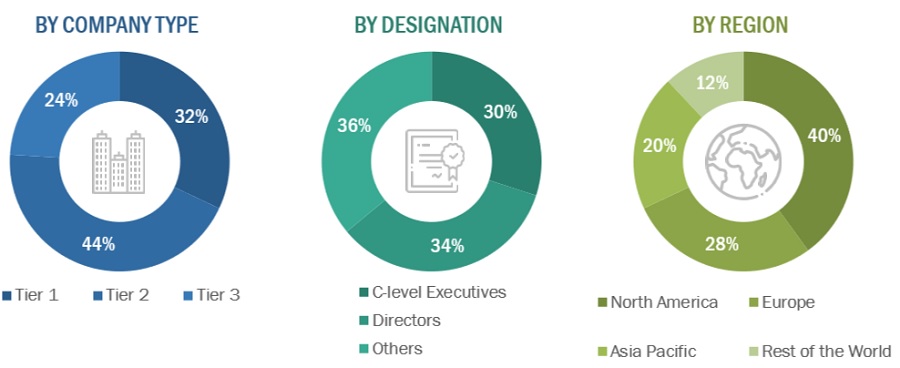
Note 1: Others include sales managers, marketing managers, and product managers.
Note 2. Tiers of companies are defined based on their total revenue. As of 2021: Tier 1 = >USD 5 billion, Tier 2 = USD 500 million to USD 5 billion, and Tier 3 = <USD 500 million.
To know about the assumptions considered for the study, download the pdf brochure
Market Size Estimation
Both top-down and bottom-up approaches were used to estimate and validate the total size of the Carrier Screening Market. These methods were also used extensively to estimate the size of various subsegments in the market. The research methodology used to estimate the market size includes the following:
- The key players in the industry and markets have been identified through extensive secondary research
- The industry’s supply chain and market size, in terms of value, have been determined through primary and secondary research processes
- All percentage shares, splits, and breakdowns have been determined using secondary sources and verified through primary sources
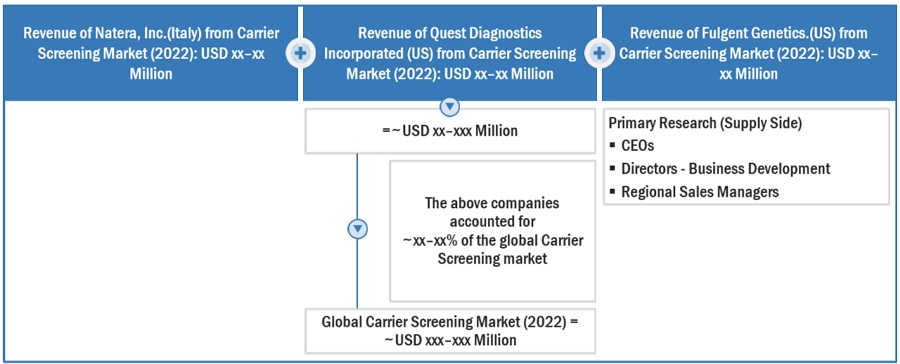
To know about the assumptions considered for the study, Request for Free Sample Report
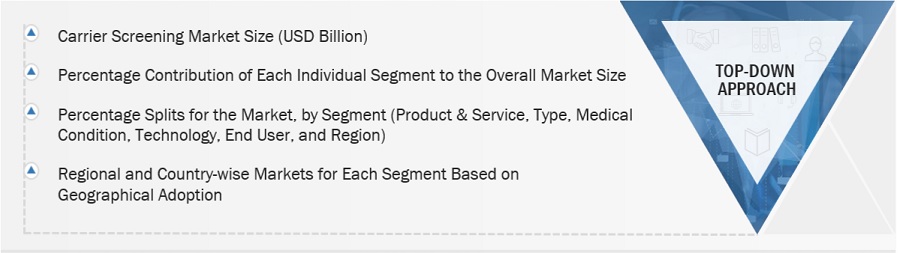
Data Triangulation
After arriving at the overall market size—using the market size estimation processes—the market was split into several segments and subsegments. To complete the overall market engineering process and arrive at the exact statistics of each market segment and subsegment, the data triangulation, and market breakdown procedures were employed, wherever applicable. The data was triangulated by studying various factors and trends from both the demand and supply sides in the Carrier Screening Market industry.
Market Definition
Carrier screening is a type of genetic testing that is used to determine if a person is a carrier for a specific autosomal recessive disease. Similarly, when it is done before or during pregnancy, it allows to find out the chances of having a child with a genetic disorder. Carrier screening involves testing a sample of blood, saliva, or tissue from the inside of the cheek.
Market Stakeholders
- Carrier screening product manufacturers, vendors, and distributors
- Carrier screening service companies
- Hospitals and private physician clinics
- Reference laboratories
- Donor banks
- Health insurance payers
- Research & consulting firms
- Diagnostic Centers, and Medical Colleges
- Research Institutes
- Clinical Laboratories
- Distributors of Carrier Screening Products and services
Report Objectives
- To define, describe, and forecast the global Carrier Screening Market based on Product & Service, Type, Medical Condition, Technology, End User, and Region
- To provide detailed information regarding the major factors influencing the growth of the market (drivers, opportunities, and industry-specific challenges)
- To strategically analyze micromarkets1 with respect to individual growth trends, future prospects, and contributions to the total market
- To analyze opportunities in the market for stakeholders and provide details of the competitive landscape for market leaders
- To forecast the size of market segments with respect to four main regions—North America, Europe, Asia Pacific and the Rest of the World (RoW)2
- To strategically profile key players and comprehensively analyze their product portfolios, market shares, and core competencies
- To track and analyze competitive developments such as acquisitions, expansions, new product launches, and partnerships in the Carrier Screening Market.
Available Customizations:
With the given market data, MarketsandMarkets offers customizations as per the company’s specific needs. The following customization options are available for the report:
- Product Analysis: Product matrix, which gives a detailed comparison of the product portfolios of each company
- Geographic Analysis: Further breakdown of the European Carrier Screening Market into specific countries.
Get the Full Carrier Screening Market Report
Full forecast, segment splits, and company analysis for all Carrier Screening Market.
Need a Tailored Report?
Customize this report to your needs
Get 10% FREE Customization
Customize This Report
