
-Rest Of GCC Countries Chillers Market (2024-2029)

The -Rest Of GCC Countries Chillers Market was valued at $251.4 Million in 2024 and projected to reach to $309.3 Million by 2029, representing a compound annual growth rate of 4.23%. The Rest of GCC Countries chillers market is poised for steady growth driven by industrial expansion and rising cooling infrastructure investments.


| Market Size in | USD 26.32 MN |
| Market Forecast in | |
| CAGR | |
| Forecast Period | |
| Units Considered | Value (USD MN) |
-Rest Of GCC Countries Chillers Market Trends and Insights
- -Rest Of GCC Countries represents a significant segment within the Middle East Africa region, driven by increasing industrial cooling demands and infrastructure development.
- The market in -Rest Of GCC Countries reflects steady growth momentum as regional economies diversify and invest in manufacturing and commercial facilities requiring advanced cooling solutions. -Rest Of GCC Countries' chillers market is characterized by rising adoption of energy-efficient cooling technologies and stringent environmental regulations.
- Between 2024 and 2029, -Rest Of GCC Countries is expected to see sustained demand from petrochemical, pharmaceutical, and data center sectors.
- The growth trajectory in -Rest Of GCC Countries underscores the region's commitment to modernizing industrial infrastructure and supporting economic diversification initiatives across the GCC bloc..
Key Market Statistics
- CAGR (2024-2029) 4.23% CAGR
- Market Size, 2024 ~USD 251.4 Million
- Forecast, 2029 ~USD 309.3 Million
- Country -Rest Of GCC Countries
-Rest Of GCC Countries Chillers Market Overview
Market Size & Growth :
The Rest of GCC Countries chillers market is valued at USD 251.4 million in 2024, with a projected CAGR of 4.23% through 2029, reaching USD 309.3 million by forecast end.
Industrial Cooling Demand :
Increasing industrial cooling requirements across manufacturing, petrochemical, and pharmaceutical sectors in Rest of GCC Countries are driving sustained market expansion and technology adoption.
Infrastructure Development :
Ongoing infrastructure projects and commercial real estate expansion in Rest of GCC Countries are creating new opportunities for chiller installations in HVAC systems and industrial applications.
Regional Market Position :
Rest of GCC Countries represents a significant segment within the Middle East Africa region, contributing meaningfully to the broader GCC chillers market landscape with distinct growth dynamics.
-Rest Of GCC Countries Chillers Market Dynamics
- The region's diversifying economy beyond oil and gas is spurring demand for advanced cooling solutions across manufacturing, data centers, and commercial facilities.
- With a 4.23% CAGR, the market reflects moderate but consistent expansion as businesses prioritize energy-efficient cooling technologies. Key growth catalysts include increasing urbanization, rising temperatures driving HVAC demand, and industrial modernization initiatives.
- The market is expected to benefit from infrastructure development projects and growing awareness of sustainable cooling solutions.
- Competition among regional and international chiller manufacturers will intensify, fostering innovation and competitive pricing in the Rest of GCC Countries market through 2029..
Market Ecosystem
Related Ecosystem
Equipment Machine And Tooling
- Wastewater Treatment
- Air Cooled Heat Exchangers
- Diaphragm Pumps
- Fiberglass
- HVAC System
- Alfa Laval Corporate AB
- Johnson Controls International plc
- Veolia
- Daikin Industries,Ltd.
- Carrier Global Corporation
Key Takeaways
- -Rest Of GCC Countries chillers market valued at USD 251.4 million in 2024, growing to USD 309.3 million by 2029.
- -Rest Of GCC Countries exhibits a 4.23% CAGR, reflecting steady regional industrial expansion and cooling infrastructure investment.
- -Rest Of GCC Countries demand is driven by petrochemical, pharmaceutical, and data center sectors requiring advanced cooling solutions.
- -Rest Of GCC Countries market growth is supported by energy efficiency mandates and economic diversification across the GCC region.
Chillers Market Report Scope
| Report Metric | Details |
|---|---|
| Base Year | 2024 |
| Fastest Growing Segment | FOOD & BEVERAGES (End-Use Industry) |
| Forecast Period | 2024-2029 |
| Growth Rate | CAGR of 5% from 2024 to 2029 |
| Largest Segment | WATER COOLED (Medium) |
| Market Size Base Year (Billions) | ~USD 12.08 (2024) |
| Revenue Forecast (Billions) | ~USD 15.42 (2029) |
| Segments Covered | Medium, Capacity, Type, End-Use Industry |
-Rest Of GCC Countries Chillers Market Report Segmentation
4 segment dimensions are covered across the global market.
By Medium
- Air Cooled
- Liquid Coolant
- Water Cooled
By Capacity
- 300 Kw - 700 Kw
- 701 Kw - 1,500 Kw
- Above 1,500 Kw
- Below 300 Kw
By Type
- Absorption Chillers
- Centrifugal
- Reciprocating Chillers
- Screw
- Scroll
- - 300 Kw - 700 Kw
- - 300 Kw- 700 Kw
- - 701 Kw - 1,500 Kw
- - 701 Kw- 1,500 Kw
- - Above 1,500 Kw
- - Below 300 Kw
By End-Use Industry
- Alternative Energy
- Chemicals & Petrochemicals
- Commercial
- Food & Beverages
- Laser Cutting
- Medical & Pharmaceutical
- Other End-Use Industries
- Plastics
- Printing
- Rubber
Target Audience
- Chiller Manufacturers & OEMs : Manufacturers need Rest of GCC Countries-specific market data to develop localized product strategies, identify distribution opportunities, and plan capacity investments aligned with regional demand growth.
- HVAC System Integrators : System integrators require detailed market insights for Rest of GCC Countries to forecast demand, optimize service offerings, and identify key customer segments in industrial and commercial cooling applications.
- Industrial Facility Operators : Facility managers and operators need market intelligence on Rest of GCC Countries cooling solutions to make informed procurement decisions and evaluate technology trends affecting operational efficiency.
- Investment & Private Equity Firms : Investors evaluating opportunities in Rest of GCC Countries require validated market sizing and growth forecasts to assess portfolio companies, identify acquisition targets, and evaluate sector attractiveness.
- Consulting & Engineering Firms : Consultants advising clients on infrastructure and industrial projects in Rest of GCC Countries need market data to support feasibility studies, cost projections, and technology recommendations.
Reasons to Buy this Report
- Precise Market Sizing : Access validated market data specific to Rest of GCC Countries with exact 2024 baseline (USD 251.4M) and 2029 forecast (USD 309.3M), enabling accurate business planning and investment decisions.
- Regional Growth Intelligence : Understand the 4.23% CAGR trajectory unique to Rest of GCC Countries, differentiated from global 5% growth, to identify localized opportunities and competitive advantages in this emerging market segment.
- Sector-Specific Insights : Gain detailed understanding of industrial cooling demand drivers, infrastructure development catalysts, and end-user requirements specific to Rest of GCC Countries market dynamics and applications.
- Strategic Market Positioning : Benchmark your business against Rest of GCC Countries market trends to optimize product offerings, pricing strategies, and go-to-market approaches tailored to regional industrial and commercial needs.
- Investment & Expansion Planning : Leverage comprehensive Rest of GCC Countries market data to support capital allocation decisions, market entry strategies, and expansion plans with confidence in regional growth projections through 2029.
Frequently asked questions
What is the market size of chillers in -Rest Of GCC Countries in 2024?
The chillers market in -Rest Of GCC Countries is estimated at USD 251.4 million in 2024.
What is the projected market size for chillers in -Rest Of GCC Countries by 2029?
-Rest Of GCC Countries chillers market is forecast to reach USD 309.3 million by 2029.
What is the CAGR for the chillers market in -Rest Of GCC Countries?
The chillers market in -Rest Of GCC Countries is expected to grow at a CAGR of 4.23% from 2024 to 2029.
Which industries drive demand for chillers in -Rest Of GCC Countries?
Key demand drivers in -Rest Of GCC Countries include petrochemical, pharmaceutical, data center, and commercial cooling sectors.
What factors support growth in the -Rest Of GCC Countries chillers market?
Growth in -Rest Of GCC Countries is supported by energy efficiency regulations, industrial diversification, and infrastructure modernization initiatives.
RESEARCH METHODOLOGY
The study involved four major activities in estimating the market size of the chillers market. Exhaustive secondary research was done to collect information on the market, the peer market, and the grandparent market. The next step was to validate these findings, assumptions, and sizing with industry experts across the value chain through primary research. Both top-down and bottom-up approaches were employed to estimate the complete market size. Thereafter, the market breakdown and data triangulation procedures were used to estimate the market size of the segments and subsegments.
Secondary Research
In the secondary research process, various secondary sources have been referred to for identifying and collecting information for this study. These secondary sources include annual reports, press releases, investor presentations of companies, white papers, certified publications, trade directories, certified publications, articles from recognized authors, gold standard and silver standard websites, and databases.
Secondary research has been used to obtain key information about the value chain of the industry, monetary chain of the market, the total pool of key players, market classification and segmentation according to industry trends to the bottom-most level, and regional markets. It was also used to obtain information about the key developments from a market-oriented perspective.
Primary Research
The chillers market comprises several stakeholders in the value chain, which include raw material suppliers, manufacturers, and end users. Various primary sources from the supply and demand sides of the chillers market have been interviewed to obtain qualitative and quantitative information. The primary interviewees from the demand side include key opinion leaders in end-use sectors. The primary sources from the supply side include manufacturers, associations, and institutions involved in the chillers industry.
Primary interviews were conducted to gather insights such as market statistics, data of revenue collected from the products and services, market breakdowns, market size estimations, market forecasting, and data triangulation. Primary research also helped in understanding the various trends related to medium, chilling medium, type, capacity, end-use industry, and region. Stakeholders from the demand side, such as CIOs, CTOs, and CSOs were interviewed to understand the buyer’s perspective on the suppliers, products, component providers, and their current usage of chillers and the future outlook of their business which will affect the overall market.
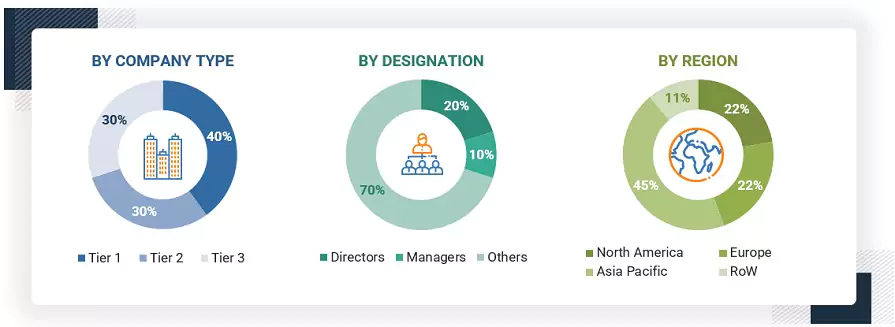
Note: Tier 1, Tier 2, and Tier 3 companies are classified based on their market revenue in 2023 available in
the public domain, product portfolios, and geographical presence.
Other designations include consultants and sales, marketing, and procurement managers.
To know about the assumptions considered for the study, download the pdf brochure
Market Size Estimation
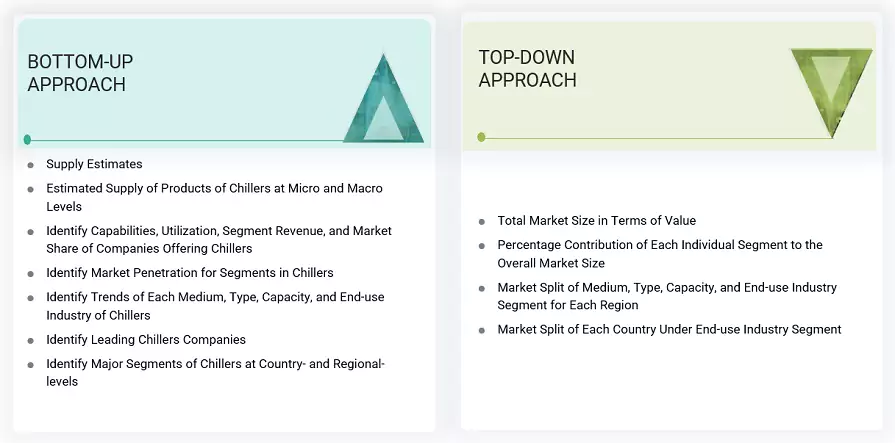
The top-down and bottom-up approaches have been used to estimate and validate the size of the chillers market.
- The key players in the industry have been identified through extensive secondary research.
- The supply chain of the industry has been determined through primary and secondary research.
- The global market was then segmented into five major regions and validated by industry experts.
- All percentage shares, splits, and breakdowns based on medium, type, capacity, end-use industry and region were determined using secondary sources and verified through primary sources.
- All possible parameters that affect the markets covered in this research study were accounted for, viewed in extensive detail, verified through primary research, and analyzed to get the final quantitative and qualitative data. This data was consolidated and added with detailed inputs and analysis and presented in this report.
Chillers Market : Top-Down and Bottom-Up Approach
Data Triangulation
After arriving at the total market size from the estimation process chillers above, the overall market has been split into several segments and sub-segments. To complete the overall market engineering process and arrive at the exact statistics for all the segments and sub-segments, the data triangulation and market breakdown procedures have been employed, wherever applicable. The data has been triangulated by studying various factors and trends from both the demand and supply sides. Along with this, the market size has been validated by using both the top-down and bottom-up approaches and primary interviews. Hence, for every data segment, there have been three sources—top-down approach, bottom-up approach, and expert interviews. The data was assumed correct when the values arrived from the three sources matched.
Market Definition
Chillers are mechanical devices that remove heat from a liquid, usually water or glycol, to produce cooling. These systems cool the fluid by circulating it in a heat exchanger for absorbing heat from the surrounding environment or process. The main usage of chillers is observed in air-conditioning and industrial cooling systems, and also in industries dealing with refrigeration and food processing. There can be air-cooled chillers and water-cooled and the types are centrifugal, reciprocating, screw, and scroll among others. They help conserve energy, retain product freshness, and promote safety of the environment with low temperature levels.
Stakeholders
- Chillers Manufacturers
- Chillers Traders, Distributors, and Suppliers
- Raw Material Suppliers
- Government and Private Research Organizations
- Associations and Industrial Bodies
- R&D Institutions
- Environmental Support Agencies
Report Objectives
- To define, describe, and forecast the chillers market size in terms of value and volume
- To provide detailed information regarding the drivers, restraints, opportunities, and challenges influencing the growth of the chillers market
- To analyze and forecast the market by medium, chilling medium, type, capacity, end-use industry, and region
- To describe and forecast the market with respect to five main regions: North America, Europe, Asia Pacific, South America, and the Middle East & Africa, along with their key countries
- To analyze opportunities for stakeholders by identifying high-growth segments of the chillers market
- To strategically analyze the ecosystem, Porter’s Five Forces, technology analysis, tariffs and regulations, patent landscape, trade landscape, key conferences and events, and case studies/use cases pertaining to the market under study
- To strategically analyze micromarkets with respect to individual growth trends, prospects, and contributions to the overall market
- To strategically profile the key players and comprehensively analyze their market positions in terms of their ranking and core competencies, along with detailing the competitive landscape for market leaders
- To analyze competitive developments such as investments & expansions and mergers & acquisitions
Available Customizations
Along with the given market data, MarketsandMarkets offers customizations according to the company’s specific needs. The following customization options are available for the report:
Regional Analysis
- Further breakdown of a region with respect to a particular country or additional end-use industry
Company Information
- Detailed analysis and profiles of additional market players
Tariff & Regulations
- Regulations and Impact on Chillers Market
Get the Full Chillers Market Report
Full forecast, segment splits, and company analysis for all Chillers Market.
- US Chillers Market
- Canada Chillers Market
- Mexico Chillers Market
- Germany Chillers Market
- France Chillers Market
- UK Chillers Market
- Italy Chillers Market
- Spain Chillers Market
- Russia Chillers Market
- Turkey Chillers Market
- China Chillers Market
- Japan Chillers Market
- India Chillers Market
- South Korea Chillers Market
- Thailand Chillers Market
- South Africa Chillers Market
- Brazil Chillers Market
- Argentina Chillers Market
- Rest Of Europe Chillers Market
- Rest Of Asia Pacific Chillers Market
- GCC Countries Chillers Market
- Rest Of South America Chillers Market
Need a Tailored Report?
Customize this report to your needs
Get 10% FREE Customization
Customize This Report
