
South Korea Chromic Materials Market (2024-2029)

The South Korea Chromic Materials Market was valued at $248.8 Million in 2024 and projected to reach to $284.7 Million by 2029, representing a compound annual growth rate of 6.8%. South Korea's chromic materials market is poised for sustained growth through 2029, driven by the country's robust manufacturing ecosystem and increasing demand from high-tech industries.


| Market Size in | USD 26.32 MN |
| Market Forecast in | |
| CAGR | |
| Forecast Period | |
| Units Considered | Value (USD MN) |
South Korea Chromic Materials Market Trends and Insights
- South Korea's advanced manufacturing base and strong chemical processing infrastructure position the country as a key regional player in chromic materials production and consumption.
- The growth trajectory reflects South Korea's increasing demand across electronics, automotive, and specialty coatings sectors, where chromic materials serve critical functional roles. Driven by South Korea's export-oriented industrial economy and investment in high-performance material applications, the chromic materials market in South Korea is expected to maintain a compound annual growth rate of 6.8% through 2029.
- South Korea's regulatory environment and commitment to sustainable manufacturing practices are shaping product innovation and market dynamics.
- The forecast period demonstrates South Korea's continued reliance on advanced material solutions to support competitive manufacturing and technological advancement..
Key Market Statistics
- CAGR (2024-2029) 6.8% CAGR
- Market Size, 2024 ~USD 248.8 Million
- Forecast, 2029 ~USD 284.7 Million
- Country South Korea
South Korea Chromic Materials Market Overview
Market Valuation :
South Korea's chromic materials market is valued at USD 248.8 million in 2024, demonstrating robust demand across manufacturing and chemical processing sectors.
Growth Trajectory :
The market is projected to reach USD 284.7 million by 2029, representing a CAGR of 6.8%, outpacing the global growth rate of 6.5%.
Manufacturing Infrastructure :
South Korea's advanced manufacturing base and sophisticated chemical processing infrastructure position it as a critical regional hub for chromic materials production and consumption.
Regional Significance :
As a key player in Asia-Pacific, South Korea's chromic materials market reflects strong industrial demand from electronics, automotive, and specialty chemical sectors.
South Korea Chromic Materials Market Dynamics
- The 6.8% CAGR reflects strong consumption patterns in electronics, automotive coatings, and specialty chemical applications.
- South Korea's commitment to advanced manufacturing and chemical innovation supports continued market expansion.
- Strategic investments in production capacity and R&D initiatives are expected to strengthen the country's position as a regional leader, with growing exports to neighboring Asian markets complementing domestic demand..
Market Ecosystem
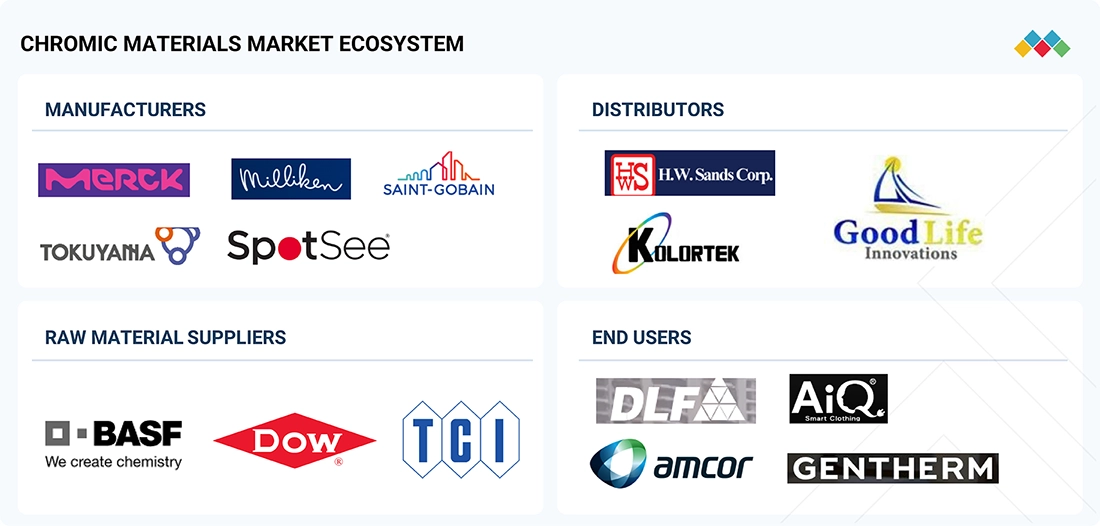
chromic-materials-market: COMMERCIAL USE CASES ACROSS INDUSTRIES
| COMPANY | USE CASE DESCRIPTION | BENEFITS |
|---|---|---|
 |
Use photochromic or electrochromic materials that automatically adjust light transmission and tint levels to improve building energy performance and comfort. | Enhanced occupant comfort and natural light control. |
 |
Integrate thermochromic or photochromic pigments into textiles that change color with temperature or light, enabling functional and aesthetic enhancements in garments. | Real-time body temperature indication. |
 |
Apply thermochromic coatings for automotive interiors, seats, or medical devices that visually indicate temperature changes or system activation | Enhanced user safety and comfort. |
 |
Use thermochromic or photochromic inks in packaging to indicate freshness, tampering, or temperature exposure in pharma and food products | Ensures product safety and integrity |
Logos and trademarks shown above are the property of their respective owners. Their use here is for informational and illustrative purposes only.
Related Ecosystem
Bulk Chemicals And Inorganics
Paints And Coatings
Speciality Chemicals
Key Takeaways
- South Korea's chromic materials market is valued at USD 248.8 million in 2024 and will reach USD 284.7 million by 2029, representing a 6.8% CAGR.
- South Korea's advanced manufacturing and electronics sectors drive significant demand for chromic materials in specialty applications.
- South Korea's regulatory focus on sustainable practices is accelerating innovation in eco-friendly chromic material formulations.
- South Korea's position as a regional manufacturing hub supports consistent market growth and export opportunities through 2029.
Chromic Materials Market Report Scope
| Report Metric | Details |
|---|---|
| Base Year | 2024 |
| Fastest Growing Segment | DISPLAYS (Application) |
| Forecast Period | 2024–2029 |
| Growth Rate | CAGR of 6.5% from 2024 to 2029 |
| Largest Segment | COLORED STATE (Type) |
| Market Size Base Year (Billions) | ~USD 4.37 (2024) |
| Revenue Forecast (Billions) | ~USD 6.37 (2029) |
| Segments Covered | Application, Material, Technology, Type |
South Korea Chromic Materials Market Report Segmentation
4 segment dimensions are covered across the global market.
By Application
- Displays
- Ophthalmic Lenses
- Other Applications
- Smart Fabrics
- Smart Label Indicators
- Smart Windows
By Material
- Carbazoles
- Indium Tin Oxide
- Liquid Crystal Polymers
- Methoxy Biphenyls
- Other Materials
- Tungsten Oxide
- Vanadium Dioxide
By Technology
- Electrochromism
- Gasochromism
- Other Technologies
- Photochromism
- Piezochromism
- Thermochromism
By Type
- Colored State
- Transparent
Target Audience
- Chemical Manufacturers : South Korea-based and international chromic materials producers need localized market data to optimize production capacity, assess competitive positioning, and identify growth opportunities in this 6.8% CAGR market.
- Industrial End-Users : Electronics, automotive, and specialty chemical companies in South Korea require detailed market intelligence to forecast material costs, secure supply chains, and plan procurement strategies.
- Investment & Private Equity Firms : Investors evaluating South Korea's chemical sector need precise market valuations and growth forecasts to assess investment returns, identify acquisition targets, and evaluate portfolio opportunities.
- Market Entry Strategists : Companies planning market entry or expansion into South Korea need country-specific data on market size, growth rates, and competitive dynamics to develop effective localization strategies.
- Supply Chain & Procurement Teams : Global procurement professionals sourcing chromic materials from South Korea require market intelligence to negotiate pricing, evaluate supplier capabilities, and optimize regional sourcing strategies.
Key Companies in the South Korea Chromic Materials Market
| Company | HQ | Ownership | Strongest segments |
|---|---|---|---|
| MERCK KGAA | United States | Public Company | Life Science (tools, reagents, bioprocessing, CDMO),Healthcare (oncology, neurology, fertility, rare diseases),Electronics (semiconductor and display materials), |
| TOKUYAMA CORPORATION | Japan | Public Company | Basic chemicals (caustic soda, soda ash, chlorine chain, solvents, PVC),Cement, building materials, and recycling,Electronics advanced materials (poly-Si, silica, ceramics, high-purity chemicals, photoresist developer), |
| OLIKROM INDUSTRY | France | Private Company | Photoluminescent coatings and masterbatches,Thermochromic and photochromic pigments,Custom formulated smart coatings for OEMs, |
| NEW PRISMATIC ENTERPRISE CO., LTD | Core legacy products / components,Value-added assemblies / systems,Customized / OEM-specific solutions, |
MERCK KGAA
Merck KGaA is a publicly traded company headquartered in the United States with a history dating back to 1668. The company employs 59,077 people and operates as a major international enterprise.
TOKUYAMA CORPORATION
Tokuyama Corporation is a Japanese public company established in 1918 with 6,390 employees. The company operates as a publicly traded enterprise in Japan.
OLIKROM INDUSTRY
Olikrom Industry is a private company based in France and founded in 2014. The company operates as a privately held enterprise.
NEW PRISMATIC ENTERPRISE CO., LTD
Insufficient data available for company description.
Reasons to Buy this Report
- Country-Specific Market Sizing : Obtain precise valuation data for South Korea's chromic materials market with verified 2024 baseline (USD 248.8M) and 2029 forecasts, enabling accurate regional business planning.
- Competitive Regional Intelligence : Understand South Korea's 6.8% CAGR performance relative to global 6.5% growth, identifying competitive advantages and market positioning opportunities in the region.
- Sector-Specific Demand Insights : Access detailed analysis of chromic materials consumption patterns across South Korea's electronics, automotive, and specialty chemical industries for targeted market entry strategies.
- Investment & Expansion Planning : Leverage comprehensive South Korea market data to evaluate production facility investments, supply chain optimization, and distribution network development in this high-growth market.
- Strategic Partnership Identification : Identify key growth drivers and market gaps specific to South Korea to inform partnership strategies, joint ventures, and acquisition opportunities with local manufacturers.
Frequently asked questions
What is the current size of South Korea's chromic materials market?
South Korea's chromic materials market was valued at USD 248.8 million in 2024.
What is the projected market size for South Korea's chromic materials by 2029?
South Korea's chromic materials market is forecast to reach USD 284.7 million by 2029.
What is the CAGR for South Korea's chromic materials market?
South Korea's chromic materials market is expected to grow at a compound annual growth rate of 6.8% from 2024 to 2029.
Which industries drive demand for chromic materials in South Korea?
South Korea's electronics, automotive, and specialty coatings sectors are primary drivers of chromic materials demand.
How does South Korea's manufacturing base influence the chromic materials market?
South Korea's advanced manufacturing infrastructure and export-oriented economy create sustained demand for high-performance chromic materials across multiple industrial applications.
RESEARCH METHODOLOGY
The study involved four major activities in estimating the market size of the chromic materials market. Exhaustive secondary research was undertaken to collect information on the market, the peer market, and the grandparent market. The next step was to validate these findings, assumptions, and sizing with industry experts across the value chain through primary research. Both, the top-down and bottom-up approaches were employed to estimate the complete market size. Thereafter, the market breakdown and data triangulation procedures were used to estimate the market size of the segments and subsegments.
Secondary Research
In the secondary research process, various secondary sources have been referred to for identifying and collecting information for this study. These secondary sources include annual reports, press releases, investor presentations of companies, white papers, certified publications, trade directories, articles from recognized authors, gold standard and silver standard websites, and databases. Secondary research has been used to obtain key information about the value chain of the industry, the monetary chain of the market, the total pool of key players, market classification and segmentation according to industry trends to the bottom-most level, and regional markets. It was also used to obtain information about the key developments from a market-oriented perspective.
Primary Research
The chromic materials market comprises several stakeholders in the value chain, which include manufacturers and end users. Various primary sources from the supply and demand sides of the chromic materials market have been interviewed to obtain qualitative and quantitative information. The primary interviewees from the demand side include key opinion leaders in the industrial sector. The primary sources from the supply side include manufacturers, associations, and institutions involved in the chromic materials industry. Interviews with experts were conducted to gather insights such as market statistics, data of revenue collected from the products and services, market breakdowns, market size estimations, market forecasting, and data triangulation. Primary research also helped in understanding the various trends related to type, material, application, technology, and region. Stakeholders from the demand side, such as CIOs, CTOs, and CSOs, were interviewed to understand the buyer’s perspective on the suppliers, products, and their current usage of chromic materials and the outlook of their business, which will affect the overall market.
The breakdown of profiles of the expert interviewees is illustrated in the figure below:
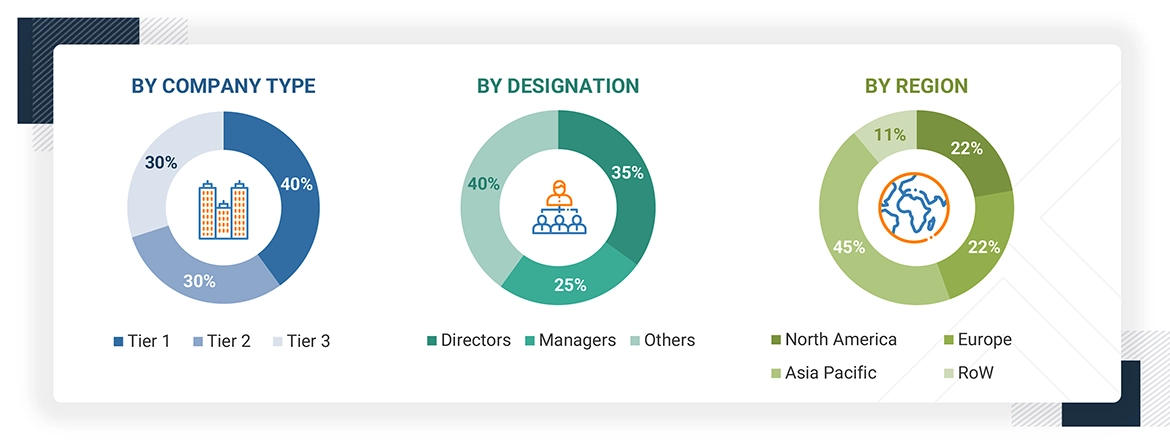
Note: Tier 1, Tier 2, and Tier 3 companies are classified based on their market revenue in 2023, available in the public domain, product portfolios, and geographical presence.
Other designations include consultants and sales, marketing, and procurement managers.
To know about the assumptions considered for the study, download the pdf brochure
Market Size Estimation
The top-down and bottom-up approaches have been used to estimate and validate the size of the chromic materials market.
- The key players in the industry have been identified through extensive secondary research.
- The supply chain of the industry has been determined through primary and secondary research.
- All percentage shares, splits, and breakdowns have been determined using secondary sources and verified through primary sources.
- All possible parameters that affect the markets covered in this research study have been accounted for, viewed in extensive detail, verified through primary research, and analyzed to obtain the final quantitative and qualitative data.
- The research includes the study of reports, reviews, and newsletters of the key market players, along with extensive interviews for opinions with leaders such as directors and marketing executives.
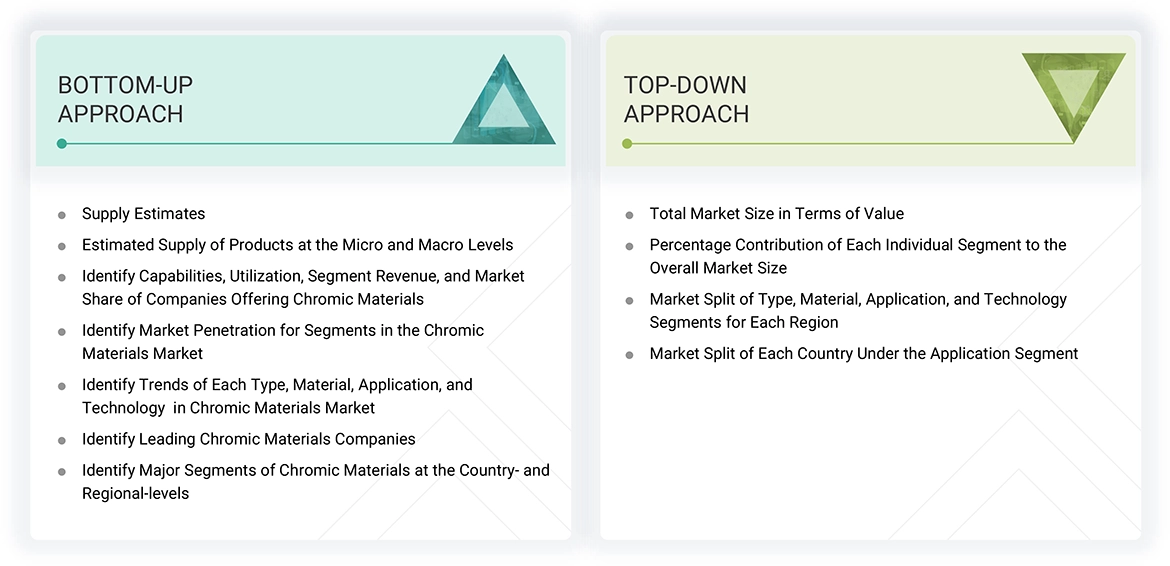
Data Triangulation
After arriving at the total market size from the estimation process, the overall market has been split into several segments and subsegments. To complete the overall market engineering process and arrive at the exact statistics for all the segments and subsegments, the data triangulation and market breakdown procedures have been employed, wherever applicable. The data has been triangulated by studying various factors and trends from both, the demand and supply sides. Along with this, the market size has been validated by using both, the top-down and bottom-up approaches and interviews with experts. Hence, for every data segment, there have been three sources—top-down approach, bottom-up approach, and interviews with experts. The data was assumed correct when the values arrived from the three sources matched.
Market Definition
Chromic materials are materials that display reversible color changes on exposure to some external stimulus like light, temperature, electricity, solvents, or mechanical operations. Some of the examples of such materials are photochromic materials responding to light, thermochromic materials responding to temperature variations, and electrochromic materials responding to electrical currents. Chromic effects find extensive use in areas such as anti-counterfeiting, data storage, fabrics, and building design because they are dynamic and responsive. The versatility of chromic materials is useful for cutting-edge applications in security, energy efficiency, and interactive technologies.
Stakeholders
- Senior Management
- End Users
- Finance/Procurement Department
- R&D Department
- Manufacturers
- Raw Material Suppliers
Report Objectives
- To define, describe, and forecast the size of the chromic materials market, in terms of value and volume
- To provide detailed information regarding the major factors (drivers, opportunities, restraints, and challenges) influencing the growth of the market
- To estimate and forecast the market size based on type, technology, application, end-use industry, and region
- To forecast the size of the market with respect to major regions, namely, Europe, North America, Asia Pacific, Middle East & Africa, and South America, along with their key countries
- To strategically analyze micro-markets with respect to individual growth trends, prospects, and their contribution to the overall market
- To analyze opportunities in the market for stakeholders and provide a competitive landscape of market leaders
- To track and analyze recent developments such as expansions, product launches, partnerships & agreements, and acquisitions in the market
- To strategically profile key market players and comprehensively analyze their core competencies
Get the Full Chromic Materials Market Report
Full forecast, segment splits, and company analysis for all Chromic Materials Market.
- US Chromic Materials Market
- Canada Chromic Materials Market
- Mexico Chromic Materials Market
- Germany Chromic Materials Market
- UK Chromic Materials Market
- France Chromic Materials Market
- Italy Chromic Materials Market
- Spain Chromic Materials Market
- China Chromic Materials Market
- Japan Chromic Materials Market
- India Chromic Materials Market
- South Africa Chromic Materials Market
- Brazil Chromic Materials Market
- Argentina Chromic Materials Market
- Rest Of Europe Chromic Materials Market
- Rest Of Apac Chromic Materials Market
- GCC Countries Chromic Materials Market
- Rest Of Mea Chromic Materials Market
- –Other GCC Countries Chromic Materials Market
- Rest Of South America Chromic Materials Market
Need a Tailored Report?
Customize this report to your needs
Get 10% FREE Customization
Customize This Report
