
Japan Climate Risk Management Market (2026-2031)

The Japan Climate Risk Management Market was valued at $423 Million in 2026 and projected to reach to $1256.6 Million by 2031, representing a compound annual growth rate of 24.3%. Japan's climate risk management market is positioned for exceptional growth as enterprises prioritize climate resilience amid increasing regulatory mandates and environmental pressures.


| Market Size in | USD 26.32 MN |
| Market Forecast in | |
| CAGR | |
| Forecast Period | |
| Units Considered | Value (USD MN) |
Japan Climate Risk Management Market Trends and Insights
- This represents a compound annual growth rate of 24.3%, significantly outpacing global trends as Japan prioritizes climate resilience across its ICT infrastructure.
- Japan's market growth is driven by increasing regulatory pressures, heightened awareness of climate-related financial risks, and the nation's commitment to achieving net-zero emissions by 2050. The forecast period from 2026 to 2031 marks a critical expansion phase for Japan's climate risk management solutions.
- Japan is witnessing accelerated adoption of advanced analytics, AI-powered risk assessment tools, and integrated climate monitoring platforms across financial institutions, enterprises, and government agencies.
- Japan's strategic investments in digital transformation and climate adaptation are positioning the country as a regional leader in climate risk management technology adoption..
Key Market Statistics
- CAGR (2026-2031) 24.3% CAGR
- Market Size, 2026 ~USD 423 Million
- Forecast, 2031 ~USD 1256.6 Million
- Country Japan
Japan Climate Risk Management Market Overview
Exceptional Growth Trajectory :
Japan's climate risk management market is expanding at 24.3% CAGR, nearly 40% faster than the global average of 17.3%, reflecting the nation's urgent commitment to climate resilience and digital transformation.
Regulatory Compliance Drivers :
Stringent Japanese environmental regulations and mandatory climate disclosure requirements are compelling enterprises to invest in advanced climate risk management solutions across their ICT infrastructure.
Market Valuation Growth :
The market is projected to nearly triple from $423.0 million in 2026 to $1,256.6 million by 2031, representing a $833.6 million expansion opportunity over five years in Japan's ICT sector.
Natural Disaster Preparedness :
Japan's vulnerability to typhoons, earthquakes, and flooding is accelerating adoption of climate risk management technologies to protect critical ICT infrastructure and ensure business continuity.
Japan Climate Risk Management Market Dynamics
- The nation's advanced ICT infrastructure and high digital adoption rates create a fertile environment for sophisticated climate risk solutions.
- Japanese organizations are increasingly recognizing the financial and operational risks posed by climate change, driving investment in predictive analytics, risk assessment platforms, and resilience planning tools. The forecast period through 2031 will see accelerated market expansion driven by mandatory climate disclosure requirements, corporate sustainability commitments, and the need to protect critical infrastructure.
- Government initiatives supporting green technology adoption and climate adaptation will further catalyze market growth.
- Japan's position as a technology leader positions it to develop and export innovative climate risk management solutions globally..
Market Ecosystem

CLIMATE RISK MANAGEMENT MARKET: COMMERCIAL USE CASES ACROSS INDUSTRIES
| COMPANY | USE CASE DESCRIPTION | BENEFITS |
|---|---|---|
 |
Climate disclosure and risk reporting improvement using Customer Data Platform (CDP) framework by Nilfisk | Improved data accuracy | Better identification of climate risks and opportunities | Alignment with global reporting standards |
 |
AI-driven climate risk insights for agriculture planning in vulnerable regions by ClimateAi | Better crop planning | Reduced climate uncertainty | Improved resilience in climate-sensitive regions |
 |
Emissions tracking and climate risk visibility enhancement using digital platform by Delivery Hero | Improved emissions monitoring | Better risk visibility | Informed decision-making |
Logos and trademarks shown above are the property of their respective owners. Their use here is for informational and illustrative purposes only.
Related Ecosystem
Analytics
- Natural Language Processing (NLP)
- Machine Learning
- Supply Chain Management
- Predictive Analytics
- Image Sensors
- International Business Machines Corporation
- MICROSOFT CORPORATION
- Oracle Corporation
- SAP SE
Software And Services
- Natural Language Processing (NLP)
- Machine Learning
- Supply Chain Management
- Predictive Analytics
- Image Sensors
- International Business Machines Corporation
- MICROSOFT CORPORATION
- Oracle Corporation
- SAP SE
- Amazon.com, Inc.
Key Takeaways
- Japan's climate risk management market will nearly triple from $423.0M (2026) to $1,256.6M (2031), driven by 24.3% CAGR growth.
- Japan's regulatory environment and net-zero commitments are accelerating enterprise adoption of climate risk solutions across financial and industrial sectors.
- Japan is leveraging AI and advanced analytics to build competitive advantages in climate risk assessment and monitoring capabilities.
- Japan's market expansion reflects broader Asia Pacific trends while establishing the nation as a regional innovation hub for climate technology.
Climate Risk Management Market Report Scope
| Report Metric | Details |
|---|---|
| Base Year | 2026 |
| Fastest Growing Segment | CLIMATE RISK ASSESSMENT APIS (Software) |
| Forecast Period | 2026–2031 |
| Growth Rate | CAGR of 17.3% from 2026 to 2031 |
| Largest Segment | SERVICES (Offering) |
| Market Size Base Year (Billions) | ~USD 8.59 (2026) |
| Revenue Forecast (Billions) | ~USD 19.08 (2031) |
| Segments Covered | Offering, Software, Service, Professional Service, Technology, Application, Vertical |
Japan Climate Risk Management Market Report Segmentation
7 segment dimensions are covered across the global market.
By Offering
- Services
- Software
By Software
- Climate Data Analytics Platforms
- Climate Data Integration Apis
- Climate Risk Assessment Apis
- Climate Risk Modeling Tools
- Compliance & Reporting Software
- Other Software
- Risk Assessment & Scenario Analysis Tools
By Service
- Managed Services
- Professional Services
By Professional Service
- Support & Maintenance
- System Integration & Deployment
- Training & Consulting
By Technology
- AI & ML
- Artificial Intelligence & Machine Learning
- Big Data & Advanced Analytics
- Blockchain
- Geospatial & Remote Sensing
- Internet Of Things (IoT)
By Application
- Business & Investment Risk Management
- Carbon Accounting & Emissions Management
- Climate Litigation & Liability Risk Management
- Disaster Preparedness & Early Warning Systems
- Esg & Sustainable Investment Risk Analysis
- Other Applications
- Weather & Agriculture Risk Management
By Vertical
- Agriculture & Forestry
- Bfsi
- Construction & Real Estate
- Construction And Real Estate
- Energy & Utilities
- Government & Public Sector
- Manufacturing
- Other Verticals
- Transportation & Logistics
Target Audience
- Japanese Enterprise IT Leaders : CIOs and IT directors need Japan-specific market intelligence to justify climate risk management investments, align ICT strategies with regulatory requirements, and protect critical infrastructure from climate impacts.
- Climate Tech Solution Providers : Software vendors and technology companies require detailed Japan market analysis to identify growth opportunities, understand local customer needs, and develop region-specific climate risk management offerings.
- Financial & Insurance Institutions : Banks, insurers, and asset managers need Japan market data to assess climate risk exposure, develop climate-resilient strategies, and identify investment opportunities in the rapidly growing climate tech sector.
- Government & Policy Makers : Japanese regulatory bodies and government agencies require market insights to inform climate policy, assess technology adoption rates, and design effective incentive programs for climate resilience initiatives.
- Management Consultants & Analysts : Strategy consultants and research firms need Japan-specific market data to advise clients on climate risk management investments, competitive positioning, and digital transformation strategies in the ICT sector.
Key Companies in the Japan Climate Risk Management Market
| Company | HQ | Ownership | Strongest segments |
|---|---|---|---|
| IBM | United States | Public Company | Software (Hybrid Cloud & AI Platforms),Consulting (Strategy, Technology, Managed Services),Infrastructure (Servers, Storage, Lifecycle Services), |
| MARSH MCLENNAN | United States | Public Company | Risk and Insurance Services,Health and Benefits Consulting,Wealth and Retirement Consulting, |
| MSCI | United States | Public Company | Index,Analytics,Sustainability and Climate, |
| CORELOGIC | United States | Private Company | Property Intelligence & Risk Management Solutions (PIRM),Underwriting & Workflow Solutions (UWS), |
| S&P GLOBAL | United States | Public Company | S&P Global Ratings,S&P Global Market Intelligence,S&P Global Energy (Commodities), |
IBM
IBM is a publicly traded American technology and consulting company founded in 1911, employing 264,300 people worldwide. The company provides hardware, software, and IT services across multiple industries.
MARSH MCLENNAN
Marsh McLennan is a publicly traded insurance services and consulting company founded in 1871 with 95,000 employees. The firm provides risk management, insurance brokerage, and consulting solutions globally.
MSCI
MSCI is a publicly traded provider of indexes, analytics, and data solutions founded in 1998 with 6,327 employees in the United States. The company serves investment professionals in the financial services industry.
CORELOGIC
CoreLogic is a privately held data and analytics company founded in 2009 with 5,300 employees in the United States. The firm provides property, financial, and consumer information solutions.
S&P GLOBAL
S&P Global is a publicly traded provider of transparent and independent ratings, benchmarks, analytics, and data founded in 1860 with 44,500 employees in the United States. The company serves the capital and commodity markets.
Reasons to Buy this Report
- Market Size & Growth Validation : Confirm Japan's climate risk management market opportunity with precise valuations ($423M in 2026, $1,256.6M in 2031) and validate 24.3% CAGR projections for strategic planning and investment decisions.
- Competitive Landscape Intelligence : Understand Japan-specific competitive dynamics, key players, and market positioning strategies to identify partnership opportunities and competitive advantages in this high-growth ICT segment.
- Regulatory & Compliance Insights : Access detailed analysis of Japan's climate disclosure requirements, environmental regulations, and compliance mandates driving market adoption to align product development and go-to-market strategies.
- Customer Segmentation & Demand Drivers : Identify Japan-specific customer segments, purchasing behaviors, and primary drivers (natural disaster preparedness, regulatory compliance, sustainability goals) to tailor solutions and messaging effectively.
- Investment & Expansion Strategy : Leverage Japan market data to evaluate entry strategies, resource allocation, partnership models, and revenue forecasting for climate risk management solutions in this outpacing-global-growth market.
Frequently asked questions
What is the projected market size for climate risk management in Japan by 2031?
Japan's climate risk management market is projected to reach $1,256.6 million by 2031, up from $423.0 million in 2026, representing a 24.3% compound annual growth rate.
What factors are driving growth in Japan's climate risk management market?
Japan's market growth is driven by regulatory pressures, climate-related financial risk awareness, net-zero emission commitments, and increased digital transformation investments across enterprises and financial institutions.
How does Japan's climate risk management market growth compare to global trends?
Japan's 24.3% CAGR significantly exceeds the global average of 17.3%, reflecting Japan's accelerated adoption of climate risk solutions and strategic focus on climate resilience.
Which sectors are leading climate risk management adoption in Japan?
Japan's financial institutions, large enterprises, and government agencies are leading adoption, driven by regulatory requirements and climate-related disclosure mandates.
What technologies are shaping Japan's climate risk management market?
AI-powered risk assessment, advanced analytics platforms, integrated climate monitoring systems, and real-time data analytics are key technologies transforming Japan's climate risk management landscape.
RESEARCH METHODOLOGY
The research methodology for the climate risk management market report involved extensive use of secondary sources and directories, as well as various reputable open-source databases, to identify and collect relevant information for this technical and market-oriented study. In-depth interviews were conducted with various primary respondents, including end users and high-level executives of multiple companies offering climate risk management software, services, and industry consultants, to obtain and verify critical qualitative and quantitative information and assess the market prospects and industry trends.
Secondary Research
During the secondary research process, various secondary sources were consulted to identify and collect information for the study. The secondary sources included annual reports, press releases, investor presentations, white papers, and certified publications.
Secondary research was used to gather key information on the industry’s value chain, the market’s monetary chain, the overall pool of key players, market classification, and segmentation based on industry trends, regional markets, and key developments from market- and technology-oriented perspectives.
Primary Research
In the primary research process, a diverse range of stakeholders from the supply and demand sides of the climate risk management ecosystem were interviewed to gather qualitative and quantitative insights specific to this market. From the supply side, key industry experts, including chief executive officers (CEOs), vice presidents (VPs), marketing directors, technology & innovation directors, and technical leads from vendors offering climate risk management software and services, were consulted. Additionally, system integrators, service providers, and IT service firms that implement and support climate risk management were included in the study. On the demand side, input from IT decision-makers, consulting managers, and business heads of prominent industry end users was collected to understand the user perspectives and adoption challenges within targeted industries.
The primary research ensured all crucial parameters affecting the climate risk management market, from technological advancements and evolving use cases to regulatory and compliance needs, were considered. Each factor was thoroughly analyzed, verified through primary research, and evaluated to obtain precise quantitative and qualitative data for this market.
Once the initial phase of market engineering, including detailed calculations for market statistics, segment-specific growth forecasts, and data triangulation, was completed, a second round of primary research was conducted. This step was crucial for refining and validating critical data points, such as climate risk management offerings (Software and services); industry adoption trends; the competitive landscape; and key market dynamics like demand drivers (Increasing frequency and intensity of extreme weather events, growing economic pressures to build climate-resilient infrastructure, mounting regulatory pressure and disclosure requirements, increasing influence of investors and financial institutions), challenges (Significant financial resources and technical expertise requirements, methodological Inconsistencies and lack of standardization), opportunities (Growing demand for climate risk solutions in global finance, growth in advanced software and AI-powered climate solutions, green infrastructure and resilient supply chains strengthen business resilience to climate risk), and restraints (Limited availability of high-quality, standardized climate data, organizational resistance to change).
In the comprehensive market engineering process, the top-down and bottom-up approaches, along with several data triangulation methods, were extensively employed to perform market estimation and forecasting for the overall market segments and subsegments listed in this report. Extensive qualitative and quantitative analyses were conducted across the entire market engineering process to capture critical information/insights throughout the report.
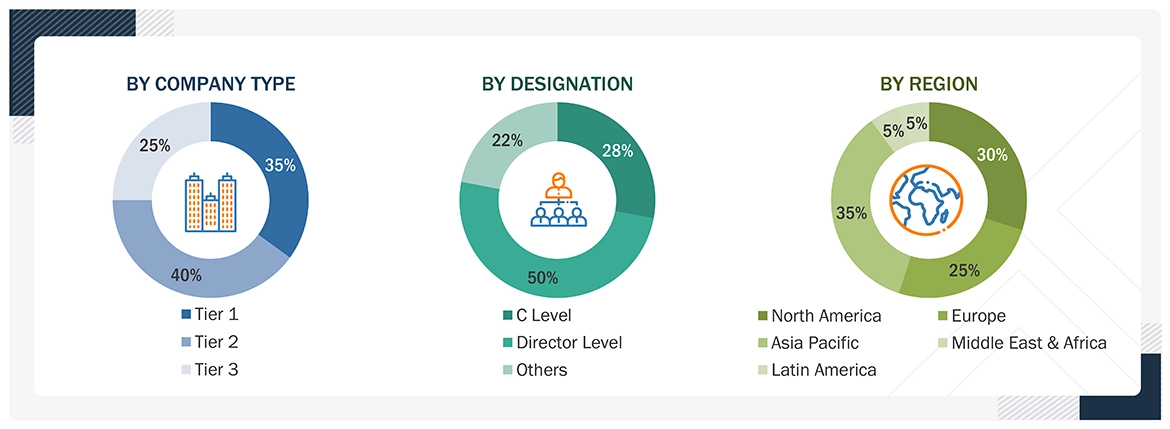
Note: Tier 1 companies’ revenue is over USD 1 billion; tier 2 companies’ revenue ranges between USD 500 million and USD 1 billion; and tier 3 companies’ revenue ranges between USD 100 million and USD 500 million
Source: MarketsandMarkets Analysis
To know about the assumptions considered for the study, download the pdf brochure
Market Size Estimation
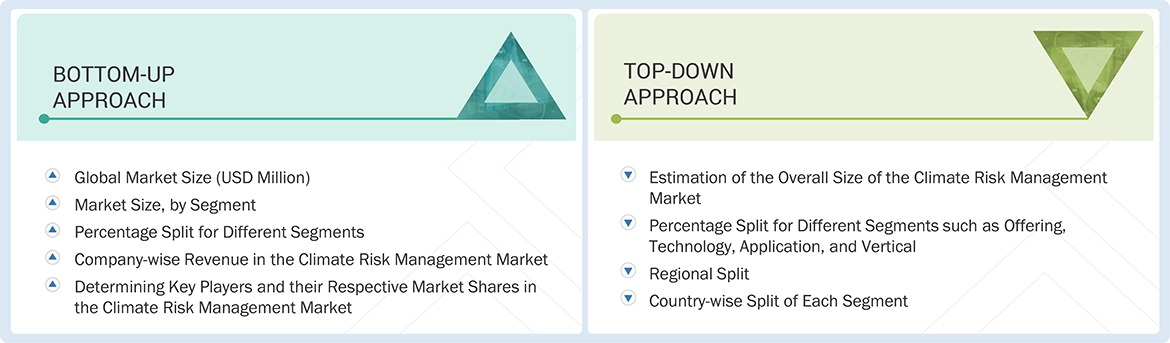
The top-down and bottom-up approaches were used to estimate and forecast the climate risk management market and its dependent submarkets. This multi-layered analysis was further reinforced through data triangulation, which incorporated primary and secondary research inputs. The market figures were also validated against the MarketsandMarkets repository to ensure accuracy.
Climate Risk Management Market : Top-Down and Bottom-Up Approach
Data Triangulation
The climate risk management market was divided into several segments and subsegments after determining the overall market size using the market size estimation processes described above. To complete the overall market engineering process and determine the exact statistics for each market segment and subsegment, data triangulation and market segmentation procedures were employed, wherever applicable. The overall market size was then used in the top-down approach to estimate the size of other individual markets by applying percentage splits to the market segmentation.
Market Definition
Climate risk management is the systematic use of data analysis, scenario planning, and financial evaluation to understand and address risks related to climate change. It examines physical risks, such as extreme weather events, and transition risks, including policy changes and carbon pricing, across business activities and investments. By combining climate data, emissions tracking, and regulatory insights, organizations can assess potential impacts on operations, supply chains, and long-term value. Using forward-looking models and risk frameworks, businesses can perform stress testing, prioritize adaptation strategies, and align with decarbonization goals. These approaches also support better governance by improving disclosure, strengthening resilience planning, and integrating climate considerations into strategic and financial decisions.
Key Stakeholders
- Climate risk management vendors
- Network and system Integrators (SIS)
- Cloud service providers
- Managed service providers
- Support and maintenance service providers
- System integrators/migration service providers
- Value-added resellers and distributors
- Independent software vendors (ISV)
- Technology providers
Report Objectives
- To define, describe, and predict the climate risk management market by offering (software and services), technology, application, vertical, and region
- To provide detailed information related to major factors (drivers, restraints, opportunities, and industry-specific challenges) influencing market growth
- To analyze opportunities in the market and provide details of the competitive landscape for stakeholders and market leaders
- To forecast the market size of segments with respect to five main regions: North America, Europe, Asia Pacific, the Middle East & Africa, and Latin America
- To analyze each submarket with respect to individual growth trends, prospects, and contributions to the overall climate risk management market
- To analyze competitive developments, such as partnerships, product launches, mergers & acquisitions, in the climate risk management market
- To analyze the impact of macroeconomic factors on the climate risk management market across all regions
Available customizations:
Using the provided market data, MarketsandMarkets offers customizations tailored to the company’s specific needs. The following customization options are available for the report.
Product Analysis
- Product comparative analysis, which gives a detailed comparison of innovative products offered by prominent vendors
Regional Analysis
- Further breakup of additional European countries by offering (software and services), technology, application, vertical, and region
- Further breakup of additional Asia Pacific countries by offering (software and services), technology, application, vertical, and region
- Further breakup of additional Middle East & African countries by offering (software and services), technology, application, vertical, and region
- Further breakup of additional Latin American countries by offering (software and services), technology, application, vertical, and region
Company Information
- Detailed analysis and profiling of additional market players (up to five)
Get the Full Climate Risk Management Market Report
Full forecast, segment splits, and company analysis for all Climate Risk Management Market.
- Mexico Climate Risk Management Market
- Argentina Climate Risk Management Market
- Rest Of Europe Climate Risk Management Market
- US Climate Risk Management Market
- Canada Climate Risk Management Market
- UK Climate Risk Management Market
- Germany Climate Risk Management Market
- France Climate Risk Management Market
- Italy Climate Risk Management Market
- Spain Climate Risk Management Market
- China Climate Risk Management Market
- India Climate Risk Management Market
- Singapore Climate Risk Management Market
- South Korea Climate Risk Management Market
- UAE Climate Risk Management Market
- South Africa Climate Risk Management Market
- Brazil Climate Risk Management Market
Need a Tailored Report?
Customize this report to your needs
Get 10% FREE Customization
Customize This Report
