
Japan Closed Systems Transfer Devices Market (2025-2030)

The Japan Closed Systems Transfer Devices Market was valued at $19.3 Million in 2025 and projected to reach to $27.1 Million by 2030, representing a compound annual growth rate of 7.1%. Japan's Closed Systems Transfer Devices Market is poised for steady expansion through 2030, supported by stringent occupational health regulations and the pharmaceutical industry's commitment to worker safety.


| Market Size in | USD 26.32 MN |
| Market Forecast in | |
| CAGR | |
| Forecast Period | |
| Units Considered | Value (USD MN) |
Japan Closed Systems Transfer Devices Market Trends and Insights
- Japan's healthcare sector is increasingly adopting closed systems transfer devices to enhance worker safety and reduce occupational exposure risks in pharmaceutical and oncology settings.
- The market growth in Japan is driven by stringent occupational safety regulations, an aging population requiring advanced pharmaceutical handling solutions, and rising awareness among healthcare institutions regarding contamination prevention and employee protection standards. Japan's pharmaceutical industry and hospital networks are investing significantly in modernizing their drug preparation and handling infrastructure.
- The adoption of closed systems transfer devices in Japan reflects broader healthcare trends toward safer, more efficient drug administration protocols.
- By 2030, Japan's market expansion will be supported by continued regulatory emphasis on workplace safety, technological innovations in device design, and increased procurement by major medical institutions across the country..
Key Market Statistics
- CAGR (2025-2030) 7.1% CAGR
- Market Size, 2025 ~USD 19.3 Million
- Forecast, 2030 ~USD 27.1 Million
- Country Japan
Japan Closed Systems Transfer Devices Market Overview
Market Valuation :
Japan's Closed Systems Transfer Devices Market is valued at $19.3 million in 2025, with strong growth trajectory driven by regulatory compliance and occupational safety mandates in pharmaceutical manufacturing.
Robust Growth Rate :
The market is expanding at a CAGR of 7.1% from 2025 to 2030, outpacing the global average of 7%, reflecting Japan's heightened focus on worker protection in hazardous drug handling environments.
Oncology & Pharma Adoption :
Japanese pharmaceutical and oncology sectors are increasingly implementing closed systems transfer devices to minimize occupational exposure risks, particularly in cytotoxic drug preparation and handling procedures.
2030 Market Projection :
The market is forecasted to reach $27.1 million by 2030, representing a $7.8 million increase driven by stricter workplace safety regulations and growing awareness of hazardous drug exposure prevention.
Japan Closed Systems Transfer Devices Market Dynamics
- The adoption of closed systems transfer devices in Japanese hospitals and manufacturing facilities is accelerating due to increased awareness of hazardous drug exposure risks and compliance with international safety standards.
- Healthcare institutions are investing in advanced containment technologies to protect healthcare workers and maintain product integrity during drug preparation and administration. The market's 7.1% CAGR reflects Japan's aging population requiring increased pharmaceutical interventions and the country's emphasis on workplace safety innovation.
- Government initiatives promoting occupational health standards and pharmaceutical companies' investments in safety infrastructure will continue to drive demand.
- As Japan's healthcare sector modernizes and regulatory frameworks strengthen, closed systems transfer devices will become standard practice in oncology units, compounding pharmacies, and pharmaceutical manufacturing facilities..
Market Ecosystem
Related Ecosystem
Medical Devices
- Polymerase Chain Reaction (PCR)
- Magnetic Resonance Imaging (MRI)
- Disposable Autoinjectors
- Pulse Oximeters
- Blood Pressure Monitors
- Medtronic plc
- Abbott Laboratories
- Stryker Corporation
- Becton, Dickinson and Company
- JOHNSON & JOHNSON
Key Takeaways
- Japan's Closed Systems Transfer Devices Market is valued at $19.3 million in 2025 and will reach $27.1 million by 2030, representing a 7.1% CAGR.
- Japan's stringent occupational safety regulations and aging population are primary drivers of market growth in the closed systems transfer devices sector.
- Healthcare institutions across Japan are prioritizing worker safety and contamination prevention, accelerating adoption of advanced transfer device technologies.
- Japan's pharmaceutical and oncology sectors are leading market expansion through increased investment in safer drug handling infrastructure and protocols.
Closed Systems Transfer Devices Market Report Scope
| Report Metric | Details |
|---|---|
| Base Year | 2025 |
| Fastest Growing Segment | NEEDLELESS SYSTEMS (Type) |
| Forecast Period | 2025-2030 |
| Growth Rate | CAGR of 7% from 2025 to 2030 |
| Largest Segment | MEMBRANE-TO-MEMBRANE SYSTEMS (Type) |
| Market Size Base Year (Billions) | ~USD 1.49 (2025) |
| Revenue Forecast (Billions) | ~USD 2.09 (2030) |
| Segments Covered | Closing Mechanism, Type, Component, Technology, End User |
Japan Closed Systems Transfer Devices Market Report Segmentation
5 segment dimensions are covered across the global market.
By Closing Mechanism
- Click-To-Lock Systems
- Color-To-Color Alignment Systems
- Luer Lock Systems
- Push-To-Turn Systems
By Type
- Membrane-To-Membrane Systems
- Needleless Systems
By Component
- Bag Spikes
- Female Components
- Male Luers
- Other Components
- Vial Access Components
By Technology
- Air Cleaning/Filtration Devices
- Compartmentalized Devices
- Diaphragm-Based Devices
By End User
- Hospitals & Clinics
- Oncology Centers
- Other End Users
JAPAN: CLOSED SYSTEM TRANSFER DEVICES MARKET, BY END USER, 2023–2030
| Segment | 2023 | 2024 | 2025 | 2026 | 2027 | 2028 | 2029 | 2030 | CAGR (%) |
|---|---|---|---|---|---|---|---|---|---|
| HOSPITALS & CLINICS | 33.4 | 36 | 40.6 | 45.4 | 49.5 | 53.6 | 57.7 | 61.7 | 8.7 |
| ONCOLOGY CENTERS | 12.5 | 13.7 | 15.7 | 17.9 | 19.9 | 21.9 | 24 | 26.2 | 10.7 |
| OTHER END USERS | 5 | 5.3 | 5.8 | 6.4 | 6.9 | 7.3 | 7.7 | 8.1 | 6.7 |
| TOTAL | 50.8 | 54.9 | 62.1 | 69.7 | 76.3 | 82.8 | 89.4 | 95.9 | 9.1 |
Target Audience
- Pharmaceutical Manufacturers : Japanese and international pharmaceutical companies need Japan-specific market data to understand local demand for closed systems transfer devices, optimize product offerings, and comply with occupational safety regulations.
- Medical Device Distributors : Distributors operating in Japan require detailed market insights to identify growth opportunities, assess competitive positioning, and develop targeted sales strategies for CSTD products in the Japanese healthcare market.
- Hospital & Healthcare Administrators : Japanese hospital procurement teams and healthcare facility managers need market intelligence to justify CSTD investments, benchmark against industry standards, and ensure worker safety compliance in their institutions.
- Regulatory & Compliance Officers : Healthcare compliance professionals in Japan need country-specific market data to understand regulatory drivers, occupational exposure standards, and best practices for implementing closed systems transfer devices.
- Investment & Business Development Teams : Investors and business development professionals evaluating opportunities in Japan's healthcare sector require detailed market forecasts and growth metrics to assess investment viability and partnership potential in the CSTD market.
Reasons to Buy this Report
- Japan-Specific Market Sizing : Obtain precise valuation data for Japan's CSTD market ($19.3M in 2025) with country-specific forecasts through 2030, enabling accurate budget allocation and market entry strategies tailored to Japanese healthcare infrastructure.
- Regulatory & Compliance Insights : Understand Japan's unique occupational safety regulations and pharmaceutical compliance requirements driving CSTD adoption, helping manufacturers align products with local standards and accelerate market penetration.
- Sector-Specific Opportunities : Identify high-growth segments within Japan's oncology and pharmaceutical sectors where closed systems transfer devices are becoming mandatory, enabling targeted sales strategies and partnership development.
- Competitive Landscape Analysis : Gain insights into Japan's competitive dynamics, key market players, and differentiation strategies specific to the Japanese healthcare market, supporting informed business decisions and positioning strategies.
- Growth Trajectory Planning : Leverage Japan's 7.1% CAGR data to forecast revenue potential, plan capacity investments, and develop long-term strategies aligned with the country's healthcare modernization and safety-focused market evolution.
Frequently asked questions
What is the current market size of Closed Systems Transfer Devices in Japan?
Japan's Closed Systems Transfer Devices Market is valued at $19.3 million in 2025 and is expected to grow to $27.1 million by 2030.
What is the projected growth rate for Japan's Closed Systems Transfer Devices Market?
Japan's market is projected to grow at a compound annual growth rate of 7.1% from 2025 to 2030.
What are the main drivers of market growth in Japan?
Key drivers include Japan's stringent occupational safety regulations, an aging population, rising awareness of contamination prevention, and increased investment by healthcare institutions in worker safety infrastructure.
Which sectors in Japan are leading the adoption of closed systems transfer devices?
Japan's pharmaceutical industry and oncology sectors are leading adoption, driven by the need for safer drug handling and preparation protocols in clinical and hospital settings.
How is Japan's regulatory environment influencing the closed systems transfer devices market?
Japan's stringent occupational safety regulations and workplace protection standards are compelling healthcare institutions to adopt closed systems transfer devices to ensure employee safety and regulatory compliance.
RESEARCH METHODOLOGY
The study involved major activities in estimating the current market size of the closed system transfer devices market. Exhaustive secondary research was done to collect information on the closed system transfer devices market. The next step was to validate these findings, assumptions, and sizing with industry experts across the value chain using primary research. Different approaches, such as top-down and bottom-up, were employed to estimate the total market size. After that, the market breakup and data triangulation procedures were used to estimate the market size of the segments and subsegments of the closed system transfer devices market.
Secondary Research
This research study involved the wide use of secondary sources, directories, and databases such as Dun & Bradstreet, Bloomberg Businessweek, Factiva, whitepapers, and companies’ house documents. Secondary research was undertaken to identify and collect information for this extensive, technical, market-oriented, and commercial study of the closed system transfer devices market. It was also used to obtain important information about the top players, market classification, and segmentation according to industry trends to the bottom-most level, geographic markets, and key developments related to the market. A database of the key industry leaders was also prepared using secondary research.
Primary Research
In the primary research process, various supply- and demand-side sources were interviewed to obtain qualitative and quantitative information for this report. Primary sources from the supply side included industry experts such as CEOs, vice presidents, marketing and sales directors, technology & innovation directors, engineers, and related key executives from various companies and organizations operating in the closed system transfer devices market. Primary sources from the demand side included hospitals, clinics, researchers, lab technicians, purchase managers, and stakeholders in corporate & government bodies.
Breakdown of Primary Interviews
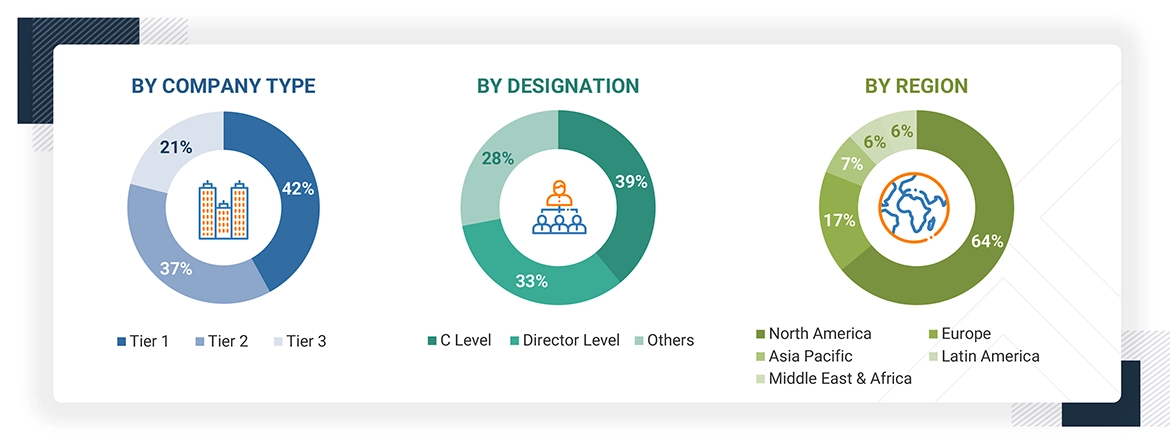
Note 1: C-level primaries include CEOs, COOs, and CTOs.
Note 2: Others include sales managers, marketing managers, and product managers.
Note 3: Companies are classified into tiers based on their total revenue. As of 2023: Tier 1=>USD 1 billion, Tier 2 = USD 500 million to USD 1 billion, Tier 3=< USD 500 million
To know about the assumptions considered for the study, download the pdf brochure
Market Size Estimation
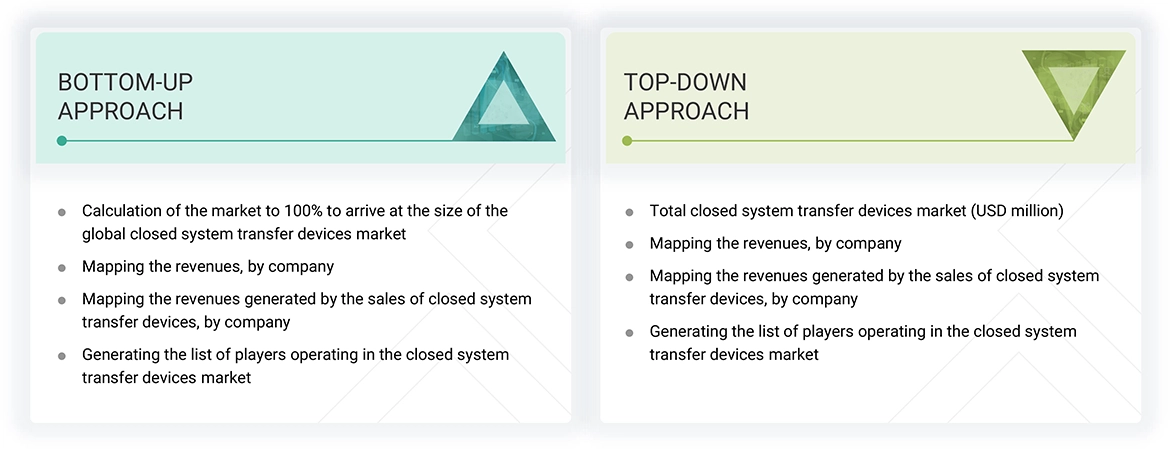
Both top-down and bottom-up approaches were used to estimate and validate the total size of the closed system transfer devices market. These methods were also used extensively to estimate the size of various subsegments in the market. The research methodology used to estimate the market size includes the following:
Data Triangulation
The entire market was split into five segments when the market size was determined. Data triangulation and market breakdown processes were used where necessary to complete the entire market engineering process and arrive at precise statistics for all segments.
Approach to derive the market size and estimate market growth.
Using secondary data from paid and unpaid sources, the market rankings for the major players were determined following a thorough analysis of their sales of CSTD. Due to data restrictions, the revenue share in certain cases was determined after a thorough analysis of the product portfolio of big corporations and their individual sales performance. This information was verified at each stage by in-depth interviews with professionals in the field.
Market Definition
Closed system transfer devices are highly specialized devices that mechanically prohibit the transfer of environmental contaminants into a system and the escape of hazardous drug or vapor concentrations outside the system. These devices are uniquely designed to protect healthcare providers and patients from exposure to hazardous drugs.
Stakeholders
- CSTD Manufacturers
- CSTD Suppliers & Distributors
- Original Equipment Manufacturers (OEMs)
- Hospitals and Clinics
- Oncology Centers
- Medical Device Research and Consulting Firms
- Contract Research Organizations (CROs)
- Academic & Research Institutes
- Government Associations
- Market Research and Consulting Firms
- Venture Capitalists and Investors
Report Objectives
- To define, describe, and forecast the closed system transfer devices market based on closing mechanism, type, component, technology, end user, and region
- To provide detailed information regarding the major factors influencing the market growth (drivers, restraints, opportunities, and challenges)
- To analyze the micromarkets with respect to individual growth trends, prospects, and contributions to the overall closed system transfer devices market
- To analyze market opportunities for stakeholders and provide details of the competitive landscape for key players
- To forecast the size of the closed system transfer devices market in five regions, namely, North America (US and Canada), Europe (Germany, UK, France, Spain, Italy, and Rest of Europe), the Asia Pacific (Japan, China, India, Australia & New Zealand, South Korea, and Rest of Asia Pacific), Latin America (Brazil, Mexico, Colombia, and Rest of Latin America), and the Middle East & Africa (GCC Countries, and Rest of Middle East & Africa)
- To analyze the impact of the economic recession on the growth of the closed system transfer devices market
- To strategically profile the key players in the global market and comprehensively analyze their core competencies
- To track and analyze competitive developments, such as product approvals, launches, expansions, and acquisitions, of the leading players in the market
Get the Full Closed Systems Transfer Devices Market Report
Full forecast, segment splits, and company analysis for all Closed Systems Transfer Devices Market.
- Canada Closed Systems Transfer Devices Market
- US Closed Systems Transfer Devices Market
- Germany Closed Systems Transfer Devices Market
- UK Closed Systems Transfer Devices Market
- France Closed Systems Transfer Devices Market
- Spain Closed Systems Transfer Devices Market
- Italy Closed Systems Transfer Devices Market
- China Closed Systems Transfer Devices Market
- India Closed Systems Transfer Devices Market
- South Korea Closed Systems Transfer Devices Market
- Brazil Closed Systems Transfer Devices Market
- Mexico Closed Systems Transfer Devices Market
- Colombia Closed Systems Transfer Devices Market
- Rest Of Europe Closed Systems Transfer Devices Market
- Rest Of Asia Pacific Closed Systems Transfer Devices Market
- Rest Of Latin America Closed Systems Transfer Devices Market
Need a Tailored Report?
Customize this report to your needs
Get 10% FREE Customization
Customize This Report
