
Brazil Commercial Refrigeration Market (2025-2030)

The Brazil Commercial Refrigeration Market was valued at $577.4 Million in 2025 and projected to reach to $643.4 Million by 2030, representing a compound annual growth rate of CAGR 2.2%. Brazil's commercial refrigeration market is positioned for steady growth as the country continues to urbanize and modernize its food retail and logistics infrastructure.


| Market Size in | USD 26.32 MN |
| Market Forecast in | |
| CAGR | |
| Forecast Period | |
| Units Considered | Value (USD MN) |
Brazil Commercial Refrigeration Market Trends and Insights
- This moderate growth trajectory reflects Brazil's developing infrastructure in food retail, hospitality, and cold chain logistics sectors.
- Brazil's market expansion is driven by increasing urbanization, rising demand for perishable goods storage, and modernization of retail facilities across major metropolitan areas. The commercial refrigeration sector in Brazil faces both opportunities and constraints shaped by economic conditions and regulatory frameworks.
- Brazil's growth rate of 2.2% CAGR through 2030 is notably lower than the global average of 5.6%, indicating a more cautious market expansion influenced by local economic factors and competition.
- Key drivers for Brazil include growing food and beverage consumption, expansion of supermarket chains, and investments in cold storage infrastructure for agricultural exports.
- The forecast period (2025–2030) will be critical for Brazil as manufacturers and distributors adapt to sustainability requirements and energy efficiency standards..
Key Market Statistics
- CAGR (2025-2030) CAGR 2.2%
- Market Size, 2025 ~USD 577.4 Million
- Forecast, 2030 ~USD 643.4 Million
- Country Brazil
Brazil Commercial Refrigeration Market Overview
Market Valuation :
Brazil's commercial refrigeration market is valued at USD 577.4 million in 2025, with projected growth to USD 643.4 million by 2030, representing a steady expansion in the region's cold chain infrastructure.
Growth Rate :
The Brazilian market is expanding at a CAGR of 2.2% through 2030, reflecting moderate but consistent growth driven by urbanization and retail sector development, though below the global average of 5.6%.
Key Growth Drivers :
Rising urbanization, expanding food retail networks, growing hospitality sector demand, and increasing investment in cold chain logistics are propelling commercial refrigeration adoption across Brazil's developing infrastructure.
Market Opportunity :
Brazil's emerging middle class and growing e-commerce food delivery sector present significant opportunities for commercial refrigeration equipment suppliers and cold chain solution providers in the coming years.
Brazil Commercial Refrigeration Market Dynamics
- The 2.2% CAGR reflects a maturing market with consistent demand from supermarkets, restaurants, and food distribution centers.
- Investment in cold chain development, particularly in emerging regions outside major metropolitan areas, will support market expansion through 2030. The market faces growth constraints from economic volatility and infrastructure limitations in certain regions, yet opportunities exist in modernizing existing equipment and expanding refrigeration solutions to underserved areas.
- Strategic focus on energy-efficient technologies and localized manufacturing will be critical for market participants seeking to capture Brazil's growing demand for commercial refrigeration solutions..
Market Ecosystem
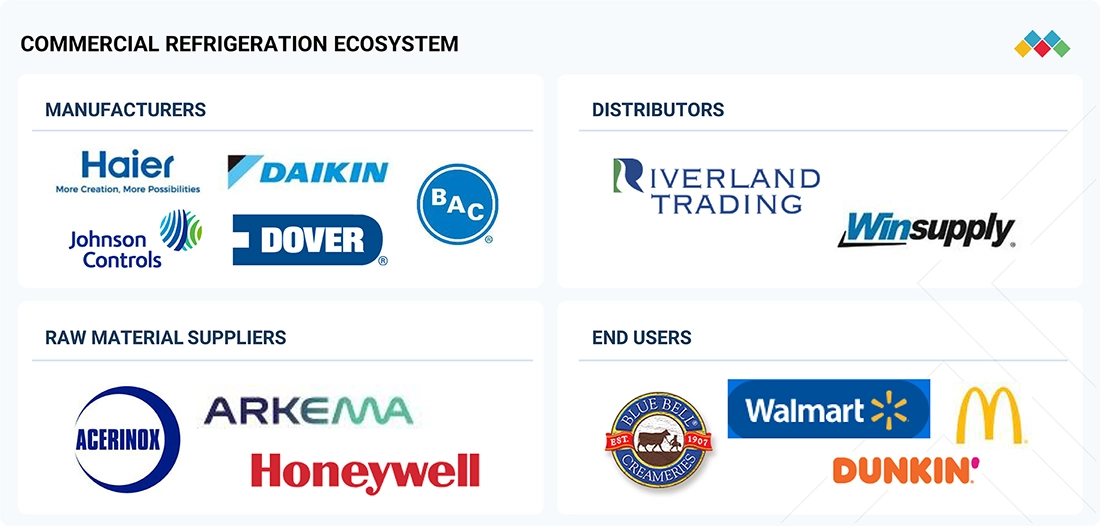
commercial-refrigeration-market: COMMERCIAL USE CASES ACROSS INDUSTRIES
| COMPANY | USE CASE DESCRIPTION | BENEFITS |
|---|---|---|
 |
Manufactures commercial refrigeration systems such as display cases, freezers, chillers, and cold storage units used in supermarkets, convenience stores, restaurants, and food service chains; Also offers IoT-integrated and energy-efficient cooling systems | Enhances energy efficiency and reduces operating costs, improves food preservation and temperature accuracy, and supports smart connectivity for real-time monitoring and predictive maintenance |
 |
Provides advanced commercial refrigeration solutions, including CO2 systems, heat-pump-based cooling, and variable refrigerant systems for retail, cold chain, and hospitality environments | Ensures precise temperature control, reduces environmental impact with low-GWP refrigerants, and increases reliability and system lifespan through advanced compressor and control technologies |
 |
Offers refrigeration systems, controls, and building automation solutions for retail food chains, distribution centers, and food processing facilities; Also integrates refrigeration into smart building management platforms | Improves operational efficiency through automated monitoring, ensures high food safety standards, reduces energy consumption, and enables seamless integration with building systems for centralized control |
 |
Designs and manufactures commercial refrigeration equipment, including refrigerated cases, specialty merchandisers, transportation refrigeration systems, and CO2-based refrigeration architectures | Enhances product display and merchandising effectiveness, reduces total cost of ownership with energy-efficient systems, and improves sustainability through natural refrigerant solutions |
 |
Provides evaporative condensers, fluid coolers, and heat-transfer equipment used in supermarket refrigeration, industrial cooling, cold storage, and large food distribution facilities | Delivers high efficiency in heat rejection, minimizes water and energy use, extends equipment lifespan, and improves system reliability for large-scale refrigeration operations |
Logos and trademarks shown above are the property of their respective owners. Their use here is for informational and illustrative purposes only.
Related Ecosystem
Equipment Machine And Tooling
- Wastewater Treatment
- Air Cooled Heat Exchangers
- Diaphragm Pumps
- Fiberglass
- HVAC System
- Alfa Laval Corporate AB
- Veolia
- Daikin Industries,Ltd.
- Johnson Controls International plc
- Parker-Hannifin Corporation
Key Takeaways
- Brazil's commercial refrigeration market is valued at USD 577.4 million in 2025 and will reach USD 643.4 million by 2030.
- Brazil's market growth rate of 2.2% CAGR is significantly lower than the global rate of 5.6%, reflecting regional economic constraints.
- Brazil's market expansion is driven by urbanization, retail modernization, and cold chain infrastructure for agricultural exports.
- Brazil's commercial refrigeration sector must adapt to energy efficiency standards and sustainability requirements through 2030.
Commercial Refrigeration Market Report Scope
| Report Metric | Details |
|---|---|
| Base Year | 2025 |
| Fastest Growing Segment | –PROPANE (Refrigerant Type) |
| Forecast Period | 2025–2030 |
| Growth Rate | CAGR of 5.6% from 2025 to 2030 |
| Largest Segment | FLUOROCARBONS (Refrigerant Type) |
| Market Size Base Year (Billions) | ~USD 51.26 (2025) |
| Revenue Forecast (Billions) | ~USD 67.31 (2030) |
| Segments Covered | Refrigerant Type, Product Type, Application, End Use |
Brazil Commercial Refrigeration Market Report Segmentation
4 segment dimensions are covered across the global market.
By Refrigerant Type
- Fluorocarbons
- Hydrocarbons
- Inorganics
- –Ammonia
- –Carbon Dioxide
- –Hydrochlorofluorocarbons (Hcfcs)
- –Hydrofluorocarbons (Hfcs)
- –Hydrofluoroolefins (Hfos)
- –Isobutane
- –Others Hydrocarbons
- –Others Inorganics
- –Propane
By Product Type
- Beverage Refrigeration
- ICE Cream Merchandiser
- Refrigerated Display Case
- Refrigerated Vending Machine
- Refrigerator & Freezer
- South America
- Transportation Refrigeration
By Application
- Food & Beverage Distribution
- Food & Beverage Production
- Food & Beverage Retail
- Food Service
- Other Applications
By End Use
- Bakeries
- Convenience Stores
- Hotels & Restaurants
- Supermarkets & Hypermarkets
Target Audience
- Commercial Refrigeration Manufacturers : Equipment producers need Brazil-specific market data to assess production capacity requirements, localization strategies, and competitive positioning in a 2.2% CAGR growth environment with distinct regional demand patterns.
- Cold Chain Logistics Providers : Distribution and logistics companies require detailed market insights to plan infrastructure investments, identify growth corridors, and align service offerings with Brazil's expanding food retail and e-commerce sectors.
- Retail & Hospitality Operators : Supermarket chains, restaurants, and food service businesses need market forecasts to budget refrigeration equipment upgrades, plan expansion strategies, and optimize cold storage investments across Brazil's urbanizing regions.
- Investment & Private Equity Firms : Investors evaluating opportunities in Brazil's food infrastructure and cold chain sectors require market sizing, growth projections, and competitive landscape data to assess portfolio company valuations and exit potential.
- Government & Policy Makers : Brazilian regulatory bodies and development agencies need market intelligence to inform infrastructure policies, cold chain modernization initiatives, and food safety standards aligned with commercial refrigeration market evolution.
Key Companies in the Brazil Commercial Refrigeration Market
| Company | HQ | Ownership | Strongest segments |
|---|---|---|---|
| DAIKIN INDUSTRIES, LTD. | Japan | Public Company | Residential split/multi-split and unitary AC,VRV/VRF and packaged commercial systems,Air-to-water heat pumps and heating systems, |
| JOHNSON CONTROLS | Ireland | Public Company | HVAC equipment and controls,Building management and digital solutions,Fire detection and suppression, |
| DANFOSS | Denmark | Private Company | Power Solutions (mobile hydraulics, power units, motors, pumps, steering),Climate Solutions – Cooling (refrigeration, AC components, cold chain),Climate Solutions – Heating (hydronic, smart heating, district energy), |
| DOVER CORPORATION | United States | Public Company | Pumps & Process Solutions,Clean Energy & Fueling,Imaging & Identification, |
| HAIER INC. | China | Refrigeration (refrigerators & freezers),Laundry (washing machines & dryers),Air Conditioning & HVAC, | |
| BLUE STAR LIMITED | India | Public Company | Electro-Mechanical Projects and Commercial Air Conditioning Systems,Unitary Products (Room ACs, Light Commercial AC, Commercial Refrigeration, Air Coolers),Professional Electronics and Industrial Systems, |
| DE RIGO REFRIGERATION | Italy | Private Company | Remote multideck and wall cabinets for supermarkets,Plug-in cabinets and islands for convenience and small formats,Specialty and custom display cases (patisserie, deli, premium food), |
DAIKIN INDUSTRIES, LTD.
Daikin Industries, Ltd. is a Japanese public company founded in 1924 with 104,095 employees. The company operates as a major global manufacturer in its industry sector.
JOHNSON CONTROLS
Johnson Controls is a public company headquartered in Ireland, founded in 1885 with 87,000 employees. The company operates internationally across multiple business segments.
DANFOSS
Danfoss is a Danish private company established in 1933 with 39,360 employees. The company operates globally in engineering and manufacturing sectors.
DOVER CORPORATION
Dover Corporation is a United States-based public company founded in 1947 with 24,000 employees. The company operates across diversified industrial and commercial markets.
HAIER INC.
Haier Inc. is a Chinese company founded in 1984. The company operates as a major manufacturer in the home appliances and refrigeration sectors.
BLUE STAR LIMITED
Blue Star Limited is an Indian public company founded in 1943 with 3,655 employees. The company operates in the air conditioning and refrigeration sectors.
DE RIGO REFRIGERATION
De Rigo Refrigeration is an Italian private company founded in 1965. The company operates in the refrigeration equipment sector.
Reasons to Buy this Report
- Market-Specific Sizing : Access precise valuation data for Brazil's commercial refrigeration market with verified 2025 baseline (USD 577.4M) and 2030 forecasts, enabling accurate budget allocation and revenue projections for regional operations.
- Growth Trajectory Analysis : Understand Brazil's 2.2% CAGR in context of global 5.6% growth, identifying why the market underperforms globally and where localized opportunities exist for differentiated market entry strategies.
- Sector-Specific Insights : Gain detailed intelligence on Brazil's food retail, hospitality, and cold chain logistics segments, including urbanization trends and infrastructure development patterns that drive commercial refrigeration demand.
- Competitive Positioning : Benchmark your Brazil operations against market growth rates and identify gaps in the 2.2% CAGR expansion, revealing underserved customer segments and geographic regions for targeted market penetration.
- Strategic Planning : Leverage Brazil-specific market forecasts through 2030 to develop long-term product development, distribution, and investment strategies aligned with the country's unique refrigeration market dynamics and growth catalysts.
Frequently asked questions
What is the current size of Brazil's commercial refrigeration market?
Brazil's commercial refrigeration market is valued at USD 577.4 million in 2025.
What is the projected market size for Brazil by 2030?
Brazil's commercial refrigeration market is forecast to reach USD 643.4 million by 2030.
What is the CAGR for Brazil's commercial refrigeration market?
Brazil's commercial refrigeration market is expected to grow at a CAGR of 2.2% from 2025 to 2030.
How does Brazil's growth rate compare to the global market?
Brazil's CAGR of 2.2% is lower than the global CAGR of 5.6%, indicating slower regional expansion.
What are the main drivers of growth in Brazil's commercial refrigeration market?
Key drivers include urbanization, retail modernization, food and beverage consumption growth, and cold chain infrastructure development for agricultural exports.
RESEARCH METHODOLOGY
The research encompassed four primary actions in assessing the present market size of commercial refrigeration. Comprehensive secondary research was conducted to gather information on the market, the peer market, and the parent market. The subsequent stage involved corroborating these findings, assumptions, and dimensions with industry specialists throughout the commercial refrigeration value chain via primary research. The total market size is ascertained with both top-down and bottom-up methodologies. Subsequently, market segmentation analysis and data triangulation were employed to ascertain the dimensions of the market segments and sub-segments.
Secondary Research
The research approach employed to assess and project the commercial refrigeration market begins with the collection of revenue data from prominent suppliers using secondary research. In the course of the secondary research, many secondary sources, such as Hoovers, Bloomberg BusinessWeek, Factiva, the World Bank, and industry magazines, were utilized to identify and compile information for this study. The secondary sources comprised annual reports, press releases, and investor presentations from corporations; white papers; accredited periodicals; writings by esteemed authors; announcements from regulatory agencies; trade directories; and databases. Vendor offerings have been considered to ascertain market segmentation.
Primary Research
The commercial refrigeration market comprises several stakeholders, such as manufacturers, suppliers, traders, associations, and regulatory organizations, in the supply chain. The demand side of this market is characterized by the development of hotels & restaurants, supermarkets & hypermarkets, convenience stores, bakeries, and others. Advancements in technology characterize the supply side. Various primary sources from both the supply and demand sides of the market were interviewed to obtain qualitative and quantitative information. The following is the breakdown of the primary respondents:
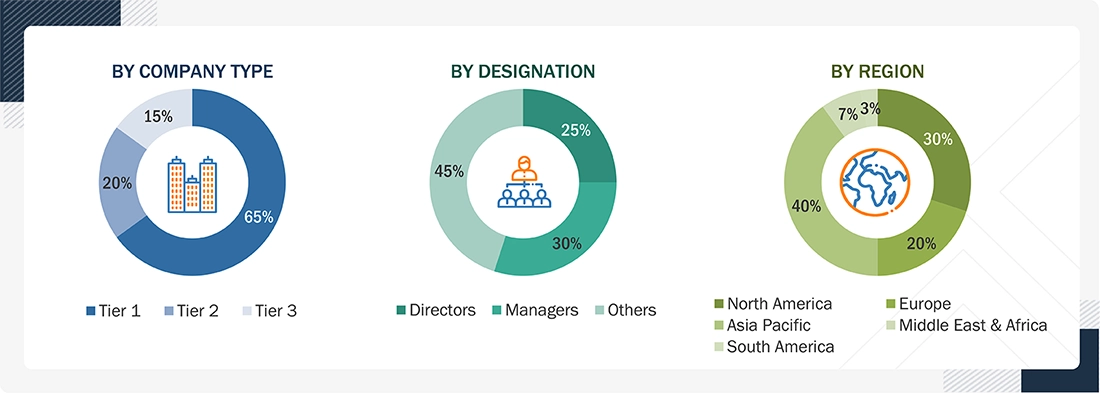
To know about the assumptions considered for the study, download the pdf brochure
Market Size Estimation
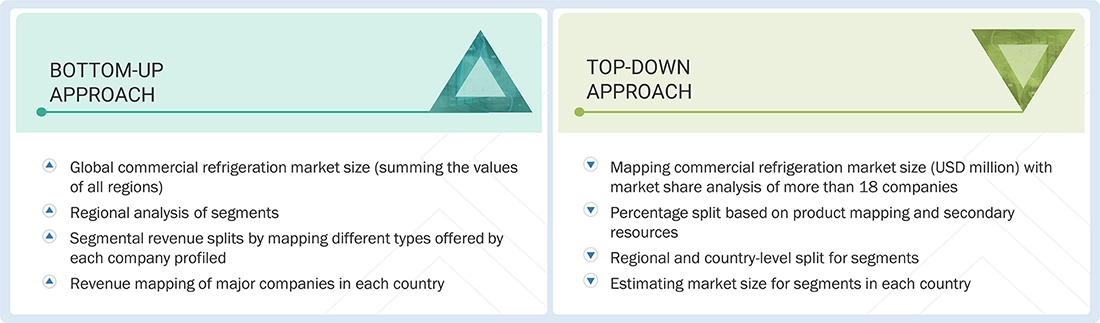
Both the top-down and bottom-up approaches were used to estimate and validate the total size of the commercial refrigeration market. These methods were also used extensively to determine the size of various sub-segments in the market. The research methodology used to estimate the market size included the following:
- The key players were identified through extensive primary and secondary research.
- The value chain and market size of the commercial refrigeration market, in terms of value, were determined through primary and secondary research.
- All percentage shares, splits, and breakdowns were determined using secondary sources and verified through primary sources.
- All possible parameters that affect the market covered in this research study were accounted for, viewed in extensive detail, verified through primary research, and analyzed to obtain the final quantitative and qualitative data.
- The research included the study of reports, reviews, and newsletters of top market players, along with extensive interviews for opinions from key leaders, such as CEOs, directors, and marketing executives.
Commercial Refrigeration Market : Top-Down and Bottom-Up Approach
Data Triangulation
After arriving at the overall market size using the market size estimation processes as explained above, the market was split into several segments and sub-segments. To complete the overall market engineering process and arrive at the exact statistics of each market segment and subsegment, data triangulation and market breakdown procedures were employed, wherever applicable. The market size was calculated globally by summing up the country-level and regional-level data.
Market Definition
Commercial refrigeration refers to the systems and equipment designed for commercial and industrial environments to store, chill, or freeze perishable goods under controlled temperature conditions. It plays a critical role in businesses such as supermarkets, grocery stores, convenience stores, restaurants, hospitals, and other industries. By maintaining precise temperature levels, commercial refrigeration inhibits the growth of bacteria, yeast, and mold, thereby extending shelf life, reducing product waste, and ensuring food safety and quality across retail and foodservice operations. These systems encompass a wide range of equipment, including display cases, walk-in coolers and freezers, reach-in refrigerators and freezers, refrigerated prep tables, beverage coolers, ice machines, and centralized refrigeration systems. Product categories in the market include transportation refrigeration, refrigerated display cases, beverage refrigeration, refrigerators and freezers, ice cream merchandisers, and refrigerated vending machines.
Key Stakeholders
- Commercial Refrigeration Manufacturers
- Commercial Refrigeration Suppliers
- Commercial Refrigeration Traders, Distributors, and Suppliers
- Investment Banks and Private Equity Firms
- Raw Material Suppliers
- Government and Research Organizations
- Consulting Companies/Consultants in the Chemicals and Materials Sectors
- Industry Associations
- Contract Manufacturing Organizations (CMOs)
- NGOs, Governments, Investment Banks, Venture Capitalists, and Private Equity Firms
Report Objectives
- To define, describe, and forecast the size of the global commercial refrigeration market in terms of value
- To provide detailed information regarding the key factors, such as drivers, restraints, opportunities, and industry-specific challenges, influencing the growth of the global commercial refrigeration market
- To analyze and forecast the size of various segments (product type, refrigerant type, end-use, and application) of the commercial refrigeration market based on five major regions—North America, Asia Pacific, Europe, the Middle East & Africa, and South America, along with key countries in each of these regions
- To strategically profile the key players in the market and comprehensively analyze their core competencies
Available Customizations
With the given market data, MarketsandMarkets offers customizations according to client-specific needs.
The following customization options are available for the report:
- Additional country-level analysis of the commercial refrigeration market
- Profiling of additional market players (up to 5)
Product Analysis
- Product matrix, which gives a detailed comparison of the product portfolio of each company.
Get the Full Commercial Refrigeration Market Report
Full forecast, segment splits, and company analysis for all Commercial Refrigeration Market.
- China Commercial Refrigeration Market
- Japan Commercial Refrigeration Market
- India Commercial Refrigeration Market
- South Korea Commercial Refrigeration Market
- Thailand Commercial Refrigeration Market
- Malaysia Commercial Refrigeration Market
- Singapore Commercial Refrigeration Market
- Indonesia Commercial Refrigeration Market
- Canada Commercial Refrigeration Market
- Mexico Commercial Refrigeration Market
- US Commercial Refrigeration Market
- UK Commercial Refrigeration Market
- Germany Commercial Refrigeration Market
- Italy Commercial Refrigeration Market
- France Commercial Refrigeration Market
- Spain Commercial Refrigeration Market
- Egypt Commercial Refrigeration Market
- Turkey Commercial Refrigeration Market
- Argentina Commercial Refrigeration Market
- Chile Commercial Refrigeration Market
- Rest Of Europe Commercial Refrigeration Market
- Rest Of Asia Pacific Commercial Refrigeration Market
- GCC Countries Commercial Refrigeration Market
- –Rest Of GCC Commercial Refrigeration Market
Need a Tailored Report?
Customize this report to your needs
Get 10% FREE Customization
Customize This Report
