
Switzerland Compressed Air Energy Storage Market (2025-2030)

The Switzerland Compressed Air Energy Storage Market was valued at $0 Million in 2025 and projected to reach to $0 Million by 2030, representing a compound annual growth rate of . Switzerland's compressed air energy storage market remains underdeveloped, with no commercial presence anticipated through 2030.


| Market Size in | USD 26.32 MN |
| Market Forecast in | |
| CAGR | |
| Forecast Period | |
| Units Considered | Value (USD MN) |
Switzerland Compressed Air Energy Storage Market Trends and Insights
- The country's established reliance on hydroelectric power and nuclear energy has historically reduced the urgency for alternative energy storage solutions like CAES.
- As Switzerland approaches 2030, the market is not projected to develop significant commercial activity, maintaining a zero market valuation throughout the forecast period.
- Switzerland's energy infrastructure and regulatory environment have not yet created conditions favorable for CAES deployment at scale. Despite global compressed air energy storage markets experiencing robust growth with a 31.4% CAGR between 2025 and 2030, Switzerland remains an outlier with zero projected growth.
- The country's abundant renewable hydroelectric capacity and existing pumped-storage hydroelectricity systems continue to serve as the primary energy storage mechanism.
- Switzerland's focus on grid stability and decarbonization is being addressed through established technologies rather than emerging CAES solutions.
- Market entry for CAES providers in Switzerland will require significant shifts in energy policy, infrastructure investment, and competitive positioning against entrenched storage alternatives..
Key Market Statistics
- CAGR (2025-2030)
- Market Size, 2025 ~USD 0 Million
- Forecast, 2030 ~USD 0 Million
- Country Switzerland
Switzerland Compressed Air Energy Storage Market Overview
Zero Market Presence :
Switzerland's CAES market recorded no measurable commercial activity in 2025, reflecting the country's minimal adoption of compressed air energy storage technology despite global market expansion.
Hydroelectric Dominance :
Switzerland's energy infrastructure is anchored by hydroelectric power, which accounts for approximately 60% of electricity generation, reducing the perceived need for alternative storage solutions like CAES.
Nuclear Energy Reliance :
The country's established nuclear energy portfolio provides stable baseload power, further diminishing the urgency for developing compressed air energy storage capacity through 2030.
Stagnant Growth Trajectory :
With a 0% CAGR projected through 2030, Switzerland's CAES market is not expected to develop significant commercial deployment or investment activity in the forecast period.
Switzerland Compressed Air Energy Storage Market Dynamics
- The country's robust hydroelectric infrastructure and established nuclear energy base have historically eliminated the competitive advantage of CAES technology.
- Unlike global markets experiencing 31.4% CAGR growth, Switzerland's energy security model relies on proven renewable and nuclear sources, limiting CAES market penetration. Looking ahead, Switzerland's transition toward renewable energy integration may eventually create opportunities for energy storage solutions.
- However, the country's existing capacity and regulatory framework favor continued investment in hydroelectric expansion and grid modernization over CAES deployment.
- Market development remains contingent on significant shifts in energy policy or technological breakthroughs that demonstrate clear advantages over current storage alternatives..
Market Ecosystem
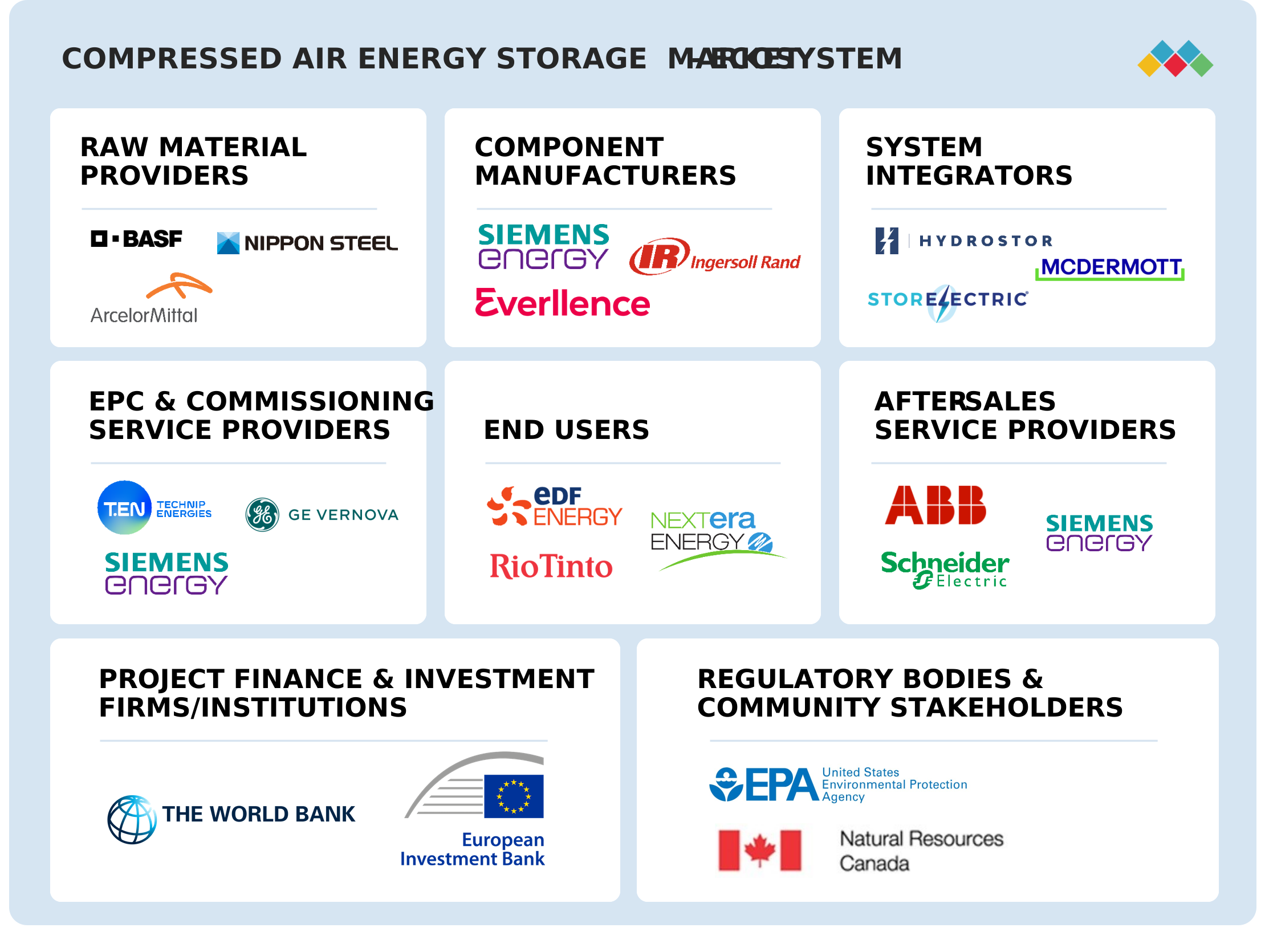
Compressed Air Energy Storage Market: COMMERCIAL USE CASES ACROSS INDUSTRIES
| COMPANY | USE CASE DESCRIPTION | BENEFITS |
|---|---|---|
 |
Researchers proposed an underwater compressed air energy storage system, where surplus renewable electricity is used to compress air into large underwater storage units. | When demand is high, the stored air is released to generate electricity. This system is designed to cover Sicily’s electricity needs for an entire year by storing and releasing energy as required. |
 |
The Abhar and Kahak regions of Iran have strong wind resources, making them ideal for wind power projects. However, the electricity generated varies greatly depending on the time of day and seasonal weather patterns. | Engineers studied the use of compressed air energy storage alongside the wind farms to capture excess energy during high-wind periods. The stored compressed air was then released to generate power when demand was greater than wind output. This system achieved round-trip efficiencies of 40–45%, significantly improving the reliability of wind energy for the region. |
Logos and trademarks shown above are the property of their respective owners. Their use here is for informational and illustrative purposes only.
Related Ecosystem
Decarbonization
Smart Grid
Key Takeaways
- Switzerland's CAES market shows zero market size in 2025 with no growth projected through 2030, contrasting sharply with the global 31.4% CAGR.
- Switzerland's hydroelectric and pumped-storage infrastructure dominates energy storage, reducing near-term demand for compressed air solutions.
- Switzerland's regulatory framework and energy policy currently do not prioritize CAES as a strategic storage technology.
- Market development in Switzerland will depend on policy shifts, cost competitiveness improvements, and infrastructure modernization initiatives.
Compressed Air Energy Storage Market Report Scope
| Report Metric | Details |
|---|---|
| Base Year | 2025 |
| Fastest Growing Segment | ABOVE GROUND (Storage Form) |
| Forecast Period | 2025–2030 |
| Growth Rate | CAGR of 31.4% from 2025 to 2030 |
| Largest Segment | UNDERGROUND (Storage Form) |
| Market Size Base Year (Billions) | ~USD 0.48 (2025) |
| Revenue Forecast (Billions) | ~USD 1.88 (2030) |
| Segments Covered | Expenditure Type, Type, Capacity, Storage Form, Application |
Switzerland Compressed Air Energy Storage Market Report Segmentation
5 segment dimensions are covered across the global market.
By Expenditure Type
- Capex
- Opex
By Type
- Adiabatic
- Diabatic
By Capacity
- Large–Scale
- Medium–Scale
- Small–Scale
By Storage Form
- Above Ground
- Underground
By Application
- Grid Management
- Renewable Energy Integration
Target Audience
- Energy Storage Technology Providers : Understand Switzerland's current market barriers and identify alternative positioning strategies to penetrate this underdeveloped CAES market or pivot to complementary storage solutions.
- Utility Companies & Grid Operators : Assess whether CAES technology aligns with Switzerland's energy infrastructure modernization plans and grid stability requirements through 2030 and beyond.
- Investment & Private Equity Firms : Evaluate the risk-return profile of CAES investments in Switzerland, determining whether market development timelines justify capital allocation in this nascent segment.
- Government & Policy Makers : Leverage market intelligence to inform energy storage policy decisions and identify whether CAES should be prioritized in Switzerland's renewable energy transition strategy.
- Renewable Energy Developers : Determine optimal energy storage partnerships and technologies for Swiss renewable projects, considering the limited CAES availability and alternative storage solutions.
Key Companies in the Switzerland Compressed Air Energy Storage Market
| Company | HQ | Ownership | Strongest segments |
|---|---|---|---|
| AUGWIND | Israel | Public Company | Adiabatic / hybrid AirBattery systems,Compression and expansion equipment & services,Software, controls, and ancillary services, |
| KEEP ENERGY SYSTEMS | Netherlands | Private Company | Adiabatic CAES Systems,Diabatic / Hybrid CAES Solutions,Engineering & Project Development Services, |
| BAROMAR | Israel | Adiabatic CAES Systems,Diabatic / Hybrid CAES Systems,Engineering & Project Development Services, | |
| SHERWOOD POWER | United Kingdom | Private Company | Adiabatic CAES Systems,Diabatic / Hybrid CAES Systems,CAPEX-Funded Project Delivery, |
AUGWIND
Augwind is an Israeli public company founded in 2007 with 21 employees, specializing in energy storage technology.
KEEP ENERGY SYSTEMS
Keep Energy Systems is a Netherlands-based private company founded in 2019 operating in the energy storage industry.
BAROMAR
Insufficient data provided for company description.
SHERWOOD POWER
Sherwood Power is a United Kingdom-based private company founded in 2020 operating in the energy sector.
Reasons to Buy this Report
- Understand Market Barriers : Gain insights into why Switzerland's established hydroelectric and nuclear infrastructure creates structural barriers to CAES adoption, informing strategic market entry decisions.
- Competitive Landscape Analysis : Identify alternative energy storage technologies and solutions that compete effectively in Switzerland's unique energy market, supporting technology positioning strategies.
- Policy & Regulatory Context : Access detailed analysis of Swiss energy regulations and policies that influence storage technology adoption, critical for compliance and partnership planning.
- Long-term Market Potential : Evaluate emerging opportunities for CAES development as Switzerland transitions toward greater renewable integration and grid modernization initiatives post-2030.
- Investment Risk Assessment : Make informed investment decisions with comprehensive risk analysis specific to Switzerland's energy sector, avoiding costly market entry mistakes in this nascent segment.
Frequently asked questions
Why does Switzerland have zero compressed air energy storage market activity?
Switzerland's abundant hydroelectric resources and existing pumped-storage hydroelectricity systems provide cost-effective energy storage, eliminating current market demand for CAES technology.
Is Switzerland planning to develop CAES infrastructure by 2030?
Current forecasts indicate no significant CAES market development in Switzerland through 2030, as the country continues to rely on established hydroelectric storage solutions.
How does Switzerland's energy storage strategy differ from global CAES trends?
While global CAES markets grow at 31.4% CAGR, Switzerland prioritizes hydroelectric and pumped-storage technologies aligned with its renewable energy portfolio and grid stability needs.
What would be required for CAES adoption in Switzerland?
CAES market entry in Switzerland would require competitive cost advantages, supportive regulatory changes, and demonstrated benefits over existing hydroelectric storage infrastructure.
Are there any pilot CAES projects planned in Switzerland?
No commercial or pilot CAES projects are currently documented in Switzerland's energy development pipeline as of 2025.
RESEARCH METHODOLOGY
The study involved major activities in estimating the current size of the compressed air energy storage market. Exhaustive secondary research was done to collect information on the peer and parent markets. The next step was to validate these findings, assumptions, and sizing with industry experts across the value chain through primary research. The top-down and bottom-up approaches were employed to estimate the total market size. Thereafter, market breakdown and data triangulation techniques were used to estimate the market size of the segments and subsegments.
Secondary Research
This research study involved the use of extensive secondary sources, directories, and databases, such as Hoover’s, Bloomberg, Factiva, IRENA, the International Energy Agency, and Statista Industry Journal, to collect and identify valuable information for a technical, market-oriented, and commercial study of compressed air energy storage. Other secondary sources included annual reports, press releases, and investor presentations of companies; white papers; certified publications; and articles by recognized authors, manufacturer associations, trade directories, and databases.
Primary Research
In the primary research process, various primary sources from the supply and demand sides were interviewed to obtain qualitative and quantitative information for this report. Primary sources from the supply side include industry experts such as chief executive officers (CEOs), vice presidents (VPs), marketing directors, and related key executives from various companies and organizations operating in the compressed air energy storage market.
In the complete market engineering process, the top-down and bottom-up approaches, along with several data triangulation methods, were extensively used to perform the market size estimations and forecasts for all segments and subsegments listed in this report. Extensive qualitative and quantitative analyses were conducted to complete the market engineering process and list key information/insights throughout the report.
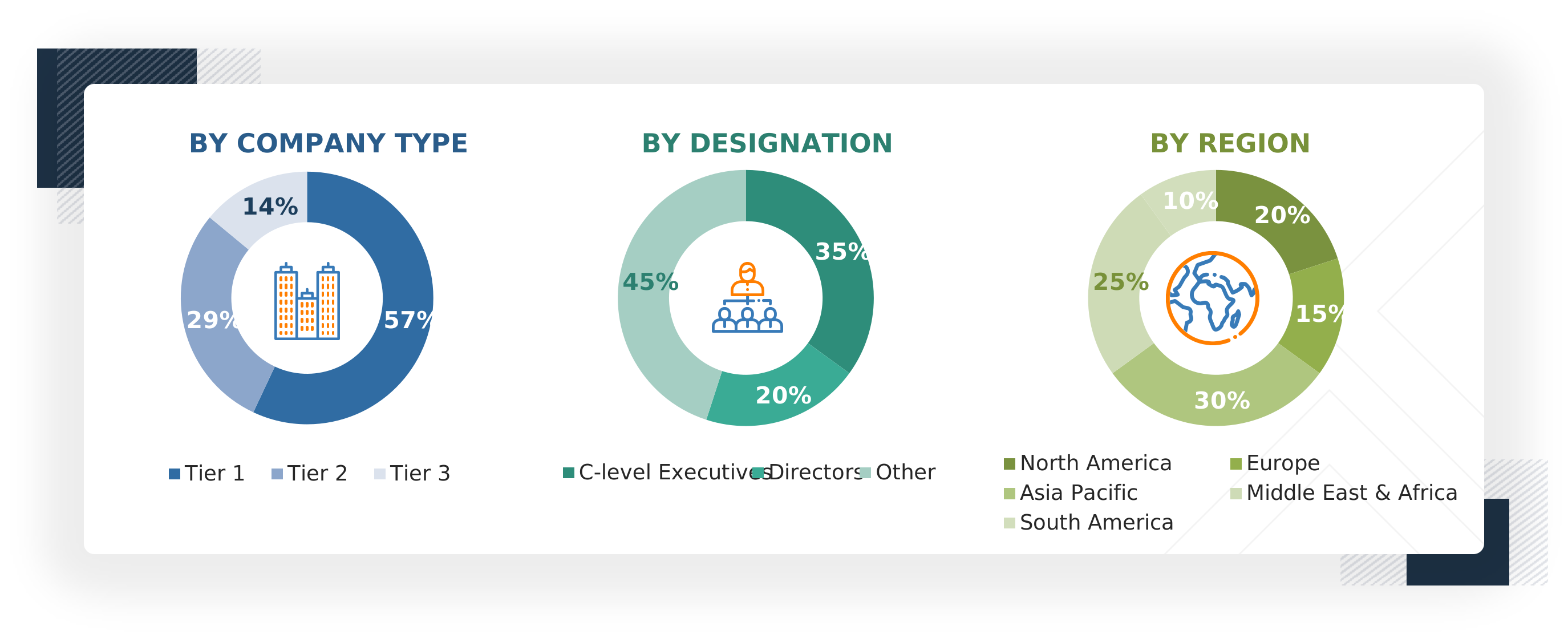
Notes: The tiers of the companies are defined based on their total revenues as of 2024; Tier 1: >
USD 1 billion, Tier 2: From USD 500 million to USD 1 billion, and Tier 3: < USD 500 million. Others include sales managers, engineers,
and regional managers.
To know about the assumptions considered for the study, download the pdf brochure
Market Size Estimation
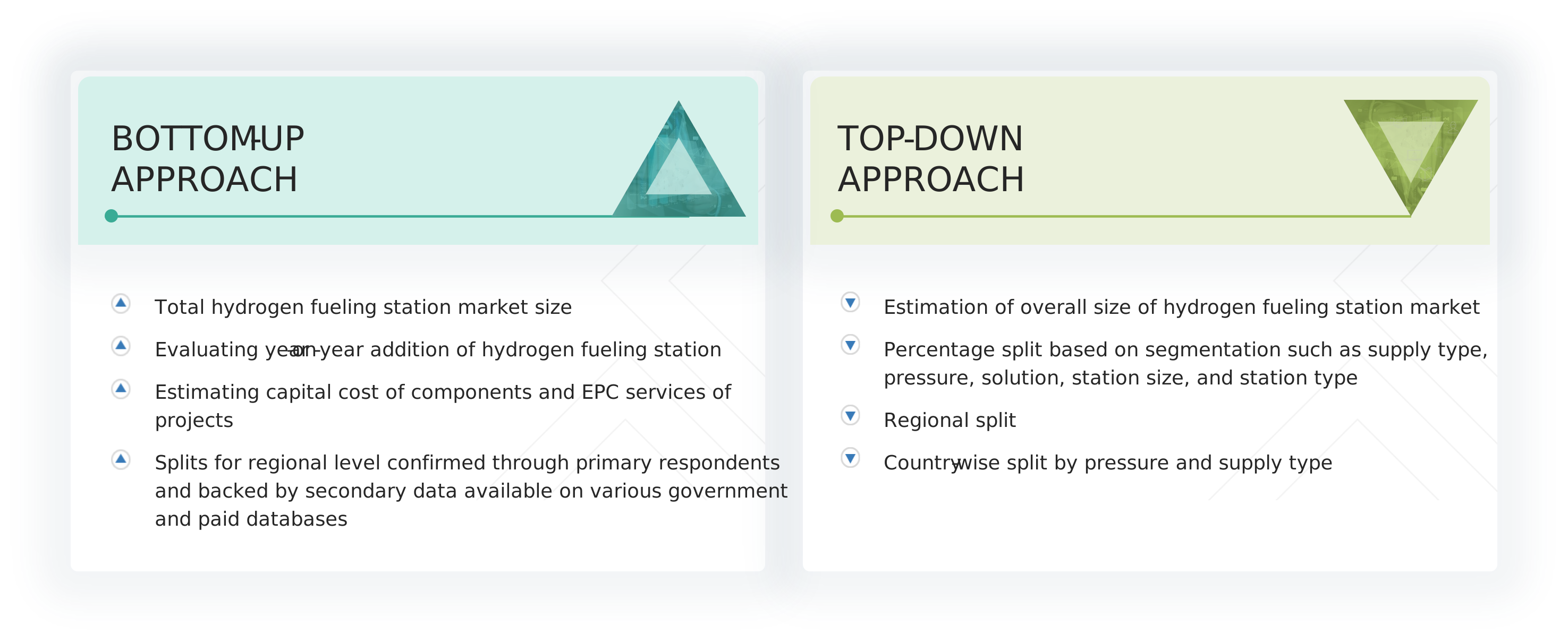
The top-down and bottom-up approaches were used to estimate and validate the total size of the compressed air energy storage market. These methods were also used extensively to estimate the size of various subsegments of the market. The research methodology used to estimate the market size includes the following.
Compressed Air Energy Storage Market : Top-Down and Bottom-Up Approach
Data Triangulation
The total market was split into several segments and subsegments after arriving at the overall market size from the above estimation process. Data triangulation and market breakdown processes were employed to complete the overall market engineering process and arrive at the exact statistics for all the segments and subsegments, wherever applicable. The data was triangulated by studying various factors and trends from the demand and supply sides. In addition, the market size was validated using both the top-down and bottom-up approaches.
Market Definition
Compressed air energy storage (CAES) is a form of mechanical energy storage that converts electricity into compressed air and later back into electricity when needed. In the charging phase, an electric motor powers a compressor that compresses ambient air and stores it in a reservoir such as an underground cavern, above-ground tank, or underwater balloon. During the discharging phase, the stored air is released and expanded through a turbine, which drives a generator to produce electricity. Compressed air energy storage (CAES) is emerging as a critical long-duration energy storage technology for stabilizing modern power grids. With the rapid growth of renewable energy sources such as wind and solar, CAES provides a reliable solution to address intermittency by storing excess electricity and delivering it back when demand rises. Compared to conventional batteries, CAES offers advantages such as longer operational lifespans, grid-level scalability capacities, low maintenance requirements, and the potential for zero-emission operation when deployed in adiabatic configurations.
The compressed air energy storage market comprises revenues of companies that offer technology and equipment for the compressed air energy storage market. The market has been studied for four key regions: North America, Europe, Asia Pacific, and RoW.
Stakeholders
- Compressed air energy storage (CAES) system manufacturers
- Turbine, compressor, and generator manufacturers
- Underground cavern and storage facility developers
- State and national regulatory authorities
- State and national regulatory authorities
- Organizations, forums, alliances, and associations
- Investors/Shareholders
- Manufacturers’ associations
- Long-duration energy storage raw material and component manufacturers
- Long-duration energy storage manufacturers, dealers, and suppliers
- Electrical equipment manufacturers’ associations and groups
- Power utilities and other end-use companies
Report Objectives
- To define, describe, segment, and forecast the compressed air energy storage market size by type, capacity, by storage form, and by application in terms of value
- To forecast the market size across five key regions, namely, North America, Europe, Asia Pacific, the Middle East & Africa, and South America, in terms of value
- To provide detailed information about the key drivers, restraints, opportunities, and industry-specific challenges influencing the growth of the compressed air energy storage market
- To provide the supply chain analysis, trends/disruptions impacting customer business, ecosystem analysis, regulatory landscape, patent analysis, case study analysis, technology analysis, key conferences & events, impact of AI/Gen AI, pricing analysis, Porter’s five forces analysis, and regulatory analysis for the compressed air energy storage market
- To strategically analyze the micromarkets1 with respect to individual growth trends, upcoming expansions, and their contributions to the overall market
- To analyze opportunities for stakeholders in the compressed air energy storage market and draw a competitive landscape for market players
- To benchmark players within the market using the company evaluation matrix, which analyzes market players on various parameters within the broad categories of business and product strategies
- To compare key market players with respect to the market share, product specifications, and applications
- To strategically profile key players and comprehensively analyze their market ranking and core competencies
- To track and analyze competitive developments in the compressed air energy storage market, such as sales contracts, agreements, investments, expansions, product launches, alliances, mergers, partnerships, joint ventures, collaborations, and acquisitions
Available Customizations
MarketsandMarkets offers customizations according to the specific needs of the companies using the given market data.
The following customization options are available for the report:
Product Analysis
- Product matrix, which gives a detailed comparison of the product portfolio of each company
Geographic Analysis as per Feasibility
- Further breakdown of the compressed air energy storage market by country
Company Information
- Detailed analysis and profiling of additional market players (up to five)
Get the Full Compressed Air Energy Storage Market Report
Full forecast, segment splits, and company analysis for all Compressed Air Energy Storage Market.
- Canada Compressed Air Energy Storage Market
- US Compressed Air Energy Storage Market
- Germany Compressed Air Energy Storage Market
- UK Compressed Air Energy Storage Market
- Netherlands Compressed Air Energy Storage Market
- China Compressed Air Energy Storage Market
- Australia Compressed Air Energy Storage Market
Need a Tailored Report?
Customize this report to your needs
Get 10% FREE Customization
Customize This Report
