
Canada Heavy Equipment Telematics Market (2025-2030)

The Canada Heavy Equipment Telematics Market was valued at $26827 Million in 2025 and projected to reach to $47422 Million by 2030, representing a compound annual growth rate of 8.5%. Canada's heavy equipment telematics market is positioned for sustained growth as industries increasingly recognize the value of real-time monitoring and predictive maintenance capabilities.


| Market Size in | USD 26.32 MN |
| Market Forecast in | |
| CAGR | |
| Forecast Period | |
| Units Considered | Value (USD MN) |
Canada Heavy Equipment Telematics Market Trends and Insights
- This 8.5% compound annual growth rate reflects Canada's increasing adoption of IoT-enabled monitoring solutions across construction, mining, and transportation sectors.
- Canada's mature infrastructure and regulatory environment support the deployment of advanced telematics systems that enhance equipment efficiency, reduce downtime, and improve operational safety. The Canadian market benefits from strong demand for real-time fleet management and predictive maintenance capabilities among large equipment operators.
- Canada's focus on digital transformation and sustainability initiatives is driving investment in telematics technologies that optimize fuel consumption and emissions tracking.
- By 2030, Canada is expected to solidify its position as a key regional hub for heavy equipment telematics innovation, supported by growing partnerships between equipment manufacturers and technology providers..
Key Market Statistics
- CAGR (2025-2030) 8.5% CAGR
- Market Size, 2025 ~USD 26827 Million
- Forecast, 2030 ~USD 47422 Million
- Country Canada
Canada Heavy Equipment Telematics Market Overview
Market Valuation Growth :
Canada's heavy equipment telematics market is valued at USD 26,827 million in 2025, with projections reaching USD 47,422 million by 2030, representing an 8.5% CAGR driven by digital transformation across industrial sectors.
Sector Adoption Leaders :
Construction, mining, and transportation sectors in Canada are leading the adoption of IoT-enabled telematics solutions, leveraging real-time monitoring for operational efficiency and asset management across geographically dispersed operations.
Regulatory & Infrastructure Support :
Canada's mature regulatory framework and advanced infrastructure create a favorable environment for telematics deployment, with government initiatives supporting digital innovation and equipment tracking compliance across provinces.
Growth Differential :
Canada's 8.5% CAGR is moderating compared to the global 13.4% rate, reflecting market maturity and saturation in certain segments, though emerging applications in remote asset monitoring present expansion opportunities.
Canada Heavy Equipment Telematics Market Dynamics
- The 8.5% CAGR through 2030 reflects steady adoption among established players in construction, mining, and logistics sectors, supported by Canada's robust digital infrastructure and regulatory compliance requirements.
- Investment in IoT connectivity and cloud-based fleet management solutions continues to accelerate across major metropolitan and resource-rich regions. Looking ahead, the market will be shaped by integration of AI-driven analytics, enhanced cybersecurity protocols, and expansion into remote operations management.
- Canadian equipment manufacturers and fleet operators are increasingly prioritizing telematics as a competitive differentiator, while regulatory pressures around emissions tracking and safety compliance drive further adoption.
- The market's trajectory suggests consolidation among solution providers and growing demand for integrated platforms serving multi-sector customers..
Market Ecosystem
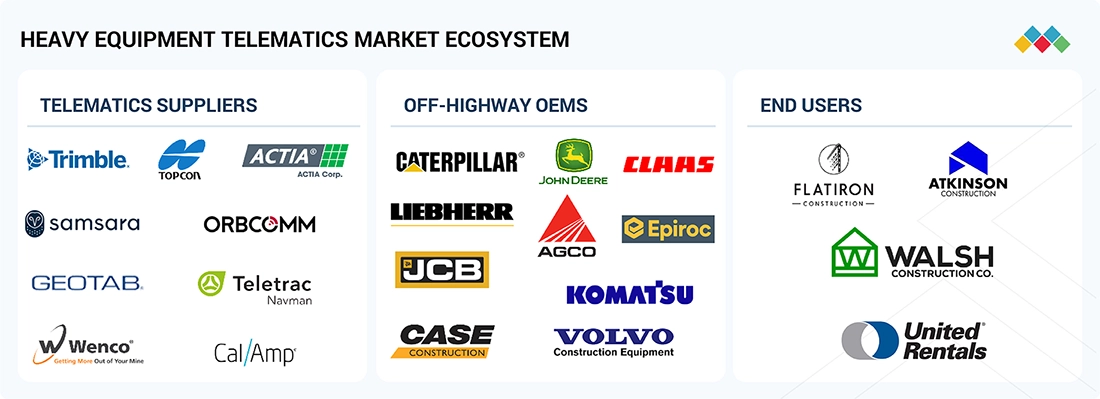
construction and heavy equipment telematics market: COMMERCIAL USE CASES ACROSS INDUSTRIES
| COMPANY | USE CASE DESCRIPTION | BENEFITS |
|---|---|---|
 |
Kuchera Mining deployed ORBCOMM dual-mode IoT terminals within the teamUP platform for real-time monitoring of equipment metrics (fuel, load, distance, inclination) | Reduced idling (~30%), fuel savings (~400 liters per truck per shift), increased uptime (from 8.5 to 10 hours) |
 |
Terex integrated ORBCOMM telematics to track equipment health, utilization, and location across fleets | Improved service scheduling, reduced downtime, increased customer satisfaction and aftersales revenue |
 |
CNH Industrial used telematics to cut down non-productive idling and optimize fleet efficiency | Reduced idling by 20%, saving 6,000 gallons of diesel weekly, lowering CO2 emissions, and saving USD 25,000/week |
Logos and trademarks shown above are the property of their respective owners. Their use here is for informational and illustrative purposes only.
Related Ecosystem
Key Takeaways
- Canada's heavy equipment telematics market is valued at USD 26,827 million in 2025 and is forecast to reach USD 47,422 million by 2030, representing an 8.5% CAGR.
- Canada's regulatory framework and digital infrastructure create favorable conditions for telematics adoption across construction, mining, and transportation industries.
- Predictive maintenance and real-time fleet monitoring are key drivers of growth in Canada's heavy equipment telematics sector.
- Canada's commitment to sustainability and emissions reduction is accelerating investment in telematics solutions that track and optimize equipment performance.
Heavy Equipment Telematics Market Report Scope
| Report Metric | Details |
|---|---|
| Base Year | 2025 |
| Fastest Growing Segment | EQUIPMENT/FLEET MAINTENANCE & DIAGNOSTICS (Service) |
| Forecast Period | 2025–2030 |
| Growth Rate | CAGR of 13.4% from 2025 to 2030 |
| Largest Segment | EXISTING FLEET (Sales Channel) |
| Market Size Base Year (Billions) | ~USD 1.33 (2025) |
| Revenue Forecast (Billions) | ~USD 2.5 (2030) |
| Segments Covered | Service, Connectivity, Sales Channel, Form Factor, Hardware, Industry |
Canada Heavy Equipment Telematics Market Report Segmentation
6 segment dimensions are covered across the global market.
By Service
- Equipment/Fleet Maintenance & Diagnostics
- Fleet Performance Reporting
- Fleet Safety
- Fuel Management
- Navigation & Asset Tracking
By Connectivity
- Cellular
- Satellite
By Sales Channel
- Existing Fleet
- New Sales
By Form Factor
- Embedded
- Integrated
By Hardware
- Gps Receiver
- Sensors
- Telematics Control Unit
By Industry
- Agriculture
- Construction
- Mining
Target Audience
- Equipment Manufacturers & OEMs : Canadian and international heavy equipment manufacturers need market-specific data to develop telematics-integrated products, understand local adoption rates, and identify partnership opportunities with fleet operators and service providers.
- Fleet Operators & Logistics Companies : Transportation and construction fleet operators require insights into telematics ROI, competitive solution offerings, and regulatory compliance drivers specific to Canada to optimize asset utilization and operational efficiency.
- Telematics Solution Providers : Software and IoT platform vendors targeting Canada need market sizing, sector-specific demand drivers, and competitive positioning data to refine product offerings, pricing strategies, and customer acquisition approaches.
- Investment & Private Equity Firms : Investors evaluating opportunities in Canada's automotive and transportation tech sectors require detailed market forecasts, growth trajectory analysis, and sector dynamics to assess portfolio companies and identify acquisition targets.
- Government & Policy Makers : Canadian federal and provincial agencies developing digital infrastructure and emissions compliance policies need market intelligence on telematics adoption to inform regulatory frameworks and support industrial modernization initiatives.
Key Companies in the Canada Heavy Equipment Telematics Market
| Company | HQ | Ownership | Strongest segments |
|---|---|---|---|
| CLAAS KGAA MBH | Germany | Private Company | Asset Navigation & Tracking,Fleet Performance,Diagnostics, |
| EPIROC | Sweden | Public Company | Asset Navigation & Tracking,Fleet Performance,Diagnostics, |
| VISTEON CORPORATION | United States | Public Company | Asset Navigation & Tracking,Fleet Performance,Diagnostics, |
| MIX TELEMATICS | South Africa | Private Company | Asset Navigation & Tracking,Fleet Performance,Diagnostics & Maintenance, |
CLAAS KGAA MBH
CLAAS KGAA MBH is a private German agricultural machinery manufacturer founded in 1913, employing 11,654 people.
EPIROC
EPIROC is a Swedish public company established in 1873 with 19,398 employees, operating in the industrial equipment sector.
VISTEON CORPORATION
VISTEON CORPORATION is a publicly traded American company founded in 2000 with 10,500 employees.
MIX TELEMATICS
MIX TELEMATICS is a private South African company founded in 1995 with 1,077 employees.
Reasons to Buy this Report
- Market-Specific Sizing & Forecasts : Access precise valuation data for Canada's telematics market (USD 26.8B in 2025, USD 47.4B by 2030) with country-specific CAGR analysis to inform investment decisions and competitive positioning strategies.
- Sector-Level Insights : Understand adoption patterns and growth drivers specific to Canada's construction, mining, and transportation industries, enabling targeted go-to-market strategies and partnership development in high-opportunity segments.
- Regulatory & Compliance Context : Gain insights into Canada's regulatory environment and infrastructure advantages that support telematics deployment, helping stakeholders navigate compliance requirements and capitalize on government-backed digital initiatives.
- Competitive Landscape Analysis : Benchmark against regional market dynamics and identify growth gaps between Canada's 8.5% CAGR and global 13.4% rates, revealing untapped opportunities and emerging competitive threats in the Canadian market.
- Strategic Planning & Risk Mitigation : Develop data-driven expansion strategies with country-specific market intelligence, reducing investment risk and enabling informed decisions on resource allocation, partnerships, and product localization for the Canadian market.
Frequently asked questions
What is the current size of Canada's heavy equipment telematics market?
Canada's heavy equipment telematics market is valued at USD 26,827 million in 2025 and is expected to grow to USD 47,422 million by 2030.
What is the growth rate of Canada's heavy equipment telematics market?
Canada's heavy equipment telematics market is growing at a compound annual growth rate (CAGR) of 8.5% from 2025 to 2030.
Which industries in Canada are driving telematics adoption?
Construction, mining, and transportation sectors in Canada are the primary drivers of heavy equipment telematics adoption, seeking improved efficiency and safety.
What are the main benefits of telematics for Canadian equipment operators?
Canadian equipment operators benefit from real-time monitoring, predictive maintenance, reduced downtime, improved fuel efficiency, and enhanced safety through telematics solutions.
How is Canada's regulatory environment supporting telematics growth?
Canada's mature regulatory framework and digital infrastructure support telematics deployment, while sustainability initiatives encourage adoption of emissions-tracking technologies.
RESEARCH METHODOLOGY
The study encompassed four primary tasks to determine the present and future scope of the heavy equipment telematics market. Initially, extensive secondary research was conducted to gather data on the market, its related sectors, and overarching industries. Subsequently, primary research involving industry experts across the supply chain corroborated and validated these findings and assumptions. The complete market size was estimated by using the bottom-up and top-down methodologies. Following this, a market breakdown and data triangulation approach were utilized to determine the size of specific segments and subsegments within the market.
Secondary Research
Secondary sources for this research study included annual reports & investor presentations of key off-highway OEMs, press releases, news articles, industry associations and trade bodies, and financial reports of telematics providers. Secondary data were collected and analyzed to determine the total market size, which was further validated through primary research.
Primary Research
Extensive primary research was conducted following an understanding of the heavy equipment telematics market scenario through secondary research. Several primary interviews were conducted with market experts from both the demand (OEMs/operators) and supply (service providers) sides across major regions, namely Asia Pacific, Europe, and the Americas. Approximately 60% and 40% of primary interviews were conducted with the OEMs and telematics providers, respectively. Primary data was collected through questionnaires, emails, and telephonic interviews. During the canvassing of primaries, various departments within organizations, including sales, operations, and marketing, were covered to provide a holistic perspective in the report.
After interacting with industry experts, brief sessions were conducted with highly experienced independent consultants to reinforce the findings from the primaries. This, along with the opinions of in-house subject matter experts, led to the findings described in the remainder of this report.
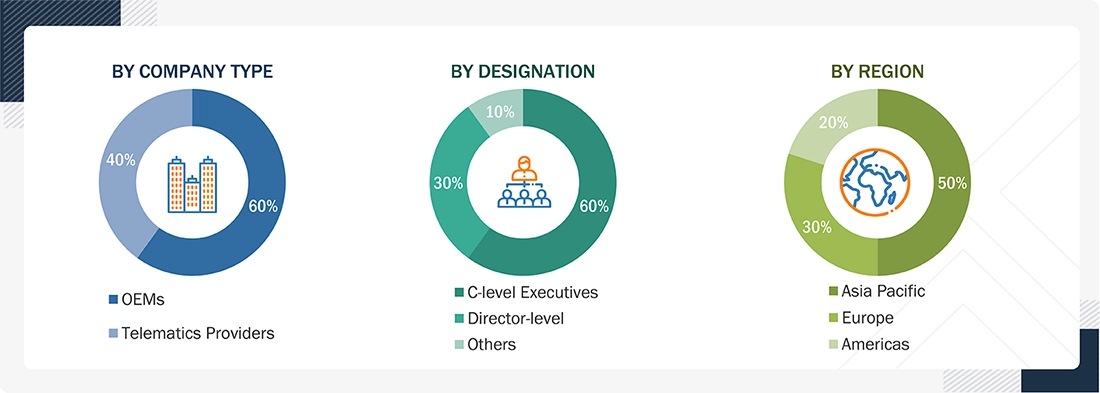
Note: Company tiers are based on the supply chain; company revenue is not considered. OEMs include major
off-highway OEMs serving the construction, agriculture, and mining industries, and Telematics Providers comprise key suppliers of telematics services.
*Others include sales, marketing, and product managers.
To know about the assumptions considered for the study, download the pdf brochure
Market Size Estimation
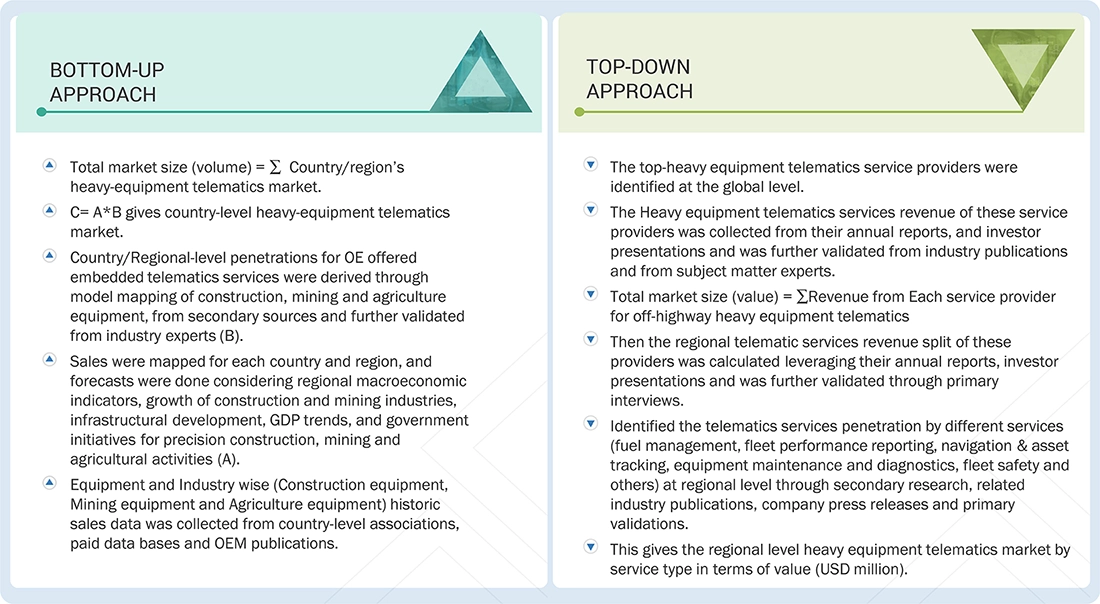
A detailed market estimation approach was followed to estimate and validate the value of the heavy equipment telematics market and other dependent submarkets. The bottom-up and top-down approaches were used to estimate and validate the size of the heavy equipment telematics market.
Market Size Estimation Methodology- Top-down approach
Global heavy equipment telematics service providers were identified, and their revenue data was sourced from annual reports, investor presentations, industry publications, and expert interviews. Based on this, the total market size was calculated by combining off-highway heavy equipment telematics revenue from each service provider.
Regional revenue splits were determined using company financials and validated through primary research, which gave the regional telematics market. Further telematics penetration by service type (e.g., fuel management, fleet performance, navigation, diagnostics) was mapped at the country/regional level using both secondary and primary sources. This provides the country/region level market size for heavy equipment telematics by service type in USD million.
Market Size Estimation Methodology-Bottom-up approach
The bottom-up approach is used to analyze the heavy equipment telematics market by industry & form factor segments. Country-wise historical sales data by equipment types within construction, mining, and agriculture was sourced from country/regional level associations, paid databases, OEM publications, and other secondary sources. These sales were forecasted based on macroeconomic indicators, industry growth, GDP trends, and government initiatives per region. Furthermore, the penetration rates for embedded & integrated telematics services were derived and validated through a mapping of construction, mining, and agricultural equipment markets. Multiplication of country-level equipment sales with embedded & integrated adoption rate would give the country-level heavy equipment telematics market, by industry & form factor, in terms of volume. The summation of this derived country-level market gave the regional and global demand for telematics by industry and by form factor.
Heavy Equipment Telematics Market : Top-Down and Bottom-Up Approach
Data Triangulation
After determining the overall size of the equipment that complies with telematics through the aforementioned methodology, the market was divided into several segments and subsegments. Data triangulation is a research technique used to increase the validity and reliability of findings by cross-validating data from multiple sources or methods. This technique involves the use of multiple data sources, such as surveys, interviews, observations, and secondary data, to confirm and corroborate the findings obtained from each source. The extrapolated market data was triangulated by studying various macro indicators and regional trends from both the supply and demand sides.
Market Definition
Telematics services in heavy off-highway equipment refer to the use of GPS, sensors, wireless networks, and onboard computing systems to collect, transmit, and analyze real-time data from heavy machinery. These services enable operators and fleet managers to monitor machine location, fuel use, engine health, safety conditions, and productivity, while also supporting predictive maintenance and compliance. By combining telecommunications with data analytics, telematics provides actionable insights that help optimize fleet performance, reduce downtime, improve safety, and maximize the return on high-value equipment investments.
Stakeholders
- Off-Highway Equipment Telematics Software Suppliers
- Companies Operating in the Telematics Ecosystem
- Off-Highway Equipment Manufacturers
- Off-highway Equipment Telematic service providers
- Hardware providers
- Fleet operators & rental companies
- Internet service providers
- Associations, Forums, and Alliances Related to Off-Highway Equipment
- Off-Highway Industry Investors
- Government Agencies and Policy Makers
Report Objectives
-
To segment and forecast the heavy equipment telematics market size in terms of volume & value:
- By Industry (Construction Equipment, Mining Equipment, Agriculture Equipment)
- By hardware (telematics control units, GPS receivers, and sensors)
- By form factor (embedded and integrated)
- By connectivity (satellite and cellular)
- By equipment category (new sales and existing fleet)
- By service (fuel management, fleet performance reporting, navigation & asset tracking, equipment maintenance and diagnostics, fleet safety, and others)
- By region (Americas, Europe, and Asia Pacific)
- To provide detailed information about the major factors influencing market growth (drivers, challenges, restraints, and opportunities).
- To track and analyze competitive developments, including product launches, mergers and acquisitions, and other key activities by industry participants.
- To strategically analyze the market with supply chain analysis, revenue analysis, and regulatory analysis in the heavy equipment telematics market.
- To examine the opportunities in the market for stakeholders and provide details of the competitive landscape for market leaders.
Available Customizations
With the given market data, MarketsandMarkets offers customizations according to the specific requirements of companies. The following customization options are available for the report:
Heavy equipment telematics market, by service at the country level (for countries covered in the report)
- Fuel management
- Fleet performance reporting
- Navigation & asset tracking
- Equipment maintenance and diagnostics
- Fleet safety
- Others
Company Information
- Profiles of additional market players (up to five)
Get the Full Heavy Equipment Telematics Market Report
Full forecast, segment splits, and company analysis for all Heavy Equipment Telematics Market.
- China Heavy Equipment Telematics Market
- India Heavy Equipment Telematics Market
- Japan Heavy Equipment Telematics Market
- Indonesia Heavy Equipment Telematics Market
- France Heavy Equipment Telematics Market
- Germany Heavy Equipment Telematics Market
- UK Heavy Equipment Telematics Market
- Italy Heavy Equipment Telematics Market
- Spain Heavy Equipment Telematics Market
- Mexico Heavy Equipment Telematics Market
- Brazil Heavy Equipment Telematics Market
- US Heavy Equipment Telematics Market
Need a Tailored Report?
Customize this report to your needs
Get 10% FREE Customization
Customize This Report
