
Japan Containerized Battery Energy Storage System (BESS) Market (2025-2030)

The Japan Containerized Battery Energy Storage System (BESS) Market was valued at $712.1 Million in 2025 and projected to reach to $1839.5 Million by 2030, representing a compound annual growth rate of 20.9%. Japan's containerized battery energy storage system market is positioned for substantial expansion through 2030, driven by the nation's aggressive renewable energy targets and grid modernization initiatives.


| Market Size in | USD 26.32 MN |
| Market Forecast in | |
| CAGR | |
| Forecast Period | |
| Units Considered | Value (USD MN) |
Japan Containerized Battery Energy Storage System (BESS) Market Trends and Insights
- Japan is leveraging containerized BESS solutions to support its renewable energy transition and grid stability objectives.
- The market in Japan is driven by increasing renewable energy adoption, aging power infrastructure modernization, and government incentives promoting energy storage deployment across the nation. Japan's containerized BESS market benefits from the country's advanced manufacturing capabilities and technological expertise in battery systems.
- Japan is investing heavily in energy storage infrastructure to reduce reliance on fossil fuels and enhance grid resilience following past energy crises.
- The forecast period through 2030 reflects Japan's commitment to achieving carbon neutrality and integrating distributed energy resources into its power ecosystem. Japan's containerized BESS sector is characterized by strong participation from domestic and international players, with applications spanning utility-scale storage, industrial facilities, and microgrid deployments.
- Japan's regulatory environment and renewable energy targets continue to create favorable conditions for containerized BESS market expansion through 2030..
Key Market Statistics
- CAGR (2025-2030) 20.9% CAGR
- Market Size, 2025 ~USD 712.1 Million
- Forecast, 2030 ~USD 1839.5 Million
- Country Japan
Japan Containerized Battery Energy Storage System (BESS) Market Overview
Market Valuation Growth :
Japan's containerized BESS market is valued at USD 712.1 million in 2025, with a projected CAGR of 20.9%, reaching USD 1,839.5 million by 2030, reflecting strong investment in energy storage infrastructure.
Renewable Energy Integration :
Japan is accelerating containerized BESS adoption to support its renewable energy transition, particularly for solar and wind integration, addressing intermittency challenges and grid stability requirements.
Grid Modernization Imperative :
Aging power infrastructure across Japan necessitates modernization through containerized battery solutions, enabling distributed energy resources and enhanced grid resilience in preparation for future energy demands.
Strategic Energy Independence :
Japan's commitment to reducing fossil fuel dependency and achieving carbon neutrality by 2050 drives containerized BESS deployment as a critical component of its decentralized energy storage strategy.
Japan Containerized Battery Energy Storage System (BESS) Market Dynamics
- The market benefits from government incentives, technological advancements in battery efficiency, and increasing corporate investments in sustainable energy infrastructure.
- Japan's unique geographic and demographic challenges create strong demand for flexible, scalable storage solutions that containerized systems provide. The forecast period will witness accelerated adoption across utility-scale, industrial, and commercial segments as Japan transitions toward a decarbonized energy ecosystem.
- Strategic partnerships between energy providers, technology manufacturers, and government agencies will further catalyze market growth.
- Containerized BESS solutions will play a pivotal role in Japan's energy security strategy, supporting grid stability while enabling higher renewable energy penetration rates..
Market Ecosystem
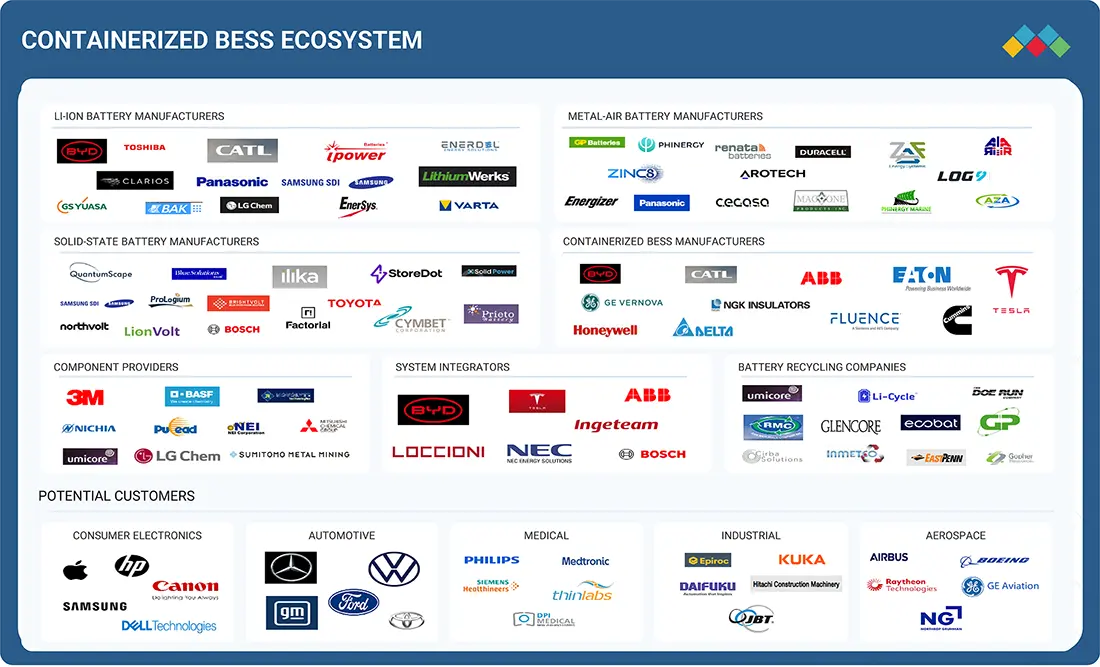
Containerized Battery Energy Storage System (BESS) Market: COMMERCIAL USE CASES ACROSS INDUSTRIES
| COMPANY | USE CASE DESCRIPTION | BENEFITS |
|---|---|---|
 |
Megapack containerized BESS for utility-scale renewable integration and grid balancing | High-capacity energy storage | Fast deployment | Modular scalability | Grid stability |
 |
Blade battery-based containerized BESS for commercial and industrial energy management | Enhanced safety | Long lifecycle | Space optimization | Reliable power supply |
 |
Lithium-ion and sodium-ion containerized BESS for large-scale energy storage and microgrid solutions | High energy density | Cost-efficient | Adaptable to wide temperature ranges | Faster charging |
 |
Integrated containerized BESS with smart monitoring for commercial buildings and industrial sites | Improved energy efficiency | Predictive maintenance | Operational cost savings |
 |
Modular containerized BESS for commercial, industrial, and utility backup applications | Reliable power supply | Grid support | Easy scalability | Reduced operational downtime |
Logos and trademarks shown above are the property of their respective owners. Their use here is for informational and illustrative purposes only.
Related Ecosystem
Battery And Wireless Charging
- Nickel-Cadmium Battery
- Battery Electric Vehicle (BEV)
- Energy Harvesting
- Hybrid Electric Vehicle (HEV)
- Smart Cards
- Panasonic Holdings Corporation
- MOMENTIVE PERFORMANCE MATERIALS INC.
- Lg corp
- FDK Corporation
- Samsung
Key Takeaways
- Japan's containerized BESS market is valued at USD 712.1 million in 2025 and will reach USD 1,839.5 million by 2030, representing a 20.9% CAGR.
- Japan is prioritizing energy storage infrastructure to support renewable energy integration and achieve carbon neutrality targets.
- Japan's advanced manufacturing base and technological expertise position the country as a key hub for containerized BESS innovation and deployment.
- Japan's regulatory framework and government incentives are accelerating containerized BESS adoption across utility, industrial, and distributed energy applications.
Containerized Battery Energy Storage System (BESS) Market Report Scope
| Report Metric | Details |
|---|---|
| Base Year | 2025 |
| Fastest Growing Segment | INSTALLED CAPACITY (Installed Capacity) |
| Forecast Period | 2025-2030 |
| Growth Rate | CAGR of 20.9% from 2025 to 2030 |
| Largest Segment | LITHIUM-ION BATTERIES (Battery Type) |
| Market Size Base Year (Billions) | ~USD 13.87 (2025) |
| Revenue Forecast (Billions) | ~USD 35.82 (2030) |
| Segments Covered | Battery Type, Installed Capacity, Capacity, Application, Container Size, Capacity Size, Energy Capacity |
Japan Containerized Battery Energy Storage System (BESS) Market Report Segmentation
7 segment dimensions are covered across the global market.
By Battery Type
- Advanced Lead Acid Batteries
- Advanced Lead-Acid Batteries
- Lithium-Ion Batteries
- Other Batteries
By Installed Capacity
- Installed Capacity
By Capacity
- Above 5,000 Kwh
- Below 1,000 Kwh
- Between 1,000 And 5,000 Kwh
By Application
- Commercial
- Commercial & Industrial
- Residential
- Utilities
By Container Size
- 10 Feet
- 20 Feet
- 40 Feet
By Capacity Size
- Above 5,000 Kwh
- Below 1,000 Kwh
- Between 1,000 And 5,000 Kwh
By Energy Capacity
- Above 5,000 Kwh
- Below 1,000 Kwh
- Between 1,000 And 5,000 Kwh
JAPAN: CONTAINERIZED BESS, BY APPLICATION, 2025–2030
| Segment | 2025 | 2026 | 2027 | 2028 | 2029 | 2030 | CAGR (%) |
|---|---|---|---|---|---|---|---|
| COMMERCIAL & INDUSTRIAL | 184.8 | 257.5 | 333.1 | 406.3 | 473.4 | 532.6 | 23.6 |
| RESIDENTIAL | 35.6 | 46.1 | 55.5 | 63.1 | 68.6 | 72 | 15.1 |
| UTILITIES | 491.7 | 665.2 | 836.3 | 992.4 | 1126.2 | 1234.8 | 20.2 |
| TOTAL | 712.1 | 968.9 | 1224.9 | 1461.8 | 1668.2 | 1839.5 | 20.9 |
Target Audience
- Energy Utility Companies : Japanese utilities require market intelligence to optimize grid infrastructure investments, plan renewable energy integration strategies, and evaluate containerized BESS deployment for enhanced grid stability and reliability.
- Battery & Energy Storage Manufacturers : Manufacturers need Japan-specific market data to assess market potential, identify growth segments, benchmark competitive positioning, and develop localized product strategies for the Japanese market.
- Investment & Private Equity Firms : Investors seeking Japan exposure require detailed market forecasts, valuation metrics, and growth drivers to evaluate investment opportunities in containerized BESS companies and energy storage infrastructure projects.
- Government & Policy Makers : Japanese government agencies and policymakers need market insights to inform renewable energy policies, infrastructure planning, and incentive programs supporting containerized BESS adoption and energy transition goals.
- Industrial & Commercial Enterprises : Large Japanese corporations evaluating energy resilience and sustainability strategies require market data on containerized BESS solutions, cost-benefit analysis, and deployment trends for informed procurement decisions.
Reasons to Buy this Report
- Japan-Specific Market Sizing : Access precise valuation data for Japan's containerized BESS market with verified 2025 baseline (USD 712.1M) and 2030 forecast (USD 1,839.5M), enabling accurate business planning and investment decisions.
- Regulatory & Policy Insights : Understand Japan's unique regulatory environment, government incentives, and carbon neutrality targets that directly influence containerized BESS adoption rates and market dynamics specific to the Japanese market.
- Competitive Landscape Analysis : Identify key players, market share distribution, and competitive strategies within Japan's containerized BESS sector to inform partnership, acquisition, and market entry strategies.
- Segment & Application Breakdown : Gain detailed insights into Japan-specific market segments including utility-scale, industrial, and commercial applications, with growth projections for each sector through 2030.
- Investment & Growth Opportunities : Discover high-potential investment opportunities in Japan's containerized BESS market, including emerging technologies, regional expansion areas, and strategic partnership possibilities aligned with Japan's energy transition goals.
Frequently asked questions
What is the current market size of containerized BESS in Japan?
Japan's containerized BESS market is valued at USD 712.1 million in 2025 and is projected to grow to USD 1,839.5 million by 2030.
What is the expected growth rate for Japan's containerized BESS market?
Japan's containerized BESS market is expected to grow at a compound annual growth rate (CAGR) of 20.9% from 2025 to 2030.
What are the primary drivers of containerized BESS adoption in Japan?
Japan's containerized BESS adoption is driven by renewable energy integration needs, grid modernization requirements, carbon neutrality commitments, and government incentive programs supporting energy storage deployment.
Which applications dominate Japan's containerized BESS market?
Japan's containerized BESS market spans utility-scale storage facilities, industrial energy management systems, and distributed microgrid applications supporting renewable energy integration.
How does Japan's containerized BESS market compare regionally?
Japan represents a significant portion of the Asia Pacific containerized BESS market, driven by the country's technological capabilities, regulatory support, and energy transition priorities.
RESEARCH METHODOLOGY
The study involved major activities in estimating the current market size for the Containerized Battery Energy Storage System (BESS) Market. Exhaustive secondary research was done to collect information on the building information modeling industry. The next step was to validate these findings, assumptions, and sizing with industry experts across the value chain using primary research. Different approaches, such as top-down and bottom-up, were employed to estimate the total market size. After that, the market breakdown and data triangulation procedures were used to estimate the market size of the segments and subsegments of the Containerized Battery Energy Storage System (BESS) Market.
Secondary Research
The secondary research for this study involved gathering information from a wide range of credible sources. These included company annual reports, investor presentations, press releases, whitepapers, certified publications, and articles from reputable associations and government publications. Additional data was obtained from corporate filings, professional and trade associations, journals, and industry-recognized authors. Research from consortia, councils, and gold- and silver-standard websites, directories, and databases also contributed to the qualitative framework. Key global sources such as the International Trade Centre (ITC) and the International Monetary Fund (IMF) were consulted to support and validate the market analysis.
Primary Research
Extensive primary research was conducted after understanding and analyzing the Containerized Battery Energy Storage System (BESS) Market scenario through secondary research. Several primary interviews were conducted with key opinion leaders from demand- and supply-side vendors across four major regions—North America, Europe, Asia Pacific, and RoW. Approximately 20% of the primary interviews were conducted with the demand side and 80% with the supply side. Primary data was collected through questionnaires, e-mails, and telephonic interviews. Various departments within organizations, such as sales, operations, and administration, were contacted to provide a holistic viewpoint in the report.
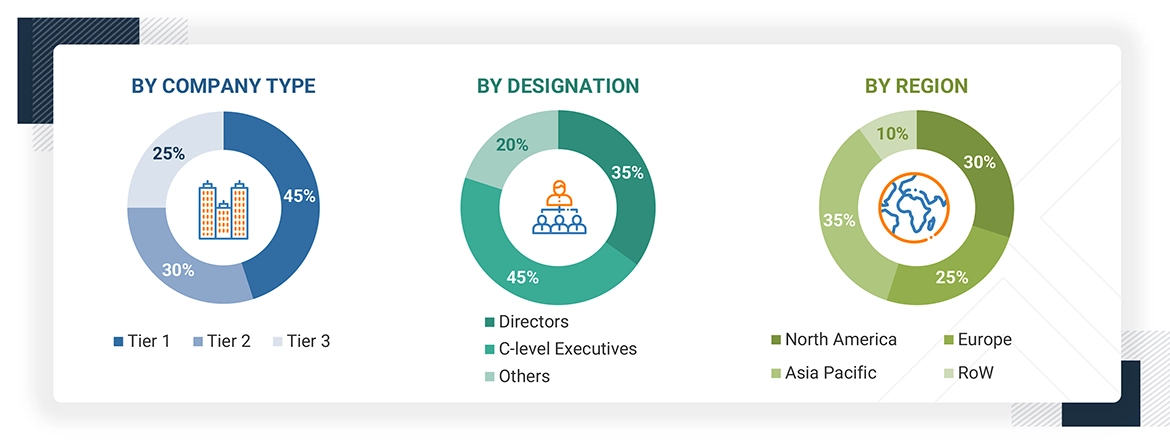
Note: Three tiers of companies are defined based on their total revenue as of 2024: tier 1 = revenue more than USD 5 billion; tier 2 = revenue between USD 500 million and USD 5 billion; and tier 3 = revenue less than USD 500 million. Other designations include sales managers, marketing managers, and product managers.
To know about the assumptions considered for the study, download the pdf brochure
Market Size Estimation
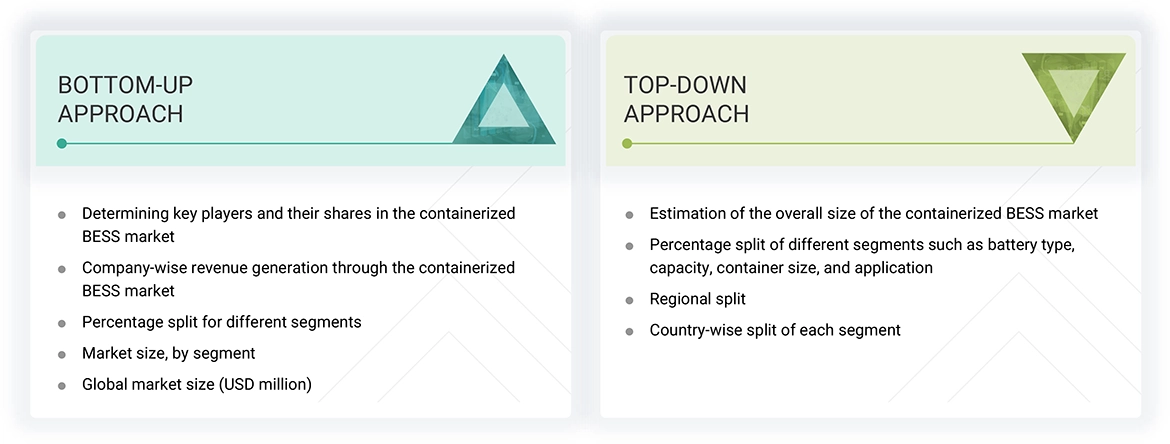
Both top-down and bottom-up approaches have been used to estimate and validate the total size of the containerized BESS market. These methods have also been used extensively to estimate the size of various subsegments in the market. The following research methodology has been used to estimate the market size:
- Major players in the industry and markets have been identified through extensive secondary research.
- The industry’s value chain and market size (in terms of value) have been determined through primary and secondary research processes.
- All percentage shares, splits, and breakdowns have been determined using secondary sources and verified through primary sources.
Containerized Battery Energy Storage System (BESS) Market : Top-Down and Bottom-Up Approach
Data Triangulation
After arriving at the overall size of the containerized BESS market from the market size estimation process explained above, the total market has been split into several segments and subsegments. Data triangulation and market breakdown procedures have been employed, wherever applicable, to complete the overall market engineering process and arrive at the exact statistics for all segments and subsegments of the market. The data has been triangulated by studying various factors and trends from both the demand and supply sides. Along with this, the market size has been validated using both top-down and bottom-up approaches.
Market Definition
A containerized battery energy storage system (BESS) is a plug-and-play, pre-assembled energy storage solution housed within standard 10-ft, 20-ft, or 40-ft containers. It integrates batteries, inverters, thermal management, and safety systems into a modular and transportable unit. Designed for fast deployment and easy scalability, it minimizes on-site work and supports various grid and off-grid applications. Its standardized design ensures efficient logistics, making it ideal for utility, commercial, and industrial use. These systems enable flexible, space-efficient energy storage with reduced installation time and costs..
Key Stakeholders
- BESS manufacturers and integrators
- Lithium-ion battery manufacturers
- Government bodies and policymakers
- Standards organizations, forums, alliances, and associations
- Market research and consulting firms
- Raw material suppliers and distributors
- Research institutes and organizations
- Material and technology providers
- Battery cell and battery pack manufacturers
- Consumer electronics manufacturers
- Testing, inspection, and certification providers
- Distributors and resellers
Report Objectives
- To define, describe, and forecast the containerized BESS market in terms of battery type, capacity, container size, application, and region
- To describe and forecast the market, in terms of value, with regard to four main regions: North America, Europe, Asia Pacific, and Rest of the World (RoW), along with their respective countries
- To provide detailed information regarding major factors influencing the market growth (drivers, restraints, opportunities, and challenges)
- To provide a detailed overview of the value chain of the containerized BESS market.
- To strategically analyze micromarkets with respect to individual growth trends, prospects, and contributions to the containerized BESS market
- To analyze opportunities in the market for stakeholders by identifying high-growth segments of the containerized BESS market
- To strategically profile key players and comprehensively analyze their market position in terms of ranking and core competencies, along with detailing the competitive landscape for market leaders
- To analyze competitive strategies, such as product launches, expansions, and mergers & acquisitions, adopted by key market players in the containerized BESS market
Available customizations:
With the given market data, MarketsandMarkets offers customizations according to the company’s specific needs. The following customization options are available for the report:
Company Information
- Detailed analysis and profiling of additional market players (up to five)
Get the Full Containerized Battery Energy Storage System (BESS) Market Report
Full forecast, segment splits, and company analysis for all Containerized Battery Energy Storage System (BESS) Market.
- Mexico Containerized Battery Energy Storage System (BESS) Market
- Germany Containerized Battery Energy Storage System (BESS) Market
- UK Containerized Battery Energy Storage System (BESS) Market
- France Containerized Battery Energy Storage System (BESS) Market
- Italy Containerized Battery Energy Storage System (BESS) Market
- China Containerized Battery Energy Storage System (BESS) Market
- South Korea Containerized Battery Energy Storage System (BESS) Market
- India Containerized Battery Energy Storage System (BESS) Market
- Rest Of Europe Containerized Battery Energy Storage System (BESS) Market
- Rest Of Asia Pacific Containerized Battery Energy Storage System (BESS) Market
- Africa Containerized Battery Energy Storage System (BESS) Market
- Middle East Containerized Battery Energy Storage System (BESS) Market
- South America Containerized Battery Energy Storage System (BESS) Market
- GCC Countries Containerized Battery Energy Storage System (BESS) Market
- Rest Of Middle East Containerized Battery Energy Storage System (BESS) Market
- Rest Of Africa Containerized Battery Energy Storage System (BESS) Market
- South Africa Containerized Battery Energy Storage System (BESS) Market
- Argentina Containerized Battery Energy Storage System (BESS) Market
- US Containerized Battery Energy Storage System (BESS) Market
- Canada Containerized Battery Energy Storage System (BESS) Market
- Brazil Containerized Battery Energy Storage System (BESS) Market
- Rest Of South America Containerized Battery Energy Storage System (BESS) Market
Need a Tailored Report?
Customize this report to your needs
Get 10% FREE Customization
Customize This Report
