
France Content Detection Market (2024-2029)

The France Content Detection Market was valued at $724.3 Million in 2024 and projected to reach to $1312.9 Million by 2029, representing a compound annual growth rate of 12.6%. France's content detection market is poised for sustained growth through 2029, driven by increasing regulatory pressures and digital transformation across industries.


| Market Size in | USD 26.32 MN |
| Market Forecast in | |
| CAGR | |
| Forecast Period | |
| Units Considered | Value (USD MN) |
France Content Detection Market Trends and Insights
- This 12.6% compound annual growth rate reflects France's increasing investment in digital content moderation, cybersecurity, and compliance technologies across both public and private sectors.
- France's regulatory environment, particularly GDPR enforcement and digital service regulations, is driving demand for advanced content detection solutions among enterprises and service providers. The French market benefits from a strong technology ecosystem and heightened awareness of content-related risks including misinformation, illegal content, and data protection violations.
- France's position as a digital innovation hub in Europe supports the adoption of AI-powered detection systems across media, telecommunications, and financial services industries.
- Between 2024 and 2029, France is expected to see accelerated deployment of content detection technologies as organizations prioritize compliance and risk management in an increasingly regulated digital landscape..
Key Market Statistics
- CAGR (2024-2029) 12.6% CAGR
- Market Size, 2024 ~USD 724.3 Million
- Forecast, 2029 ~USD 1312.9 Million
- Country France
France Content Detection Market Overview
Strong Market Valuation :
France's content detection market reached $724.3 million in 2024, demonstrating significant investment in digital content moderation and cybersecurity infrastructure across French enterprises and government institutions.
Robust Growth Trajectory :
With a CAGR of 12.6% through 2029, France's market is expanding faster than many European counterparts, driven by increasing regulatory compliance requirements and digital transformation initiatives.
Regulatory Compliance Drivers :
France's stringent regulatory environment, including GDPR enforcement and local data protection laws, is accelerating adoption of advanced content detection solutions across public and private sectors.
Projected Market Expansion :
The market is forecasted to reach $1,312.9 million by 2029, representing an 81% increase from 2024, reflecting growing demand for AI-powered content moderation and compliance technologies in France.
France Content Detection Market Dynamics
- The country's commitment to data protection and cybersecurity, coupled with mandatory compliance frameworks, is compelling organizations to invest in sophisticated content detection solutions.
- French enterprises are prioritizing AI-driven moderation tools to manage digital risks and ensure regulatory adherence. The market expansion will be supported by growing adoption among financial services, media, telecommunications, and government sectors.
- France's position as a digital innovation hub in Europe, combined with heightened awareness of content-related risks, positions the market for continued momentum.
- Investment in local technology infrastructure and partnerships with European tech providers will further accelerate market penetration and solution sophistication..
Market Ecosystem
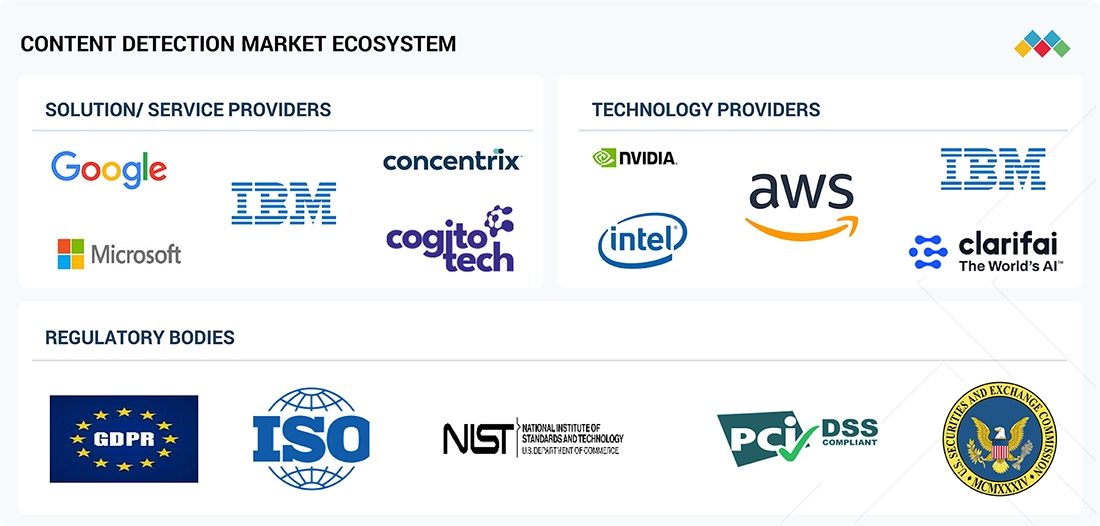
CONTENT DETECTION MARKET: COMMERCIAL USE CASES ACROSS INDUSTRIES
| COMPANY | USE CASE DESCRIPTION | BENEFITS |
|---|---|---|
 |
Enterprise multimodal moderation and generative-AI safety APIs for platforms and apps. | Automated filtering, policy controls, human-review workflows, unified scalable content safety. |
 |
Toxicity scoring and multimodal safety filters for comments, chat and generated content. | Configurable thresholds, integrated pipelines, automation, analytics, robust moderation at scale. |
 |
Image and video moderation with custom labels and human-review workflows. | Scalable multimedia moderation, reduced manual review, customizable taxonomies, faster decisions. |
 |
API-first multimodal moderation for social platforms, marketplaces and streaming at scale. | Single API, rapid model updates, enterprise-scale moderation and risk detection. |
 |
Visual and multimodal moderation with custom models for marketplaces and UGC. | Customizable models, OCR and NLP pipelines, fast deployment for brand safety. |
Logos and trademarks shown above are the property of their respective owners. Their use here is for informational and illustrative purposes only.
Related Ecosystem
Analytics
- Natural Language Processing (NLP)
- Machine Learning
- Supply Chain Management
- Predictive Analytics
- Image Sensors
- International Business Machines Corporation
- MICROSOFT CORPORATION
- Oracle Corporation
- SAP SE
Cloud Computing
- Software as A Service (SaaS)
- Natural Language Processing (NLP)
- Platform as A Service (PaaS)
- Machine Learning
- Supply Chain Management
- International Business Machines Corporation
- MICROSOFT CORPORATION
- Oracle Corporation
- Amazon.com, Inc.
Cyber Security
- Cloud Security
- Biometric Systems
- Data Loss Prevention (DLP)
- Multi-Factor Authentication
- Security Analytics
- REDINGTON
- International Business Machines Corporation
- Cisco Systems, Inc.
- MITSUI BUSSAN SECURE DIRECTIONS INC
- MICROSOFT CORPORATION
Key Takeaways
- France's content detection market is valued at $724.3 million in 2024 and will reach $1,312.9 million by 2029, representing a 12.6% CAGR.
- France's stringent regulatory framework, including GDPR and digital service laws, is a primary driver of content detection technology adoption.
- France's strong technology sector and digital innovation ecosystem accelerate the deployment of AI-powered content detection solutions.
- Between 2024 and 2029, France will see increased investment in content detection across media, telecommunications, and financial services sectors.
Content Detection Market Report Scope
| Report Metric | Details |
|---|---|
| Base Year | 2024 |
| Fastest Growing Segment | INFLUENCER MARKETING (Product Type) |
| Forecast Period | 2024-2029 |
| Growth Rate | CAGR of 16.9% from 2024 to 2029 |
| Largest Segment | SOLUTIONS (Offering) |
| Market Size Base Year (Billions) | ~USD 14.39 (2024) |
| Revenue Forecast (Billions) | ~USD 31.42 (2029) |
| Segments Covered | Offering, Service, Professional Service, Detection Type, Content Type, Technology, End User, Application, Component, Content, Deployment Mode, Organization Size, Platform, Industry Vertical, Product Type, Use Case, Enterprise |
France Content Detection Market Report Segmentation
17 segment dimensions are covered across the global market.
By Offering
- Services
- Solutions
By Service
- Managed Services
- Professional Services
By Professional Service
- Consulting & Advisory
- Implementation & Integration
- Support & Maintenance
By Detection Type
- AI-Generated Content Detection
- Content Moderation
- Other Detection Types
- Plagiarism Detection
By Content Type
- Audio
- Image
- Text
- Video
By Technology
- Audio
- Audio & Video Fingerprinting
- Audio & Video Watermarking
- Image
- Optical Character Recognition
- Other Technologies
- Speech Recognition
- Text
- Video
By End User
- Enterprise
- Gaming Platforms
- Individual User
- Other End Users
- Retail & Ecommerce
- Social Media Platforms
- Streaming & Content Sharing Platforms
By Application
- Advertisement Targeting & Pricing
- Audience Segmentation & Measurement
- Broadcast Monitoring
- Content Filtering
- Gaming Platforms
- Other Applications
- Other End Users
- Retail & Ecommerce
- Social Media Platforms
- Streaming And Content Sharing Platforms
By Component
- Services
- Solution
By Content
- Audio
- Image
- Text
- Video
By Deployment Mode
- Cloud
- On-Premises
By Organization Size
- Large Enterprises
- Smes
By Platform
- Connected Tv
- Linear Tv
- Other Platforms
- Ott Applications
By Industry Vertical
- Automotive
- Avionics
- Consumer Electronics
- Education
- Government & Defense
- Healthcare & Life Sciences
- It & Telecommunication
- Media & Entertainment
- Other Verticals
- Retail & Ecommerce
By Product Type
- Audience Targeting & Engagement
- Content Creation & Optimization
- Content Strategy
- E-Commerce & Conversion Optimization
- Influencer Marketing
- Reporting & Analytics
- Social Media Management
By Use Case
- Customer Service
- Hr
- It & Security
- Marketing
- Sales
By Enterprise
- Advertising & Creative Marketing Agencies
- Banking & Financial Services
- Education
- Healthcare & Pharma
- Insurance
- News & Publishing Agencies
- Other Enterprises
- Pr Agencies
- Professional Services
- Retail & E-Commerce
- Sports & Gaming
- Technology & Software
- Telecommunications
- Travel & Hospitality
Target Audience
- French Technology Vendors : Content detection solution providers and cybersecurity firms operating in France need market-specific data to benchmark performance, identify growth opportunities, and refine product positioning for local customers.
- Enterprise Decision Makers : CIOs, compliance officers, and digital transformation leaders in French organizations require market insights to justify technology investments, evaluate vendor options, and align solutions with regulatory requirements.
- Investment and Private Equity Firms : Investors evaluating opportunities in French tech and cybersecurity sectors need detailed market analysis to assess growth potential, competitive dynamics, and valuation benchmarks for content detection companies.
- Consulting and Systems Integrators : French consulting firms and IT service providers need market intelligence to advise clients on content detection strategy, vendor selection, and implementation roadmaps aligned with local market trends.
- Government and Regulatory Bodies : French government agencies and regulatory authorities benefit from market data to understand technology adoption rates, compliance effectiveness, and emerging risks in the content detection landscape.
Reasons to Buy this Report
- France-Specific Market Intelligence : Gain detailed insights into France's unique regulatory landscape, compliance requirements, and market dynamics that differ from broader European trends, enabling targeted business strategy development.
- Competitive Positioning Data : Understand the competitive landscape specific to France, including local players, market share distribution, and emerging competitors to inform market entry or expansion strategies.
- Growth Opportunity Identification : Identify high-growth segments and vertical markets within France experiencing accelerated adoption of content detection solutions, enabling focused investment and resource allocation decisions.
- Regulatory Compliance Insights : Access comprehensive analysis of French regulatory drivers including GDPR implementation, local data protection laws, and compliance mandates shaping market demand and solution requirements.
- Investment and Expansion Planning : Leverage France-specific forecasts and market sizing data to support investment decisions, partnership development, and go-to-market strategies for the 2024-2029 period.
Frequently asked questions
What is the current size of France's content detection market?
France's content detection market is valued at $724.3 million in 2024 and is projected to grow to $1,312.9 million by 2029.
What is the growth rate of France's content detection market?
France's content detection market is growing at a compound annual growth rate (CAGR) of 12.6% from 2024 to 2029.
What factors are driving growth in France's content detection market?
Growth in France is driven by stringent GDPR compliance requirements, digital service regulations, increasing cybersecurity concerns, and the need for misinformation detection across media and telecommunications sectors.
Which industries in France are adopting content detection solutions?
Key industries in France adopting content detection include media and broadcasting, telecommunications, financial services, e-commerce, and government agencies focused on regulatory compliance.
How does France's market compare to the global content detection market?
France's 12.6% CAGR is lower than the global average of 16.9%, reflecting France's mature regulatory environment and earlier adoption of compliance technologies compared to emerging markets.
RESEARCH METHODOLOGY
This research study involved extensive secondary sources, directories, and databases, such as Dun & Bradstreet (D&B) Hoovers and Bloomberg BusinessWeek, to identify and collect valuable information for a technical, market-oriented, and commercial study of the content detection market. The primary sources have been mainly industry experts from the core and related industries and preferred suppliers, manufacturers, distributors, service providers, technology developers, alliances, and organizations related to all segments of the value chain of this market. In-depth interviews have been conducted with various primary respondents, including key industry participants, subject matter experts, C-level executives of key market players, and industry consultants, to obtain and verify critical qualitative and quantitative information.
Secondary Research
The market for companies offering content detection solutions and services to different verticals has been estimated and projected based on the secondary data made available through paid and unpaid sources and by analyzing their product portfolios in the ecosystem of the Content detection market. It also involved rating company products based on their performance and quality. In the secondary research process, various sources such as the International Journal of Content detections and Networking (IJSCN), the International Journal of Remote Sensing, and the Einstein International Journal Organization (EIJO) have been referred to for identifying and collecting information for this study on the Content detection market. The secondary sources included annual reports, press releases, investor presentations of companies, white papers, journals, certified publications, and articles by recognized authors, directories, and databases. Secondary research has been mainly used to obtain essential information about the supply chain of the market, the total pool of key players, market classification, segmentation according to industry trends to the bottommost level, regional markets, and key developments from both market- and technology-oriented perspectives that primary sources have further validated.
Primary Research
In the primary research process, various primary sources from both the supply and demand sides were interviewed to obtain qualitative and quantitative information on the market. The primary sources from the supply side included various industry experts, including Chief Experience Officers (CXOs); Vice Presidents (VPs); directors from business development, marketing, and product development/innovation teams; related critical executives from Content detection service vendors, SIs, professional service providers, and industry associations; and key opinion leaders. Primary interviews were conducted to gather insights, such as market statistics, revenue data collected from services, market breakups, market size estimations, market forecasts, and data triangulation. Primary research also helped in understanding various trends related to technologies, applications, deployments, and regions. Stakeholders from the demand side, such as Chief Information Officers (CIOs), Chief Technology Officers (CTOs), Chief Strategy Officers (CSOs), and end users using Content detection services, were interviewed to understand the buyer’s perspective on suppliers, products, service providers, and their current usage of Content detection services which would impact the overall Content detection market.
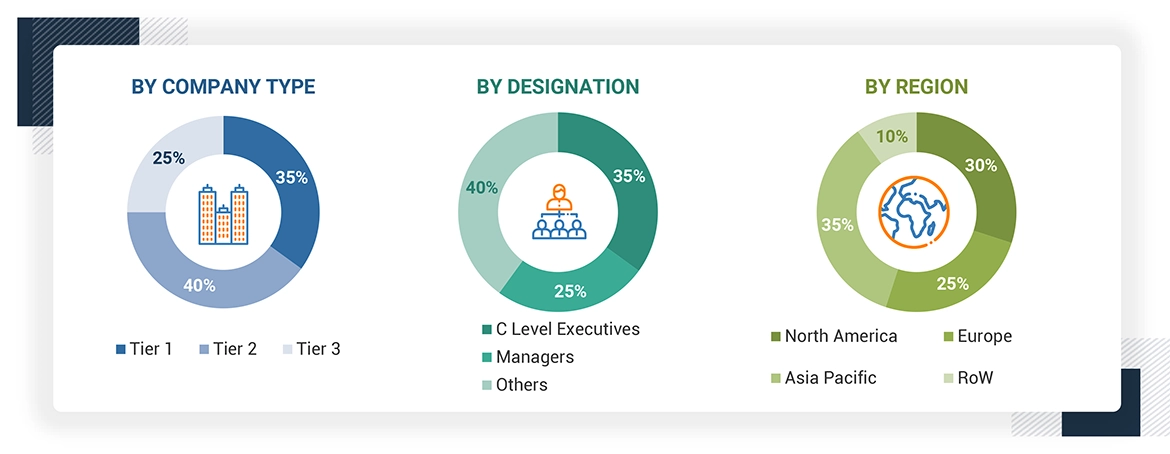
Note: Others include sales managers, marketing managers, and product managers.
To know about the assumptions considered for the study, download the pdf brochure
Market Size Estimation
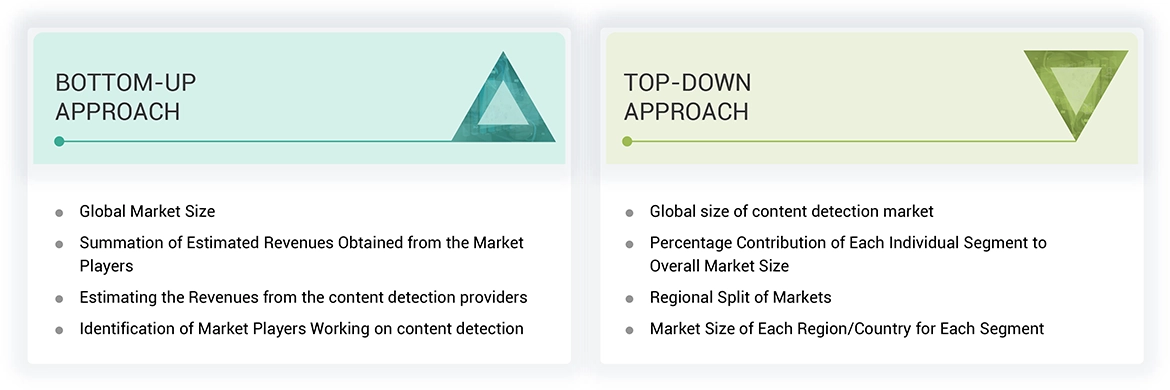
Multiple approaches were adopted to estimate and forecast the size of the content detection market. The first approach involves estimating market size by summing up the revenue generated by companies through the sale of content detection offerings. Both top-down and bottom-up approaches were used to estimate and validate the total size of the content detection market. These methods were extensively used to estimate the size of various segments in the market. The research methodology used to estimate the market size includes the following:
- Key players in the market have been identified through extensive secondary research.
- In terms of value, the industry’s supply chain and market size have been determined through primary and secondary research processes.
- All percentage shares, splits, and breakups have been determined using secondary sources and verified through primary sources.
Content Detection Market : Top-Down and Bottom-Up Approach
Data Triangulation
After arriving at the overall market size, the content detection market was divided into several segments and subsegments. A data triangulation procedure was used to complete the overall market engineering process and arrive at the exact statistics for all segments and subsegments, wherever applicable. The data was triangulated by studying various factors and trends from the demand and supply sides. Along with data triangulation and market breakdown, the market size was validated by the top-down and bottom-up approaches.
Market Definition
Content detection is the process of identifying, analyzing, and categorizing of digital content, including text, images, audio, and video, using algorithms, tools, or software systems. It involves recognizing patterns, features, or specific elements in the content to achieve objectives such as moderation, copyright enforcement, sentiment analysis, or data categorization. Content detection employs techniques such as machine learning (ML), natural language processing (NLP), computer vision, and audio signal processing to detect and classify elements like keywords, objects, behaviors, or metadata.
Stakeholders
- Content detection technology providers
- Content detection solution providers
- Content detection service providers
- Regulatory authorities
- Content creators and rights holders
- Content moderators and reviewing Teams
- Civil Society groups
- Advertisers and brands
- Legal and compliance teams
- Academic and research communities
Report Objectives
- To determine, segment, and forecast the content detection market by offering, detection type, content type, end user, and region in terms of value
- To forecast the size of the market segments concerning 5 main areas: North America, Europe, Asia Pacific, Middle East & Africa, and Latin America
- To provide detailed information about the major factors (drivers, restraints, opportunities, and challenges) influencing the market's growth.
- To study the complete supply chain and related industry segments and perform a supply chain analysis of the market landscape
- To strategically analyze the macro and micro-markets with respect to individual growth trends, prospects, and contributions to the total market
- To analyze the industry trends, pricing data, patents, and innovations related to the market
- To analyze the opportunities for stakeholders by identifying the high-growth segments of the market
- To profile the key players in the market and comprehensively analyze their market share/ranking and core competencies
- To track and analyze competitive developments, such as mergers & acquisitions, product launches & developments, partnerships, agreements, collaborations, business expansions, and R&D activities
Available Customizations
With the given market data, MarketsandMarkets offers customizations as per the company’s specific needs. The following customization options are available for the report:
Geographic Analysis as per Feasibility
- Analysis for additional countries (up to five)
Company Information
- Detailed analysis and profiling of additional market players (up to 5)
Get the Full Content Detection Market Report
Full forecast, segment splits, and company analysis for all Content Detection Market.
- UK Content Detection Market
- Germany Content Detection Market
- China Content Detection Market
- India Content Detection Market
- Brazil Content Detection Market
- US Content Detection Market
- Canada Content Detection Market
- Rest Of Europe Content Detection Market
- Japan Content Detection Market
- Rest Of Asia Pacific Content Detection Market
- Mexico Content Detection Market
- Rest Of Latin America Content Detection Market
- Ksa Content Detection Market
- Rest Of GCC Countries Content Detection Market
- UAE Content Detection Market
Need a Tailored Report?
Customize this report to your needs
Get 10% FREE Customization
Customize This Report
