
South Korea Conveyor System Market (2026-2031)

The South Korea Conveyor System Market was valued at $377 Million in 2026 and projected to reach to $579 Million by 2031, representing a compound annual growth rate of 6.3%. South Korea's conveyor system market is poised for sustained growth through 2031, driven by the country's position as a global manufacturing powerhouse and commitment to industrial automation.


| Market Size in | USD 26.32 MN |
| Market Forecast in | |
| CAGR | |
| Forecast Period | |
| Units Considered | Value (USD MN) |
South Korea Conveyor System Market Trends and Insights
- Valued at $377.0 million in 2026, South Korea's market is expected to expand to $579.0 million by 2031, reflecting a compound annual growth rate of 6.3%.
- This growth trajectory underscores South Korea's commitment to automation and industrial modernization across automotive, electronics, and e-commerce sectors. The South Korea conveyor system market benefits from the nation's robust automotive and semiconductor industries, which drive demand for efficient material handling solutions.
- South Korea's strategic investments in smart factories and Industry 4.0 initiatives are accelerating adoption of advanced conveyor technologies.
- Between 2026 and 2031, South Korea is anticipated to see increased integration of IoT-enabled and AI-driven conveyor systems, positioning the country as a regional innovation hub. South Korea's market growth is supported by rising labor costs, supply chain optimization needs, and government incentives for manufacturing automation.
- South Korea's competitive manufacturing base and export-oriented economy create sustained demand for high-performance conveyor solutions across multiple industrial verticals..
Key Market Statistics
- CAGR (2026-2031) 6.3% CAGR
- Market Size, 2026 ~USD 377 Million
- Forecast, 2031 ~USD 579 Million
- Country South Korea
South Korea Conveyor System Market Overview
Market Valuation Growth :
South Korea's conveyor system market is valued at $377.0 million in 2026 and projected to reach $579.0 million by 2031, demonstrating robust expansion driven by industrial automation investments.
Strong CAGR Performance :
The South Korean market exhibits a 6.3% CAGR from 2026-2031, outpacing the global average of 5.2%, indicating accelerated adoption of conveyor technologies in the region.
Manufacturing Excellence Hub :
South Korea's advanced manufacturing sector, including automotive and electronics industries, drives significant demand for sophisticated conveyor systems and logistics automation solutions.
Industrial Modernization Focus :
Government initiatives and corporate investments in Industry 4.0 and smart factory implementations are propelling conveyor system upgrades across South Korean manufacturing facilities.
South Korea Conveyor System Market Dynamics
- The 6.3% CAGR reflects increasing investments in smart logistics, automotive production optimization, and supply chain modernization across major industrial zones.
- South Korean manufacturers are increasingly adopting advanced conveyor technologies to enhance operational efficiency, reduce labor costs, and maintain competitive advantages in global markets.
- The convergence of government support for Industry 4.0 initiatives, rising labor costs, and demand for faster production cycles creates a favorable environment for conveyor system market expansion.
- Key sectors including automotive, electronics, and food processing are driving technology adoption, while integration with IoT and AI-enabled systems represents emerging growth opportunities..
Market Ecosystem
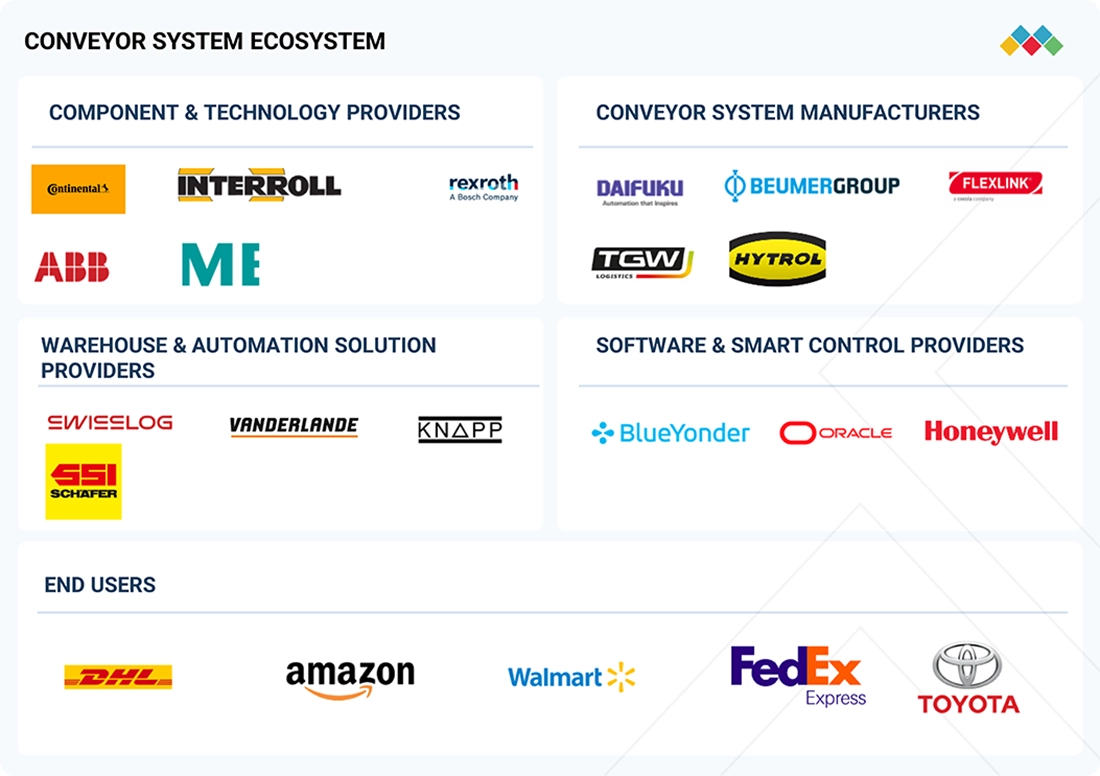
CONVEYOR SYSTEM MARKET SIZE & GROWTH: COMMERCIAL USE CASES ACROSS INDUSTRIES
| COMPANY | USE CASE DESCRIPTION | BENEFITS |
|---|---|---|
 |
Automated conveyor and material handling systems for warehouses, automotive plants, airports, and cleanrooms | Higher throughput, reduced manual handling, continuous material flow, and integrated facility automation |
 |
Conveyor belt systems for mining, industrial processing, and bulk material handling operations | Efficient bulk transport, lower downtime, longer belt life, and improved operational reliability |
 |
Conveyor and sortation systems integrated with warehouse automation and fulfillment operations | Faster order processing, improved warehouse efficiency, and scalable fulfillment operations |
 |
Conveyor based baggage handling, parcel sorting, and warehouse automation systems | High throughput handling, accurate sorting, and reliable baggage and parcel movement |
 |
Modular conveyor platforms, rollers, drives, and pallet handling systems for intralogistics applications | Flexible system integration, efficient material movement, and easier warehouse scalability |
Logos and trademarks shown above are the property of their respective owners. Their use here is for informational and illustrative purposes only.
Related Ecosystem
Logistics And Transportation
- Internal Combustion Engine (ICE)
- Crawler Excavator
- Fuel Cell
- Light Commercial Vehicles (LCVs)
- Sensors
- Siemens ag
- Alstom s.a.
- Hitachi, Ltd.
- Godrej Industries Limited
- ABB India Limited
Key Takeaways
- South Korea's conveyor system market will grow from $377.0M (2026) to $579.0M (2031) at a 6.3% CAGR.
- South Korea's automotive and semiconductor sectors are primary drivers of conveyor system demand and innovation.
- South Korea is rapidly adopting smart, IoT-enabled conveyor technologies aligned with Industry 4.0 initiatives.
- Rising labor costs and supply chain pressures in South Korea are accelerating automation investments through 2031.
Conveyor System Market Report Scope
| Report Metric | Details |
|---|---|
| Base Year | 2026 |
| Fastest Growing Segment | FLOOR (Type) |
| Forecast Period | 2026–2031 |
| Growth Rate | CAGR of 5.2% from 2026 to 2031 |
| Largest Segment | AUTOMATIC (Operation) |
| Market Size Base Year (Billions) | ~USD 10.27 (2026) |
| Revenue Forecast (Billions) | ~USD 13.23 (2031) |
| Segments Covered | Type, Component, Operation, Application, Technology, Sub-Industry, Industry |
South Korea Conveyor System Market Report Segmentation
7 segment dimensions are covered across the global market.
By Type
- Belt
- Bucket
- Buket
- Cable
- Crescent
- Floor
- Other Types
- Overhead
- Pallet
- Roller
- Tri-Planar
By Component
- Aluminum Profile
- Driving Unit
- Extremity Unit
- Other Components
By Operation
- Automatic
- Manual
- Semi-Automatic
By Application
- Open-Pit Mining
- Underground Mining
By Technology
- Automated
- Drive
- Gearless
By Sub-Industry
- Dairy
- Meat & Poultry
- Other Sub-Industries
By Industry
- Airport
- Automotive
- Electronics
- Food & Beverage
- Mining
- Retail & Distribution
Target Audience
- Conveyor System Manufacturers : South Korean and international manufacturers need detailed market sizing and growth projections to identify expansion opportunities, assess competitive positioning, and plan product localization strategies.
- Automotive & Transportation Companies : OEMs and logistics providers operating in South Korea require market intelligence to optimize supply chain investments, evaluate conveyor technology upgrades, and benchmark against regional competitors.
- Industrial Automation Integrators : System integrators and automation solution providers need South Korea-specific data to identify client opportunities, justify technology investments, and develop industry-tailored conveyor solutions.
- Investment & Private Equity Firms : Investors evaluating opportunities in South Korea's manufacturing and logistics sectors require accurate market data to assess growth potential, identify acquisition targets, and evaluate portfolio companies.
- Government & Policy Makers : South Korean government agencies and industrial development organizations need market insights to inform Industry 4.0 policies, allocate development funds, and support manufacturing competitiveness initiatives.
Key Companies in the South Korea Conveyor System Market
| Company | HQ | Ownership | Strongest segments |
|---|---|---|---|
| FLSMIDTH | United States | Public Company | Belt & Overland Conveyors,Apron, Hybrid Apron & Floor Feeders,Pallet, Bucket & Specialized Conveyors, |
| GATES CORPORATION | United States | Public Company | Power transmission belts for conveyors,Metal drive components (pulleys, idlers, tensioners, sprockets),Hydraulic hoses, tubing, couplings, and assemblies, |
| GODREJ GROUP | India | Private Company | Belt conveyors,Roller conveyors,Overhead and floor conveyors, |
| DAIFUKU CO., LTD. | Japan | Public Company | Airport baggage handling conveyors and integrated systems,Automotive production line conveyors (overhead, floor, skillet, pallet),Retail, e-commerce, and distribution center conveyors, |
| CONTINENTAL AG | Germany | Public Company | Belt Conveyors,Roller Conveyors,Overhead & Floor Conveyors, |
| INTERROLL GROUP | Switzerland | Public Company | Roller and Belt Conveyors (incl. MCP, high performance conveyor platform, belt curves),Rollers, Drum Motors, and Drives (components),Sorters and Pallet Handling (sorter, modular pallet platform, pallet flow-storage), |
| FIVES GROUP | France | Private Company | Belt Conveyors,Roller and Pallet Conveyors,Overhead and Floor Conveyors, |
| SIEMENS AG | Germany | Public Company | Belt and roller conveyor automation (PLC, drives, motors, sensors),Overhead, floor, and pallet conveyor control systems,Airport and distribution center sortation and baggage handling automation, |
| DüRR GROUP | Germany | Public Company | Automotive final assembly conveyors (floor, skillet, pallet, overhead),Paint shop and body handling conveyors,Conveyor-related automation, control, and DXQ software, |
| HONEYWELL INTERNATIONAL, INC. | United States | Public Company | Retail & Distribution (incl. belt and roller conveyors),Airport baggage handling and related conveyors,Automotive and Electronics manufacturing conveyors, |
| SWISSLOG HOLDING AG | Switzerland | Private Company | Belt and roller conveyors,Overhead and floor conveyors,Pallet conveyors, |
| METSO | Finland | Public Company | Belt conveyors and overland/in-pit systems,Conveyor components and wear parts,Feeding, chutes, and material handling auxiliaries, |
| TAIKISHA LTD | Japan | Public Company | Overhead and floor conveyors for automotive paint and assembly lines,Belt and roller conveyors for electronics and industrial facilities,Customized conveyors within environmental and HVAC-controlled processes, |
FLSMIDTH
FLSmidth is a publicly traded Danish-American engineering company founded in 1882 with 5,340 employees operating in the United States. The company provides equipment and services for the cement, minerals, and metals industries.
GATES CORPORATION
Gates Corporation is a publicly traded American manufacturer founded in 1911 with 13,000 employees. The company produces power transmission belts, hoses, and fluid power products for industrial and automotive applications.
GODREJ GROUP
Godrej Group is a privately held Indian conglomerate founded in 1897 with 13,316 employees. The company operates across multiple sectors including consumer goods, real estate, and industrial products.
DAIFUKU CO., LTD.
Daifuku Co., Ltd. is a publicly traded Japanese company founded in 1937 with 11,417 employees. The company specializes in material handling systems and automation solutions for warehouses and manufacturing facilities.
CONTINENTAL AG
Continental AG is a publicly traded German automotive and industrial supplier founded in 1871 with 22,076 employees. The company manufactures tires, brake systems, and other components for vehicles and industrial applications.
INTERROLL GROUP
Interroll Group is a publicly traded Swiss company founded in 1959 with 2,400 employees. The company manufactures rollers, drives, and automation solutions for material handling systems.
FIVES GROUP
Fives Group is a privately held French industrial company founded in 1812 with 8,132 employees. The company provides engineering and equipment solutions for various industrial sectors including automotive, aerospace, and logistics.
SIEMENS AG
Siemens AG is a publicly traded German multinational conglomerate founded in 1847 with 310,312 employees. The company operates across electrification, automation, and digitalization sectors serving diverse industrial and infrastructure markets.
DüRR GROUP
Dürr Group is a publicly traded German engineering company founded in 1895 with 17,731 employees. The company provides machinery, systems, and services for automotive, chemical, and pharmaceutical industries.
HONEYWELL INTERNATIONAL, INC.
Honeywell International, Inc. is a publicly traded American multinational conglomerate founded in 1885 with 101,000 employees. The company operates across aerospace, building technologies, performance materials, and safety solutions.
SWISSLOG HOLDING AG
Swisslog Holding AG is a privately held Swiss company founded in 1900 with 2,372 employees. The company provides warehouse automation and logistics solutions for distribution and healthcare sectors.
METSO
Metso is a publicly traded Finnish company founded in 1990 with 17,806 employees. The company provides equipment and services for mining, aggregates, recycling, and process industries.
TAIKISHA LTD
Taikisha Ltd is a publicly traded Japanese company founded in 1913 with 5,525 employees. The company manufactures industrial equipment and systems for automotive, semiconductor, and environmental applications.
Reasons to Buy this Report
- Market-Specific Sizing Data : Access precise valuation figures for South Korea's conveyor system market ($377M in 2026, $579M in 2031) with detailed CAGR analysis to support investment and expansion decisions.
- Competitive Benchmarking : Compare South Korea's 6.3% CAGR against the global 5.2% benchmark to identify regional growth advantages and market positioning opportunities within the automotive and transportation sectors.
- Sector-Specific Insights : Understand how South Korea's advanced manufacturing, automotive, and electronics industries are driving conveyor system demand, enabling targeted market entry and product development strategies.
- Localized Growth Drivers : Identify South Korea-specific factors including Industry 4.0 adoption, labor cost pressures, and government modernization initiatives that are accelerating conveyor system market expansion.
- Strategic Planning Foundation : Leverage comprehensive South Korea market data to develop informed business strategies, forecast revenue potential, and allocate resources effectively for regional market penetration.
Frequently asked questions
What is the current size of South Korea's conveyor system market?
South Korea's conveyor system market is valued at $377.0 million in 2026 and is projected to reach $579.0 million by 2031.
What is the expected growth rate for South Korea's conveyor system market?
South Korea's conveyor system market is expected to grow at a compound annual growth rate (CAGR) of 6.3% from 2026 to 2031.
Which industries drive demand for conveyor systems in South Korea?
South Korea's automotive, semiconductor, electronics, and e-commerce sectors are the primary drivers of conveyor system demand.
What technological trends are shaping South Korea's conveyor system market?
South Korea is experiencing increased adoption of IoT-enabled, AI-driven, and smart conveyor systems as part of broader Industry 4.0 and smart factory initiatives.
What factors are accelerating conveyor system adoption in South Korea?
Rising labor costs, supply chain optimization needs, government automation incentives, and competitive manufacturing pressures are key drivers of conveyor system adoption in South Korea.
RESEARCH METHODOLOGY
Various secondary sources, directories, and databases have been used to identify and collect information for the extensive study on the conveyor system market. The study involved four main activities in estimating the current size of the conveyor system market: secondary research, validation through primary research, assumptions, and market analysis. The research study used various secondary sources, including company annual reports/presentations, industry association publications, magazine articles, directories, technical handbooks, the World Economic Outlook, trade websites, technical articles, and databases, to identify and collect information for an extensive study of the conveyor system market. Primary sources from related industries, OEMs, and suppliers were interviewed to obtain and verify critical information and assess prospects and market estimations.
Secondary Research
Secondary sources for this research study include corporate filings, such as annual reports, investor presentations, and financial statements; trade, business, and professional associations; whitepapers; certified publications; articles by recognized authors; directories; and databases. Secondary data was collected and analyzed to determine the overall market size, further validated by primary research.
Primary Research
Extensive primary research was conducted after understanding the conveyor system market scenario through secondary research. Several primary interviews were conducted with market experts from the demand side (vehicle manufacturers, country-level government associations, and trade associations) and the supply side (conveyor system and bus manufacturers, component providers, and system integrators). The regions considered for the research include North America, Europe, Asia Pacific, and the Rest of the World. Primary data was collected through questionnaires, emails, and telephonic interviews.
After interacting with industry experts, brief sessions were conducted with highly experienced independent consultants to reinforce the findings from the primaries. This, along with the in-house subject matter experts’ opinions, led to the findings described in this report.
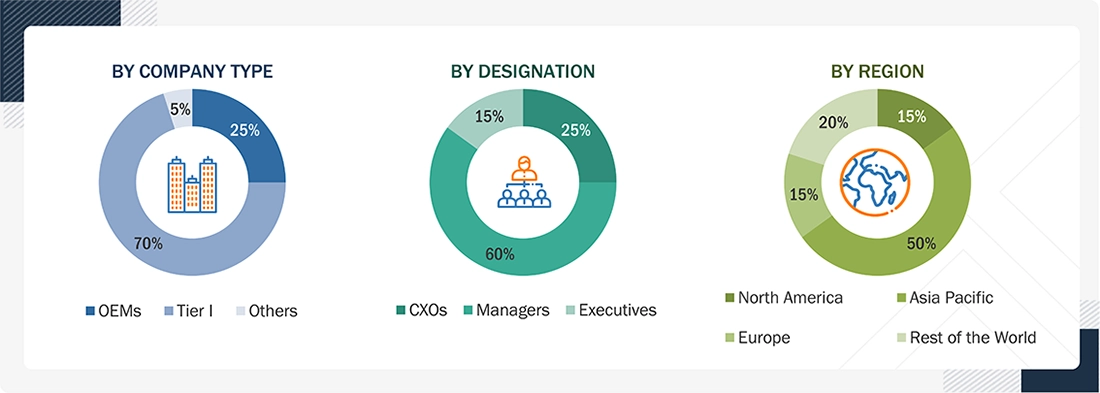
Note: Tiers of companies are based on the value chain of the conveyor system market; companies’ revenues were not considered.
To know about the assumptions considered for the study, download the pdf brochure
Market Size Estimation
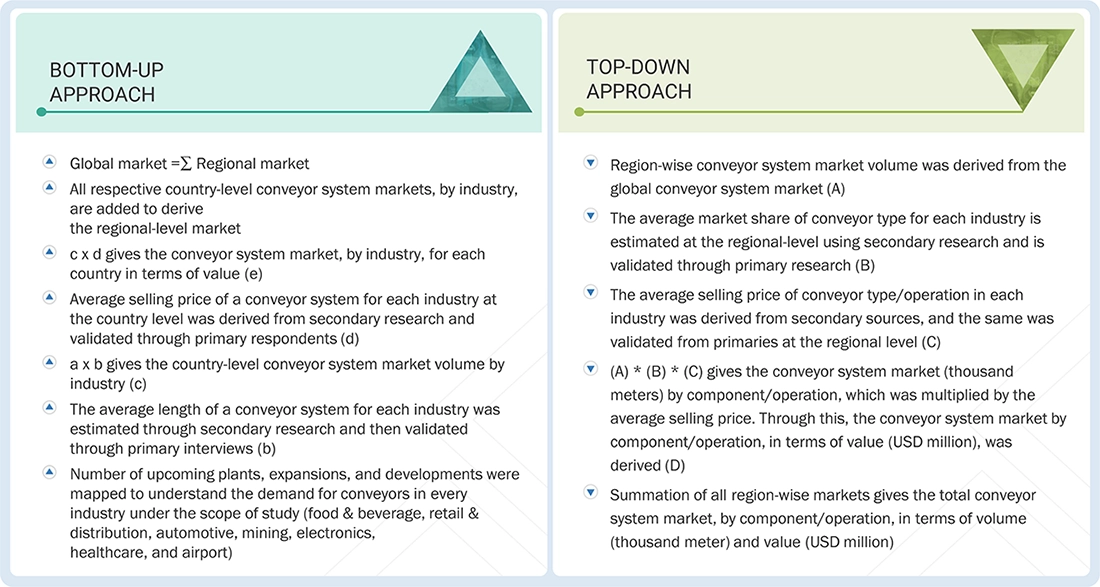
Both top-down and bottom-up approaches were used to estimate and validate the total size of the conveyor system market. These methods were also used extensively to estimate the size of various subsegments in the market. Secondary research was done to identify key players in the conveyor system market. Their global market share was determined through primary and secondary research.
Conveyor System Market : Top-Down and Bottom-Up Approach
Data Triangulation
After arriving at the overall market size through the bottom-up approach, the conveyor system market was split into several segments and subsegments. Where applicable, the data triangulation procedure was employed to complete the overall market engineering process and arrive at the exact market value for key segments and subsegments. The extrapolated market data was triangulated by studying various macroindicators and regional trends from both demand- and supply-side participants.
Market Definition
Britannica defines a conveyor as any device that provides mechanized movement of material, such as in a factory; it is used principally in industrial applications and on large farms, as well as in warehousing and freight handling for moving raw materials. Conveyors may be only a few inches in length, or they may be integrated systems several miles long.
Key Stakeholders
- Automation System Manufacturers
- Automotive Ancillary Players
- Automotive OEMs
- Conveyor OEMs
- Conveyor System Component Manufacturers
- Conveyor System Cybersecurity Providers
- Electronics Companies
- Food & Beverage Companies
- Industrial Machinery Insurance Providers
- Legal and Regulatory Authorities
- Mining Companies
- Raw Material Suppliers
- Sensor Manufacturers
- Software Providers
- Traders, Distributors, and Suppliers
Report Objectives
-
To define, segment, analyze, and forecast the conveyor system market, in terms of volume (thousand meter) and value (USD million) between 2026 and 2033 based on:
- To segment and forecast the market size, by type (roller, pallet, overhead, tri-planar, bucket, floor, cable, crescent, and other types)
- To segment and forecast the market size, by operation (manual, automatic, and semi-automatic)
- To segment and forecast the market size, by component (aluminum profile, driving unit, extremity unit, and other components)
- To segment and forecast the market size for the airport industry, by type (belt, tri-planar, crescent, and other types)
- To segment and forecast the market size for the retail & distribution industry, by type (belt, roller, pallet, and other types)
- To segment and forecast the market size for the automotive industry, by type (overhead, floor, roller, and other types)
- To segment and forecast the market size for the mining industry, by type (belt, cable, bucket, and other types)
- To segment and forecast the market size for the electronics industry, by type (belt, roller, and other types)
- To segment and forecast the market size for the food & beverage industry, by subindustry (meat & poultry, dairy, and other types)
- To segment and forecast the mining conveyor system market size, by application (open-pit mining and underground mining)
- To segment and forecast the mining conveyor system market size, by technology (drive, gearless, and automated)
- To segment and forecast the market size by region (Asia Pacific, Europe, North America, and the Rest of the World)
- To provide detailed information about the factors influencing market growth (drivers, challenges, restraints, and opportunities)
- To strategically analyze the market, considering individual growth trends, prospects, and contributions to the total market
-
To study the following factors with respect to the market:
- Value Chain Analysis
- Ecosystem Analysis
- Technology Analysis
- Pricing Analysis
- Trade Data
- Case Study Analysis
- Patent Analysis
- Impact of Generative AI
- Regulatory Landscape
- Key Stakeholders and Buying Criteria
- Key Conferences and Events
- Impact of Israel-Iran War
- Europe-India Trade Deals Impact Analysis
- ROI Benchmarking
- Future Monetization Outlook
-
To determine the following with respect to the market:
- Market Share Analysis
- To analyze the competitive landscape and prepare a competitive leadership mapping/market quadrant for the global players operating in the conveyor system market
- To analyze recent developments, alliances, joint ventures, mergers & acquisitions, product launches, and other activities carried out by key participants in the conveyor system market
Customization Options
With the given market data, MarketsandMarkets offers customizations tailored to a company’s specific needs.
Get the Full Conveyor System Market Report
Full forecast, segment splits, and company analysis for all Conveyor System Market.
- China Conveyor System Market
- India Conveyor System Market
- Japan Conveyor System Market
- Germany Conveyor System Market
- France Conveyor System Market
- UK Conveyor System Market
- Spain Conveyor System Market
- Italy Conveyor System Market
- Russia Conveyor System Market
- Canada Conveyor System Market
- Mexico Conveyor System Market
- US Conveyor System Market
- Brazil Conveyor System Market
- South Africa Conveyor System Market
- Rest Of Europe Conveyor System Market
- Rest Of Asia Pacific Conveyor System Market
Need a Tailored Report?
Customize this report to your needs
Get 10% FREE Customization
Customize This Report
