
Japan Counter-UAS Systems Market (2025-2030)

The Japan Counter-UAS Systems Market was valued at $235.3 Million in 2025 and projected to reach to $467 Million by 2030, representing a compound annual growth rate of 14.7%. Japan's counter-UAS systems market is positioned for sustained growth as the nation addresses evolving security challenges from unauthorized drone operations.


| Market Size in | USD 26.32 MN |
| Market Forecast in | |
| CAGR | |
| Forecast Period | |
| Units Considered | Value (USD MN) |
Japan Counter-UAS Systems Market Trends and Insights
- Japan is increasingly investing in counter-unmanned aerial systems to address emerging security threats from unauthorized drone operations, particularly in critical infrastructure protection and airspace management.
- The market expansion in Japan reflects heightened government focus on national security and the growing adoption of advanced detection and mitigation technologies across both public and private sectors. Driving Japan's counter-UAS market growth are regulatory frameworks strengthening drone oversight, rising incidents of unauthorized drone incursions, and Japan's preparation for major international events requiring enhanced airspace security.
- Japan's defense modernization initiatives and collaboration with allied nations have accelerated procurement of sophisticated counter-UAS solutions.
- The forecast period through 2030 indicates Japan will continue to prioritize investment in integrated counter-UAS capabilities, positioning the nation as a key market within the Asia Pacific region for advanced airspace protection technologies..
Key Market Statistics
- CAGR (2025-2030) 14.7% CAGR
- Market Size, 2025 ~USD 235.3 Million
- Forecast, 2030 ~USD 467 Million
- Country Japan
Japan Counter-UAS Systems Market Overview
Market Valuation & Growth :
Japan's counter-UAS systems market is valued at USD 235.3 million in 2025 and is projected to reach USD 467.0 million by 2030, with a steady CAGR of 14.7% over the forecast period.
Critical Infrastructure Protection :
Japan is prioritizing counter-UAS deployment across critical infrastructure sectors including airports, power plants, and government facilities to mitigate risks from unauthorized drone operations and security threats.
Government Investment & Policy :
Japanese government agencies are increasing budget allocations for counter-UAS technologies as part of national security initiatives, driven by regulatory frameworks and emerging drone-related security incidents.
Technology Adoption Trends :
Japanese organizations are adopting advanced detection, tracking, and neutralization technologies, with growing preference for integrated solutions that combine radar, RF detection, and kinetic countermeasures.
Japan Counter-UAS Systems Market Dynamics
- Government agencies, critical infrastructure operators, and defense organizations are increasingly allocating resources to counter-UAS capabilities, driven by regulatory requirements and real-world security incidents.
- The market is expected to benefit from technological advancements in detection and neutralization systems, coupled with rising awareness of drone-related threats across both public and private sectors. The forecast period through 2030 will see expanded deployment across airports, ports, government facilities, and urban centers.
- Japanese manufacturers and system integrators are developing localized solutions tailored to national security requirements, while international partnerships are enhancing technology transfer.
- Investment in R&D for next-generation counter-UAS systems, combined with government procurement initiatives, will drive market expansion and create opportunities for both established defense contractors and emerging technology providers..
Market Ecosystem
COUNTER-UAS SYSTEM (C-UAS) MARKET: COMMERCIAL USE CASES ACROSS INDUSTRIES
| COMPANY | USE CASE DESCRIPTION | BENEFITS |
|---|---|---|
 |
Dedrone's Counter C-UAS systems have been deployed at airports, stadiums, correctional facilities, and public events to detect, identify, track, and support mitigation of unauthorized drones using radar, RF sensors, cameras, and software. | Improves drone awareness across large sites | Supports faster response to unauthorized drone activity | Helps maintain safe operations with continuous monitoring |
 |
DroneShield deployed fixed and mobile Counter C-UAS systems to protect critical infrastructure, energy facilities, and major public events. The systems combine RF detection, radar, EO/IR sensors, and countermeasures to manage drone threats. | Supports layered drone detection and response | Provides coverage for permanent and temporary sites | Reduces operational disruption caused by unauthorized drones |
 |
Aaronia's Counter C-UAS solutions have been used to monitor airspace around industrial facilities, government sites, and temporary security zones by integrating spectrum monitoring, radar, and RF direction-finding technologies. | Enables continuous drone monitoring | Improves localization of drone operators | Supports security teams with multiple sensor inputs for threat assessment |
Logos and trademarks shown above are the property of their respective owners. Their use here is for informational and illustrative purposes only.
Related Ecosystem
Key Takeaways
- Japan's counter-UAS market is valued at USD 235.3 million in 2025 and expected to grow to USD 467.0 million by 2030 at a 14.7% CAGR.
- Japan is strengthening regulatory frameworks and airspace security measures to combat unauthorized drone operations and protect critical infrastructure.
- Japan's defense modernization and international security partnerships are driving accelerated adoption of advanced counter-UAS technologies.
- Japan's strategic focus on integrated counter-UAS capabilities positions it as a significant growth market within the Asia Pacific region through 2030.
Counter-UAS Systems Market Report Scope
| Report Metric | Details |
|---|---|
| Base Year | 2025 |
| Fastest Growing Segment | HIGH-ENERGY LASERS (Hard Kill) |
| Forecast Period | 2025–2030 |
| Growth Rate | CAGR of 25.1% from 2025 to 2030 |
| Largest Segment | CONVENTIONAL (Technology) |
| Market Size Base Year (Billions) | ~USD 6.63 (2025) |
| Revenue Forecast (Billions) | ~USD 20.31 (2030) |
| Segments Covered | Solution, Drone Detection Radar, Counter-Drone Acoustic Sensor, Electro-Optical And Infrared Camera, Command & Control, Uas Mitigation & Neutralization, Hard Kill, Soft Kill/Electronic Countermeasure, Service, End User, Commercial & Civil, End Use, Deployment, Range, Technology, Military & Defense, Government & Law Enforcement, Ground-Based System, End User 2025–2030 |
Japan Counter-UAS Systems Market Report Segmentation
19 segment dimensions are covered across the global market.
By Solution
- Command & Control (C2)
- Drone Detection, Tracking, And Identification
- Services
- Uas Mitigation & Neutralization
By Drone Detection Radar
- C-Band
- Ku-Band
- L-Band
- Other Frequency Bands
- S-Band
- X-Band
By Counter-Drone Acoustic Sensor
- Arrays
- Microphones
By Electro-Optical And Infrared Camera
- Hyperspectral
- Multispectral
By Command & Control
- C-Uas Command & Control System
- Integrated C2 System
By Uas Mitigation & Neutralization
- Hard Kill
- Soft Kill/Electronic Countermeasures
By Hard Kill
- Anti-Drone Guns
- Anti-Swarm Munition
- C-Uas Kinetic Missiles
- High-Energy Lasers
- High-Power Microwave Anti-Drone Systems
- Intercept Drones
By Soft Kill/Electronic Countermeasure
- Anti-Fpv Rf Jamming Technology
- Global Navigation Satellite System (Gnss) Jamming
- Spoofing, Protocol Manipulation, And Cyber-Takeover Systems
By Service
- Hardware Upgrade
- Installation & Integration Services
- Maintenance & Support
- Software Upgrade
By End User
- Commercial & Civil
- Government & Law Enforcement
- Military & Defense
By Commercial & Civil
- Critical Infrastructure
- Public Venues
By End Use
- Commercial & Civil
- Government & Law Enforcement
- Military & Defense
By Deployment
- Ground-Based
- Handheld
By Range
- Extended Range (> 50 Km)
- Long Range (21–50 Km)
- Medium Range (6–20 Km)
- Short Range (< 1 Km)
- Tactical Range (1–5 Km)
By Technology
- AI-Powered
- Conventional
By Military & Defense
- Air Force
- Armed Forces
- Navy
- Other Special Forces
By Government & Law Enforcement
- Civilian Intelligence & Security Agents
- National/Federal Police
- Paramilitary Police
By Ground-Based System
- Fixed
- Mobile
By End User 2025–2030
- Commercial & Civil
- Government & Law Enforcement
- Military & Defense
JAPAN: COUNTER-UNMANNED AIRCRAFT SYSTEMS (C-UAS) MARKET,BY END USER, 2025–2030
| Segment | 2025 | 2026 | 2027 | 2028 | 2029 | 2030 | CAGR (%) |
|---|---|---|---|---|---|---|---|
| COMMERCIAL & CIVIL | 39.4 | 47.8 | 54.8 | 66.2 | 78 | 90.6 | 18.2 |
| GOVERNMENT & LAW ENFORCEMENT | 24.6 | 29.2 | 32.9 | 38.9 | 45 | 51.3 | 15.9 |
| MILITARY & DEFENSE | 171.4 | 199.8 | 220.4 | 255.8 | 290.4 | 325 | 13.7 |
| TOTAL | 235.3 | 276.8 | 308.1 | 360.9 | 413.4 | 467 | 14.7 |
JAPAN: COUNTER-UNMANNED AIRCRAFT SYSTEMS (C-UAS) MARKET, BY END USER, 2021–2024
| Segment | 2021 | 2022 | 2023 | 2024 | CAGR (%) |
|---|---|---|---|---|---|
| COMMERCIAL & CIVIL | 24.2 | 22.6 | 28 | 35.2 | 13.3 |
| GOVERNMENT & LAW ENFORCEMENT | 17 | 15.3 | 18.5 | 22.6 | 10 |
| MILITARY & DEFENSE | 125.6 | 112.2 | 132.7 | 160.1 | 8.4 |
| TOTAL | 166.8 | 150.1 | 179.2 | 217.9 | 9.3 |
Target Audience
- Defense & Aerospace Companies : Japanese and international defense contractors need market intelligence to develop counter-UAS product portfolios, identify procurement opportunities, and establish partnerships with Japanese government agencies and critical infrastructure operators.
- Critical Infrastructure Operators : Airport authorities, port operators, utility companies, and government facility managers require market insights to evaluate counter-UAS solutions, understand technology options, and plan security infrastructure investments.
- Government & Security Agencies : Japanese Ministry of Defense, national police, and security agencies need market data to inform procurement strategies, budget planning, and policy development for counter-UAS capabilities and drone threat mitigation.
- Technology & System Integrators : System integrators and technology providers targeting Japan's security sector need market analysis to identify growth opportunities, understand customer requirements, and develop localized counter-UAS solutions.
- Investment & Consulting Firms : Private equity, venture capital, and management consulting firms require detailed market forecasts and competitive analysis to evaluate investment opportunities and advise clients on Japan's counter-UAS market dynamics.
Key Companies in the Japan Counter-UAS Systems Market
| Company | HQ | Ownership | Strongest segments |
|---|---|---|---|
| RTX | United States | Public Company | Collins Aerospace (avionics, interiors, mission systems, aftermarket),Pratt & Whitney (commercial and military engines, APU, MRO),Raytheon (sensors, effectors, C2, space solutions), |
| LOCKHEED MARTIN CORPORATION | United States | Public Company | Aeronautics (combat and air mobility aircraft, UAVs),Missiles and Fire Control (air and missile defense, precision weapons),Rotary and Mission Systems (helicopters, C2, cyber, training), |
| NORTHROP GRUMMAN | United States | Public Company | Space Systems,Mission Systems (C4ISR, sensors, EW, cyber),Defense Systems (weapons, missile defense, sustainment), |
| ELBIT SYSTEMS LTD | Israel | Public Company | Aerospace (airborne platforms, UAS, avionics, training),C4I and Cyber,ISTAR and Electronic Warfare, |
| DEDRONE BY AXON | United States | Subsidiary | Detection & tracking software (SaaS),Fixed and mobile sensor hardware,Command-and-control and integrations, |
| DRONESHIELD LTD | Australia | Public Company | DroneSentry-C2 platform (C2, Enterprise, Tactical, Access Portal, plugins),Handheld and wearable effectors (DroneGun Mk4, DroneGun Tactical, RfPatrol Mk2, RfPatrol-Plugin),Fixed and mobile integrated systems (DroneSentry, DroneSentry-X Mk2, EFS Kit, Immediate Response Kit), |
| LEONARDO DRS | United States | Public Company | Advanced Sensing (EO/IR, SIGINT, surveillance, EW sensing),Network and Tactical Computing,Integrated Mission Systems and Electric Propulsion, |
| THALES | France | Public Company | Defence & Security Systems (air, land, naval, C4ISR, EW, robotics, drones),Aerospace & Space (avionics, ATM, IFEC, satellite solutions, services),Digital Identity & Security (banking, IAM, biometrics, secure IoT, software monetization), |
| HENSOLDT AG | Germany | Public Company | Radar & IFF Systems (air, land, naval, ATC),Optronics & EO/IR (sights, periscopes, thermal, night vision),Electronic Warfare, SIGINT & Jammers, |
| SAAB AB | Sweden | Public Company | Aeronautics (manned and unmanned aircraft, aviation tech),Dynamics (combat weapons, missiles, training & simulation),Surveillance (radar, EW, combat systems, C4I), |
RTX
RTX is a United States-based public company founded in 1934 with 180,000 employees.
LOCKHEED MARTIN CORPORATION
Lockheed Martin Corporation is a United States-based public company founded in 1912 with 123,000 employees.
NORTHROP GRUMMAN
Northrop Grumman is a United States-based public company founded in 1939 with 95,000 employees.
ELBIT SYSTEMS LTD
Elbit Systems Ltd is an Israel-based public company founded in 1966 with 20,000 employees.
DEDRONE BY AXON
Dedrone by Axon is a United States-based subsidiary company founded in 2014.
DRONESHIELD LTD
DroneShield Ltd is an Australia-based public company founded in 2014 with 450 employees.
LEONARDO DRS
Leonardo DRS is a United States-based public company founded in 1968 with 7,300 employees.
THALES
Thales is a France-based public company founded in 1893 with 82,111 employees.
HENSOLDT AG
HENSOLDT AG is a Germany-based public company founded in 2020 with 9,362 employees.
SAAB AB
Saab AB is a Sweden-based public company founded in 1937 with 28,667 employees.
Reasons to Buy this Report
- Market Size & Growth Validation : Obtain precise market valuation data for Japan's counter-UAS sector with verified CAGR of 14.7%, enabling accurate financial forecasting and investment decision-making for the 2025-2030 period.
- Japan-Specific Competitive Intelligence : Gain insights into Japan's unique market dynamics, local player strategies, and government procurement patterns to identify competitive advantages and market entry opportunities in this high-growth segment.
- Critical Infrastructure Opportunity Mapping : Understand deployment priorities across Japanese airports, ports, power facilities, and government sites to target sales efforts and develop solutions aligned with national security requirements and regulatory standards.
- Technology Adoption Roadmap : Access detailed analysis of technology preferences, integration trends, and emerging solutions in Japan's counter-UAS ecosystem to align product development and positioning with market demand.
- Strategic Planning & Risk Assessment : Leverage comprehensive market forecasts and trend analysis specific to Japan to support strategic planning, resource allocation, and risk mitigation in the counter-UAS sector through 2030.
Frequently asked questions
What is the current size of Japan's counter-UAS systems market?
Japan's counter-UAS systems market is valued at USD 235.3 million in 2025 and is projected to reach USD 467.0 million by 2030.
What is the expected growth rate for Japan's counter-UAS market?
Japan's counter-UAS market is expected to grow at a compound annual growth rate (CAGR) of 14.7% from 2025 to 2030.
What are the primary drivers of growth in Japan's counter-UAS market?
Key growth drivers in Japan include strengthened regulatory frameworks for drone oversight, rising unauthorized drone incidents, defense modernization initiatives, and enhanced airspace security requirements for major international events.
Which sectors are driving counter-UAS adoption in Japan?
Japan's counter-UAS adoption is driven by government defense agencies, critical infrastructure operators, airport authorities, and private security providers seeking to protect sensitive facilities and airspace.
How does Japan's counter-UAS market compare to the global market?
While Japan's market grows at 14.7% CAGR, the global counter-UAS market expands at 25.1% CAGR, indicating Japan represents a significant but moderately-paced segment within the broader Asia Pacific region.
RESEARCH METHODOLOGY
This research study involves the extensive use of secondary sources, directories, and databases, such as D&B Hoovers, Bloomberg Businessweek, and Factiva, to identify and collect useful information on the counter-UAS (C-UAS) system market. Secondary sources included company websites, product brochures, annual reports, investor presentations, government procurement portals, tender documents, contract announcements, defense budget publications, and industry databases. Primary sources included experts from core and related industries, preferred suppliers, manufacturers, solution providers, technology developers, alliances, and organizations related to all segments of the industry’s value chain.
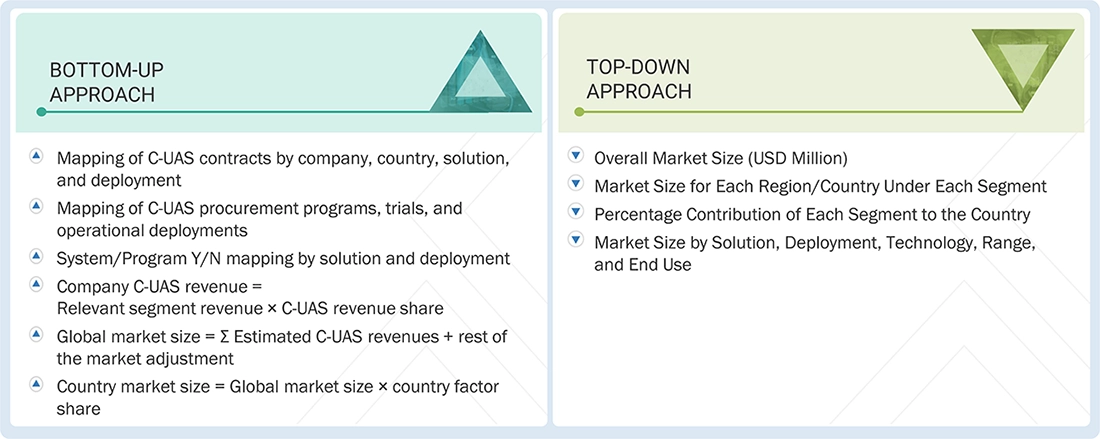
All primary sources have been interviewed to obtain and verify critical qualitative and quantitative information and assess the prospects of the counter-UAS (C-UAS) system market. A deductive approach, also known as the bottom-up approach, combined with the top-down approach, has been used to forecast the market size of different market segments.
Secondary Research
The ranking of companies in the counter-UAS (C-UAS) system market has been conducted using secondary data from paid and unpaid sources and by analyzing their product portfolios and service offerings. These companies have been rated based on the performance and quality of their products. The data points have been further validated by primary sources.
Primary Research
Extensive primary research has been conducted after obtaining information about the current scenario of the counter-UAS (C-UAS) system market through secondary research. Several primary interviews have been conducted with market experts from the demand and supply sides across five regions: North America, Europe, Asia Pacific, the Middle East, and RoW. This primary data has been collected through questionnaires, emails, and telephonic interviews. These interviews have been conducted to gather insights such as market statistics, data on revenue collected from the products and services, market breakdowns, market size estimations, market size forecasting, and data triangulation. They also help analyze the solution, deployment, range, technology, and end use segments of the market for the regions mentioned above.
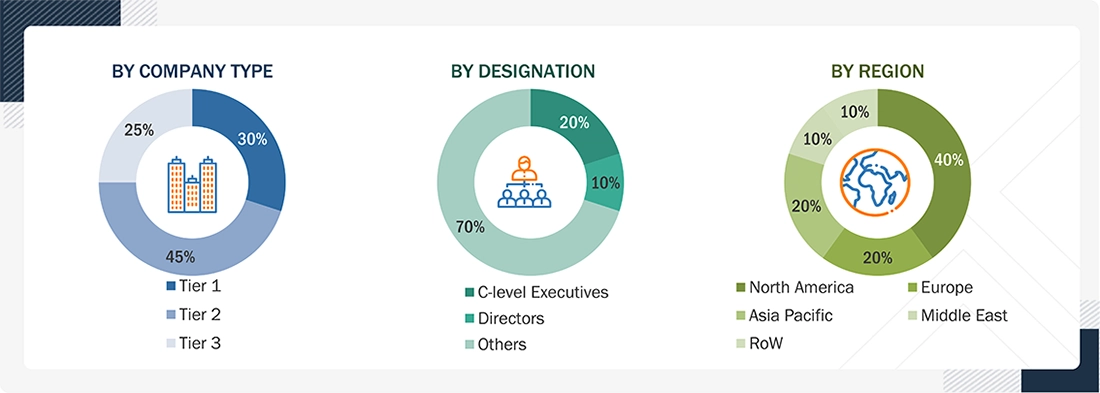
To know about the assumptions considered for the study, download the pdf brochure
Market Size Estimation
The top-down and bottom-up approaches have been used to estimate and validate the size of the counter-UAS (C-UAS) system market. The top-down approach was used to assess the addressable market opportunity by evaluating the adoption of C-UAS systems across defense, homeland security, critical infrastructure, and commercial applications. The bottom-up approach was used to estimate company-level C-UAS revenue based on product portfolios, solution offerings, deployment across end users, contract awards, procurement activities, and regional business presence.
Counter-UAS System (C-UAS) Market : Top-Down and Bottom-Up Approach
Data Triangulation
After arriving at the overall size of the counter-UAS (C-UAS) system market from the market size estimation process explained above, the total market has been split into several segments and subsegments. The data triangulation and market breakdown procedures explained below have been implemented, wherever applicable, to complete the overall market engineering process and arrive at the exact statistics for various segments and sub-segments of the market. The data has been triangulated by studying various factors and trends from the demand and supply sides. The market size has been validated using the top-down and bottom-up approaches.
Market Definition
Counter-UAS comprises the technologies, software, and services used to detect, track, identify, and neutralize uncrewed aircraft across small- to large-range UAS, including integration with ground-based air defense (GBAD) and integrated air and missile defense (IAMD) command-and-control. The scope covers detection sensors (radar, RF, EO/IR, acoustic, and cooperative feeds), identification/classification analytics, C2/fusion (standalone and IAMD-grade), and mitigation effectors (electronic, directed-energy, and kinetic), plus associated services (survey, deployment, training, O&M, and managed services).
Key Stakeholders
- Defense Ministries & Armed Forces
- Homeland Security & Border Security Agencies
- Law Enforcement Agencies
- Critical Infrastructure Operators
- Airports & Civil Aviation Authorities
- Defense System Integrators
- Radar, RF & EO/IR Sensor Manufacturers
- Command & Control (C2) Software Providers
- Countermeasure Technology Providers (Electronic, Directed Energy & Kinetic)
- Government Procurement & Defense Acquisition Agencies
Report Objectives
- To define, segment, and forecast the size of the counter-UAS (C-UAS) system market, by solution, deployment, range, technology, and end use, in terms of value
- To forecast the size of market segments based on five regions, namely North America, Europe, Asia Pacific, the Middle East, and RoW, in terms of value
- To identify and analyze key drivers, restraints, opportunities, and challenges influencing the market growth
- To identify industry trends, market trends, and technology trends prevailing in the market
- To analyze micro markets with respect to individual technological trends, prospects, and their contribution to the overall market
- To strategically profile key market players and comprehensively analyze their market ranking and core competencies
- To provide a detailed competitive landscape of the market and analyze competitive growth strategies, such as product launches/developments, contracts, partnerships, agreements, and collaborations, adopted by key players in the market
- To identify the detailed financial position of key players, as well as their key products, unique selling points, and key developments
Available customizations:
MarketsandMarkets offers the following customizations for this market report:
- Additional country-level analysis of the Counter-UAS System (C-UAS) market
- Profiling of other market players (up to 5)
Product Analysis
- Product matrix, which provides a detailed comparison of the product portfolio of each company in the Counter-UAS System (C-UAS) market
Get the Full Counter-UAS Systems Market Report
Full forecast, segment splits, and company analysis for all Counter-UAS Systems Market.
- US Counter-UAS Systems Market
- Canada Counter-UAS Systems Market
- UK Counter-UAS Systems Market
- Germany Counter-UAS Systems Market
- France Counter-UAS Systems Market
- Italy Counter-UAS Systems Market
- Spain Counter-UAS Systems Market
- Poland Counter-UAS Systems Market
- China Counter-UAS Systems Market
- Australia Counter-UAS Systems Market
- South Korea Counter-UAS Systems Market
- India Counter-UAS Systems Market
- Israel Counter-UAS Systems Market
- Turkey Counter-UAS Systems Market
- GCC Counter-UAS Systems Market
- Rest Of Middle East Counter-UAS Systems Market
Need a Tailored Report?
Customize this report to your needs
Get 10% FREE Customization
Customize This Report
