
Other Countries Cross Laminated Timber Market (2025-2030)

The Other Countries Cross Laminated Timber Market was valued at $23.2 Million in 2025 and projected to reach to $43.1 Million by 2030, representing a compound annual growth rate of 13.21%. Other Countries represent a critical emerging segment within the global Cross Laminated Timber market, characterized by accelerating adoption rates and expanding construction activities.


| Market Size in | USD 26.32 MN |
| Market Forecast in | |
| CAGR | |
| Forecast Period | |
| Units Considered | Value (USD MN) |
Other Countries Cross Laminated Timber Market Trends and Insights
- In 2025, Other Countries accounted for an estimated market size of $23.2 million, reflecting growing adoption of CLT in construction and packaging applications across diverse regional economies.
- By 2030, Other Countries is forecast to expand to $43.1 million, driven by increasing infrastructure development and sustainable building material demand. The Cross Laminated Timber market in Other Countries is experiencing accelerated growth as emerging economies invest in modern construction techniques and environmentally conscious building practices.
- Other Countries' 13.21% compound annual growth rate (CAGR) between 2025 and 2030 underscores strong market momentum, supported by rising awareness of CLT's structural benefits and sustainability credentials.
- This expansion reflects broader global trends toward engineered wood products and renewable construction materials. Other Countries' market trajectory demonstrates the untapped potential in regions beyond established CLT markets.
- As regulatory frameworks evolve and manufacturing capacity increases in Other Countries, stakeholders are positioning themselves to capture growth opportunities in this dynamic segment of the packaging, construction, mining, and gases industries..
Key Market Statistics
- CAGR (2025-2030) 13.21% CAGR
- Market Size, 2025 ~USD 23.2 Million
- Forecast, 2030 ~USD 43.1 Million
- Country Other Countries
Other Countries Cross Laminated Timber Market Overview
Emerging Market Growth :
Other Countries segment is experiencing rapid expansion with a 13.21% CAGR, positioning it as a high-growth emerging market for Cross Laminated Timber applications across construction and packaging sectors.
Market Size Expansion :
The segment is projected to nearly double from $23.2 million in 2025 to $43.1 million by 2030, demonstrating strong market momentum and increasing regional adoption of CLT technologies.
Infrastructure-Driven Demand :
Growing infrastructure development initiatives across Other Countries are driving increased demand for sustainable CLT solutions in construction, modernization projects, and industrial applications.
Outpacing Global Growth :
While the global CLT market grows at 14.68% CAGR, Other Countries' 13.21% growth rate reflects significant untapped potential and emerging opportunities in developing regional economies.
Other Countries Cross Laminated Timber Market Dynamics
- The segment's projected growth from $23.2 million to $43.1 million by 2030 reflects increasing recognition of CLT's benefits in sustainable building practices and packaging applications across diverse regional economies. Key drivers include rising infrastructure investments, growing environmental consciousness, and expanding industrial sectors seeking innovative timber solutions.
- As regional economies develop and construction standards evolve, Other Countries are expected to capture greater market share.
- Strategic market entry and localized product offerings will be essential for stakeholders seeking to capitalize on this high-growth emerging segment..
Market Ecosystem
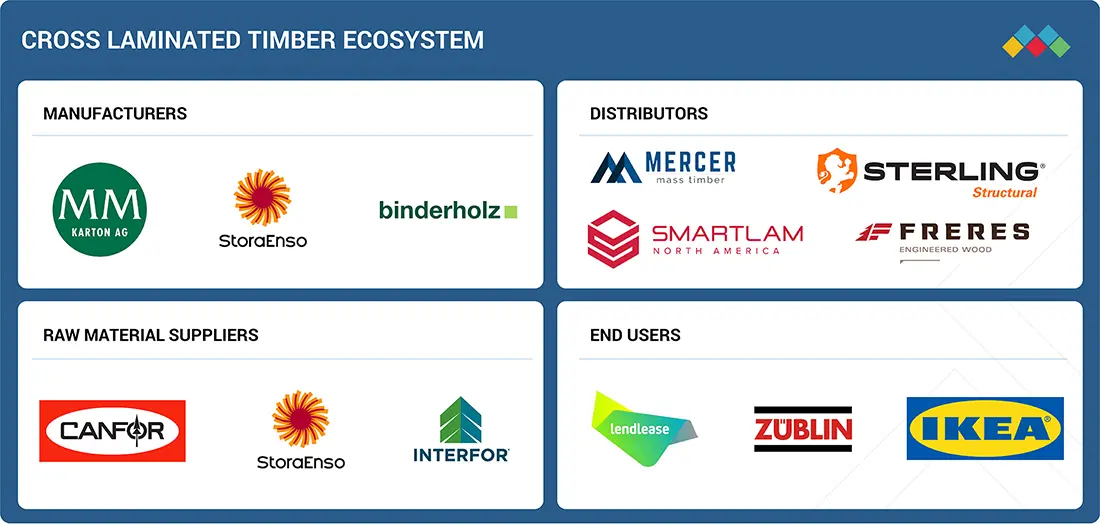
Cross Laminated Timber Market: COMMERCIAL USE CASES ACROSS INDUSTRIES
| COMPANY | USE CASE DESCRIPTION | BENEFITS |
|---|---|---|
 |
Constructing hyperscale datacenters using cross-laminated timber for floors and ceilings in a hybrid model with steel and concrete | Reduces embodied carbon footprint by 35% compared to steel and 65% compared to concrete; lighter and stronger material; enables prefabrication for faster, safer installation; promotes sustainability and carbon negativity goals |
 |
Building a new corporate headquarters campus, featuring multiple mass timber office buildings | Enhances sustainability through regionally sourced lumber; creates a nature-connected workspace; sets a milestone as the largest mass timber campus in the US; reduces environmental impact and supports greener construction practices |
 |
Leading the design of Walmart's mass timber headquarters incorporating cross-laminated timber and glulam at an unprecedented scale | Facilitates large-scale sustainable construction; integrates nature-inspired elements for employee well-being; significantly cuts carbon emissions through timber use |
 |
Developing office buildings such as Google Borregas using mass timber for structural design and elements like cross-laminated timber members | Achieves net-zero emissions targets and incorporates biophilic design for improved occupant well-being |
 |
Piloting mass timber construction for sustainable data centers | Lowers emissions through greener building materials |
Logos and trademarks shown above are the property of their respective owners. Their use here is for informational and illustrative purposes only.
Related Ecosystem
Building And Construction
- HVAC System
- Acoustic Insulation
- Alkyd Resins
- Fiberglass
- Thermal Insulation
- Snc-lavalin group inc.
- Saint-gobain
- LHOIST S.A
- USG CORPORATION
- Basf se
Key Takeaways
- Other Countries' CLT market is valued at $23.2 million in 2025 and projected to reach $43.1 million by 2030.
- Other Countries demonstrates a robust 13.21% CAGR, outpacing many mature markets and reflecting strong regional demand.
- Emerging economies in Other Countries are increasingly adopting CLT for sustainable construction and infrastructure projects.
- Other Countries' growth is supported by regulatory shifts, manufacturing expansion, and rising environmental awareness in construction.
Cross Laminated Timber Market Report Scope
| Report Metric | Details |
|---|---|
| Base Year | 2025 |
| Fastest Growing Segment | ADHESIVE BONDED (Type) |
| Forecast Period | 2025-2030 |
| Growth Rate | CAGR of 14.68% from 2025 to 2030 |
| Largest Segment | ADHESIVE BONDED (Type) |
| Market Size Base Year (Billions) | ~USD 1.81 (2025) |
| Revenue Forecast (Billions) | ~USD 3.59 (2030) |
| Segments Covered | Type, Industry, Sub-Industry, End Use, End Use 2025-2030, End Use Industry, Non-Residential Industry, Resin Type |
Other Countries Cross Laminated Timber Market Report Segmentation
8 segment dimensions are covered across the global market.
By Type
- Adhesive Bonded
- Mechanically Fastened
By Industry
- Non-Residential
- Residential
By Sub-Industry
- Industrial
- Public
By End Use
- Non-Structural
- Structural
By End Use 2025-2030
- Non-Structural
- Structural
By End Use Industry
- Non-Residential
- Residential
By Non-Residential Industry
- Industrial
- Public
By Resin Type
- Melamine Formaldehyde
- Phenol Resorcinol Formaldehyde
- Polyurethane
Target Audience
- Construction & Real Estate Developers : Need market intelligence on CLT adoption trends and infrastructure opportunities in Other Countries to identify project applications and sustainable building material sourcing strategies.
- CLT Manufacturers & Suppliers : Require detailed market sizing and growth forecasts for Other Countries to evaluate expansion opportunities, production capacity planning, and regional distribution network development.
- Investment & Private Equity Firms : Seek emerging market growth data and financial projections for Other Countries' CLT sector to identify investment targets, assess portfolio opportunities, and evaluate market entry timing.
- Government & Policy Makers : Need market analysis to understand CLT adoption barriers, infrastructure gaps, and economic potential in Other Countries for policy development and sustainable construction initiatives.
- Packaging & Industrial Companies : Require market insights on CLT applications and regional demand trends in Other Countries to evaluate material sourcing alternatives and packaging innovation opportunities.
Reasons to Buy this Report
- Identify High-Growth Opportunities : Gain detailed insights into the fastest-growing emerging segment with 13.21% CAGR, enabling strategic market entry and investment decisions in Other Countries' CLT sector.
- Competitive Market Positioning : Understand regional market dynamics, adoption patterns, and competitive landscape specific to Other Countries to develop targeted go-to-market strategies and differentiation approaches.
- Forecast-Driven Planning : Access precise market size projections ($23.2M to $43.1M by 2030) to inform business planning, resource allocation, and revenue forecasting for Other Countries operations.
- Infrastructure Investment Tracking : Monitor infrastructure development trends driving CLT demand across Other Countries, identifying key sectors, projects, and regional opportunities for product and service expansion.
- Risk Mitigation & Market Intelligence : Leverage comprehensive market analysis to assess regional risks, regulatory environments, and market maturity levels, enabling informed decision-making for Other Countries market participation.
Frequently asked questions
What is the current market size of Cross Laminated Timber in Other Countries?
Other Countries' CLT market was valued at $23.2 million in 2025 and is expected to grow to $43.1 million by 2030.
What is the projected growth rate for Other Countries' CLT market?
Other Countries is projected to grow at a compound annual growth rate (CAGR) of 13.21% from 2025 to 2030.
Which industries drive demand for CLT in Other Countries?
Other Countries' CLT demand is primarily driven by the construction, packaging, mining, and gases sectors seeking sustainable and engineered wood solutions.
What factors are accelerating CLT adoption in Other Countries?
Other Countries is experiencing accelerated CLT adoption due to infrastructure development, regulatory support for sustainable materials, and increased environmental awareness among builders.
How does Other Countries' growth compare to the global CLT market?
Other Countries' 13.21% CAGR is competitive with the global market's 14.68% CAGR, demonstrating strong regional momentum in emerging economies.
RESEARCH METHODOLOGY
The study involved four major activities in estimating the size of the cross-laminated timber market. Exhaustive secondary research was done to collect information on the market, the peer market, and the parent market. The next step was to validate these findings, assumptions, and sizing with industry experts across the value chain through primary research. Both top-down and bottom-up approaches were employed to estimate the complete market size. After that, the market breakdown and data triangulation procedures were used to estimate the market size of the segments and subsegments.
Secondary Research
Secondary sources used in this study included annual reports, press releases, and investor presentations of companies; white papers; certified publications; articles from recognized authors; and gold standard & silver standard websites such as Factiva, ICIS, Bloomberg, and others. The findings of this study were verified through primary research by conducting extensive interviews with key officials such as CEOs, VPs, directors, and other executives.
Primary Research
The cross-laminated timber market comprises several stakeholders, such as raw material suppliers, end-product manufacturers, and regulatory organizations in the supply chain. The demand side of this market is characterized by key opinion leaders in various applications for the cross-laminated timber market. The supply side is characterized by advancements in technology and diverse application industries. Various primary sources from both the supply and demand sides of the market were interviewed to obtain qualitative and quantitative information. The breakdown of profiles of the primary interviewees is illustrated in the figure below:
Breakdown of Primary Participants
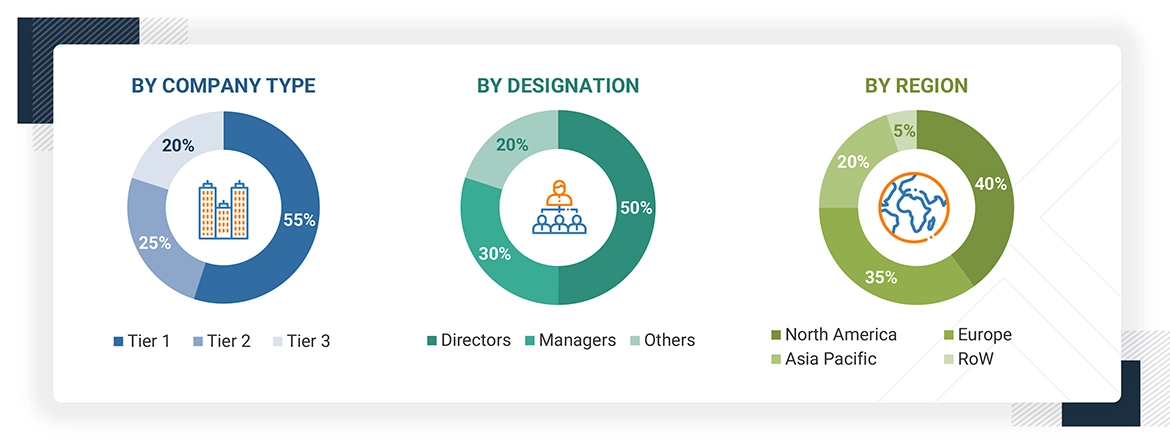
Note: Tier 1, Tier 2, and Tier 3 companies are classified based on their market revenue in 2024, available in the public domain, product portfolios, and geographical presence.
Other designations include consultants and sales, marketing, and procurement managers.
To know about the assumptions considered for the study, download the pdf brochure
| COMPANY NAME | DESIGNATION | |
|---|---|---|
| Mayr-Melnhof Holz | Senior Manager | |
| Stora Enso | Innovation Manager | |
| Binderholz GmbH | Vice-President | |
| HASSLACHER Holding GmbH | Production Supervisor | |
| Schilliger Holz AG | Sales Manager | |
Market Size Estimation
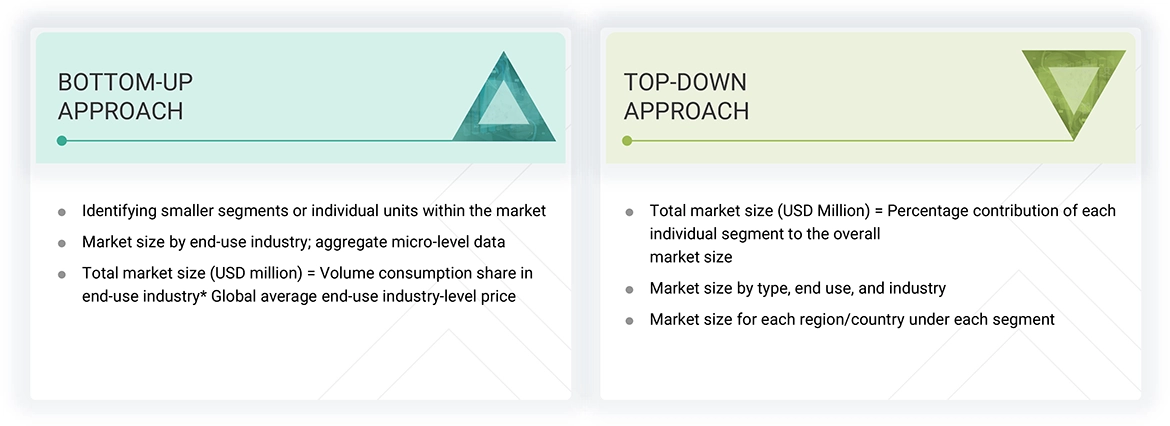
Both top-down and bottom-up approaches were used to estimate and validate the total size of the cross-laminated timber market. These methods were also used extensively to estimate the size of various subsegments in the market. The research methodology used to estimate the market size includes the following:
- The key players in the industry have been identified through extensive secondary research.
- The supply chain of the industry has been determined through primary and secondary research.
- All percentage shares, splits, and breakdowns have been determined using secondary sources and verified through primary sources.
- All possible parameters that affect the markets covered in this research study have been accounted for, viewed in extensive detail, verified through primary research, and analyzed to obtain the final quantitative and qualitative data.
Data Triangulation
After arriving at the overall market size—using the market size estimation processes as explained above—the market was split into several segments and subsegments. To complete the overall market engineering process and arrive at the exact statistics of each market segment and subsegment, data triangulation and market breakdown procedures were employed, wherever applicable. The data was triangulated by studying various factors and trends from both the demand and supply sides in the cross-laminated timber industry.
Market Definition
Cross-laminated timber (CLT) is an engineered wood product made by stacking layers of solid-sawn lumber boards in alternating directions (typically at 90-degree angles) and bonding them with structural adhesives. This crosswise arrangement significantly enhances the strength, rigidity, and dimensional stability of the panel, making CLT ideal for load-bearing applications. It is widely used in the construction of walls, floors, and roofs in both residential and commercial buildings. CLT is prefabricated and offers advantages such as faster installation, reduced waste, and a lower carbon footprint compared to traditional concrete or steel. Recognized by associations such as the American Wood Council and WoodWorks, CLT aligns with modern sustainable building practices and green certification standards.
Stakeholders
- Manufacturers, dealers, and suppliers of cross-laminated timber and their raw materials
- Manufacturers in various end-use industries, such as automotive, building & construction, packaging, leather & footwear, general industrial, and furniture & decoration
- Traders, distributors, and suppliers of cross-laminated timber
- Regional manufacturers’ associations and polyurethane adhesive associations
- Government & regional agencies and research organizations
Report Objectives
- To analyze and forecast the cross-laminated timber market in terms of value and volume
- To provide detailed information about the key factors (drivers, restraints, opportunities, and challenges) influencing market growth
- To define, segment, and project the size of the global cross-laminated timber market based on type, end-use, and industry
- To project the market size for the four main regions: North America, Europe, Asia Pacific, and the Rest of the World
- To analyze the micromarkets concerning individual growth trends, prospects, and their contribution to the overall market
- To analyze opportunities in the market for stakeholders and provide a competitive landscape of the market leaders
- To track and analyze R&D and competitive developments such as expansions, product launches, collaborations, investments, partnerships, agreements, developments, and mergers & acquisitions in the cross-laminated timber market
Get the Full Cross Laminated Timber Market Report
Full forecast, segment splits, and company analysis for all Cross Laminated Timber Market.
- Canada Cross Laminated Timber Market
- US Cross Laminated Timber Market
- Austria Cross Laminated Timber Market
- Czech Republic Cross Laminated Timber Market
- France Cross Laminated Timber Market
- Germany Cross Laminated Timber Market
- Italy Cross Laminated Timber Market
- Norway Cross Laminated Timber Market
- Portugal Cross Laminated Timber Market
- Rest Of Europe Cross Laminated Timber Market
- Slovakia Cross Laminated Timber Market
- Sweden Cross Laminated Timber Market
- Switzerland Cross Laminated Timber Market
- UK Cross Laminated Timber Market
- Australia Cross Laminated Timber Market
- China Cross Laminated Timber Market
- Japan Cross Laminated Timber Market
- New Zealand Cross Laminated Timber Market
- Rest Of Asia Pacific Cross Laminated Timber Market
- Argentina Cross Laminated Timber Market
- Brazil Cross Laminated Timber Market
Need a Tailored Report?
Customize this report to your needs
Get 10% FREE Customization
Customize This Report
